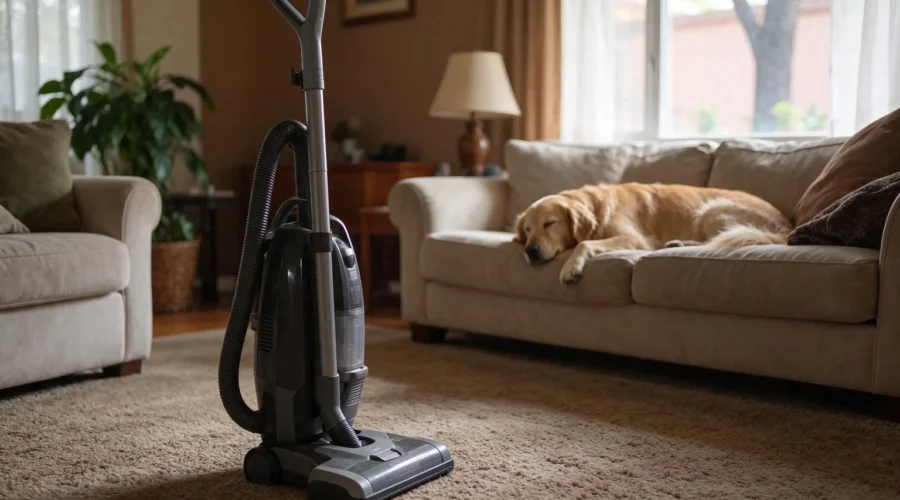
Sebo vs Dyson is the quiet German workhorse against the loud British icon. To keep the fight fair we compare one current corded upright from each brand: the SEBO Essential G5, a bagged commercial-grade machine with hospital-grade filtration, and the Dyson Ball Animal 3, a bagless upright built around 290 AW of suction and a self-de-tangling brush bar. They take opposite approaches to the same job, which makes the choice clearer than you might expect. We have also compared Dyson’s cordless models, including the Dyson V11 vs V15.
Last updated: November 29, 2026
Affiliate disclosure: As an Amazon Associate I earn from qualifying purchases.
If you buy through the Amazon links on this page, we may earn a small commission at no extra cost to you. It never changes which product we recommend.
How we compared: We compared the makers’ product information and the Amazon listings for one comparable corded upright from each brand. We did not test these vacuums ourselves.
Quick answer
Choose the SEBO Essential G5 if you want sealed bagged filtration and a machine built to be repaired for decades. Choose the Dyson Ball Animal 3 if you want maximum suction with no bags to buy.
Sebo vs Dyson at a glance
| SEBO Essential G5 | Dyson Ball Animal 3 | |
|---|---|---|
| Design | Bagged upright, commercial-grade parts | Bagless upright with Ball steering |
| Power | 1,300W dual-stage motor | 290 AW suction |
| Filtration | Sealed S-class, hospital-grade | Whole-machine filtration, cyclone-based |
| Brush | 4-level height adjust, obstruction warning light | Motorbar head that de-tangles hair itself |
| Cleaning path | 15 in L-shaped power head | Standard head with 3 suction modes |
| Cord | 40 ft | 35 ft |
| Ongoing cost | Filter bags to buy | No bags; filters washed |
| Where to buy | See it on Amazon | See it on Amazon |
Bagged vs bagless philosophies
The SEBO’s whole design is sealed: dust goes into a large filter bag and stays there, which keeps the machine hygienic and the exhaust clean. That is why SEBO uprights are common in hotels and hospitals. The trade-off is a few dollars of bags per year.
The Dyson spins dust out of the air with Radial Root Cyclones into a bin you empty, so there is nothing to buy, but emptying the bin puffs some dust back into the air.
Power and carpet behavior
Dyson claims the best cleaning performance of any upright de-tangling vacuum, with 290 AW and three suction modes from deep-pile carpet down to hard floors, and the Motorbar head clears wrapped hair on its own.
The SEBO counters with a 1,300W dual-stage motor, a 15 in cleaning path that covers rooms quickly, four brush height settings and warning lights for a worn brush, a full bag or a clog, so the machine tells you what it needs.
Living with them for ten years
SEBO builds with commercial-grade components, heavy-duty belts and easy brush removal, and the brand is known for long service life and repairability.
The Ball Animal 3 is heavier at about 17 lb and its bin, filters and brush bar need regular cleaning, but there are no consumables. Both include on-board tools; the SEBO adds an instant-use wand and hose built into the handle.

Best for allergies and longevity
SEBO Essential G5
A German commercial-grade bagged upright: sealed S-class filtration, 15 in cleaning path, 40 ft cord and warning lights that flag problems before they become repairs.
- Motor: 1,300W dual-stage
- Filtration: Sealed S-class, bagged
- Cleaning path: 15 in
Pros
- Hospital-grade sealed filtration suits allergy homes
- Commercial parts built for years of service
- Wide 15 in path and 40 ft cord speed up big homes
Cons
- Filter bags are an ongoing cost
- Understated looks and fewer flashy features
Skip it if: you refuse to buy bags on principle.

Best for raw suction
Dyson Ball Animal 3
Dyson’s strongest upright: 290 AW, a Motorbar head that de-tangles pet hair as you clean, Ball steering and no bags ever.
- Suction: 290 AW
- Brush: De-tangling Motorbar
- Modes: 3 suction modes
Pros
- Huge suction for deep-pile carpet
- Brush bar clears wrapped hair automatically
- No bags or filters to buy
Cons
- Heavy to push and carry upstairs
- Emptying the bin raises dust
Skip it if: sealed allergen handling is your top priority.
Which one should you buy?
- Allergy or asthma household: the SEBO Essential G5.
- Thick carpet and shedding pets: the Dyson Ball Animal 3.
- Lowest fuss over a decade: the SEBO, bags and all.
- No recurring costs: the Dyson.
FAQ
Is Sebo better than Dyson?
They win different contests. SEBO wins on sealed filtration, build quality and service life; Dyson wins on raw suction and bagless convenience. Match the brand to what you care about.
Do Sebo vacuums use bags?
Yes, SEBO machines are bagged by design; the sealed bag system is central to their hospital-grade filtration.
Is the Dyson Ball Animal 3 good for pet hair?
Yes, it is aimed squarely at pet homes: the Motorbar cleaner head de-tangles wrapped hair as you clean and the suction handles embedded hair in carpet.
Which lasts longer?
SEBO’s commercial-grade components and repair-friendly design give it the reputation for decade-plus service. Dysons last too, but the plastic bin-and-cyclone assembly sees more wear.
Which is better for hard floors?
Both manage hard floors; the Dyson has a dedicated low-suction mode, while the SEBO’s brush height adjustment and 5.5 in profile under furniture help it cover mixed floors.
Final verdict
Buy the SEBO Essential G5 if you think of a vacuum as a 10-year appliance: sealed filtration, repairable build and calm, effective cleaning. Buy the Dyson Ball Animal 3 if you want the strongest pull on carpet and would rather empty a bin than ever buy a bag.
Sources
- SEBO Essential G5 product details
- Dyson Ball Animal 3 range (Dyson)
- RTINGS SEBO Felix vs Ball Animal 3 test data
- Amazon listings for both vacuums (linked above)