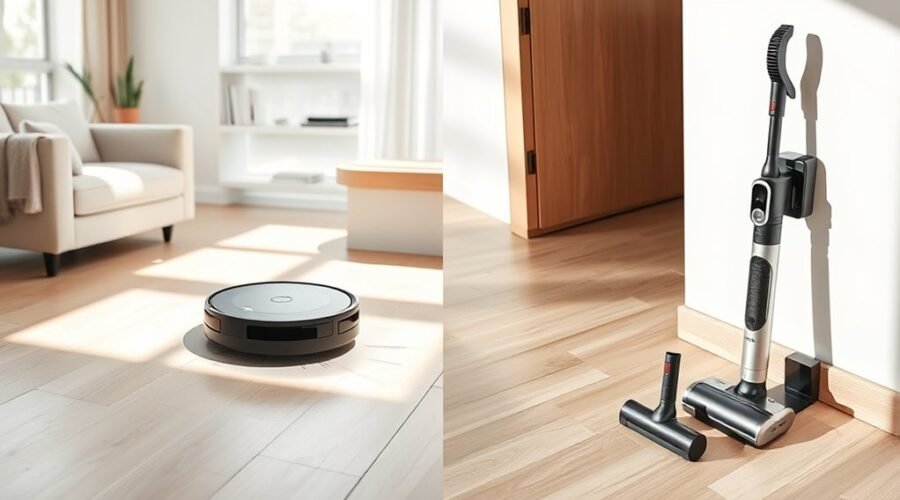
Robot vacuums and stick vacuums solve different cleaning problems, and the better choice often depends on how a home is used. One offers hands-free routine cleaning with minimal effort, while the other delivers stronger manual control for carpets, corners, and sudden messes. Their differences in suction, maintenance, floor performance, and price can be significant. The practical tradeoffs are not always obvious, especially once features and daily habits enter the picture.
Robot Vacuum vs. Stick Vacuum
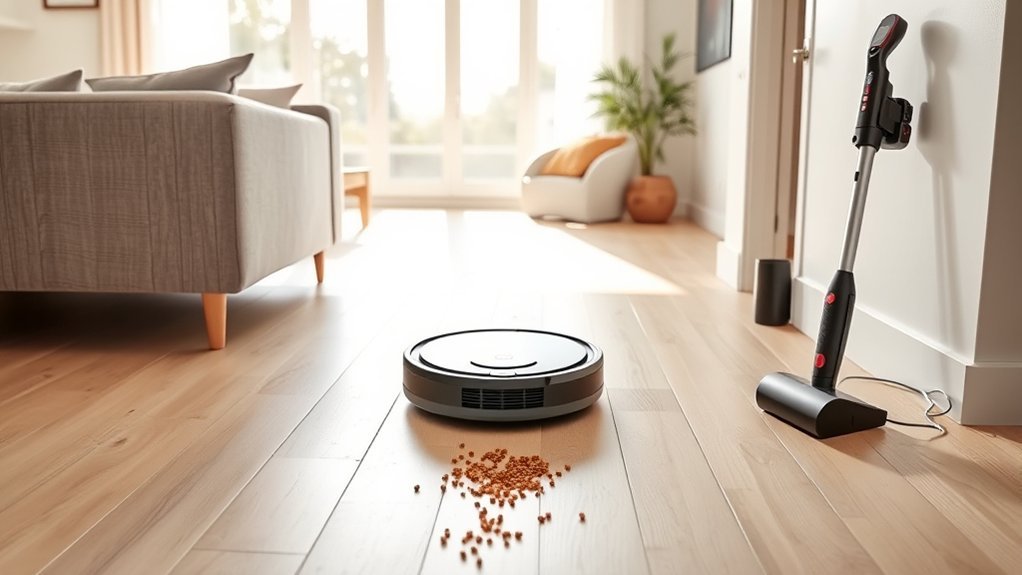
When comparing a robot vacuum with a stick vacuum, the most significant difference lies in how each handles cleaning tasks: robot vacuums work autonomously with sensors and mapping for hands-free maintenance, while stick vacuums require manual control for more targeted cleaning.
In a robot vacuum vs stick vacuum comparison, the former emphasizes routine upkeep, while the latter offers immediate control. This distinction affects cleaning performance in practical ways.
Cordless stick models usually deliver stronger suction, making them better for deep carpet cleaning and stubborn debris. Robot vacuums, however, can be scheduled to run regularly, preserving cleaner floors with minimal effort and reducing the burden of constant attention.
Cost also differs: robot units often carry a higher upfront price, while stick vacuums remain more budget-friendly.
Maintenance follows the same pattern. Robot designs may include self-emptying bins, whereas stick vacuums typically need frequent emptying and filter cleaning after use, limiting convenience.
What Is a Robot Vacuum?
A robot vacuum is an autonomous floor-cleaning device that uses sensors and mapping technology to move through a home with minimal human input. It represents an automated approach to cleaning that supports hands-free upkeep and reduces routine labor.
Many models run on schedules set in a mobile app, allowing frequent cleaning that limits dust buildup before it becomes visible. Advanced navigation systems, including LiDAR and camera-based mapping, help the robot vacuum cover rooms efficiently and adapt to different layouts. This makes it practical for busy households seeking more freedom from daily chores.
Most units handle hard floors well and can also manage low- to medium-pile rugs, though performance depends on the model. Self-emptying bases further reduce maintenance by cutting down how often debris must be cleared manually. The result is a convenient, consistently functioning cleaning tool.
What Is a Stick Vacuum?
A stick vacuum is a battery-powered cleaning tool designed for quick, targeted jobs without the limits of a cord.
Its lightweight build makes it easier to carry, steer, and use in tight areas than heavier vacuum types.
With strong suction for spot cleaning, it can handle spills, carpets, and other immediate messes efficiently.
Battery-Powered Design
Unlike corded uprights, a stick vacuum runs on a rechargeable battery, giving it cordless mobility and making it easier to move quickly from room to room without managing a plug. This battery-powered design supports cordless operation, which suits quick cleanups after spills or routine touch-ups.
Battery life varies by model, so runtime should be weighed against cleaning needs; some premium units deliver up to 60 minutes per charge. Even on battery power, many models maintain powerful suction for carpets and hard floors, balancing freedom with performance.
Compared with plug-in machines, this format removes cord interruptions and allows faster response to messes. For users seeking liberation from outlet dependence, the design offers practical flexibility while still covering everyday cleaning demands efficiently.
Lightweight Maneuverability
Lightweight maneuverability is one of the defining traits of a stick vacuum, making it easy to carry, steer, and use for quick clean-ups.
Weighing about 5 to 10 pounds, a cordless stick vacuum gives users freedom from dragging a heavy body or managing a cord. Its slim frame supports effortless movement through stairs, hallways, and tight corners, where bulkier machines feel restrictive.
The compact shape also suits small homes, since storage needs stay minimal. Many models add crevice tools and dusting brushes, increasing practical reach without sacrificing portability.
Compared with traditional vacuums, the stick vacuum emphasizes agility over size, offering a more liberated cleaning experience for people who want less strain and faster handling.
Spot Cleaning Power
For quick messes that need immediate attention, a stick vacuum offers strong spot-cleaning power in a lightweight, cordless form. Its suction is often sufficient to lift crumbs, pet hair, and grit from carpets, upholstery, and hard floors, giving it an edge over a robot vacuum when the task requires direct intervention.
Many models include attachments for edges, corners, curtains, and shelves, expanding practical use beyond floor cleaning. Battery life usually ranges from 20 to 60 minutes, enough for focused sessions without cord limits.
Compared with a robot vacuum, the stick vacuum provides faster control, greater reach, and more freedom for targeted cleanup. It is also usually more budget-friendly, making efficient spot cleaning power accessible for households that value independence and speed.
Robot Vacuum vs. Stick Vacuum for Daily Cleaning
When daily cleaning needs are the priority, robot vacuums and stick vacuums serve different strengths. A robot vacuum supports hands-free upkeep through smart mapping and scheduling, making it useful in busy homes where routine matters. A stick vacuum offers direct control, stronger suction, and faster response for messes that appear without warning.
| Feature | Robot Vacuum | Stick Vacuum |
|---|---|---|
| Operation | Automated | Manual |
| Best use | Routine daily cleaning | Quick clean-ups |
| Coverage | Mostly flat areas | Corners, stairs, upholstery |
| Cleaning style | Prevents buildup | Handles targeted dirt |
| Cost | Higher upfront | More budget-friendly |
For households seeking freedom from constant effort, the robot vacuum reduces repetition. For those who want immediate control, the stick vacuum remains practical. The most capable choice depends on whether consistency or flexibility defines the daily cleaning routine.
Which Vacuum Works Better on Carpets?
On carpets, cordless stick vacuums generally have the advantage because their stronger suction and direct control make them better suited to pulling embedded dirt and pet hair from carpet fibers.
A stick vacuum can move quickly over carpets and rugs, reaching deeper into high-pile surfaces with less hesitation. A robot vacuum can still support routine upkeep, especially between manual cleans, but its lower suction often limits removal of packed debris.
Even advanced models such as the DEEBOT X9 PRO OMNI may perform well, yet they usually remain behind a stick vacuum in deep-cleaning force.
- Stronger suction for embedded dirt
- Better control on thick carpets and rugs
- Robot vacuum useful for maintenance, not heavy buildup
For people seeking freedom from grime without constant effort, the most practical approach is pairing both tools: the robot vacuum handles regular passes, while the stick vacuum delivers the thorough carpet reset when needed.
Robot Vacuum vs. Stick Vacuum on Hardwood Floors
On hardwood floors, the main question is whether a vacuum can clean effectively without dulling or scratching the surface.
Robot vacuums tend to favor gentle, adjustable cleaning and may add mopping for routine maintenance, while stick vacuums usually provide stronger suction for heavier debris.
Regular upkeep of brushes and filters matters for both, since performance and surface protection depend on how well each tool is maintained.
Hardwood Floor Care
For hardwood floor care, robot vacuums and stick vacuums serve different needs while still delivering effective results.
In hardwood floor care, a robot vacuum suits routine upkeep, using sensors to modulate suction and reduce scratch risk, while scheduled runs keep dust from settling. Many models, including the DEEBOT X9 PRO OMNI, also mop, supporting a cleaner finish with less effort.
A stick vacuum, by contrast, offers stronger suction and greater control for focused attention on tracked-in grit or spills.
- robot vacuum: ideal for automated maintenance
- stick vacuum: better for immediate, targeted cleanup
- both: effective on hardwood floors, with different strengths
Together, they offer practical freedom: one preserves order quietly, the other restores it fast.
Surface Protection Differences
Surface protection on hardwood floors differs noticeably between robot vacuums and stick vacuums. A robot vacuum usually moves with lighter pressure, softer brushes, and sensors that recognize floor changes, reducing scuffs while maintaining steady dust control. A stick vacuum can clean more aggressively, yet hard bristles and rushed handling may mark delicate surfaces. For households seeking freedom from constant upkeep, the robot vacuum offers dependable, low-effort preservation.
| Vacuum Type | Risk Level | Best Use |
|---|---|---|
| Robot vacuum | Low | Routine dust removal |
| Stick vacuum | Moderate | Deep cleaning sessions |
| Both | Manageable | Careful hardwood maintenance |
On hardwood floors, the key difference is control: the robot vacuum protects through automation, while the stick vacuum depends on user care to avoid damage.
How Much Maintenance Does Each Need?
Robot vacuums generally require less frequent day-to-day upkeep because many models include self-emptying docks and can run on a schedule with little user involvement. For households seeking liberation from chores, this reduces the visible burden of maintenance.
A robot vacuum still needs periodic filter cleaning, brush detangling, and sensor care, so the work is lighter but not absent. By contrast, stick vacuums usually ask for immediate attention after each use: the bin must be emptied, attachments organized, and the battery managed to preserve performance. They can also need more hands-on effort when dealing with pet hair or stubborn debris.
- Robot vacuums: lower routine effort, but more parts to inspect
- Stick vacuums: faster to grab, yet more direct cleanup afterward
- Both: regular filter care remains necessary
In practical terms, robot systems favor convenience, while stick vacuums reward close, ongoing attention.
Which Features Matter Most in 2026?
In 2026, the most important features depend on how much cleaning automation versus raw cleaning power a household values.
Robot vacuum cleaners now stand out for advanced navigation, better obstacle avoidance, and scheduled routines that reduce manual effort. Many also combine vacuuming and mopping, giving a more complete floor-care approach without extra labor. For households seeking time freedom, these smart functions can be decisive.
Cordless stick vacuums, by contrast, emphasize stronger suction and tend to excel on carpets and other deep-cleaning jobs. Their multiple attachments also improve reach on upholstery, corners, and other awkward areas, making them more adaptable in hands-on cleaning.
The comparison is thus practical: robot models prioritize autonomy, while stick models prioritize intensity and versatility. In 2026, the clearest feature difference is not appearance but how much control, effort, and cleaning depth a user wants to keep.
Which Vacuum Should You Buy for Your Home?
Choosing between a robot vacuum and a cordless stick vacuum comes down to how a home is cleaned day to day. A robot vacuum suits households seeking automated upkeep, especially when time is scarce and routine dust control matters most.
It moves through rooms on its own with smart mapping and obstacle avoidance, offering a hands-free path to cleaner floors. A stick vacuum better serves cleaning needs that demand speed, reach, and control, such as spills, stairs, edges, and upholstery.
- Robot vacuum: Best for daily maintenance and low-effort cleaning
- Stick vacuum: Better for quick response and deep, targeted cleaning
- Best pairing: Use both for a flexible, liberated cleaning system
Cost also shapes the choice. Robot models usually require a higher upfront investment, while cordless options are often more budget-friendly.
In homes with pets, a stick vacuum often delivers stronger suction. For many households, combining both creates the most efficient balance.
Frequently Asked Questions
Which Is Better for Me, a Stick Vacuum or a Robot Vacuum?
It depends on suction power, cleaning modes, and floor types. A stick vacuum suits deeper, faster spot cleaning; a robot vacuum suits hands-free routine upkeep. Households seeking liberation from chores often prefer the robot.
What Are the Downsides of Using a Robotic Vacuum Cleaner?
Downsides include weaker suction power, higher maintenance costs, and inconsistent results across floor types. Navigation can miss spots, bins need frequent emptying, brushes and filters require upkeep, and stairs or cramped layouts limit performance.
What Are the Key Differences Between a Robot Vacuum and a Regular Vacuum?
Robot vacuums differ by navigation technology, automated cleaning modes, and lower suction power; regular vacuums demand manual control, deliver stronger suction power, and suit targeted cleaning. One grants convenience, the other greater immediate control and liberation.
What Are the Key Differences Between a Robot Vacuum and a Cordless Vacuum?
Robot vacuums automate cleaning with scheduling and navigation, but cordless vacuums demand manual use. Cordless models usually deliver greater suction power and cleaning efficiency, while robot models excel at everyday maintenance and specific floor compatibility.
Conclusion
In the comparison between robot vacuum and stick vacuum, each tool serves a different rhythm of the home. The robot vacuum glides like a quiet tide, steady and automatic for daily upkeep on hard floors. The stick vacuum stands like a focused brush, delivering stronger control for carpets, corners, and stubborn debris. Choosing between them depends on whether the household needs a hands-free caretaker or a nimble workhorse.