Affiliate disclosure: This article contains Amazon affiliate links. If you buy through these links, we may earn a commission at no extra cost to you.
Quick Verdict: For a large damp basement, start with the AEOCKY 4500 Sq.Ft Smart Dehumidifier or the Vellgoo 64-Pint Energy Star model. For smaller basement areas, the Midea Cube gives you smart control in a more compact size. If your drain point sits higher than the unit, the AEOCKY pump version is the easiest hands-free option.
If your basement only has light moisture, a compact 95-ounce unit can help with comfort. If your basement smells musty, has condensation, or stays humid most of the year, choose a compressor model with hose or pump drainage instead.
For basement moisture control in 2026, the right dehumidifier depends on how damp your space gets, how often you want to empty the tank, and whether you need automatic drainage. This guide compares seven automatic basement dehumidifiers, including larger compressor models for damp basements and compact units for lighter moisture problems. The top choices here include the AEOCKY 4500 Sq.Ft Smart Dehumidifier, Midea Cube 20 Pint, 95OZ Home Dehumidifier, ToLife 1000 sq.ft model, KNKA 2500 Sq.Ft unit, Vellgoo 64-Pint Energy Star, and AEOCKY’s pump version.
If your basement is large, musty, or humid most of the year, choose a higher-capacity model with a drain hose or pump. If you only need light moisture control in a small finished basement, bathroom, bedroom, RV, or storage area, a compact 95-ounce unit may be easier to manage. Use the quick comparison below to match each product to your space.
Before You Buy: Check your basement size, average humidity, drain location, noise needs, and whether you want app control. A small unit may look affordable, but a damp basement usually needs more pint capacity and continuous drainage.
Quick Comparison: Automatic Basement Dehumidifiers
| Product | Best For | Key Feature | Drainage |
|---|---|---|---|
| AEOCKY 4500 Sq.Ft Smart Dehumidifier | Large damp basements | High-capacity smart humidity control | Drain hose |
| Midea Cube 20 Pint | Small to medium basements | App and voice control | Tank or hose |
| 95OZ Home Dehumidifier | Light moisture and small spaces | Compact tank with auto shutoff | Manual tank |
| ToLife 1000 sq.ft Dehumidifier | Quiet light-duty use | Sleep mode under 30 dB | Manual tank |
| KNKA 2500 Sq.Ft Dehumidifier | Medium to large basements | Multiple modes and humidity settings | Tank or hose |
| Vellgoo 64-Pint Energy Star | Large basements and energy savings | Energy Star Most Efficient rating | Tank or hose |
| AEOCKY 4500 Sq.Ft Smart Dehumidifier with Pump | Basements without a floor drain nearby | Built-in pump drainage | Pump drainage |
AEOCKY 4500 Sq.Ft Smart Dehumidifier with Drain Hose
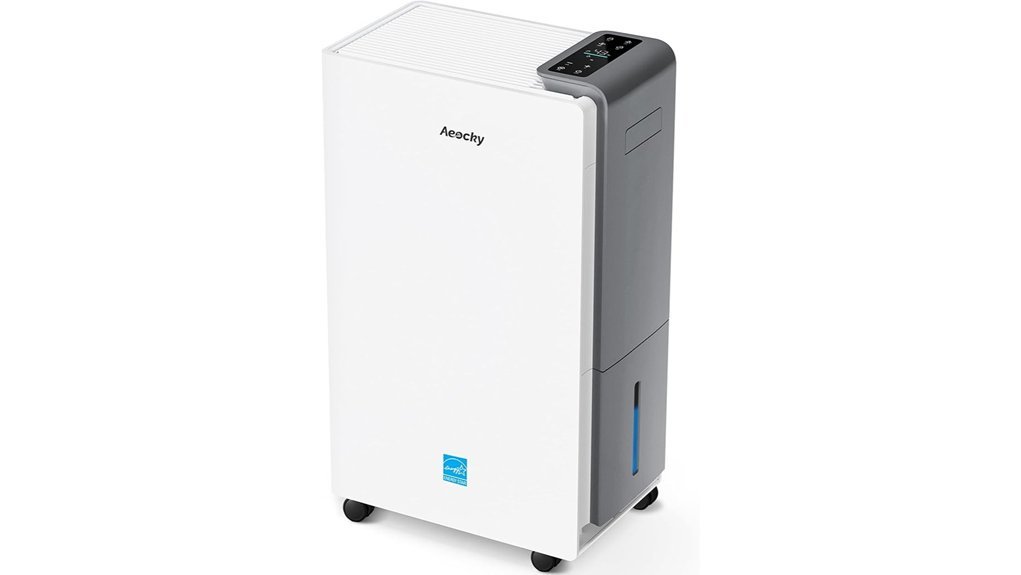
If you want a basement dehumidifier that can handle large, damp spaces without constant tank emptying, the AEOCKY RHEA-001 is a strong pick. It is positioned as an ENERGY STAR Most Efficient 2025 model, so it is built for lower energy use compared with many standard units. It removes up to 80 pints daily in extreme humidity and covers spaces up to 4,500 sq. ft. Its quiet 44dB operation, smart humidity control, drain hose, child lock, and 3-year warranty make it easy to trust in your basement.
Why You’ll Like It: This model solves the biggest basement headache: keeping humidity under control without checking a water tank all day. The included drain hose lets you set up continuous drainage, while the smart humidity control helps the unit adjust to your basement’s moisture level.
This model makes the most sense if your basement feels damp often and you want continuous drainage instead of frequent tank emptying. It is also a better fit for large finished basements, laundry areas, storage rooms, and crawlspace-adjacent rooms where moisture keeps coming back.
Best For: Homeowners needing an energy-efficient, quiet, high-capacity dehumidifier for basements, large rooms, or other damp spaces up to 4,500 sq. ft.
Who Should Buy This: Buy it if your basement is large, musty, humid after rain, or used for storage, laundry, workouts, or living space.
Who Should Skip It: Skip this one if your room is small, only mildly humid, or you do not want to set up a drain hose.
Pros:
- ENERGY STAR Most Efficient 2025 positioning adds strong energy-saving appeal
- Removes up to 80 pints per day and covers large spaces up to 4,500 sq. ft.
- Quiet 44dB operation with smart humidity control, drain hose, child lock, and 3-year warranty
Cons:
- Its 31 lb weight may make it less convenient to move frequently
- Best suited for larger damp areas, so it may be overkill for small rooms
- Requires setup for continuous draining if you want the most hands-off operation
Bottom Line: Choose this AEOCKY model if you want a high-capacity automatic dehumidifier for a larger basement and prefer hose drainage over manual emptying.
Midea Cube 20 Pint Dehumidifier with Alexa Control
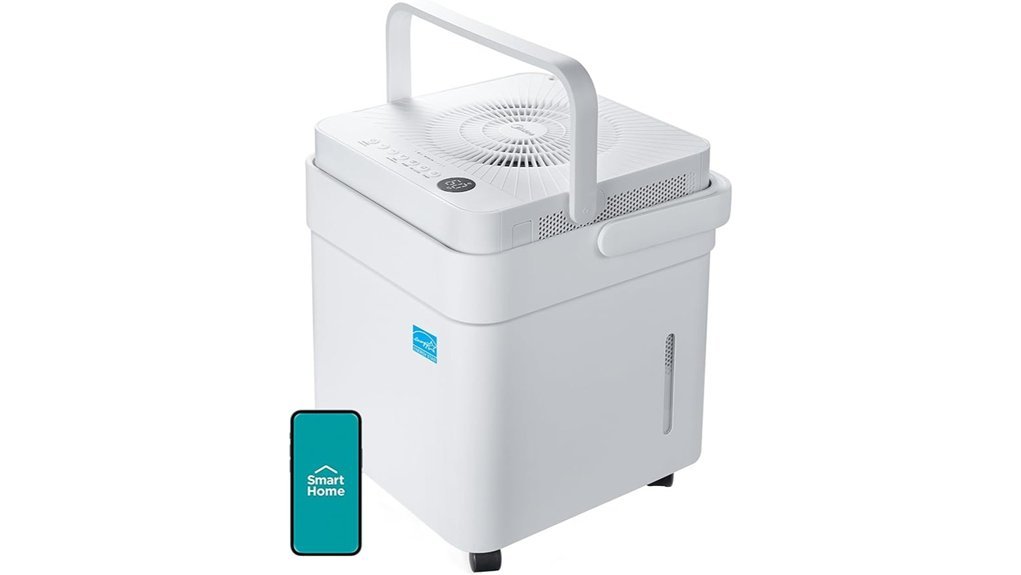
The Midea Cube 20 Pint Dehumidifier is ideal for tech-savvy homeowners managing up to 1,500 sq. ft. of basement space. You can adjust humidity from 35% to 85% and control it through the SmartHome app or with Alexa and Google Assistant. Its lift-and-twist design gives you flexible 3.2-gallon storage or compact nesting when you’re done. Use the included hose for continuous drainage into a sink or drain. With three fan speeds, auto restart, auto defrost, a washable filter, and a 1-year warranty, it keeps your basement drier and easier to maintain.
Why You’ll Like It: The main advantage is control. You can check and adjust humidity without walking downstairs, which is helpful if the unit sits in a utility room, finished basement, or storage area.
If you like checking humidity from your phone or using voice commands, this model feels more convenient than a basic manual dehumidifier. The 20-pint size also makes it easier to place in smaller basements, utility rooms, or apartment storage areas.
Best For: Tech-savvy homeowners or apartment dwellers needing app- and voice-controlled dehumidification for basements or other spaces up to 1,500 sq. ft.
Who Should Buy This: Buy it if you want smart controls, a compact shape, and flexible tank or hose drainage.
Who Should Skip It: Skip it if your basement is very wet, larger than the rated coverage area, or you do not need smart-home features.
Pros:
- SmartHome app control plus Alexa and Google Assistant compatibility for convenient remote operation
- Large 3.2-gallon lift-and-twist tank with compact nesting design for flexible use and storage
- Continuous drain option, washable filter, auto restart, and auto defrost for low-maintenance operation
Cons:
- 20-pint capacity may be too small for very damp or larger-than-rated spaces
- Requires Wi-Fi and smart-home setup to get the most out of its connected features
- 214-watt operation and continuous mode may be less energy-efficient than some users prefer
Bottom Line: The Midea Cube is a practical pick for smaller basements where smart control, a large tank, and flexible drainage matter more than maximum pint capacity.
95OZ Home Dehumidifier with Ambient Light
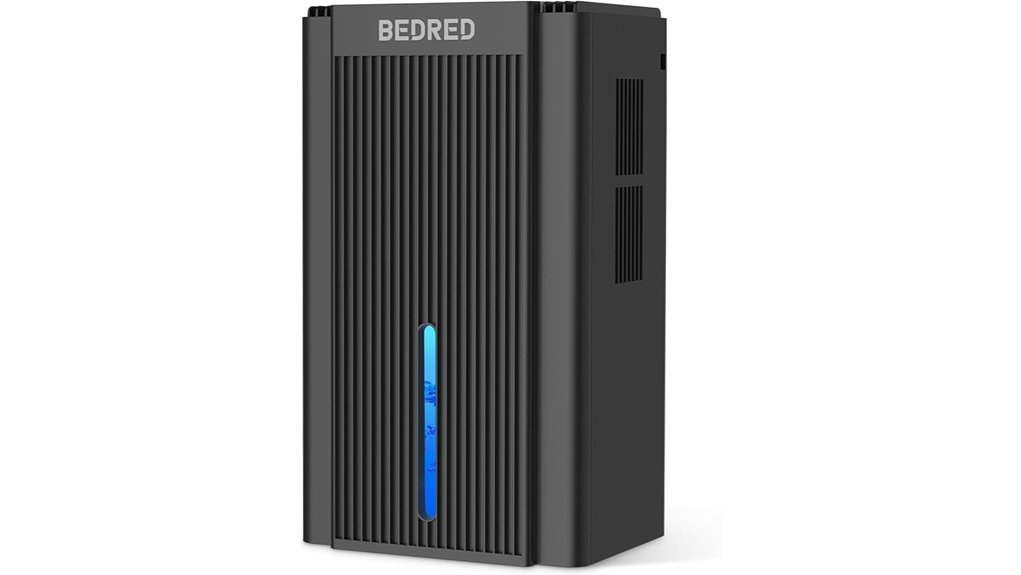
With 95 ounces of capacity, this compact dehumidifier suits small-to-medium basements up to 1,000 square feet. You’ll use its semiconductor cooling to pull moisture from the air and improve comfort without bulky hardware. The unit’s auto shutoff kicks in when the tank fills, so you don’t have to monitor it constantly. Sleep Mode keeps operation quieter at night, while the 7-color ambient light adds a calming touch. Its sleek black body fits basements, bedrooms, bathrooms, and RVs. If you want a simple, set-it-and-forget-it option, this model delivers easy everyday humidity control.
Why You’ll Like It: It is easy to place, simple to use, and better suited for light dampness than large compressor units. It can be a nice choice when you want a small machine for a finished basement corner, closet, bathroom, RV, or bedroom.
This is not the best choice for a wet, musty basement with serious moisture problems. It is better for light humidity, small rooms, closets, bathroom corners, RVs, or finished basement areas where you want a compact unit with automatic shutoff.
Best For: Homeowners or renters looking for a compact, easy-to-use dehumidifier for small spaces like basements, bedrooms, bathrooms, or RVs.
Who Should Buy This: Buy it if you need a portable unit for mild moisture, not full-basement drying.
Who Should Skip It: Skip it if you need heavy-duty basement drying, hose drainage, or fast moisture removal after leaks or flooding.
Pros:
- 95-ounce capacity handles everyday moisture control in spaces up to 1,000 sq. ft.
- Auto shutoff and Sleep Mode make it convenient and quieter for overnight use.
- 7-color ambient light and sleek design add a modern, relaxing touch.
Cons:
- Semiconductor dehumidifiers are generally less powerful than larger compressor-based models.
- Best suited for smaller spaces, not heavy-duty whole-home moisture problems.
- Warranty details are not clearly provided upfront.
Bottom Line: Pick this compact 95-ounce model for light moisture control, not for a large or persistently damp basement.
ToLife 1000 sq.ft Home Dehumidifier with 95 OZ Tank
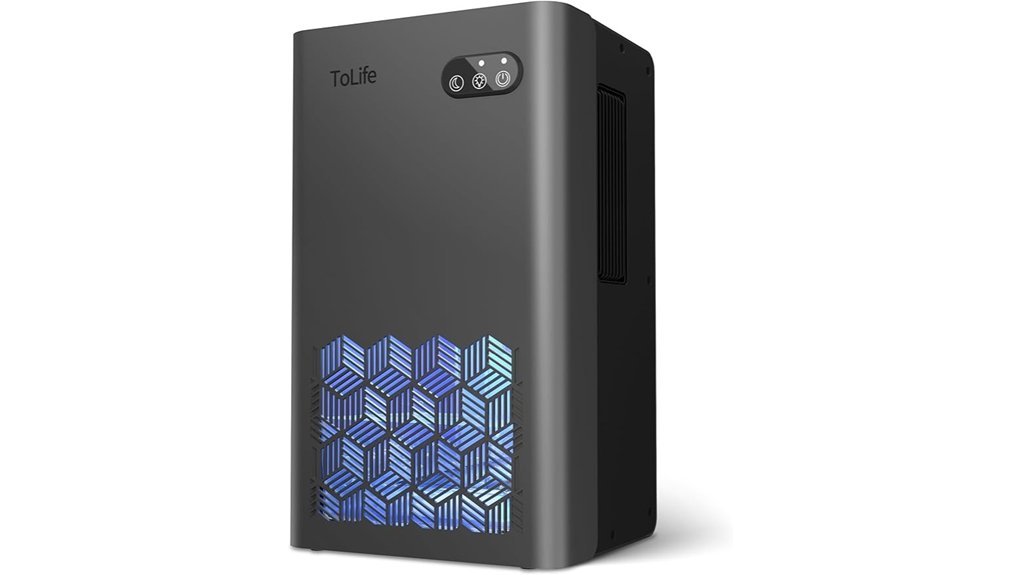
ToLife’s 1000 sq. ft. dehumidifier suits you if you need quiet basement moisture control. You get semiconductor condensation, which pulls moisture efficiently from spaces up to 1,000 square feet. Use powerful mode when humidity spikes, or switch to sleep mode for operation under 30 dB. The 95-ounce tank and 1-liter daily capacity help you manage dampness without constant emptying. It shuts off automatically when full or misplaced, so you avoid overflow. Its compact 2.64 kg build and handles let you move it easily, while seven LED colors add a soft night-light touch.
Why You’ll Like It: This model focuses on quiet comfort and simple use. It works best when you want a small dehumidifier that can run in the background without making your basement, bedroom, or RV feel noisy.
Because this is a compact semiconductor unit, it is best for lighter moisture issues. It may help in a small finished basement, bedroom, bathroom, closet, or RV, but it should not be your first choice for a basement that stays wet or smells strongly musty.
Best For: People who want a compact, quiet dehumidifier for basements, bedrooms, or other small-to-medium spaces up to 1,000 sq. ft.
Who Should Buy This: Buy it if quiet operation, portability, and simple auto shutoff matter more than maximum drying power.
Who Should Skip It: Skip it if you need a drain hose, smart controls, pump drainage, or heavy-duty drying power.
Pros:
- Quiet sleep mode runs under 30 dB, making it suitable for nighttime use.
- 95 oz tank and 1-liter daily dehumidification capacity reduce the need for frequent emptying.
- Automatic shut-off and portable handles add convenience and safety.
Cons:
- Not compatible with smart home systems.
- Best suited for smaller areas, so it may not be strong enough for very large or extremely damp spaces.
- Plastic build and basic feature set may feel less premium than higher-end models.
Bottom Line: The ToLife model is a quiet, simple option for light basement humidity, but it is not a replacement for a full-size compressor dehumidifier.
KNKA 2500 Sq.Ft Dehumidifier with Drain Hose
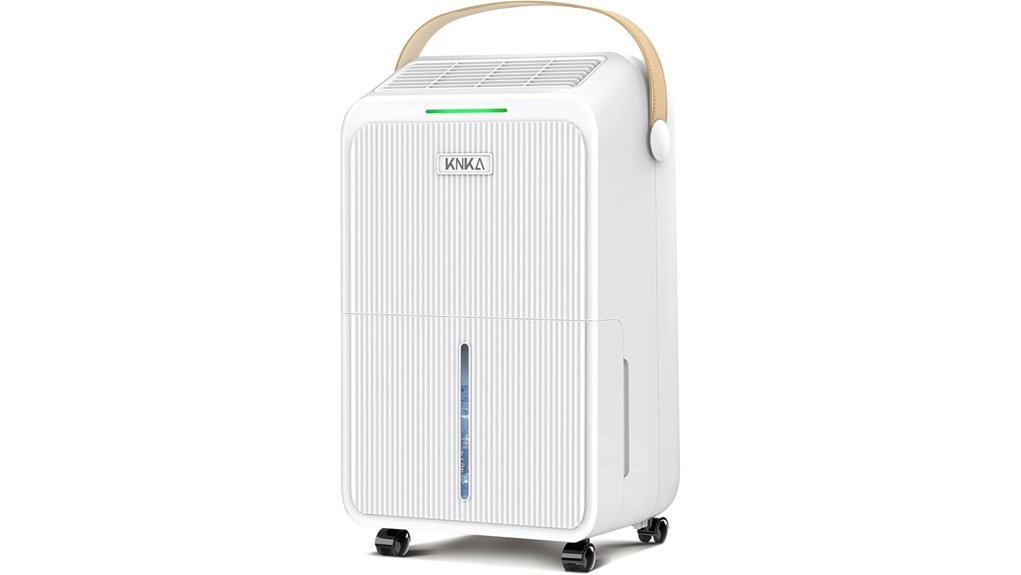
If you need steady moisture control in a 2,500-square-foot basement, KNKA fits well. You can remove up to 34 pints of moisture per day, then choose DEHU, DRY, or CONT mode to match damp conditions. The unit lets you set humidity from 30% to 80%, adjust fan speed, and use the timer or child lock for easier control. You can drain manually with the 3L tank, or connect the included 3.28-foot hose for nonstop flow. At 37dB, it stays quiet, and the LED display, wheels, defrost, and washable filter add convenience.
Why You’ll Like It: KNKA gives you a useful middle ground. It has more drying power than compact 95-ounce units, but it is still easier to manage than some larger high-capacity models.
This is a useful middle-ground pick if the smaller 95-ounce units feel too limited but you do not need a 4,500 sq. ft. model. The drain hose also helps if you want the machine to run for longer periods without checking the tank every few hours.
Best For: People who need quiet, flexible humidity control in medium to large spaces like basements, bedrooms, offices, or laundry areas.
Who Should Buy This: Buy it if your basement is moderately damp and you want both tank drainage and hose drainage.
Who Should Skip It: Skip it if your basement is extremely wet, if you need pump drainage, or if your drain point is higher than the unit.
Pros:
- Removes up to 34 pints of moisture per day, making it effective for 2,500 sq. ft. spaces
- Offers multiple modes, adjustable humidity settings, fan speed control, timer, and child lock
- Includes both a 3L tank and continuous drainage hose, plus quiet 37dB operation
Cons:
- 3L water tank may require frequent emptying during heavy use if not using the hose
- At 230 watts, it may use more power than smaller low-energy units
- Best suited for indoor residential or light commercial spaces, not very large industrial areas
Bottom Line: The KNKA model is a strong fit for medium-size basements where quiet operation, hose drainage, and adjustable humidity settings are priorities.
Vellgoo 64-Pint Energy Star Dehumidifier with Drain Hose
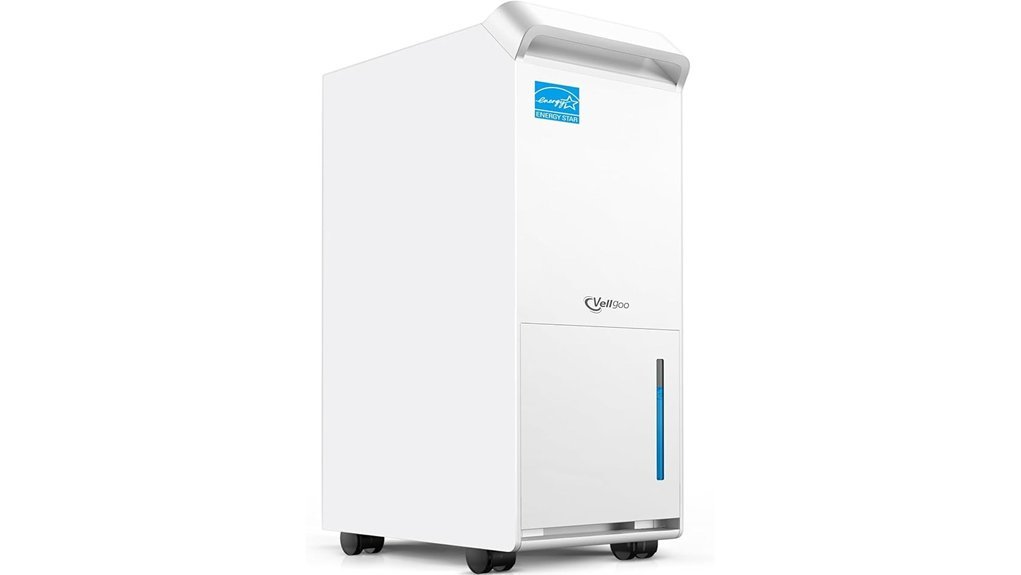
The Vellgoo Max 64-Pint Dehumidifier suits large basements up to 4,000 square feet. You get strong moisture removal with a high-performance rotary compressor and a refined 3+2 copper-and-aluminum coil system, so it dries fast in humidity from 40% to 80% and temperatures up to 95°F. Its Energy Star 2024 Most Efficient rating is a strong benefit if your dehumidifier may run often. You can empty the 5.5-liter tank manually, or use the included 6.56-foot hose and quick-connect adapter for continuous drainage. It also adds a washable filter, timer, child lock, and three speeds.
Why You’ll Like It: This model is built for buyers who want large-space moisture control without ignoring energy use. The hose option is also helpful if you want to run the unit longer without relying only on the tank.
This is one of the better choices if your basement needs serious moisture removal but you still care about energy use. It also fits buyers who want the option to drain manually at first and switch to hose drainage later.
Best For: Homeowners or renters with large spaces like basements up to 4,000 sq. ft. who want an energy-efficient dehumidifier with flexible drainage options.
Who Should Buy This: Buy it if you want a high-capacity compressor dehumidifier for a larger basement and prefer Energy Star-focused performance.
Who Should Skip It: Skip it if you have a very small room, limited floor space, or only need light moisture control.
Pros:
- Energy Star 2024 Most Efficient positioning supports better energy efficiency.
- Strong moisture removal with a rotary compressor and 3+2 copper-and-aluminum coil system.
- Includes both manual tank emptying and continuous drainage with hose and adapter.
Cons:
- Large size may be less convenient for smaller rooms or tight storage spaces.
- 5.5-liter tank may still require regular emptying if not using the drain hose.
- Best performance is limited to humidity levels between 40% and 80% and temperatures up to 95°F.
Bottom Line: The Vellgoo 64-Pint model is a smart choice for larger basements where high moisture removal and energy efficiency both matter.
AEOCKY 4500 Sq.Ft Smart Dehumidifier with Pump
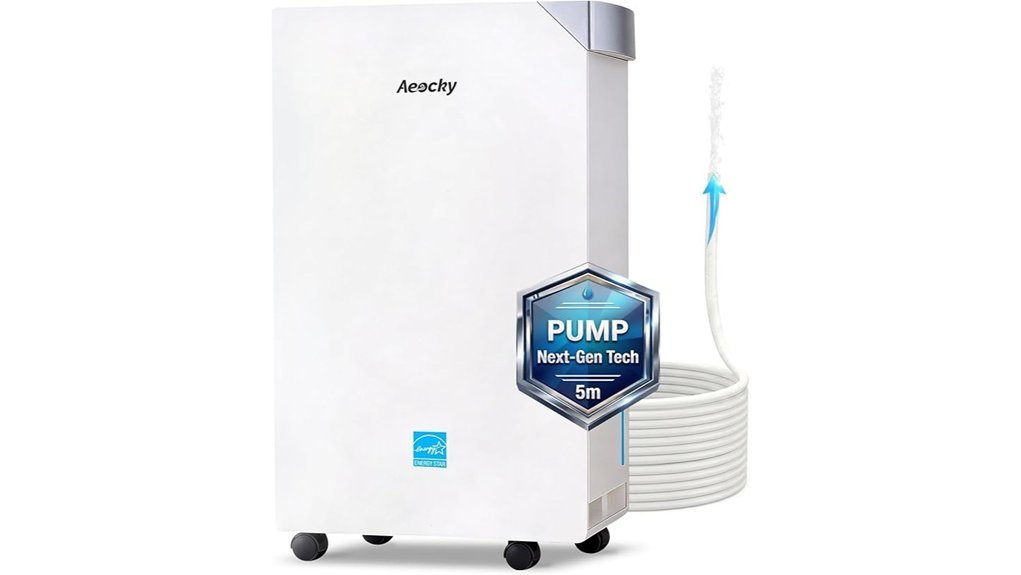
AEOCKY’s 4500 Sq.Ft smart dehumidifier suits you if you need hands-free basement moisture control. You get ENERGY STAR Most Efficient 2025 efficiency, plus a pump system that sends water upward for true 360° auto-drainage. It removes up to 80 pints a day in heavy humidity and 56 pints in damp basements, so you can trust it in tough spaces. It runs quietly, cuts vibration, and uses smart sensors to avoid dry running. With durability tested over 10,000 times, it’s built for long-term basement moisture control.
Why You’ll Like It: A pump model is useful when gravity drainage is not enough. If your basement sink, window, or drain outlet sits above the dehumidifier, the pump can move water upward and reduce manual emptying.
The built-in pump is the biggest reason to choose this version. If your basement drain, sink, or window exit sits higher than the dehumidifier, a gravity hose may not be enough. A pump model can be more convenient in that setup because it can move water upward instead of relying only on downward flow.
Best For: Homeowners, especially those with basements or large damp spaces, who want a high-efficiency smart dehumidifier with hands-free drainage and reliable long-term performance.
Who Should Buy This: Buy it if you need to drain water upward to a sink, window, utility tub, or elevated outlet.
Who Should Skip It: Skip it if you already have a nearby floor drain and do not need upward water removal.
Pros:
- ENERGY STAR Most Efficient 2025 positioning gives it strong efficiency appeal.
- Pump system enables 360° auto-drainage and upward water removal, reducing manual emptying.
- Quiet operation with smart sensors and durability tested over 10,000 times.
Cons:
- Pump models can be more expensive than basic dehumidifiers.
- Best suited for spaces with drainage needs, so the pump feature may be unnecessary for some users.
- May be more complex to set up and maintain than simpler non-smart units.
Bottom Line: Choose this AEOCKY pump model if you want a large-capacity automatic basement dehumidifier and need to send water upward to a sink, drain, or other outlet.
Factors to Consider When Choosing Automatic Dehumidifiers for Basements
When you choose a basement dehumidifier with automatic features, you’ll want to match its moisture removal capacity to your space’s dampness. You should also check auto drain options, energy efficiency, noise level, and how well the unit fits your basement’s coverage and size. Picking the right balance helps you keep the area dry without wasting energy or adding hassle.
Simple Buying Rule: Choose a compressor dehumidifier for a damp or musty basement. Choose a compact semiconductor unit for light moisture in a small area. Choose a pump model if the water must travel upward.
Best humidity target: Many homeowners aim for about 40% to 50% relative humidity in basement storage areas, while avoiding over-drying the space.
Moisture Removal Capacity
Moisture removal capacity is one of the most important factors when you’re choosing a basement dehumidifier with automatic controls. You’ll usually see capacity listed in pints per day, and basement models often range from 20 to 80 pints. Match that number to your space and humidity level, because a small unit won’t keep up in a damp, oversized basement. Aim for a model that can remove more moisture than you expect on average, especially if your basement stays humid. If you’re dealing with a larger area, up to 4,500 sq. ft., choose a higher-capacity unit. In extreme conditions, like 95°F and 95% RH, an 80-pint model gives you much better control. Regularly check your humidity so you stay on target.
Auto Drain Options
Once you’ve matched a dehumidifier’s capacity to your basement, check how it handles drainage, since auto drain options can save you from constantly emptying a tank. A continuous drain hose lets you route water to a floor drain or sink, so the unit keeps working without interruption. If your drain sits higher than the dehumidifier, choose a model with a built-in pump that can push water upward. You can also look for adapters that fit standard garden hoses, which give you more installation flexibility in tight or unusual spaces. Even with auto drain, an automatic shut-off adds protection by stopping the unit when the tank fills. That way, you avoid overflow, protect the basement, and keep maintenance simple year-round.
Energy Efficiency Rating
Energy efficiency should be high on your list, especially for a basement unit that may run often to keep humidity in check. Look for ENERGY STAR-certified models, since they are designed to use less electricity than standard units. If you want top-tier performance, check for the ENERGY STAR Most Efficient label; it highlights models that meet stronger efficiency criteria in their category. You’ll also benefit from dehumidifiers with humidity control algorithms that adjust operation to current conditions, so you don’t waste power. Efficient compressors and airflow design matter too, because they help the unit remove moisture effectively while using less energy. Over time, those savings can add up fast.
Noise Level Considerations
Noise matters a lot in a basement dehumidifier, especially if the space doubles as a living area, office, or bedroom. You should look for models that stay around 44dB or lower, so they won’t interrupt conversation, work, or sleep. A unit rated at 37dB is even better, since that’s quieter than a normal chat. Many efficient dehumidifiers run at a soft level similar to white noise, which can feel soothing at night. Check for sleep mode, too, because it trims sound output when you need the quietest operation. Design also matters: optimized air ducts and low-vibration parts usually keep the machine calmer. When you choose a quieter model, you make your basement more comfortable day and night.
Coverage And Size
When you’re choosing a basement dehumidifier, size and coverage should come first. Match the unit to your basement’s square footage so it can actually keep up. For larger spaces, look for models that cover up to 4,500 sq. ft., and pick a capacity between 20 and 80 pints per day based on how damp the room gets. If your basement stays very humid, choose higher pint output; 80 pints per day works better in extreme conditions like 95°F and 95% RH. Also check the unit’s dimensions and weight so you can move it easily, especially if it’s over 30 lbs. Finally, make sure it supports continuous drainage, since that helps you manage persistent moisture without constant emptying.
Tank Size vs Continuous Drainage
A larger tank is useful if you cannot run a drain hose, but it still needs manual emptying. For a basement that stays damp, continuous drainage is usually easier. Before buying, check whether your basement has a floor drain, sink, sump pit, or safe drainage point. If the drain point is above the dehumidifier, look for a pump model instead of a gravity-drain model.
Compressor vs Semiconductor Models
Compressor dehumidifiers are usually better for larger basements and heavier moisture. Semiconductor models are often smaller, quieter, and easier to move, but they usually remove less moisture per day. If your basement has musty odors, damp walls, or visible condensation, a compressor model is usually the safer choice. If you only want light moisture control in a small finished area, a compact semiconductor unit may be enough.
Maintenance and Cleaning
A basement dehumidifier works better when you keep it clean. Check the water tank, washable filter, drain hose, and air intake regularly. If you use continuous drainage, make sure the hose slopes correctly and does not kink. If the unit has a pump, follow the product manual for pump cleaning and seasonal maintenance. Clean parts help reduce odors, improve airflow, and keep the unit from working harder than needed.
Best Placement for Basement Use
Place your dehumidifier where air can move freely around the unit. Avoid pushing it tightly against a wall, storage box, or furniture. If the basement has one very damp corner, start near that area but keep the drain route safe and stable. For finished basements, consider noise level and foot traffic so the machine does not become a tripping hazard.
Pro Tip: Use a separate hygrometer in your basement if you want a second humidity reading. This helps you confirm whether the dehumidifier’s built-in sensor matches the actual room conditions.
Safety Note: Do not use a basement dehumidifier to hide serious water intrusion. If you see standing water, wet drywall, foundation leaks, or repeated flooding, fix the moisture source first.
Frequently Asked Questions
How Often Should a Basement Dehumidifier Be Cleaned?
You should clean your basement dehumidifier every two to four weeks, and empty or rinse the tank weekly. If you use it heavily, check filters and coils more often to keep it running efficiently.
Can a Dehumidifier Help Prevent Mold Spores?
Yes, a dehumidifier can help make your basement less friendly to mold growth by lowering humidity. It can reduce musty odors and moisture, but it does not remove an existing mold problem by itself. If mold is already present, clean it safely and fix the source of moisture.
Should Basement Dehumidifiers Run Continuously?
You don’t need to run it continuously; you should use humidistat settings or intermittent cycles instead. Let it maintain 30% to 50% humidity, since constant operation wastes energy and may over-dry your basement.
What Humidity Level Is Best for Basement Storage?
For basement storage, you’ll want humidity around 40% to 50%; it keeps mold at bay and protects boxes, fabrics, and finishes. Keep it steady, and you’ll shield your stored items from damp damage.
Do Dehumidifiers Increase Electricity Bills Significantly?
Usually, no, you’ll see a modest increase, not a huge one. You can lower costs by choosing an energy-efficient model, setting the right humidity level, and running it only when your basement actually needs drying.
What Size Dehumidifier Do I Need for a Basement?
For a small, lightly damp basement, a lower-capacity model may be enough. For a larger or consistently damp basement, look for a higher-pint compressor dehumidifier and match the coverage rating to your square footage. If your basement smells musty or humidity climbs quickly, choose more capacity rather than less.
Is a Pump Dehumidifier Worth It for a Basement?
A pump dehumidifier is worth it when your drain point is higher than the unit or far from where the machine will sit. If you have a floor drain nearby, a standard hose-drain model may be enough. If you need to send water to a sink, window, or elevated drain, a pump model is easier.
Can a Small Dehumidifier Dry a Whole Basement?
A small dehumidifier can help with light moisture in a small area, but it usually will not dry a whole damp basement. For large spaces, heavy humidity, or recurring musty odors, choose a compressor model with a higher pint rating and continuous drainage.
Is Continuous Drainage Better Than a Water Tank?
Continuous drainage is usually better for damp basements because the unit can keep running without frequent emptying. A water tank is still useful when you do not have a safe drain nearby, but it requires more attention during humid days.
Where Should I Place a Dehumidifier in the Basement?
Place it in an open area with good airflow and safe access to power. Keep the intake and exhaust vents clear. If you use a hose, make sure the drainage path is secure and does not create a trip hazard.
Conclusion
Final Recommendation: For most large damp basements, the AEOCKY 4500 Sq.Ft Smart Dehumidifier is the best starting point because it combines high capacity, smart humidity control, and hose drainage. If energy savings are your top concern, compare it closely with the Vellgoo 64-Pint Energy Star model. If your drain point is above the unit, choose the AEOCKY pump version.
For smaller or lighter moisture problems, the Midea Cube, ToLife, and 95OZ Home Dehumidifier are easier to place and manage. Just remember that compact models are best for light humidity, while damp basements usually need a stronger compressor unit.
Choosing the right basement dehumidifier depends on your space, drainage options, and how much control you want. For a large damp basement, start with a high-capacity model like the AEOCKY 4500 Sq.Ft Smart Dehumidifier or the Vellgoo 64-Pint Energy Star unit. If your drain point is higher than the machine, the AEOCKY pump version is the better hands-free choice. For smaller spaces, the Midea Cube, ToLife, or 95OZ Home Dehumidifier can help with lighter moisture without taking up as much room.