Disclosure: As an Amazon Associate, we earn from qualifying purchases. If you click a link on this page and make a purchase, we may receive a small commission at no extra cost to you.
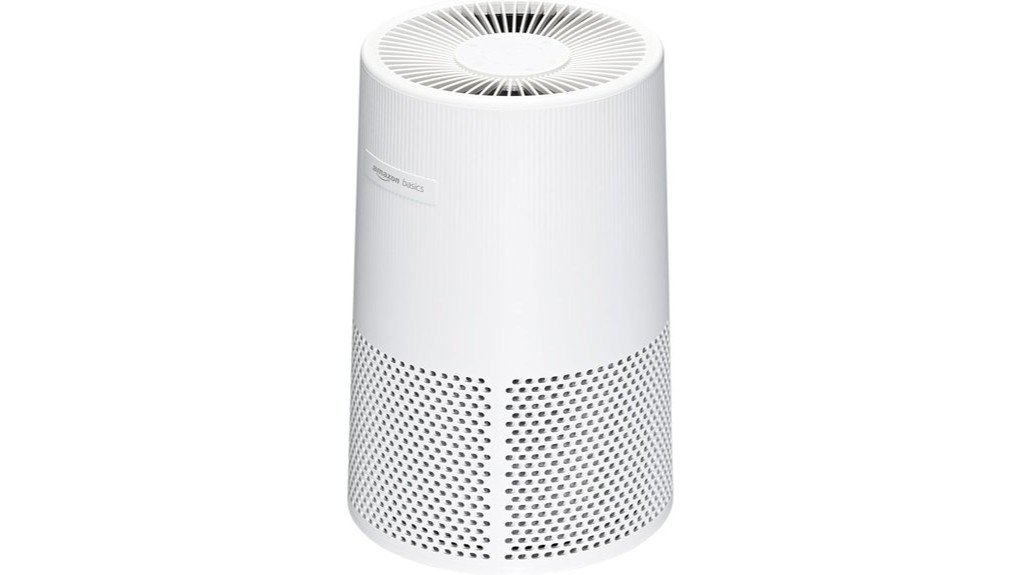
Choosing an air purifier gets confusing when one product lists several room-size figures. The Amazon Basics Air Purifier AC2224A combines H13 HEPA filtration, activated carbon, automatic air-quality sensing, and a compact design, but its strongest cleaning rate applies to a much smaller room than its maximum advertised coverage. This review explains what the 213 ft² and 1067 ft² figures actually mean, how its filtration and controls work, and what you should know about noise and filter replacement. It is a practical choice for bedrooms and home offices, with some important limits for larger spaces.
Quick Verdict
Rating: 8/10, Recommended with caveats
Best For: Bedrooms, home offices, pet areas, and other rooms around 213 ft² where you want frequent air circulation.
Bottom Line: The AC2224A offers useful H13 HEPA filtration, activated carbon, Auto Mode, and a 238 m³/h CADR in a small 31W unit. Its main limitation is room-size interpretation: 1067 ft² represents about one air change per hour, while the stronger five-air-changes-per-hour performance applies to about 213 ft².
Amazon Basics Air Purifier Specifications
| Specification | Detail |
|---|---|
| Brand | Amazon Basics |
| Model | AC2224A |
| ASIN | B0CL993435 |
| Product type | Corded room air purifier |
| Dimensions | 9.6″D x 9.6″W x 14.3″H |
| Weight | About 3 lb |
| Rated power | 31W |
| Voltage at purifier | 24V DC |
| CADR | 238 m³/h (140 CFM) |
| Filtration | Pre-filter, activated-carbon/deodorizing stage, and H13 HEPA filter |
| Particle claim | 99.97% of particles as small as 0.3 microns under the manufacturer’s stated filtration claim |
| Fan settings | Low, medium, high, and Auto Mode |
| Sleep Mode | 32 dB stated by Amazon |
| General noise specification | 57 dB in the user manual |
| Timer | 2, 4, 6, or 8 hours |
| 5 ACH coverage | 213 ft² / 20 m² |
| 3 ACH coverage | 356 ft² / 33 m² |
| 2 ACH coverage | 534 ft² / 50 m² |
| 1 ACH coverage | 1067 ft² / 99 m² |
| Replacement filter | B0CL97Z4K8 |
| Filter reminder | 2,000 operating hours |
| Certification | ENERGY STAR certified |
| Warranty | 1-year limited warranty |
What Is the Amazon Basics Air Purifier?
The Amazon Basics AC2224A is a compact room air purifier built around a 360-degree air intake and three-stage filtration system. Its filter combines a pre-filter for larger debris, an activated-carbon/deodorizing layer for odors, and an H13 HEPA stage for fine airborne particles such as dust, pollen, and pet dander.
The purifier measures 9.6 inches by 9.6 inches at its base and stands 14.3 inches high. At about 3 pounds, it is light enough to move between rooms when needed. Its built-in sensor also lets Auto Mode respond to detected air quality instead of requiring you to choose a fan level manually.
Key Takeaways
- The AC2224A has a CADR of 238 m³/h (140 CFM) and delivers five air changes per hour in a room up to about 213 ft².
- The advertised 1067 ft² maximum represents approximately one air change per hour, so room size has a major effect on cleaning frequency.
- Its three-stage system combines a pre-filter, activated carbon/deodorizing filtration, and H13 HEPA filtration.
- Auto Mode uses a built-in air-quality sensor, while LED colors show poor, moderate, or good detected air quality.
- Sleep Mode is rated at 32 dB, while the manual lists 57 dB as the purifier’s general noise specification.
- The filter reminder activates after 2,000 operating hours, although heavy dust, smoke, pet dander, and debris can shorten useful filter life.
Before You Buy: Do not treat “up to 1067 ft²” as equivalent to the purifier’s 213 ft² high-circulation rating. The manual lists 1067 ft² at one air change per hour, but 213 ft² at five air changes per hour. Choose your room size based on how frequently you want the room’s air processed.
Who Should Buy It?
Best For
- Bedrooms or offices around 213 ft² where you want frequent air circulation.
- Homes with dust, pollen, or pet dander where H13 HEPA filtration is useful.
- Buyers who want automatic fan adjustment, an air-quality indicator, timer, and Sleep Mode without a large purifier.
Skip If
- You need several air changes per hour across a large open-plan room.
- You expect the 1067 ft² maximum rating to provide the same cleaning frequency as the 213 ft² rating.
- You want a purifier primarily for strong gas or odor removal rather than particle filtration.
Key Features of the Amazon Basics Air Purifier
Compact Design and 360-Degree Air Intake
The purifier’s 9.6-inch square footprint makes it easier to place in bedrooms, offices, and smaller living spaces than a large console-style unit. Its 360-degree intake allows air to enter around the unit rather than from only one narrow side.
The compact body is useful only when the intake remains open. Pushing the purifier tightly against furniture or blocking its air openings can restrict airflow, so give it open space and keep both the inlet and outlet clear.
Three-Stage H13 HEPA Filtration
The filtration system combines a pre-filter, an activated-carbon/deodorizing stage, and an H13 HEPA filter. Amazon states that the filter captures 99.97% of particles as small as 0.3 microns under its stated test conditions. The practical benefit is that the purifier can target common airborne particles such as pollen, dust, pet dander, and fine debris rather than simply circulating room air.
The activated-carbon component adds some odor-control capability. You should still treat strong smoke or persistent household odors at their source because a compact purifier cannot replace ventilation, cleaning, or source removal.
CADR and Room-Cleaning Performance
With a stated CADR of 238 m³/h, or 140 CFM, this model is best understood as a medium-room purifier. In a 213 ft² room, the manual rates it for five air changes per hour. That drops to three changes per hour at 356 ft², two at 534 ft², and one at 1067 ft².
This distinction matters more than the largest number on the product page. If you are trying to reduce airborne particles quickly, the smaller-room ratings provide a more useful guide than the maximum coverage figure.
How Smart Air Quality Monitoring Works
The built-in sensor supports Auto Mode, which changes fan speed according to detected air quality. The air-quality indicator uses red for poor, orange for moderate, and green for good conditions. According to the manual, Auto Mode can take up to three minutes to detect current air quality.
You can also select low, medium, or high fan speed yourself. This is useful when you know you want stronger airflow after vacuuming, cooking, opening windows during pollen season, or bringing a pet into the room.
Timer, Child Lock, and Light Controls
The timer can shut the purifier off after 2, 4, 6, or 8 hours. A child lock prevents accidental control-panel changes, while the lighting controls let you manage the night light and air-quality indicator.
In Sleep Mode, the purifier runs at low fan speed. The manual says the control lights first dim to 50% brightness and can then be turned completely off, which is useful when the purifier sits near your bed.
Noise Level and Sleep Mode
Amazon lists Sleep Mode at 32 dB. That figure applies specifically to the quiet operating mode, not every fan speed. The user manual separately lists a 57 dB general noise specification, so you should expect more audible airflow when the purifier runs harder.
For a bedroom, Sleep Mode is the setting that matters most. In a dusty room or during poor detected air quality, stronger settings will clean faster but will also be easier to hear.
How It Performs in Real Use
For Bedroom Use
A bedroom around 213 ft² fits the purifier’s strongest published coverage figure. Sleep Mode lowers the fan speed to the stated 32 dB level and lets you dim or switch off the control lights, making this one of the model’s more practical use cases.
For a Home Office
In an office, Auto Mode is convenient because you can leave the purifier running while the sensor adjusts the fan. The compact footprint also takes up less floor space than a full-size console purifier.
For Pet Areas and Seasonal Allergens
The H13 HEPA stage is designed to capture fine particles including pollen and pet dander, while the pre-filter catches larger debris. If you have pets, more frequent pre-filter cleaning can help prevent hair and dust from building up on the filter surface.
For Larger Rooms
The purifier can circulate air in rooms larger than 213 ft², but cleaning frequency falls as room size increases. At 534 ft² the manual lists about two air changes per hour, and at 1067 ft² only one. If fast particle reduction in a large room is your priority, a higher-capacity purifier may be a better fit.
Placement, Setup, and Maintenance Tips
- Remove the filter’s plastic bag before first use. The filter ships protected inside plastic and must be unwrapped before the purifier can work correctly.
- Use the purifier upright on a flat surface. This matches the manufacturer’s setup instructions.
- Keep the air inlet and outlet clear. Avoid blocking airflow with walls, curtains, furniture, bedding, or other objects.
- Clean the outer filter regularly. The manual recommends cleaning the filter with a soft brush or cloth every 2 to 4 weeks to remove hair, dust, and larger debris. Do not wash the filter with water.
- Use the filter indicator as a reminder, not a guarantee. The reminder is set for 2,000 operating hours, but heavy smoke, dust, pet dander, or other debris may reduce filter life.
- Reset the reminder after replacement. After installing the replacement filter, hold the filter replacement button for five seconds until the unit beeps.
Pro Tip: Check the outer pre-filter every few weeks, especially in homes with pets. Removing accumulated hair and dust with a soft brush or cloth can help maintain airflow and may extend useful filter life.
Setup and Safety Notes
Use the purifier indoors, upright, and on a stable flat surface. The manual warns against operating it outdoors, on wet surfaces, near water, in extreme heat, or around flammable gas. Keep the air inlet and outlet unobstructed.
Unplug the unit before moving, cleaning, or servicing it. The housing can be wiped with a soft dry cloth or, for stubborn marks, a warm damp cloth while keeping the purifier itself dry. The filter should not be washed with water or liquids.
The official product information describes a pre-filter, activated carbon, and H13 HEPA filtration system. It does not list an ionizer or user-selectable ozone-generation function. Because the documentation does not provide a measured ozone-emission specification, it is better not to make a blanket zero-ozone claim.
Pros and Cons
Pros
- 238 m³/h (140 CFM) CADR with five air changes per hour in rooms up to about 213 ft².
- H13 HEPA, activated carbon, and pre-filtration in one replacement filter system.
- Auto Mode with red, orange, and green air-quality feedback.
- 32 dB Sleep Mode with dimmable or switchable control lights.
- Compact 9.6 x 9.6-inch footprint, 31W power rating, and ENERGY STAR certification.
Cons
- The 1067 ft² maximum rating provides only about one air change per hour.
- The 32 dB figure applies to Sleep Mode, while the manual lists a 57 dB general noise specification.
- The dedicated B0CL97Z4K8 replacement filter is an ongoing ownership requirement.
Is It Worth the Price?
Because Amazon prices can change, value is best judged by comparing the current price with other medium-room H13 HEPA purifiers. The AC2224A is a value-focused option when you want a 238 m³/h CADR, automatic air-quality sensing, timer, Sleep Mode, activated carbon, and ENERGY STAR certification in one compact unit.
You get the most value when your main room is close to its 213 ft² five-ACH rating. It is less compelling if your priority is frequent air cleaning across a much larger open area because the air-change rate falls as room size increases.
How It Compares to Alternatives
The Levoit Core 300S-P is worth comparing if app control and voice-assistant features matter to you. The Blueair Blue Pure 511 is another compact small-room alternative for buyers who prefer a simpler control design.
The Amazon Basics AC2224A makes the most sense when you want automatic air-quality sensing, a straightforward control panel, H13 HEPA plus activated-carbon filtration, and strong published airflow for a room around 213 ft² without making app connectivity a priority.
Frequently Asked Questions
How large a room can the Amazon Basics AC2224A actually handle?
The manual lists 213 ft² at five air changes per hour, 356 ft² at three, 534 ft² at two, and 1067 ft² at one. For faster and more frequent cleaning, use the smaller coverage figures rather than relying only on the 1067 ft² maximum.
How often should you replace the filter?
The purifier’s filter-life reminder is set for 2,000 operating hours. Actual filter life can be shorter when the unit handles large amounts of pet dander, dust, smoke, or other debris, so inspect performance rather than relying only on the clock.
What replacement filter does it use?
The user manual identifies replacement filter model B0CL97Z4K8. Check the model designation before ordering so you do not accidentally buy a filter intended for a different Amazon Basics purifier size.
Is the purifier quiet enough for a bedroom?
Amazon rates Sleep Mode at 32 dB, and the mode uses low fan speed with dimmable control lights. Higher fan settings will be more noticeable, and the manual lists 57 dB as the unit’s general noise specification.
Can it help with pet dander, pollen, and smoke?
Its H13 HEPA stage is intended for fine airborne particles such as pollen, dust, pet dander, and smoke particles. Activated carbon can also help with some odors, but a compact purifier should not be treated as a substitute for ventilation or removing a strong odor or smoke source.
Does the Amazon Basics air purifier produce ozone?
The official listing and manual describe pre-filter, activated-carbon, and H13 HEPA filtration and do not list an ionizer or ozone-generation mode. They do not provide a measured ozone-emission specification, so this review does not claim a verified zero-ozone output.
What should you do before using it for the first time?
Remove the bottom cover, take out the pre-installed filter, and remove its protective plastic bag before reinstalling it. Then place the purifier upright on a flat surface with the air inlet and outlet unobstructed before connecting power.
The Bottom Line
The Amazon Basics AC2224A earns an 8/10 recommendation with caveats for bedrooms, offices, pet areas, and other spaces where its 213 ft² five-ACH rating fits your needs. Its strongest points are H13 HEPA plus activated-carbon filtration, a 238 m³/h CADR, Auto Mode, and useful sleep controls, while its main limitation is that the much larger 1067 ft² figure represents only one air change per hour.
If you need frequent purification across a large open-plan room, choose a higher-capacity model. For a smaller room where compact size, automatic sensing, and straightforward controls matter, this Amazon Basics purifier is worth considering.