A high-capacity dehumidifier with a pump can solve drainage problems in a large basement, sealed crawl space, whole-home system, warehouse, or restoration site. The first decision is not simply which unit has the largest pint number. Choose the right format—portable, ductable whole-house, or commercial—and then compare the rating basis, condensate-pump setup, vertical lift, hose route, operating-temperature range, and installation needs.
Affiliate disclosure: This article contains Amazon affiliate links. We may earn a commission from qualifying purchases at no extra cost to you.
Quick verdict: Choose the DECIUU Max for portable residential use, the AprilAire E100PZ bundle for a planned whole-home or crawl-space installation, the Moiswell Explorer VP190 when an AHAM figure is important for commercial comparison, or the Moiswell Pioneer-XII when maximum advertised capacity and airflow are the priority.
How these picks were compared: Product type, stated capacity and test basis, pump arrangement, drain-hose information, mobility, controls, operating limits, installation burden, and suitability for the intended space. Advertised square-foot figures are treated as guidance rather than guaranteed performance.
Quick Comparison
| Product | Best For | Capacity Basis | Pump Setup | Main Tradeoff |
|---|---|---|---|---|
| DECIUU Max | Large basements and portable home use | Up to 100 pints/day at maximum conditions; listed at 70 pints/day under standard conditions | Built-in pump, gravity drain, or tank | Do not compare the 100-pint headline directly with standardized ratings |
| AprilAire E100PZ | Whole-home, basement, or sealed crawl-space installation | Marketed as 100 pints/day; current ENERGY STAR capacity is 85 pints/day | External condensate pump included in this bundle | Installation and duct planning are more involved |
| AVAHUM 150 Pint | Very damp large rooms, garages, and basements | Up to 150 pints/day at 95°F and 90% RH | Built-in pump, gravity drain, or tank | Confirm current certification, warranty, and included parts |
| Uhome 150 Pint | Flexible portable drainage in large residential spaces | Up to 150 pints/day at 95°F and 90% RH | Built-in pump, gravity drain, or tank | Verify the current hose, lift, and accessory details |
| Moiswell Explorer VP190 | Commercial drying, restoration, and large facilities | 190 pints/day maximum; 90 pints/day AHAM | Built-in pump with included 16.4-foot hose | Heavy commercial footprint and higher airflow |
| Moiswell Pioneer-XII | Highest-capacity jobs in this roundup | Up to 200 pints/day maximum-condition rating | Built-in pump with included 16.4-foot hose | A 78-pound machine intended for demanding work |
Choose by setup:
- Portable residential: DECIUU, AVAHUM, or Uhome
- Ducted whole-home or crawl space: AprilAire E100PZ bundle
- Commercial drying or restoration: Moiswell Explorer VP190 or Pioneer-XII
DECIUU 100 Pint Dehumidifier with Pump and Hose
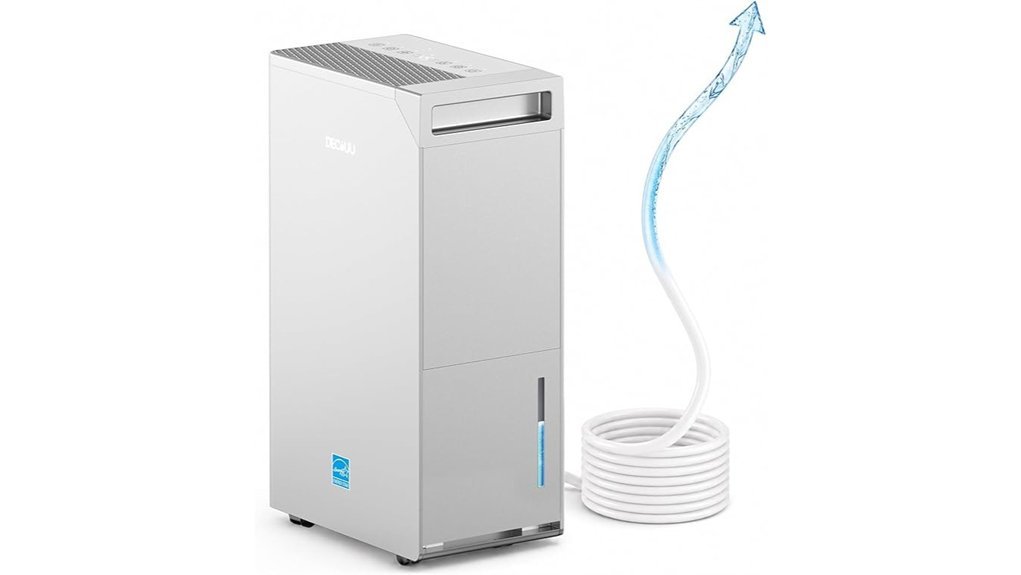
Best Portable Pick: The DECIUU Max is designed for large, damp residential spaces where gravity drainage is inconvenient. Its headline claim is up to 100 pints per day at 95°F and 90% RH, while the same model is listed at 70 pints per day under standard conditions. The product listing also advertises coverage up to 5,000 sq. ft., a built-in pump with up to 16.4 feet of lift, continuous hose drainage, and a 1.45-gallon tank.
Why You’ll Like It: The pump, gravity-drain connection, and tank give you three ways to handle condensate. A humidistat, timer, child lock, washable filter, wheels, and digital controls make it easier to use as a portable basement or utility-room dehumidifier.
Who Should Buy This: Homeowners or property managers who want a portable, pump-equipped dehumidifier for a large basement, garage, laundry area, or similarly damp space.
Who Should Avoid This: Buyers who need a permanently ducted whole-home system or a commercial restoration machine.
Pros:
- Built-in pump supports upward drainage when a floor drain is unavailable
- Also supports gravity drainage and manual tank collection
- Portable controls and wheels suit changing room layouts
Cons:
- The 100-pint figure is a maximum-condition rating, not the output you should expect in every room
- The coverage figure is an advertised maximum and depends on moisture load, temperature, airflow, and room layout
- The tank can fill quickly if neither pump nor continuous drainage is connected
AprilAire E100PZ Whole-House Dehumidifier With Pump Bundle
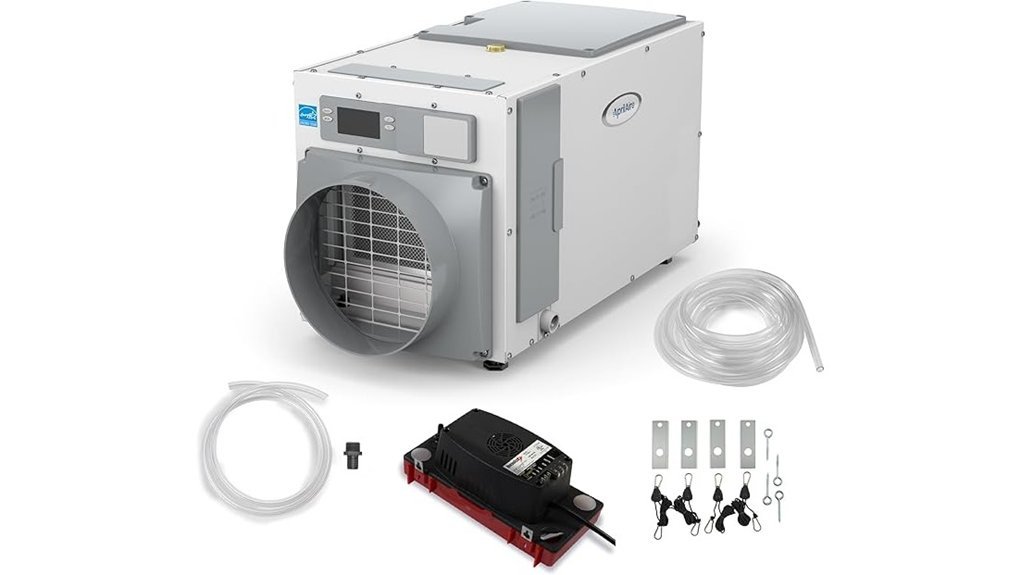
Best Whole-Home Pick: The AprilAire E100 is a bucketless, ductable dehumidifier intended for basements, sealed crawl spaces, and whole-home applications up to an advertised 5,500 sq. ft. The Amazon ASIN used here is an E100PZ bundle that pairs the dehumidifier with an external condensate pump, drainage tubing, and a hanging kit. The pump is included as a separate accessory rather than built into the E100 cabinet.
Why You’ll Like It: AprilAire markets the E100 as a 100-pint model, while current ENERGY STAR data lists 85 pints per day under its standardized test. Automatic humidity control, a washable MERV 8 filter, and flexible ducting options make it a stronger long-term choice than a portable unit when the installation is planned correctly. Confirm the current warranty terms for the exact bundle and seller before ordering.
Who Should Buy This: Homeowners who want permanent, automatic humidity control across a large basement, crawl space, or multiple rooms.
Who Should Avoid This: Renters, buyers seeking a plug-and-roll portable unit, or anyone unwilling to plan drainage, hanging, or duct connections.
Pros:
- Designed for whole-home, basement, and crawl-space applications
- Bundle includes a separate condensate pump and installation accessories
- Washable MERV 8 filter and automatic humidity control support long-term use
Cons:
- Installation is more involved than with a portable dehumidifier
- The current standardized capacity is lower than the 100-pint marketing name
- Warranty coverage and included accessories should be confirmed for the exact bundle
AVAHUM 150 Pint Dehumidifier With Pump for Large Rooms
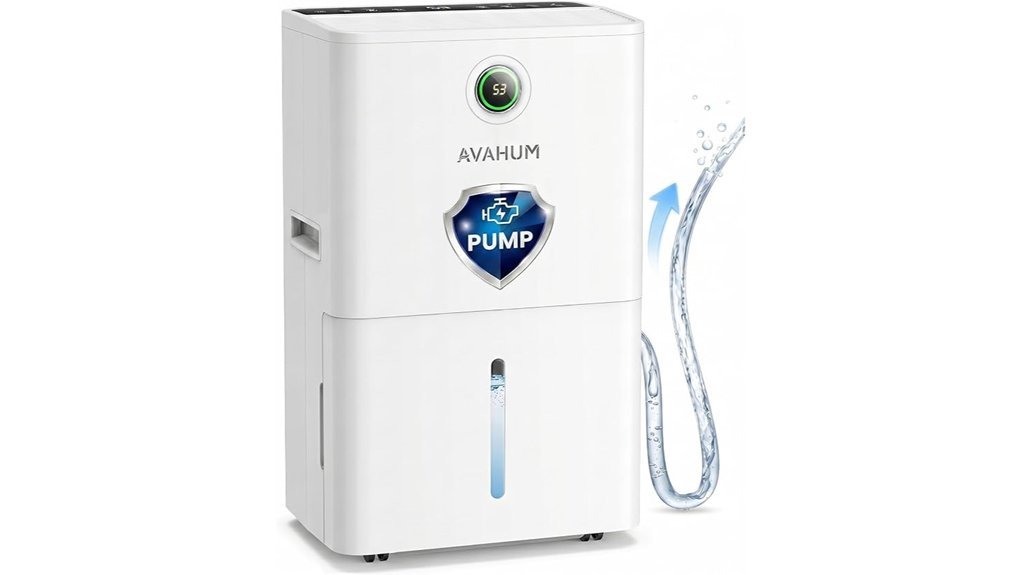
Best High-Capacity Residential Pick: The listing tied to this ASIN identifies the AVAHUM as a 150-pint dehumidifier for large basements, garages, and rooms up to an advertised 7,000 sq. ft. The 150-pint claim is measured at 95°F and 90% RH, so output in a cooler or less humid room will be lower.
Why You’ll Like It: A 2.1-gallon tank, gravity drain, and built-in pump advertised for up to 16.4 feet of vertical lift provide flexible placement. The timer, auto-defrost, power-loss memory, and full-tank shutoff reduce routine monitoring, but current certification and warranty details should still be checked on the live listing.
Who Should Buy This: Buyers who need more capacity than a typical residential portable model and want several drainage choices.
Who Should Avoid This: Buyers who need independently confirmed commercial performance data or a compact machine for a small room.
Pros:
- High maximum-condition capacity for very damp, large spaces
- Tank, gravity hose, and pump drainage provide flexible placement
- Automatic controls reduce routine monitoring
Cons:
- The maximum capacity and coverage claims should not be treated as guaranteed real-world performance
- Current certification and warranty details should be checked on the live listing before purchase
- Large size and feature count may be unnecessary for moderate humidity
Uhome 150 Pint Dehumidifier With Pump
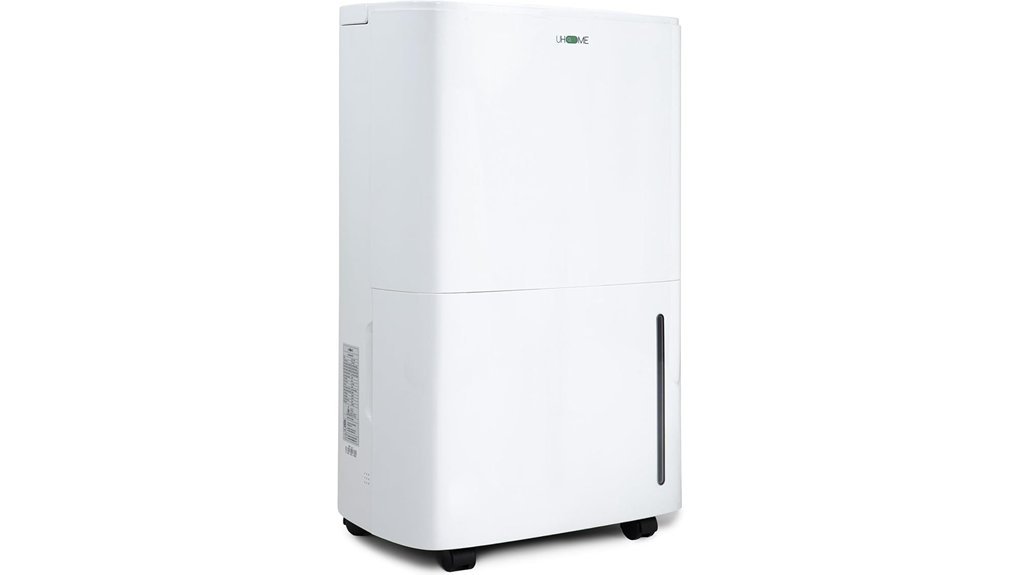
Best Alternative for Flexible Drainage: Uhome advertises this model at up to 150 pints per day under 95°F and 90% RH conditions, with coverage up to 7,000 sq. ft. It supports manual tank collection, continuous gravity drainage, and pump drainage when the outlet is above the machine.
Why You’ll Like It: Humidity settings from 30% to 80% RH in 5% steps, a 24-hour timer, two fan speeds, a child lock, a water-full alert, and a 1.85-gallon tank suit large residential spaces. Published descriptions are not fully consistent, so verify the current pump lift, hose length, standard-condition capacity, warranty, and included accessories before ordering.
Who Should Buy This: Homeowners who want a large-capacity portable unit with three drainage choices and straightforward controls.
Who Should Avoid This: Buyers who need a verified AHAM rating, long vertical pump run, or commercial restoration certification.
Pros:
- Three drainage methods suit different basement and utility-room layouts
- Wide humidistat range and timer provide useful control
- Wheels and portable design are easier to reposition than a ducted system
Cons:
- The 150-pint figure is measured under maximum-condition testing
- Published listings are inconsistent about some specifications
- The current pump-lift and hose specifications should be verified before purchase
Moiswell Explorer VP190 Commercial Dehumidifier With Pump
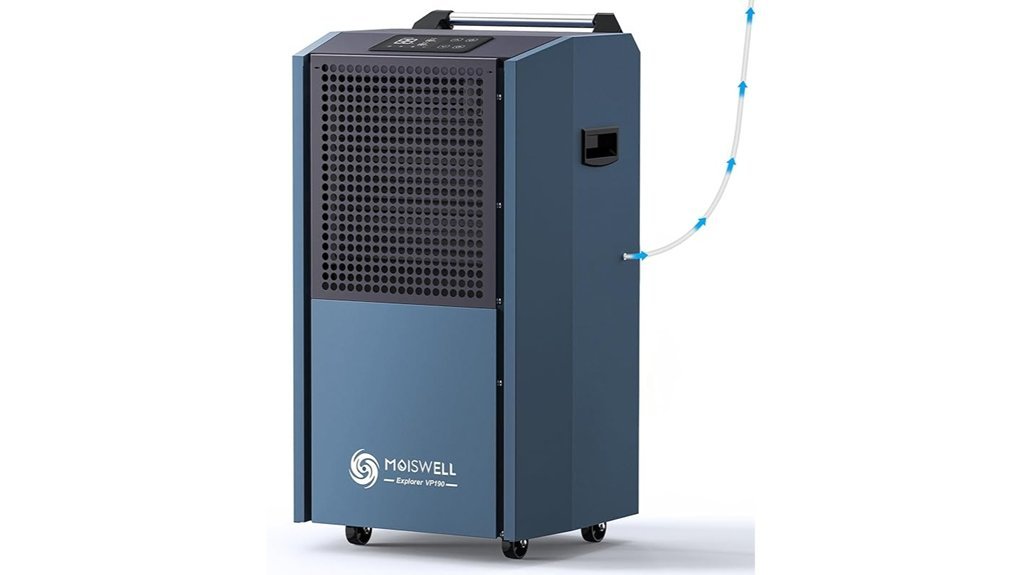
Best Commercial Pick: The Moiswell Explorer VP190 is built for large basements, warehouses, construction drying, and water-damage restoration. Moiswell publishes both a maximum removal rate of 190 pints per day and a 90-pint-per-day AHAM rating, making it easier to compare with other commercial machines that also disclose standardized performance.
Why You’ll Like It: A 265 CFM airflow rating, advertised 7,500 sq. ft. coverage, built-in pump, included 16.4-foot hose, automatic defrost, auto-restart, and 24-hour timer suit demanding jobs. Four swivel casters, a main handle, and recessed grips help with movement, although the unit still weighs about 76.8 pounds.
Who Should Buy This: Contractors, facility managers, landlords, or homeowners handling severe moisture in a large area.
Who Should Avoid This: Buyers dehumidifying a bedroom, small basement, or lightly damp living area.
Pros:
- Publishes both maximum-condition and AHAM moisture-removal ratings
- Built-in pump and included hose simplify commercial drainage
- Casters and multiple handles improve job-site mobility
Cons:
- Large and heavy compared with residential portable models
- Commercial airflow and sound may be excessive near occupied rooms
- Requires enough floor space and a planned drain route
Moiswell Pioneer-XII 200 Pint Commercial Dehumidifier With Pump and Hose
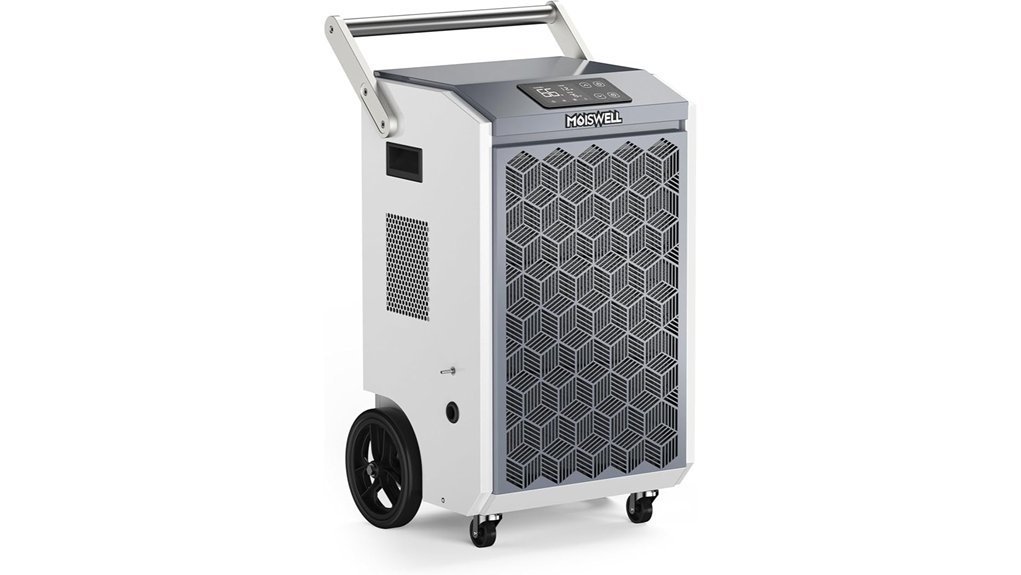
Best for Maximum Advertised Capacity: The Moiswell Pioneer-XII has the largest headline capacity in this roundup. Moiswell lists up to 200 pints per day, 320 CFM airflow, and coverage up to 7,500 sq. ft. for basements, garages, warehouses, construction sites, and water-damage restoration.
Why You’ll Like It: The built-in pump and included 16.4-foot drain hose support continuous condensate removal. Eight-inch wheels, detachable handles, automatic defrost, power-outage auto-restart, and simple controls help make the 78-pound machine more manageable on demanding jobs. Because no AHAM figure is stated in the cited product specifications, compare its 200-pint maximum only with ratings measured under similar conditions.
Who Should Buy This: Commercial users or property owners who prioritize maximum moisture removal and high airflow.
Who Should Avoid This: Anyone who needs a quiet, compact dehumidifier for routine living-space comfort.
Pros:
- Highest advertised maximum capacity and airflow in this roundup
- Built-in pump and included hose support continuous drainage
- Large wheels and detachable handles improve transport
Cons:
- Heavy and bulky for residential room-to-room use
- The maximum-condition rating is not directly comparable with an AHAM figure unless both are provided
- Commercial capacity can raise energy use when the unit is oversized for the space
Factors to Consider When Choosing a High-Capacity Dehumidifier With Pump
A high-capacity pump dehumidifier is easier to compare when you look beyond the largest pint number on the box. Use the points below to judge whether a product fits your moisture load, condensate-drain route, room type, operating temperature, and installation plan.
Before You Buy Checklist
- Measure the route from the dehumidifier to the drain, including vertical rise and bends.
- Compare pint ratings measured under the same test conditions.
- Check the lowest expected room temperature and the unit’s operating range.
- Confirm whether the pump is built in or supplied as a separate accessory.
- Plan filter access, service clearance, electrical supply, and overflow protection.
Understand Pint Ratings
Some products advertise a maximum daily capacity measured around 95°F and 90% RH, while others publish an AHAM or current DOE/ENERGY STAR figure measured under less extreme conditions. These numbers are not interchangeable. When two models appear similar, compare ratings measured under the same standard and expect real output to change with temperature, humidity, airflow, and frost conditions.
Match the Unit to the Moisture Load
Square-foot coverage is only a starting point. A cool, wet basement with seepage, laundry moisture, or poor air circulation can require more capacity than a larger but mildly humid room. Consider the current RH, target RH, temperature, air leaks, standing water, and how quickly moisture returns after the unit shuts off.
Built-In Versus External Pump
A built-in pump keeps the system compact, while an external condensate pump can be easier to service or replace. The AprilAire bundle in this article uses an external pump; the portable and commercial picks use integrated pump systems. Check whether the pump starts automatically, how the reservoir is accessed, and what happens if the pump or hose becomes blocked.
Pump Lift and Hose Routing
Confirm both vertical lift and total hose length. A product advertising 16.4 feet of lift may still have routing limits, bend restrictions, or hose-diameter requirements. Keep the line secure, avoid kinks, and route the discharge to an approved drain where leaks will not damage finished surfaces.
Drainage Options
Gravity drainage is simple and quiet when a drain sits below the outlet. Pump drainage is useful when water must move up to a sink, window, standpipe, or higher drain. A tank provides flexibility but requires manual emptying. For unattended use, test the drain route, full-tank shutoff, pump operation, and power-restart behavior before leaving the unit running.
Energy Efficiency
Look for a current ENERGY STAR listing, integrated energy factor, wattage, and annual energy estimate rather than relying only on broad savings percentages or an outdated badge in a marketplace title. An oversized machine may cost more to operate than necessary, while an undersized one may run continuously without reaching the target. Timers, humidistats, and auto-restart features help, but correct sizing, drainage, and moisture-source control matter more.
Temperature and Defrost
Refrigerant dehumidifiers lose capacity as temperatures fall. Check the minimum operating temperature and confirm that the unit has automatic defrost if it will run in a cool basement or crawl space. A pump does not solve low-temperature coil icing.
Noise and Portability
Portable residential models are easier to place near occupied rooms, while commercial units prioritize airflow and drying speed. Check published dB data when available and consider wheel size, handle design, total weight, stair access, and clearance around the air inlet and outlet.
Installation and Maintenance
Clean or replace the filter on schedule, inspect the pump reservoir and float, flush the tubing when buildup appears, and keep the intake and discharge clear. Whole-home models may require ducting, hanging hardware, electrical planning, and professional setup. Always follow the current manual for the exact model and bundle.
Frequently Asked Questions
How Noisy Are Pump-Equipped Dehumidifiers During Overnight Use?
The fan and compressor create most of the continuous sound, while the pump adds a shorter cycling noise. A residential model on low speed may work in a distant basement or utility room, but a commercial unit is usually better kept away from bedrooms and offices. Check the published dB rating for the exact fan mode.
Can a High-Capacity Dehumidifier With Pump Run Continuously?
Yes, when the manufacturer allows continuous operation and the drain route is correctly installed. Test the pump, hose, shutoff system, and power-restart behavior first. Continuous drainage removes the need to empty a tank, but the filter, reservoir, float, tubing, and coils still need routine inspection.
What Maintenance Do Pump Reservoirs Require?
Disconnect power before maintenance, then follow the manual for accessing and cleaning the reservoir. Remove slime, dust, mineral deposits, and debris; inspect the float and check valve; and flush or replace damaged tubing. Do not use cleaners that the manufacturer prohibits.
Do Pump Dehumidifiers Work Well in Unheated Basements?
They can, but only within the model’s operating-temperature range. Low temperatures reduce moisture-removal performance and can cause coil frost. Choose a unit with automatic defrost, keep the air path open, and avoid expecting the warm-weather pint rating in a cold basement.
Is a Built-In Pump Better Than a Gravity Drain?
Not always. Gravity drainage has fewer moving parts and is often the simplest choice when a floor drain sits below the dehumidifier. A pump is valuable when water must travel upward or across a longer route. The best option is the one that matches your drain location and maintenance preferences.
What Humidity Level Should I Set?
A practical starting target is about 40% to 50% RH. ENERGY STAR generally describes 30% to 50% RH as the optimum range for a building, and colder climates may need a lower winter setting to reduce window condensation. Adjust the setting for outdoor temperature, building materials, comfort, and any active moisture problem.
Conclusion
Final recommendation: The DECIUU Max is the clearest fit for portable residential use with a built-in pump. The AprilAire E100PZ is the stronger choice for a planned whole-home or sealed crawl-space installation. For commercial drying, the Moiswell Explorer VP190 provides both maximum and AHAM ratings, while the Pioneer-XII offers the highest advertised maximum capacity and airflow in this group.
Before buying, compare ratings measured under the same standard, confirm the pump’s vertical lift and total hose route, and make sure the unit can operate at the lowest expected room temperature. Correct sizing, moisture-source control, service access, and a reliable drain route matter more than choosing the largest headline number.