For pet owners comparing air purifiers in 2026, the most useful choices combine strong particle filtration, odor control, suitable room coverage, and manageable noise. After removing replacement-filter listings and a discontinued purifier from the original lineup, three actual air purifiers stand out: the BLUEAIR DustMagnet 5410i for medium rooms, the COWAY Airmega Icon for design-conscious homes, and the COWAY Airmega 250S for larger spaces and smart controls. The right choice depends on your room size, how quickly you want the air circulated, and whether pet dander, odors, or both are your main concern.
Affiliate disclosure: This article contains Amazon affiliate links. We may earn a commission from qualifying purchases at no extra cost to you.
- Best for medium rooms: BLUEAIR DustMagnet 5410i — useful when you want particle filtration, light odor control, and connected features in a moderately sized room.
- Best for design-conscious spaces: COWAY Airmega Icon — combines air purification with a furniture-inspired design and built-in wireless charging.
- Best for large rooms and smart controls: COWAY Airmega 250S — offers clearly published air-change coverage, app control, voice control, and HEPA-plus-carbon filtration.
Quick Comparison of the Best Air Purifiers for Pet Homes
| Air Purifier | Best For | Room-Coverage Guidance | Filtration | Amazon |
|---|---|---|---|---|
| BLUEAIR DustMagnet 5410i | Medium rooms | About 357 sq. ft. recommended room size under the manufacturer’s AHAM-based specification | HEPASilent filtration with particle and activated-carbon filtration | Check Product Details |
| COWAY Airmega Icon | Stylish living spaces | Marketed for coverage up to 1,298 sq. ft.; faster air turnover requires a smaller room | Particulate filtration plus activated carbon and washable pre-filter | Check Product Details |
| COWAY Airmega 250S | Large rooms and smart-home users | 1,860 sq. ft. at 1 air change/hour; 930 sq. ft. at 2; 465 sq. ft. at 4 | Washable pre-filter plus Max2 HEPA and activated-carbon filter | Check Product Details |
BLUEAIR DustMagnet 5410i Air Purifier
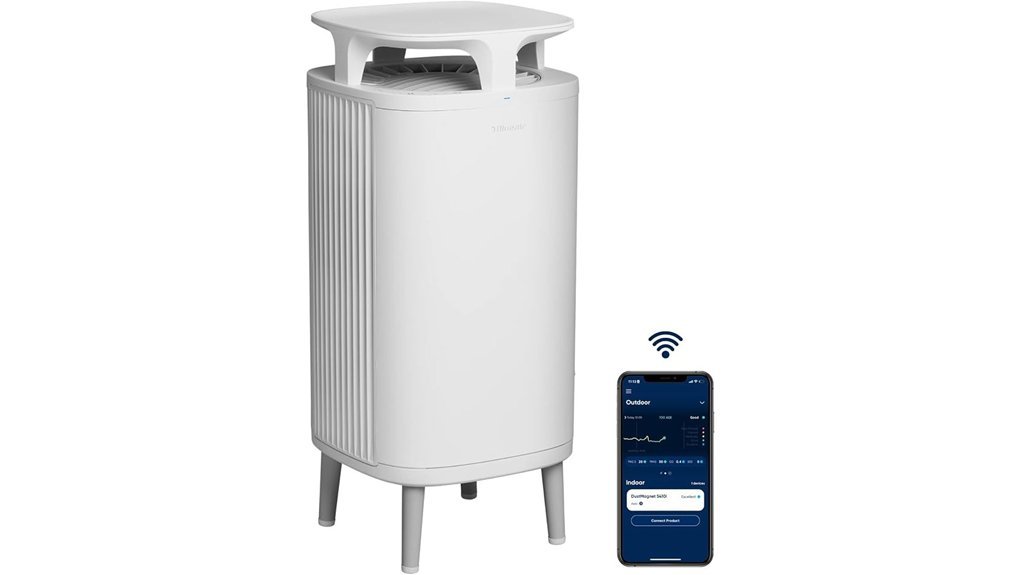
The BLUEAIR DustMagnet 5410i is a strong option for pet owners who need an air purifier for a medium-sized bedroom, office, or living area. Blueair’s published specifications list a recommended room size of about 357 square feet, with CADR ratings of approximately 230 cfm for smoke, 240 cfm for dust, and 255 cfm for pollen. Its HEPASilent filtration system is designed to capture airborne particles such as dust, pollen, and pet dander, while activated carbon helps with light household odors.
For pet homes, the main advantage is the combination of particle capture and odor filtration without requiring an oversized unit. Connected features can also help you monitor operation and filter status. Keep in mind that an air purifier can capture airborne dander, but it will not remove pet hair already sitting on carpets, upholstery, or bedding.
Best For: Pet owners who need air purification in a medium-sized room and want connected monitoring features.
Pros:
- Published CADR and recommended-room-size figures make capacity easier to evaluate.
- Particle filtration targets airborne pet dander, dust, and pollen.
- Activated carbon helps reduce light pet and household odors.
- Connected features make operation and filter monitoring more convenient.
Cons:
- It is better suited to medium rooms than very large open-plan spaces.
- Odor control depends on the amount and condition of the carbon filter and does not replace cleaning the odor source.
- Replacement filters add ongoing ownership cost.
COWAY Airmega Icon Air Purifier
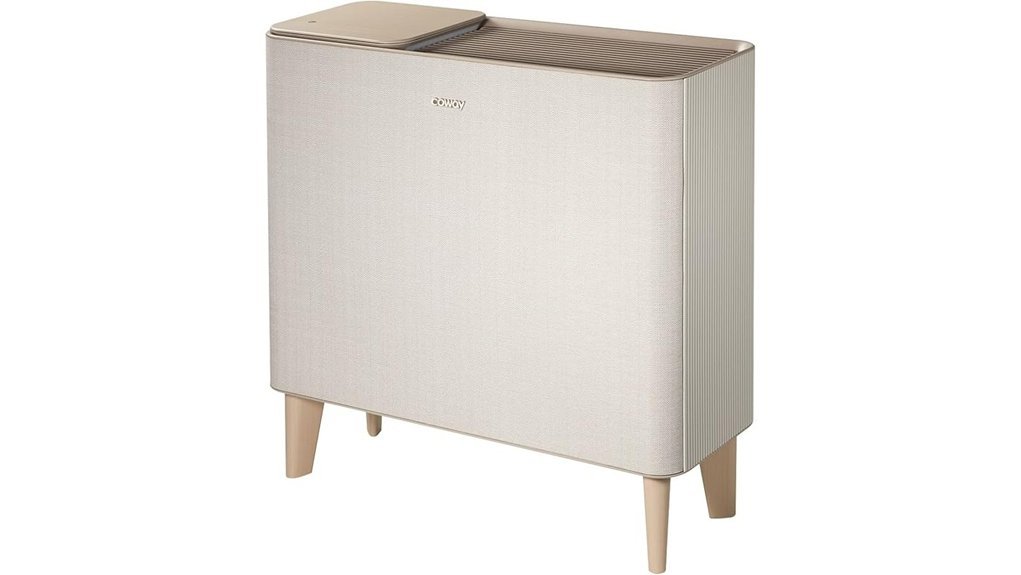
The COWAY Airmega Icon is designed for buyers who want an air purifier that fits more naturally into a living room or bedroom. Coway currently lists coverage of up to 1,298 square feet, although buyers should remember that a purifier cleans the air more frequently when it is used in a smaller room. That distinction matters in homes with pets, where frequent circulation may be more useful than simply choosing the largest advertised coverage number.
The Airmega Icon uses Coway’s multi-stage HyperCaptive filtration approach, including a washable pre-filter, particulate filtration, and activated carbon. The particle filter targets airborne contaminants such as dust, pollen, and pet dander, while the carbon stage helps reduce household odors and gases. Smart Mode can adjust airflow according to detected air quality, and the built-in wireless charging surface is a useful extra for rooms where the purifier doubles as part of the furniture.
Best For: Pet owners who want capable filtration without placing a purely appliance-looking purifier in a main living space.
Pros:
- Particle and activated-carbon filtration address both airborne dander and odor-related pollutants.
- Washable pre-filter can capture larger airborne debris before it reaches the main filter.
- Smart Mode automatically responds to changing air conditions.
- Furniture-inspired design and wireless charging add practical value in living areas.
Cons:
- The maximum coverage figure represents slower air turnover than you would get in a smaller room.
- Its larger footprint may not suit cramped bedrooms or narrow spaces.
- Main filters still need periodic replacement even though the pre-filter is washable.
COWAY Airmega 250S Air Purifier
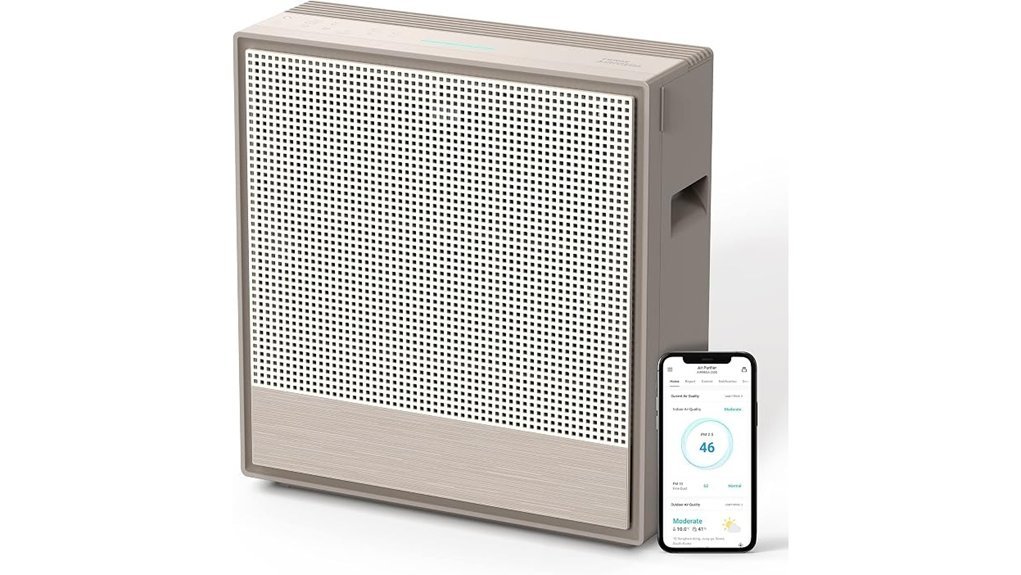
Pet owners looking for stronger large-room performance should consider the COWAY Airmega 250S. Coway publishes several useful room-size figures rather than just one maximum number: approximately 1,860 square feet at one air change per hour, 930 square feet at two air changes per hour, and 465 square feet at four air changes per hour. This makes it easier to choose the purifier based on how often you want the room’s air filtered.
The Airmega 250S combines a washable pre-filter with a Max2 filter containing HEPA and activated-carbon filtration. The system addresses airborne particles such as dust, pollen, and pet dander while the carbon layer helps manage household odors. Its published CADR ratings are 249 cfm for smoke, 261 cfm for dust, and 230 cfm for pollen.
The 250S also adds Wi-Fi connectivity, the Coway IoCare app, scheduling, real-time air-quality monitoring, and voice control. Its listed operating range is approximately 22 to 54 dB(A), allowing quieter operation when maximum airflow is not required.
Best For: Pet owners with larger rooms who want strong filtration plus app and voice-control features.
Pros:
- Clear air-change-based room coverage makes sizing easier.
- HEPA and activated-carbon filtration address both particles and odors.
- Real-time air-quality monitoring can automatically adjust airflow.
- App, scheduling, and voice-control features provide convenient remote operation.
Cons:
- Maximum coverage does not mean the same cleaning frequency as using the purifier in a smaller room.
- The unit weighs about 20.5 pounds, so it is less portable than compact models.
- Higher fan speeds are noticeably louder than sleep-level operation.
- The Max2 filter is an ongoing replacement expense.
Factors to Consider When Choosing Air Purifiers for Pets in 2026
Choosing an air purifier for a home with pets involves more than selecting the model with the largest coverage number. Filtration type, room size, air-change frequency, odor control, noise, filter cost, and placement all affect how useful the purifier will be in daily life.
Particle Filtration and Pet Dander
Pet allergies are commonly associated with proteins carried on tiny particles such as pet dander, rather than only the visible fur you find around the home. A capable particle filter can capture some of those airborne particles as they pass through the purifier.
Do not expect an air purifier to remove fur and dander that have already settled on carpets, bedding, curtains, or furniture. Regular vacuuming and surface cleaning remain important alongside air filtration.
Activated Carbon for Pet Odors
A particle filter and an odor filter do different jobs. Activated carbon helps adsorb some airborne gases and odor compounds, which can make it useful in homes with litter boxes, pet bedding, cooking smells, or other odor sources.
Carbon filtration cannot replace cleaning the source of an odor. For persistent smells, wash pet bedding, maintain litter areas, clean accidents promptly, and provide appropriate ventilation when possible.
Room Size and Air-Change Rate
One of the easiest mistakes is comparing purifiers only by their largest advertised square-foot figure. A purifier may technically treat a very large room once per hour while cleaning a much smaller room several times during that same period.
For a useful comparison, look at CADR, recommended room size, and the number of air changes per hour. If pet dander is a major concern, faster circulation in the room where the pet spends the most time may be more useful than choosing a very large maximum-coverage figure.
Pet Hair and Pre-Filters
A washable or removable pre-filter can catch larger airborne dust and hair before they reach the main filter. This may reduce how quickly the primary filter becomes loaded with larger debris.
However, most pet hair settles quickly. A vacuum or other floor-cleaning method remains much more effective for fur already on floors and furniture.
Noise Level Preferences
Noise matters when the purifier will run in a bedroom, home office, or near a pet’s resting area. Manufacturers usually quote a range because higher fan speeds produce more airflow and more sound.
If nighttime use is important, look for a sleep mode or low-speed setting. Just remember that reducing fan speed also reduces the rate at which air moves through the filter.
Maintenance and Filter Lifespan
Air-purifier performance depends on maintaining the filters. Replacement intervals vary significantly by model, fan speed, operating hours, and indoor pollution levels, so there is no single replacement schedule that fits every purifier.
Use the manufacturer’s filter indicator and maintenance instructions rather than automatically replacing every filter after a fixed number of months. Blueair states that its DustMagnet replacement filter can last up to around nine months depending on use, while Coway rates the Airmega 250-series Max2 filter at about one year.
Smart Features and Connectivity
Smart features are useful when they solve a real problem. Air-quality sensors can automatically change fan speed, while app control makes it easier to check operation when you are away from home. Scheduling can also help you run the purifier more aggressively during certain parts of the day.
If you do not need remote controls, however, filtration performance and suitable room sizing should take priority over extra connectivity features.
Before You Buy: Quick Checklist
- Measure the room where the purifier will actually operate.
- Compare coverage at similar air-change rates rather than only maximum square footage.
- Choose particle filtration for airborne dander and dust.
- Look for activated carbon if pet odors are an important concern.
- Check replacement-filter availability and expected maintenance frequency.
- Consider low-speed noise if the purifier will run while you sleep.
- Leave enough open space around the intake and outlet for unrestricted airflow.
- Keep power cords and controls positioned so pets cannot easily chew, block, or disturb them.
Frequently Asked Questions
How Do Air Purifiers Help With Pet Allergies?
Air purifiers can help by capturing airborne pet dander and other particles as air passes through the filter. They do not cure allergies or remove allergens already settled on furniture, carpets, clothing, or bedding, so regular cleaning is still important.
What Size Air Purifier Do I Need for My Home?
Measure the room where you plan to use the purifier and compare that area with the manufacturer’s recommended coverage and CADR. When possible, compare models at the same number of air changes per hour. A purifier used in a smaller room will normally circulate and filter the room’s air more frequently.
How Often Should I Replace Air Purifier Filters?
There is no universal replacement interval. Follow the filter-life indicator and manufacturer instructions for your exact model. Usage hours, fan speed, pet dander, dust, smoke, and other indoor pollutants can all shorten or extend filter life.
Are Air Purifiers Safe for Pets?
Air purifiers designed for normal household use are generally intended to operate in occupied rooms when used according to the manufacturer’s instructions. Keep the unit stable, prevent pets from blocking the air intake or outlet, and protect the power cord from chewing. If you are concerned about ozone or ionization, review the manufacturer’s emissions and certification information before buying.
Can Air Purifiers Eliminate Pet Odors Effectively?
An air purifier with a suitable activated-carbon filter can help reduce some airborne odor compounds, but it cannot eliminate the physical source of the smell. Cleaning litter boxes, pet bedding, upholstery, carpets, and accident areas remains essential for effective odor control.
Do Air Purifiers Remove Pet Hair?
They may capture some lightweight fur that becomes airborne, especially when a model has a pre-filter, but most pet hair settles onto surfaces quickly. A vacuum or other surface-cleaning method is more effective for visible pet hair.
Where Should I Place an Air Purifier in a Home With Pets?
Place it in the room where your pet spends significant time while leaving sufficient clearance around the air intake and outlet. Avoid squeezing the purifier behind furniture or placing objects directly against the vents, because restricted airflow can reduce performance.
Conclusion
The best air purifier for a pet home depends on the room and the problem you want to solve. The BLUEAIR DustMagnet 5410i is the most natural fit here for medium rooms, while the COWAY Airmega Icon combines filtration with a design suited to prominent living spaces. For larger rooms and buyers who value app control, scheduling, voice features, and clearly published air-change coverage, the COWAY Airmega 250S is the strongest all-around option in this three-model lineup.
Whichever model you choose, match the purifier to the room size, use adequate fan speed, maintain its filters, and continue cleaning pet hair, bedding, and odor sources. An air purifier works best as one part of a broader approach to keeping a pet-friendly home cleaner and more comfortable.