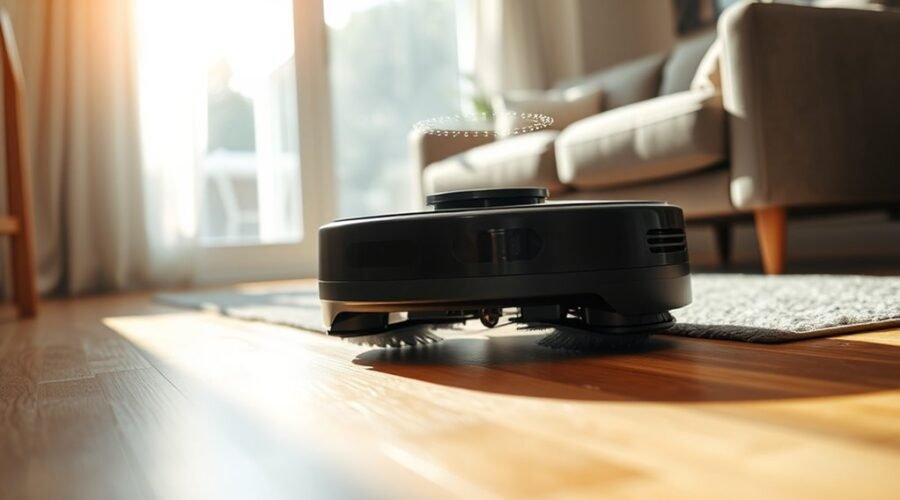
Robot vacuums combine sensors, mapping systems, and cleaning hardware to move through a home with limited human input. They detect walls, furniture, drops, and debris, then convert that data into a route for coverage and obstacle avoidance. Brushes, suction, and sometimes mopping components handle floor contact, while software adjusts behavior over time. The basic system is straightforward; the details behind its reliability are less so.
What Is a Robot Vacuum?
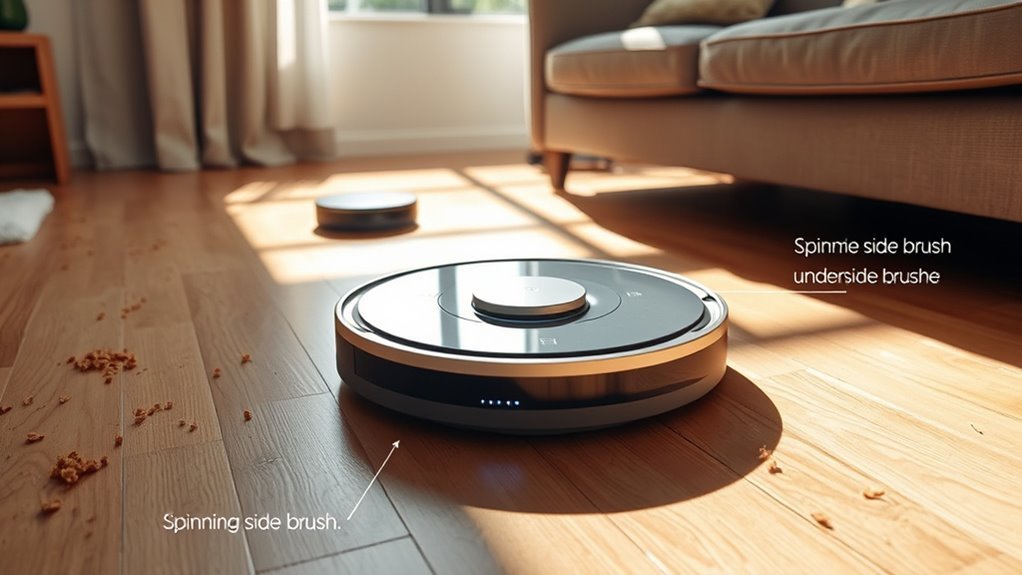
A robot vacuum is an autonomous cleaning device designed to navigate and clean floors with minimal human intervention. This robot vacuum combines compact mechanics, onboard processors, and sensors to perform autonomous cleaning across varied surfaces.
Its design supports liberation from repetitive floor maintenance by reducing manual labor while preserving control through smart home integration. During operation, sensors supply data for navigation and obstacle avoidance, allowing the unit to adjust paths in response to furniture, walls, and debris.
Brushes and suction power work together to lift dust, hair, and particles from hardwood, tile, and carpet. Because cleaning performance depends on hardware and control logic, models vary in coverage, efficiency, and battery endurance.
Many systems can be scheduled through apps or voice interfaces, then return to a dock for recharging after completion. In technical terms, the robot vacuum is a mobile cleaning platform built for predictable, low-intervention floor care.
How Robot Vacuums Navigate Your Home
Robot vacuums use sensor-based mapping, combining LiDAR, infrared, and related inputs to construct an internal representation of the home.
They detect obstacles and hazards, including furniture and stairs, through continuous sensor feedback and cliff detection.
Their route-planning algorithms then adjust cleaning paths to avoid restricted zones and improve coverage.
Sensor-Based Mapping
Sensor arrays form the basis of navigation in modern robot vacuums, combining LiDAR, infrared, and camera data to build accurate maps of interior spaces for efficient cleaning routes. This sensor data supports mapping and navigation by generating a digital map that guides cleaning paths with minimal wasted motion.
Advanced models use the mapped layout to set no-go zones and to obstacles and avoid restricted areas, reducing manual intervention and preserving autonomy. Continuous learning algorithms refine route selection after each session, improving efficient navigation as room configurations change.
Multiple stored floor plans allow operation across floors or distinct layouts, extending practical independence in varied homes. The result is a system that translates environmental measurement into structured movement, enabling liberated cleaning through adaptive, data-driven control.
Obstacle Detection
Obstacle detection relies on infrared, LiDAR, and related sensing systems to identify furniture, walls, and other impediments while the vacuum evaluates its surroundings in real time.
In obstacle detection, navigation systems use infrared sensors and LiDAR returns to classify nearby objects, measure distance, and support avoiding obstacles with minimal wasted motion. Real-time data processing updates movement decisions instantly, reducing impacts and preserving momentum across open floors.
Cliff sensors add a safety layer by detecting stairs and ledges, preventing falls in multi-level homes. Corner detection technology extends coverage into edges and tight recesses through specialized brushes.
These mechanisms produce efficient cleaning paths without requiring constant human intervention. Continuous learning further refines obstacle handling, allowing the machine to adapt its behavior across repeated sessions and sustain precise, independent cleaning freedom.
Route Planning
With obstacles identified and avoided, the next challenge is route planning, where a robot vacuum determines how to move through a home in an organized and efficient pattern.
Sensors, including LiDAR, cameras, and infrared, support mapping and navigation by measuring distances, recognizing room boundaries, and tracking changes in layout. Gyroscopic and inertial units refine direction control, helping maintain systematic coverage without wasted passes.
- Visual and LiDAR mapping define space.
- Gyroscopic data confirms heading.
- No-go zones protect restricted areas.
- Learning algorithms revise routes.
This route planning reduces overlap, increases cleaning efficiency, and gives users greater control over where cleaning occurs.
Robot Vacuum Sensors and Mapping
A robot vacuum’s navigation system relies on infrared emitters, LiDAR, and onboard cameras to detect surroundings, build maps, and plan efficient cleaning routes. These robot vacuum sensors support navigation by combining mapping with obstacle detection, allowing the machine to track furniture, walls, and open paths with measured precision.
Cliff sensors add a separate safety layer, identifying sudden drops so the device can avoid stairs and preserve operational continuity. Advanced models use SLAM technology, updating position and map data simultaneously as conditions change. This continuous recalibration reduces blind movement and increases route efficiency.
Mapping also enables no-go zones, giving users control over restricted areas such as pet bowls or fragile objects. During cleaning cycles, the system references stored spatial data to maintain order and avoid repeated coverage.
The result is a disciplined, self-directed mechanism that minimizes interference and expands practical autonomy within the home.
How Robot Vacuums Clean Floors
Robot vacuums clean floors by coordinating navigation data with a mechanical pickup system that combines side brushes, a main brush, and adjustable suction.
Their cleaning system translates maps into disciplined coverage, helping robot vacuums detect obstacles while maintaining efficient paths across rooms. Suction mechanisms are typically tuned to surface resistance, so carpets and hard floors receive different intake levels without wasted power.
Edge performance matters as well; side brushes extend debris from walls and corners toward the intake path, reducing neglect in liberated domestic spaces. Smart vacuums may also add a mopping function to remove fine dust and light stains after vacuuming.
Side brushes draw debris from walls and corners, while optional mopping clears fine dust and light stains.
- Sensors guide route precision and limit repeated passes.
- Side brushes move debris from boundaries inward.
- Adjustable suction adapts to carpets and hard floors.
- Optional mopping function addresses residue beyond dry pickup.
How Robot Vacuum Brushes, Suction, and Mopping Work
Side brushes sweep debris inward, while the main brush agitates surface material and lifts it into the dustbin, creating a coordinated pickup path that improves capture efficiency.
In a robot vacuum cleaner, this brush system supports steady cleaning tasks by combining mechanical agitation with airflow-driven collection. The suction channel generates strong pressure differentials, and high-end units can reach about 8200 Pa, enabling reliable dirt and dust removal from carpets, tile, and other surface types.
Control software often adjusts suction automatically, increasing output on dense pile and reducing it on hard floors to conserve energy without weakening performance.
Some models add advanced mopping systems, using water tanks and microfiber pads to remove fine residue and light stains after dry pickup.
To preserve liberation from repetitive chores, regular maintenance of side brushes, the main brush, and filters remains necessary, because buildup reduces suction efficiency and shortens operating life.
How Robot Vacuums Clean Corners and Edges
Robot vacuums clean corners and edges through edge-hugging brush designs that extend beyond the chassis to dislodge debris from tight boundaries.
Corner detection sensors identify walls and abrupt shifts, enabling the unit to adjust its trajectory and maintain close perimeter coverage.
Together, these systems improve pickup along edges while reducing missed areas in confined spaces.
Edge-Hugging Brush Design
At the perimeter, specialized edge-hugging brushes extend beyond the vacuum’s main body to sweep debris from walls and corners toward the central suction inlet. These edge-hugging brush designs use side brushes to clean baseboards, furniture legs, and narrow margins with controlled reach.
- Side brushes rotate outward, loosening dust.
- Angled bristles direct particles inward.
- Navigation systems coordinate cleaning patterns for coverage.
- Edge-cleaning mode intensifies perimeter passes for liberation from overlooked dirt.
Corner detection sensors may refine approach, but the brush geometry performs the primary transfer of debris. By pairing mechanical reach with suction inlet alignment, the system reduces missed spots and sustains precise boundary cleaning.
The result is a technically efficient, quietly autonomous perimeter strategy that supports cleaner living spaces and user independence.
Corner Detection Sensors
Corner detection sensors identify when a robot vacuum nears a wall, corner, or obstacle, then adjust the cleaning path to maintain coverage in tight spaces.
These corner detection sensors guide navigation by detecting furniture edges and other obstacles before contact, reducing collisions and preserving route stability. Their signals coordinate with edge-cleaning brushes, which extend outward to sweep debris from boundary zones into the main intake area.
In advanced systems, sensor data refines the cleaning path to minimize missed spots, especially where straight-line travel would leave residue. Some units also shift into edge-hugging mopping mode, increasing precision along perimeters while conserving energy.
The result is efficient cleaning that expands coverage without unnecessary repetition, allowing robotic motion to remain controlled, adaptive, and deliberately thorough.
Robot Vacuum App Control and Smart Home Features
Through smartphone apps, many robot vacuums can be started, stopped, and directed remotely, giving users fine-grained control over cleaning sessions. This robot vacuum app control reduces dependence on manual intervention and expands operational autonomy.
In smart home systems, the device can join routines with voice assistants, allowing a user to issue commands without touching the phone. Scheduling features let the cleaning cycle begin on specified days and times, turning maintenance into automated cleaning tasks that preserve a cleaner interior with minimal effort.
Advanced models add adaptive AI, learning habits and floor changes to refine routes and energy use. Matter protocol compatibility improves interoperability, linking the vacuum with other connected devices for coordinated operation.
- Remote launch
- Scheduled routine
- Voice command
- Cross-device coordination
Common Robot Vacuum Problems
Common failures in robot vacuums typically involve docking, sensing, power management, and software reliability.
When observing how robot vacuums work, charging base issues often appear first: blocked routes or poor dock placement prevent a return, interrupting the cleaning cycle and leaving floors partially serviced.
Sensor obstructions from dust or debris degrade obstacle detection, producing navigation errors that may cause missed zones or collisions with furniture.
Some units also fail to perceive transparent or low-light obstacles, exposing limits in path planning and reducing operational autonomy.
Battery life degradation is another constraint; as cells age, runtime shortens and coverage becomes less predictable.
Firmware updates can correct connectivity faults and improve navigation algorithms, yet they do not eliminate hardware wear.
For users seeking control over domestic labor, these faults matter because they define the boundary between automated convenience and dependable performance.
Careful evaluation of dock placement, sensing quality, and battery condition thus remains central to reliable operation.
Robot Vacuum Maintenance Tips
Routine maintenance directly affects a robot vacuum’s suction efficiency, mobility, and battery longevity. Effective robot vacuum maintenance depends on disciplined inspection and cleaning cycles that preserve autonomy and reduce dependence on costly repairs.
To prevent blockages and sustain efficient cleaning performance, operators should:
- Clean brushes and filters regularly to maintain airflow and suction.
- Empty the dustbin often, especially in pet-heavy or high-traffic homes.
- Check for tangled hair and debris in wheels and brushes after each run.
- Store in a cool place and follow battery care guidelines to limit heat damage and detect capacity loss early.
These actions protect mechanical freedom: the machine moves with less resistance, completes routes with fewer interruptions, and retains charge longer.
Routine attention also lowers wear on internal components, preserving consistent output across varied floor conditions. A maintained robot vacuum remains predictable, efficient, and less prone to stoppages, giving users greater control over cleaning schedules and household labor.
Frequently Asked Questions
What Are the Downsides of Using a Robot Vacuum?
Robot vacuums have robot vacuum limitations: reduced cleaning efficiency, imperfect obstacle detection, short battery life, recurring maintenance requirements, noticeable noise levels, constrained floor compatibility, and unfavorable price comparison. Privacy concerns and stair hazards further narrow their usefulness.
How Many Times a Week Do You Run Your Robot Vacuum?
Typically 3–7 times weekly, depending on Cleaning frequency, Home layout, Pet hair, Floor types, Dust detection, Battery life, Maintenance tips, and User preferences; higher-traffic homes often benefit from daily runs to reduce dust and sustain liberation.
Do Robotic Vacuum Cleaners Really Work?
Yes, robotic vacuum cleaners really work, especially with robust robotic sensors, navigation systems, and smart technology. Their cleaning efficiency varies by floor types, battery life, noise levels, and maintenance tips; expectations should remain practical.
How Long Do Robot Vacuums Typically Last?
Like a small workhorse, a robot vacuum typically lasts 3–5 years. Battery lifespan, Maintenance tips, Replacement parts, Performance factors, Technology advancements, Brand comparisons, User reviews, and Cost efficiency all shape durability and liberation from chores.
Conclusion
In conclusion, robot vacuums combine mapping, obstacle detection, and adaptive cleaning to automate floor care with increasing precision. For example, a LiDAR-equipped model can chart a multi-room apartment, identify high-traffic zones, and return to its dock with minimal user intervention. Performance still depends on sensor quality, brush design, and regular maintenance. As these systems improve, their role in integrated smart homes will likely expand, but effective operation will remain tied to proper setup and upkeep.