Disclosure: As an Amazon Associate I earn from qualifying purchases. If you click a link on this page and make a purchase, we may receive a small commission at no extra cost to you.
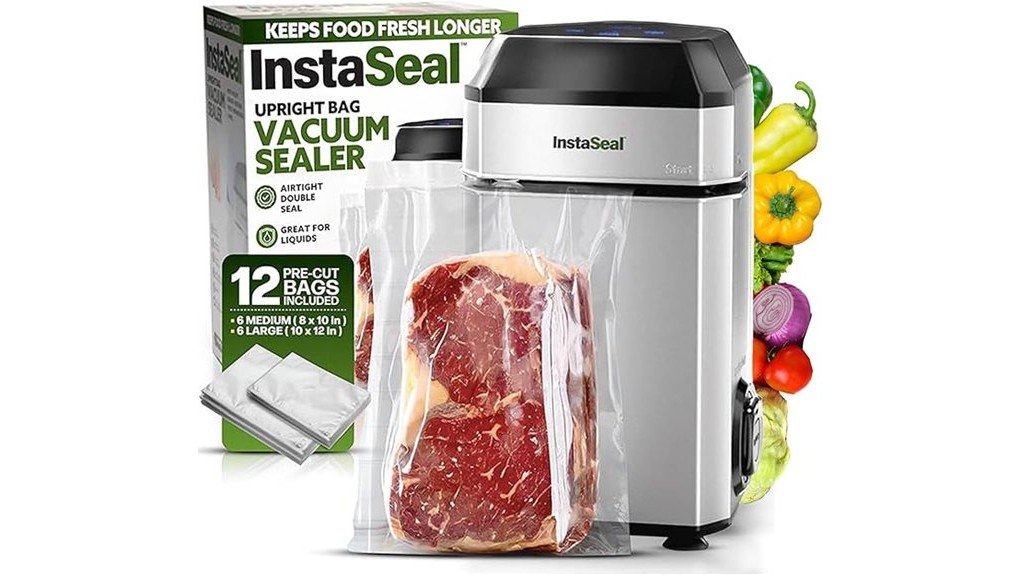
Traditional horizontal vacuum sealers save freezer space and reduce food waste, but their wide 15-to-17-inch bodies hog counter space and often struggle when liquids rush toward the heat bar. In this InstaSeal Vacuum Sealer review, we examine a machine that takes a different approach: a compact, top-loading upright tower with a 5-inch by 5-inch base, an automatic Smart Sensor, and a double heat seal built to handle meats, vegetables, leftovers, marinades, and soups. While its tiny footprint and vertical bag orientation make everyday portioning simple, its reliance on compatible pre-cut vacuum bags rather than built-in roll storage and an integrated cutter means it is not right for every kitchen. Below, we break down exactly how InstaSeal works, where it shines, and when a full-size sealer is the smarter buy.
Quick Verdict
Rating: 8.2/10 — Recommended with caveats
Best For: Small kitchens, apartments, RVs, weekly meal prep, batch-cooked soups or marinades, and buyers who want one-touch automatic sealing.
Skip If: You want built-in roll storage with a sliding bag cutter, custom-width sealing for oversized roasts, or manual pulse/pressure controls.
Top Strengths: Ultra-compact 5 × 5-inch base, upright liquid-friendly loading, automatic Smart Sensor shutoff, and an airtight double seal.
Main Limitation: Designed around compatible pre-cut vacuum bags rather than custom-cut rolls; lacks external canister accessory ports.
Key Takeaways
- Space-Saving Footprint: Measuring roughly 5 inches wide, 5 inches deep, and 9 inches high, the upright housing occupies about 25 square inches of counter space—a fraction of what horizontal sealers require.
- One-Touch Smart Sensor: Automatic air detection evacuates the bag and triggers the heat seal without requiring you to guess between multiple dry, moist, or pressure modes.
- Airtight Double Seal: Two parallel heat-seal barriers provide extra protection against freezer burn and slow air leaks during long-term storage.
- Gravity-Assisted Liquid Handling: Loading bags vertically from the top helps keep broths, marinades, and stews at the bottom of the bag instead of spilling directly into the vacuum channel.
- Pre-Cut Bag System: Retail packages commonly include 12 pre-cut starter bags (six medium and six large), the corded sealer unit, and an instruction manual.
- Food Safety Reminder: Vacuum sealing slows oxidation and prevents freezer burn, but it never replaces refrigeration or freezing for perishable foods.
| Specification | Detail |
|---|---|
| Brand | InstaSeal |
| Product Type | Upright external/suction food vacuum sealer (1st-generation standalone model) |
| Design Format | Compact vertical tower, top-loading sealing slot |
| Approx. Dimensions | 5 in. W × 5 in. L × 9 in. H (approx. 25 sq. in. footprint) |
| Power Source | Corded electric |
| Sealing System | Airtight double heat seal |
| Automatic Control | Smart Sensor automatically evacuates air and stops when sealing finishes |
| Operating Modes | Vacuum/Seal and Seal Only (top-mounted buttons) |
| Liquid Handling | Vertical bag posture with built-in liquid-protection/overflow catch system |
| Bag Compatibility | Designed for compatible pre-cut textured/embossed vacuum bags |
| Included Starter Kit | Commonly listed with 12 pre-cut bags (6 medium, 6 large), power cord, and manual |
| Best Applications | Freezer portioning, leftovers, meal prep, meats, blanched vegetables, marinades, soups, and sous vide prep |
What Is the InstaSeal Vacuum Sealer?
The InstaSeal Vacuum Sealer is a corded external suction sealer built as a compact vertical tower rather than the wide clamshell bar used by traditional countertop machines. Instead of laying a bag flat across your counter and pressing down a long lid, you insert the open top of a compatible pre-cut bag into the top sealing slot. The machine draws out the air and applies a double heat seal automatically.
Unlike major appliance brands that iterate through multiple generations of horizontal sealers, InstaSeal is sold as a standalone, first-generation space-saving design aimed at everyday convenience. Its vertical orientation solves two common frustrations at once: it shrinks the appliance base to the size of a large canister, and it lets gravity hold liquids in the bottom of the pouch while air is pulled from the top.
Who Should Buy It?
Best For
- Home cooks with cramped counters, small apartments, dorms, or RV kitchens.
- Meal preppers who regularly portion soups, stews, wet marinades, and bulk meats.
- Beginners who prefer single-button automatic cycles over complex manual settings.
Skip If
- You want internal roll storage and a built-in cutter bar for custom-length bags.
- You need a manual “Pulse” button to protect delicate baked goods, berries, or chips from crushing.
- You seal wide bulk cuts (such as whole briskets or full rib racks) that require an 11-inch sealing bar, or you want an accessory hose port for vacuum canisters and mason jars.
Before You Buy: Because the unit’s body is only 5 inches wide, it is engineered specifically around compatible pre-cut vacuum bags that fit its top sealing channel. If you already own bulk 8-inch or 11-inch rolls made for wide horizontal sealers, they will not feed straight across a 5-inch slot.
Preserve Your Food: How InstaSeal Extends Freshness
When food sits in a conventional zipper bag or plastic container, trapped oxygen reacts with fats and pigments while moisture evaporates from the surface and freezes into ice crystals—the dry, leathery discoloration known as freezer burn. Vacuum sealing evacuates the surrounding air and pulls the plastic film tightly against the food before welding the bag shut.
InstaSeal’s marketing materials state that vacuum sealing keeps food fresh up to five times longer than conventional storage. In practice, that figure is an industry benchmark for freezer longevity (for example, keeping frozen beef or poultry free of freezer burn for 1 to 2 years instead of 3 to 6 months in a standard freezer bag). Actual shelf life always depends on starting freshness, freezer temperature stability (0°F or below), and bag barrier thickness.
Where InstaSeal adds practical protection is its airtight double seal. Entry-level compact sealers typically melt a single thin seam across the bag, which can fail if a microscopic drop of grease or moisture bridges the line. A dual-line seal creates a backup barrier that helps prevent slow “leakers” in the back of the freezer.
User-Friendly Features of the InstaSeal Vacuum Sealer
Automatic Smart Sensor
Traditional sealers often force you to toggle between Dry, Moist, Normal, and Gentle switches before pressing Vacuum. InstaSeal simplifies the workflow with an internal Smart Sensor that monitors suction pressure, draws out air, and automatically transitions to the heat-seal phase once target vacuum is reached.
Keep in mind that automatic sensing reduces button pushing, not prep work. You still need to wipe the inside mouth of the bag clean and smooth out creases before inserting it into the top slot. Also, because the sensor pulls full automatic vacuum, delicate foods like soft bread, raspberries, or crackers can get compressed unless you pre-freeze them first or stop the cycle early using the seal function.
Top-Mounted Controls
All controls sit directly on top of the tower at eye level. Retailer listings highlight two core buttons: Vacuum/Seal (for full air extraction followed by automatic heat sealing) and Seal Only (for creating an airtight heat seam without removing air, or for stopping suction manually if liquid begins creeping upward).
Airtight Double Seal
Instead of a single heating wire, InstaSeal applies two parallel heat seals. This redundancy is especially helpful when sealing marinated proteins or soups for the freezer, where a secondary seam guards against accidental seam separation when heavy frozen bags shift in a crowded freezer drawer.
Bag Compatibility, Width Limits, and Ongoing Costs
Understanding how vacuum bags work with InstaSeal will save you frustration after you go through the 12 included starter bags. Like all external suction sealers, InstaSeal requires textured (embossed) vacuum-sealer bags. These heavy-duty multilayer bags have microscopic mesh air channels molded into one side so air can escape even after the plastic walls press together. Smooth household sandwich bags, standard zipper freezer bags, and thin produce bags lack these channels and will either block airflow or melt onto the heating element.
Because InstaSeal has a 5-inch-wide footprint, pay close attention to bag opening dimensions when reordering refills:
- Starter Bag Assortment: The box commonly includes six medium and six large pre-cut bags tailored to the machine’s top slot.
- Refill Availability: Before ordering third-party embossed bags, check that the bag opening width matches the top slot width of the unit (such as narrow pint/quart pre-cut bags or manufacturer-matched InstaSeal refills). Wide 11-inch horizontal-sealer bags cannot be sealed across a 5-inch bar in a single pass.
- Reusability: As long as a bag held dry or safe foods (never raw meat, poultry, or fish) and you leave enough extra length at the top, you can cut off the old seam, wash and dry the bag thoroughly, and reseal it once or twice to lower ongoing costs.
Space-Saving Design for Small Kitchens
A standard horizontal vacuum sealer measures 15 to 17 inches wide and 6 to 9 inches deep, taking up roughly 100 to 150 square inches of counter space—plus extra clearance in front for the bag to lie flat. By standing vertically on a 5-inch by 5-inch base, InstaSeal cuts that footprint down to roughly 25 square inches.
At about 9 inches tall, it tucks neatly next to a coffee maker, fits under low upper cabinets, and slides easily into a narrow pantry shelf or RV cupboard. Because it takes up so little room, you are far more likely to leave it accessible and use it for everyday leftovers rather than burying it in a closet where it gets forgotten.
Pro Tip: When loading bags into a pre-cut sealer, fold the top 2 inches of the bag outward like a cuff before spooning in wet stews or marinated meat. Once filled, flip the cuff back up—this guarantees the inner sealing zone stays completely free of oil, sauce, and moisture.
Liquid Handling and Moist Foods
Sealing soups, stocks, and wet marinades is the Achilles’ heel of flat vacuum sealers: the moment you lay a liquid-filled pouch down on the counter, broth rushes toward the open mouth and gets sucked straight into the pump and heating bar. InstaSeal’s top-loading upright design uses gravity to your advantage, allowing the bag to stay predominantly vertical while air is pulled from the top headspace.
Current product descriptions also note a built-in liquid-protection or removable overflow tray designed to catch minor moisture droplets that enter the vacuum channel. Even with this safeguard, you should follow three best practices for liquid-heavy foods:
- Leave 3 inches of headspace: Never fill a bag past two-thirds capacity; air bubbles expand slightly under vacuum and need room before the seal triggers.
- Watch the liquid line on soups: For thin broths, press Seal Only manually if you see liquid rising near the top slot before the automatic cycle finishes.
- Pre-freeze pure liquids for 45–60 minutes: If you want a rock-hard, 100% air-free vacuum on thin chicken stock or tomato soup, chill the filled open bag upright in the freezer until slushy, then run the standard Vacuum/Seal cycle.
Food Safety, Blanching, and Sous Vide Readiness
Retailer listings specify that the included bags are food-safe and suitable for freezer storage and sous vide water baths. If you buy replacement bags for sous vide cooking, always confirm they are explicitly labeled BPA-free, phthalate-free, and boil/sous-vide safe (typically multi-ply polyethylene with a nylon outer barrier rated up to 195°F–212°F).
More importantly, every vacuum-sealer owner must understand what low-oxygen packaging does—and does not—do for food safety:
- Not a substitute for canning or refrigeration: Removing oxygen stops aerobic mold and slows freezer burn, but it does not sterilize food. Perishable meats, fish, poultry, cooked grains, and soups must be refrigerated or frozen immediately after sealing.
- Anaerobic bacteria risks (Botulism): Certain dangerous pathogens, including Clostridium botulinum, thrive in oxygen-free environments at unsafe temperatures. Never store vacuum-sealed raw garlic in oil, fresh raw mushrooms, or soft unpasteurized cheeses at room temperature, and always thaw vacuum-sealed fish in the refrigerator—removing the fish from the vacuum bag before thawing if directed by food-safety guidelines.
- Blanch cruciferous vegetables before sealing: Raw broccoli, cauliflower, cabbage, kale, and Brussels sprouts naturally emit gases during storage. If you vacuum-seal them raw, those gases will inflate the bag inside your freezer and ruin the seal. Blanch them in boiling water for 2 to 3 minutes, shock them in ice water, dry them thoroughly, and then vacuum seal.
How Vacuum Sealing Saves You Time and Cash
The fastest way an upright sealer pays for itself is through bulk protein portioning and zero-waste batch cooking. Buying warehouse-club packs of chicken thighs, ground beef, salmon fillets, or pork chops often costs significantly less per pound than small grocery-store trays—provided the extra portions do not end up ruined by freezer burn a month later.
InstaSeal also streamlines weeknight dinners and marinades. Vacuum pressure opens the surface pores of meat and poultry, allowing marinades to penetrate in 20 to 30 minutes rather than several hours in a bowl. Sealed bags also freeze flat and stack neatly like file folders, reclaiming up to 30–40% more usable drawer space compared to bulky plastic tubs.
What to Expect in Everyday Use: Step-by-Step Workflow
Using InstaSeal in daily kitchen routines takes less than a minute per bag when you follow a clean sequence:
- Prep and cuff the bag: Select a compatible medium or large pre-cut bag, fold the top edge down, and load your food, leaving at least 2.5 to 3 inches of clean headspace at the top.
- Wipe and flatten the mouth: Unfold the cuff and wipe away any stray moisture or grease along the inner sealing edge with a paper towel.
- Insert into the top slot: Hold the bag upright and guide the open top evenly into the top sealing channel, making sure there are no wrinkles or folds across the seam line.
- Run the cycle: Press the top-mounted Vacuum/Seal button. The Smart Sensor will extract the air, apply the double heat seal, and stop automatically. (If sealing fragile snacks like potato chips or pretzels in original mylar-style bags compatible with heat sealing, use Seal Only.)
- Inspect and label: Remove the bag and check that both heat-seal lines look uniform, clear, and wrinkle-free. Write the contents and date on the bag with a permanent marker before freezing.
Practical Ownership Realities and Maintenance Considerations
When evaluating a compact upright sealer like InstaSeal against larger countertop appliances, three real-world usability factors stand out beyond the spec sheet:
- Countertop Stability With Heavy Bags: Because the tower is tall (9 inches) with a narrow 5 × 5-inch footprint, holding a heavy 2-pound bag of soup or meat up to the top slot requires you to support the bag’s weight with one hand or prop the bottom of the bag on a small box or book so it does not pull sideways on the sealing channel.
- Pacing During Large Batch Sessions: Compact vacuum sealers have smaller internal heating transformers than heavy-duty commercial machines. When sealing 8 to 10 bags in a row, allow 15 to 20 seconds between cycles so the double heat bar doesn’t overheat and soften the next bag prematurely.
- Cleaning the Overflow System: Always unplug the machine and let the sealing strip cool before wiping it down. After sealing moist foods, check the liquid-protection overflow tray right away; emptying and washing any trapped meat juice or broth immediately prevents odors and protects the internal vacuum pump.
Pros and Cons
Pros
- Ultra-small 5 × 5-inch footprint fits tiny counters, apartments, and RV kitchens.
- Top-loading vertical orientation naturally keeps soups and marinades away from the seal bar.
- Smart Sensor automates air extraction and heat sealing with one-button simplicity.
- Airtight double heat seal provides stronger leak protection than single-wire mini sealers.
- Includes 12 pre-cut starter bags (6 medium, 6 large) so you can start sealing out of the box.
Cons
- 5-inch housing restricts bag mouth width; lacks built-in roll storage and a bag cutter.
- No manual pulse-vacuum button for delicate baked goods or soft berries, and no external hose port for canisters.
- Model identifiers and warranty coverage vary across third-party sellers, requiring careful check at checkout.
Is It Worth the Price?
InstaSeal delivers its best value as a space-saving everyday preservation tool rather than a heavy-duty butchering appliance. If you have avoided buying a vacuum sealer because you refuse to surrender 16 inches of counter space—or because your old horizontal sealer constantly sucked liquid into the foam gasket—InstaSeal directly solves both problems at a mid-range price point.
However, you should factor in the ongoing cost of pre-cut bags. Buying bulk 50-foot vacuum rolls and cutting custom bags on a wide horizontal machine is generally cheaper per bag over several years than purchasing pre-cut pouches. If you process deer, whole briskets, or dozens of freezer meals every weekend, a larger roll-compatible machine will pay off faster. For smaller households sealing 3 to 10 portions a week, InstaSeal’s convenience easily outweighs the roll trade-off.
How It Compares to Alternatives
Because InstaSeal is a standalone first-generation upright sealer with no prior model version, the most helpful comparison is against established horizontal countertop sealers across three capability tiers:
| Model | Orientation & Size | Bag Format | Seal Type | Best For |
|---|---|---|---|---|
| InstaSeal Vacuum Sealer | Upright (5 × 5 × 9 in.) | Compatible pre-cut bags | Double seal | Small kitchens, soups, marinades, one-touch prep |
| Anova Precision Vacuum Sealer Pro | Horizontal (~14.8 × 7.8 × 4.3 in.) | Built-in roll storage + cutter & pre-cut bags (up to 11 in.) | Double seal | Sous vide enthusiasts wanting pulse mode & roll cutter |
| Nesco Deluxe Vacuum Sealer (VS-12) | Horizontal (~15.7 × 8 × 4.5 in.) | Built-in roll storage + cutter & pre-cut bags (up to 11.8 in.) | Single or double seal selectable | Heavy batch sealing with dual pump & viewing lid |
| FoodSaver Elite All-in-One Liquid+ | Horizontal (~16 × 6.4 × 9 in.) | Built-in roll storage + cutter, zipper bags & containers | Single wide heat seal | Full-ecosystem users sealing liquids, jars & containers |
- Choose the Anova Precision Vacuum Sealer Pro if: You have the counter depth for a 15-inch horizontal bar and want built-in roll storage, a sliding cutter, one-handed lid locking, an accessory port, and a manual Pulse button alongside a double heat seal.
- Choose the Nesco Deluxe VS-12 if: You process large batches of meat or garden produce at once and want a dual-piston pump, a clear viewing window to align bags accurately, and selectable gentle/normal pressure with single or double heat seals.
- Choose the FoodSaver Elite All-in-One Liquid+ if: You want dedicated liquid-sealing technology inside a full-featured horizontal station that also includes a retractable handheld sealer for zipper bags, canisters, and marinating containers.
- Choose the InstaSeal Vacuum Sealer if: Every square inch of counter space counts, you prefer loading liquid-rich bags vertically without fussing over six different mode buttons, and you are comfortable using compatible pre-cut bags.
Frequently Asked Questions
Can I use any type of bag with the InstaSeal Vacuum Sealer?
No. InstaSeal requires compatible textured (embossed) pre-cut vacuum-sealer bags that fit its top sealing slot. Smooth household sandwich bags, produce bags, and standard zipper storage bags lack the embossed air channels needed for air extraction and will not form a reliable heat seal.
Can the InstaSeal Vacuum Sealer handle soups and liquids?
Yes. Its upright top-loading design is specifically engineered for soups, stews, marinades, and moist foods because gravity keeps liquids at the bottom of the bag while air is drawn from the top. Current listings also include a liquid-protection overflow system, though you should still leave 3 inches of headspace and avoid overfilling bags.
How large is the InstaSeal Vacuum Sealer?
The unit measures approximately 5 inches wide, 5 inches long, and 9 inches high. That 25-square-inch upright footprint takes up roughly one-fifth the counter space of a traditional horizontal vacuum sealer.
How many bags come with InstaSeal?
Current retail packages are commonly listed with 12 pre-cut starter bags (typically six medium bags and six large bags). Because bundle contents can vary by seller, verify the included bag count on the product page before ordering.
Does vacuum sealing make food safe to store at room temperature?
No. Vacuum sealing removes oxygen to slow freezer burn and oxidation, but it does not sterilize food or prevent anaerobic bacteria growth (such as botulism). Perishable meats, poultry, fish, cooked dishes, and soups must always be refrigerated or frozen promptly, and gas-emitting vegetables like broccoli or cabbage should be blanched before freezing.
Is the InstaSeal Vacuum Sealer difficult to clean?
No. Unplug the unit and allow the heat strip to cool, then wipe the exterior and sealing slot with a damp cloth and empty any moisture caught by the overflow protection tray. Always check the included manual before washing removable components.
What warranty does InstaSeal include?
Published warranty coverage and return windows vary across third-party sellers and retail listings. Check the specific seller’s warranty terms and return policy on the checkout page before completing your order.
Who should skip the InstaSeal Vacuum Sealer?
Skip it if you want built-in bag-roll storage with a sliding cutter, an 11-inch wide sealing bar for oversized roasts, a manual pulse button for fragile foods, or an external hose port for mason jars and canisters. Full-size horizontal models from Anova, Nesco, or FoodSaver are better suited for those tasks.
The Bottom Line
The InstaSeal Vacuum Sealer earns its keep by solving the two biggest headaches of traditional vacuum sealers: sprawling countertop clutter and messy horizontal liquid spills. Its 5 × 5-inch upright tower, automatic Smart Sensor, and double heat seal make everyday freezer portioning, marinades, and leftover soups remarkably easy to manage in tight kitchens.
As long as you are comfortable using compatible pre-cut bags rather than cutting custom lengths from wide bulk rolls, InstaSeal is a practical, space-smart kitchen upgrade that earns our 8.2/10 — Recommended with caveats verdict.
Ready to Buy?
Check the latest availability, included starter bag count, and seller warranty details on Amazon.