Disclosure: As an Amazon Associate, we earn from qualifying purchases. If you click a link on this page and make a purchase, we may receive a small commission at no extra cost to you.
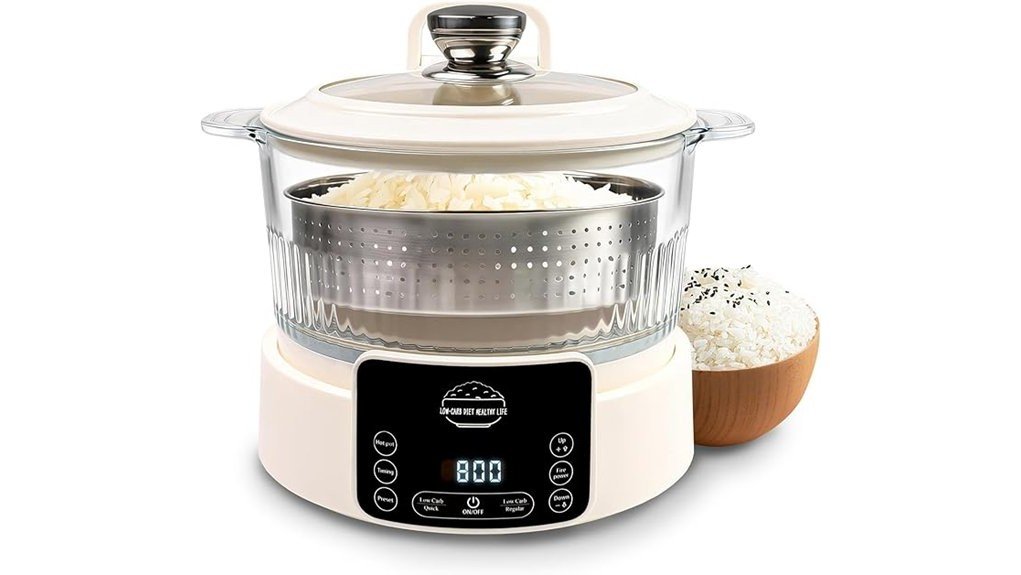
Choosing a low-carb rice cooker is harder than choosing a basic rice cooker because you are paying for an extra starch-separation process, not just heat and a timer. The wait wit 3L Low Carb Rice Cooker combines an 800W heating system, a 3-liter capacity, four-stage lift draining, a glass lid, smart touch controls, and a 24-hour delay timer in a compact appliance aimed at small households. Its strongest appeal is convenience: you can cook rice with a starch-draining cycle and still use the cooker for other simple meals. The main tradeoff is that its health-related benefit should be viewed as a food-preparation feature, not as a guarantee that cooked rice will meet a specific carbohydrate or blood-sugar target.
Quick Verdict
Rating: Recommended with caveats
Best For: Small households that want a compact rice cooker with a dedicated starch-draining function and flexible rice texture controls.
Bottom Line: The 3L capacity, 800W power, 24-hour delay timer, clear glass lid, and four-stage draining system make this a practical specialty cooker. Buy it for the cooking method and convenience, but do not treat “low carb” as a medical claim or assume the cooker removes a fixed amount of carbohydrate from every batch.
| Specification | Detail |
|---|---|
| Brand | wait wit |
| Model name / number | 3L Low Carb Rice Cooker |
| ASIN | B0G7YZ2DLQ |
| Product type | Digital low-starch / low-carb rice cooker and multi-cooker |
| Capacity | 3 liters, described for about 1 to 4 servings |
| Power | 800W |
| Dimensions | 9.44 in D × 8.66 in W × 9.44 in H |
| Power source | Corded electric |
| Low-starch method | Four-stage lift draining |
| Controls | Smart touch panel with Soft/Firm rice settings and Hot Pot mode |
| Timer | 24-hour delay timer |
| Keep-warm | Automatic keep-warm |
| Lid | Glass |
| Cooking-pot claim | Listing describes a coating-free 304 stainless steel pot |
| Care guidance | Amazon product details say hand wash; follow the supplied manual for removable parts |
| Included component confirmed | Instruction manual |
Key Takeaways
- The 3-liter size is suited to small households and modest meal prep, with the listing describing roughly 1 to 4 servings.
- The main differentiator is the four-stage lift-draining process, which is designed to separate some starchy cooking liquid from the rice.
- An 800W heating system, Soft/Firm rice controls, Hot Pot mode, auto keep-warm, and a 24-hour delay timer give you more flexibility than a one-button rice cooker.
- The listing describes a coating-free 304 stainless steel cooking pot and a glass lid, which may appeal if you prefer to avoid a conventional coated inner pot.
- The biggest caution is the “low carb” positioning. The listing does not establish that every recipe or rice type reaches a specific carbohydrate reduction, so dietary decisions should be based on your actual food portions and professional guidance when needed.
What Is the wait wit 3L Low Carb Rice Cooker?
The wait wit 3L Low Carb Rice Cooker is a compact digital rice cooker that adds a starch-separation step to normal rice cooking. Instead of simply cooking rice until the water is absorbed, its low-carb mode uses a lift-and-drain approach intended to separate part of the starchy liquid from the grains. The product is also presented as a multi-cooker, with a Hot Pot mode and adjustable Soft/Firm rice settings.
Its 3-liter capacity and compact footprint make it more appropriate for individuals, couples, and small families than for large-batch cooking. The glass lid and touch panel keep operation straightforward, while the starch-draining option remains the main reason to consider this model.
Who Should Buy It?
Best For
- Small households that typically cook one to four servings at a time.
- Buyers who specifically want a lift-and-drain rice function rather than a standard absorption-only cooker.
- People who value a 24-hour delay timer, automatic keep-warm, touch controls, and adjustable rice texture.
Skip If
- You need a large-capacity cooker for a bigger family or frequent batch cooking.
- You want a well-established premium rice-cooker brand with extensive model documentation and long-term parts support.
- You need medically predictable carbohydrate control from every serving of rice.
Before You Buy: Do not assume “low carb” means rice becomes low-carbohydrate food in a clinical sense. Grain type, portion size, water ratio, cooking mode, and how much starch is drained can all affect the final meal. If you manage diabetes or another condition that depends on carbohydrate intake, use your nutrition plan and professional guidance rather than relying on the appliance name.
How the Four-Stage Starch-Draining System Works
The cooker’s signature feature is its four-stage lift draining technology. The product listing describes this system as a way to filter more starch than basic rice-cooking methods by separating rice from starchy cooking liquid during the cycle. That is different from a conventional rice cooker, where most of the cooking water remains with the grain until absorbed or evaporated.
The practical benefit is a built-in starch-separation method instead of manually boiling and draining rice. The limitation is equally important: the listing does not give a universal laboratory value for the amount of carbohydrate removed from every rice type, serving size, or cooking condition.
Cooking Performance and Rice Texture
The 800W power rating is relatively strong for a compact 3-liter cooker and is intended to support faster, even heating. More power alone does not guarantee better rice, but it supports the cooker’s draining cycle and multi-cooker functions.
The Soft/Firm rice settings are useful because starch-draining can change texture depending on the rice and water ratio. If you prefer softer rice, you can use the softer setting rather than treating the low-carb mode as a one-texture process. If you prefer more separated grains, the firm setting gives you another starting point. Expect some trial and error with your usual rice brand, especially during the first few batches.
Controls, Timer, and Everyday Convenience
The smart touch panel gives you a 24-hour delay timer, automatic keep-warm, Hot Pot mode, and dual Soft/Firm rice settings. That is more flexible than a simple switch-style cooker.
The delay timer is useful when you want rice ready closer to mealtime. Use delayed cooking only with ingredients that are safe to hold at room temperature, and follow the manual for permitted programs.
Build Quality, Materials, and Cleaning
The listing highlights a coating-free 304 stainless steel pot and a clear glass lid, a useful combination if you prefer to avoid a conventional coated cooking surface.
Cleaning guidance deserves attention because Amazon’s marketing bullets mention dishwasher-safe parts, while the structured product-care field says hand wash. The safest approach is to hand wash the removable food-contact parts unless the supplied instruction manual specifically identifies a component as dishwasher-safe. Wipe the powered base with a damp cloth only, and never immerse the electrical body in water.
Food Safety and Dietary Considerations
Use the water amounts and fill limits in the manual, keep the steam path clear, and place the cooker on a stable, heat-resistant surface with room for steam to escape.
The product’s starch-draining function may be useful if you prefer that preparation method, but it should not be treated as a treatment for diabetes, high blood sugar, or any other medical condition. Rice still contains carbohydrate. If you track carbohydrate intake, count the portion you actually eat and follow advice from a qualified health professional when needed.
How It Performs in Real Use
For Daily White Rice
For a small household, the 3-liter capacity handles a few servings without a large countertop footprint. The Soft/Firm options let you refine texture after you learn how your preferred rice behaves.
For Brown Rice and Other Grains
The original product positioning includes white and brown grains, and the multi-cooker design broadens the use beyond one rice type. Brown rice normally needs more water and time than white rice, so use the specific program and ratios in the manual rather than copying your white-rice settings.
For Meal Planning
The 24-hour delay timer and auto keep-warm can reduce last-minute cooking work. They are most useful when the ingredients can safely remain in the cooker during the delay period. For best texture, avoid leaving cooked rice on keep-warm longer than necessary and refrigerate leftovers promptly.
For Small-Kitchen Use
At about 9.44 inches deep, 8.66 inches wide, and 9.44 inches high, this is a relatively compact countertop appliance. That makes it easier to place in an apartment, dorm-style kitchen setup where allowed, or a small home kitchen, but you still need clearance around the steam outlet and lid.
How to Use It Correctly
- Read the manual first. Confirm the correct rice, water, and maximum-fill guidance for the mode you plan to use.
- Use the starch-draining mode only as directed. The lift-and-drain process depends on correct placement of the cooking components.
- Start with the recommended texture setting. After one batch, adjust Soft/Firm based on your rice variety and preference rather than changing several variables at once.
- Keep steam vents clear. Do not cover the cooker or place it under a shelf where hot steam can damage surfaces.
- Clean after cooling. Hand wash removable parts unless the manual clearly says a specific component is dishwasher-safe.
Pro Tip: For your first three batches, keep the rice type and measured amount the same and adjust only one variable, such as the Soft/Firm setting or water level. That makes it much easier to find a repeatable texture you like.
What Customers Are Saying?
Available buyer feedback is not strong enough to support broad claims about texture, cleaning, or long-term reliability. Specialty starch-draining results can also vary with rice type and technique.
Focus on the verified feature set and check current buyer comments about the lifting mechanism, control panel, cleaning, and durability before ordering.
Pros and Cons
Pros
- Four-stage lift draining gives you a dedicated starch-separation cooking method.
- 3-liter capacity suits small households and modest meal prep.
- 800W heating, Soft/Firm settings, Hot Pot mode, and auto keep-warm add useful flexibility.
- 24-hour delay timer can simplify meal scheduling.
- Glass lid and claimed coating-free 304 stainless steel pot offer a different design from many coated rice cookers.
Cons
- The “low carb” name does not tell you the exact carbohydrate reduction in your finished serving.
- Cleaning guidance is inconsistent across the listing, so hand washing is the safer default.
- The confirmed included-components field lists only the instruction manual, so do not assume a measuring cup or rice paddle is included unless the current package details say so.
Is It Worth the Price?
This cooker is best judged as a specialty compact model. You are paying for the lift-and-drain mechanism, touch controls, texture settings, timer, glass lid, and multi-cooker functions. If you will use the starch-draining mode regularly, it is worth considering.
It offers less reassurance if your main goal is brand reputation, long-term parts availability, or highly documented cooking programs. In that case, a conventional rice cooker from a more established manufacturer may provide better confidence even if it does not include the same low-starch cooking method.
How It Compares to Alternatives
If you care more about established-brand support and conventional rice quality than starch draining, the Zojirushi NL-BAC05 is a compact 3-cup Micom option with fuzzy-logic cooking, multiple grain programs, keep-warm, and delay-timer functions. It does not target starch removal in the same way, but it is a stronger comparison for buyers who prioritize cooking refinement and documented specifications.
If you need more capacity, the CUCKOO CR-0675F is a 6-cup Micom cooker with fuzzy logic, preset programs, keep-warm, reheat, preset timing, and texture customization. The wait wit model makes more sense when your priority is the four-stage draining feature and a smaller 3-liter footprint, while the CUCKOO is better suited to larger batches and broader conventional rice-cooker use.
Frequently Asked Questions
Does this rice cooker really make rice low carb?
It uses a four-stage lift-and-drain process designed to separate some starchy cooking liquid from the rice. The listing does not establish one fixed carbohydrate-reduction percentage for every rice type and serving, so treat “low carb” as the product’s cooking-method description rather than a guaranteed nutrition result.
How much rice can the 3L cooker prepare?
The listed capacity is 3 liters, and the product description positions it for about 1 to 4 servings. Actual yield depends on the rice type, portion size, program, and the fill limits in the manual.
Can you cook foods besides rice?
Yes. The listing includes a Hot Pot mode and presents the unit as a multi-cooker, while the original product description also identifies uses such as oatmeal, steaming, and soup. Follow the manual for program-specific quantities and liquid levels.
Are the removable parts dishwasher-safe?
The Amazon listing contains conflicting care information: a marketing bullet mentions dishwasher-safe parts, while the structured care field says hand wash. Hand washing is the safer default unless the instruction manual clearly identifies a specific removable part as dishwasher-safe.
Does it include a measuring cup and rice spoon?
Do not assume those accessories are included. Amazon’s current structured product information confirms the instruction manual as an included component, so check the current package description before ordering if a cup or paddle matters to you.
Can it be used on a 240V outlet?
The verified listing confirms 800W power but does not establish universal 240V compatibility. Wattage is not the same as input voltage. Check the rating label on the appliance and the current seller documentation before using it outside the voltage range printed on the unit.
How long does rice take to cook?
A single verified universal cooking time is not provided for every grain and mode. White rice, brown rice, low-starch cycles, and different batch sizes can take different amounts of time, so use the selected program and the timing guidance in the manual.
Who should skip this rice cooker?
Skip it if you need large-batch capacity, if you want a long-established premium rice-cooker brand, or if you need a medically predictable carbohydrate result. A standard Micom or fuzzy-logic cooker may be a better fit when rice texture and brand support matter more than starch draining.
The Bottom Line
The wait wit 3L Low Carb Rice Cooker is worth considering if you cook for a small household and specifically want four-stage starch draining, an 800W heater, 24-hour scheduling, Soft/Firm settings, and a compact glass-lid design. Its biggest limitation is that “low carb” should not be interpreted as a guaranteed nutritional outcome, and the listing leaves some care and package details less clear than established-brand alternatives.
If those caveats are acceptable and the draining method is a feature you expect to use often, this is a practical specialty cooker. If you mainly want predictable conventional rice performance, extensive documentation, and stronger long-term brand support, compare it with a mainstream Micom model before buying.