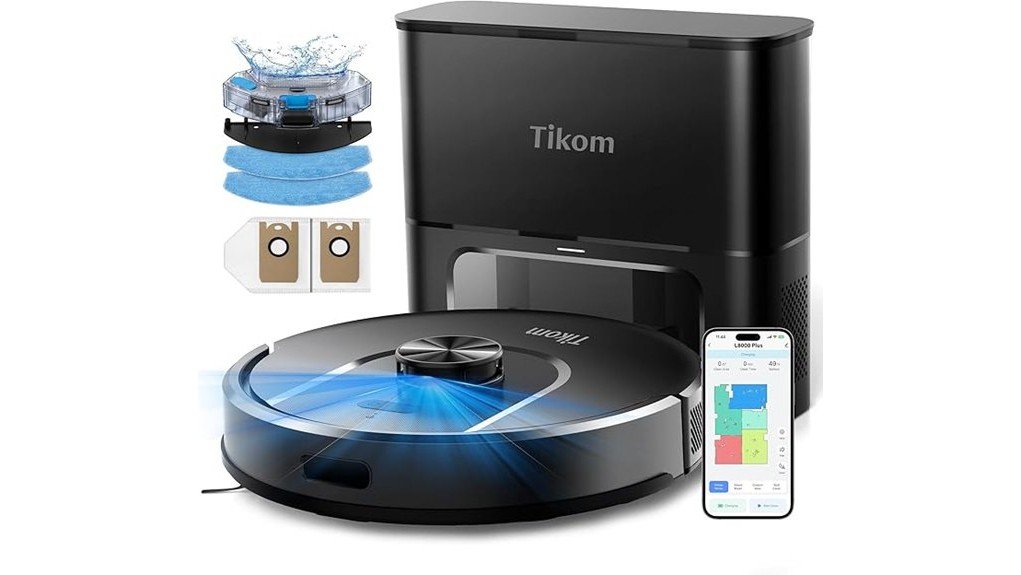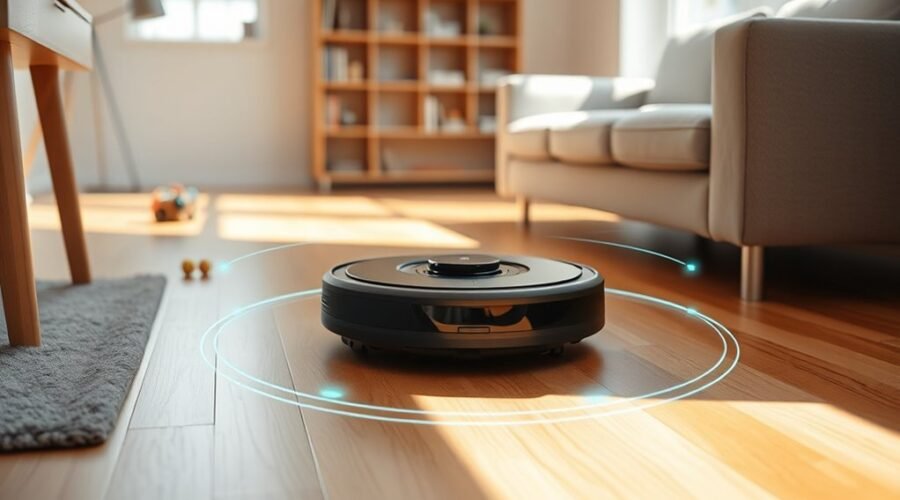
Robot vacuum navigation combines sensors, mapping software, and route planning to move with surprising precision. LiDAR, cameras, and inertial sensors help the machine detect walls, furniture, and open space while SLAM builds a usable map of the home. The system then selects efficient cleaning paths, avoids obstacles, and manages battery life. What appears simple on the surface depends on a layered control process with more complexity than most users expect.
What Makes Robot Vacuum Navigation Smart
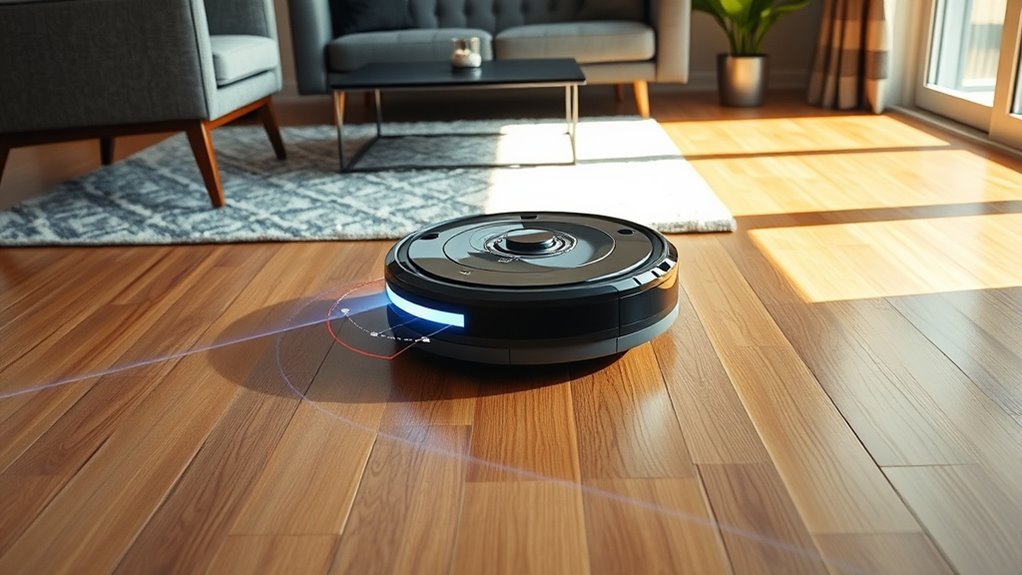
Smart robot vacuum navigation is defined by the integration of LiDAR, cameras, and AI algorithms that build detailed maps of the home and generate efficient cleaning routes.
This Robot Navigation framework depends on Mapping precision, where LiDAR measures spatial geometry and Sensors register walls, furniture, stairs, and floor edges.
An Obstacle Avoidance System uses these inputs to prevent collisions and reduce falls, supporting safe operation without constant supervision.
AI algorithms then analyze environmental data, learn from recurring layouts, and revise route selection over time.
AI algorithms analyze environmental data, learn recurring layouts, and refine route selection over time.
The result is adaptive coverage with fewer unnecessary passes and less backtracking.
Such systems also enable room-specific and zone-based cleaning, giving users greater control over where cleaning occurs.
In practical terms, the technology replaces rigid movement with responsive decision-making, improving efficiency while preserving autonomy in domestic maintenance.
How Robot Vacuum Navigation Works
Robot vacuum navigation operates through layered sensing and control systems that convert environmental data into movement decisions.
In practice, robot vacuums navigate by fusing mapping technologies with onboard processors that interpret sensor input and guide motion. LiDAR, cameras, and infrared units supply positional cues, while Simultaneous Localization and Mapping constructs a usable floor plan and locates the machine within it.
During operation, sensors detect obstacles in real time, and intelligent navigation algorithms recalibrate speed, angle, and route without user intervention. This advanced navigation reduces collisions, limits repeated coverage, and improves room-by-room efficiency.
Machine learning further refines performance by storing route outcomes and adapting to layout changes, which supports cleaner paths and fewer missed zones.
The result is a system that replaces manual steering with autonomous, evidence-based movement, giving users practical freedom from repetitive floor cleaning and enabling consistent, systematic coverage across varied interior environments.
LiDAR Mapping and Laser Paths
LiDAR mapping uses rapid laser pulses to generate a detailed 360-degree representation of a room, even in low-light conditions.
In mapping robot vacuums, LiDAR technology projects laser beams, times their return, and calculates distances up to 6 meters, producing detailed maps that expose walls, furniture, and open routes. This measured scan gives the machine spatial autonomy, reducing dependence on manual guidance and supporting a more liberated cleaning process.
- Rapid pulse emission establishes a calibrated room model.
- Return timing informs obstacle avoidance with high precision.
- Advanced algorithms recalibrate cleaning paths in real time.
- Stored maps enable adaptation across multiple floor plans.
Camera-Based Mapping and Visual AI
Camera-based mapping relies on visual input to construct a spatial model of the home, allowing the vacuum to identify furniture, distinguish room boundaries, and plan efficient routes.
In advanced robot vacuums, this camera-based mapping is paired with visual AI to strengthen object recognition and interpret obstacles with minimal delay. The navigation technology can classify rooms, assign local boundaries, and generate customizable cleaning paths that reduce wasted motion and support efficient cleaning.
Machine learning refines these maps over time, improving accuracy as layouts change and enabling the device to adapt without repeated manual intervention.
Because visual systems may be limited in low light, many designs combine cameras with supplementary sensors so operation remains stable across conditions, including darkness.
The result is a more autonomous platform, one that lessens dependence on human correction and expands practical control over domestic space through precise, data-driven guidance.
Gyroscopes and Accelerometers
Gyroscopes and accelerometers provide the inertial reference system that helps a robot vacuum maintain stable motion while maneuvering a home. These sensors supply continuous motion data that supports navigation, keeping the platform oriented without dependence on external signals. Gyroscopes measure angular velocity, while accelerometers register changes in speed and direction; together they refine control during cleaning.
- Gyroscopes preserve heading across varied floor surfaces.
- Accelerometers correct drift and sustain a straight course.
- Their fusion strengthens mapping alongside LiDAR and cameras.
- The combined sensor stream improves obstacle awareness and cleaning efficiency.
From an analytical perspective, this integration reduces erratic movement and enables disciplined path execution. The result is more autonomous operation, with fewer interruptions and greater freedom from manual oversight.
How Robot Vacuums Avoid Obstacles
Robot vacuums rely on sensor-based detection, using LiDAR, cameras, and cliff sensors to map their surroundings and identify hazards in real time.
When an obstacle is detected, onboard algorithms recalculate the route immediately to preserve cleaning efficiency and reduce collisions.
More advanced systems apply smart object recognition through structured light and RGB imaging, enabling accurate detection of small objects and adaptive navigation in changing layouts.
Sensor-Based Detection
Sensor-based detection gives robot vacuums the ability to identify and respond to obstacles as they move through a room. Using sensor-based detection, robot vacuums rely on high-precision sensors for obstacle detection, preserving efficient navigation without constant human intervention.
LiDAR technology adds 360-degree environmental mapping, improving spatial awareness in low light and around irregular furnishings.
- Infrared and ultrasonic sensors register nearby objects with high resolution.
- Cliff sensors detect vertical drops, preventing unsafe descents.
- Machine learning refines recognition of recurring barriers over time.
- Combined sensor fusion supports measured motion through constrained spaces.
This architecture produces disciplined movement, reducing collisions while maintaining autonomous coverage.
Real-Time Rerouting
Real-time rerouting depends on continuous obstacle detection, with LiDAR, cameras, and related sensors identifying furniture, walls, and other barriers as the vacuum moves.
This real-time navigation process triggers immediate path recalculation, allowing the robot to bypass obstructions without halting its cleaning cycle. AI algorithms evaluate the current scene and prior movement patterns to choose efficient reroutes that preserve coverage and reduce wasted motion.
Cliff sensors add another safety layer by preventing falls near stairs or ledges. Over time, machine learning refines obstacle avoidance, enabling the system to adapt to changing room layouts and recurring blockages.
The result is stronger cleaning efficiency, fewer dead zones, and a more autonomous path through constrained spaces. Such control supports a practical form of domestic liberation.
Smart Object Recognition
Smart object recognition allows a vacuum to distinguish furniture, cables, toys, and other obstacles by combining LiDAR, cameras, structured light, and RGB imaging into a unified environmental model.
This smart object recognition depends on advanced sensors and LiDAR navigation to classify surfaces and estimate spatial boundaries with high accuracy.
- obstacle recognition improves through structured light and RGB fusion.
- real-time data processing updates paths as conditions shift.
- machine learning algorithms refine detections from prior encounters.
- precision and efficiency increase when clutter is mapped correctly.
Together, these systems reduce collisions and missed zones, enabling autonomous movement through complex layouts.
The result is a cleaner route, less manual intervention, and greater practical freedom from repetitive household labor.
SLAM and Room Mapping
SLAM enables a robot vacuum to localize itself while building a map of the surrounding room in real time.
By combining LiDAR, camera, and ultrasonic data, it detects layout boundaries, furniture placement, and open pathways with measurable accuracy.
As cleaning sessions accumulate, saved maps are refined and updated to reflect changes in room configuration or new obstacles.
SLAM Mapping Basics
Mapping in robot vacuums relies on SLAM, a method that lets the machine build a digital floor plan while tracking its own position within that plan. Using sensors such as LiDAR and cameras, robot vacuums collect spatial data, convert it into mapping output, and refine cleaning paths with each pass. The resulting digital map supports systematic cleaning by reducing overlap and preserving coverage efficiency.
- SLAM fuses localization and mapping in one process.
- Sensors detect boundaries, objects, and free space.
- Real-time updates adjust routes when obstacles shift.
- Stored maps help robot vacuums manage multiple layouts.
This analytical loop gives the system operational independence, allowing navigation to remain adaptive rather than rigid.
Room Layout Detection
Room layout detection in robot vacuums depends on SLAM-based sensing to construct a detailed floor plan while simultaneously estimating the device’s position within it.
Through coordinated sensors such as LiDAR and cameras, SLAM collects spatial data, producing 360-degree maps that support mapping capabilities and efficient obstacle avoidance. During initial passes, the robot traces boundaries, furniture, and openings, building a navigable representation for systematic coverage.
This method reduces dependence on fixed infrastructure and gives the machine operational autonomy. Continuous learning then permits adaptive interpretation of environmental change, preserving accuracy as rooms shift.
Many systems also provide multi-map storage, allowing distinct floor plans to be retained for separate levels.
In practice, room layout detection converts irregular domestic space into an intelligible, machine-readable field of movement.
Saved Map Updates
Once a robot vacuum has established a floor plan, the same SLAM process continues to refine it during routine cleaning. Through saved map updates, SLAM technology uses sensors to create a dynamic model, identify obstacles, and revise cleaning routes as furniture shifts or rooms are reopened. This adaptive loop improves navigation and helps by preserving spatial order without user intervention.
- Automatic revisions capture new layout data.
- Multiple maps support distinct floors and zones.
- Room mapping enables targeted access or exclusion.
- LiDAR and cameras increase mapping accuracy.
The result is a system that does not merely repeat a path; it learns, updates, and extends operational freedom across changing environments.
How Robot Vacuums Plan Efficient Routes
Robot vacuums plan efficient routes by combining sensor-based mapping, path-planning algorithms, and adaptive decision-making to organize cleaning into logical zones rather than relying on random movement.
In practice, robot vacuums use LiDAR and camera data so mapping works as a structured model of walls, furniture, and open floor space. Advanced path planning then sequences passes for efficient coverage, reducing overlap and preserving battery autonomy for cleaner independence from manual control.
Real-time obstacle detection allows immediate route recalibration when chairs, cables, or pets alter the environment. Many systems also apply AI and machine learning to refine routes from prior cleanings, matching cleaning preferences and spatial changes over time.
Spot Cleaning and Edge Cleaning further direct motion toward targeted areas, concentrating effort where debris accumulates most. This architecture produces disciplined, adaptable navigation that supports systematic cleaning without sacrificing responsiveness to changing domestic conditions.
How Robot Vacuums Recharge and Resume
Robot vacuums monitor battery state continuously and, when charge falls below a threshold, compute an ideal return path to the dock while avoiding obstacles in real time.
Self-docking systems then refine alignment at the charging station to guarantee reliable contact and uninterrupted recharge cycles.
After charging, the controller stores the last cleaning coordinate and resumes operation from that position to preserve coverage continuity.
Auto-Docking Process
When battery levels fall below a threshold, the unit initiates an autonomous return-to-dock sequence, using onboard navigation algorithms to determine the most efficient route back to its charger. In the auto-docking process, intelligent recharging cycles preserve cleaning efficiency by minimizing idle time and unnecessary travel.
- Sensors verify the charging dock position and refine approach geometry.
- Navigation algorithms adjust paths around obstacles with measured precision.
- Contact points are aligned to secure a stable electrical connection.
- Continuous learning capabilities update route selection as room conditions change.
This control loop allows the machine to operate with greater autonomy and less dependence on manual intervention.
The result is a disciplined recharge phase that sustains coverage, conserves energy, and maintains operational continuity in dynamic domestic environments.
Cleaning Resumption Logic
After the vacuum identifies a low-battery state and returns to its dock, the recharging phase is designed to preserve task continuity rather than restart the job from zero.
Intelligent recharging cycles guide the unit to the docking station, where sensors confirm alignment and initiate power transfer without human intervention. During this interval, advanced algorithms store the last cleaning path, allowing the machine to resume cleaning at the exact interruption point.
This logic reduces overlap, preserves coverage, and minimizes wasted motion, a practical advantage for users seeking autonomy from repetitive oversight.
In systems with scheduled cleanings, the cycle can repeat on a timetable, enabling the robot to recharge, redeploy, and continue operation with minimal manual setup.
The result is a controlled, efficient, and self-directed cleaning workflow.
Smart Cleaning Modes and App Controls
Smart cleaning modes such as Spot Cleaning, Edge Cleaning, and Room-Specific Cleaning let robot vacuums direct effort where it is most needed, rather than treating the home as a single uniform area. Through app controls, operators name rooms, define no-go zones, and assign cleaning schedules. This customization guarantees efficient use of battery and suction, while robot vacuums learn spatial priorities over time.
- Targeted modes reduce wasted traversal.
- Real-time mapping shows progress and coverage.
- Adjustable suction, from Quiet to Max, matches debris load.
- Integration with smart home systems enables voice commands and hands-free control.
Analytically, these functions convert navigation into a user-directed workflow. The app becomes a command layer, while onboard sensing maintains path execution.
As a result, cleaning decisions shift from fixed routines to adaptive, local control, giving users more autonomy over when, where, and how each pass is performed.
Frequently Asked Questions
How Do Robot Vacuums Navigate?
They navigate through sensor technology, mapping rooms with LiDAR, cameras, and infrared, then optimize cleaning efficiency via algorithms. Real-time obstacle avoidance, floor types detection, and battery life management guide motion; user interface settings and maintenance tips refine performance.
How Does Mapping Work on a Robot Vacuum?
Mapping works by sensor technology and mapping techniques; one study found LiDAR systems improve coverage by 30%. Navigation algorithms and data processing build a floor plan, enable room recognition, and support obstacle avoidance for autonomous cleaning freedom.
What Is a Robot Navigation System?
A robot navigation system is sensor technology coordinating obstacle detection, path optimization, battery management, user interface, cleaning modes, and performance metrics, enabling autonomous movement, adaptive mapping, efficient coverage, and reduced dependence on manual control.
What Is Lidar Navigation on a Robot Vacuum?
LiDAR navigation uses laser scans reaching 6 meters, freeing a robot vacuum from guesswork. Lidar technology and robot sensors improve obstacle detection, mapping accuracy, and navigation algorithms, producing disciplined cleaning patterns and greater vacuum efficiency.
Conclusion
In the end, robot vacuum navigation appears intelligent not by accident, but by the coincidence of multiple systems aligning at the right moment: LiDAR, cameras, inertial sensors, and SLAM all converge to transform raw surroundings into coherent movement. This coordination enables accurate mapping, efficient routing, and controlled recharging behavior. The result is a machine that cleans with measurable precision while adapting continuously to changing room conditions and user-defined routines, with minimal human intervention.