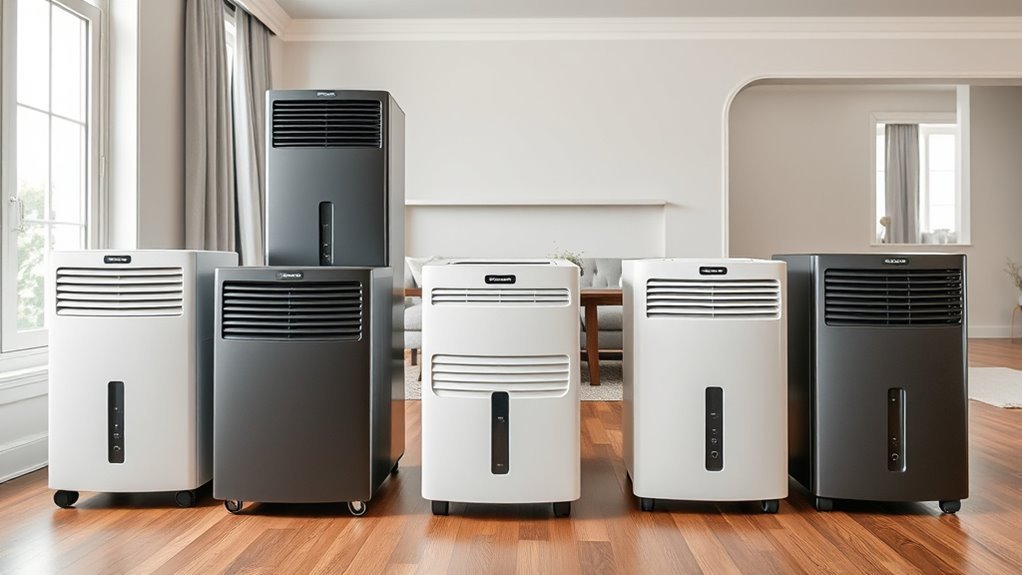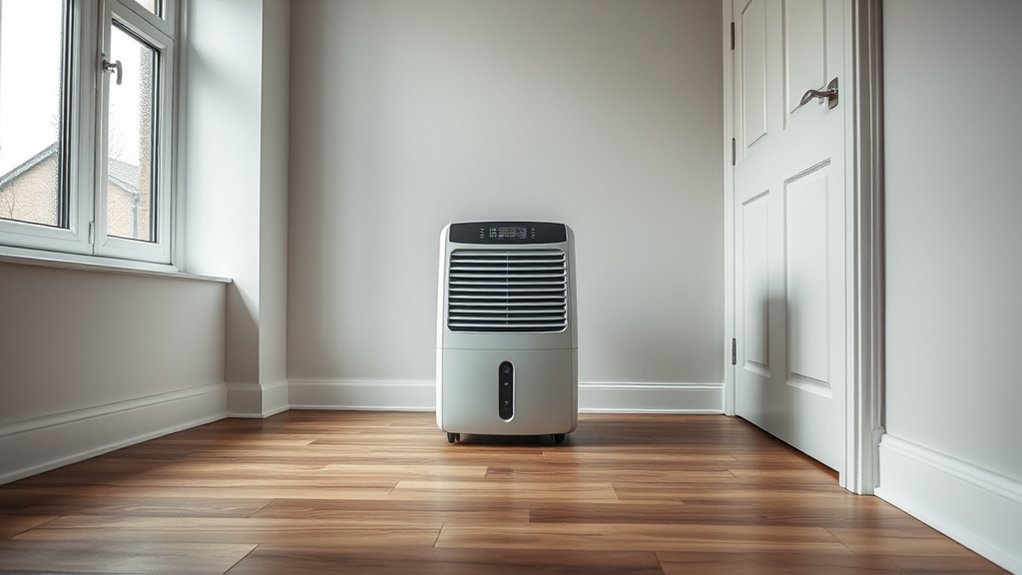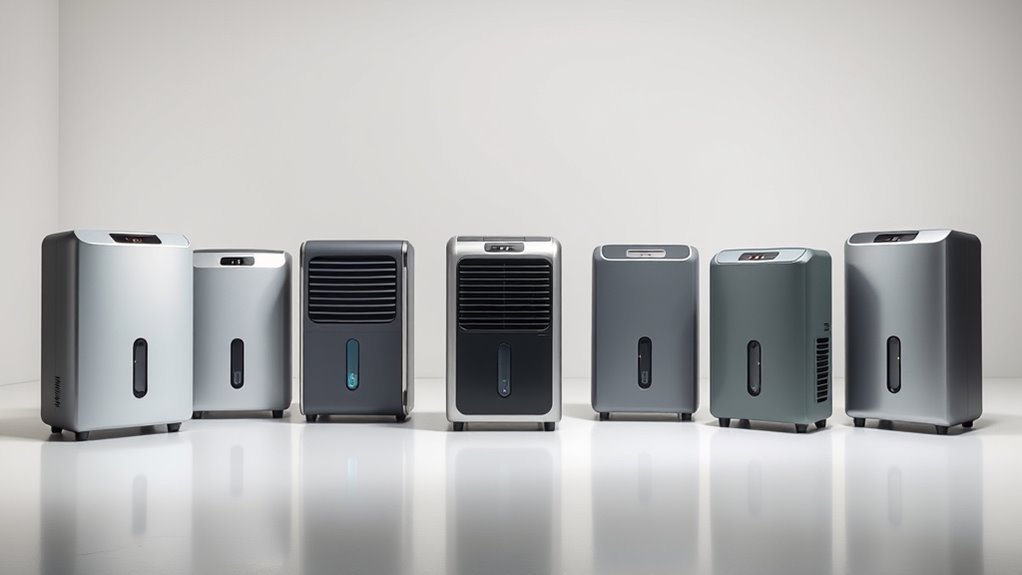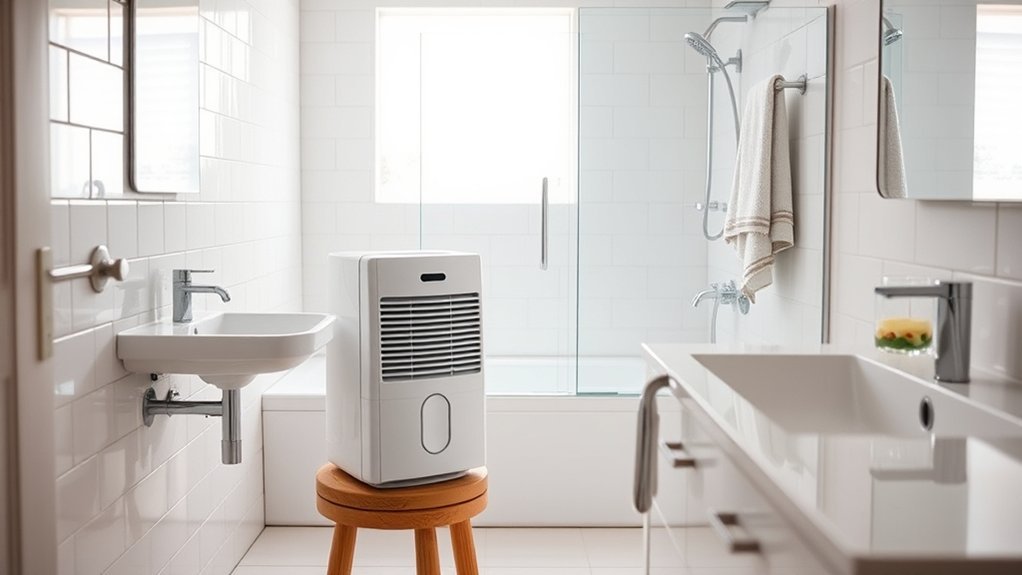
Bathrooms create a difficult combination of steam, condensation, wet surfaces, and mains electricity. A dehumidifier can help control moisture elsewhere in the home, but a standard portable model should not automatically be treated as bathroom-safe. The right solution depends on the appliance instructions, its location, your ventilation system, and the electrical rules where you live.
Quick Answer
Do not place a standard plug-in dehumidifier inside a bathroom unless its manual specifically approves that location and the electrical installation meets local bathroom rules. Use the extractor fan first. If extra drying is needed, operate the dehumidifier from a dry adjoining area after the shower.
Key Takeaways
- Never assume a portable dehumidifier is suitable for a bathroom simply because it is advertised for humid rooms.
- Check the exact model’s manual and never use an extension lead to bring mains power into the bathroom.
- Run an extractor during bathing and for at least 15 minutes afterward, or until steam and condensation have cleared.
- For extra moisture control, place the dehumidifier in a dry hallway or adjoining room and open the bathroom door after bathing.
- Persistent mould, wet patches, peeling finishes, or musty smells may indicate a leak or ventilation fault rather than ordinary shower condensation.
At a Glance
| Time Required | A few minutes of daily surface drying, plus at least 15 minutes of extractor operation after bathing |
| Difficulty | Easy for daily moisture control; professional help may be needed for electrical or ventilation work |
| Tools Needed | Extractor fan or window, squeegee or cloth, and an optional hygrometer or non-electric absorber |
| Cost | Daily ventilation changes may cost nothing; absorbers, hygrometers, fan upgrades, and professional work vary in price |
Can You Use a Dehumidifier in a Bathroom?
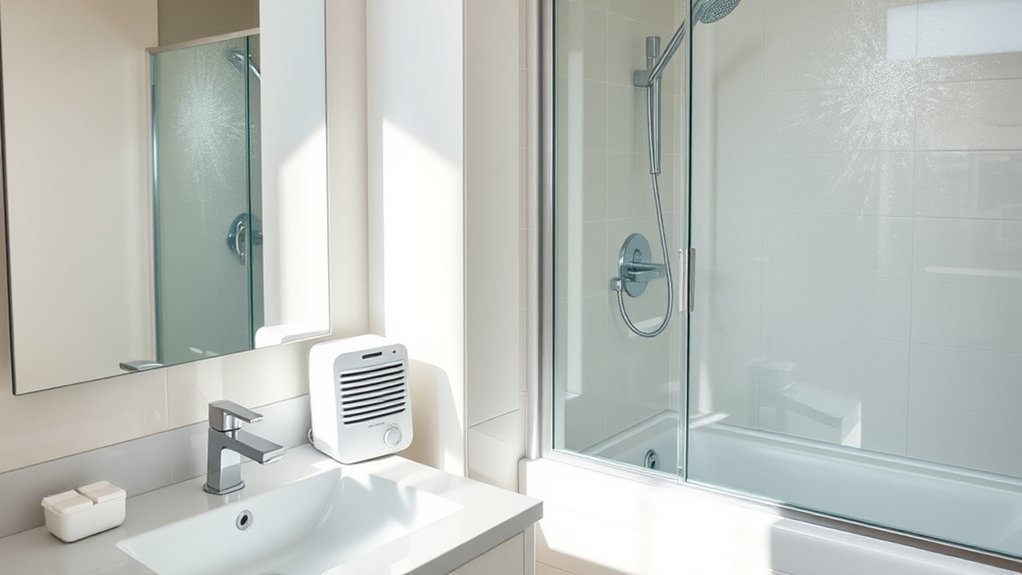
You should not operate a standard portable dehumidifier inside a bathroom unless the manufacturer clearly states that the exact model is suitable for that environment. A bathroom exposes an appliance to splashes, wet hands, condensation, and water on the floor. A product designed for a bedroom, landing, or living area may not have the protection needed for those conditions.
This does not mean every dehumidifying system is banned from every bathroom. A purpose-built fixed unit may be suitable when it has the required protection, is approved for the intended location, and is correctly installed by a qualified professional. A wall-mounted design alone does not make an appliance safe. Its electrical classification, bathroom zone, water resistance, instructions, circuit, and installation all matter.
Warning: Never run an extension lead into a bathroom, place a portable dehumidifier beside a bath or shower, handle its plug with wet hands, or operate it where water could splash or collect around the unit. An RCD can reduce the severity of some electrical faults, but it does not make an unsuitable appliance bathroom-safe.
What UK Electrical Guidance Says
In the UK, bathrooms and shower rooms are treated as higher-risk electrical locations. Current Electrical Safety First bathroom guidance states that ordinary socket outlets are not permitted unless they are at least 2.5 metres from the edge of the bath or shower tray. Shaver supply units and certain specially designed equipment are treated differently.
The distance rule does not mean that any portable appliance becomes suitable once it is 2.5 metres away. The equipment’s design and manufacturer instructions must also be considered. Electrical rules differ by country, so follow the code that applies to your home and ask a qualified electrician when the location is uncertain.
The Safest Way to Use a Portable Dehumidifier Nearby
If ventilation has already removed most of the steam but the bathroom and nearby rooms remain damp, a portable dehumidifier may be used from a dry adjoining space:
- Keep the bathroom door closed during the shower so steam does not spread through the home.
- Run the bathroom extractor during bathing and afterward.
- Wipe or squeegee wet walls, screens, and floors to remove liquid water directly.
- After bathing, place the dehumidifier in a dry hallway or adjoining room using a normal dry socket that is suitable for the appliance.
- Open the bathroom door once the shower is over so the remaining humid air can reach the unit.
- Follow the model’s clearance and temperature requirements and stop using it if the plug, cable, or casing becomes wet.
Do not balance the unit in the doorway, obstruct a fire route, or position the power lead where someone could trip over it.
Why Standard Bathroom Dehumidifiers Can Be Unsafe
Wet skin conducts electricity more easily than dry skin, which can make an electric shock more severe. Condensation can also form on or inside an appliance that was not designed for a wet location. Splashes, a leaking shower screen, an overflowing basin, or a wet floor can turn an ordinary setup into a dangerous one.
IP Ratings Are Only Part of the Decision
An IP rating describes protection against the entry of solid objects and water. However, an IP label alone does not prove that a portable appliance may be placed anywhere in a bathroom. The required protection depends on the bathroom zone and the type of equipment. Installation instructions and local electrical requirements still apply.
If a dehumidifier has no clear bathroom-use statement, no suitable protection information, or a manual that warns against wet rooms, treat it as unsuitable for use inside the bathroom.
RCD Protection Is Not Permission to Ignore the Manual
Bathroom circuits commonly require residual current device protection. An RCD is an important backup that can disconnect power during certain faults. It cannot prevent every accident, stop water entering the appliance, or change the location approved by the manufacturer.
Safe Alternatives to Bathroom Dehumidifiers
The best way to control bathroom humidity is to remove steam at its source, limit the amount of liquid water left on surfaces, and keep the room warm enough to reduce condensation.
Recommended Products

Installation Support: Designed for 4-inch duct. If your existing ductwork is 3 inches, reach out to Amico for a free 4" to 3" duct reducer for quick, trouble-free installation.

Safe & Secure: The end of the wire is equipped with a junction box, which is more convenient and safe.3-Year Warranty. If you have any questions, please contact us by email.

50 CFM BATHROOM EXHAUST FAN: 50 CFM is sufficient ventilation to remove, moisture, odor and pollutants from your smaller powder room or bathroom up to 45 sq. ft.
Use an Extractor That Vents Outdoors
A bathroom extractor should discharge humid air outside rather than into a loft, wall cavity, or another room. Run it during bathing and continue afterward. In England, the current Approved Document F gives a minimum intermittent bathroom extract rate of 15 litres per second and says run-on timers should be set to at least 15 minutes.
Current England guidance uses 15 litres per second as the minimum intermittent bathroom extract rate and at least 15 minutes for a run-on timer.
These figures are building guidance rather than a reason to modify wiring or replace a fan without proper assessment. Duct length, bends, grilles, room size, noise, and installation quality can all reduce real airflow.
Open a Window When Conditions Allow
An open window can provide rapid ventilation when the outside air is reasonably dry and outdoor air quality is acceptable. Keep the bathroom door closed while the window and fan remove steam so moisture does not migrate into colder rooms.
In cold weather, a short period of wide opening may clear moisture more effectively than leaving a window slightly open for hours while the room becomes cold.
Keep Surfaces Warm and Dry
A radiator or properly installed heated towel rail can help surfaces dry and reduce the chance of warm air condensing on cold walls. Heating does not remove water vapour by itself, so it should support ventilation rather than replace it.
After bathing, use a squeegee on tiles and the shower screen. Wipe standing water from ledges, sealant, window frames, and the floor. Hang towels so air can move around them, and avoid drying laundry in the bathroom unless the moisture is being extracted outdoors.
Pro Tip: Removing water from the shower screen and tiles takes less energy than waiting for that water to evaporate and then trying to remove it from the air.
Use a Non-Electric Moisture Absorber as a Supplement
A refillable calcium-chloride absorber can collect a small amount of background moisture without a plug or power cable. It may help in a cupboard, small cloakroom, or bathroom that already has effective ventilation. It will not clear a large burst of shower steam as quickly as a working extractor.
Place the absorber on a stable surface outside the shower and bath splash areas. Keep it where children and pets cannot knock it over, and follow the refill, spill-cleanup, and disposal instructions supplied with the product.
How to Ventilate a Bathroom Properly
Use the following routine to remove moisture without sending steam into the rest of the home:
- Before bathing: Switch on the extractor. Make sure its grille is not blocked by dust.
- During the shower or bath: Keep the bathroom door closed. Open the window where practical and safe.
- After bathing: Leave the extractor running for at least 15 minutes, or longer if mirrors and walls remain wet.
- Remove surface water: Squeegee the enclosure and wipe puddles or soaked window ledges.
- Check the room: Steam should clear, surfaces should begin drying, and the musty smell should not remain.
- Use adjoining-room dehumidification only when needed: Once bathing has ended, open the door and operate the portable unit from a dry location according to its manual.
A continuous mechanical extract or MVHR system should normally remain in its intended operating mode. Do not switch off a whole-home ventilation system simply because it is quiet or because the bathroom appears dry.
Recommended Products
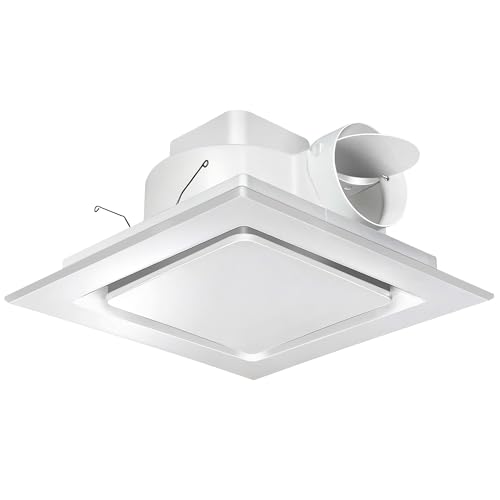
【Banish Bathroom Moisture & Odors for Good】Tired of foggy mirrors, musty smells, and damp walls? Whether you call it a bathroom exhaust fan, a bathroom vent fan, or even a fart fan for bathroom, our model quickly removes steam, humidity, and unpleasant odors—leaving your bathroom fresh, dry, and comfortable.

Dimensions and Fit: Housing size 7.5 x 7.2 x 4 inches; Grille cover measures 9.4 x 8.6 inches; Includes 4-inch duct diameter for flexible installation; recommended ceiling cutout size 7.6 x 7.3 inches.
What to Do in a Windowless Bathroom
A windowless bathroom depends heavily on mechanical extraction and a path for replacement air. The fan must vent outdoors, and air must be able to enter through the intended door undercut or transfer route.
If steam remains for a long time, check whether the fan is running, the grille is dirty, the duct is crushed or disconnected, or the external flap is stuck. A qualified ventilation installer can measure the actual airflow rather than judging performance by noise alone.
Use a Hygrometer to Check Recovery
A small digital hygrometer can show whether the humidity spike falls after bathing. The US Environmental Protection Agency recommends keeping general indoor relative humidity below 60%, ideally around 30–50% where practical.
A temporary bathroom spike is normal. The concern is humidity that stays high for long periods, repeated condensation on colder rooms, or surfaces that never dry. Avoid forcing the home excessively dry, especially if occupants experience dry eyes, skin, or airways.
Is It Condensation or a Leak?
A dehumidifier cannot repair the underlying source of every damp problem. Before buying equipment, look at when and where the moisture appears.
Signs of Ordinary Shower Condensation
- Water appears mainly during or shortly after bathing.
- Mirrors, windows, tiles, and other cold surfaces become wet.
- The moisture improves after ventilation and surface drying.
- Problems are worse in cold weather or after long showers.
Signs of a Leak or Building Defect
- A patch remains wet even when the bathroom has not been used.
- Paint bubbles, plaster softens, or staining spreads from one point.
- The floor becomes wet beside the bath, shower tray, toilet, or pipework.
- A downstairs ceiling stains after the shower is used.
- Mould returns quickly despite good extraction and regular cleaning.
- There is a persistent musty smell inside a wall, cupboard, or ceiling void.
Fix leaking pipework, failed seals, damaged grout, blocked vents, or defective building fabric before relying on a dehumidifier. Tenants should report persistent damp, leaks, and mould to the landlord or housing provider promptly and keep a written record.
Best Bathroom Moisture Absorbers to Try
Once you have improved airflow, a non-electric moisture absorber can help manage low-level background damp between showers. It should be viewed as a supplement, not a substitute for a working extractor or leak repair.
- Absodry moisture absorber: A refillable, non-electric calcium-chloride system available in several sizes. Choose the unit according to the manufacturer’s stated room capacity and keep it on a stable surface.
- Bostik Breathe dehumidifier: A reusable two-tablet absorber intended for humid indoor spaces. Bostik states that the two-tablet design provides up to 33% more absorption than a single-tablet system.
- Other refillable absorbers: Choose a sealed, stable housing with readily available refills and clear spill and disposal instructions.
Check the collection tank regularly and replace the refill according to the manufacturer’s instructions. Do not place an absorber where it could fall into the bath, shower, basin, or toilet.
Note: Passive absorbers work slowly. A container collecting little water does not prove that the bathroom is dry, and a container filling rapidly may indicate that ventilation or the building fabric needs attention.
Recommended Products
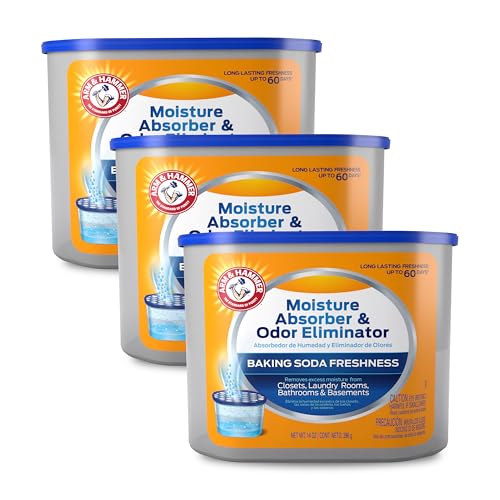
Arm & Hammer Refillable Moisture Absorber and Odor Eliminator attracts and traps excess moisture, eliminating musty odors.

Helps Reduce Excess Moisture and Dampness Designed to absorb excess moisture in enclosed spaces such as basements, attics, garages, closets, and crawl spaces.

DON'T JUST COVER UP ODORS, ELIMINATE THEM: DampRid 11-ounce Refillable Fresh Scent Moisture Absorbers attract and trap excess moisture - eliminating musty odors for fresher, cleaner air. Pack of 6 cups.
When to Get Professional Help
Contact a qualified electrician when:
- You are unsure whether a socket, fixed appliance, fan, mirror, or towel rail is suitable for its bathroom zone.
- An RCD or circuit breaker repeatedly trips.
- A plug, cable, switch, socket, or appliance becomes hot, wet, discoloured, or damaged.
- You hear buzzing or crackling or notice a burning smell.
- You are installing or altering fixed bathroom wiring.
Contact a ventilation specialist when the fan runs but steam remains for a long time, the duct discharges into the loft, or airflow appears weak. Contact a plumber or building professional when damp remains without shower use, staining spreads, or water appears beneath fittings.
Large mould areas, recurring mould, or mould linked to a leak should be assessed and the moisture source corrected. Cleaning the visible surface without fixing the cause usually leads to regrowth.
Sources
- Electrical Safety First: Bathroom Electrical Safety — bathroom shock risks, sockets, RCD protection, and extension-lead advice.
- Electrical Safety First: BS 7671 Technical Guidance — the 2.5-metre socket restriction and requirement to consider manufacturer instructions.
- GOV.UK: Approved Document F — bathroom extract rates, ventilation provision, testing, and fan run-on guidance for England.
- US EPA: A Brief Guide to Mold, Moisture and Your Home — indoor humidity, condensation, drying, and mould prevention.
- NHS: Living With COPD — humidity, weather, indoor-air triggers, and individual symptom management.
- Bostik Breathe Product Information — manufacturer specifications for the non-electric two-tablet moisture absorber.
Frequently Asked Questions
Where should you not use a dehumidifier?
Do not use a standard portable dehumidifier where it may be splashed, immersed, exposed to standing water, or handled with wet hands. Avoid baths, showers, pool areas, wet floors, and any location prohibited by the manual. Do not use an extension lead to bring power into a bathroom.
Should you use a dehumidifier if you have COPD?
A dehumidifier is not a treatment for COPD. Controlling damp and mould may help create a healthier home, but very humid, very dry, hot, or cold air can affect people differently. Monitor your symptoms, avoid mould and indoor pollutants, and ask your respiratory nurse or doctor for advice suited to your condition.
How long should you run a dehumidifier for bathroom moisture?
Do not run a standard portable unit inside the bathroom unless its manual explicitly permits that use. Run the extractor during bathing and for at least 15 minutes afterward. If more drying is needed, use the dehumidifier from a dry adjoining space until its humidistat reaches the selected level.
Is a bathroom a good place for a portable dehumidifier?
Usually not. A bathroom contains wet surfaces, splashes, condensation, and restricted electrical zones. Use purpose-built ventilation first. Only use equipment inside the room when the manufacturer approves the location and the electrical arrangement meets applicable requirements.
Can you put a dehumidifier just outside the bathroom?
Yes, this is often the safer way to provide supplemental drying. Keep the unit in a dry hallway or adjoining room, plug it directly into a suitable dry socket, and open the bathroom door after the shower. Maintain the clearances stated in the manual and keep the cable out of walkways.
What humidity level should a bathroom have?
Humidity will rise temporarily during bathing. The important point is that it falls again as ventilation runs and surfaces dry. For the home generally, aim to keep relative humidity below 60%, with roughly 30–50% being a useful target where practical and comfortable.
Conclusion
A standard portable dehumidifier is usually better kept outside the bathroom. Use a properly vented extractor, a window where suitable, surface drying, and steady background heat as your first line of defence. If extra drying is needed, operate the dehumidifier from a dry adjoining area and follow its manual.
Only use electrical equipment inside the bathroom when it is specifically approved for that environment and correctly installed for the applicable zone. Persistent damp, mould, staining, or wet patches should be investigated rather than hidden with an absorber or dehumidifier.