Disclosure: As an Amazon Associate I earn from qualifying purchases.
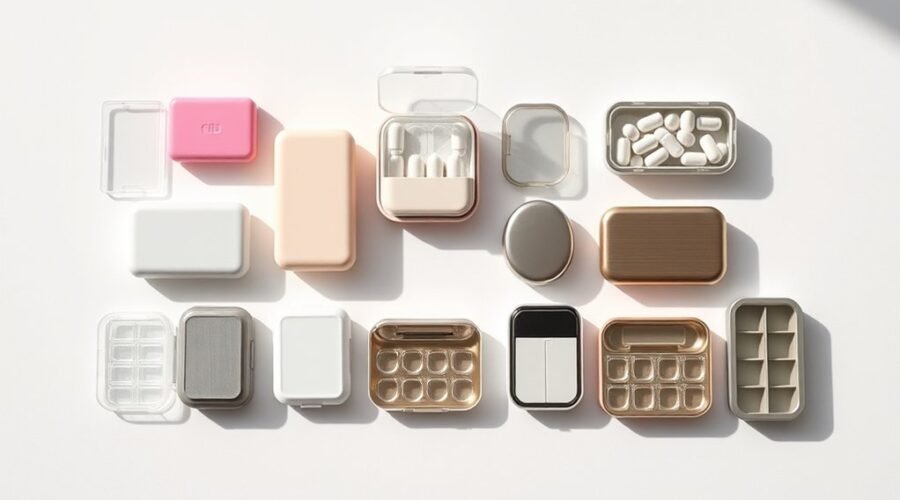
The best pill organizers for 2027 make it easier to separate doses while matching the way you actually take medication or supplements. Compact options such as the Holii Travel Pill Organizer work well for short trips, while the AUVON 28-Day Moisture-Proof Pill Organizer and TookMag XL Monthly Pill Organizer are designed for longer refill cycles. If you take pills several times per day, dedicated AM/PM, three-times-daily, and four-times-daily layouts can make each dose easier to identify.
Quick Verdict: Choose by schedule first. A small multi-compartment case is better for travel, a weekly AM/PM box is easier for twice-daily routines, and a 28-day system reduces how often you need to refill. Also check compartment dimensions if you use large capsules or supplements.
Medication Safety Note: A pill organizer is not suitable for every medicine. Some medications need their original packaging or specific protection from moisture, light, or temperature changes. Follow the medicine label or ask a pharmacist before transferring medication. Keep all pill organizers out of the sight and reach of children; a snap, push-button, or locking lid should not automatically be treated as child-resistant packaging.
Quick Comparison of Pill Organizers
| Pill Organizer | Best Use | Layout | Main Consideration | Amazon |
|---|---|---|---|---|
| Holii Travel Pill Organizer | Compact travel | 8 compartments | Not designed for a full weekly schedule | Check Amazon |
| AUVON 28-Day Moisture-Proof Pill Organizer | Monthly planning | 28 daily compartments | Larger than a basic weekly box | Check Amazon |
| Weekly 3-Times-A-Day Pill Organizer | Three daily doses | 21 compartments | Requires weekly refilling | Check Amazon |
| AUVON Weekly Pill Organizer | Easy-open daily use | 7 large compartments | One compartment per day | Check Amazon |
| Sukuos AM/PM Weekly Pill Organizer | Twice-daily routines | 7-day AM/PM | Larger than ultra-compact travel cases | Check Amazon |
| Zannaki Metal Travel Weekly Organizer | Rugged travel storage | 7 compartments | Metal construction adds weight | Check Amazon |
| 4PS Travel Pill Organizer | Flexible travel sorting | 10 compartments | Not a day-by-day weekly planner | Check Amazon |
| Sukuos Large Weekly AM/PM Organizer | Detachable daily carry | 7-day AM/PM | Limited to two dosing periods per day | Check Amazon |
| TookMag XL 28-Day Monthly Pill Organizer | Large monthly planning | 28 daily compartments | Takes more storage space | Check Amazon |
| AUVON Large Weekly Pill Organizer | Four daily doses | 7 days × 4 doses | Individual dose compartments are relatively compact | Check Amazon |
Holii Travel Pill Organizer, 8-Compartment Portable Pill Case
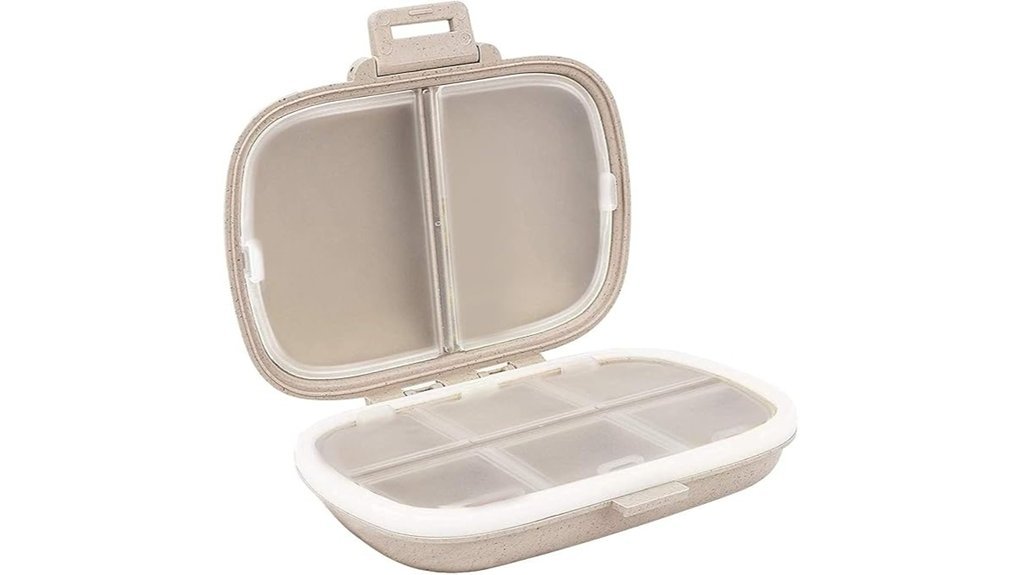
Best for compact travel: The Holii Travel Pill Organizer is useful when you want several compartments without carrying a full weekly medication planner. It measures approximately 4.33 x 3.54 x 1.18 inches and has 8 compartments, including smaller and larger sections for separating different pill sizes. Its food-grade plastic construction, inner compartment lid, silicone sealing ring, and outer closure are designed to reduce accidental opening and mixing during normal carry.
Why You’ll Like It: It packs a useful number of compartments into a small case, making it convenient for a purse, backpack, coat pocket, or travel bag.
Best For: Travelers and everyday users who need a compact case for a limited number of medications, vitamins, or supplements.
Pros:
- Compact 8-compartment layout separates different pill sizes.
- Silicone sealing ring and double-closure design help reduce spills and mixing.
- Removable inner parts make routine cleaning easier.
Cons:
- Not organized by day or dosing time.
- Capacity may be too limited for large daily medication routines.
- Small sections may not fit bulky supplements.
AUVON 28-Day Moisture-Proof Pill Organizer
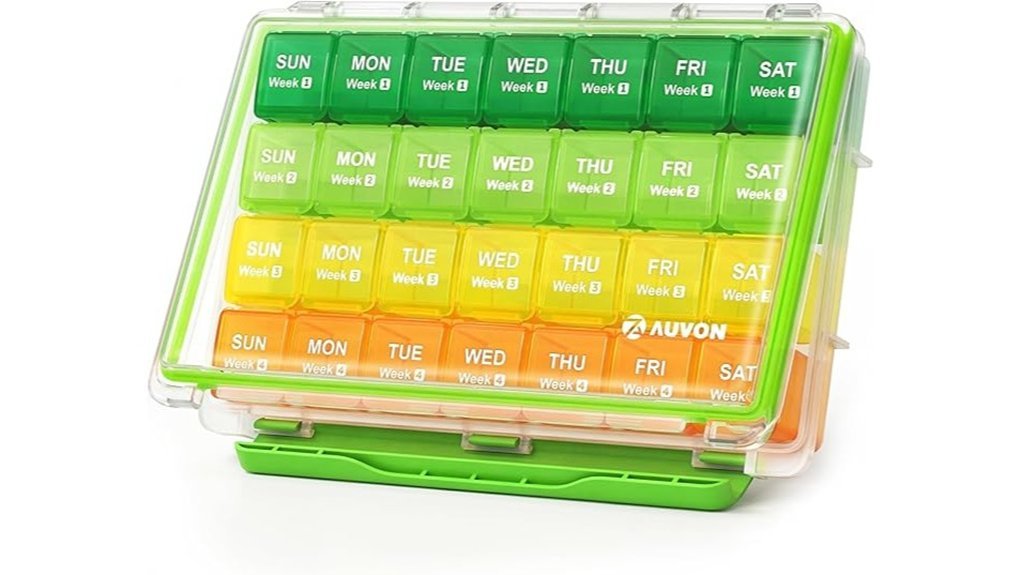
Best for monthly planning: The AUVON 28-Day Moisture-Proof Pill Organizer is designed for people who prefer to organize up to four weeks at once. It uses removable weekly rows inside a clear outer case, so you can prepare a longer schedule while still taking an individual row when needed. Each compartment measures about 1.2 x 1.1 x 1.1 inches, while the complete case measures about 8.7 x 5.6 x 1.4 inches.
The manufacturer describes the design as moisture- and spill-resistant, with a sealing structure and snap closure. That can help limit everyday exposure, but it should not replace medication-specific storage instructions.
Best For: Users who prefer a 28-day pill organizer and want removable weekly sections rather than refilling one small weekly box every few days.
Pros:
- 28-day format supports longer medication or supplement planning.
- Removable weekly rows make the system more flexible for travel.
- Clear outer case and prominent date markings improve visibility.
Cons:
- Bulkier than a compact weekly pill organizer.
- Daily compartments do not provide separate AM/PM dosing sections.
- Large or unusually shaped supplements should be checked against compartment dimensions before purchase.
Weekly 3-Times-A-Day 7 Day Pill Organizer
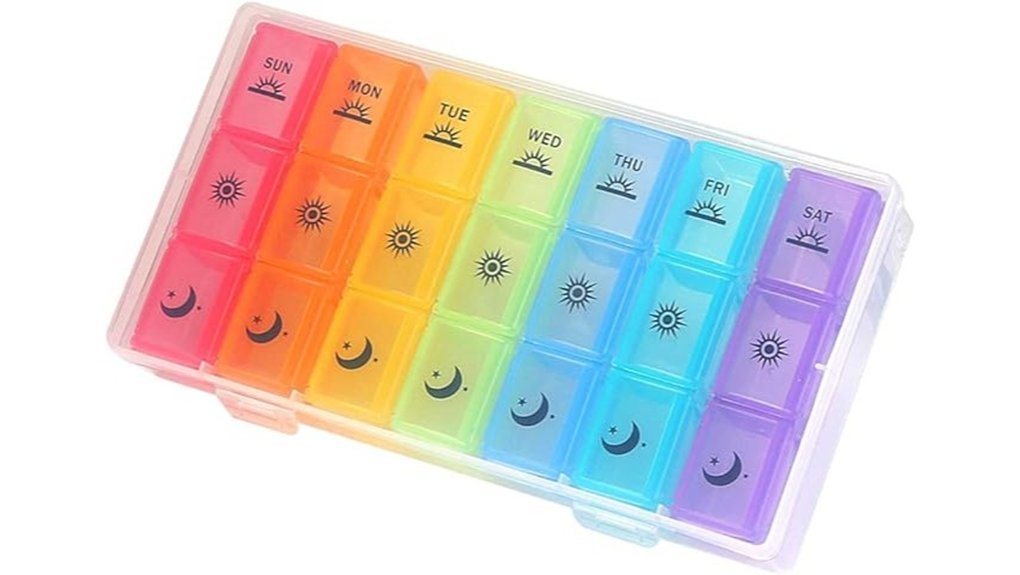
Best for three daily doses: This 7-day pill organizer provides 21 compartments, separating morning, noon, and night doses for each day of the week. Its removable daily boxes make it easier to carry only one day when leaving home, while the translucent construction lets you check whether a compartment is empty without opening it.
At roughly 4.33 x 1.37 x 8.26 inches, it is larger than a pocket pill case but offers considerably more scheduling structure. The manufacturer markets the design as moisture-resistant and portable.
Best For: People who need three clearly separated dosing periods per day.
Pros:
- Morning, noon, and night sections simplify three-times-daily routines.
- Seven removable daily boxes provide grab-and-go flexibility.
- Translucent construction makes dose checking easier.
Cons:
- Requires weekly refilling.
- More cumbersome than a simple daily travel case.
- Individual dose compartments may be restrictive for multiple large supplements.
AUVON Weekly Pill Organizer with Large Compartments
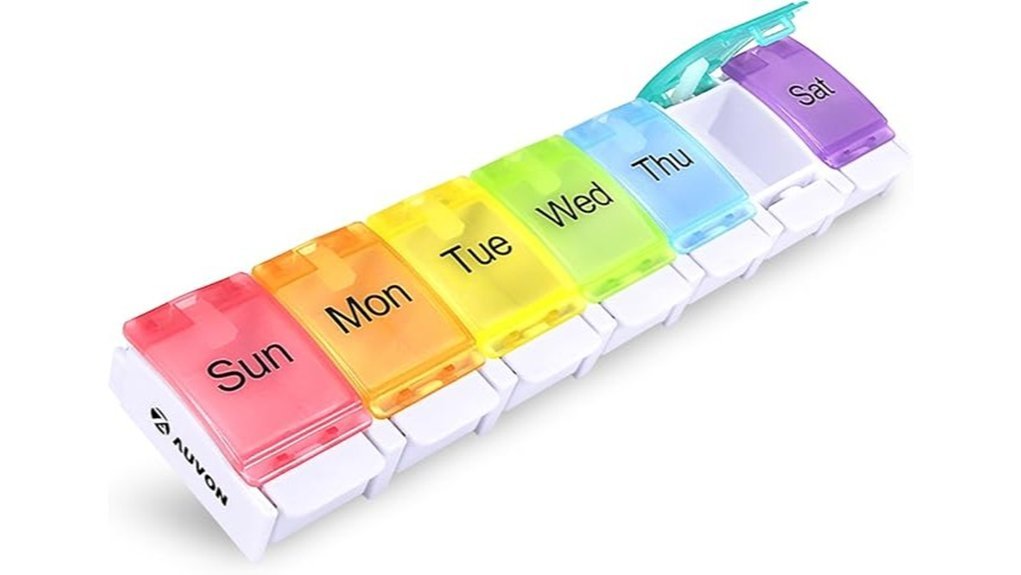
Best for easy opening: The AUVON Weekly Pill Organizer uses spring-assisted lids and rubber grip areas to make one-handed opening easier. Its seven large daily compartments are designed for medications and bulky supplements, with advertised capacity of up to 8 fish-oil capsules or 12 large vitamins per compartment.
The push-button closure helps reduce accidental opening, while the colored, clearly marked lids make it easy to identify the day. However, the closure should not be assumed to be certified child-resistant packaging.
Best For: Users who need one roomy compartment per day and prefer easier-opening lids.
Pros:
- Spring-assisted lids are convenient for users with limited hand strength.
- Large daily compartments accommodate many common pills and supplements.
- Clear day markings improve weekly tracking.
Cons:
- Only one compartment is provided per day.
- Not ideal when morning and evening doses must remain separated.
- Larger daily sections make the case less compact than minimalist travel organizers.
Sukuos AM PM Weekly Pill Organizer, 7-Day, Rainbow
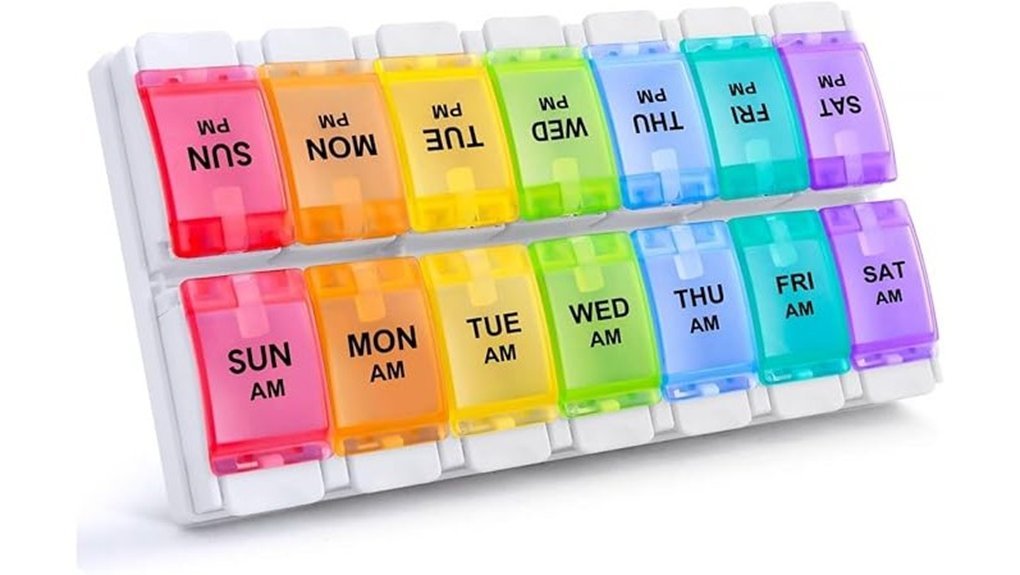
Best for easy-open AM/PM planning: The Sukuos AM PM Weekly Pill Organizer combines push-button opening with separate morning and evening sections. The two sections can be detached, allowing you to carry only the half needed for part of the day.
The organizer measures approximately 9 x 4.5 x 1.2 inches. Each compartment is advertised to hold up to 8 fish-oil capsules or 9 vitamins, although actual capacity depends on pill shape and size. Bold day markings help users quickly identify each scheduled dose.
Best For: People who take medication or supplements twice daily and value easy-open lids.
Pros:
- AM/PM layout separates morning and evening doses clearly.
- Push-button lids require less prying than traditional snap tabs.
- Detachable sections make partial-day travel more convenient.
Cons:
- Not suitable for routines requiring three or four separated doses per day.
- The full case is larger than an ultra-compact travel organizer.
- Advertised pill capacity varies with capsule and tablet dimensions.
Zannaki Metal Travel Weekly Pill Organizer
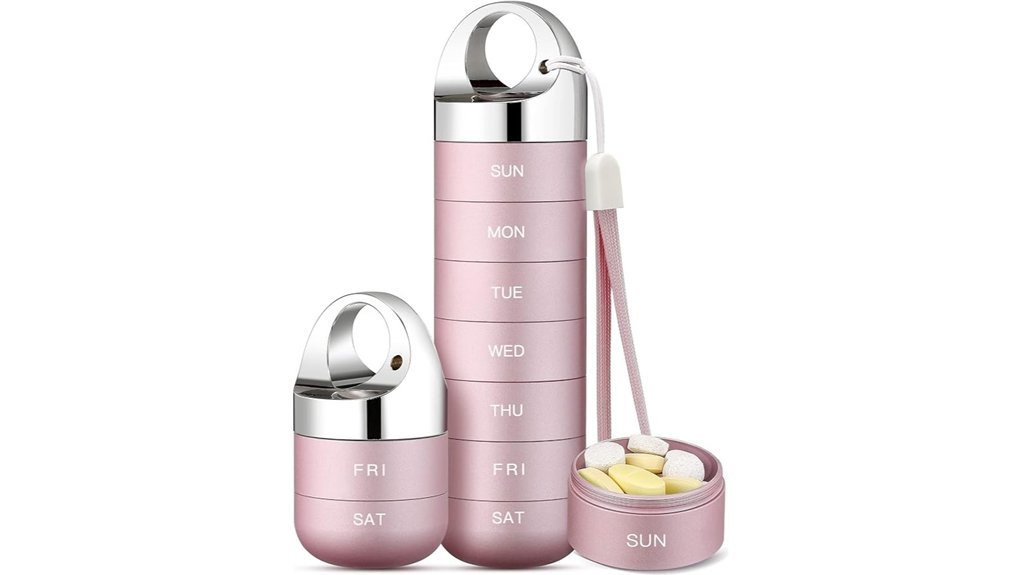
Best for rugged travel: The Zannaki Metal Travel Pill Organizer uses an aluminum-alloy outer construction and seven weekly compartments. Rubber O-rings around the compartments are part of the manufacturer’s waterproof and airtight design, making this model more rugged than a basic thin-plastic pill case.
Its metal construction may appeal to campers and frequent travelers who want a sturdier container. Even with sealing rings, medications that require original packaging or specific humidity control should remain stored according to their label instructions.
Best For: Travelers who prioritize a sturdy metal case and individually separated daily compartments.
Pros:
- Aluminum-alloy body is more rigid than typical lightweight plastic cases.
- Seven compartments support a simple weekly schedule.
- Rubber sealing rings help limit everyday water and moisture exposure.
Cons:
- Metal construction is heavier than plastic alternatives.
- Does not provide separate AM/PM sections.
- Its sealed design is not a substitute for medication-specific storage requirements.
4PS Travel Pill Organizer 10-Compartment Folding Case
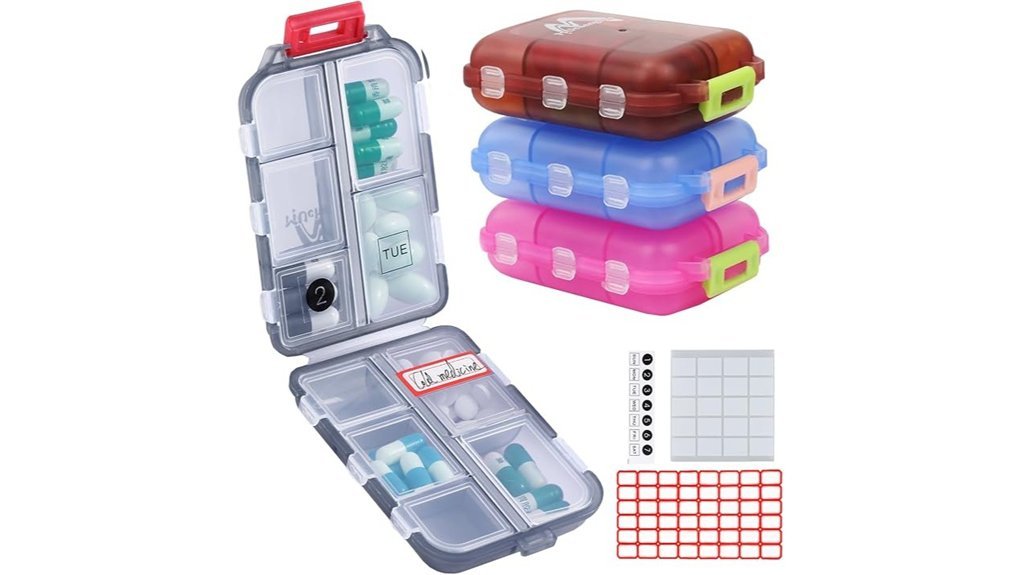
Best for flexible compartment sorting: The 4PS Travel Pill Organizer uses 10 compartments, including four larger and six smaller sections. That mixed-size layout is useful when you need to separate different tablets, capsules, or supplements without following a standard seven-day schedule.
The set includes 164 labels for creating your own organization system. Its folding design and BPA-free food-grade PP construction make it practical for short trips and everyday carry.
Best For: Travelers and commuters who want different compartment sizes rather than a fixed day-by-day pill planner.
Pros:
- Ten mixed-size compartments provide flexible sorting.
- Folding design is compact enough for travel bags.
- Included labels support customized organization.
Cons:
- No built-in weekly or AM/PM schedule.
- Small compartments may not fit bulky supplements.
- More manual labeling is required than with a dedicated weekly organizer.
Sukuos Weekly Pill Organizer with AM/PM Compartments
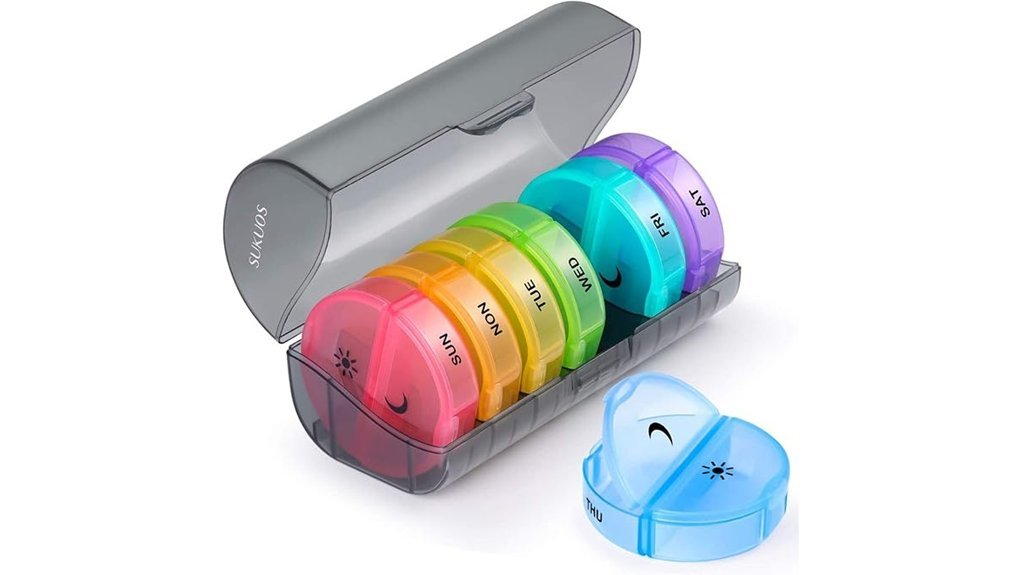
Best for detachable daily carry: The Sukuos Large Weekly Pill Organizer separates seven days into AM and PM doses and uses individual daily cases that can be removed from the outer holder. This makes it easy to take one day’s medication rather than carrying the entire week.
The organizer is about 5.94 x 2.83 x 2.62 inches. Each compartment is advertised to accommodate up to 6 fish-oil capsules, 7 vitamins, or 14 capsules, although actual capacity depends on pill size.
Best For: People who take morning and evening doses and want removable daily cases.
Pros:
- AM/PM separation makes twice-daily routines straightforward.
- Individual daily boxes are convenient for travel or work.
- Large compartments accommodate a range of tablets and supplements.
Cons:
- Only two dosing periods are available per day.
- The outer holder adds bulk compared with carrying one daily case.
- Weekly format still requires regular refilling.
TookMag XL 28-Day Monthly Pill Organizer
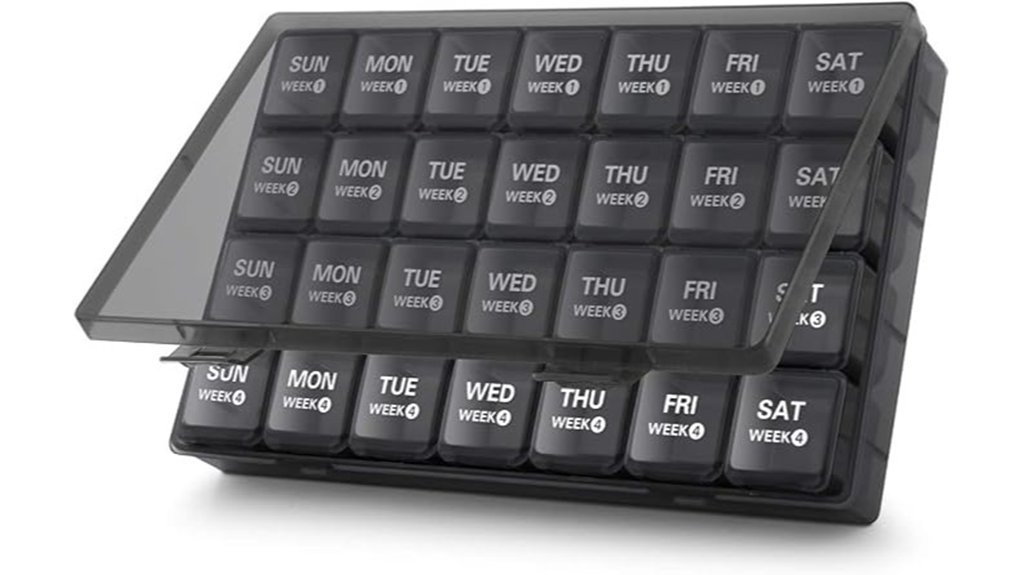
Best for large monthly planning: The TookMag XL 28-Day Monthly Pill Organizer is designed around four weeks of daily pill storage. The full organizer measures approximately 9.45 x 5.9 x 1.5 inches, with individual weekly cases that can be removed when you do not need the entire monthly system.
Each compartment is advertised to hold up to 9 fish-oil capsules or 10 large vitamins. Food-grade PP is used for the pill sections, while the outer container is made from ABS plastic. The large format is useful for people who prefer preparing several weeks at once.
Best For: Users who want a roomy 28-day medication or supplement organizer with removable weekly sections.
Pros:
- 28-day design reduces the need to refill a small organizer every few days.
- Large daily compartments suit many bulky supplements.
- Removable weekly cases provide more flexibility for travel.
Cons:
- Large overall footprint takes more storage space.
- Not a dedicated AM/PM or multi-dose-per-day organizer.
- May be excessive for users taking only one or two small pills daily.
AUVON Large Weekly Pill Organizer, 4 Times Daily
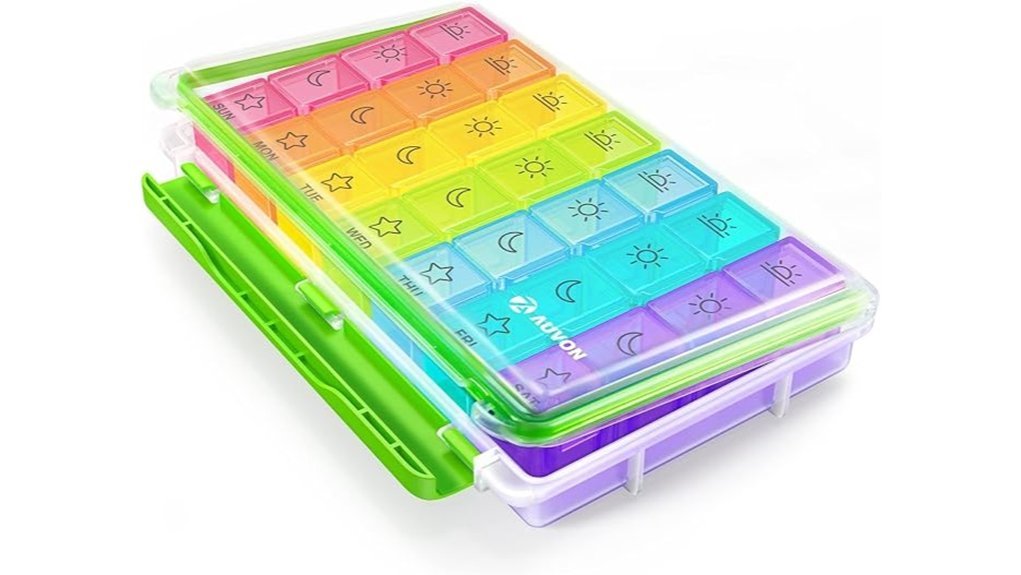
Best for four daily doses: The AUVON Large Moisture-Proof Weekly Pill Organizer separates each day into four dosing periods. Seven removable daily containers allow you to carry one day at a time, while color coding and translucent plastic make it easier to see which doses remain.
Each dose compartment measures approximately 1.1 x 0.9 x 0.9 inches. Snap-on lids are designed to stay closed during normal use and reduce accidental spills.
Best For: People who need four clearly separated medication or supplement periods each day.
Pros:
- Four compartments per day support more complex schedules.
- Removable daily containers make grab-and-go use convenient.
- Color coding and translucent material aid quick dose checks.
Cons:
- Individual dose compartments are smaller than single-dose daily organizers.
- Bulky tablets or multiple large supplements may require more space.
- Weekly format requires regular refilling.
Factors to Consider When Choosing a Pill Organizer in 2027
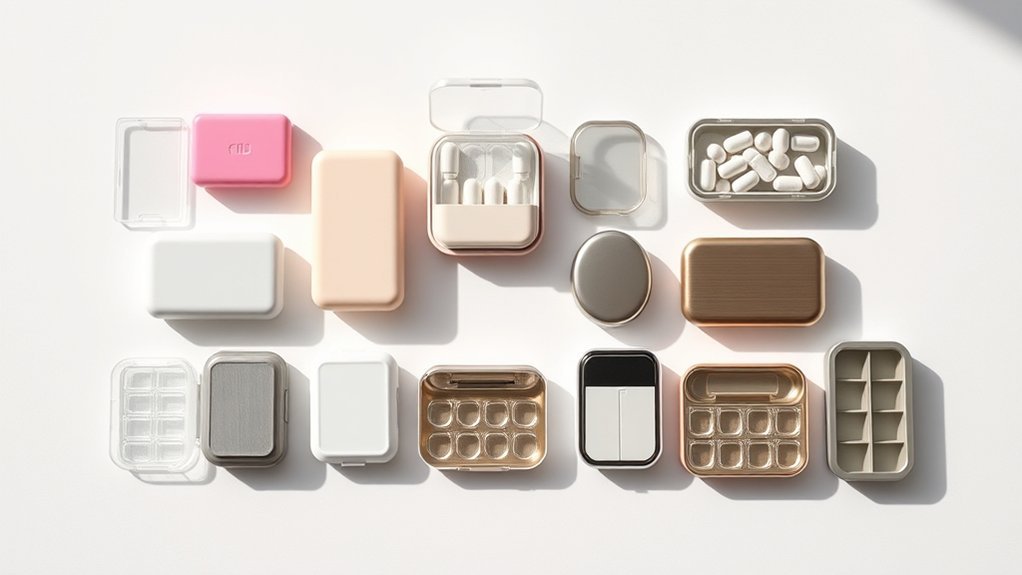
The right pill organizer should match your dosing schedule before anything else. Capacity, compartment dimensions, opening mechanism, portability, labeling, and cleaning requirements can then help narrow the choices. Medication storage instructions should also be checked before transferring pills from their original packaging.
Capacity And Size
Start by counting how many separate dosing periods you need. A simple seven-compartment weekly organizer works for once-daily medication, while AM/PM models separate two doses and three- or four-times-daily boxes handle more complex schedules. Monthly organizers reduce refill frequency but take up more room. Check individual compartment dimensions as well as the organizer’s overall measurements, especially when storing large vitamins, capsules, or fish-oil supplements.
Material Safety
Many pill organizers are marketed as BPA-free or made from food-grade plastics. These features can be useful when comparing construction, but they do not override the storage requirements printed on a medicine label. Look for smooth surfaces, sturdy hinges, secure closures, and materials that can be cleaned according to the manufacturer’s directions. Replace a case if its plastic cracks, warps, develops residue that cannot be removed, or no longer closes properly.
Moisture Protection
Silicone seals, O-rings, and tightly closing lids can help reduce everyday exposure to humidity and splashes. However, terms such as moisture-proof, airtight, or waterproof should not be treated as a guarantee that a pill organizer provides the same protection as the medicine’s original packaging. If a medicine must remain in its original bottle, blister pack, or container with a desiccant, follow those instructions.
Locking Mechanisms
A dependable closure helps stop compartments from opening inside a bag and mixing doses. Push-button lids, snap closures, double-lock cases, and screw-style designs all provide different balances of access and security. Users with arthritis or limited hand strength may prefer spring-assisted or push-button designs. In homes with children, remember that an ordinary locking pill organizer is not automatically a certified child-resistant container, so medication should still be stored securely out of sight and reach.
Portability Needs
For daily carry, small cases with a handful of compartments are usually easier to fit into a pocket, handbag, or backpack. For scheduled medication, removable daily containers can be more practical because you can leave the larger weekly or monthly holder at home. Frequent travelers should balance capacity against bulk and choose a closure that is unlikely to open accidentally in transit.
Label Clarity
Clear day and dosing-time labels can reduce confusion, particularly with AM/PM or multi-dose schedules. Large text, contrasting colors, engraved markings, or durable printing are useful for repeated handling. If labels begin to fade or become difficult to read, replace the organizer or use clearly legible replacement labels rather than relying on memory.
Cleaning Ease
Choose a pill organizer that can be cleaned without damaging its hinges, labels, seals, or locking mechanism. Removable trays and simple compartment shapes make residue easier to reach. Unless the manufacturer specifically states that the organizer is dishwasher-safe, handwashing with mild soap and water is the safer approach. Allow every compartment and seal to dry completely before refilling it.
Frequently Asked Questions
How Do I Clean Pill Organizers Safely?
Follow the manufacturer’s cleaning instructions first. For many plastic organizers, gentle handwashing with mild soap and warm water is appropriate. Rinse thoroughly and allow every compartment to dry completely before adding pills. Avoid harsh cleaners that could damage plastic, printing, or sealing materials.
Are Pill Organizers Dishwasher-Safe?
Some are, but many are not. Dishwasher heat can warp plastic, loosen seals, or damage printed day labels. Unless the manufacturer specifically lists the organizer as dishwasher-safe, handwashing is the more cautious option.
Can Pill Organizers Keep Vitamins Separate From Medications?
Yes. Models with multiple compartments can separate vitamins, supplements, and medications by day or dosing time. Label the compartments clearly and make sure each product can safely be removed from its original packaging before combining it into an organizer.
How Often Should I Replace a Pill Organizer?
There is no universal replacement interval. Replace the organizer when lids become loose, hinges crack, plastic warps, labels are difficult to read, seals are damaged, or the compartments can no longer be cleaned properly.
Do Pill Organizers Work for Liquid Supplements?
Standard pill organizers are intended for solid tablets and capsules, not liquids. Use the liquid supplement’s original container or a dispenser specifically designed and approved for liquid storage and measurement.
Can Every Medication Be Put in a Pill Organizer?
No. Some medications need protection from moisture, light, air, or temperature changes, and some should remain in their original packaging. Check the medicine label or ask a pharmacist before transferring medication into a pill organizer.
Conclusion
The best pill organizer depends primarily on how often you take medication and how much storage space you need. The Holii and 4PS cases are compact choices for flexible travel storage, while the AUVON and TookMag 28-day systems reduce refill frequency. Sukuos AM/PM models work well for twice-daily routines, and the AUVON four-times-daily organizer provides greater separation for more complex schedules.
Before choosing, compare the actual compartment dimensions with your pills, decide whether removable daily sections would be useful, and consider how easily you can open and read the organizer. Most importantly, follow the storage instructions for each medication rather than assuming that a moisture-resistant or locking pill box can replace specialized original packaging.