Affiliate Disclosure: This page contains affiliate links. If you purchase through a link, we may earn a commission at no extra cost to you.
If you are considering the Weber iGrill Mini, the main question is whether its compact, single-probe Bluetooth setup fits the way you cook. It can monitor food temperature from a compatible phone, offers up to a 150-foot line-of-sight Bluetooth range, and is designed for simple grilling, smoking, and roasting without repeatedly opening the cooker.
It is also an older connected-thermometer platform. That makes current app compatibility, the single-probe limit, and its lack of Wi-Fi important considerations before buying. This guide explains what the iGrill Mini does well, where it falls short, and what to check before ordering.
Quick Verdict
The Weber iGrill Mini makes the most sense for a cook who wants one compact Bluetooth probe, simple phone alerts, magnetic mounting, and no separate handheld receiver. It is less suitable if you need multiple probes, Wi-Fi monitoring, or a newer connected platform with longer-term software support. Check current app compatibility and Amazon availability before buying.
Weber iGrill Mini
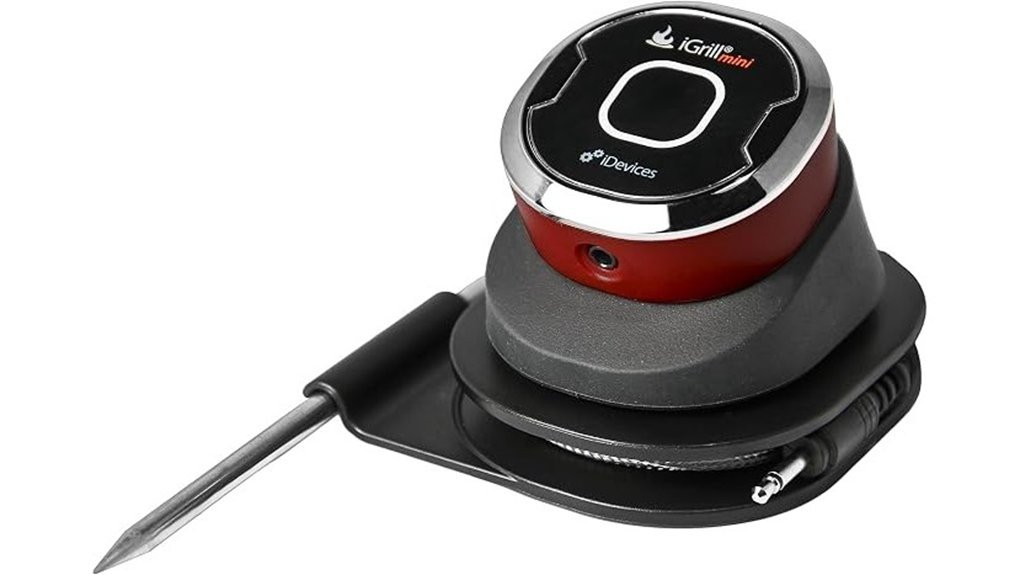
The Weber iGrill Mini is a compact app-connected cooking thermometer built around a simple idea: leave one probe in your food and monitor its temperature from a compatible smartphone instead of constantly opening the grill, smoker, or oven.
Older listings may still identify the product as the iDevices iGrill Mini. Weber acquired the iGrill product line from iDevices, and current Weber documentation refers to the product as the Weber iGrill Mini and uses the Weber iGrill app.
Its biggest strengths are simplicity and size. The thermometer has single-probe capacity, a magnetic base, temperature alerts, timers, and a stated Bluetooth range of up to 150 feet in straight line-of-sight conditions. Weber also rates battery life at up to 150 hours.
Best For: Home cooks and grillers who mainly need to monitor one piece of meat at a time and prefer phone-based Bluetooth alerts over carrying a separate receiver.
Who Should Avoid It: Buyers who need several probes at once, Wi-Fi monitoring beyond normal Bluetooth range, or a newer smart-thermometer platform with more current software support.
Why You May Like It: The iGrill Mini removes much of the guesswork from long cooks without adding a large control unit. You can set a target temperature in the app, leave the probe in the food, and receive an alert as the cook approaches the selected target.
Pros:
- Compact single-probe design is easy to store and move between cooking setups.
- Up to 150-foot line-of-sight Bluetooth range can cover many kitchens, patios, and backyard grilling areas.
- Magnetic mounting makes positioning convenient on a suitable cool metal surface.
- Temperature alerts and timers reduce the need to constantly check the food manually.
- Up to 150 hours of rated battery life can cover many cooking sessions between battery changes.
Cons:
- Only one probe can be connected, so you cannot independently monitor several foods or food plus pit temperature at the same time.
- Bluetooth range can decrease considerably through walls, metal grills, and other obstacles.
- It depends on a compatible mobile device and the Weber iGrill app.
- The iGrill platform is older, so current app compatibility should be checked before purchase.
- The thermometer and probe system are not designed to be submerged in water.
Weber iGrill Mini Quick Specs and Buying Notes
| Feature | What to Know |
|---|---|
| Connection | Bluetooth through the Weber iGrill app |
| Advertised Range | Up to 150 feet / 45 meters in straight line-of-sight conditions |
| Probe Capacity | One probe |
| Battery Life | Up to 150 hours according to Weber |
| Mounting | Magnetic base; keep the base on a cool surface |
| Water Protection | Not waterproof; do not submerge the device or probe wiring |
| Main Limitation | Older app-based platform and single-probe monitoring |
What to Check Before Buying the Weber iGrill Mini
The iGrill Mini is straightforward, but a few details can determine whether it is convenient or frustrating in your kitchen. Check the wireless range you actually need, how many temperatures you want to monitor, your phone compatibility, and how you plan to position and clean the probe.
Bluetooth Range
Weber specifies a Bluetooth range of up to 150 feet in straight line-of-sight conditions. Treat that as a best-case maximum rather than a guaranteed indoor distance. Walls, closed grill lids, metal surfaces, house construction, and wireless interference can reduce the usable range.
For a grill directly outside the kitchen or a smoker on a nearby patio, Bluetooth may be sufficient. If you want to monitor a cook from a distant room, another floor, or while away from home, a Wi-Fi-based thermometer may better match that use case.
Single-Probe Capacity
The iGrill Mini has one probe channel. That keeps operation simple, but it is an important limitation for barbecue and meal prep. You can monitor one food temperature at a time, rather than tracking several steaks, two large cuts, or both food and smoker temperature independently.
If most of your cooks involve one roast, one chicken, or one large cut of meat, one probe may be enough. Frequent smoking or multi-item cooking generally benefits from a multi-probe system.
App and Phone Compatibility
The iGrill Mini uses the Weber iGrill app. Weber’s product information lists compatibility requirements for supported Apple and Android devices, but this is an older connected-product platform and software requirements can change as phones and operating systems are updated.
Before You Buy
Confirm that the Weber iGrill app is currently available for your phone and that your device can connect to the iGrill Mini. Weber’s published security-update support periods for the iGrill Mini and listed iGrill app versions have ended, so buyers should not assume the same long-term software support offered by a newer connected thermometer.
Temperature and Heat Limits
Do not treat the thermometer body, magnetic base, probe tip, and probe cable as if they all have the same heat tolerance. Weber’s instructions say the magnetic base must remain on a cool surface and that probe wiring should be routed away from direct flames and excessive heat.
Probe limits can also differ depending on the exact Weber probe being used. Follow the limit supplied with your probe rather than placing the wire directly over flames or the hottest part of a grill. The iGrill documentation also limits the temperature range displayed through the app, so this is a cooking-monitoring tool rather than a general-purpose high-temperature instrument.
Cleaning and Water Resistance
The iGrill Mini is not waterproof. Clean the probe according to Weber’s instructions and avoid immersing the probe wiring, connector, or thermometer body. Moisture at the cable connection can damage the probe and lead to unreliable readings.
For routine cleanup, focus on the food-contact portion of the metal probe and keep the cable and electronics as dry as possible.
Battery Life
Weber rates the iGrill Mini for up to 150 hours of battery life. Actual runtime can vary with use, connection behavior, temperature, and battery condition. Keeping a spare compatible battery available is sensible if you frequently run long smoking sessions.
Temperature Alerts and Monitoring
The app can provide target-temperature alerts, timers, and preset cooking options. These features are useful because you can monitor progress without repeatedly lifting a grill or smoker lid and losing heat.
However, an alarm is only as useful as the probe placement. Insert the sensing portion into the thickest appropriate area of the food while avoiding bone where possible, and verify unusual readings rather than relying blindly on a preset.
Food-Safety Temperatures
A thermometer preset and a safe minimum internal temperature are not always the same thing. For food safety, current USDA guidance calls for whole cuts of beef, pork, veal, and lamb to reach at least 145°F with a three-minute rest, ground meats to reach 160°F, and poultry to reach 165°F. Fish is generally listed at 145°F.
Use the thermometer to verify the internal temperature in the correct part of the food rather than relying only on color, cooking time, or an app’s preferred doneness label.
Who Should Buy the iGrill Mini?
The iGrill Mini is most appealing when simplicity matters more than advanced connectivity. It fits cooks who normally monitor one food item, keep their phone reasonably close to the grill or oven, and like app-based temperature alarms without a large receiver or multi-probe control box.
It is harder to recommend for a serious smoker setup where you want to track several cuts plus pit temperature, or for anyone who expects Wi-Fi access and modern long-term app support. In those situations, a newer multi-probe or Wi-Fi design may be worth considering instead.
Frequently Asked Questions
Is the iDevices iGrill Mini the Same as the Weber iGrill Mini?
The iGrill product line originally came from iDevices, but Weber acquired the iGrill business in 2016. Current manufacturer documentation calls the product the Weber iGrill Mini. Older packaging and Amazon listings may still use the iDevices name.
Does the iGrill Mini Use Wi-Fi?
No. The iGrill Mini uses Bluetooth to communicate with a compatible smartphone or tablet. That means its practical monitoring distance is limited by Bluetooth range and by obstacles such as walls and metal grill bodies.
How Far Does the iGrill Mini Work?
Weber lists a maximum Bluetooth range of up to 150 feet, or about 45 meters, in straight line-of-sight conditions. Real-world indoor or backyard range may be shorter because walls, metal, and wireless interference can weaken the signal.
Can the iGrill Mini Monitor Meat and Smoker Temperature at the Same Time?
Not with one iGrill Mini. It has a single probe channel, so it monitors one connected probe at a time. Buyers who need simultaneous food and pit monitoring should look for a thermometer with multiple probe channels.
Is the iGrill Mini Waterproof?
No. Weber states that the product is not waterproof. Do not submerge the thermometer or probe wiring, and follow the manufacturer’s cleaning instructions for the metal probe.
Can the iGrill Mini Probe Stay in Food While Cooking?
Yes, the compatible leave-in cooking probe is designed to monitor food during cooking. Keep the thermometer base on a cool surface, route the cable away from direct flame, and follow the heat limit for the exact probe you are using.
Does the iGrill Mini Still Have App Support?
Weber continues to publish iGrill Mini product and support information, but the iGrill platform is an older connected system and Weber’s published security-update support periods for the iGrill Mini and listed iGrill app versions have ended. Check current app availability and compatibility with your phone before ordering.
How Often Does the iGrill Mini Battery Need Replacement?
Weber rates battery life at up to 150 hours. Replacement frequency therefore depends on how often and how long you use the thermometer. Checking the battery before an overnight or all-day cook can help prevent an interruption.
Conclusion
The Weber iGrill Mini remains a simple option for cooks who want one leave-in probe, Bluetooth phone monitoring, temperature alerts, a compact magnetic design, and minimal setup. Its biggest advantages are convenience and simplicity rather than advanced connectivity.
The main tradeoffs are equally important: it monitors only one probe, Bluetooth range depends heavily on the cooking environment, the electronics are not waterproof, and the iGrill ecosystem is an older software platform. Check current phone compatibility and product availability before buying. If those limitations fit your cooking routine, the iGrill Mini can still provide a straightforward way to monitor food without repeatedly opening the grill, smoker, or oven.
Final Buying Check
Choose the iGrill Mini if one Bluetooth probe is enough for your cooking. If you need several probes, Wi-Fi monitoring, or a newer connected platform, compare newer designs before purchasing.