Affiliate disclosure: As an Amazon Associate I earn from qualifying purchases. This article contains affiliate links to Amazon, so we may earn a commission if you buy through them, at no extra cost to you.
The 4 best resistance bands for 2026 include Heavy Resistance Exercise Bands with handles, the HPYGN Door Anchor for secure setups, THERABAND green bands for rehab and progression, and a Pull-Up Assist Resistance Band Set for stretching and strength work. These options stand out for durability, portability, and consistent resistance across home, gym, and travel use. Each one supports different training goals, and a closer look reveals how the right choice depends on intended use.
Heavy Resistance Exercise Bands with Handles for Workout
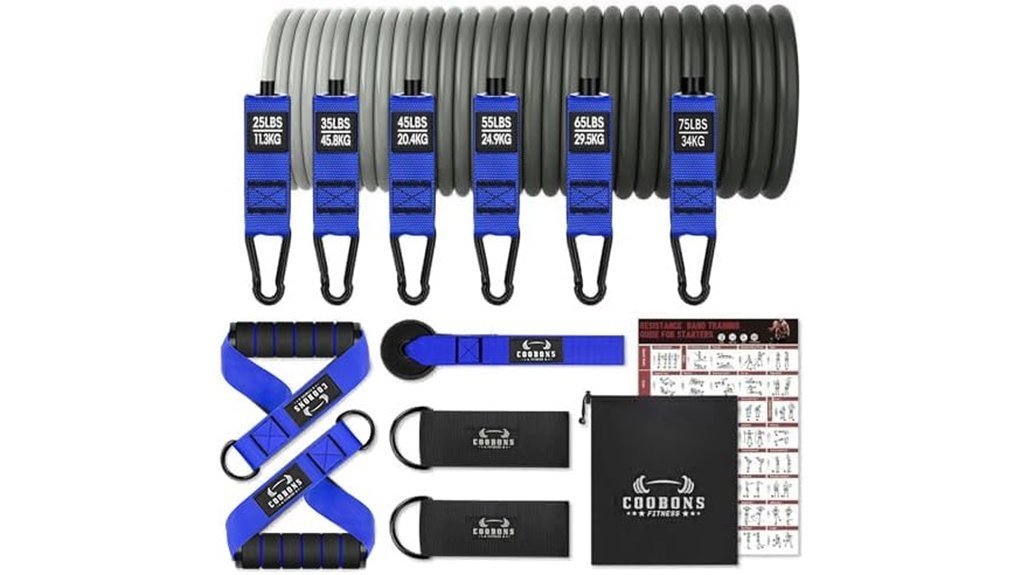
The Heavy Resistance Exercise Bands with Handles for Workout are a strong choice for sports and fitness enthusiasts who want a versatile tool for muscle training, fat burning, and home workouts. Their heavy resistance supports squats, push-ups, leg raises, and planks, making them useful in compact home gym setups. Included ankle straps help target leg muscles, while the bands also support coordination, stamina, and flexibility. They can assist in shaping the hips, chest, and abdomen. Suitable for beginners and advanced users, COOBONS FITNESS offers black and blue 51-inch versions for training and rehabilitation.
Best For: Sports and fitness enthusiasts, beginners to advanced users, and anyone seeking a versatile resistance band for home workouts, muscle training, and rehabilitation.
Pros:
- Supports a wide range of exercises, including squats, push-ups, leg raises, and planks.
- Helps improve muscle strength, coordination, stamina, flexibility, and targeted leg training.
- Useful for both fitness training and physical therapy, including joint support and recovery.
Cons:
- Heavy resistance may be challenging for absolute beginners or users needing very light resistance.
- Limited color and size options may not suit everyone’s preferences.
- Best suited for band-based training, so it may not replace more complete gym equipment for all goals.
HPYGN Door Anchor for Resistance Bands
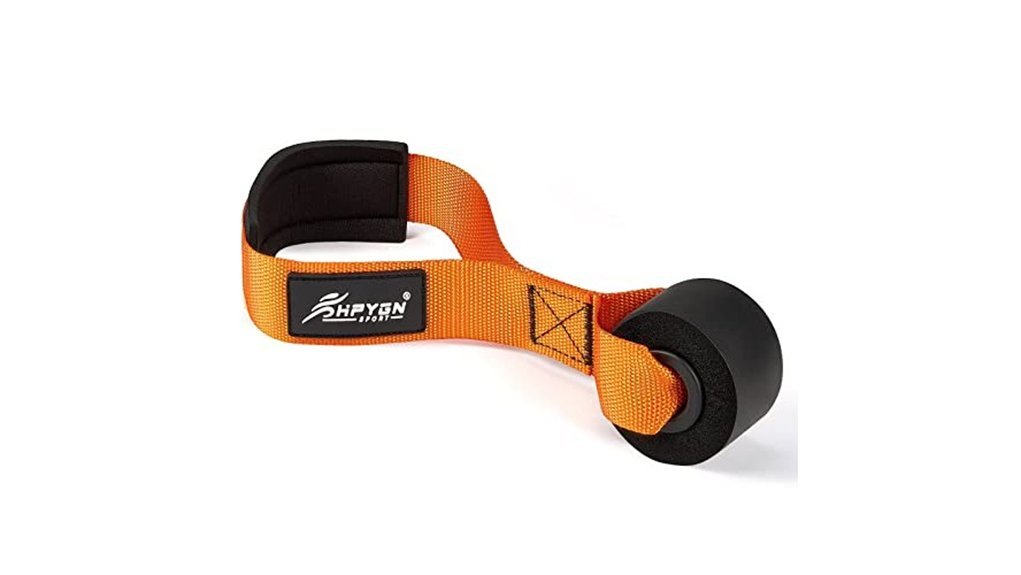
HPYGN’s door anchor suits users who want a secure, portable setup for band-based training. Designed for yoga straps, physical therapy bands, and closed loop bands, it uses thick nylon webbing and heavy-duty stitching for dependable durability. Dense foam padding helps prevent door scratches and band wear, while creating friction that keeps attachments stable during exercise. The anchor installs in two simple steps by closing and locking the door. Its 2-inch stopper and 1.46-inch width support versatile mounting. Lightweight and travel-friendly, it fits yoga, Pilates, stretching, and strength routines, and serves well as a practical gift.
Best For: People who want a secure, portable door anchor for resistance bands, yoga straps, physical therapy, stretching, and home or travel workouts.
Pros:
- Thick nylon webbing and heavy-duty stitching add durability and stability.
- Soft dense foam helps protect door frames and reduces wear on bands.
- Lightweight, easy to install, and convenient to pack for travel.
Cons:
- Requires a door to be closed and locked for use, so it is not universally compatible.
- Best suited for band-based exercises rather than a full range of gym equipment.
- Orange color may not appeal to users who prefer a more neutral look.
THERABAND Resistance Bands, Workout Band, Exercise, Physical Therapy, Green

THERABAND’s green heavy band suits rehab users and intermediate trainees needing measurable progression. Model 20040 uses THERABAND’s color-coded system, placing it fourth of eight resistance levels. Made from natural rubber latex, the 6-yard by 5-inch band delivers controlled positive and negative force for stretching, toning, and conditioning major muscle groups. It provides 4.6 pounds at 100% elongation and 6.7 pounds at 200%, a 25% increase over the prior level. Its portability supports clinic, home, gym, and travel use. The design emphasizes strength, range of motion, and flexibility development.
Best For: Rehab users and intermediate exercisers who want a portable, measurable resistance band for stretching, toning, and progressive strength training.
Pros:
- Color-coded progressive resistance makes it easy to track improvement.
- Provides controlled positive and negative force for effective rehab and conditioning.
- Portable and versatile for use at home, in the gym, clinic, or while traveling.
Cons:
- Heavy resistance may be too challenging for beginners.
- Latex material may not be suitable for users with latex sensitivities.
- Sold as a long band, so some users may need to cut or adjust it for certain exercises.
Resistance Bands for Pull Up Assist, Stretch Bands & Exercise Workout Set
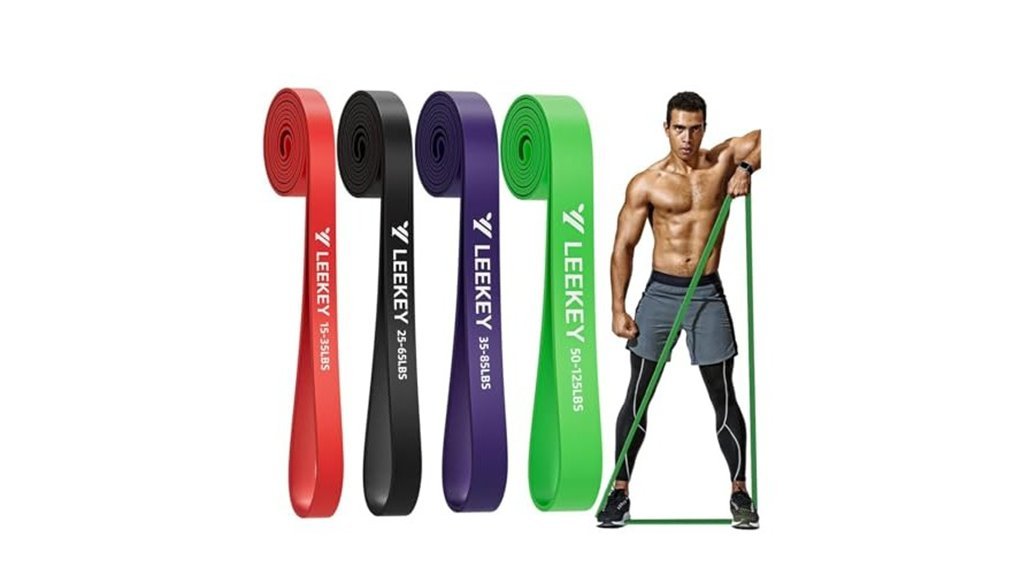
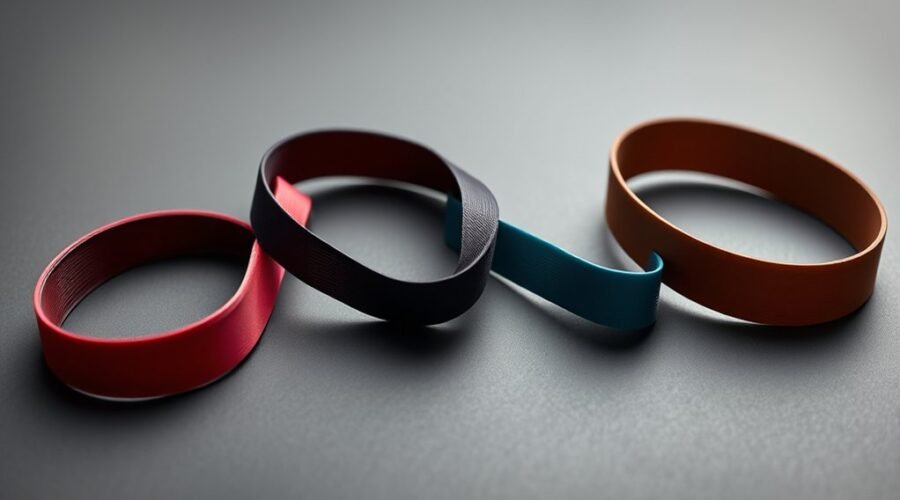
LEEKEY’s pull-up assist resistance band set suits users wanting a compact all-in-one home gym. It includes four natural rubber bands, a carry case, and an exercise guide, making it practical for home, office, or travel use. The resistance range spans 15 to 125 pounds, with red, black, purple, and green bands supporting different strength levels. The set handles pull-up assistance, stretching, warm-ups, cool-downs, and flexibility work. Its 100% natural rubber construction delivers smooth resistance, flexibility in cold weather, and reliable durability against tearing, cracking, and snapping.
Best For: People looking for a compact, versatile resistance band set for pull-up assistance, stretching, and all-around home, office, or travel workouts.
Pros:
- Includes four resistance levels, making it easy to progress without buying another set.
- Made from 100% natural rubber for smooth resistance, flexibility, and durability.
- Comes with a carry case and exercise guide for convenient storage and use anywhere.
Cons:
- Not as specialized as larger gym equipment for advanced strength training.
- Resistance bands may not provide enough challenge for very strong users at the highest level.
- Requires proper care to maximize lifespan and prevent wear over time.
Factors to Consider When Choosing Resistance Bands 2026: Top Picks and Buying Guide
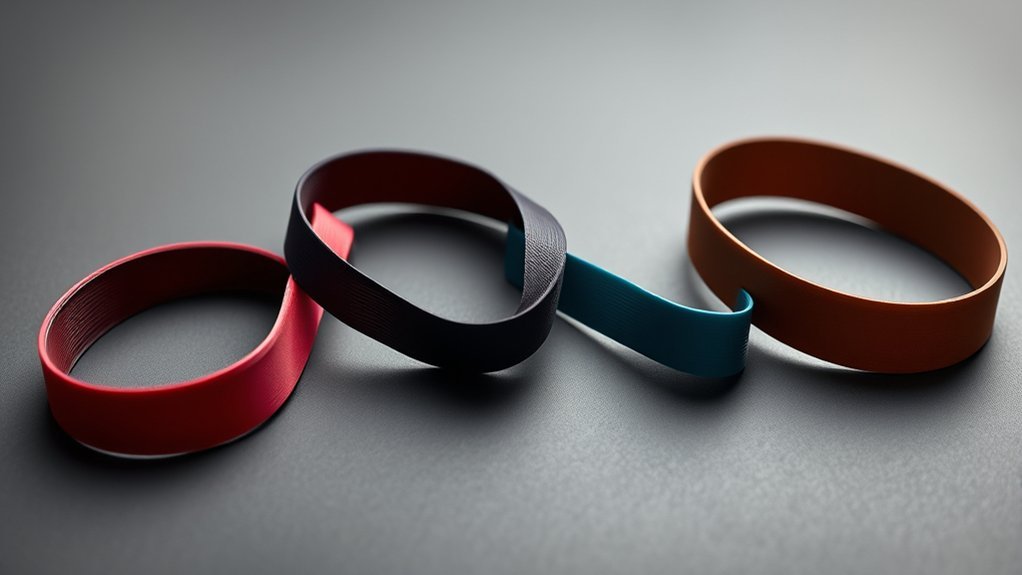
Choosing the right resistance bands in 2026 starts with matching the band type to the intended use, whether for strength training, mobility, or assisted pull-ups. Resistance levels should be clear and appropriate, while material durability, anchors, and included accessories affect both safety and performance. Portability and storage also matter, especially for users who need a compact option for travel or small spaces.
Band Type And Use
Resistance bands are not one-size-fits-all; the best choice depends on how they will be used. Heavy bands suit strength training, muscle building, and fat-burning routines, while lighter bands are better for stretching and rehabilitation. Exercise goals should guide selection, whether the focus is physical therapy, flexibility, or full-body conditioning. Bands with handles improve grip and control during squats and push-ups, making them practical for many home workouts. Door anchors expand training options by allowing varied angles and anchored movements. Progressive, color-coded bands help users follow gradual changes in difficulty and monitor improvement over time. Material also matters: natural rubber offers durability and steady tension, supporting consistent performance indoors or outdoors.
Resistance Levels Explained
Band selection also comes down to how much force the band delivers. Resistance bands are typically color-coded so users can match strength to fitness level and training goals. Light bands, often around 15 to 35 pounds, suit beginners and rehabilitation work, while heavier options, roughly 50 to 125 pounds, support advanced strength training. As training capacity improves, moving to higher resistance helps keep muscles challenged and can build strength, flexibility, and endurance. Resistance also changes with stretch, so the same band may feel easier at the start of a movement and harder at full elongation. That variation can improve muscle engagement by loading both the lifting and lowering phases, making workouts efficient across major muscle groups.
Material Durability Matters
Durability is a key factor in any resistance band purchase. Bands made from high-quality natural rubber are often preferred because they hold flexibility over time, even in cold conditions, and provide smooth, even resistance. For demanding routines, thick nylon webbing and heavy-duty stitching can improve tear strength and help the band stay stable during intense workouts. A dependable band should resist tearing, cracking, and snapping, since those failures shorten service life and raise long-term cost. Material quality also influences performance consistency, so stronger construction usually means better value. Secure designs with padding can further protect the user and reduce wear on the band itself, helping preserve performance. Choosing durable materials supports safer training and longer-lasting results.
Anchors And Accessories
A dependable anchor can make resistance band training far safer and more effective. The best options use thick nylon webbing, reinforced stitching, and padded contact points to keep bands secure under tension. Simple installation matters too; many effective models rely on a two-step setup that fastens neatly to a door frame without hassle. Compatibility is equally important, since a strong anchor should work with loop bands, tube bands, and handles across yoga, Pilates, and strength routines. Soft padding helps protect both the frame and the band from wear, reducing scratches and friction. Lightweight, compact designs also add convenience, allowing users to move between workout spaces with little effort while preserving stable performance and consistent resistance.
Portability And Storage
Beyond secure anchors, portability and storage are major reasons resistance bands remain a practical training tool. Their lightweight, compact form makes them simple to slip into a gym bag or suitcase, supporting workouts while traveling or commuting. Many sets include carrying cases that keep bands sorted and easy to transport, reducing tangles and clutter. At home, the same low-profile design lets them fit neatly in drawers, closets, or small shelves without consuming much space. Durability also matters, since bands that resist wear better preserve their shape and performance during repeated packing and use. Stackable or combinable bands add another advantage: users can vary resistance without carrying multiple bulky sets. For many buyers, these storage benefits improve convenience and long-term usability.
Frequently Asked Questions
How Do I Clean Resistance Bands Safely?
Resistance bands should be cleaned with mild soap and lukewarm water, then air-dried fully. Harsh chemicals, heat, and direct sunlight should be avoided to prevent material damage, weakening, or premature cracking.
How Long Do Resistance Bands Usually Last?
Most resistance bands last six months to two years; roughly 30% fail sooner with heavy use. Lifespan depends on material, storage, and exposure to heat or sunlight. Regular inspection helps prevent sudden snapping.
Can Resistance Bands Replace Free Weights Entirely?
Resistance bands cannot fully replace free weights for everyone; they offer useful resistance, portability, and joint-friendly training, but free weights better build maximal strength, stability, and progressive overload in many programs, especially advanced ones.
Are Resistance Bands Suitable for Outdoor Workouts?
Yes, resistance bands are suitable for outdoor workouts, offering portability, versatility, and light equipment needs. They perform well in parks or yards, though secure anchoring and weather conditions can affect safety and durability.
What Should I Do if a Band Snaps During Use?
They should stop immediately, set the band aside, and inspect for wear. A snapped band signals a failed companion; replacing it promptly, wearing eye protection, and checking anchors reduces future mishaps and keeps training composed.
Conclusion
Choosing the right resistance band can turn a simple routine into a steady path toward strength, mobility, and control. From heavy-duty handles to pull-up assist bands, each option offers something useful for different training goals. The best choice depends on comfort, durability, and how well the band fits a workout style. In the end, the right band should feel like a trusted partner, helping every rep pull its own weight.