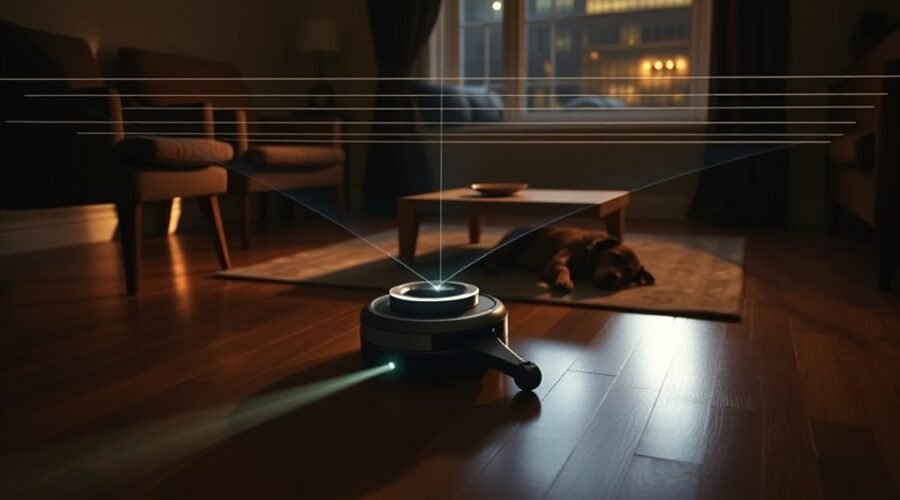
Robot vacuums use LiDAR because it gives them a fast, measurable view of space without depending on ambient light or visual guesswork. The sensor can trace walls, furniture, and open areas with enough precision to support consistent route planning and obstacle avoidance. That advantage is not universal, though. In some homes, the mapping method that looks most advanced is not always the most effective choice.
What Is LiDAR Navigation in Robot Vacuums?
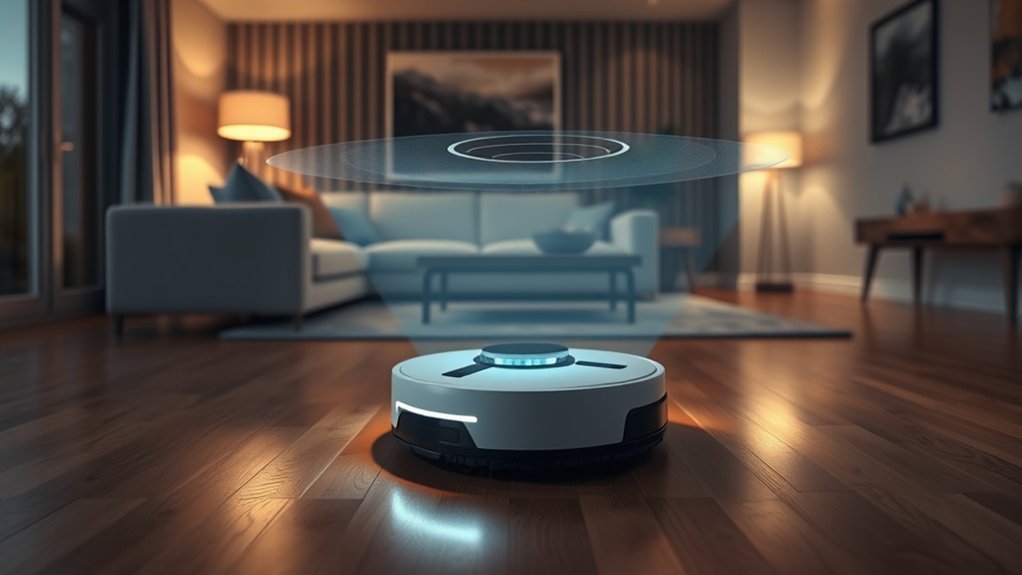
LiDAR navigation in robot vacuums uses laser pulses to measure distances and build accurate 3D maps of surrounding spaces, enabling efficient route planning and obstacle avoidance.
In practice, LiDAR emits laser pulses in multiple directions, then performs distance measurement from return times to construct accurate mapping of rooms, corridors, and furniture. This navigation method supports robot vacuums in homes with complex layouts by maintaining centimeter-level precision, even when lighting conditions are poor.
The resulting map can be retained across sessions, allowing smart cleaning routines, no-go zones, and reduced repetition. Compared with simpler systems, LiDAR improves cleaning efficiency by lowering missed areas and optimizing path selection across multiple rooms.
Its analytical control framework gives the machine a stable spatial model, which helps it move with less uncertainty and more autonomy. For users seeking liberation from manual oversight, LiDAR-based navigation offers a disciplined, adaptive, and efficient cleaning process.
Why LiDAR Beats Cameras for Mapping
Although camera-based systems can function adequately in bright, open spaces, LiDAR delivers more reliable mapping because it measures distance directly with laser pulses rather than inferring structure from visual features.
LiDAR technology achieves millimeter-level distance measurement, producing mapping accuracy above 95 percent even in low-light conditions, while camera systems may lose substantial precision when illumination drops.
By scanning repeatedly with a spinning turret, it forms persistent 3D maps that capture a home’s layout with greater consistency and support navigation in cluttered, complex rooms.
This direct sensing method avoids dependence on texture, color, or ambient light, so the system remains operational in dark environments and through light fog.
The resulting map improves cleaning efficiency by enabling reusable routes and defined no-go zones, which preserve coverage and reduce wasted motion.
For a household seeking autonomy and freedom from manual oversight, LiDAR offers a technically stronger foundation than vision-only mapping.
How LiDAR Robot Vacuums Avoid Obstacles
By emitting rapid laser pulses and measuring their return time, LiDAR robot vacuums construct a detailed 3D map that supports obstacle detection with millimeter-level precision.
This accurate mapping enables obstacle avoidance by separating walls, furniture, cables, and small debris into navigable and blocked regions. As the sensor rotates about five times per second, real-time detection updates navigation continuously, allowing the vacuum to alter course without hesitation.
Because LiDAR measures distances up to 50 meters, it preserves spatial awareness across an entire room, strengthening path selection and reducing collisions.
In low-light conditions, the system remains operational, so dark or cluttered spaces do not compromise control.
Virtual no-go zones can be programmed onto the 3D map to exclude fragile or hazardous areas, reinforcing autonomous discipline.
The result is higher cleaning efficiency: the machine moves with precision, avoids interference, and preserves the user’s freedom from constant supervision.
Where LiDAR Robot Vacuums Work Best
In homes with complex layouts, LiDAR robot vacuums perform especially well because their laser-based mapping can track room geometry, furniture placement, and passageways with high precision. LiDAR-based robot vacuums are most effective in complex environments, where accurate mapping supports robust navigation systems and sustained cleaning efficiency. Their sensors retain over 95% accuracy in low-light conditions, so dark corridors, cluttered rooms, and multi-level spaces remain fully legible to the machine. With detection ranges reaching 50 meters, they can survey large floor plans without losing positional awareness.
| Environment | Advantage |
|---|---|
| Complex homes | Detailed 3D maps |
| Low-light conditions | Reliable navigation |
| Homes with pets | Customize cleaning paths |
These systems also improve obstacle avoidance around furniture and delicate objects. By defining no-go zones, users can customize cleaning paths and preserve autonomy over domestic space. In homes with pets, that control reduces interference and supports disciplined, emancipated floor care.
How to Choose a LiDAR Vacuum for Your Home
Selecting a LiDAR vacuum for a home requires matching system capabilities to floor plan demands, obstacle density, and furniture clearance.
In a larger home environment, LiDAR navigation usually delivers stronger cleaning coverage because it builds a reliable map and routes around obstacles with minimal supervision. A model with multi-floor mapping is preferable when stairs, split levels, or separate zones are present, since it preserves distinct layouts and reduces re-scanning.
No-go zones add control, allowing the vacuum to avoid fragile items, cables, or confined areas. Accuracy should be verified; reputable units often map within 2 to 5 centimeters, which supports precise edge tracking and repeatable coverage.
Physical height also matters, because typical LiDAR turrets stand about 3.9 inches, limiting access under low furniture. Brand reputation, customer support, warranty terms, and user reviews further indicate long-term reliability, helping the buyer choose a vacuum that supports efficient, autonomous upkeep.
Frequently Asked Questions
Is Lidar Better for Robot Vacuums?
Yes, LiDAR is generally better for robot vacuums, offering superior LiDAR accuracy, mapping precision, obstacle detection, and sensor efficiency. Battery consumption rises modestly, yet performance comparison, cost implications, maintenance requirements, technology adoption, and consumer preferences often favor it.
Why Does Elon Musk Not Use Lidar?
Elon Musk avoids LiDAR technology in autonomous vehicles because his sensor preferences favor cameras, reducing cost analysis, complexity, and safety concerns. He argues navigation systems can improve through alternative sensors, market trends, and evolving industry standards.
What Are the Downsides of Using Lidar?
LiDAR downsides include cost implications, maintenance challenges, environmental limitations, and data processing burden. LiDAR accuracy can drop near obstacles or in fog; sensor integration raises complexity. Mapping efficiency improves, yet safety concerns and consumer preferences still shape technology advancements.
What Are the Downsides of Using a Robotic Vacuum Cleaner?
Robotic vacuum cleaners may reduce robot efficiency, cleaning performance, battery life, and navigation accuracy, while increasing maintenance costs, noise levels, and floor compatibility limits; user experience and smart features vary, so price comparison remains essential.
Conclusion
In practice, the theory is confirmed: LiDAR gives robot vacuums a measurement advantage that cameras cannot match as reliably. By tracing distances with laser pulses, these systems build accurate maps, detect obstacles early, and navigate with consistent performance in dim light and complex rooms. The result is not novelty but control. For households that value repeatable coverage and fewer collisions, LiDAR remains the more technically sound choice.