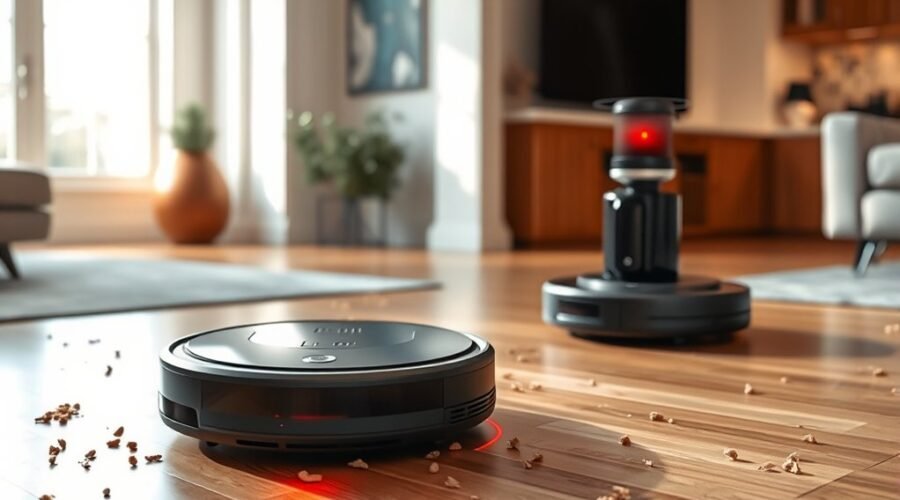
Infrared vs LiDAR robot vacuum sensors can make a big difference in how well your machine cleans. Both technologies detect nearby objects, but they serve different purposes. Understanding their accuracy, mapping abilities, and limitations helps you choose a robot vacuum that suits your home’s layout and cleaning needs.
Quick Answer
LiDAR is generally better for robot vacuum mapping, planned cleaning routes, and navigation through complex rooms. Infrared sensors are better suited to short-range obstacle detection and detecting drops near stairs. Both can work in darkness, but neither guarantees perfect obstacle avoidance. Many robot vacuums use both technologies together for better navigation and safety.
Key Takeaways
- LiDAR can create detailed floor maps, while basic infrared proximity sensors mainly detect nearby objects.
- Active infrared sensors do not require visible room lighting, although strong sunlight and certain surfaces can interfere with readings.
- A LiDAR navigation system can still miss cables, socks, low furniture, and transparent objects.
- Sensor quality, placement, and navigation software matter more than the sensor label alone.
- Battery runtime depends on the entire robot, including its cleaning path, suction setting, and battery capacity.
Infrared vs LiDAR: What’s the Difference?
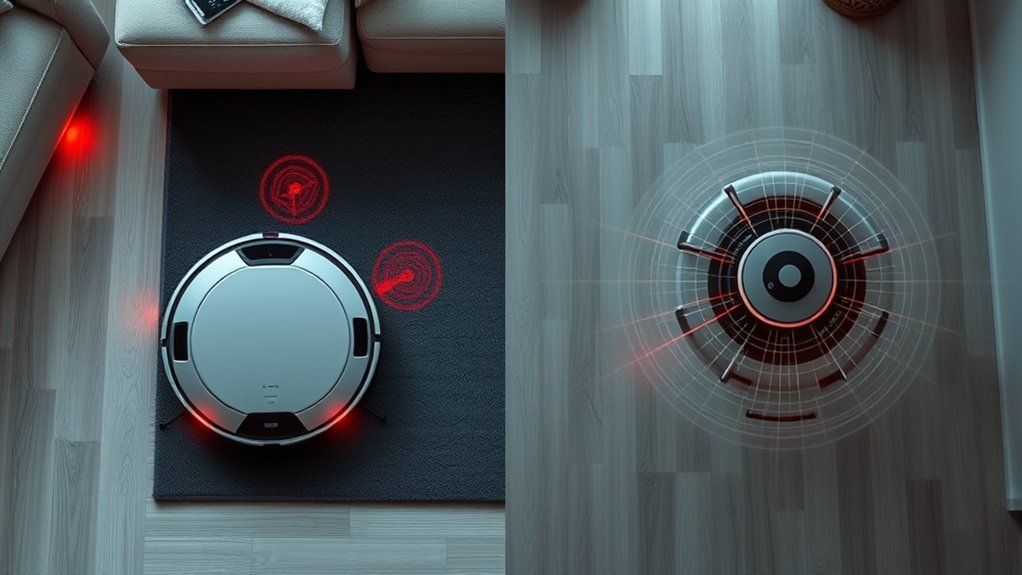
The main difference between infrared and LiDAR sensors is how they measure the space around a robot vacuum. Basic infrared sensors detect nearby surfaces using reflected infrared light. LiDAR uses laser-based distance measurements to help the robot understand its surroundings and create a map.
LiDAR stands for Light Detection and Ranging. In robot vacuums, it commonly scans walls, furniture, and other large objects to support systematic cleaning.
Infrared sensors usually handle more localized tasks, such as detecting furniture at close range or identifying drops near stairs.
| Feature | Infrared Sensors | LiDAR |
|---|---|---|
| Main function | Nearby obstacle and edge detection | Distance scanning, mapping, and navigation |
| Typical range | Usually short range; varies by sensor | Generally longer range; varies by scanner |
| Room mapping | Not normally used alone for full room maps | Supports detailed floor maps |
| Dark-room operation | Works without visible light when actively emitting infrared | Works without visible light |
| Small obstacles | Detection depends on position and sensor design | May miss low or thin objects |
| Cost | Generally lower for basic sensors | Generally higher for a mapping system |
The important distinction is that mapping and obstacle avoidance are not the same feature. Mapping tells the robot where it is and where to clean next. Obstacle avoidance helps it react to objects in its path.
A well-designed robot vacuum may combine LiDAR with infrared, bump sensors, or other detection technologies.
How Infrared Sensors Work in Robot Vacuums
Infrared sensors work by sending out infrared light and detecting the signal that returns from nearby surfaces. The robot uses this information to identify obstacles, estimate distance, or detect a change in floor height.
Most basic systems contain an infrared emitter and a receiver. The emitter sends light toward an object, while the receiver detects the reflected signal.
Depending on the sensor design, the robot can use the signal to estimate how far away an object is or simply determine whether something is nearby.
Some infrared distance sensors use triangulation rather than reflected light intensity alone. This means infrared sensors are not limited to simple yes-or-no detection.
For example, published infrared distance sensor specifications include models with measuring ranges of 10 to 80 cm and 20 to 150 cm. These figures describe particular sensor modules, not every robot vacuum.
Common Uses of Infrared Sensors
Robot vacuums can use infrared sensors for several practical functions:
- Obstacle detection: Recognizing nearby furniture, walls, and other surfaces.
- Cliff detection: Helping the robot avoid stairs and sudden floor drops.
- Wall following: Maintaining a suitable distance from walls during edge cleaning.
- Docking assistance: Detecting infrared signals used by compatible charging stations.
These functions help a robot move safely, but a few proximity sensors cannot normally provide the detailed room coverage of a rotating LiDAR scanner.
Infrared sensing is relatively simple and cost-effective. However, dark surfaces may return weak signals, and direct sunlight can interfere with some sensor designs.
How LiDAR Navigation Works in Robot Vacuums
LiDAR navigation works by measuring distances to surrounding surfaces using laser light. As the robot moves, it combines these measurements with its estimated position to build and update a map of the room.
Many robot vacuums use a rotating laser scanner that measures the outlines of walls and furniture. The robot then follows planned cleaning routes instead of relying mainly on random direction changes.
LiDAR also works with mapping software to identify previously cleaned areas and adjust routes around larger obstacles.
Time-of-Flight Mapping
Time of Flight (ToF) is a distance-measuring method that calculates how long light takes to travel to an object and return. Some LiDAR systems use this method to estimate distance.
However, not every LiDAR scanner uses Time of Flight. Some measure distance through laser triangulation, which uses the geometry of the returned beam.
For example, published laser scanner specifications describe a 360-degree scanner based on triangulation. It collects thousands of distance measurements per second to support mapping and robot navigation.
Many rotating scanners produce a two-dimensional outline of the surroundings at the height of the laser beam. More advanced sensors can collect additional depth information.
This is why a robot’s advertised LiDAR system does not automatically mean it produces a complete 3D model of every object in the room.
Another useful distinction is that LiDAR itself may use infrared laser light. The meaningful comparison is between simple infrared proximity sensing and a laser-based mapping system, not necessarily between two different colors of light.
For example, time-of-flight sensor documentation describes a sensor using an invisible 940 nm infrared laser with distance measurement up to 4 meters.
Real-Time Path Planning
Real-time path planning allows a robot vacuum to adjust its cleaning route as it moves through the home. LiDAR provides distance information that helps the robot locate itself and identify the areas it still needs to clean.
This process often uses SLAM, which stands for Simultaneous Localization and Mapping.
SLAM combines sensor readings with movement information to estimate the robot’s position while building or updating its map.
For example, if the robot encounters a chair that was moved after its previous cleaning session, it can update its route around the new obstacle.
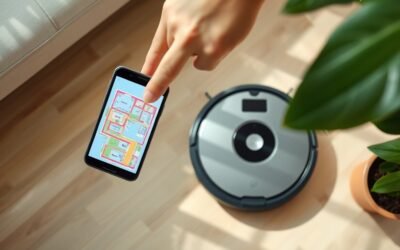
Accurate maps can also support room-specific cleaning, virtual boundaries, and saved cleaning areas. However, these features depend on the robot’s software and model.
Some machines use LiDAR for navigation while keeping separate infrared and bumper sensors for obstacle detection. One manufacturer’s robot vacuum specifications explicitly list LDS navigation alongside infrared and bumper obstacle avoidance.
Obstacle Detection Accuracy
LiDAR can detect walls, furniture, and larger obstacles before the robot reaches them. Its repeated distance measurements help the machine plan movements through narrow spaces and around fixed objects.
However, LiDAR accuracy varies with the sensor, target material, scanning angle, and distance.
Although some laser sensors can provide very fine measurements, millimeter-level accuracy should not be assumed for every consumer robot vacuum.
A robot may measure a nearby wall accurately while still missing a charging cable lying below the scanning beam.
This limitation matters because precise distance measurement does not automatically mean reliable object recognition.
For a cluttered home, additional front-facing sensors or cameras may be necessary to recognize smaller items.
Infrared vs LiDAR: Accuracy and Range
LiDAR generally offers better room-scale distance measurements and environmental coverage than basic infrared proximity sensors. It can scan many points across a room, while individual infrared sensors usually monitor smaller areas.
However, accuracy and range vary widely between sensor models.
A compact infrared distance sensor might measure objects only a short distance away. Other infrared-based ToF modules can detect objects several meters from the receiver.
Similarly, robot-oriented LiDAR scanners have different maximum measuring distances.
For example, one documented rotating scanner supports measurements up to 12 meters under specified conditions. This is much more relevant to indoor robot navigation than the several-hundred-meter ranges associated with certain industrial or outdoor LiDAR systems.
Actual usable range also depends on the object’s reflectivity and the surrounding environment.
LiDAR has an important advantage in spatial coverage. A rotating scanner can collect measurements around the robot, giving navigation software a broader picture than a small collection of fixed proximity sensors.
That broader coverage helps the vacuum follow organized routes and avoid cleaning the same area unnecessarily.
For a small room, the difference may be less noticeable. In a home with several rooms, narrow passages, and complicated furniture arrangements, it becomes more useful.
Which Sensor Works Better in Dark Rooms?
Both active infrared sensors and LiDAR can operate in dark rooms because they emit their own light. However, LiDAR usually provides better room mapping and navigation than basic infrared proximity sensors.
The key difference is not that infrared requires visible light. It is that the two sensor systems collect different amounts and types of spatial information.
Active infrared sensors can still detect nearby objects when the room lights are off. Their performance depends on reflected signals, target surfaces, and the sensor design.
LiDAR also operates without relying on ordinary room lighting. This makes it useful for scheduled nighttime cleaning or rooms with limited natural light.
However, darkness can affect other parts of a robot vacuum.
For example, a robot that uses LiDAR for mapping but relies on visible-light cameras for identifying small obstacles may navigate successfully while recognizing fewer objects.
Bright light creates a different problem. Direct sunlight can interfere with certain infrared sensors and some LiDAR systems.
Therefore, LiDAR is generally the better option for dark-room mapping, but neither system is completely immune to environmental interference.
Infrared vs LiDAR for Obstacle Avoidance
LiDAR usually performs better at identifying the layout of a room and navigating around larger obstacles. Infrared sensors remain useful for detecting nearby objects, wall distances, and changes in floor height.
For small-object avoidance, the best system often combines several sensor types.
Obstacles LiDAR Handles Well
LiDAR navigation is particularly useful for identifying:
- Walls and room boundaries.
- Large furniture such as sofas and cabinets.
- Major obstacles in hallways.
- Open spaces between furniture.
- Changes in the arrangement of larger objects.
The robot can use this information to choose a cleaning path before reaching an obstacle.
Obstacles LiDAR May Miss
A rotating LiDAR scanner does not necessarily detect every object on the floor.
Common problem objects include:
- Charging cables and thin electrical cords.
- Socks and small toys.
- Objects below the scanner’s measurement height.
- Thin furniture legs.
- Transparent glass surfaces.
- Mirrors and highly reflective materials.
- Dark objects that return weak laser signals.
These limitations are documented in manufacturer obstacle-detection guidance, which explains why a LiDAR robot can still collide with low, small, dark, or reflective objects.
Warning: Do not assume LiDAR will prevent a robot vacuum from catching electrical cords. Remove loose cables and delicate objects before cleaning. Keep stairs protected according to the manufacturer’s instructions, since mapping alone does not replace cliff detection.
Why Additional Obstacle Sensors Matter
Some advanced robot vacuums combine LiDAR mapping with structured light, cameras, or other close-range sensors.
These extra systems help the machine detect objects that a horizontal scanning beam may miss.
For example, manufacturer documentation for combined navigation and obstacle-avoidance systems describes LiDAR-based mapping alongside a separate structured-light detection system.
This distinction is useful when comparing robot vacuums. A machine advertised with LiDAR navigation may still offer only basic obstacle avoidance.
If your floors regularly contain cables, toys, or pet-related clutter, examine the model’s dedicated obstacle-detection features rather than relying on LiDAR alone.
How to Choose the Right Robot Vacuum Sensor
The best robot vacuum sensor depends on your floor plan, cleaning habits, budget, and the obstacles in your home. LiDAR is generally preferable for detailed maps and planned coverage, while basic infrared detection can be enough for simpler navigation tasks.
Choose LiDAR for Complex Layouts
Consider a LiDAR-equipped robot vacuum if your home has:
- Several rooms connected by hallways.
- Large cleaning areas.
- Complicated furniture arrangements.
- Spaces that require organized cleaning routes.
- A need for room-specific cleaning or virtual no-go zones.
LiDAR mapping can reduce unnecessary route changes and help the robot cover rooms systematically.
However, confirm that the particular model includes the mapping and app features you want.
Choose Basic Infrared Navigation for Simpler Needs
A lower-cost robot vacuum using infrared proximity sensors may be sufficient when your home has open floors, fewer obstacles, and modest cleaning requirements.
These systems can help a robot detect nearby objects without the expense of a dedicated rotating mapping scanner.
However, basic infrared sensors alone usually cannot provide the same detailed room maps.
The robot’s actual cleaning pattern will also depend on its movement sensors and navigation software.
Check the Complete Sensor System
Before choosing a robot vacuum, consider these questions:
- Does the robot create and save a room map?
- Can it clean specific rooms or selected areas?
- Does it have dedicated small-object detection?
- Are infrared cliff sensors included?
- Can it recognize obstacles in low light?
- Does its height allow it to fit beneath your furniture?
- Are the sensor windows easy to clean?
These questions reveal more about everyday performance than the sensor name alone.
Pro Tip: Compare mapping and obstacle avoidance as separate specifications. If you have a cluttered home, prioritize reliable small-object detection alongside LiDAR navigation. If your floors are usually clear, accurate mapping may provide more value than advanced object recognition.
Infrared vs LiDAR: Cost, Battery, and Maintenance
Basic infrared sensors are generally cheaper and simpler than a complete LiDAR mapping system. However, the effect on battery life and maintenance depends on the full robot vacuum design.
LiDAR adds optical hardware and mapping calculations. Basic infrared proximity systems usually require less complex hardware.
These differences can affect manufacturing cost, power use, and servicing requirements.
| Factor | LiDAR | Infrared Sensors |
|---|---|---|
| Cost | Generally higher for a mapping system | Generally lower for basic proximity detection |
| Battery usage | Scanning and processing consume power | Basic sensor modules often consume less power |
| Maintenance | Keep scanner windows clean and the mechanism unobstructed | Keep sensor windows clean |
| Integration complexity | Requires mapping and positioning software | Simpler for basic proximity detection |
| Performance longevity | Depends on scanner condition, software, and operating environment | Depends on sensor condition, surfaces, and operating environment |
Does LiDAR Use More Battery?
LiDAR scanning and the software processing its data use electrical power. However, that does not mean every LiDAR robot vacuum has shorter battery life.
A robot with accurate mapping may complete cleaning with fewer unnecessary movements.
Meanwhile, the suction motor, driving system, battery capacity, and cleaning mode can have a major effect on total runtime.
Therefore, compare the manufacturer’s rated cleaning runtime and coverage rather than judging battery life from sensor type alone.
Which Sensor Requires More Maintenance?
Both technologies need clean sensor windows to work correctly.
Dust, fingerprints, and debris can weaken optical signals or interfere with navigation.
A rotating LiDAR unit may also have moving components that must remain unobstructed. Some newer sensor designs avoid a traditional rotating turret.
For regular care:
- Wipe accessible sensor windows with a soft, dry cloth.
- Keep dust and hair away from exposed scanner openings.
- Check the manufacturer-approved cleaning instructions.
- Avoid scratching sensor lenses or forcing moving parts.
- Investigate repeated mapping errors or unexpected sensor warnings.
Ordinary users generally do not need to perform manual LiDAR calibration unless their robot’s manufacturer specifically instructs them to do so.
Which Technology Offers Better Long-Term Value?
LiDAR may provide better value if accurate mapping reduces missed areas and repeated cleaning runs in your home.
Infrared-based navigation may be more economical when your cleaning area is simple and advanced mapping features would rarely be used.
A published review of indoor robot sensing technologies identifies low cost as an infrared advantage and high distance-measurement accuracy as a LiDAR advantage. It also notes environmental limitations for both technologies.
The most useful choice is the system that provides the coverage, obstacle handling, and maintenance level your home requires without paying for features you will not use.
Frequently Asked Questions
Is LiDAR Better for Robot Vacuums?
LiDAR is usually the better choice when you want reliable room maps, planned cleaning routes, and multiroom coverage. Infrared sensors are still useful for nearby obstacles and drop detection, including on robots that have LiDAR. For cables and other small objects, check whether the model adds a separate obstacle-avoidance system.
What Are the Downsides of Using LiDAR?
LiDAR can raise purchase cost and needs a clear, clean sensor window. A raised scanning turret may also reduce how far the robot fits beneath furniture. Glass, mirrors, dark surfaces, and low objects can confuse it, and a mapping laser alone does not guarantee cord avoidance.
What Are the Key Differences Between LiDAR and Ultrasonic Sensors?
LiDAR measures distance using laser light, usually to support room mapping and position tracking. Ultrasonic sensors send sound pulses and measure returning echoes, which can help detect objects that are difficult for optical sensors. Neither technology alone guarantees accurate cleaning paths; placement and software matter.
What Can LiDAR Not Detect?
LiDAR can miss charging cables, thin chair legs, and objects beneath its scan height. Glass, mirrors, very dark surfaces, and direct sunlight may also affect readings. Use extra obstacle detection or no-go zones for trouble spots, and clear loose cords before cleaning.
Conclusion
Infrared and LiDAR sensors help robot vacuums clean in different ways. Infrared provides practical short-range detection, while LiDAR gives the robot a broader view of its surroundings for mapping and planned navigation.
For larger homes or complicated layouts, LiDAR usually offers the stronger navigation system. For smaller, simpler spaces, a basic infrared-equipped robot may be enough.
Before buying, compare mapping features, small-object detection, battery runtime, and maintenance needs. A balanced combination of sensors often matters more than any single technology.
Sources
- Pololu, Sharp Distance Sensors: Published infrared sensing ranges, output types, and basic module specifications.
- SLAMTEC, RPLIDAR A1: Laser triangulation, 360-degree scanning, and robot-oriented LiDAR mapping.
- STMicroelectronics, VL53L1X: Infrared laser time-of-flight distance measurement and sensor range.
- ECOVACS, DEEBOT NEO 2.0 PLUS: Example of LiDAR navigation combined with infrared and bumper obstacle detection.
- Xiaomi, Robot Vacuum S60+ FAQ: LiDAR navigation, small-object limitations, infrared cliff sensors, lighting conditions, and maintenance.
- Roborock, Q10 Series: LiDAR mapping and separate structured-light obstacle avoidance.
- A Review of Sensing Technologies for Indoor Autonomous Mobile Robots: Research comparing the advantages and limitations of infrared, LiDAR, and ultrasonic sensing.