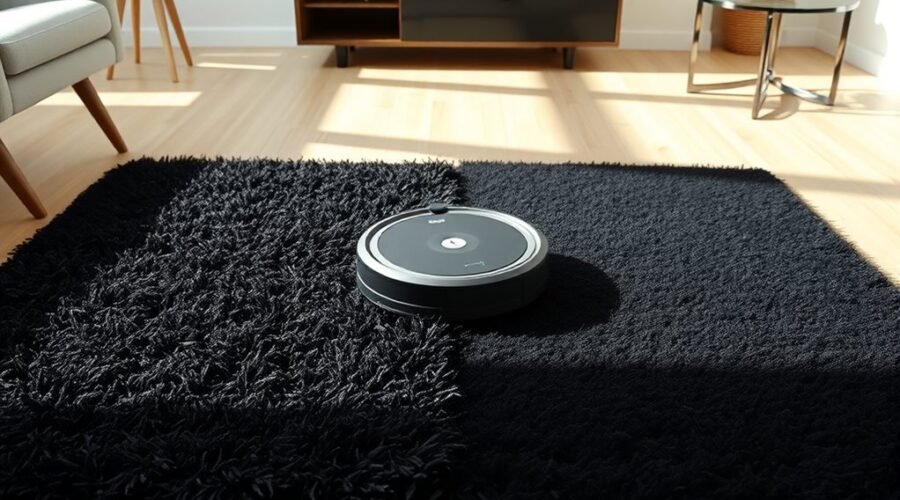
Can robot vacuums clean black rugs without getting stuck or skipping sections? Some models handle them well, but others mistake dark fibers for a dangerous drop. The problem often comes from infrared cliff sensors rather than weak suction. Rug thickness, loose fringe, and cleaning settings also affect whether your robot can finish the job.
Quick Answer
Yes, robot vacuums can clean black rugs, especially those with short, tightly woven fibers. However, some models mistake dark surfaces for stairs because their infrared cliff sensors receive too little reflected light. Clean sensors, suitable carpet settings, and a secure rug can help. Severe sensor incompatibility may require excluding the rug from automatic cleaning.
Key Takeaways
- Black rug color and pile height cause different problems. A thin black rug can trigger sensors even when wheels move easily.
- Low-pile rugs usually offer better traction and debris pickup than high-pile or shag rugs.
- LiDAR navigation and higher suction do not guarantee that a robot will recognize a dark rug correctly.
- Always preserve stair-detection safety features. Use supported settings or no-go zones instead of covering cliff sensors.
- For mixed floors, carpet recognition and mop-lifting features help protect rugs from moisture.
Can Robot Vacuums Clean Black Rugs?
)
Robot vacuums can clean black rugs when their sensors recognize the surface and their wheels can move across the fibers. Low-pile black rugs offer the best chance of reliable cleaning, but color compatibility still depends on the model.
A robot may have powerful suction and accurate room mapping yet refuse to cross a black rug. This happens because the cliff sensors underneath the robot may interpret the surface as a drop.
For example, Roborock’s official dark-carpet guidance confirms that dark carpet can trigger cliff sensors in the same way as a real drop-off.
The important factors are:
- Rug color: Very dark fibers may absorb the infrared light used for drop detection.
- Pile height: Thick fibers can trap wheels and reduce cleaning effectiveness.
- Brush design: Long fibers and pet hair can wrap around rotating brushes.
- Navigation: Mapping helps the robot cover reachable areas, but it cannot always overcome cliff-sensor errors.
- Rug placement: Curled corners, loose backing, and fringe create additional obstacles.
If your robot already cleans the black rug without hesitation, regular maintenance may be enough. If it stops at the same dark patch, identify the sensor problem before changing suction settings.
Why Black Rugs Trigger Cliff Sensors
Black rugs can trigger cliff sensors because dark materials often reflect less infrared light. When the robot receives too little reflected light, it may interpret a flat rug as the edge of a staircase.
Cliff sensors are downward-facing sensors designed to prevent falls. They typically send infrared light toward the floor and analyze the reflected signal.
On a normal floor, the returning signal helps the robot confirm that a surface is present. On some black carpets, much of that light is absorbed.
A black rug can look like a drop-off to a robot vacuum, even when the floor underneath is completely flat.
When this happens, the robot may:
- Stop before entering the rug.
- Reverse direction at a dark section.
- Move around the rug instead of crossing it.
- Display a cliff-sensor or drop-detection error.
- Leave parts of the rug uncleaned.
Rug material matters as much as visible color. Two black rugs may reflect infrared light differently, so a robot might clean one successfully and avoid the other.
Dirty sensors can make recognition worse. Dust on the sensor windows reduces the signal the robot receives.
LiDAR navigation helps a robot build a room map, but LiDAR does not automatically override cliff sensors. A model with excellent mapping may still avoid dark carpet for safety reasons.
Which Rug Piles Cause the Most Trouble?
Low-pile rugs are usually easiest for robot vacuums to clean. Medium-pile rugs require more traction and brush clearance, while high-pile and shag rugs create the greatest risk of tangling or getting stuck.
Pile height means the height of the rug fibers above the backing. It affects how easily the robot moves and how deeply the brush can reach.
| Rug Type | Typical Performance | Main Problem | Best Approach |
|---|---|---|---|
| Low-pile | Usually good | Dark-color sensor errors | Check sensor compatibility and carpet mode |
| Medium-pile | Varies by model | Reduced traction and brush resistance | Use a compatible model and carpet boost |
| High-pile | Limited | Wheel resistance and embedded dirt | Verify supported carpet thickness |
| Shag or fringed | Often poor | Fiber tangling and sensor interference | Secure fringe or exclude the rug |
There is no universal pile-height limit for all robot vacuums. For example, eufy’s G-series carpet specifications list a maximum total carpet thickness of 10 mm for the G20 series and 26 mm for several G30, G40, and related models.
These are manufacturer-specific limits, not guarantees for every black rug. Infrared reflectivity can still prevent cleaning even when the carpet meets the thickness requirement.
Low-Pile Rug Ease
Low-pile rugs have short fibers that offer less resistance to robot wheels and brushes. Flat-woven and tightly woven rugs are often the easiest choices for automated cleaning.
Dirt and pet hair usually remain more accessible to the brushroll than on deep-pile carpet. The robot also has less material to climb through or pull into its wheels.
However, short pile does not prevent black-rug sensor errors. A robot can refuse a perfectly flat black rug if the sensor receives insufficient reflected infrared light.
Choose a rug that lies flat, stays securely in place, and has no loose threads around the edges.
Medium-Pile Transition Trouble
Medium-pile rugs can be more challenging because their thicker fibers create extra resistance. The robot needs enough wheel traction and clearance to move across the surface without sinking or dragging.
Problems may include:
- Wheels losing traction on soft fibers.
- Reduced pickup of dirt deep in the pile.
- Brushrolls meeting increased resistance.
- Higher battery use when stronger suction is selected.
- Cliff sensors misreading dark sections of the rug.
If the robot supports carpet boost, that setting may improve debris pickup. It will not correct a cliff-sensor error caused by the rug’s color.
High-Pile and Shag Limits
High-pile and shag rugs are the hardest surfaces for many robot vacuums. Their long fibers can interfere with wheel movement, wrap around brushes, and prevent effective deep cleaning.
The robot may enter the rug but stall before completing its cleaning route.
Roborock’s shag-carpet guidance also confirms that long carpet fibers can trigger cliff sensors in the same way as a drop.
If your robot repeatedly struggles on shag, use a vacuum designed for deep carpet rather than forcing repeated automatic runs.
Best Robot Vacuum Features for Black Rugs
The best robot vacuum for black rugs is one proven to recognize your rug’s dark surface and handle its pile height. Strong suction helps with dirt pickup, but sensor compatibility should come first.
Look for the following features:
- Reliable cliff sensing: Verified performance on dark rugs without false drop warnings.
- Carpet detection: Automatic recognition of rugs and suitable cleaning modes.
- Adjustable suction: Carpet boost or manual power settings for tougher debris.
- Anti-tangle brushes: Brush designs that reduce hair and fiber wrapping.
- Good wheel clearance: Enough mobility to cross the rug’s edge and travel across its fibers.
- LiDAR or structured navigation: Accurate mapping that helps cover reachable floor areas.
- App controls: Carpet-area settings, cleaning zones, and virtual boundaries.
Do not choose a model based on suction power alone. Advertised figures such as 2,000 Pa, 2,500 Pa, or 15,000 Pa do not establish a universal minimum for carpet cleaning.
Actual performance also depends on airflow, brush design, floor contact, and the debris being removed. A machine with a high advertised suction rating may still avoid a black rug entirely.
Before buying, prioritize model-specific evidence of dark-carpet performance over broad claims about intelligent navigation.
How Low-Pile Black Rugs Perform
Low-pile black rugs usually perform well with robot vacuums that can recognize their dark surfaces. Their short fibers allow easier movement and help rotating brushes reach dirt and pet hair.
These rugs are especially practical in living rooms, bedrooms, and hallways where you want frequent maintenance cleaning.
A successful cleaning run should show three things:
- The robot enters the black rug without stopping or reversing.
- It crosses the entire accessible area without repeated wheel errors.
- It removes visible surface debris without dragging or folding the rug.
If the robot completes the route but leaves fine dust behind, try a compatible higher suction setting or an additional pass.
For deeply embedded dirt, use a conventional vacuum occasionally. Robot vacuums are generally better suited to regular maintenance than full deep cleaning.
Black fibers can also make some dirt difficult to notice. Inspect the rug under good lighting rather than judging cleaning quality only by appearance.
Why High-Pile and Shag Rugs Fail
High-pile and shag rugs often cause cleaning failures because thick fibers interfere with suction, traction, and brush movement. Black versions can add a separate sensor problem.
These are mechanical and sensing limitations, so increasing suction alone may not solve them.
Pile Height Problems
Deep carpet fibers can prevent the robot from maintaining steady contact with the surface. Its wheels may sink while the cleaning head struggles to reach dirt near the rug backing.
A robot also needs enough clearance to climb onto the rug from the surrounding floor.
For example, eufy’s X8 and LR-series compatibility guidance lists rug-entry height limits of less than 17 mm for X8 models and less than 19 mm for the listed LR20 through L60 models.
These limits concern climbing onto the rug. They are not universal maximum pile heights, and cleaning performance still depends on the carpet material.
Before choosing a robot, check both its stated climbing ability and its carpet compatibility.
Shag Fiber Snags
Shag rugs have long strands that can become wrapped around the brushroll or wheel axles. This increases resistance and can cause the robot to stop during cleaning.
An anti-tangle brushroll can reduce hair wrapping, but it does not make every shag rug safe for robotic cleaning.
Watch for these warning signs:
- The robot repeatedly slows or stops in the same spot.
- The brushroll makes an unusual sound.
- Long fibers become trapped around the brush.
- The robot drags or distorts the rug surface.
- The vacuum reports a trapped-brush or wheel error.
Stop the cleaning cycle if you notice these problems. Repeatedly forcing the robot across the rug can damage the fibers or strain its cleaning components.
Setup Limits on Rugs
Even a powerful robot can fail on thick black rugs if the setup is unsuitable. Loose corners, unstable backing, and unsupported carpet settings can prevent consistent cleaning.
Check the rug’s construction before scheduling unattended runs. A rug that bunches up or shifts under the robot needs better support.
For a model that cannot safely clean thick pile, a no-go zone is often more practical than repeated rescue attempts.
Remember that excluding a rug keeps the robot from cleaning it. You will need a separate cleaning method for that area.
How Tassels, Fringe, and Edges Interfere
Tassels and fringe interfere with robot vacuums when loose strands enter rotating brushes. Raised edges create another problem because they can catch the front bumper or prevent the wheels from climbing smoothly.
On black rugs, these physical obstacles can occur alongside infrared sensor errors.
Before cleaning a fringed rug:
- Fold loose tassels underneath the rug when the rug design allows it.
- Secure corners with a suitable non-slip rug pad or rug-safe fastening method.
- Flatten curled edges that the robot might catch.
- Remove loose strings that could wrap around the brushroll.
- Exclude delicate or heavily fringed sections if they cannot be secured safely.
For supported models, eufy’s rug troubleshooting instructions recommend securing lightweight rug corners or creating a no-go zone when the robot repeatedly gets stuck.
Use fastening methods that suit the rug and floor finish. Some adhesives can damage delicate textiles or leave residue.
A stable rug helps the vacuum move consistently and reduces unnecessary stops, even when it cannot eliminate dark-color sensor errors.
How to Stop Black Rugs From Confusing Sensors
To stop a robot vacuum from avoiding black rugs, first check for dirty sensors, unsuitable carpet settings, and physical obstacles. If the problem remains limited to the dark surface, the robot may have a genuine sensor-compatibility limitation.
Follow these troubleshooting steps in order.
- Identify the behavior. Watch whether the robot reverses at a dark section, stops with an error, or gets physically trapped in the rug.
- Stop and switch off the robot. Place it on a stable surface away from stairs before inspecting the underside.
- Clean the cliff sensors. Use a clean, dry microfiber or soft cotton cloth on the sensor windows, following your model’s instructions.
- Check the brushes and wheels. Remove trapped hair or loose fibers according to the manufacturer’s maintenance procedure.
- Review the cleaning map. Check whether a no-go zone, carpet-avoidance mode, or incorrect rug boundary is preventing entry.
- Test on a light-colored floor. Restart the robot on a safe, level surface away from stairs and observe whether it cleans normally.
- Retest the black rug. Run a supervised cleaning pass and check whether the same error occurs at the same location.
- Use a supported alternative. If the robot still refuses the rug, create a no-go zone or use another cleaning method. Contact the manufacturer if sensor errors also occur on ordinary flooring.
These steps help separate a dark-color problem from a dirty sensor or mechanical obstruction.
The official iRobot cliff-sensor cleaning instructions recommend wiping sensor openings with a clean, dry microfiber or soft cotton cloth.
Warning: Do not cover cliff sensors with tape, foil, paper, or other materials to force the robot onto a black rug. Blocking these sensors can disable protection against stairs and other drop-offs. Keep the robot’s safety systems working, even if that means excluding the rug.
If the robot works on light flooring but always backs away from the same black patch, changing suction power is unlikely to solve the underlying problem.
In that case, choose a compatible robot or a different rug rather than attempting an unsafe sensor modification.
Best Practices for Homes With Mixed Flooring
Homes with hardwood, tile, and black rugs benefit from robot vacuums that recognize carpet and support separate cleaning settings. These features help the machine adjust suction and avoid unnecessary mopping on fabric surfaces.
If your robot also mops, pay particular attention to carpet detection. Not every vacuum-mop combination automatically raises its mop when it reaches a rug.
Some models offer several carpet behaviors. For example, Roborock’s carpet-avoidance modes include:
- Rise: Lifts the mop and stops water flow when carpet is detected.
- Avoid: Keeps the robot away from carpeted areas.
- Cross: Allows travel across carpets without cleaning them.
- Ignore: Uses a different carpet-handling behavior intended for suitable floor setups.
These modes are model-specific. Check which choices your robot supports before changing carpet behavior.
For reliable cleaning in mixed-floor homes, follow a simple routine:
- Use carpet boost only where the robot can travel safely.
- Choose vacuum-only cleaning for rugs that should stay dry.
- Use no-mop zones when mop lifting is unavailable or insufficient.
- Keep rug corners flat and avoid placing loose textiles along the cleaning route.
- Inspect the finished cleaning map for missed black-rug sections.
A thin rug pad can reduce slipping or bunching, but it does not change the black fibers’ infrared reflectivity. It is not a direct fix for cliff-sensor errors.
When you combine suitable carpet settings, steady navigation, and regular maintenance, your robot has a better chance of cleaning mixed floors without repeated intervention.
Frequently Asked Questions
Do Robot Vacuums Clean Rugs?
Yes, robot vacuums can clean many low-pile and medium-pile rugs. Their performance depends on rug thickness, suction, brush design, and navigation. Very dark rugs may trigger cliff sensors, while thick fibers and loose fringe can cause mechanical problems. Regular robot vacuuming helps manage daily dirt, but some rugs still need deeper manual cleaning.
What Are the Downsides of Using a Robotic Vacuum Cleaner?
Robot vacuums can struggle with deep carpet dirt, thick rugs, tangled hair, obstacles, and missed corners. Battery life, noise, maintenance, app problems, and purchase cost are additional considerations. They may also stop on dark rugs because of sensor errors. Most work best as regular maintenance cleaners rather than complete replacements for conventional vacuums.
Can Robot Vacuums Go Over Thick Rugs?
Some robot vacuums can cross and clean thick rugs, but only within their supported carpet and climbing limits. Larger wheels, suitable brush clearance, and carpet boost can help. Very thick or shag rugs may still trap wheels or brushes. Black versions can also trigger false cliff warnings, regardless of suction power.
What Type of Rug Is Best for a Robot Vacuum?
A low-pile, tightly woven rug with flat edges and no loose fringe is usually the best option. Its short fibers make movement and debris pickup easier. A non-slip backing also helps keep it in place. If your robot struggles with dark surfaces, choose a lighter rug or confirm compatibility with your exact model.
Conclusion
Robot vacuums can clean black rugs, but successful cleaning depends on sensor compatibility, rug pile, and proper setup. Low-pile rugs are usually the easiest, while high-pile and shag rugs create more mechanical problems.
If your robot skips a black rug, clean its sensors, review the carpet settings, and test it safely. When dark fibers continue to trigger false cliff warnings, use an exclusion zone or another cleaning method rather than disabling fall protection.
Sources
- Roborock Support: Dark Carpet: Explains why dark carpeting can trigger cliff sensors.
- eufy Support: G-Series Carpet Compatibility: Provides carpet thickness limits and advice for dark carpets and tasseled rugs.
- eufy Support: X8 and LR-Series Carpet Compatibility: Documents specific rug-entry height limits and carpet restrictions.
- Roborock Support: Shag Carpet: Confirms that long carpet fibers can interfere with cliff-sensor detection.
- iRobot Home Support: Cleaning Cliff Sensors: Explains the recommended dry-cloth sensor cleaning procedure.
- eufy Support: Rug Troubleshooting: Covers securing rug corners, carpet recognition, and no-go zones.
- Roborock Support: Carpet Avoidance Modes: Describes Rise, Avoid, Ignore, and Cross carpet behaviors.
- CHOICE: Robot Vacuum Advantages and Disadvantages: Independent testing and practical evidence about carpet performance and robot vacuum limitations.