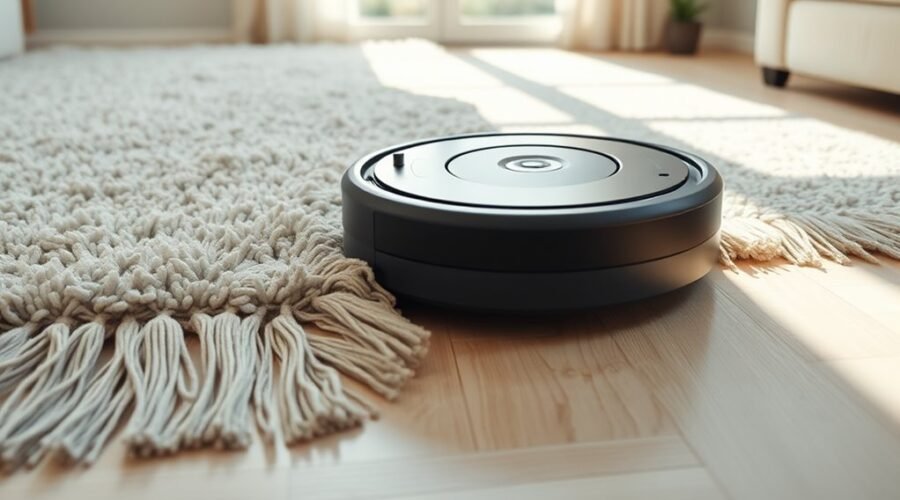
Robot vacuums and rug tassels can be a tricky combination. Many robot vacuums clean low-pile rugs well, but loose fringe can wrap around brushes, catch under wheels, or stop a cleaning cycle. Rug thickness, edge height, and sensor design also affect performance. Knowing how to prepare your rugs helps you avoid tangles, protect delicate fibers, and reduce interruptions.
Quick Answer
Robot vacuums can clean many rugs, but loose tassels can get caught in rotating brushes and wheels. Low-pile rugs with flat, secure edges are usually the safest choice. Tuck loose fringe beneath the rug, use compatible no-go zones, and choose anti-tangle brushes when possible. Avoid robot cleaning on delicate or heavily fringed rugs.
Key Takeaways
- Low-pile rugs generally offer better traction and fewer cleaning problems than thick or shag rugs.
- Anti-tangle brushes reduce some wrapping problems but cannot guarantee protection against long fringe.
- Dark rugs may confuse infrared cliff sensors, even when the rug is physically easy to cross.
- Carpet boost improves cleaning power but does not increase a robot’s ability to climb thick rug edges.
- Oriental and delicate rugs often need gentle manual cleaning instead of an unsupervised robot vacuum.
How Robot Vacuums Handle Rug Tassels
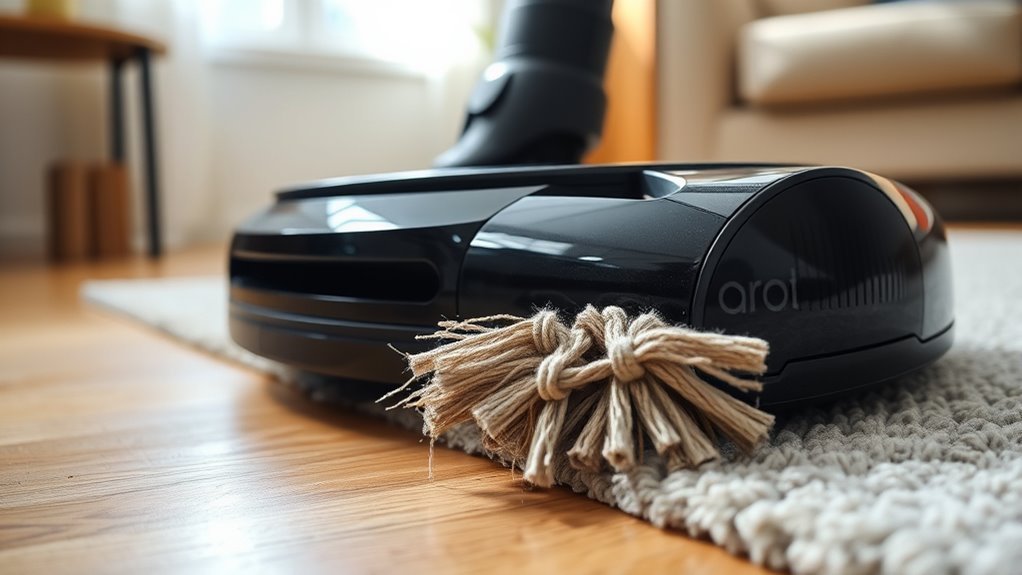
Robot vacuums can struggle with rug tassels because their rotating brushes may pull loose strands into the cleaning mechanism. Long fringe can also catch around wheels or drag beneath the vacuum.
When strands become trapped, the robot may slow down, reverse, stop cleaning, or display a brush error. Repeated tangles can also damage rug fibers.
Short, tightly secured fringe is generally less troublesome than long, loose tassels. However, even a low-pile rug can cause problems if its fringe reaches the brushroll.
Anti-tangle brushrolls can reduce wrapping, especially when compared with traditional bristle designs. Still, they cannot eliminate the risk of snagging decorative threads.
The safest approach depends on your rug:
- Sturdy rugs with short fringe: Tuck the tassels underneath before cleaning.
- Rugs with long, loose fringe: Use a compatible no-go zone or physical barrier.
- Lightweight decorative rugs: Secure loose corners or remove the rug before cleaning.
- Delicate or valuable rugs: Avoid unsupervised robot cleaning and use gentle manual methods.
Smart robot vacuums with mapping features can avoid problem areas while continuing to clean the surrounding floor. Models without these features may need physical barriers or more preparation.
This approach helps you maintain regular floor cleaning without exposing every rug to the same level of mechanical stress.
Which Rug Pile Heights Cause Problems?
Rug pile height affects how easily a robot vacuum moves and collects dirt. Low-pile rugs are usually easiest, medium-pile rugs require more suitable hardware, and thick or shag rugs cause the most trouble.
Pile height is the length of the rug fibers above the backing. However, total rug thickness, padding, raised borders, and tassels also influence compatibility.
Low Pile Rugs
Low-pile rugs, generally those with fibers under 1/4 inch tall, are usually the easiest surfaces for robot vacuums to clean. Their short fibers create less resistance and allow the wheels to maintain steady contact.
Robot vacuums can often move across these rugs without major changes in speed or direction. Short fibers also let brushes reach surface debris more easily.
However, low pile does not automatically make a rug safe. Long tassels, curled corners, or slippery backing can still create problems.
| Feature | Effect | Outcome |
|---|---|---|
| Low pile rugs | Less wheel resistance | Smoother movement |
| Suction power | Removes surface debris | More consistent cleaning |
| Navigation systems | Help maintain cleaning routes | Better floor coverage |
| Tassels | May catch when left loose | Possible interruptions |
| Mixed flooring | Usually easier transitions | More reliable cleaning |
For homes with hard floors and area rugs, low-pile designs with flat edges are often the most practical option.
Keep the rug flat and use suitable suction settings to remove dirt without putting unnecessary stress on the fibers.
Medium Pile Risks
Medium-pile rugs can work with robot vacuums, but their taller fibers create more resistance. Some robots lose traction, push against raised edges, or struggle to remove dirt trapped deeper in the pile.
Loose tassels increase the risk because they can reach the brushroll while the robot climbs onto the rug.
Models with strong suction, larger wheels, and flexible suspension generally have an advantage. Some buying guides suggest suction ratings around 2,500 Pa or higher, but that figure alone does not guarantee good carpet cleaning.
Brush design, airflow, cleaning-head contact, and wheel movement also matter. Independent vacuum performance testing evaluates actual debris pickup rather than relying only on advertised suction figures.
Medium-pile rugs are often manageable when their edges remain flat and the robot can move without dragging its body across the fibers.
Test the rug under supervision before adding it to an automatic cleaning schedule.
High Pile Limits
High-pile and shag rugs create the greatest challenges for robot vacuums. Very thick rugs, especially those approaching or exceeding 1 inch in height, can interfere with wheel movement and brush rotation.
Long fibers increase friction and may reduce the cleaning head’s contact with the rug. A robot may struggle to climb the edge, lose traction, or stop because its brushes cannot rotate freely.
Stronger suction, including models advertised at 2,500 Pa or more, may help remove some debris. However, suction cannot overcome every physical limitation.
For example, manufacturer carpet compatibility guidance lists a maximum total carpet thickness of 26 mm for several G-series models. Other models in the same family are limited to low-pile carpets of around 10 mm total thickness.
These specifications are model-dependent. They should not be treated as universal limits for every robot vacuum.
High-pile rugs can also trap dust below the surface, where routine robot cleaning may not reach it effectively.
If your robot frequently stalls on a thick rug, use a no-go zone and clean that rug separately.
How Tassels Get Wrapped Around Brushes
Rug tassels become tangled when rotating brushes pull loose strands into the vacuum’s cleaning head. The threads twist around the main roller, side brush, or nearby moving parts.
Long, flexible strands create the greatest risk because they can continue wrapping as the brush turns. This can tighten the tangle and prevent normal movement.
The problem may begin at the edge of a rug, even if the robot can clean the center without difficulty.
Common warning signs include:
- The robot stops or turns back near the same rug edge.
- The brush makes an unusual rattling or strained sound.
- The vacuum reports a blocked brush or stalled roller.
- Loose rug threads appear wrapped around the cleaning head.
- The robot leaves part of the rug uncleaned after an interrupted run.
Warning: Never pull a trapped robot forcefully away from rug tassels while the brushes are running. Stop the cleaning cycle, switch off the machine as directed by its manual, and carefully release the strands. Pulling against a tight tangle can damage both the rug and the brush mechanism.
What to Do When Rug Tassels Get Stuck
If tassels become wrapped around a brush, stop the robot before attempting to remove them. A careful inspection usually reveals whether the fringe, brushroll, or wheels caused the problem.
- Stop the cleaning cycle. Turn off the robot according to its manufacturer’s instructions.
- Move the robot carefully. Lift it away from the rug without pulling against trapped strands.
- Inspect the brushes. Check the main roller, side brush, wheel axles, and brush ends for wrapped fibers.
- Release the threads. Follow the manual to remove the brush if needed, then gently unwind the tassels.
- Check for damage. Look for broken threads, worn brush parts, or debris beneath the brush end caps.
- Test the robot. Restart it on a clear hard floor before attempting another rug cleaning cycle.
For Roomba i-series machines, iRobot’s Error 2 troubleshooting guidance explains that the error occurs when the rubber brushes cannot rotate. Thick carpet and high-pile rugs can also cause this problem.
If the error continues after removing debris and reinstalling the brushes, further maintenance or replacement parts may be necessary.
Prevent repeated jams by keeping the robot away from fringe that cannot be tucked or secured safely.
How Robot Vacuums Cross Rug Edges
Robot vacuums cross rug edges using their drive wheels, suspension, and available ground clearance. A flat, firm edge is easier to climb than a thick, curled, or flexible border.
The height change between the floor and rug determines how much lifting force the wheels need. Rug weight and backing also influence whether the edge stays in place.
Even if a robot climbs onto a rug successfully, loose tassels can still catch beneath it during the transition.
Edge Height Limits
Rug edge height can determine whether a robot vacuum enters an area or turns away. Each model has its own obstacle-crossing limit, which may differ from the maximum carpet thickness it can clean.
For example, manufacturer guidance for the Omni C30 Edge lists an approximate obstacle-crossing height of 2 cm and a carpet thickness limit below 26 mm, including the pile.
These are different measurements. A robot may operate on a carpet that is thicker than the vertical edge it can climb from a hard floor.
Soft or inclined edges can also reduce traction, even when they fall within the advertised height limit.
Robot vacuums with larger drive wheels and flexible suspension often handle these transitions more smoothly.
During the first cleaning session, watch the robot approach each rug edge. If it repeatedly pushes against the border, lifts the rug, or scrapes underneath, that rug may not be suitable for automatic cleaning.
Sensor and Wheel Clearance
Wheel clearance affects how easily a robot vacuum moves between different floor heights. Models with larger wheels and responsive suspension can often climb raised rug borders with less difficulty.
Chassis clearance is the space beneath the robot’s body. Insufficient clearance can cause scraping or drag when the vacuum moves onto thicker rugs.
There is no single clearance measurement that guarantees compatibility with every low-pile rug. Wheel design, suspension movement, rug backing, and edge shape all affect the result.
Cliff sensors serve a different purpose. They help prevent the robot from falling over stairs or other drops, but some sensors can mistake dark surfaces for an unsafe edge.
More advanced navigation systems may improve movement across mixed flooring, yet they cannot remove the physical risk of tassels catching in rotating parts.
Keep wheels and sensors free from accumulated dust and wrapped hair so they can operate normally.
Rugs That Confuse Robot Sensors
Dark, heavily textured, and high-pile rugs can interfere with a robot vacuum’s sensors or movement. The problem depends on the sensor design and the rug’s surface.
Some robot vacuums use infrared cliff sensors to detect drops. Very dark carpet can absorb enough infrared light to make the robot interpret a safe floor as a drop-off.
As a result, the vacuum may stop, reverse, or avoid part of the rug.
Other rugs create different problems:
- Black or very dark rugs: May trigger false cliff warnings on some models.
- High-pile rugs: Can reduce wheel traction and disrupt cleaning paths.
- Thick patterned rugs: May affect certain optical sensing systems, depending on the model.
- Rugs with loose fringe: Can cause mechanical tangles rather than direct sensor failures.
- Lightweight rugs: May curl or move when the vacuum pushes against an edge.
LiDAR navigation uses laser-based distance measurements to help a robot map its surroundings. Camera-based systems use visual information, while other sensors monitor floor contact and movement.
These systems can improve route planning, but they do not guarantee that a robot will identify thin, flexible tassels before reaching them.
For rugs that repeatedly trigger errors, keeping the affected area outside the robot’s route is often more reliable than adjusting suction.
Do not cover or disable cliff sensors to force a robot onto a dark rug. These sensors provide important protection near stairs and raised floor edges.
Best Robot Vacuum Settings for Rugs
The best settings depend on rug thickness, fiber strength, and the features available on your robot vacuum. Carpet boost can improve pickup on suitable rugs, while reduced suction may be better for delicate materials.
Settings cannot make an unsafe rug edge or loose tassel completely safe. Prepare the rug before changing cleaning modes.
Use these adjustments where your model supports them:
- Carpet boost: Increases suction on detected carpet to improve debris removal.
- Turbo or maximum suction: Can help remove stubborn debris from sturdy, compatible rugs.
- Standard or lower suction: May reduce pulling on delicate fibers and lightweight rugs.
- No-go zones: Keep the robot away from rugs with exposed tassels or raised edges.
- Virtual barriers: Provide another way to block difficult areas when supported.
- Appropriate brush settings: Use gentler or suction-only cleaning where the model allows it and the rug needs it.
Carpet boost is not available on every robot. It improves suction rather than increasing wheel clearance or obstacle-crossing height.
For dark rugs, clean the cliff sensors as directed by the manufacturer. Dirty sensors can make an existing detection problem worse, although cleaning will not fix every dark-surface limitation.
Pro Tip: Test one rug at a time before scheduling whole-home cleaning. Watch whether the robot climbs the edge, maintains traction, and exits without pulling the fringe. A successful supervised run is more useful than relying only on an advertised suction rating.
If a rug remains difficult after adjusting the settings, exclude it from automated cleaning instead of repeatedly forcing the robot across it.
Best Robot Vacuums for Rugs
Robot vacuums with anti-tangle brushes, effective carpet pickup, and reliable navigation are generally better suited to homes with several rugs. However, no brush design guarantees safe cleaning over loose fringe.
The Roomba i3 and i7+ are examples of models that use dual rubber cleaning brushes rather than traditional bristle-only rollers.
According to iRobot’s rubber brush specifications, these flexible rollers are designed to maintain contact with carpets and hard floors while limiting pet-hair tangles.
That does not mean the brushes are guaranteed to resist long rug tassels. Fringe can still become trapped around rollers or other rotating parts.
Choose a robot vacuum for its rug-cleaning performance, brush design, and ability to avoid unsafe fringe, not suction power alone.
Useful features to compare include:
- Anti-tangle brushrolls: Reduce some hair and fiber wrapping during cleaning.
- Strong suction: Helps remove embedded dirt when supported by an effective brush system.
- Carpet boost: Automatically raises suction on compatible models.
- Large drive wheels: Improve the ability to cross raised rug edges.
- LiDAR or other advanced navigation: Supports more organized coverage and mapping.
- No-go zones: Allow you to exclude difficult rugs from cleaning routes.
- Accessible brushes: Make routine tangle removal and maintenance easier.
One important difference is that not every mapped robot supports exclusion zones.
The official Roomba feature compatibility guide identifies Keep Out Zone support on the i7 series but not the i3 series. It also shows that these i-series models do not offer the automatic Carpet Boost feature.
Therefore, the i7+ offers more control over avoiding problematic rugs, while an i3 may require a compatible physical barrier or other preparation.
For rooms with many decorative rugs, the ability to exclude specific areas can matter more than a small difference in advertised suction.
Compare actual carpet-cleaning performance, rug clearance, and the manufacturer’s stated restrictions before selecting a model.
Safely Clean Oriental Rugs
Oriental, Persian, and other decorative rugs require special care because their fibers, fringe, and woven construction can be delicate. Robot vacuums may pull loose threads or put unnecessary stress on the edges.
This is especially important for antique, handmade, or valuable rugs. Even a robot equipped with anti-tangle brushes can catch fringe or damage weakened fibers.
Before cleaning an Oriental rug, identify its material and follow the maker’s care instructions.
For sturdy rugs that permit machine vacuuming, suction-only cleaning is often gentler than using an aggressive rotating brush. However, not every robot vacuum provides a true suction-only mode.
The Carpet and Rug Institute’s rug-care guidance recommends gentle suction when cleaning fringed rugs. It advises working from the rug’s center toward the fringe without catching the strands in a rotating brush.
For valuable Oriental, Turkish, or Persian rugs, professional cleaning may be the safer option.
Use these precautions:
- Keep long fringe away from rotating brushes.
- Follow the rug manufacturer’s cleaning instructions.
- Use gentle suction where the material allows it.
- Avoid aggressive brush action on fragile or loose fibers.
- Inspect the rug for wear, separated threads, or damaged edges.
- Arrange professional cleaning for antique or heirloom rugs when appropriate.
A traditional vacuum with suitable attachments can provide more precise control than a robot. It also allows you to clean around decorative edges without sending a moving brush directly over them.
Robot vacuums may help maintain sturdy rug surfaces between deeper cleaning sessions, but they should not replace careful textile maintenance.
Secure Tassels and Loose Edges Before Cleaning
Securing tassels and raised rug edges before cleaning reduces the risk of brush jams and interrupted routes. The goal is to keep loose material away from rotating parts while maintaining a flat, stable rug surface.
Follow these steps before starting your robot vacuum.
- Inspect the rug. Check for loose tassels, raised corners, damaged backing, and long threads.
- Tuck suitable fringe underneath. Fold tassels beneath a sturdy rug when doing so will not damage the weave or create a raised obstacle.
- Flatten loose corners. For compatible rugs, use a suitable rug pad or rug-safe adhesive designed for the floor and backing.
- Set exclusion areas. Add a no-go zone around rugs that cannot be prepared safely, or use a compatible physical barrier.
- Inspect the robot. Remove wrapped hair and debris from accessible brushes and wheels.
- Run a supervised test. Watch the robot cross the edge and confirm that it does not pull, fold, or drag the rug.
Low-residue tape may help secure some ordinary rug edges, but it is not suitable for every material.
Avoid applying adhesive directly to delicate tassels, antique textiles, or valuable rug fibers unless the rug manufacturer approves it. Adhesives may leave residue or damage sensitive materials when removed.
If a lightweight rug continues to slide or curl, remove it before running the vacuum or exclude it from the cleaning route.
For larger rugs, check that the backing lies flat and that furniture does not create uneven tension along the edges.
After cleaning, inspect the rug and robot brushes for trapped threads. This helps you identify small problems before they become repeated jams.
A few minutes of preparation can make routine cleaning easier while protecting both your vacuum and your rugs.
Frequently Asked Questions
Can Robot Vacuums Go Over Rugs With Fringe?
Yes, some robot vacuums can move over rugs with fringe, but loose tassels create a tangling risk. Short, secured fringe is less troublesome than long strands. Tuck suitable tassels beneath the rug or use a no-go zone to avoid damage.
Can Robot Vacuums Cope With Rugs?
Yes, robot vacuums can clean many rugs, especially sturdy low-pile designs. An estimate of about 60% managing rugs well needs independent verification and should not be treated as a reliable industry average. Actual performance depends on rug thickness, brush design, traction, and navigation.
Which Types of Rugs Are Compatible With Robot Vacuums?
Low-pile rugs with firm backing and flat edges are generally the most compatible with robot vacuums. Some models can also handle medium-pile rugs. Thick shag rugs, loose fringe, lightweight materials, and dark surfaces may create additional cleaning or navigation problems.
What Are the Downsides of Using a Robotic Vacuum Cleaner?
Robot vacuums can struggle with thick carpets, rug tassels, obstacles, and deep dirt. They also require brush maintenance, filter care, and charging. Battery life, noise, purchase cost, and uneven navigation performance may make them less suitable for some homes.
Conclusion
Robot vacuums work best on rugs with short fibers, stable backing, and secure edges. Long tassels and thick pile can still cause jams, even with anti-tangle brushes and strong suction.
Before cleaning, tuck suitable fringe, check the rug’s edges, and test the robot under supervision. Use no-go zones for difficult rugs and gentler cleaning methods for delicate textiles. These simple choices help protect your rugs while keeping routine floor cleaning more reliable.
Sources
- eufy Support: Carpet Edges and Tassels: Supports model-specific crossing limits, fringe precautions, and carpet boost guidance.
- eufy Support: G-Series Carpet Compatibility: Supports carpet thickness limits and dark-surface sensor behavior.
- iRobot Support: Roomba i-Series Error 2: Explains brush stalls, thick-carpet problems, and cleaning-head troubleshooting.
- RTINGS: Vacuum Performance Tests: Explains why actual debris pickup matters beyond advertised suction ratings.
- iRobot: Dual Multi-Surface Rubber Brushes: Documents the rubber brush design and compatible Roomba series.
- iRobot Support: Features and Compatible Parts: Supports the differences in Keep Out Zone and Carpet Boost availability across Roomba models.
- Carpet and Rug Institute: Cleaning and Maintenance: Supports gentle fringe cleaning and special care for Oriental and valuable rugs.