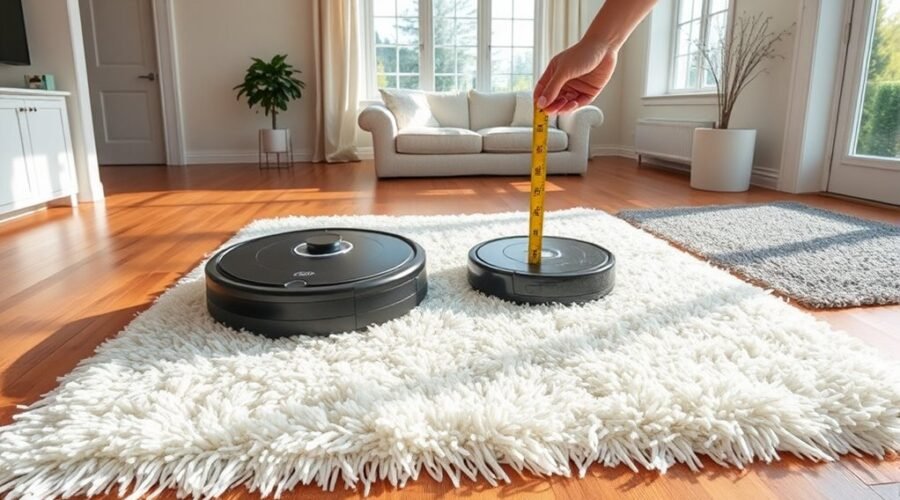
Robot vacuums can clean some shag rugs, but long fibers and thick pile make the job difficult. A robot may struggle to climb onto the rug, lose traction, or catch fibers in its brush. The best results depend on rug thickness, brush design, suction settings, and whether the manufacturer approves the surface.
Quick Answer
Yes, robot vacuums can clean shag rugs when the pile is within the machine’s supported range. Models with adjustable suction, anti-tangle brushes, and suitable ground clearance have the best chance. However, very thick or delicate shag rugs may require a suction-only vacuum to prevent snagging, fiber damage, and repeated stalls.
Key Takeaways
- Some conventional robot vacuums support carpet thickness up to 26 mm, while specialized models can handle thicker surfaces.
- High suction ratings do not guarantee that a robot can move through dense shag fibers.
- Dark rugs can cause false cliff-sensor warnings, while fringe and loose fibers can jam brushes.
- Start with gentle settings and test a small area before scheduling automatic cleaning.
- Use a suitable manual vacuum for deep cleaning when the robot cannot safely reach embedded dirt.
Can Robot Vacuums Clean Shag Rugs?
)
Robot vacuums can remove surface dust, crumbs, and pet hair from compatible shag rugs. However, they usually perform better on low-pile and medium-pile carpets because shorter fibers allow more consistent brush contact and airflow.
Shag rugs contain long, soft fibers that can bend around the vacuum’s wheels and cleaning brushes. This makes movement harder and leaves some debris trapped near the rug’s backing.
Robots with suction ratings above 2,500 Pa may offer useful cleaning power, but that figure is not a guaranteed minimum for shag rugs. The machine must also move freely and clean without pulling fibers.
For example, the eufy carpet compatibility guidance specifies the following limits for certain models:
- G20 series: Low-pile carpets with total thickness up to 10 mm.
- G30, G40, G50, and related models: Medium-pile carpets with total thickness up to 26 mm.
- G10 Hybrid: Not suitable for carpet cleaning because it lacks a rolling brush.
These limits describe specific machines, not every robot vacuum. Thick wool rugs, loose fibers, and tassels can still cause problems even when the thickness falls within a stated range.
Before cleaning, check both the robot’s instructions and the rug’s care label. A small supervised test will help you see whether the robot glides smoothly or pulls at the pile.
Why Shag Rugs Trip Up Robot Vacuums
Shag rugs challenge robot vacuums because their long fibers create more resistance than flat flooring. This affects suction, wheel traction, brush movement, and navigation.
The main problems include:
- Brush tangling: Long strands can wrap around the main brush or side brushes, slowing rotation and increasing motor strain.
- Reduced airflow: Dense fibers can restrict the cleaning opening and make embedded debris harder to extract.
- Wheel resistance: A low-clearance robot may sink into soft pile, spin its wheels, or stop moving.
- Uneven edges: Thick rug backing and curled corners make climbing and leaving the rug more difficult.
- Sensor errors: Some dark surfaces and uneven areas can trigger false obstacle or drop-off detection.
Even a powerful robot may travel across the surface without reaching dirt near the backing. Running additional passes does not always solve this problem.
According to Shaw Floors carpet-care guidance, long shag yarns may wrap around rotating vacuum brushes. Shaw recommends suction-only cleaning or a vacuum with an adjustable brush raised away from the carpet.
This advice matters because an anti-tangle brush designed for human hair is not automatically safe for loose rug fibers.
How Cliff Sensors Handle Thick Rugs
Cliff sensors help robot vacuums detect stairs and other sudden drops. Many models use infrared light to measure the surface beneath the machine.
Thick pile, uneven flooring, and very dark colors can affect these readings. Some robots may stop or turn away even when the rug is safe to cross.
Cliff Sensor Limits
Dark shag rugs are especially challenging for infrared-based cliff sensors. Dark fibers can absorb enough infrared light to make the robot interpret the surface as a drop.
The following conditions can affect navigation:
| Condition | Result |
|---|---|
| Dark shag rugs | May absorb infrared light and trigger false drop warnings |
| High-pile shag rugs | Can interfere with sensor readings and wheel movement |
| Thick rug pads | Increase edge height and may affect navigation |
| False ledge detection | Causes the robot to stop, reverse, or avoid the area |
| Advanced sensor systems | May improve surface recognition, depending on the model |
For example, iRobot’s Error 6 troubleshooting guide identifies dirty cliff sensors, dark surfaces, and uneven floors as possible causes of false drop warnings.
If your robot repeatedly stops on a dark rug, clean its cliff sensors with a dry, soft cloth. Then test the area again.
Never disable or cover cliff sensors to force a robot onto a rug. These sensors help prevent falls from stairs and raised surfaces.
Rug Height Detection
Rug height detection helps compatible robots recognize changes between hard floors and carpets. However, not every robot measures carpet height directly.
Some models use carpet detection to increase suction. Others have lifting mechanisms or more advanced sensors that help them cross thick surfaces.
A useful distinction is the difference between pile height and total rug thickness.
- Pile height: The length of the fibers above the rug backing.
- Total thickness: The combined thickness of the fibers and backing, sometimes affected by a rug pad beneath it.
- Edge height: The raised transition the robot must climb from the surrounding floor.
These measurements are not interchangeable. A robot may be able to clean a carpet of a stated thickness but still struggle to climb onto a rug with a raised edge.
Before comparing measurements, confirm which definition the manufacturer uses.
Best Settings for Shag Rugs
The safest starting point for a compatible shag rug is low suction and minimal brush agitation. Increase cleaning power only when the rug and robot can handle it without snagging.
These settings provide a practical starting point:
- Select vacuum-only mode. Keep the mop inactive so moisture does not reach the shag fibers.
- Choose low suction. Start gently, especially on loose or delicate pile.
- Raise or disable the rotating brush if supported. Follow the rug maker’s instructions when using powered brushes.
- Test one small section. Watch for dragging, unusual noises, wheel slipping, or fibers lifting from the backing.
- Increase suction gradually. Adjust power only if the robot moves freely and the rug remains undamaged.
- Try a second pass if needed. Use another direction when the rug construction allows it and the first pass leaves visible debris.
Automatic carpet boost can help remove debris, but it may also increase the force applied to delicate fibers. Turn it off if stronger suction causes lifting or pulling.
Warning: Do not force a robot vacuum across shag rugs that catch its brush or cause repeated stalls. Stop the cleaning cycle immediately if you notice pulled yarn, unusual motor sounds, or loose fibers collecting around the roller.
For delicate rugs, use the manufacturer’s recommended suction-only cleaning method instead. Rugs USA’s care recommendations advise using low suction and avoiding beater bars to reduce the risk of pulling fibers from the backing.
Best Robot Vacuum Features for Shag Rugs
The best robot vacuum features for shag rugs focus on movement, controlled cleaning, and fiber protection. High suction alone cannot overcome poor ground clearance or a brush that catches long strands.
Look for adjustable suction, suitable carpet clearance, anti-tangle components, and reliable mapping. A model with no-go zones also gives you more control over delicate areas.
Suction and Height Control
Adjustable suction lets you balance dirt pickup against the risk of pulling shag fibers. Height control can also help the machine move across thick surfaces without dragging its cleaning head through the pile.
Useful features include:
- Adjustable suction: Lets you reduce power when delicate fibers lift or snag.
- Brush height adjustment: Helps prevent excessive contact with long pile, where supported.
- Carpet recognition: Allows compatible robots to change cleaning modes automatically.
- Larger wheels and suitable clearance: Improve movement across uneven surfaces.
- Liftable chassis: Helps certain advanced models travel across thicker carpeting.
A higher suction rating should never be used as the only buying criterion. A powerful vacuum that cannot move freely across the rug will leave sections uncleaned.
Check the robot’s supported carpet thickness, climbing ability, and brush configuration before deciding whether it suits your rug.
Anti-Tangle Brush Design
Anti-tangle brushes help reduce hair buildup around a vacuum’s rotating parts. This can improve cleaning consistency and reduce maintenance.
Some designs use flexible rubber rollers, while others guide hair toward the suction opening using specially shaped brush components.
For example, the DuoDivide anti-tangle brush system is designed to reduce hair entanglement and maintain cleaning performance.
However, anti-tangle performance with human or pet hair does not guarantee that long rug yarns will remain safe.
Fibers attached to a shag rug are different from loose hair. A rotating brush can still pull them, especially when they are long, loosely secured, or already damaged.
If the rug maker recommends suction-only vacuuming, follow that guidance even if your robot has an advanced anti-tangle system.
Smart Navigation Features
Smart navigation helps robot vacuums plan routes and avoid trouble spots. This is particularly useful when your home contains both shag rugs and easier-to-clean flooring.
LiDAR navigation uses laser measurements to map the room and guide the vacuum around furniture. Smart mapping can also support virtual barriers and no-go zones.
Useful options include:
- No-go zones: Block thick, fragile, or fringe-heavy rugs from the cleaning route.
- Room-specific settings: Allow different suction levels for different floor areas, where supported.
- Carpet detection: Changes cleaning behavior when the robot recognizes carpet.
- Obstacle avoidance: Helps the machine move around furniture and objects near the rug.
If your robot also mops, keep the shag rug dry. Automatic mop lifting is not always high enough for deep pile.
For example, Roborock’s carpet recognition guidance recommends automatic mop lifting for short-pile carpets on supported models.
For shag rugs, use a no-mop zone or remove the mop attachment if your machine supports that option.
How to Prep a Shag Rug for Cleaning
Prepare a shag rug before running a robot vacuum to reduce tangling, improve debris pickup, and protect the fibers. A little preparation can prevent a cleaning cycle from ending with a stuck machine.
Follow these steps:
- Read the care label. Confirm whether the rug allows powered brushing or requires suction-only cleaning.
- Remove loose debris. Shake the rug outdoors if its size and construction allow. Alternatively, use a suitable manual vacuum.
- Secure the edges. Flatten curled corners and keep the rug from sliding during cleaning.
- Manage loose fringe. Tuck tassels underneath only when doing so will not create a bulky edge or damage the rug. Otherwise, exclude the fringe area.
- Clear nearby objects. Remove cables, toys, clothing, and anything else that might interfere with movement.
- Test a small area. Start with gentle settings and observe the robot before allowing a longer cleaning cycle.
- Inspect the brush afterward. Remove trapped hair and loose fibers before the next session.
During the test, look for smooth movement, normal motor sounds, and a clean path without pulled yarn.
If the robot slows sharply, spins its wheels, or starts pulling fibers, stop the cycle and use another cleaning method.
Pro Tip: Try cleaning a narrow strip at the edge of the rug before allowing full coverage. Compare the cleaned area with the untouched pile. If fibers look pulled, flattened, or disturbed, stop using the robot on that rug.
Once the test succeeds, you can schedule regular light cleaning on compatible rugs. Continue checking the rug and brushes for signs of wear.
When a Shag Rug Is Too Much
A shag rug is too thick for a robot vacuum when the machine cannot cross it safely, maintain traction, or rotate its brushes freely. This limit varies by model rather than following one universal pile-height rule.
Many conventional robots struggle when total carpet thickness approaches or exceeds about 1 inch. However, specialized models can handle thicker carpets.
The following manufacturer specifications show why model choice matters:
| Robot model | Stated carpet limit | Practical meaning |
|---|---|---|
| eufy G20 series | 10 mm total thickness | Designed for low-pile carpets, not deep shag |
| eufy G30, G40, G50 series | 26 mm total thickness | Suitable for some medium-pile carpets; plush rugs may still cause stalls |
| eufy Robot Vacuum S2 | Up to 5 cm carpet height | Specialized lifting chassis improves access to thicker carpets |
The eufy S2 specifications describe a lifting chassis that can travel across carpets up to 5 cm thick. This demonstrates that some newer designs extend beyond conventional carpet-height limits.
However, a supported carpet height does not guarantee safe cleaning of every rug material or weave.
The Carpet and Rug Institute’s high-pile vacuum guidance warns that rotating brushes can cause serious texture changes on some shag carpets.
Signs your shag rug exceeds the robot’s practical limits include:
- The chassis sinks into the fibers and stops moving.
- The wheels spin without moving the vacuum forward.
- Long tassels twist around the brushes.
- The robot repeatedly reverses or reports a navigation error.
- Fibers stretch, pull loose, or wrap tightly around the roller.
- Visible dirt remains deep in the pile after repeated cleaning.
A conventional robot vacuum may also provide lower pickup efficiency on thick pile than on low-pile flooring. The original article’s estimate of a roughly 30% reduction requires model-specific test data before it can be treated as a reliable benchmark.
If the rug causes repeated problems, create a no-go zone and clean it with a suitable manual vacuum instead.
Practical Shag Rug Cleaning Tips
Regular cleaning helps prevent dirt from settling deep into shag fibers. However, the safest cleaning routine depends on the rug’s material, pile length, and construction.
For rugs that can safely handle robotic cleaning, aim for light maintenance at least weekly. Busy areas and homes with pets may need more frequent attention.
Use the following approaches to protect the pile:
| Action | Purpose | Result |
|---|---|---|
| Start low | Reduce excessive suction on fibers | Lower risk of pulling and snagging |
| Adjust brush height | Limit contact with long pile | Less brush resistance |
| Change direction | Expose debris between fibers | More even surface cleaning |
| Use attachments | Clean deeper areas manually | Better debris removal |
For deeper cleaning, a traditional vacuum with a suction-only head or appropriate attachment may work better than a robot vacuum.
A gentle upholstery attachment can help reach areas where long fibers prevent the robot from making good contact. Use it only when the rug maker allows that attachment.
You should also:
- Inspect and clean the robot’s brush roll regularly.
- Empty the dustbin and maintain the filter according to the machine’s instructions.
- Vacuum the underside and floor beneath the rug when its construction allows.
- Gently fluff flattened fibers using a suitable carpet rake or soft brush.
- Rotate the rug periodically to spread foot traffic and reduce uneven wear.
- Blot spills promptly rather than rubbing liquid into the fibers.
A robot vacuum is best treated as a maintenance tool for compatible shag rugs, not a complete replacement for periodic deep cleaning.
When the pile becomes heavily matted or contains deeply embedded dirt, a suitable manual vacuum or professional rug cleaner may provide a safer and more thorough result.
Frequently Asked Questions
What Is the Best Vacuum Cleaner for Shaggy Rugs?
For shaggy rugs, choose a suction-only vacuum or one with a brush roll that can be lifted away from the fibers. The eufy Robot Vacuum S2 is an option for rugs within its stated carpet-height limit, while the Dyson V12 can be used with a suitable gentle attachment. The rug care label should decide whether powered brushing is safe.
How Do You Vacuum a Very Shaggy Rug?
To vacuum a very shaggy rug, start with low suction and avoid a rotating brush if the care label calls for suction-only cleaning. Work slowly in straight passes, then change direction if the fibers do not snag. Clean the underside and floor beneath it when the rug construction allows.
Do Robot Vacuums Work on Thick Rugs?
Robot vacuums work on some thick rugs, but many stop or lose traction when the pile is deep. Compare the rug’s total thickness and edge height with the robot’s stated limits, then make a supervised test pass. Keep very thick or tasseled rugs outside the robot’s cleaning zone.
Which Types of Rugs Are Compatible With Robot Vacuums?
Low-pile, flatweave, and short-loop rugs are usually the easiest for robot vacuums to clean. Secure the edges, remove loose threads, and use carpet mode only if the rug permits a rotating brush. Dense shag, delicate wool, and long fringe often need manual care.
Can a Robot Vacuum and Mop Clean a Shag Rug?
A robot vacuum and mop can vacuum some compatible shag rugs, but it should not wet them during routine cleaning. Use vacuum-only mode, a no-mop zone, or a removable mop attachment when available. Automatic mop lifting may not provide enough clearance for long fibers.
Conclusion
Robot vacuums can clean shag rugs when the pile height, material, and rug construction match the machine’s capabilities. Adjustable suction, suitable clearance, and anti-tangle brushes can help, but they do not guarantee safe cleaning.
Before starting, confirm the rug’s care instructions and the robot’s stated carpet limits. Test a small area and watch for pulling, stalling, or navigation errors. If the robot cannot move freely or protect the fibers, use a suitable manual vacuum instead.
Sources
- eufy Support: G Series Carpet Compatibility: Supported carpet thickness, dark rugs, and tassel limitations.
- Shaw Floors: Carpet Care: Vacuuming methods and brush safety for long shag fibers.
- iRobot Support: Error 6: Cliff-sensor errors caused by dark surfaces, uneven floors, and dirty sensors.
- Rugs USA: Area Rug Care: Low-suction cleaning, beater bar precautions, and general rug maintenance.
- Roborock Support: DuoDivide Brush: Anti-tangle brush design and reduced hair entanglement.
- Roborock Support: Carpet Recognition: Automatic carpet detection and mop lifting on supported models.
- eufy: Robot Vacuum S2 Guide: Liftable chassis, suction specifications, and stated 5 cm carpet capability.
- Carpet and Rug Institute: High-Pile Carpet Technical Bulletin: Potential brush-related damage to shag and high-pile carpets.