Rug pile height determines whether a robot vacuum can cross a surface and clean effectively. The measurement must be taken from the backing to the top of the fibers, not from any padding below. A ruler or pile gauge can provide a reliable reading, but small errors change the result. The real issue is how that number compares with vacuum clearance and carpet performance limits.
What Rug Pile Height Means for Robot Vacuums
Rug pile height is the vertical length of carpet fibers above the backing, and it directly influences how a robot vacuum travels across and cleans a surface.
In practical terms, rug pile height determines resistance, traction, and the likelihood of entanglement. Low pile rugs, under 0.25 inch, usually allow efficient cleaning because robot vacuums encounter minimal drag.
Medium pile rugs, from 0.25 to 0.5 inch, often require stronger suction and navigation features to maintain consistent coverage without stalling.
Medium pile rugs often need stronger suction and navigation to keep a robot vacuum moving and cleaning evenly.
High pile carpet, above 0.5 inch, can exceed the climbing abilities of many units, especially when anti-tangle systems are absent.
From an analytical standpoint, robot vacuum compatibility depends on matching machine design to fiber height, not on marketing claims.
Selecting the wrong model can reduce cleaning performance, trap the device, and wear the rug prematurely.
Understanding rug pile height thus supports informed choice and protects autonomy in floor care.
Measure Pile Height With a Ruler
Accurate pile measurement begins with a rigid ruler or pile gauge, since flexible tools can distort the reading.
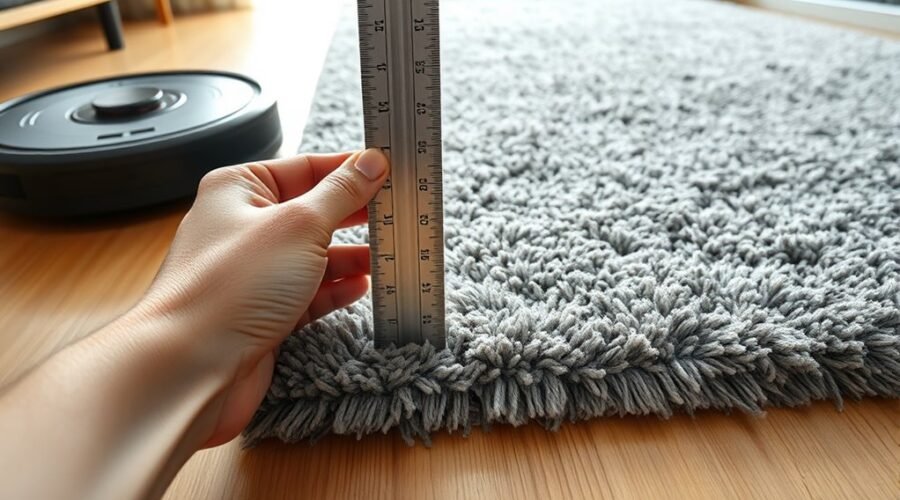
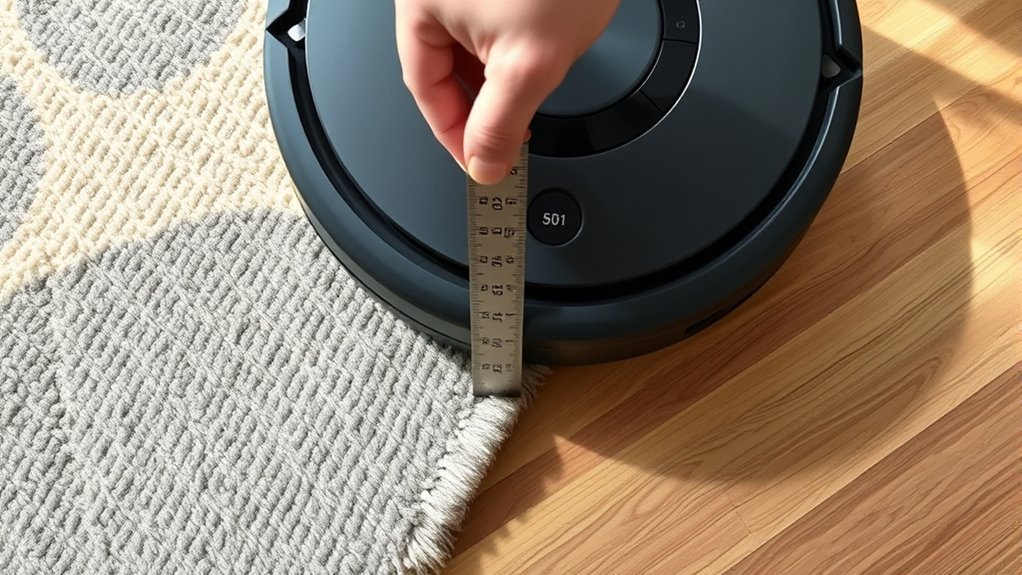
The ruler should be positioned vertically at the rug base, with the measurement taken from the backing to the tip of the tallest fiber without compressing the pile.
Repeated readings at multiple points improve accuracy and confirm the true pile height range.
Gather Measuring Tools
To measure rug pile height with precision, a rigid ruler or pile gauge should be placed on a flat surface beside the rug. The necessary measuring tools are simple, but they must enable accurate measurement without distortion.
The ruler should remain upright, and the pile gauge should read from the rug backing to the tip of the tallest fiber. Compression must be avoided, because pressure changes the true rug pile height and weakens the result. Padding and secondary backing should not be counted.
For reliable data, repeat the test in multiple areas, especially where fibers are uneven. This method preserves clarity and autonomy in assessment, allowing users to determine whether the rug meets robot vacuum clearance requirements with objective, repeatable precision.
Check Pile From Base
A rigid ruler should be set vertically against the rug to measure pile height from the backing to the tip of the tallest fiber. This method lets one measure rug structure without compressing fibers or bending them, preserving accuracy and freedom from guesswork. The rigid ruler must rest lightly, and the reading should be taken at the tallest fiber above the backing.
| Pile class | Height |
|---|---|
| low pile | under 0.25 in |
| medium pile | 0.25 to 0.5 in |
| high pile | over 0.5 in |
Recording rug pile height in inches or millimeters supports clear classification. Regular checks help match the rug to a robot vacuum able to cross it cleanly and cleanly, without obstacle or limitation.
Use a Pile Gauge for Better Accuracy
A pile gauge provides a more exact method for determining rug pile height than visual estimation alone. This instrument is designed to measure rug fibers with consistent precision, helping evaluate carpet height across different rug types.
To obtain accurate measurements, the gauge is inserted into the pile until it contacts the backing, then read without compressing the fibers. That procedure captures the tallest fibers and reduces distortion in plush or shag surfaces.
Many models display both metric and imperial scales, allowing direct comparison in inches or millimeters. Such standardized data support rational selection of robot vacuums, since suction power and cleaning geometry must align with the measured pile.
The method also clarifies whether a rug’s texture or extra padding alters the apparent height. Used correctly, a pile gauge replaces guesswork with measurable evidence, giving users greater control over vacuum compatibility and preserving practical autonomy in floor care decisions.
Measure From the Rug Backing
Accurate pile measurement begins at the rug backing, where the fibers are anchored, rather than at the visible surface.
A rigid ruler or measuring tape should be held flat against the backing and extended to the tip of the tallest fiber without compressing the pile.
This backing-to-pile method isolates pile height from padding or secondary layers and yields a reliable value for robot vacuum clearance assessment.
Backing-To-Pile Method
To measure pile height with the backing-to-pile method, a ruler should be held vertically against the rug’s backing without compressing the fibers. This technique isolates true rug pile height by starting at the highest point of the pile and excluding padding or secondary backing.
The resulting measurement supports accurate measurement across varied rug types and helps determine suction power needs for a compatible robot vacuum. For irregular shape rugs, several points should be checked because pile height may differ by zone.
- Align the ruler with the backing.
- Read from backing to peak pile.
- Repeat in multiple areas for consistency.
Measure With Ruler
A rigid ruler should be placed directly against the rug backing and held vertically so the fibers remain uncompressed during measurement. This method allows one to measure rug pile height from the backing to the tip of the tallest fiber with an accurate result.
Only the primary backing should be read; padding or secondary layers distort the measurement and weaken compatibility assessments for robot vacuums. The ruler should remain steady, since angled placement can compress pile and reduce precision.
On thick rugs, a pile gauge or digital caliper may provide better control, but the ruler remains a practical baseline tool. Record the final measurement in inches or millimeters to support objective evaluation of rug pile height and preserve informed, liberated choices about cleaning access.
Match Pile Height to Vacuum Specs
Once the rug pile height has been measured from backing to tallest fiber without compression, the result should be matched directly against the robot vacuum’s published rug compatibility. This comparison protects autonomous cleaning from avoidable failure and preserves user control.
A robot vacuum should list the exact range it can traverse, because high-pile rugs often exceed the mobility and suction power of standard units, while medium-pile rugs demand stronger specifications.
- Verify the stated rug pile height range in the manufacturer data.
- Compare suction power, especially for medium-pile rugs requiring at least 4,000 Pa.
- Check cliff sensors behavior on dark or patterned surfaces, which may trigger false drop detection.
If the measured value falls outside the listed compatibility, selection should change rather than expectation. Such matching supports efficient operation, fewer stalls, and cleaner lines of movement across the rug field.
Low-Pile Rugs and Robot Vacuum Fit
Low-pile rugs, typically under 0.25 inches (6 mm), present minimal resistance to robot vacuums because their dense, shallow surface allows smooth travel without significant risk of tangling or stalling.
For this rug pile height, most robot vacuums achieve reliable coverage and stable navigation, making liberation from manual vacuuming practical and repeatable.
Cleaning effectiveness improves when suction power reaches at least 4,000 Pa, since stronger airflow lifts embedded dust and light debris from the fibers.
Entry-level models can still perform well on low-pile rugs, provided the chassis clears the surface and the brush system remains unobstructed.
Ideal performance depends on routine brushroll maintenance, especially removal of hair and lint that can reduce contact quality or increase drag.
In operational terms, low-pile rugs are among the easiest surfaces for robot vacuums, offering consistent results without specialized carpet modes or advanced traction systems.
Medium-Pile Rugs and Carpet Boost
Medium-pile rugs, typically 0.25 to 0.5 inches (6 to 12 mm) in fiber height, place greater demands on robot vacuums than low-pile surfaces because they introduce more brush drag, deeper fiber penetration, and a higher likelihood of reduced traction.
In this range, robot vacuums benefit from carpet boost, which raises suction power automatically when pile resistance rises. Effective cleaning performance depends on stable brush contact, responsive drive control, and strong threshold-climbing so the machine crosses rug edges without stalling.
Medium-pile rugs also retain more dust and allergens than low-pile flooring, so regular passes improve dirt removal and support a cleaner indoor environment.
Medium-pile rugs trap more dust and allergens, making regular vacuuming key to a cleaner indoor environment.
Models such as the Dreame X50 Ultra illustrate how adaptive settings can refine performance on these textiles.
- Detect pile resistance
- Increase suction power
- Preserve mobility and extraction
High-Pile and Shag Rug Challenges
High-pile and shag rugs, with fibers that commonly exceed 0.5 inches (12 mm), introduce a distinct set of mobility and cleaning challenges for robot vacuums. Their deep fibers can entrap debris and impede wheel movement, so reliable rug performance depends on stronger suction, often near 4,000–8,000 Pa.
An anti-tangle brush, especially a rubberized roller, helps prevent hair and fibers from wrapping around the cleaning head, preserving airflow and contact efficiency. Threshold-climbing also becomes critical, because rugs above 1 inch (25 mm) may exceed the ascent limits of lower-spec models.
For users seeking autonomous floor care without compromise, these design factors determine whether a machine can move freely or remain constrained. Regular maintenance, including brush inspection and debris removal, further supports consistent operation by reducing clogs and sustaining cleaning output on dense textiles.
Avoid Common Measurement Mistakes
Accurate rug pile height measurement depends on avoiding a few common errors. To measure pile height with accuracy, the reader should place a rigid ruler or pile gauge from the backing to the tallest fiber tip, without compressing fibers.
Flexible measuring tapes can bend and produce inconsistent readings, reducing precise measurements. The backing and any padding must be excluded, since they artificially inflate pile height and distort robot vacuum clearance decisions.
For best results, inspect the rug in strong light, then sample several zones where uneven wear or varying pile heights may exist.
- Use a rigid tool, not flexible measuring tapes.
- Measure only from backing to the highest fiber tip.
- Repeat the measure in multiple areas for an accurate average.
These controls reduce common mistakes and support an accurate evaluation, allowing a robot vacuum setup that remains technically sound and practically liberating.
Frequently Asked Questions
Do Robot Vacuums Work on High Pile Rugs?
Yes, robot vacuums can work on high pile rugs when robot vacuum features, suction power importance, and obstacle navigation align with rug material effects; cleaning efficiency tips, maintenance routines, battery life considerations, and user reviews insights improve outcomes.
What Is the Recommended Rug Pile Height?
Recommended rug pile height is under 0.5 inches; low-pile under 0.25 inches maximizes surface compatibility. Rug types, pile materials, vacuum features, suction power, cleaning frequency, customer reviews, and maintenance tips guide selection.
What Is the Recommended Height Clearance for a Robot Vacuum?
Recommended height clearance for a robot vacuum is about 2.5 inches, balancing robot vacuum features, suction power, navigation technology, and dirt detection across rug material types, flooring compatibility, carpet cleaning techniques, and maintenance tips.
Which Robot Vacuum Is Best for High Pile Carpet?
The Dreame X50 Ultra is best for high pile carpet, combining strong vacuum suction, optimized brush design, obstacle detection, and robot navigation. Its carpet fibers penetration improves cleaning efficiency, while battery life supports larger spaces.
Conclusion
To summarize, accurate rug pile height measurement is a small but critical step in determining robot vacuum compatibility. Although some may assume surface thickness is enough, true evaluation requires measuring from the backing to avoid padding distortion. Using a rigid ruler or pile gauge, with repeated readings across the rug, yields dependable results. This data helps match low-, medium-, or high-pile surfaces to vacuum specifications, reducing cleaning errors and improving performance.