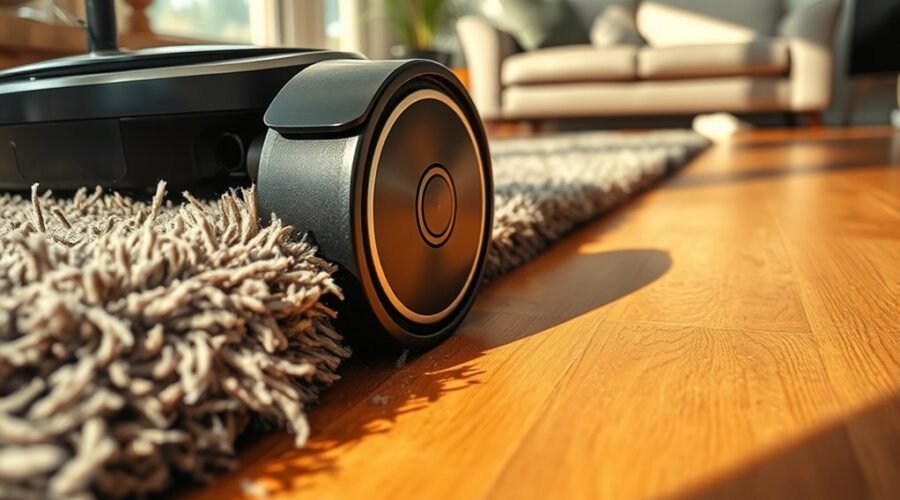
Robot vacuums do not treat every rug the same. Low-pile surfaces, up to about 0.5 inches, usually pose little problem. Medium-pile rugs begin to test traction and clearance, and high-pile or shag materials can stop many units outright. The difference is not just height; it is also wheel grip, sensor response, and threshold design. The key question is where a specific model loses its ability to cross.
How High a Rug Can a Robot Vacuum Cross
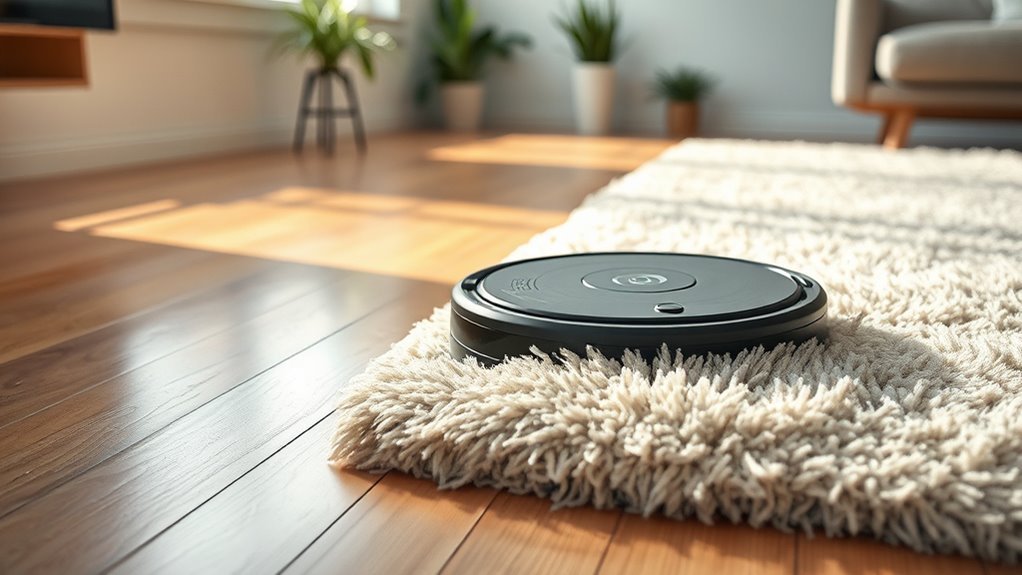
Most standard robot vacuums can cross low-pile rugs, typically up to about 0.5 inches high, without difficulty; mid-range models often manage medium-pile rugs around 0.8 inches, while high-end units can exceed that limit and climb thresholds or rugs as tall as 1.57 inches.
Rug pile height is thus a primary determinant of robot vacuum mobility and rug compatibility. Low-pile rugs present minimal resistance, whereas thick rugs and shag surfaces can interrupt movement or cause tangling.
Advanced navigation, larger wheels, suspension systems, and obstacle detection improve traversal across uneven surfaces, especially in high-end models.
Suction power also matters, but lift capability and clearance geometry usually decide whether a robot vacuum can maintain progress over medium-pile rugs.
For users seeking practical autonomy, the relevant metric is not only cleaning performance but also how reliably the machine crosses each surface without manual intervention.
That distinction defines operational freedom in mixed-floor environments.
Why Low-Pile Rugs Are Easy to Clean
Low-pile rugs, typically 1/4 inch or less in height, present an accessible surface for robot vacuums because their low profile reduces resistance during travel and cleaning.
Their flat weave keeps friction minimized, so robot vacuums can glide over the surface with stable traction and consistent debris pickup.
Flat weave minimizes friction, helping robot vacuums glide smoothly with steady traction and reliable debris pickup.
Because these low-pile rugs demand less suction power than denser textiles, cleaning efficiency improves without forcing the machine to overcompensate.
Effective navigation systems and sensor technology further support precise route selection, allowing the unit to adapt quickly and preserve uninterrupted cleaning across open areas.
The reduced risk of brush entanglement also lowers maintenance issues, which helps sustain performance over repeated cycles.
In practice, the combination of low height, low drag, and responsive automation gives robot vacuums a clear operational advantage, enabling systematic coverage with fewer interruptions and a more autonomous cleaning process.
Where Robot Vacuums Start Struggling on Medium-Pile Rugs
As rug height increases from low-pile surfaces into the 0.5 to 1 inch range of medium-pile rugs, robot vacuums begin to encounter measurable limits in suction, traction, and brush performance.
Many robot vacuums lose cleaning efficiency when suction power drops below about 4,000 Pa, because embedded debris resists lift from denser fibers. In this range, navigation becomes less forgiving: wheel slip, slowed traversal, and occasional stalling are common without advanced guidance and motorized brush rolls.
Carpet boost and auto-adjusting suction improve contact pressure and airflow, helping preserve cleaning performance across variable textile density. Even then, deep cleaning depends on repeated passes and stable brush agitation rather than speed.
Medium-pile rugs consequently represent the point where autonomy starts to require compensation, not just movement. Beyond this threshold, high-pile rugs intensify the problem, but medium-pile surfaces already expose the functional boundary between routine pickup and reliable extraction.
Why High-Pile and Shag Rugs Stop Robot Vacuums
High-pile and shag rugs often exceed the practical limits of robot vacuums because their thick, loose fibers create drag, reduce wheel traction, and obstruct brush contact with the carpet base.
Most robot vacuums are engineered with a climbing height near 0.8 inches, so high-pile rugs can block ascent before the chassis reaches stable footing.
Robot vacuums typically climb only about 0.8 inches, making high-pile rugs a serious obstacle to stable ascent.
Once on the surface, traction loss increases motor load, slows navigation, and lowers cleaning efficiency.
Dense fibers also absorb suction, leaving embedded debris beyond the reach of standard rollers.
In addition, sensors may misread dark or patterned shag rugs as drop-offs, causing avoidance behaviors and incomplete coverage.
The result is not merely slower cleaning but structural incompatibility between machine geometry and textile depth.
Models with stronger suction, typically 2500 Pa or more, and anti-tangle technology perform better, yet even they remain constrained by pile height, brush engagement, and the limits of autonomous movement across unstable textile terrain.
How to Help a Robot Vacuum Clear Rugs
Improving a robot vacuum’s ability to clear rugs depends on matching machine capability to textile resistance. A robot vacuum should deliver strong suction, ideally 2000 Pa for low-pile rugs and 2500 Pa or more for dense surfaces, to preserve rug performance.
Carpet boost or Max Suction mode can raise intake when crossing thicker fibers, reducing stall events. Anti-tangle brushrolls are preferable on decorative rugs because they limit hair and fringe entanglement, which otherwise constrains throughput.
Regular maintenance is essential: sensors, wheels, and brushes must be cleaned so navigation remains stable and lift detection stays accurate.
Where rugs create navigation challenges, virtual barriers or no-go zones can prevent repeated failures and protect fragile textiles. With calibrated settings and disciplined upkeep, the vacuum gains freer movement, better traction, and more reliable clearance over varied rug pile heights.
Frequently Asked Questions
Do Any Robot Vacuums Work on High-Pile Carpet?
Yes, some robot vacuums work on high-pile carpet, but only with strong high pile compatibility, high suction power, advanced navigation technology, optimized brush design, low carpet sensitivity, proven user reviews, brand comparisons, performance tests, and maintenance tips.
Can Robot Vacuums Handle Area Rugs?
Yes—like a cart crossing woven plains, robot vacuums can handle many area rugs. Rug types, vacuum features, suction power, and navigation technology determine cleaning efficiency, battery life, maintenance tips, price ranges, brand comparisons, customer reviews.
What Is the Best Robot Vacuum for Low-Pile Carpets?
Roborock Qrevo Edge is often the best robot vacuum for low-pile carpets, combining strong suction power, refined navigation technology, efficient brush design, low noise levels, long battery life, smart connectivity, app compatibility, and practical maintenance tips.
Can a Roomba Go Over Rugs?
Yes, a Roomba can usually cross rugs. Roomba performance depends on rug thickness, vacuum sensors, floor change handling, brush design, and obstacle detection; cleaning efficacy, battery life, maintenance tips, and user experiences vary by model.
Conclusion
To summarize, robot vacuum performance declines as rug pile height rises: low-pile rugs permit easy passage, medium-pile rugs demand greater traction and clearance, and high-pile or shag rugs often exceed standard capabilities. Matching wheel design, suction system, and navigation sensors to rug type is essential. Proper mapping, obstacle management, and rug selection improve crossing success. Therefore, effective cleaning depends not on a vacuum’s price alone, but on its ability to bridge specific pile-height thresholds.