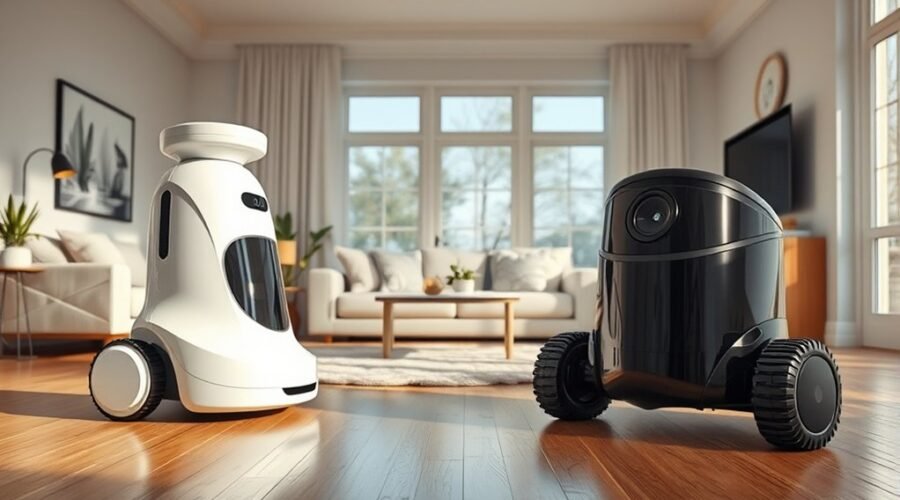
LiDAR vs camera robot vacuums is an important comparison when choosing a cleaner for your home. Both technologies help robots map rooms and plan cleaning routes, but they gather information differently. Your lighting, furniture layout, floor clutter, and privacy preferences can determine which system works better for you.
Quick Answer
LiDAR robot vacuums are generally better for accurate mapping, dark rooms, and complex layouts. Camera-based vacuums work well in bright spaces and can recognize small objects when equipped with suitable software. LiDAR often maps faster, while cameras provide richer visual information. Hybrid systems combine these strengths for more reliable cleaning in varied home environments.
Key Takeaways
- LiDAR measures distances directly, while camera navigation identifies visual landmarks to estimate position.
- Mapping accuracy and small-object detection are different features. Excellent mapping does not guarantee reliable cord avoidance.
- Camera-based models may fit under lower furniture because some lack a raised laser turret.
- Camera privacy depends on image storage, sharing permissions, and manufacturer policies.
- Compare actual models rather than assuming every LiDAR vacuum costs more or every camera vacuum navigates poorly.
Which Is Better: LiDAR or Camera Robot Vacuums?
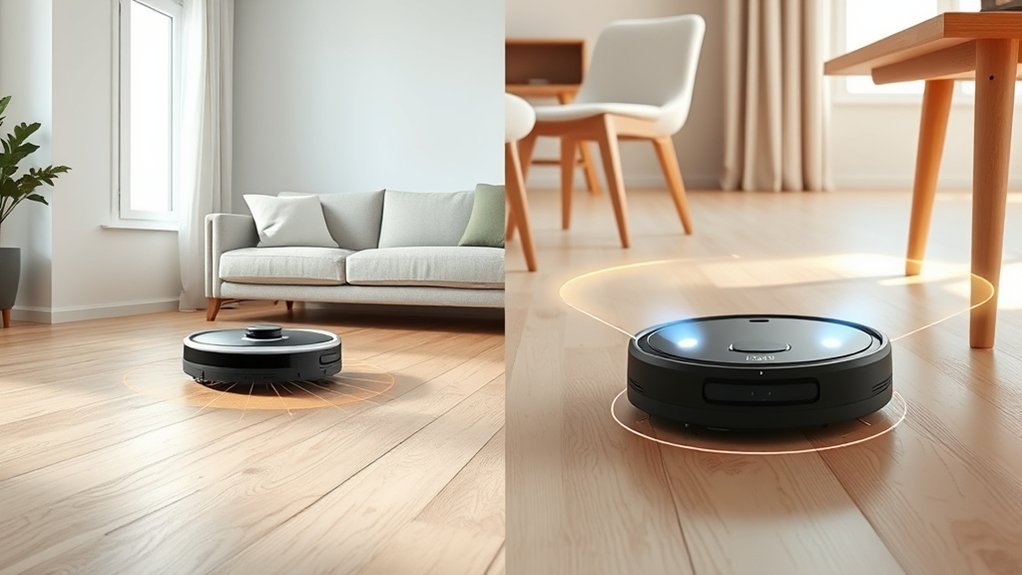
LiDAR is generally the better choice for dependable navigation. It measures distances with laser light and creates consistent maps without needing room lighting. Camera-based visual navigation, also called vSLAM, uses recognizable features to work out where the vacuum is.
Both systems can clean effectively. However, the best choice depends on your home’s conditions and the other sensors included in the robot.
| Feature | LiDAR Navigation | Camera Navigation |
|---|---|---|
| Main technology | Laser distance measurements | Visual landmarks and image processing |
| Mapping accuracy | Generally precise and consistent | Good with sufficient visual detail |
| Dark rooms | Works without visible room lighting | May struggle without lighting assistance |
| Small-object detection | Limited with basic laser mapping alone | Can identify objects with compatible recognition software |
| Mapping speed | Often faster initially | Can require more visual processing |
| Privacy | No room images needed for laser mapping | Image handling depends on the model |
| Typical best fit | Large, dark, or complex homes | Bright homes with recognizable features |
The ECOVACS comparison of LiDAR and vSLAM explains why laser mapping offers consistent geometry while cameras depend more heavily on visual information.
A hybrid vacuum can provide both accurate room mapping and detailed object recognition. That combination is particularly useful if you have pets, children, or frequently changing floor clutter.
How LiDAR Robot Vacuums Map Your Home
LiDAR stands for Light Detection and Ranging. A LiDAR robot vacuum sends laser light toward surrounding surfaces and measures the reflected signals to calculate distances.
The sensor scans walls, furniture, doorways, and other boundaries. Software converts the measurements into a digital floor plan that helps the robot determine where it has cleaned.
Most conventional robot vacuum laser systems scan in a horizontal plane and create a 2D map. More advanced systems can combine additional depth sensors or 3D sensing technology.
For example, the Vorwerk explanation of Kobold VR7 mapping describes how a 2D laser scanner and motion sensor work together to produce a floor plan.
The robot uses Simultaneous Localization and Mapping (SLAM) to build the map and estimate its position at the same time.
Direct laser measurements let the vacuum distinguish walls, corridors, and furniture edges with precision.
This gives the vacuum several practical benefits:
- Systematic routes instead of random movement
- More reliable navigation through complex rooms
- Reduced repeated cleaning of the same area
- Accurate positioning without relying on visible light
- Support for room boundaries and cleaning zones on compatible models
However, LiDAR is not perfect. Thin cables, low obstacles, mirrors, and glass surfaces can still cause detection problems.
How Camera-Based vSLAM Works
Camera-based vSLAM uses images to identify visual landmarks and estimate a robot vacuum’s position. Instead of directly measuring every surrounding distance with a laser, it analyzes how recognizable features appear and move between images.
These observations help the robot build a map and track its location. Performance depends on lighting, camera quality, processing software, and the available visual details.
Visual Landmark Detection
Visual landmarks are recognizable features that help a camera-based vacuum determine where it is. These may include corners, furniture edges, wall features, and objects that remain in consistent positions.
As the vacuum moves, its software compares newly captured images with earlier observations. Matching these landmarks helps it estimate movement and location.
| Factor | Effect | Note |
|---|---|---|
| Lighting | Strong influence | Clear images support visual tracking |
| Visual landmarks | High value | Distinctive features improve localization |
| Cluttered rooms | Mixed results | More visible features help, but moving obstacles create challenges |
Rooms with plain walls and few distinctive features can make visual localization harder. Repeated patterns and moving objects may also confuse the system.
Camera navigation does not automatically provide accurate depth measurements. Some robots use additional sensors or software to improve distance estimates.
Real-Time Map Updates
Camera-based vacuums update their maps while moving through your home. The software compares fresh images with previously recognized landmarks to estimate position and identify changes.
If you move a chair, the robot may adjust its cleaning route around the new obstruction. However, recognizing a changed object and updating the stored room map are not always the same process.
LiDAR systems also update navigation information in real time. Therefore, camera navigation does not have a universal advantage in map-update speed.
Both technologies depend on the robot’s processing power and navigation software to make useful adjustments.
Lighting and Feature Needs
Camera-based navigation works best when images contain enough light and recognizable detail. Bright, feature-rich rooms usually provide better tracking conditions than dark or visually uniform spaces.
Low light can reduce landmark recognition and cause localization errors. Some camera-equipped robots use LEDs, infrared sensors, or other supporting technology to improve performance.
These features are model-specific, so they should not be assumed to provide complete darkness compatibility.
Visual navigation is most dependable when the robot can consistently recognize its surroundings. If you frequently clean at night, check whether the model needs room lighting for navigation rather than only for obstacle detection.
Which Is More Accurate: LiDAR or Camera?
LiDAR generally provides more consistent geometric mapping because it measures distances directly. Camera navigation can also be accurate, but its performance depends more on lighting, recognizable features, and software quality.
The original comparison describes LiDAR mapping accuracy above 95% and possible camera performance losses of up to 40% in poor lighting. However, these percentages lack a common verified testing method and should not be treated as universal benchmarks.
It also helps to separate mapping accuracy from obstacle recognition. A robot may know its location precisely but still fail to recognize a small cable.
Mapping Precision
LiDAR measures distances from the vacuum to surrounding surfaces, helping create consistent room boundaries and planned cleaning paths.
Camera-based systems estimate location by tracking visual details. They can perform well in structured, well-lit rooms, but may struggle when landmarks are difficult to identify.
Both technologies can support accurate floor plans, although laser-based navigation generally offers an advantage in complex environments with limited lighting.
Sensor placement matters too. A raised LiDAR turret may detect furniture at its scanning height while missing objects close to the floor.
Likewise, camera position and field of view affect what a vision-based vacuum can detect.
Low-Light Accuracy
LiDAR offers a clear advantage in dark environments because its distance measurements do not require visible room lighting.
Visual navigation can become less reliable when the camera cannot identify landmarks. Shadows and insufficient illumination may reduce positioning accuracy or interrupt a cleaning route.
However, not every camera-equipped robot behaves the same way. Additional lighting and depth sensors can reduce these limitations.
For households that clean overnight, LiDAR remains a strong choice for consistent mapping.
Obstacle Detection
Obstacle detection depends on more than the main navigation system. LiDAR can detect walls and furniture boundaries accurately, but basic laser mapping may overlook smaller objects.
Cameras equipped with suitable recognition software can identify objects such as cables, toys, and pet waste.
For example, iRobot’s camera obstacle-recognition documentation explains how compatible robots identify common household objects and avoid them.
The practical differences are:
- LiDAR: Strong for room geometry, wall detection, and route planning.
- Camera recognition: Useful for identifying recognizable household objects.
- Additional depth sensors: Help estimate the position and size of nearby obstacles.
- Hybrid systems: Combine structural mapping with more detailed obstacle awareness.
A camera used for navigation is not necessarily a camera capable of recognizing cables or pet waste. Always confirm that a model specifically supports object recognition.
How Do They Perform in Dark Rooms?
LiDAR robot vacuums usually navigate better in dark rooms. Their laser sensors measure distance without requiring visible light, so they can continue mapping while the lights are off.
Camera-based systems may struggle because they need recognizable visual landmarks. Some models can work in dim lighting but become less reliable in complete darkness.
For example, iRobot’s low-light navigation guidance explains that extremely dark rooms can interfere with camera localization. It also notes that a robot’s obstacle-detection headlight may not provide enough light for navigation.
Keep these differences in mind:
- LiDAR can map dark rooms without depending on ordinary room lighting.
- Camera navigation may need sufficient visible landmarks.
- Infrared and other supporting sensors can improve some camera-equipped models.
- Reliable mapping in darkness does not guarantee equally strong small-object avoidance.
If you normally run the vacuum overnight, prioritize proven low-light navigation and obstacle detection.
Which Handles Clutter Better?
Camera-based object recognition can be especially useful in cluttered homes. It helps compatible robots distinguish everyday items that basic distance sensors might not identify.
LiDAR remains valuable because it provides stable room geometry and accurate routes around larger obstacles.
However, neither system guarantees perfect navigation around every household item.
Common challenges include:
- Electrical cords: Thin cables may escape detection or become tangled in brushes.
- Small toys: Low objects can sit below a laser scanner’s detection plane.
- Furniture legs: Narrow or reflective surfaces may produce difficult sensor readings.
- Moved furniture: Both systems may need to adjust their routes.
- Pet waste: Recognition requires suitable hardware and trained detection software.
Reflective surfaces present another challenge. The Xiaomi S10T support documentation identifies mirrors, windows, and shiny metal as possible causes of mapping problems.
Hybrid navigation often provides the most useful balance in busy homes. Laser measurements establish the room layout, while suitable cameras and supporting sensors help recognize obstacles.
Pro Tip: Before creating your first map, remove loose cords, small toys, and anything likely to trap the vacuum. A clear initial mapping run helps the robot learn the permanent room layout without unnecessary interruptions.
How Fast Are LiDAR and Camera Vacuums?
LiDAR robot vacuums often build initial maps faster because they gather direct distance measurements. Camera-based systems need to identify and track visual features while calculating their positions.
However, navigation speed is not the same as cleaning speed. Suction settings, room size, obstacles, software, and battery management also affect how long a cleaning session takes.
Mapping Speed
Laser scanning allows a robot to capture surrounding room geometry quickly. Some LiDAR models include dedicated quick-mapping modes that explore a home before beginning normal cleaning.
For example, the Tapo RV30C manufacturer specifications describe an 8-minute mapping result under internal test conditions.
Actual mapping times vary with room size, furniture placement, and the robot’s navigation system.
Camera-based vacuums may take longer to establish reliable visual landmarks. Still, advanced image-processing hardware can help reduce delays.
There is no universal mapping-time figure that applies to all LiDAR or camera robot vacuums.
Clean Path Planning
LiDAR helps robot vacuums plan routes using measured room boundaries. A stable map allows the robot to follow systematic cleaning patterns and reduce unnecessary overlap.
Camera systems can also plan organized routes once they have a reliable map.
Both systems use navigation software to adjust paths when they encounter furniture or other obstacles.
The speed difference becomes more noticeable when a robot must repeatedly correct its position. In these conditions, strong localization helps avoid missed areas and unnecessary movement.
For larger or complicated homes, accurate mapping can be more valuable than simply choosing a vacuum with a high advertised travel speed.
Light Condition Impact
Lighting has little direct effect on LiDAR distance measurements. This allows laser-based vacuums to maintain stable mapping in dim rooms and during nighttime cleaning.
Camera systems may need extra processing or repeated observations when landmarks become hard to recognize.
For example, a camera vacuum moving from a bright living room into a dark hallway may experience less reliable localization.
A LiDAR vacuum can continue scanning the hallway geometry without requiring visible light.
However, overall cleaning performance still depends on obstacle sensors, navigation software, and the physical conditions of the room.
What Do Privacy and Cost Mean for You?
Privacy and cost are important differences between LiDAR and camera robot vacuums. LiDAR mapping does not require visual images, while camera systems capture visual information that may need additional privacy controls.
However, this does not mean every camera-equipped robot uploads photographs or stores them permanently.
For example, iRobot’s Obstacle Image Review explanation describes an optional feature that stores encrypted obstacle images. For that feature, images not contributed to its database are automatically deleted from its servers after 30 days.
Privacy practices vary between manufacturers and models.
Before choosing a camera-equipped vacuum, review whether it:
- Processes images locally or uses cloud services
- Stores photographs or video recordings
- Allows you to disable optional image collection
- Provides controls for image deletion and sharing
- Protects access to stored maps and account information
LiDAR-only navigation avoids the need for room photographs to build its laser map. However, mapping data can still reveal your home’s layout, so privacy protection remains important.
Camera systems are sometimes cheaper because they may avoid dedicated laser-scanning hardware. Yet this is not a fixed pricing rule.
Some affordable LiDAR vacuums cost less than premium camera-based models. Advanced cameras, powerful processors, and hybrid obstacle-recognition systems can increase prices.
LiDAR hardware may also introduce additional repair considerations, especially where moving scanner components are used. Camera systems need clear lenses and reliable image-processing hardware.
Compare the complete vacuum, including navigation, cleaning performance, replacement parts, and maintenance costs, instead of judging price by sensor type alone.
Which Homes Are Best for Each Navigation Type?
LiDAR usually suits larger homes, dark rooms, and complex floor plans. Camera navigation can work well in bright homes with recognizable features, while hybrid systems are useful where small objects frequently appear.
Your furniture, lighting, and floor conditions should guide the decision.
Best Homes for LiDAR Robot Vacuums
Choose LiDAR navigation if your home has:
- Several rooms connected by narrow hallways
- Dim corridors or areas with limited natural light
- Complex furniture arrangements
- Large spaces needing consistent route planning
- Multiple floors requiring separate saved maps
For multi-level homes, confirm that the exact model supports multiple stored floor maps. Mapping one floor does not mean the robot can physically climb stairs or travel between floors.
Best Homes for Camera Robot Vacuums
Camera navigation may suit your home if:
- Rooms receive enough natural or artificial light
- There are recognizable visual features
- You value visual object-recognition features
- You have low furniture that restricts taller robots
- The model provides navigation performance that matches your needs and budget
Some camera-based models have a lower profile because they do not need a raised laser turret. Measure the vacuum’s full height before deciding whether it fits beneath your furniture.
Best Homes for Hybrid Navigation
Hybrid navigation is worth considering if you have pets, children, or a frequently changing room layout.
These systems may combine LiDAR, cameras, structured light, or other depth sensors. The goal is to support accurate mapping and stronger obstacle awareness.
However, not every hybrid vacuum includes the same technologies. Read the model’s specifications to confirm exactly what its sensors can recognize.
How Do You Choose Between LiDAR and Camera?
Choose between LiDAR and camera navigation by matching the technology to your home’s most difficult cleaning conditions. A vacuum that performs well in a bright showroom may behave differently in a dark hallway or cluttered bedroom.
Use this practical buying checklist:
- Check your lighting: If the vacuum will often clean in darkness, prioritize reliable laser navigation or a model with verified low-light capability.
- Assess your layout: Large, irregular, or multi-room homes benefit from consistent mapping and efficient routes.
- Identify common obstacles: If cables, toys, or pet items frequently cover your floors, look for proven small-object recognition.
- Measure furniture clearance: Consider the vacuum’s full height, including any raised laser turret.
- Review map controls: Confirm support for saved maps, room selection, cleaning zones, and restricted areas where needed.
- Check privacy settings: Understand how camera images and floor maps are processed and stored.
- Compare total cost: Include maintenance, replacement parts, cleaning features, and docking equipment.
LiDAR leads for precise mapping in complex spaces, staying reliable even in low light.
For most households that prioritize predictable navigation, LiDAR is a strong starting point. Camera-based systems remain useful in suitable environments, especially when they offer capable object recognition.
If your home combines dark rooms with frequent floor clutter, a well-designed hybrid model may provide the best overall balance.
Frequently Asked Questions
Is LiDAR Better for Robot Vacuums?
Yes, LiDAR is generally better for consistent room mapping, complex layouts, and cleaning in darkness. It measures distances directly and supports systematic routes. However, camera-equipped robots may recognize small household objects more effectively when they include suitable software and supporting sensors. Your ideal choice depends on the complete navigation system.
What Are the Key Differences Between LiDAR Sensors and Cameras?
LiDAR sensors measure distances using reflected laser light, while cameras capture images and identify visual features. LiDAR provides consistent geometric mapping without visible lighting. Cameras can supply richer information for object recognition but may depend more on illumination. Accuracy, cost, range, processing demands, and maintenance vary between models.
Why Does Elon Musk Not Use LiDAR?
Elon Musk has favored camera-based computer vision over LiDAR for Tesla’s driving systems. That approach relies on cameras and neural networks to interpret surroundings. However, autonomous driving and household vacuum cleaning have different requirements. Tesla’s preference does not establish that camera navigation is better than LiDAR for robot vacuums.
What Are the Downsides of Using LiDAR?
LiDAR can miss very small or low objects, struggle with reflective surfaces, and add hardware complexity. Some designs also have raised turrets that limit furniture clearance. More advanced sensing and processing may increase cost or power use. Additional cameras or depth sensors can help address certain limitations.
Conclusion
LiDAR and camera robot vacuums both offer useful navigation capabilities, but they excel in different conditions. LiDAR generally provides more reliable mapping in darkness and complex homes, while camera-based systems can contribute valuable visual object recognition.
Hybrid models combine these advantages, although their effectiveness depends on the specific sensors and software included.
Before buying, focus on your home’s lighting, room layout, clutter, furniture clearance, and privacy requirements. Choose the vacuum that handles those conditions reliably rather than relying on a navigation label alone.
Sources
- ECOVACS: LiDAR vs vSLAM Navigation: Main navigation differences, mapping methods, and environmental considerations.
- Vorwerk: Kobold VR7 Mapping Technology: 2D LiDAR scanning, motion sensing, SLAM, and floor-plan generation.
- iRobot: Camera Navigation and Low-Light Errors: Lighting requirements, localization problems, and navigation troubleshooting.
- iRobot: Camera and PrecisionVision Obstacle Recognition: Camera-assisted object identification and avoidance capabilities.
- Xiaomi: Robot Vacuum S10T FAQ: Reflective surfaces and possible laser-mapping interference.
- Tapo: RV30C Robot Vacuum Specifications: Manufacturer mapping-speed example and LiDAR navigation features.
- iRobot: Obstacle Image Review: Optional image collection, encrypted storage, and deletion practices.
- Tesla: AI and Robotics: Camera-based visual processing and neural-network perception.