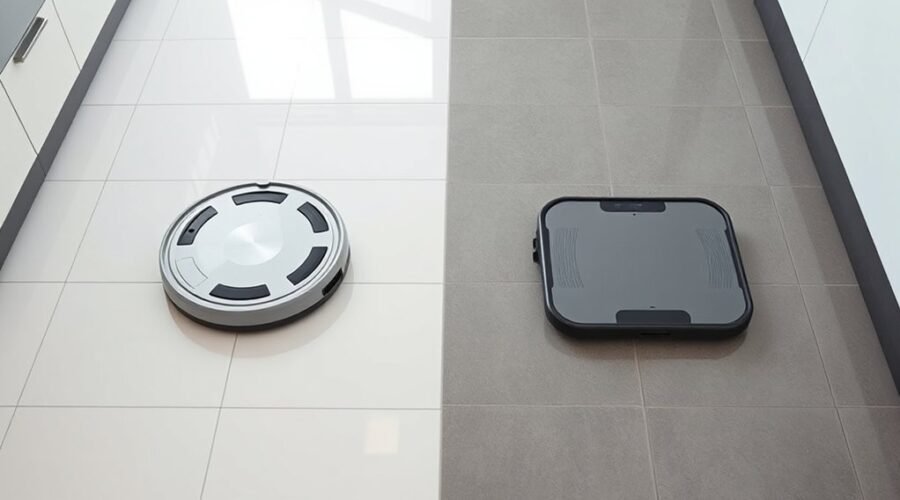
Spinning and vibrating robot mop systems approach floor cleaning in markedly different ways. Spinning models use counter-rotating pads that add pressure and improve stain removal, while vibrating systems rely on oscillation for lighter surface maintenance. The distinction matters most when spills are sticky, floors vary, or smears become a concern. Performance, water control, and upkeep do not always align, and the practical differences become clearer under real household conditions.
Spinning Vs Vibrating Robot Mops: Which Is Better?
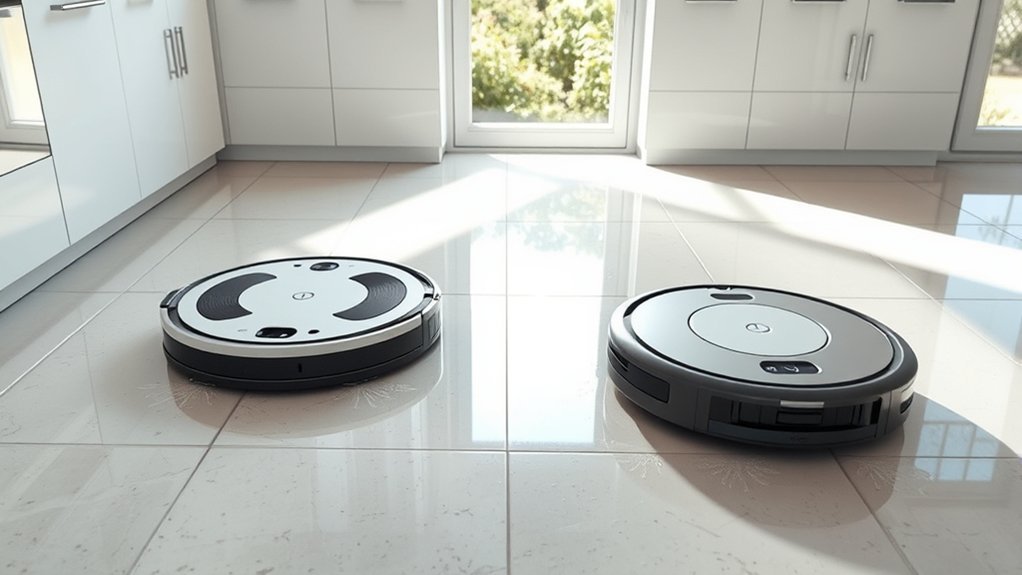
When comparing spinning and vibrating robot mops, the spinning system is generally more effective because its dual rotating pads generate direct scrubbing force that lifts dried stains, sticky residues, and ground-in dirt more reliably than oscillating pads.
In practical cleaning performance, spinning robot mops typically deliver stronger scrubbing action, especially on corners and edges where vibrating units may leave gaps. Their pad systems can remove residue more effectively across different floor types by adjusting pressure and water flow, which improves coverage without over-wetting delicate surfaces.
Spinning robot mops deliver stronger scrubbing, better edge coverage, and more effective residue removal across varied floor types.
Maintenance requirements also favor spinning designs, since many include self-cleaning functions that reduce manual washing and pad replacement.
Vibrating models remain functional for light surface maintenance, but they often struggle with tougher messes and maintain a more uniform moisture level.
For users seeking liberation from repeated labor, spinning systems present the more capable and efficient option.
What Makes Spinning And Vibrating Mops Different?
Spinning mops use counter-rotating discs to generate direct scrubbing force, while vibrating mops rely on high-frequency oscillation that is better suited to loosening light debris than removing dried residue.
Spinning systems also provide more precise moisture control through controlled water delivery, reducing oversaturation and improving contact consistency across the floor.
Edge cleaning differs as well, since vibrating rectangular heads can miss corners more easily, whereas spinning mechanisms tend to maintain more uniform coverage at junctions and along edges.
Scrubbing Motion
The key difference in scrubbing motion lies in how each system applies force to the floor: spinning mop heads use counter-rotating discs to generate direct friction, which makes them more effective at lifting dried-on residue and sticky stains, while vibrating mops rely on oscillation to loosen surface dirt with comparatively little pressure.
In practical terms, spinning mops deliver stronger scrubbing through concentrated pressure application and sustained mechanical action, improving cleaning efficiency across larger surface coverage. This scrubbing force is especially relevant on tough stains, where active rotation removes material rather than merely disturbing it.
Vibrating mops, by contrast, provide lighter contact and reduced soil removal, which can limit results in demanding conditions. For users seeking liberation from repeated manual effort, the distinction is decisive.
Moisture Control
Moisture control further separates the two systems in both consistency and performance. Spinning mops use electronically governed water flow and sensor-driven water control mechanisms to maintain precise moisture, while vibrating mops depend on passive absorption and gravity-fed delivery. This difference affects cleaning efficiency, surface compatibility, and drying time.
| System | Moisture Pattern | Result |
|---|---|---|
| Spinning mops | Even, adjustable | Controlled wetting |
| Vibrating | Uneven, passive | Streak risk |
| Spinning | Real-time regulation | Fewer sticky residues |
Edge Cleaning
Edge performance becomes the next meaningful differentiator after moisture control, because cleaning quality depends not only on how water is delivered but also on how far the mop can reach into perimeter zones.
In edge cleaning, spinning mops outperform vibrating mops by extending pads into corners and along walls, reducing uncleaned areas and limiting dirt accumulation. Their counter-rotating discs add scrubbing force, which improves effective cleaning on dried residues near furniture bases.
The dual rotating design also maintains consistent contact, a critical advantage when traversing irregular room boundaries. By contrast, vibrating mops often stop short, and their rectangular heads can leave about 5,782 mm² behind in tight spots.
That gap matters most in homes with many corners, where missed edges quickly undermine overall cleanliness and practical liberation.
How Vibrating Robot Mop Systems Clean Floors
Vibrating robot mop systems clean by driving oscillating pads at high frequency, typically 100 to 200 cycles per second, to dislodge dust and loosen light spills on smooth flooring.
Their action depends on moisture-based wiping rather than aggressive scrubbing, which makes them effective for routine maintenance on sealed tile and laminate.
However, this mechanism can be less effective on sticky or dried residues, and may leave corners or compacted debris insufficiently addressed.
Vibrating Mop Cleaning Motion
These systems clean by driving a microfiber pad through rapid oscillation, typically 100 to 200 cycles per second, which helps loosen dust and light spills from the floor surface.
The vibrating pads create repeated shear across hard surfaces, improving cleaning efficiency on sealed tile and laminate. This motion is effective for light maintenance, but its limited dwell time reduces performance on dried stains and ground-in soil.
Because the pad area is rectangular, corners and edges may remain untreated, leaving uncleaned zones.
Maintenance remains practical but not effortless: manual washing and frequent pad replacement are required to prevent smearing captured debris.
Moisture-Based Floor Wiping
Moisture-assisted wiping is the core mechanism in vibrating robot mop systems, which oscillate the microfiber pad roughly 100 to 200 times per second to loosen dust and light spills from hard floors.
The mop depends on controlled moisture and steady floor contact to raise cleaning power on sealed tile and laminate. In these vibrating systems, pads distribute liquid across hard surfaces, but effectiveness drops on sticky spills and dried residue.
Rectangular heads can leave uncleaned areas, especially near corners and obstacles, limiting coverage for users seeking liberation from routine labor. Because dirty pads smear soil, manual washing and frequent replacement are required to preserve performance.
Navigation around stairs and tight edges remains constrained, so the system offers efficient wiping, not total autonomy, across complex rooms.
How Spinning Robot Mop Systems Scrub Messes
Spinning robot mop systems scrub messes by using counter-rotating discs that create sustained friction against the floor surface, helping to break down dried-on residue and embedded stains.
In these spinning robot mop systems, scrubbing is amplified by concentrated downward force, which improves dirt dislodging and raises cleaning efficiency relative to vibrating alternatives.
Dual rotating pads reproduce the motion of manual scrubbing, but with consistent mechanical pressure across tile, vinyl, and sealed wood.
Dual rotating pads mimic hand scrubbing, delivering steady pressure across tile, vinyl, and sealed wood.
A self-cleaning mechanism keeps the microfiber fibers from becoming overloaded with soil, preserving contact quality during extended operation.
Electronically controlled water delivery regulates moisture with precision, limiting streak formation while maintaining enough lubrication for effective abrasion.
The result is a controlled, repeatable cleaning process that can remove stubborn films without excessive soaking.
For users seeking practical liberation from repetitive floor labor, the design offers a measurable transfer of work from body to machine.
Coffee, Pet Food, And Other Real-World Messes
Real-world coffee spills expose a clear difference in scrubbing mechanics: spinning mops remove dried edges more effectively, while vibrating mops can leave residual rings where moisture alone is insufficient.
Pet food residue shows a similar pattern, with spinning systems lifting ground-in particles more reliably than vibrating flat mops, which are more limited to light maintenance.
In both cases, consistent pressure, high RPM, and pad extension give spinning mops an advantage in corners and on sticky soils.
Coffee Spill Cleanup
Coffee spills expose a clear performance gap between vibrating flat mops and dual rotating systems: the vibrating pads may absorb some liquid, but they often leave dried edges and visible residue, whereas dual rotating mops scrub and lift the stain more effectively.
Their spinning action maintains contact pressure across the pad surface, which improves removal of sticky residues in modern cleaning systems. In measured comparisons, vibrating units can leave roughly 5,782 mm² uncleaned, especially near corners, while dual rotating mops extend coverage and support thorough cleaning.
For coffee spills, this reduces manual intervention and produces a more complete finish. The same mechanism also improves handling of pet food messes, where surface pickup alone is insufficient and embedded material must be lifted through sustained mechanical agitation.
Pet Food Residue
Pet food residue presents a more demanding cleaning challenge than loose debris alone, because ground-in particles and sticky food traces require both sustained contact pressure and effective agitation to be removed.
In this scenario, dual rotating mops deliver higher cleaning efficiency than vibrating flat systems. Their rotating pads provide a stronger scrubbing action, lifting pet food particles and addressing tough stains that moisture-only motion often leaves behind. They also extend into corners, reducing the uncleaned zones that can persist in messy situations.
By contrast, vibrating mops may collect loose kibble yet miss bonded residue. Self-cleaning capabilities further lower maintenance needs around feeding areas, where repeated spills are common.
For homes seeking practical liberation from repetitive labor, rotating systems offer a more capable response to real-world messes, including coffee and pet food.
Which Robot Mop Handles Corners Better?
When evaluating corner coverage, dual rotating mop systems have the clear advantage over vibrating flat mops.
Dual rotating mops use extending rotating pads to enter corners, where vibrating mops typically stop short and leave a measurable neglected space, averaging 5,782 mm². That gap matters because corners are common zones for built-up dirt, and partial contact reduces cleanliness.
The scrubbing action generated by rotating pads improves effective cleaning along edges, creating consistent pressure and motion where debris accumulates.
By contrast, vibrating mops move in a flatter pattern that can omit tight angles and fail to dislodge residues at the perimeter.
For homes with many corners, the difference becomes operationally significant: rotating systems maintain more complete coverage and limit the persistence of hidden soil.
The result is a more liberated cleaning outcome, with less manual intervention required to reclaim hard-to-reach areas and a stronger baseline of surface hygiene overall.
Robot Mop Performance By Floor Type
Floor type strongly influences robot mop effectiveness, with vibrating systems performing well on smooth, sealed surfaces such as tile and laminate for routine maintenance, but losing efficiency on sticky spills and ground-in grime. Robot mop performance consequently depends on surface types and residue load.
| Surface type | Vibrating mops | Spinning mops |
|---|---|---|
| Sealed tile | Strong daily cleaning | Strong, broader scrubbing power |
| Laminate | Efficient maintenance | High cleaning performance |
| Hardwood | Adequate, uniform moisture | Adaptive, floor-specific output |
On mixed flooring, spinning mops generally shift more cleanly and preserve cleaning performance across hardwood, tile, and laminate. Their counter-rotating discs deliver better scrubbing power on tough stains and dried residues, while vibrating mops suit light, regular passes. Yet vibrating heads can leave uncleaned corners, reducing coverage in rooms with many edges. For users seeking liberation from manual labor, spinning mops offer the more versatile, technically resilient option across diverse surface types.
How Water Use And Pad Cleaning Affect Smears
Water management and pad maintenance directly influence smear formation in robot mop systems.
In vibrating designs, oscillation loosens debris, yet saturated or contaminated pads can redistribute residue instead of removing it, producing smears. Gravity-fed water delivery often varies across the pad surface, creating uneven moisture, streaks, and reduced cleaning efficiency. When the pads are not refreshed, trapped soil increases transfer and weakens liberation from grime.
By contrast, spinning systems generate steadier friction through rotating pads, which supports more uniform contact and lowers smear risk. Electronically controlled water delivery in advanced spinning units meters moisture precisely, keeping surfaces damp enough for effective cleaning without oversaturation. Continuous self-cleaning further preserves pad performance by shedding dirt during operation, limiting re-deposition.
The result is a more controlled interface between water, pads, and floor, with less streaking and cleaner outcomes. In technical terms, consistent friction and regulated moisture are the primary mechanisms that separate spinning from vibrating systems in smear control.
How To Choose The Right Robot Mop System
Selecting the right robot mop system depends on the cleaning demands of the home, the flooring mix, and the level of maintenance acceptable to the user.
Spinning mops generally deliver higher cleaning efficiency because their mechanical contact improves scrubbing on tough stains, sticky residues, and ground-in debris. In contrast, vibrating mops are better aligned with light maintenance on smooth floors, but they may leave residue along edges and in corners.
Maintenance requirements also matter: spinning mops often include self-cleaning functions and larger tanks, reducing refill frequency, while vibrating mops usually demand more frequent pad replacement.
For multi-surface homes, adaptability is decisive. Spinning mops can modulate water flow across varied surface types, making them more versatile than vibrating mops, which can struggle as flooring changes.
User feedback consistently favors spinning mops for thorough coverage in high-traffic and pet-heavy environments. This makes them a stronger choice for users seeking practical liberation from repetitive floor care.
Best Robot Mops At A Glance
Among the leading robot mop systems, dual spinning models generally offer the strongest overall balance of cleaning power, coverage, and upkeep efficiency.
Dual spinning robot mops often deliver the best balance of cleaning power, coverage, and easy maintenance.
In a modern robot mop, dual spinning pads deliver higher cleaning efficiency than vibrating pads, especially on dried-on stains, sticky residues, and ground-in food particles. Their rotating action improves floor cleaning in corners, where flat pads may leave measurable gaps. Many spinning mops also extend their pads for better edge contact, increasing adaptability across varied layouts and surface types.
Maintenance burden is lower because these systems often include self-cleaning functions and larger water tanks, reducing manual pad washing and replacements.
By contrast, vibrating pads tend to require more frequent intervention and provide less consistent performance on messy zones. For users seeking liberation from repetitive labor, spinning mops present a more capable, lower-friction option.
Frequently Asked Questions
What Are the Key Differences Between a Flat Mop System and a Spin Mop System?
Flat mop systems prioritize ease of maneuverability and lower water usage; spin mop systems deliver superior cleaning efficiency, Spin mop benefits, and corner coverage. Mop maintenance, surface compatibility, price comparison, and user preferences diverge accordingly.
What Are the Disadvantages of Spin Mops?
Spin mop limitations include reduced cleaning efficiency, maintenance challenges, and maneuverability issues. Surface compatibility can be inconsistent, water usage may be inefficient, noise levels rise, durability concerns appear, and cost effectiveness often declines over time.
What Are the Differences Between a Robot Mop Roller and a Spin Mop?
A robot mop roller offers higher roller efficiency and cleaning performance on stains, with greater water usage control, but more maintenance requirements. A spin mop emphasizes maneuverability factors, surface compatibility, lower noise levels, easier price comparison, and mixed user reviews.
Which Robot Mop Is Considered the Best?
The best robot mop is typically the dual rotating model, according to robot mop reviews. It offers superior cleaning efficiency, battery life, floor compatibility, smart features, user satisfaction, and maintenance tips, though price comparison matters.
Conclusion
Spinning and vibrating robot mop systems are not interchangeable tools. Spinning models act like precision scrubbers, using counter-rotating pads to lift sticky residue, control moisture, and handle heavier messes more effectively. Vibrating systems are better suited to light, routine maintenance, but they can leave tougher debris behind. For buyers, the key distinction is simple: spinning mops offer stronger cleaning depth, while vibrating mops provide a lighter touch with less cleaning power.