Robot vacuums often fail at thresholds because the height, angle, or surface change exceeds their climb limit. A small bump can stop the wheels, trigger repeated retries, or push the machine off course. The fix is usually in the setup, not the robot. Measuring the shift, adjusting the doorway, and removing nearby hazards can change the outcome, but some crossings need more than one adjustment.
Why Robot Vacuums Get Stuck on Thresholds
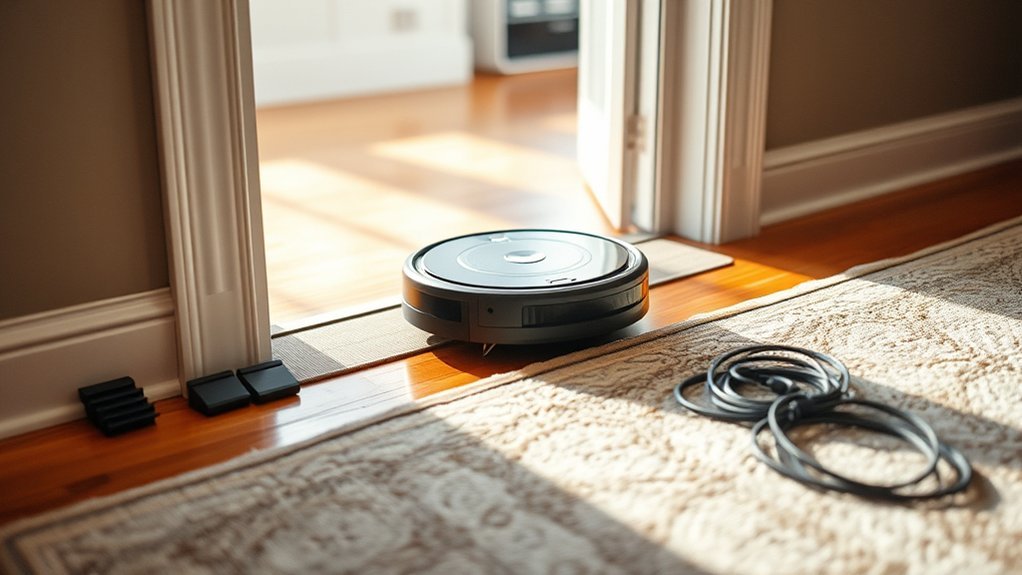
Robot vacuums often get stuck on thresholds because their mobility systems are designed for low-profile cleaning rather than obstacle climbing. Most robot vacuums work best on flat surfaces; thresholds above 0.8 inches exceed the practical limit for standard navigation.
Low ground clearance and cliff sensors can trigger false obstacle detection when a raised strip contrasts sharply with the floor, forcing a stop before crossing. The result is interrupted cleaning and unnecessary manual recovery.
Wheel design and motor torque also matter: units with larger wheels and stronger drive systems gain more traction and leverage, improving climbing ability. However, many models still prioritize sliding under furniture over traversing barriers.
Measure Your Threshold First
Before a robot vacuum is judged incompatible with a doorway, the threshold should be measured from the lower floor to the top edge with a ruler or tape measure in inches. This measure your threshold step establishes the threshold height and supports precise height assessments for freedom from guesswork.
- Record changes in elevation at each doorway; even small differences affect compatibility.
- Compare the reading with the robot vacuum manual’s maximum obstacle clearance.
- Treat raised door sills above 0.8 inches, or roughly 2 cm, as likely trouble points.
Most robot vacuums clear about 0.8 inches, while thresholds between 1.5 cm and 2.0 cm may challenge only some models.
Older homes often contain raised door sills above 2.5 cm, so exact numbers matter. Accurate measurement lets the user select a robot vacuum that can move independently, avoid repeated stoppages, and preserve a cleaner, more liberated routine.
Use Ramps to Bridge Doorway Transitions
Selecting the correct ramp material and slope is critical, since rubber, wood, or aluminum can reduce threshold height without creating a new obstacle.
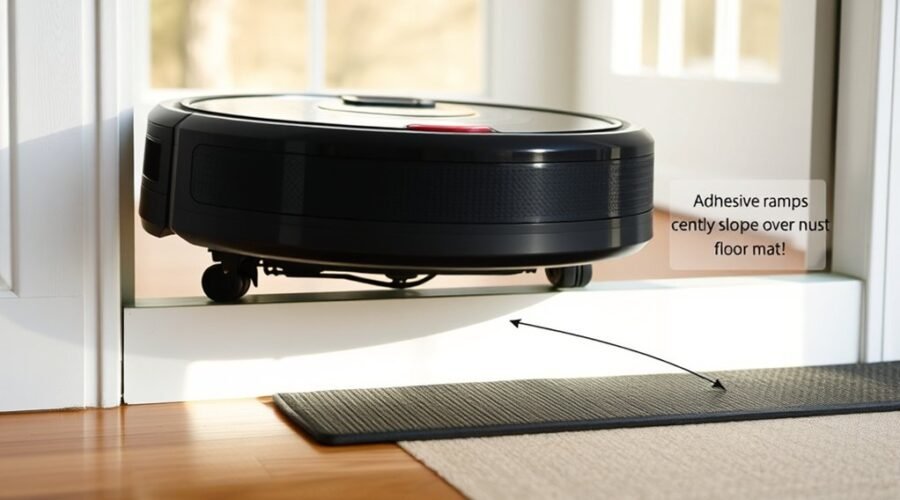
A gradual shift should be installed at the doorway so the robot vacuum can cross floor-type changes that exceed its climbing limit.
Low-pile rugs with beveled edges or custom wooden ramps may also provide a smoother, more reliable passage while preserving alignment and floor clearance.
Choosing the Right Ramp
When a robot vacuum struggles at a doorway threshold, a properly sized ramp can restore consistent movement by reducing the abrupt height change. For thresholds above 0.8 inches, ramps in rubber, wood, or aluminum support a smooth passage and lessen strain on the vacuum’s wheels.
The preferred profile is gradual, not steep, because sharp height changes increase the risk of binding.
- Select material for stability and wear resistance.
- Match width to the vacuum’s wheels for secure tracking.
- Use low-pile rugs only as temporary bridge surfaces when a fixed ramp is unavailable.
Discreet wooden ramps may match floor color, preserving clean lines while freeing the robot from repeated stoppages. Proper ramp choice turns an obstructive threshold into a manageable passage.
Installing a Smooth Transition
A smooth passage at a doorway can be created by installing a ramp that bridges the threshold and reduces the abrupt height change that interrupts robot vacuum travel.
Installing ramps in rubber, aluminum, or wood helps manage threshold changes and supports uninterrupted cleaning. A gradual slope is preferred; heights under 1.5 cm are usually easier for a robot vacuum to climb without stalling.
Threshold heights should be measured with a tape measure before fitting any insert, because small variations can defeat recovery. For cost-aware DIY solutions, thin plywood strips or low-pile rugs with beveled edges can improve access.
Matching ramp color to flooring reduces visual disruption while preserving function. These cleaning tips free the machine from repeated obstruction, restoring reliable route completion.
Try Low-Pile Mats as a Temporary Fix
A low-pile mat can function as a temporary threshold bridge by creating a gradual slope over minor height differences.
When the doorway gap is under 1.5 cm, this low-pile mat ramp can reduce abrupt changes and lower the chance of the robot vacuum stalling.
Beveled edges and thin, low-profile materials improve passage reliability while remaining compatible with most units.
Low-Pile Mat Ramp
Low-pile mats can serve as a temporary ramp, creating a gentler incline that helps a robot vacuum cross thresholds, particularly those under 0.8 inches high. This setup improves passage control for robot vacuums and supports smoother shifts between floor surfaces, without forcing the machine beyond its climbing ability.
Beveled edges reduce the abrupt step that often becomes an obstacle.
- Place low-pile mats flush against the threshold.
- Secure the mat so it cannot slip or buckle.
- Verify performance regularly, especially with thicker mats or uneven surfaces.
Used correctly, the mat ramp offers a practical, reversible adjustment that can restore movement and reduce stalls.
When conditions change, the system should be reassessed to keep the path clear and the vacuum free to move.
Temporary Threshold Bridge
An interim bridge can be created with a low-pile mat placed across the threshold to help a robot vacuum move between floor types without stalling. This temporary threshold bridge should use low-pile mats near 0.2 inches thick, with beveled edges to reduce the height difference and support smooth navigation.
The surface must be stable, flat, and compatible with the robot vacuum sensors so the boundary is not misread as a drop-off. Placement should be checked after each run, because slight shifts can impair cleaning efficiency or trap the machine at the passage.
This temporary fix can restore access without permanent modifications, giving the user practical control while preserving route freedom. If the vacuum still hesitates, reposition the mat or test another material until movement remains consistent.
Clear Cords and Narrow Gaps
Cords should be secured and kept off the floor with cable organizers so the robot vacuum does not tangle or snag while moving through the room. This preserves clear cords, reduces obstacles, and supports smooth navigation at thresholds.
- Remove narrow gaps around furniture legs, doorway trims, and baseboards where the machine can wedge or stall.
- Keep pathways open by lifting loose wiring and relocating items that create pinch points near thresholds.
- Reassess the layout near problem areas often, then use virtual barriers or no-go zones in the app if a passage remains risky.
Thin cords may be crossed, but they still increase the chance of a trap. Tight spaces and irregular thresholds can interrupt route planning and stop progress.
A cleaned route gives the vacuum from getting stuck less often and allows it to move with greater freedom across rooms.
Set No-Go Zones for Problem Doorways
No-go zones in the robot vacuum app can be used to block problem doorways where the unit repeatedly stalls or fails to clear a threshold. When the robot vacuum encounters thresholds above its climbing limit, it may waste cycles trying to pass, reduce cleaning efficiency, and increase the risk of getting stuck.
Most apps allow users to set no-go zones around those doorways or narrow transits, preventing repeated failures and preserving navigation paths that remain open. For thresholds over 0.8 inches, exclusion is often the most reliable control measure.
This approach directs the robot vacuum toward accessible rooms, where it can continue without interruption and maintain seamless cleaning. User reports show fewer recovery events after zones are placed correctly.
Software updates may refine navigation and zone mapping over time, but the immediate benefit comes from isolating the obstacle. Properly configured, no-go zones support cleaner execution, less friction, and a more liberated cleaning routine.
Update Firmware and App Settings
Keeping firmware current is a primary troubleshooting step for threshold handling, since manufacturers regularly issue updates that improve navigation logic, climbing behavior, and overall obstacle response. A user should update firmware first, then inspect app settings for any model-specific controls that affect threshold climbing capabilities.
- Verify the latest release is installed and repeat the update after syncing the dock.
- Lower or raise sensitivity settings for cliff detection if high-contrast thresholds are being misread as drop-offs.
- Use no-go zones and refine mapping features so the robot understands where crossing is inefficient or risky.
These adjustments can free the machine from repeated hesitation and reduce manual intervention.
If behavior still seems inconsistent, community support and forums often reveal hidden app settings or calibration steps for a specific model. The goal is precise control: better maps, cleaner routes, and fewer barrier failures.
When Your Robot Vacuum Still Can’t Cross
When a robot vacuum still cannot cross a threshold, the first step is to measure the obstacle accurately, since most units perform best below 2 cm, or 0.8 inches.
If the Robot Vacuums Go model still stalls, the thresholds may exceed its climbing ability, or the surface may be too abrupt. Installing a rubber or wooden ramp can convert sharp obstacles into a gradual incline, improving traction for rubberized wheels and reducing slip on uneven flooring.
If the device continues to stick, no-go zones should be set in the app to prevent repeated failures and wasted cycles. Persistent problems also justify checking firmware updates, because navigation logic can change with software revisions.
When clearance remains inadequate, a higher-capability unit, such as the DEEBOT X11 OmniCyclone, may be required; it can manage thresholds up to 1.57 inches. This approach restores control, limits friction, and keeps cleaning paths efficient.
Frequently Asked Questions
How Can I Make My Robot Vacuum Go Over a Threshold?
They can over a threshold by matching vacuum features to threshold types, using ramp solutions, border strategies, and height adjustments, while checking sensor technology, floor types, and cleaning efficiency; low-pile mats and beveled changes help.
Can a Roomba Get Over a Threshold?
Yes—most Roomba models can cross a threshold, though success depends on threshold height, robot design, wheel traction, and incline capability. At carpet crossings, navigation technology and user experiences show cleaning efficiency may falter when limits are exceeded.
How to Hard Reset Robo Vac?
A hard reset starts by holding the reset button 10–15 seconds, with power connected. If absent, remove the battery briefly. These troubleshooting tips address battery issues, error codes, cleaning modes, Wi Fi connection, maintenance checklist, performance optimization.
Which Robot Vacuum Is Best for Going Over Threshold?
Narwal Flow seems best for higher threshold height; why settle for less? Its robot vacuum features, wheel design, and climbing ability suit varied floor types. Navigation technology and user reviews favor it, while maintenance tips improve reliability.
Conclusion
If the threshold remains higher than expected, the robot vacuum will likely stall again. Measuring the height, adding a ramp, or using a low-pile mat may resolve the issue, but not every doorway will comply. Cords, gaps, and misconfigured no-go zones can still interrupt navigation. Firmware updates may improve crossing behavior, yet some units will never clear the obstacle. In those cases, the final option is reassignment—cleaning elsewhere before the next failed approach.