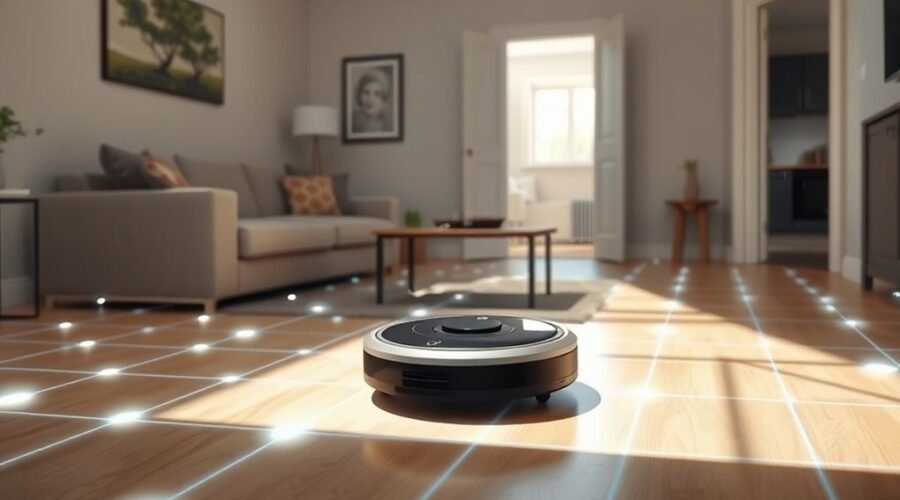
Room recognition on a robot vacuum is the process of identifying separate areas within a home and assigning them as distinct rooms. It relies on mapping, sensor data, and navigation software rather than simple collision avoidance. The system can improve cleaning routes and support room-specific commands. Yet the accuracy depends on layout, sensor quality, and how the machine interprets boundaries, which raises a question: how does it distinguish one room from another?
What Is Room Recognition on a Robot Vacuum?
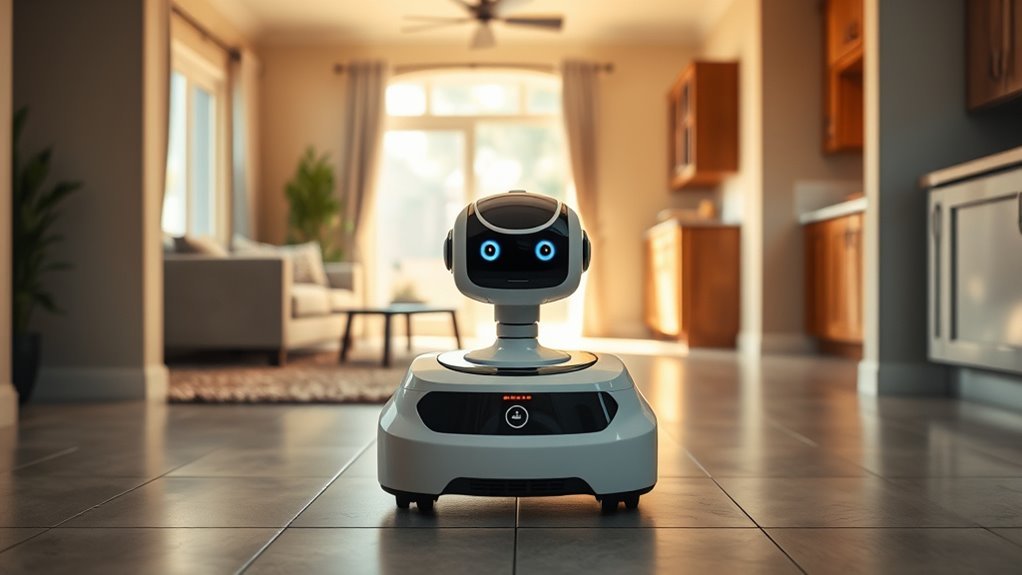
Room recognition on a robot vacuum refers to the use of sensors and mapping algorithms to identify individual rooms and build a digital layout of the home.
In practical terms, room recognition combines advanced sensors with mapping technology to distinguish one space from another, then assign cleaning actions accordingly. The system relies on simultaneous localization and mapping, or SLAM, to place the machine within its environment and maintain a coherent internal model.
This permits targeted cleaning of selected rooms, especially when dirt accumulation varies across the home. The same framework can store custom routines for different areas, enabling scheduled preferences without repeated manual input.
How Do Robot Vacuums Map Your Home?
Robot vacuums map a home by combining sensors with localization algorithms to build a digital floor plan during early cleaning runs. Using mapping technologies such as LiDAR and VSLAM, the machine traces walls, doorways, and open spans, then compiles a virtual map for route planning.
During these first passes, it moves in structured lines, measuring room dimensions and noting furniture placement so later cleanings become more autonomous and less wasteful.
- A bright living room sketched as clean edges on a screen.
- A hallway rendered as a narrow corridor of coordinates.
- A sofa marked as a stationary obstacle in the grid.
- Separate floor maps stored for upstairs and downstairs freedom.
Sensors also detect floor type and obstacles, letting the robot adjust suction and navigation without constant oversight.
Once the map is complete, it can recognize rooms, optimize coverage, and reduce missed spots.
What Sensors Power Room Recognition?
At the core of room recognition, a robot vacuum relies on a sensor suite that combines LiDAR, camera-based vision, and infrared detection to interpret spatial layout with high accuracy.
LiDAR emits laser beams to measure distance, giving the machine the raw geometry needed to build a precise map of walls, corners, and obstacles. Camera-based systems add visual recognition, allowing the device to distinguish room boundaries, landmarks, and room types with greater certainty.
LiDAR maps walls and corners with precision, while cameras add visual recognition to confirm room boundaries.
Infrared sensors provide immediate sensing to detect nearby objects and measure proximity, reducing collision risk with furniture and baseboards. Together, these sensors to detect environmental variation support algorithms that segment rooms and classify floor zones.
The result is adaptive cleaning patterns that can shift according to room size, surface changes, and obstacle density. This layered sensing architecture gives the vacuum operational independence, reducing guesswork and enabling more deliberate, efficient movement through domestic space.
How Does SLAM Help Robot Vacuums Navigate?
SLAM, or Simultaneous Localization and Mapping, enables a robot vacuum to build a detailed virtual map of its surroundings while continuously determining its position within that map.
In navigation systems, this process gives the machine a calibrated sense of place, reducing dependence on random motion and enabling cleaner paths across multiple rooms.
- A LiDAR beam traces a hallway edge like a pencil line on a blueprint.
- A camera detects a chair leg and pauses the route before impact.
- Real-time computation bends the path around a rug, then resumes in parallel lanes.
- A completed map appears as a controlled grid, not a wandering spiral.
How Do Robot Vacuums Tell Rooms Apart?
Robot vacuums distinguish rooms through sensor-based mapping that records walls, openings, furniture, and floor-plan geometry.
Visual and LiDAR cues refine this separation by supplying spatial detail that helps identify room boundaries and layout changes.
Once stored, saved maps and zones let the system reuse prior room data to classify areas consistently during later cleaning runs.
Sensor-Based Room Mapping
Modern robot vacuums distinguish rooms by building sensor-based digital maps of the home using LiDAR and VSLAM, then analyzing spatial boundaries, furniture placement, and wall geometry to segment the layout into separate areas.
This sensor-based room mapping helps the machine detect changes, map liberated pathways, and adjust its cleaning route without manual intervention. Infrared and optical sensors refine classification by sensing floor changes and obstacles.
- A hallway narrowing into a room edge.
- Chairs forming a measurable cluster around a table.
- A threshold marking a floor shift.
- A vacuum tracing a corrected path on a map.
Previous sessions are stored, so later runs compare new sensor data against known layouts. Machine learning then improves room recognition over time, increasing precision and operational autonomy.
Visual And LiDAR Cues
Visual and LiDAR cues allow a robot vacuum to separate rooms by combining surface appearance with geometric measurement. Visual cues such as color shifts, floor texture, and edge contrast help identify separations that may indicate distinct spaces.
LiDAR technology adds distance-based precision by firing laser pulses and building a 3D layout of walls, openings, and furniture. These datasets are fused by algorithms that extract room-specific features and support room recognition without human intervention.
Some systems further refine classification through machine learning, improving discrimination as home conditions change. The result is a cleaner boundary estimate, enabling the machine to move with disciplined autonomy, reduce overlap, and target each area with greater accuracy while preserving efficient coverage.
Saved Maps And Zones
Saved maps extend room recognition beyond immediate sensor input by giving the vacuum a persistent spatial model of the home.
Using SLAM, the device records walls, doorways, and furniture, then reuses that data to separate rooms on later passes.
Object recognition sharpens boundaries by classifying sofas, tables, and structural edges, letting the system infer where one space ends and another begins.
App-based cleaning zones give the user direct control: a kitchen can be targeted, a hallway excluded, or an upper floor isolated through multiple saved maps.
This structure reduces wasted motion and supports deliberate, autonomous cleaning.
- A bright living room grid
- A narrow doorway threshold
- A labeled no-go zone
- A second-floor map overlay
Why Does Room Recognition Improve Cleaning?
Room recognition improves cleaning by allowing a robot vacuum to generate detailed maps of a home and apply room-specific cleaning logic to each area.
This room recognition capability refines the cleaning routine by separating high-traffic zones from low-use spaces, so effort is allocated where debris is most likely to accumulate. Navigation accuracy also increases, because VSLAM and LiDAR reduce overlap, missed edges, and wasted passes.
Room recognition directs cleaning effort to high-traffic zones, while VSLAM and LiDAR reduce overlap, missed edges, and wasted passes.
The result is more deliberate movement and less time spent covering already cleaned floor. Different rooms can receive different suction levels and path patterns, matching carpet, tile, or mixed surfaces without manual reprogramming.
That adaptability supports a more autonomous domestic environment, where cleaning is scheduled and executed with minimal intervention. For users, the benefit is practical freedom: the machine maintains order with less oversight, fewer corrections, and more consistent results across the entire floor plan.
How Does iRobot OS Handle Room Recognition?
iRobot OS uses mapping technology to build a digital floor plan that distinguishes individual rooms within a home.
Its algorithms combine layout data with usage patterns to assign Dirt Detective priorities, weighting cleaning effort toward rooms with lower cleanliness scores.
Through the iRobot Home App, users can review room-level maps, monitor progress, and schedule targeted cleaning by room.
iRobot OS Mapping
Through advanced mapping algorithms and live sensor inputs, the system constructs detailed representations of household layouts that support accurate room recognition and efficient route planning.
iRobot OS uses mapping and sensors to partition spaces into discrete zones, then updates those zones as furniture shifts or pathways open. Mapping occurs about seven times faster than earlier systems, reducing setup time and expanding operational autonomy.
The iRobot Home App lets users assign rooms for targeted schedules, reinforcing control without manual micromanagement. This architecture favors precision, adaptability, and user-directed freedom.
- A floor plan traced in clean geometric lines
- Sensor beams sweeping across doorways
- Distinct room boundaries glowing on a screen
- A robot vacuum moving directly through open space
Dirt Detective Priorities
With advanced mapping algorithms, the system identifies and stores discrete rooms as persistent cleaning zones. It then applies Dirt Detective priorities to rank them by cleanliness history and detected debris.
In this room recognition workflow, dirt sensors measure localized soil accumulation, allowing the robot to assign heavier attention where contamination is highest. Cleaning patterns are then adjusted by room type, floor surface, and recent activity, while suction output can be increased when needed.
The iRobot Home App lets users set schedules that align with these priorities, reducing manual oversight and reinforcing autonomous control. Real-time learning updates maps as furniture shifts or layouts change, preserving efficiency.
This approach supports cleaner spaces with less effort, giving occupants more time and agency over domestic labor.
Room Recognition vs. Simple Obstacle Avoidance
Room recognition distinguishes robot vacuums from systems that rely only on simple obstacle avoidance, because it identifies individual rooms and supports targeted cleaning rather than merely detecting and bypassing nearby objects.
Technical room recognition uses visual mapping and LiDAR to build spatial layouts, while obstacle avoidance depends on proximity sensors and reactive motion. This difference directly affects cleaning efficiency and user control.
- A living room outlined in a precise digital map.
- A kitchen assigned a higher cleaning priority after meal use.
- Virtual boundaries blocking access to a delicate workspace.
- Zone cleaning directed at a single hallway.
Modern systems can learn from prior runs, improving room recognition through AI and adapting routes over time.
Obstacle avoidance cannot classify spaces, prioritize by room condition, or support scheduled room-by-room cleaning. For users seeking liberation from manual vacuuming, room recognition enables autonomous, selective, and efficient coverage across distinct household zones.
What Limits Room Recognition Accuracy?
Despite the advantages of room recognition over simple obstacle avoidance, its accuracy is constrained by several environmental and computational factors.
In low-light conditions, visual sensors lose contrast and struggle to resolve edges, reducing the reliability of room recognition. Complex layouts with irregular geometry and many obstacles can distort path inference, causing boundary misclassification and inefficient coverage.
Reflective surfaces, including mirrors and glossy floors, may return misleading signals that corrupt mapping data. Floor objects such as rugs and furniture can block or scatter sensor readings, preventing accurate estimation of room dimensions and shape.
The software layer is equally important: outdated algorithms may fail to interpret changing scenes, especially when furniture is moved or lighting shifts. Consequently, mapping becomes less stable, and autonomy is weakened.
Accurate room recognition relies on synchronized sensors, robust processing, and environments that do not confound perception.
How Can You Improve Room Recognition?
Improving room recognition on a robot vacuum depends on preserving sensor fidelity and keeping the mapping system current. Room recognition improves when sensors remain clean, unobstructed, and capable of detecting walls, edges, and furniture with minimal noise.
Advanced mapping algorithms, including SLAM, depend on stable input to build accurate layouts, so routine maintenance directly supports spatial classification and operational freedom.
- Clean optical, infrared, and bumper sensors to reduce misreads.
- Set virtual barriers or no-go zones in the app to define room boundaries.
- Update firmware regularly so mapping algorithms gain navigation refinements.
- Reposition furniture and remove small obstacles to simplify paths and improve room recognition.
When the environment is less cluttered, the vacuum can separate adjoining spaces more reliably and avoid manual intervention zones. This produces a cleaner map, stronger autonomy, and more predictable coverage across the home.
Frequently Asked Questions
What Are the Downsides of Using a Robotic Vacuum Cleaner?
Robotic vacuum cleaners can be limited by weak suction power, short battery life, and recurring maintenance costs. They also struggle in low light, miss stairs, create noise, and often require expensive upfront investment.
How Does Roomba Know Which Room Is Which?
About 90% of navigation accuracy comes from room mapping: Roomba uses sensor technology and VSLAM to compare boundaries, obstacles, and layouts, then matches learned zones in its app, improving cleaning efficiency with each session.
Should You Run Your Robot Vacuum Every Day?
Yes; daily cleaning benefits most households by limiting buildup, especially with pets or heavy traffic. An ideal vacuuming schedule may exploit room recognition technology and dirt detection, reducing labor while preserving cleaner floors and more autonomy.
Do Robot Vacuums Map Your House?
Yes, many robot vacuums map a house using mapping technology and navigation algorithms. They scan walls and obstacles, store layouts, and improve cleaning efficiency, enabling targeted room coverage, fewer repeats, and greater user control.
Conclusion
Room recognition on a robot vacuum turns basic navigation into structured, room-by-room cleaning. By combining sensors, SLAM, and software analysis, these machines can distinguish spaces, assign names, and target cleaning more efficiently than random-path systems. One notable statistic is that SLAM-based mapping can reduce repeated coverage by up to 30%, improving battery use and cleaning consistency. Accuracy still depends on layout, lighting, and map quality, but room recognition remains a major step toward autonomous home cleaning.