Robot vacuums often fail on rug tassels because loose fibers can wrap around brushes and stall the drive system. Fringes, thick pile, and dark edging may also confuse cliff sensors, leading to abrupt stops or avoidance behavior. The result is repeated interruptions and reduced cleaning efficiency. Several mechanical and setup changes can reduce these faults, but the most effective fix depends on the rug construction and the robot’s hardware.
Why Robot Vacuums Get Stuck on Tassels
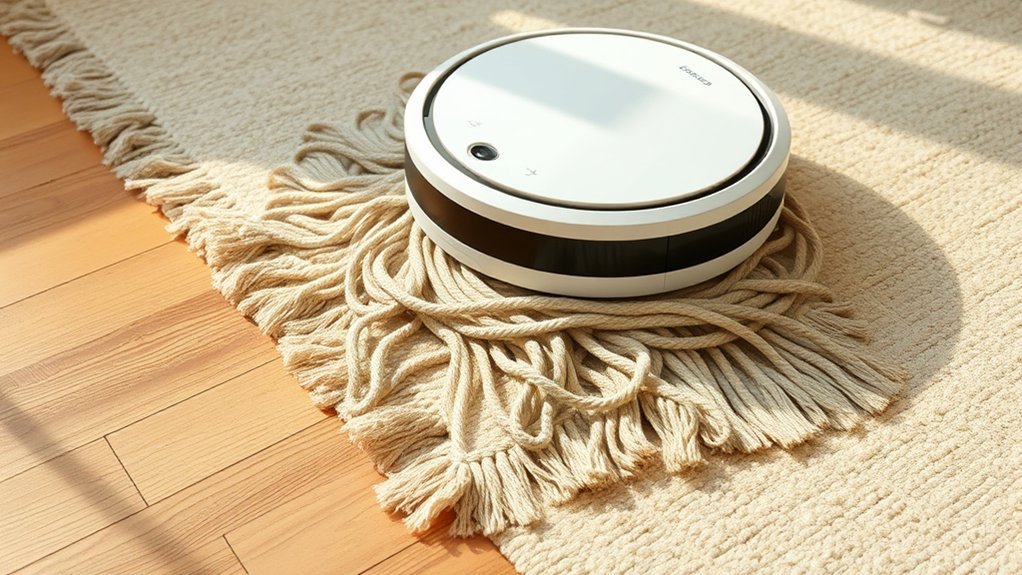
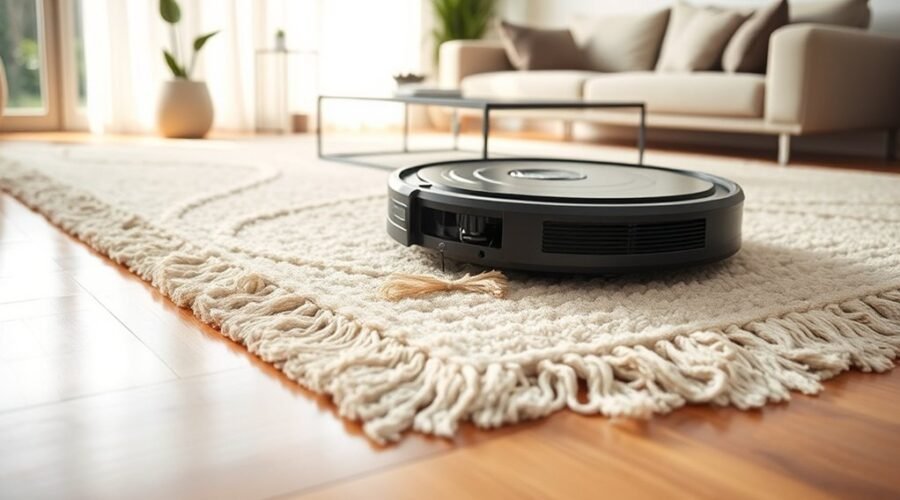
Robot vacuums commonly get stuck on rug tassels because loose fibers can wrap around the brushes, interrupting normal rotation and triggering operational faults. In this condition, the Robot loses traction on rugs, and the vacuum controller may interpret resistance as a navigation error.
Tassels also present variable height and texture, which can lift the chassis or impede forward motion, reducing effective coverage. Some dark tassels can confuse cliff sensors, causing avoidance behavior that blocks access rather than enabling cleaning.
This is not random failure; it is a predictable interaction between brush geometry, surface irregularity, and control logic. Liberation from these constraints depends on maintenance: tucking or rolling tassels before operation, selecting tangle-resistant brush assemblies, and using models with stronger navigation systems.
When these measures are applied, getting stuck becomes less frequent, and overall performance improves on rugs with complex edge structures.
How Rug Fringes and Loose Edges Cause Trouble
Even a small rug fringe can create a significant mechanical hazard for a robot vacuum. Rug fringes and loose edges present flexible obstacles that can entangle brushes, axles, and drive wheels, producing operational errors and leaving the machine stuck.
Even a small rug fringe can tangle brushes and wheels, stalling a robot vacuum and causing operational errors.
Tassels add snag points that interrupt navigation, forcing repeated backtracking or stall cycles as the robot attempts to clear the area. When loose edges lift or fold, they can obstruct forward motion, especially on models sensitive to sudden changes in surface elevation.
The vacuum may interpret these features as barriers, triggering avoidance behavior that reduces cleaning efficiency and leaves sections untreated. From a maintenance standpoint, the issue is straightforward: secure fringes, tuck in loose edges, and remove excess slack before operation.
Such preventive care lowers strain on components, improves route planning, and helps the robot vacuum move with greater independence across the floor.
Why Dark Rugs and Thick Pile Confuse Sensors
Dark rugs can disrupt a robot vacuum’s infrared sensors because the surface absorbs more emitted light, causing the machine to misread the area as a drop-off or obstacle. This misinterpretation is common on dark rugs, where infrared light returns weakly and basic sensors lack enough resolution to distinguish texture from hazard.
Older robot vacuum models consequently trigger avoidance behavior, reducing coverage and impairing performance.
Thick pile adds a separate fault line. The denser surface can block sensor signals and create physical resistance that confuses navigation systems, especially when the robot vacuum expects a flatter path.
In combination, dark rugs and thick pile increase uncertainty and can trap the machine in repetitive rerouting.
Multi-sensor navigation systems improve detection by cross-checking data, lowering misidentification risk across varied flooring.
Adequate lighting also supports sensor accuracy, helping the unit interpret surface boundaries more reliably and move with greater independence.
How to Stop Tassels From Jamming Your Vacuum
Tassels create a different failure mode than sensor confusion: their loose fibers can wrap around robot vacuum brushes, stall the cleaning cycle, and in some cases damage both the rug and the machine. To prevent tangling, the first control is physical isolation of rug fringe during cleaning sessions.
| Control | Effect |
|---|---|
| Tuck tassels under rug | Reduces exposure |
| Weighted clips | Prevents lift |
| Tangle-resistant brushroll | Limits wrap |
| Virtual No-Go Zones | Blocks access |
If a robot vacuum gets stuck, the rug should be checked for loose tassels and the brushroll cleared. Regularly inspect the drive path, then clean the sensors and brush assembly to preserve peak performance. When rug fringe cannot be secured, virtual No-Go Zones are the most reliable safeguard. The result is predictable operation, fewer interruptions, and a cleaning system that remains autonomous rather than trapped by decorative fibers.
Best Robot Vacuum Settings for Rugs
For thick or high-pile rugs, the most effective setup typically starts with increased suction power, since carpet boost settings improve debris extraction and reduce the chance of the vacuum bogging down in dense fibers.
For rug cleaning, Robot Vacuums avoid friction better when paired with tangle-resistant brushes, which limit snagging on fringe and tassels.
Regular sensor maintenance is essential: dirty cliff sensors can misread rug edges and trigger stalls.
Virtual boundaries can isolate problem zones, preventing repeated contact with decorative edges and preserving autonomy.
Different rug types require different calibrations, so testing different settings—eco, standard, and max—helps identify the least disruptive mode.
Specific models may expose finer controls, but the operative principle remains constant: match suction power to pile depth, then verify navigation accuracy.
A disciplined configuration, maintained consistently, lets the machine work freely, with fewer interruptions and less manual intervention.
Best Robot Vacuums for Rugs and Tassels
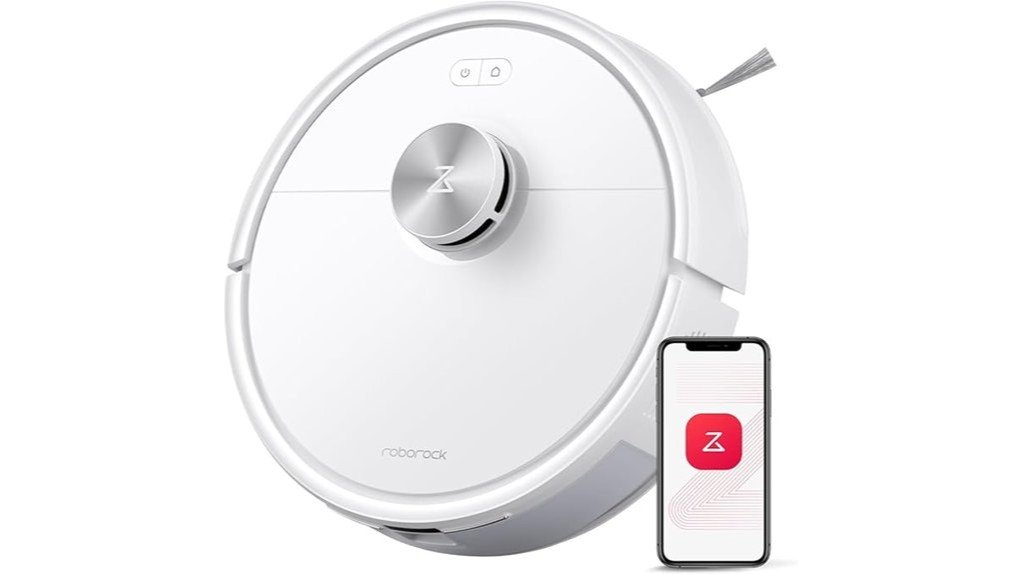
When selecting a robot vacuum for rugs with tassels, the most reliable choices combine anti-tangle brush rolls, suction of at least 2000 Pa, and advanced navigation such as LiDAR or 3D depth vision to reduce snagging and misalignment at fringe edges.
In practice, robot vacuums with strong suction lift embedded debris without forcing repeated passes, which improves cleaning efficiency and limits contact time with tassels. Anti-tangle brush rolls reduce fiber wrap, while advanced navigation systems map rug boundaries and detect fringe shifts with greater precision.
For homes with problem areas, keep out zones and virtual walls provide controlled exclusion, preventing repeated entanglement. User reviews often indicate that heavier units perform better on lightweight rugs, because added mass reduces shifting during traversal.
Selection should prioritize these diagnostics over marketing claims, since liberation from manual intervention depends on stable movement, reliable edge recognition, and consistent debris removal across variable textile surfaces.
Frequently Asked Questions
Can Robot Vacuums Go Over Rugs With Fringe?
Usually, yes, but performance depends on rug material, fringe types, vacuum height, suction power, cleaning mode, robot design, rug thickness, navigation technology, and obstacle detection; maintenance tips include securing tassels and setting no-go boundaries.
Why Does My Robot Vacuum Get Stuck on the Carpet?
About 70% of stalls trace to carpet height, rug material, or weak wheel design. The robot vacuum features, suction power, navigation technology, obstacle detection, cleaning modes, maintenance tips, and user experiences should be diagnostically reviewed.
What Are the Most Common Problems With Robot Vacuums?
Most common problems include Battery issues, Navigation problems, Dustbin capacity limits, Sensor malfunctions, Brush entanglement, Connectivity errors, and reduced Cleaning efficiency; proper Maintenance tips, Floor compatibility checks, and Software updates improve liberation from recurring faults.
Why Does My Vacuum Get Stuck on My Rug?
It gets stuck because vacuum design, rug material, suction power, navigation technology, cleaning patterns, sensor accuracy, weight distribution, rug thickness, bot maintenance, and user settings interact poorly, trapping wheels, brushes, or sensors on uneven fibers.
Conclusion
Robot vacuums stall on tassels because loose fibers wrap brushes, frayed edges snag wheels, and dark fringes can mislead cliff sensors. The remedy is straightforward: tuck the tassels, secure the border, and clean the machine. With tangle-resistant brushrolls, appropriate rug settings, and routine sensor maintenance, the vacuum moves smoothly, not hesitantly; scans accurately, not erratically; and finishes the floor, not stops at the fringe.