Affiliate disclosure: This article contains Amazon affiliate links. We may earn a commission from qualifying purchases at no additional cost to you.
Last updated: August 2026
The best dehumidifier for a college dorm should be compact, quiet, simple to empty, and suitable for mild room humidity. For most small dorm rooms, the CLEVAST 30-ounce model offers the strongest combination of compact dimensions and a seller-stated 24 dB quiet mode. The NeedDuck model adds more timer and operating controls, while the TABYIK offers a slightly larger tank and a higher stated daily moisture-removal rate. The BEDRED 95-ounce model is the better choice when your main priority is reducing how often you empty the tank.
Quick Verdict
- Best Compact Dorm Pick: CLEVAST 30OZ Mini Dehumidifier
- Best Adjustable Controls: NeedDuck 44OZ Dehumidifier
- Best Balanced Pick: TABYIK 38OZ Dehumidifier
- Best Large Tank: BEDRED 95OZ Dehumidifier
Before You Buy
Check your college housing rules before bringing any electrical appliance into the dorm. Also remember that these are compact semiconductor dehumidifiers intended mainly for mild or moderate humidity. Persistent condensation, water stains, active leaks, strong musty odors, or visible mold should be reported to campus housing rather than managed only with a small appliance.
How We Compared These Picks
We prioritized dorm-friendly footprint, tank size, seller-published noise information, disclosed moisture-removal test conditions, automatic shutoff, operating controls, portability, and ease of maintenance. Seller-listed square-foot coverage was treated only as a rough placement reference, not as a standardized capacity rating.
Quick Comparison
| Product | Best For | Tank | Notable Features | Main Limitation | Amazon |
|---|---|---|---|---|---|
| CLEVAST Mini Dehumidifier | Small dorm rooms and quiet nighttime use | 30 oz | 24 dB quiet-mode claim, auto shutoff, compact footprint | Maximum output applies under warm, very humid test conditions | Check Details |
| NeedDuck 44OZ Dehumidifier | Students who want timers and multiple modes | 44 oz | Three modes, four timer options, auto defrost and shutoff | Gentle thermoelectric performance is not intended for severe dampness | Check Details |
| TABYIK 38OZ Dehumidifier | Quiet operation with a useful tank-to-size balance | 38 oz | Below-30 dB claim, auto defrost, full-tank indicator | Stated daily removal was measured at 86°F and 80% humidity | Check Details |
| BEDRED 95OZ Dehumidifier | Students who want fewer tank-emptying trips | 95 oz | Large reservoir, sleep mode, auto shutoff and ambient light | Large tank does not equal compressor-level moisture removal | Check Details |
CLEVAST Small Mini Dehumidifier — Best Compact Dorm Pick
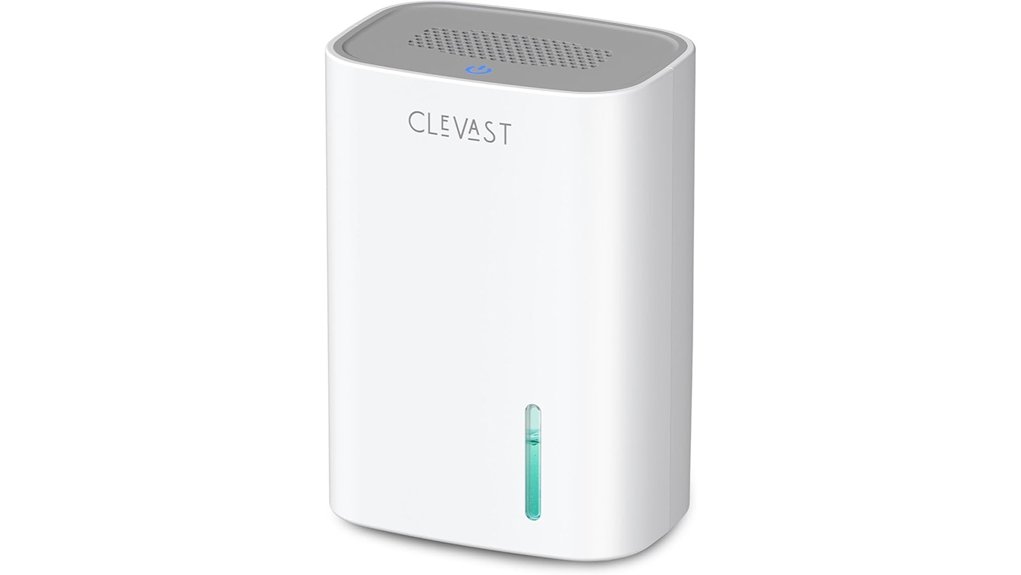
The CLEVAST Small Mini Dehumidifier is the most dorm-friendly choice in this comparison when desk and floor space are limited. Its approximately 4.55 × 6.52 × 9.2-inch body can fit on a sturdy shelf, dresser, or open section of the floor without dominating the room.
The unit has a 30-ounce tank, automatic shutoff, two operating speeds, and a seller-stated 24 dB quiet mode. CLEVAST states that it can collect up to 10 ounces of water in 24 hours, but that maximum was measured in a closed space at 86°F and 85% relative humidity. Expect lower collection in a cooler or less humid dorm.
Why You’ll Like It: It takes up little space, has straightforward controls, and provides one of the lowest published noise claims among the featured products.
Best For: A small dorm room, bedroom, closet area, or shared space where compact size and low operating noise matter most.
Who Should Avoid It: Students dealing with a water leak, widespread condensation, visible mold, or a room that stays severely damp. A compact thermoelectric unit is unlikely to solve those conditions.
Pros:
- Small footprint fits more easily into a crowded dorm.
- Seller-stated 24 dB quiet mode is a useful low-noise option for sleep or study areas.
- Automatic shutoff helps prevent tank overflow.
- Published daily energy consumption makes operating-cost comparison easier.
Cons:
- The 10-ounce daily maximum applies only under favorable test conditions.
- The 30-ounce tank is smaller than the other powered models in this guide.
- It is intended for mild small-space humidity rather than serious dampness.
- The unit requires a power connection and is not cordless.
NeedDuck 44OZ Dehumidifier — Best Adjustable Controls
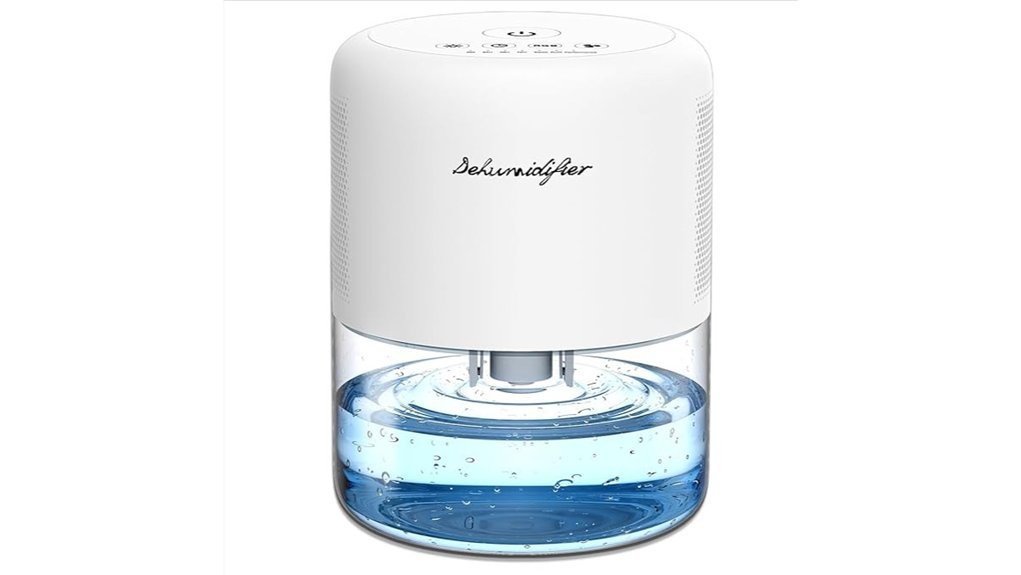
The NeedDuck dehumidifier is a practical choice for students who want more control than a basic one-button mini unit provides. It has a 44-ounce tank, weighs about 2.56 pounds, and measures approximately 5.91 × 5.91 × 8.46 inches.
The seller lists coverage of up to 215 square feet, but that figure should be treated as a placement guide rather than a guarantee of moisture-removal performance. More useful features include Sleep, Auto, and Performance modes, plus continuous, 24-hour, 48-hour, and 72-hour timer options. Automatic defrost and automatic shutoff add convenience in a shared room.
Why You’ll Like It: The timer and operating-mode choices let you reduce light and noise at night or select stronger operation when the room feels more humid.
Best For: Students who want a portable small-room dehumidifier with more scheduling and operating options.
Who Should Avoid It: Anyone who needs rapid moisture removal after water intrusion or who expects a compact semiconductor appliance to perform like a full-size compressor model.
Pros:
- 44-ounce tank provides more capacity than the CLEVAST model.
- Three operating modes suit different dorm routines.
- Continuous, 24-, 48-, and 72-hour timer options improve scheduling flexibility.
- Automatic shutoff can stop operation if the tank is full, removed, or improperly positioned.
- Automatic defrost supports operation in cooler conditions.
Cons:
- The listing does not provide a directly comparable standardized pint-per-day rating.
- The seller-listed coverage figure does not guarantee strong performance throughout every 215-square-foot room.
- Ambient lighting may be unnecessary for students who prefer a plain appliance.
- A small thermoelectric unit may collect little water in a cool or only slightly humid room.
TABYIK 38OZ Small Dehumidifier — Best Balanced Pick
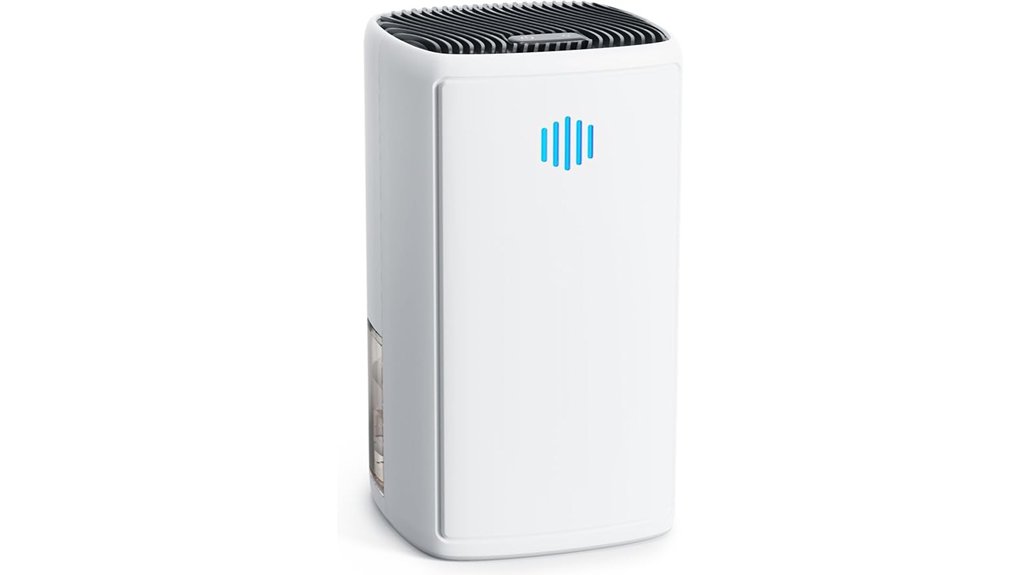
The TABYIK 38-ounce model offers a useful middle ground between compact size, tank capacity, and published extraction performance. Its approximately 6.5 × 6.5 × 9.5-inch frame can fit in a dorm corner, beside a dresser, or on another stable surface with adequate airflow.
TABYIK states that the unit can collect up to 11 ounces in 24 hours at 86°F and 80% humidity. It is also marketed for areas up to 280 square feet and operation below 30 dB. These figures make it promising for a small room, but actual results will depend on temperature, humidity, airflow, and placement.
Why You’ll Like It: It combines a reasonably sized tank, a published daily removal figure, automatic defrost, and a low-noise claim without taking up much floor space.
Best For: Students who want a quiet thermoelectric dehumidifier with more tank capacity than the smallest mini units.
Who Should Avoid It: Students expecting the advertised room-coverage number to mean that the unit can correct severe dampness across a large suite.
Pros:
- Below-30 dB seller claim is suitable for bedrooms and study areas.
- 38-ounce tank balances reservoir capacity and portability.
- Automatic shutoff and a red full-tank indicator simplify maintenance.
- Automatic defrost can reduce frost-related interruptions.
- Published extraction conditions make the maximum output easier to evaluate honestly.
Cons:
- The maximum 11-ounce collection rate was measured in warm, highly humid conditions.
- Real dorm-room extraction may be lower than the published maximum.
- Seller-listed 280-square-foot coverage is not a standardized capacity rating.
- It is not designed for leaks, flooding, or heavy structural dampness.
BEDRED 95OZ Dehumidifier — Best Large Tank
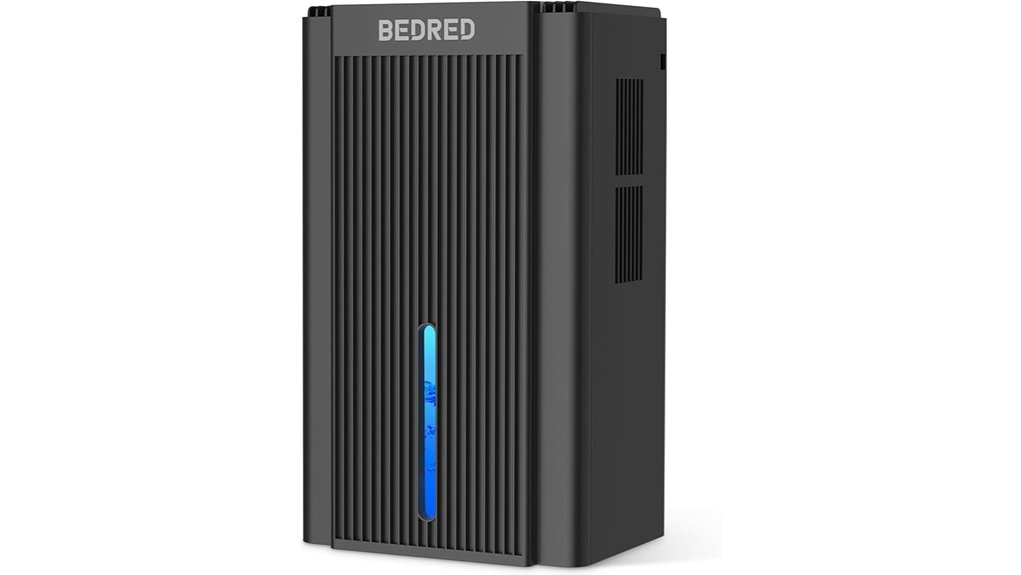
The BEDRED 95-ounce model is the best option here when your main concern is reducing how often you empty the reservoir. Its tank is more than twice the size of the NeedDuck or TABYIK tanks, which can be convenient when you are busy with classes or cannot check the appliance frequently. The current listing gives dimensions of approximately 6.7 × 8.7 × 14.6 inches, so measure the intended placement before choosing it.
This semiconductor unit includes automatic shutoff, seven-color ambient lighting, and a Sleep Mode that turns off the atmosphere lights and reduces operating noise. The seller lists coverage of up to 1,000 square feet, but that claim should not be interpreted as proof of compressor-level moisture removal. Its strongest dorm benefit is the large tank, not heavy-duty extraction.
Why You’ll Like It: The 95-ounce reservoir can reduce maintenance compared with smaller mini dehumidifiers, especially when the unit collects water steadily.
Best For: Students with enough floor or shelf space who prioritize a larger reservoir and fewer emptying trips in a mildly humid dorm or shared suite.
Who Should Avoid It: Anyone choosing it primarily because of the 1,000-square-foot marketing claim or needing a full-size dehumidifier for heavy moisture.
Pros:
- 95-ounce tank can reduce the number of emptying trips.
- Automatic shutoff helps prevent overflow when the reservoir fills.
- Sleep Mode turns off decorative lighting for nighttime use.
- Its 6.7 × 8.7 × 14.6-inch body can fit many dorm setups, though it needs more space than the other featured models.
Cons:
- Tank size does not indicate how quickly the unit removes moisture.
- The seller-listed coverage should not be compared directly with standardized compressor-dehumidifier capacity.
- It is larger than the other mini models in this comparison.
- Ambient lighting may not appeal to every student or roommate.
Factors to Consider When Choosing a Dehumidifier for a College Dorm
A dorm-room dehumidifier needs to fit more than the room’s square footage. Consider your residence-hall appliance rules, the severity of the moisture, published extraction conditions, noise, reservoir size, appliance dimensions, and the amount of maintenance you can manage.
Dorm Appliance Rules
Do not assume that every college permits dehumidifiers. Housing departments may restrict appliance wattage, extension cords, unattended operation, or where electrical devices can be placed. Check the current residence-hall policy or ask housing staff before ordering.
Follow the product manual, place the appliance on a stable and level surface, and keep its air openings clear. Avoid placing it where bedding, curtains, papers, or clothing can block airflow.
Room Size and Moisture Severity
Seller-listed room coverage can be useful for rough comparison, but it does not tell you how much water a machine will remove under your dorm’s actual conditions. A compact thermoelectric unit may work well for mild condensation, a musty closet area, or seasonal humidity while still being inadequate for a leak or a persistently wet wall.
For a better decision, consider the room’s actual humidity, temperature, visible condensation, and published daily extraction rate. A basic hygrometer can help you determine whether the room is genuinely humid or simply feels stuffy.
Daily Moisture Removal
Daily moisture-removal claims are most meaningful when the test conditions are provided. Warm air can hold more moisture, so a unit may collect considerably more water at 86°F and 80%–85% humidity than it does in a cool, air-conditioned dorm.
Do not treat an “up to” figure as a guaranteed everyday result. Compare the conditions attached to the claim and choose a stronger appliance category if the room has substantial moisture.
Tank Capacity
Tank capacity determines how much water the unit can store before it needs to be emptied. It does not determine how quickly the appliance removes moisture or how much room it can effectively serve.
A 30-ounce tank is easier to fit into a tight dorm, while a 95-ounce tank may require less frequent emptying. The best choice depends on available space, expected water collection, and how often you are willing to perform maintenance.
Noise Level
Noise matters because a dorm room is used for sleeping, studying, and relaxing. The CLEVAST has a seller-stated 24 dB quiet mode, while TABYIK markets its model as operating below 30 dB. NeedDuck and BEDRED include sleep-focused modes but do not provide equally clear comparable noise figures in the reviewed specifications.
Published decibel claims may be measured under different conditions. Place the appliance away from your pillow and use its quieter mode at night when available.
Energy Use
For the mini semiconductor products in this article, compare published wattage or daily electricity consumption rather than assuming they carry an ENERGY STAR certification. Timers, sleep modes, and automatic shutoff can reduce unnecessary operation, but they do not make an undersized appliance suitable for a severe humidity problem.
Check whether your dorm electricity is included in housing costs and whether the school limits appliance wattage.
Auto Shut-Off
Automatic shutoff is especially useful in a dorm because it stops the appliance when the reservoir is full. This reduces overflow risk when you are sleeping or away in class.
Even with automatic shutoff, inspect the tank regularly, reseat it correctly after emptying, and clean it according to the manufacturer’s directions.
Temperature and Humidity
Thermoelectric dehumidifiers generally perform better in warmer, more humid rooms. Their water collection may slow significantly in cool conditions. Automatic defrost can help manage frost, but it does not guarantee high extraction in a cold room.
If the dorm remains damp despite correct placement and regular operation, report the issue rather than continuously running an appliance that is too small for the moisture source.
Portability and Placement
Measure the intended location before choosing a model. Leave enough clearance for air circulation and enough room to remove the tank without moving books, electronics, or furniture.
A lightweight unit is easier to relocate during cleaning or room inspections. However, it should still sit on a stable surface where it cannot be kicked, tipped, or exposed to splashing water.
Ease of Use and Cleaning
One-button operation is convenient, but additional timers and modes may suit students with changing schedules. A visible tank or full-tank indicator helps you know when maintenance is needed.
Empty collected water promptly, rinse or clean the reservoir as directed, and inspect air openings for dust. Do not allow water to remain in the tank during long breaks or storage.
Moisture and Mold Safety Note
A dehumidifier can help control airborne moisture, but it cannot repair a plumbing leak, roof leak, damaged wall, or existing mold problem. EPA guidance recommends fixing the moisture source and keeping indoor humidity below 60%, ideally around 30%–50%. Report visible mold, water stains, persistent condensation, or strong musty odors to campus housing. See the EPA moisture-control guidance for more information.
Frequently Asked Questions
How Often Should I Empty a Dorm Dehumidifier Tank?
Check the tank daily during the first week. A mini dehumidifier may need emptying every day in warm, humid conditions or much less often in a cool room. The appliance should stop when its tank is full, but regular checks help prevent odors and keep it ready to operate.
Are Dehumidifiers Allowed in All College Dorms?
No. Appliance rules vary by school and residence hall. Check your housing agreement or contact the housing office before bringing one into your room. Ask about wattage limits, unattended operation, extension cords, and placement requirements.
Do Dorm Dehumidifiers Use a Lot of Electricity?
Compact semiconductor models generally use less power than large compressor dehumidifiers, but electricity use varies by wattage and runtime. Review the product’s stated consumption and use timers or lower-power modes when appropriate.
Can a Dehumidifier Remove Mold From Dorm Walls?
No. It may help reduce the humidity that supports future growth, but it does not remove existing mold or fix the water source. Report visible mold, leaks, water stains, or recurring dampness to campus housing promptly.
Should I Choose a Thermoelectric or Compressor Dehumidifier?
A thermoelectric model is usually smaller and quieter, making it convenient for mild humidity in a compact dorm. A compressor model removes substantially more moisture and is more appropriate for serious dampness, but it is larger, noisier, and may not be permitted in every residence hall. Confirm dorm rules before choosing either type.
Where Should I Place a Dehumidifier in a Dorm?
Place it on a stable, level surface where air can enter and exit freely. Keep it away from bedding, curtains, loose papers, clothing piles, and locations where it may be kicked or splashed. Follow the clearance instructions in the product manual.
Conclusion
For a typical small college dorm, the CLEVAST 30OZ Mini Dehumidifier is the most practical overall choice because of its compact footprint, automatic shutoff, and published quiet-mode specification. The NeedDuck 44OZ is better when you want timers and multiple modes, while the TABYIK 38OZ offers a useful balance of tank size and stated moisture removal. Choose the BEDRED 95OZ when a large reservoir and fewer emptying trips matter more than minimum size.
Final Recommendation
Choose a compact thermoelectric model only for mild or moderate dorm humidity. Confirm your housing rules, compare extraction conditions rather than relying only on square-foot claims, and contact campus housing when moisture comes from a leak, damaged wall, or mold problem.