Affiliate Disclosure: This article contains Amazon affiliate links. We may earn a commission from qualifying purchases at no additional cost to you.
If you want dependable humidity control throughout your home in 2026, focus on a ducted whole-house dehumidifier rather than a portable room unit or a crawl-space-only machine. The strongest options in this guide are the AprilAire E100 and E080 for professional HVAC integration and the Moiswell Marshal WD160 when controlled fresh-air intake is part of the plan. Compare rated moisture-removal capacity, test conditions, duct connections, drainage, controls, and installation requirements before choosing a system.
Quick Verdict
Best Overall: The AprilAire E100 is the strongest all-around choice for larger homes that need a purpose-built, professionally installed whole-house system.
Best for Medium-to-Large Homes: The AprilAire E080 offers similar whole-home installation flexibility with a lower 80-pint capacity.
Best for Fresh-Air Integration: The Moiswell Marshal WD160 combines ducted dehumidification with a dedicated outdoor-air intake connection.
Quick Comparison of the Best HVAC Whole-House Dehumidifiers
| Product | Best For | Published Capacity | Installation Type | Drainage | Amazon |
|---|---|---|---|---|---|
| AprilAire E100 Bundle | Larger homes and higher moisture loads | Up to 100 pints/day | Existing HVAC ductwork or dedicated whole-home ducts | Continuous gravity drain; external pump if needed | Check Current Amazon Availability |
| AprilAire E080 Bundle | Medium-to-large homes | Up to 80 pints/day | Existing HVAC ductwork or dedicated whole-home ducts | Continuous gravity drain; external pump if needed | Check Current Amazon Availability |
| Moiswell Marshal WD160 | Whole-home dehumidification with planned fresh-air intake | 65 pints/day at the manufacturer’s standardized condition; up to 160 pints/day in high heat and humidity | Whole-home ducted system with optional outdoor-air connection | Gravity drain or external condensate pump | Check Current Amazon Availability |
Capacity Note: Pint ratings are only useful when the test conditions are comparable. A capacity measured in very hot, saturated air can look much higher than an AHAM or DOE figure measured under milder conditions. Use the standardized rating when available and have the home’s moisture load checked before sizing a central system.
How These Systems Were Compared
The ranking prioritizes true whole-home duct compatibility, manufacturer-published moisture-removal capacity, drainage options, humidity controls, service access, and installation flexibility. It does not assume that the largest advertised pint number is automatically the best choice.
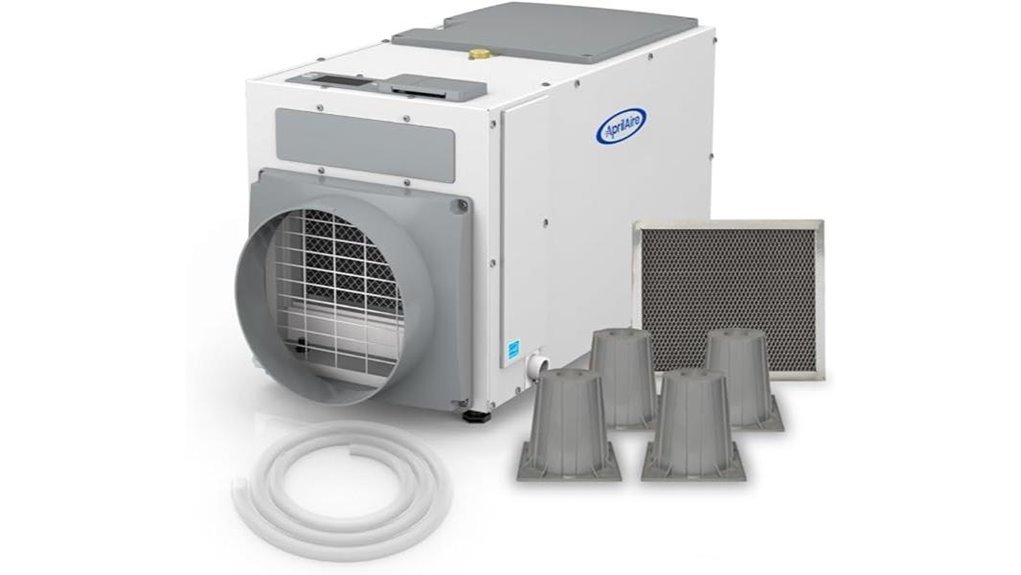
AprilAire E100 Pro Dehumidifier Bundle (100 Pint)
Best Overall Whole-House Dehumidifier
The AprilAire E100 is a purpose-built whole-house dehumidifier for larger homes, sealed crawl spaces, and basements. AprilAire rates the core E100 unit to remove up to 100 pints of moisture per day and serve whole houses up to approximately 5,500 square feet. Its 10-inch inlet and outlet duct collars allow an HVAC contractor to connect it to an approved central-duct layout or install independent return-and-supply ducts.
The built-in digital humidistat starts dehumidification when moisture rises above the selected setting. Because the E100 drains continuously, there is no collection tank to empty. Corrosion-resistant aluminum coils, a removable washable MERV 8 filter, automatic restart, and a control panel that can be positioned on the top or inlet side support long-term installation.
Best For: Larger homes that need a professionally sized, set-it-and-forget-it humidity-control system.
Why You’ll Like It: It is designed for broad ducted applications and offers more capacity than the E080 without relying on a portable cabinet or water bucket.
Who Should Buy This: Homeowners with a high moisture load, a larger conditioned area, or an HVAC contractor recommending the 100-pint class.
Who Should Avoid This: Buyers who only need one room treated or who do not have a practical route for ducts, power, drainage, and service access.
Pros:
- Purpose-built for whole-house and ducted applications
- Up to 100 pints per day of published moisture-removal capacity
- Manufacturer coverage guidance up to approximately 5,500 sq. ft.
- Built-in digital humidity control and continuous drainage
- Washable MERV 8 filter and corrosion-resistant aluminum coils
Cons:
- Professional sizing and duct installation may be needed
- A gravity drain or separate condensate pump must be planned
- The Amazon offer is a seller-created bundle, so included accessories and warranty terms should be confirmed on the current listing
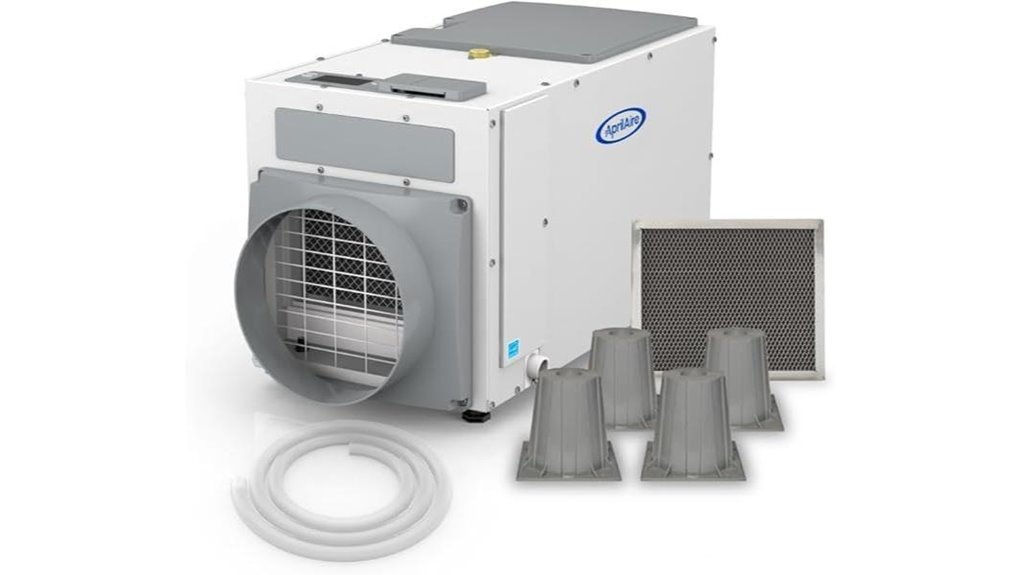
AprilAire E080 Pro Dehumidifier Bundle (80 Pint)
Best for Medium-to-Large Homes
The AprilAire E080 offers many of the same installation advantages as the larger E100 but with an 80-pint daily capacity. AprilAire lists it for whole houses, basements, and sealed crawl spaces up to approximately 4,400 square feet, making it a more balanced option when the E100’s higher output is unnecessary.
The E080 includes built-in digital humidity control, 10-inch inlet and outlet duct connections, a removable washable MERV 8 filter, and continuous drainage. It can operate through an approved HVAC connection or with dedicated return and supply ducts, depending on the home’s layout and the installation manual.
Best For: Homeowners who want a true whole-house system but do not need the E100’s higher capacity.
Why You’ll Like It: It provides the same basic professional-grade format as the E100 in a lower-capacity model that may better match a moderate moisture load.
Who Should Buy This: Owners of medium-to-large homes whose contractor determines that an 80-pint system is sufficient.
Who Should Avoid This: Homes with unusually heavy moisture intrusion or buyers choosing only by square footage without accounting for climate, air leakage, and basement conditions.
Pros:
- Designed for ducted whole-home applications
- Up to 80 pints per day of published capacity
- Manufacturer coverage guidance up to approximately 4,400 sq. ft.
- Built-in humidistat and continuous drainage
- Washable MERV 8 filter and corrosion-resistant aluminum coils
Cons:
- Installation is more involved than plugging in a portable unit
- Drain routing, duct resistance, and service clearance must be planned in advance
- The current Amazon bundle contents and warranty terms should be confirmed before purchase
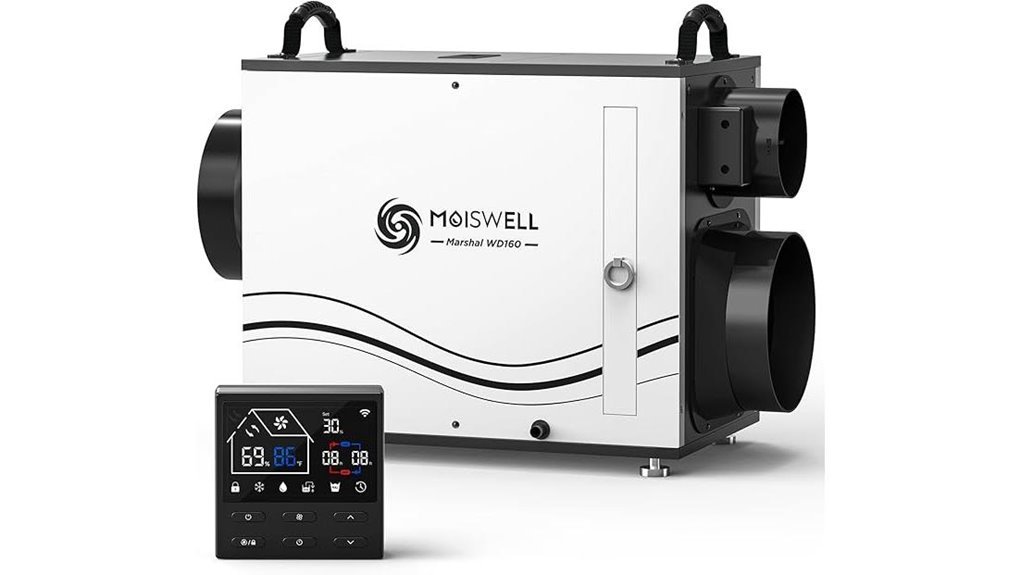
Moiswell Marshal WD160 Whole-House Dehumidifier with Fresh-Air Function
Best for Fresh-Air Integration
The Moiswell Marshal WD160 is a dedicated whole-home dehumidifier with an outdoor-air intake connection. In a properly designed installation, this allows the system to introduce controlled fresh air while removing excess moisture. It supports ducted whole-home use and provides a convertible air outlet for horizontal or vertical discharge.
The WD160 is rated at 65 pints per day under the manufacturer’s standardized condition and up to 160 pints per day under hotter, more humid conditions. Its published 330 CFM airflow, automatic defrost, restart memory, remote control, and continuous drainage support unattended operation. The fresh-air damper should only be used as part of a calculated ventilation plan because outdoor air can add both heat and moisture.
Best For: Homes that need both whole-home humidity control and a planned source of outdoor ventilation air.
Why You’ll Like It: The dedicated outdoor-air connection and adjustable discharge direction offer installation flexibility that basic ducted dehumidifiers may not provide.
Who Should Buy This: Homeowners working with an HVAC professional who wants to combine dehumidification with controlled ventilation.
Who Should Avoid This: Buyers looking for a simple plug-in appliance or anyone planning to leave the outdoor-air intake open without calculating the added ventilation load.
Pros:
- Designed as a ducted whole-home system
- Dedicated outdoor-air intake for planned fresh-air ventilation
- Published airflow of 330 CFM
- 65-pint manufacturer-standardized rating and up to 160 pints under high-temperature, high-humidity conditions
- Horizontal or vertical supply-air configuration
Cons:
- Ventilation airflow must be designed carefully to avoid introducing excessive outdoor moisture
- Professional duct sizing and balancing are strongly recommended
- A separate condensate pump may be needed when gravity drainage is unavailable
Factors to Consider When Choosing an HVAC Whole-House Dehumidifier
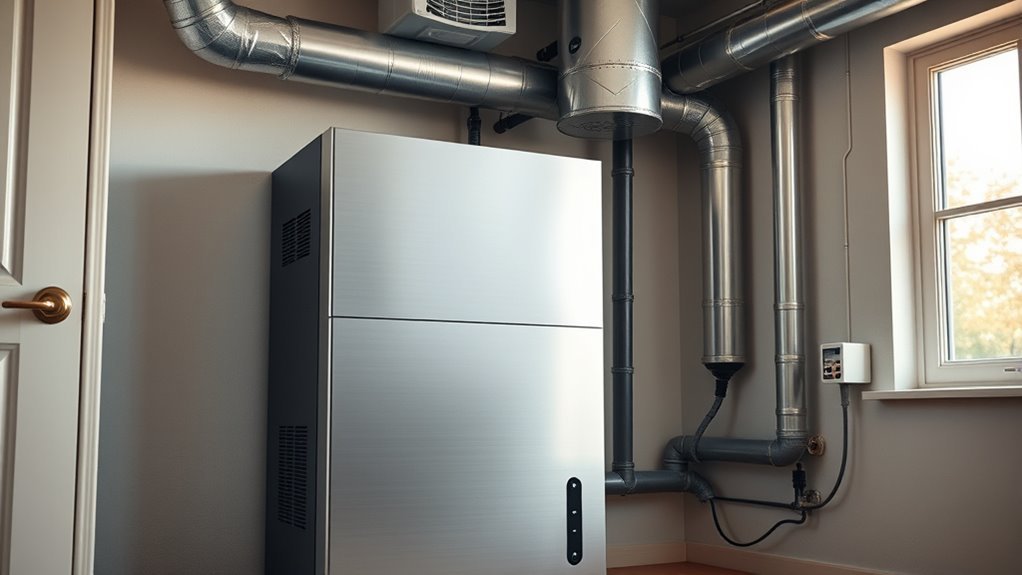
Choosing a whole-house dehumidifier involves more than matching a square-foot number. Compare standardized moisture-removal capacity, approved duct configurations, airflow, drainage, installation space, controls, electrical requirements, warranty terms, and maintenance access.
Whole-House vs. Portable and Crawl-Space Dehumidifiers
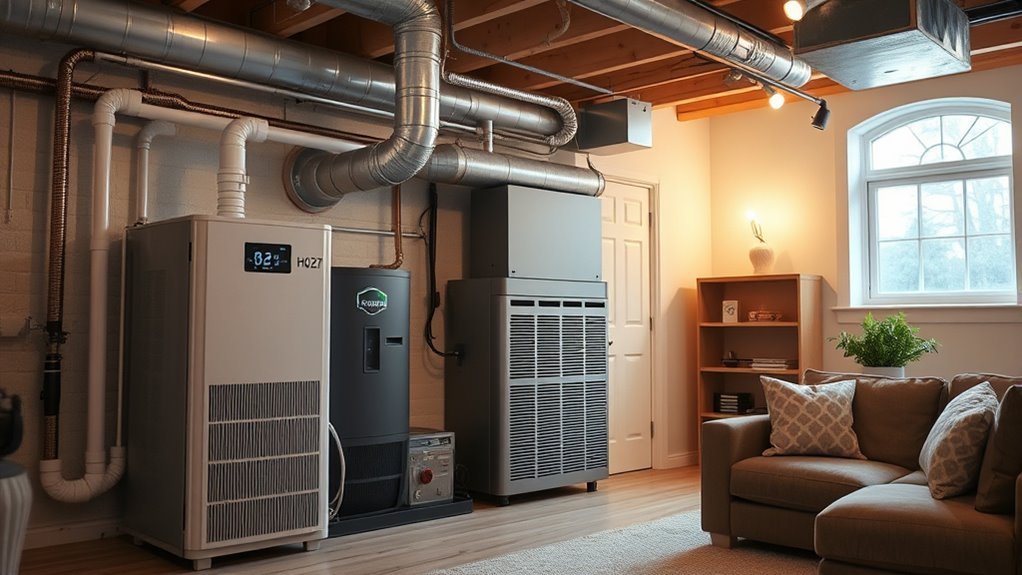
A purpose-built whole-house dehumidifier includes duct connections and installation guidance for serving multiple rooms through an HVAC system or an independent whole-home duct layout. A portable unit is designed mainly for one open area and depends on a collection tank or short drain hose. A crawl-space dehumidifier may support limited ducting, but that alone does not make it suitable for every central HVAC configuration.
For true whole-home control, choose a model whose manual supports the exact return, supply, fan-interlock, and ventilation arrangement planned for the property.
Moisture Removal Capacity and Test Conditions
Moisture-removal capacity is measured in pints per day, but test conditions matter. Capacity rises sharply in hotter, more humid air. A high-temperature rating should not be compared directly with a standardized AHAM or DOE rating.
Use comparable figures whenever possible. Also consider climate, air leakage, basement or crawl-space conditions, ceiling height, building materials, the number of occupants, and how much moisture the air-conditioning system already removes.
Coverage Area and Moisture-Load Needs
Manufacturer square-foot ratings are useful starting points, but they assume adequate airflow and typical moisture conditions. Closed doors, multiple floors, leaky foundations, damp basements, high ceilings, and long duct runs can reduce real-world performance. A contractor may need to calculate the home’s moisture load rather than selecting a machine from square footage alone.
Ductwork and Airflow
Check the required inlet and outlet duct sizes, maximum duct length, available static pressure, and recommended return-and-supply locations. Poor duct design can reduce water removal, increase noise, and create unwanted pressure differences.
A whole-house unit may use HVAC return air, a dedicated return, a supply-plenum connection, or a fully independent duct layout. Follow an approved manufacturer configuration rather than improvising a connection.
Fresh-Air Ventilation
A fresh-air intake can improve ventilation, but outdoor air also adds heat and moisture. The ventilation rate must match the home, climate, exhaust systems, and HVAC capacity. Do not leave an outdoor-air damper fully open without calculating the additional load and confirming how the dehumidifier and central blower will operate together.
Drainage System Options
Whole-house machines produce too much water for routine manual emptying. A continuous drain is therefore essential. Gravity drainage is simple and reliable when the line can maintain a continuous downward slope. A built-in or external condensate pump is needed when water must travel upward.
Install the drain according to the manual and local requirements, avoid kinks, provide an air gap when required, and make sure the discharge location will not return water toward the foundation.
Installation Space and Service Access
Measure the equipment area before ordering. Allow room for duct collars, filter removal, drain connections, electrical access, and future servicing. Attic installations may also need an auxiliary drain pan, overflow protection, vibration isolation, and freeze-risk planning.
Electrical and Energy-Efficiency Requirements
Confirm the voltage, circuit requirements, plug type, and any local code rules before installation. ENERGY STAR recognition can help identify efficient equipment, but correct sizing and duct design remain essential. An oversized machine that short-cycles or an undersized machine that runs continuously may not deliver the expected comfort or operating cost.
Avoid unsupported claims that one unit will reduce electricity use by a fixed percentage. Climate, humidity setting, runtime, duct resistance, utility rates, and interaction with the air conditioner all affect energy use.
Noise Level Considerations
A ducted unit is often installed away from living areas, but fan and compressor noise can travel through ducts and framing. Flexible connectors, proper mounting, correctly sized ducts, and adequate airflow can reduce vibration and air noise.
Humidity Controls
A built-in humidistat is sufficient for many installations. A remote wall control or wired sensor is useful when the machine sits in a crawl space, attic, or mechanical room. For occupied areas, a target near 45% to 50% relative humidity is a practical starting point, although seasonal adjustments may be needed.
Warranty and Durability
Review the complete warranty rather than relying only on the longest number advertised in a marketplace title. Check registration requirements, labor coverage, shipping responsibility, exclusions, and whether professional installation is required. For seller-created bundles, confirm whether the warranty applies to the dehumidifier, the accessories, or both.
Before You Buy
- Confirm that the manual approves the planned central-HVAC or independent whole-home duct layout.
- Compare capacity under equivalent test conditions.
- Have the moisture load and airflow checked instead of relying only on square footage.
- Measure the installation area and required service clearances.
- Plan the return duct, supply duct, drain route, electrical connection, and filter access.
- Confirm whether a condensate pump, remote control, hanging kit, drain hose, or extra duct fittings are included or sold separately.
- Verify current bundle contents and warranty terms on the Amazon listing before ordering.
Frequently Asked Questions
How Often Should a Whole-House Dehumidifier Be Serviced?
Inspect the filter and drain several times during the humid season and follow the manufacturer’s maintenance schedule. A professional inspection once a year is sensible for a ducted system, especially if airflow drops, the drain backs up, ice forms repeatedly, or the unit no longer reaches its humidity setting.
Can It Work With Existing HVAC Ductwork?
Yes, many whole-house models can connect to existing HVAC ductwork, but only through a manufacturer-approved layout. The installer must consider duct size, static pressure, airflow direction, central-fan operation, and where the dry air will be discharged.
Should I Choose the AprilAire E080 or E100?
The E080 is the better starting point when an 80-pint system matches the home’s calculated moisture load. The E100 provides more published capacity for larger homes or heavier humidity conditions. Do not choose only by floor area; climate, foundation moisture, air leakage, and duct design can change the correct size.
Can a Crawl-Space Dehumidifier Control the Whole House?
It may reduce moisture entering the home from a damp crawl space, but that does not guarantee even humidity control in every room. Treat a crawl-space unit as a whole-home solution only when its manual, ducting, airflow, controls, and installation layout specifically support that use.
Does Installation Require a Dedicated Drain Line?
Usually, yes. Whole-house systems produce water continuously and should discharge through a properly sloped gravity line or a condensate pump. Manual tank emptying is not a practical long-term solution for this type of equipment.
When Is a Condensate Pump Needed?
A pump is needed when the drain destination is above the dehumidifier or when a gravity line cannot maintain a continuous downward slope. Check the pump’s maximum lift, hose-length limit, overflow protection, and maintenance requirements before installation.
How Much Noise Does a Whole-House Unit Make?
Noise depends on the compressor, fan speed, duct size, mounting surface, and equipment location. A correctly installed unit in a basement or mechanical room may be difficult to hear in occupied rooms, while undersized ducts or rigid mounting can transmit noticeable vibration.
What Humidity Setting Should I Use?
A setting around 45% to 50% RH works well for many homes. Avoid setting the control unnecessarily low because that increases runtime and energy use. Adjust the target based on season, comfort, condensation, and the manufacturer’s recommendations.
Will It Improve Indoor Air Quality Year-Round?
Controlling excess humidity can reduce musty conditions and make the environment less favorable for moisture-related problems. However, a dehumidifier does not remove every pollutant and does not replace source control, balanced ventilation, filtration, leak repair, or professional mold remediation when contamination is already present.
Conclusion
The best HVAC whole-house dehumidifier depends on the home’s moisture load and the approved installation layout. The AprilAire E100 is the strongest overall option for a larger home, while the AprilAire E080 offers similar professional-grade operation at a lower capacity. Choose the Moiswell Marshal WD160 when a controlled outdoor-air connection is an important part of the design.
Before ordering, compare capacity under equivalent test conditions and confirm the duct sizes, static-pressure limits, drain route, electrical requirements, control strategy, service clearances, bundle contents, and warranty terms. A qualified HVAC professional should verify sizing and airflow before connecting any dehumidifier to existing ductwork.
Final Recommendation
Start with the AprilAire E100 for a larger home or heavier moisture load and the E080 when an 80-pint system is sufficient. Select the Moiswell Marshal WD160 when fresh-air intake is part of a professionally designed ventilation and dehumidification plan.