Affiliate disclosure: This article contains Amazon affiliate links. We may earn a commission from qualifying purchases at no extra cost to you.
Last updated: August 2, 2026
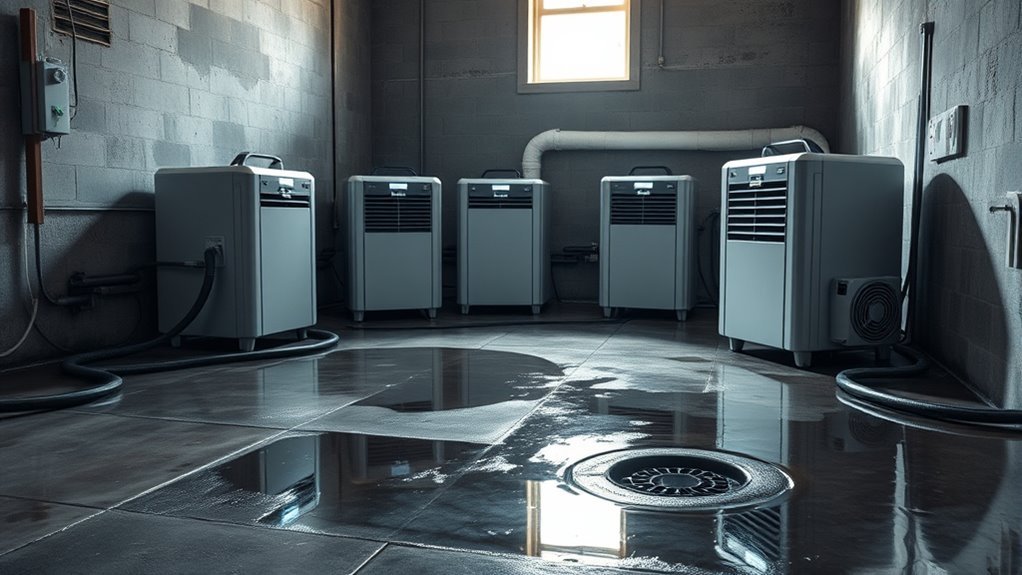
Construction drying can involve two very different jobs. Active water-damage restoration usually calls for a mobile LGR or high-capacity commercial dehumidifier, while a contained crawl space, basement, storage zone, or renovation area may be handled by a smaller fixed commercial unit. The right choice depends on comparable moisture-removal capacity, drainage, airflow, portability, temperature, electrical supply, containment, and how much wet material is present.
For most mobile construction and restoration work, the Abestorm Hurricane 850 offers the best overall balance of 85-pint AHAM capacity, pump drainage, wheels, and jobsite-oriented construction. The MOUNTO 310-Pint LGR is the stronger heavy-duty choice, with a published 165-pint AHAM rating for demanding water-loss projects. For a fixed drying zone that still needs pumped drainage, the Airzentti 155-Pint and ARGENDON Guardian 60 Pump Model are more compact alternatives.
Quick verdict
- Best Overall: Abestorm Hurricane 850 for mobile construction and general restoration work.
- Best Heavy-Duty LGR: MOUNTO 310-Pint LGR for major water-damage drying.
- Best Large Fixed-Space Pick: Airzentti 155-Pint for pump-equipped drying in enclosed commercial zones.
- Best Compact Pump Pick: ARGENDON Guardian 60 for crawl spaces, basements, and contained renovation areas.
- Best Small Isolated-Zone Pick: CADPXS Remois X70 for tight areas with a reliable gravity drain.
Important capacity note: AHAM, DOE, saturation, and seller-stated maximum pints per day are not interchangeable. Saturation figures are measured in hotter, wetter air and normally appear much higher. Compare AHAM figures when available, then consider jobsite temperature, relative humidity, room volume, outdoor-air leakage, wet-material load, airflow, and the required drying time.
How these picks were evaluated
The products were compared using published AHAM or standardized capacity where available, saturation capacity, pump or gravity drainage, airflow, low-temperature controls, weight, mobility, housing design, and intended use. Manufacturer square-foot claims were treated only as rough placement guides, not guaranteed jobsite performance.
Quick Comparison of the Best Construction Dehumidifiers
| Model | Best For | Comparable Capacity | Maximum or Saturation Capacity | Drainage | Mobility | Amazon |
|---|---|---|---|---|---|---|
| Abestorm Hurricane 850 | General construction and restoration | 85 AHAM PPD | 180 saturation PPD | Built-in pump | Wheels and large handle; about 99 lb | Check on Amazon |
| MOUNTO 310-Pint LGR | Heavy water-damage restoration | 165 AHAM PPD | 310 saturation PPD | Built-in pump | Wheeled but approximately 130 lb | Check on Amazon |
| Airzentti 155-Pint | Large contained commercial drying zones | 70 AHAM PPD | 155 saturation PPD | Built-in pump and gravity drain | Semi-portable; about 60 lb | Check on Amazon |
| ARGENDON Guardian 60 Pump Model | Compact fixed-space drying with pump drainage | 60 AHAM PPD | 145 saturation PPD | Built-in pump and gravity drain | Compact; about 47.5 lb | Check on Amazon |
| Airecoler GT-X5 | Large crawl spaces and fixed renovation zones | About 58 to 60 PPD at 80°F and 60% RH | 125 maximum PPD | Gravity drain hose | Low-profile; about 50 lb | Check on Amazon |
| ALORAIR Sentinel HD55S | Compact, durable fixed installation | 55 AHAM PPD | 120 saturation PPD | Continuous gravity drain | Compact; about 42 lb | Check on Amazon |
| CADPXS Remois X70 | Small crawl spaces and isolated drying zones | 38 AHAM / 24.2 DOE PPD | 80 saturation PPD | Gravity drain hose | Very compact; about 36 lb | Check on Amazon |
| MOISWELL Defender ME-7 | Light-duty commercial and localized drying | 35 AHAM PPD | 70 saturation PPD | Gravity drain hose | Compact; about 40 lb | Check on Amazon |
Abestorm Hurricane 850 180-Pint Commercial Dehumidifier with Pump
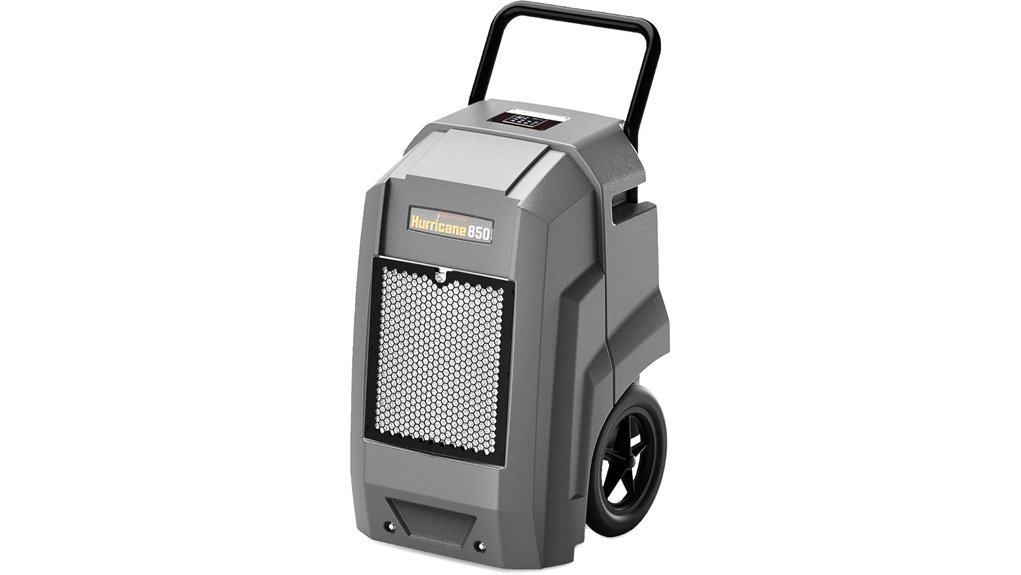
The Abestorm Hurricane 850 is the most balanced mobile construction dehumidifier in this roundup. Published specifications list 85 pints per day at AHAM conditions and up to 180 pints per day at saturation, which is a more useful comparison than the headline figure alone. Its wheeled vertical chassis, large transport handle, automatic defrost, digital controls, and built-in condensate pump are designed for movement between renovation zones and restoration projects.
The pump is listed for a vertical lift of up to 14.7 feet, while the approximately 210 CFM airflow helps move humid air through the unit. At about 99 pounds, it remains heavy, but the wheel-and-handle layout is more practical for routine jobsite transport than a low-profile crawl-space cabinet.
Why you’ll like it: It combines verified AHAM output, pump drainage, durable jobsite mobility, and automatic controls without reaching the extreme weight of the largest LGR machine.
Best for: Contractors, remodelers, carpet-drying crews, property-restoration teams, and enclosed renovation areas that need a mobile commercial machine.
Who should avoid it: Buyers who need a lightweight unit for stairs, occupied bedrooms, very small areas, or spaces without a suitable 115-volt circuit.
Pros:
- Published 85-pint AHAM rating supports meaningful comparisons.
- Built-in pump supports drainage when a lower floor drain is unavailable.
- Large wheels and a tall handle improve movement across level jobsites.
- Automatic defrost and restart functions support longer drying runs.
- Rotomolded-style jobsite housing protects the unit during transport.
Cons:
- Approximately 99 pounds and difficult to carry safely on stairs.
- The 180-pint headline is a saturation rating, not AHAM capacity.
- Commercial airflow, compressor operation, and pump cycles create more heat and noise than a home unit.
- A second person or suitable lifting equipment may be needed for loading and unloading.
MOUNTO 310-Pint LGR Commercial Dehumidifier with Pump
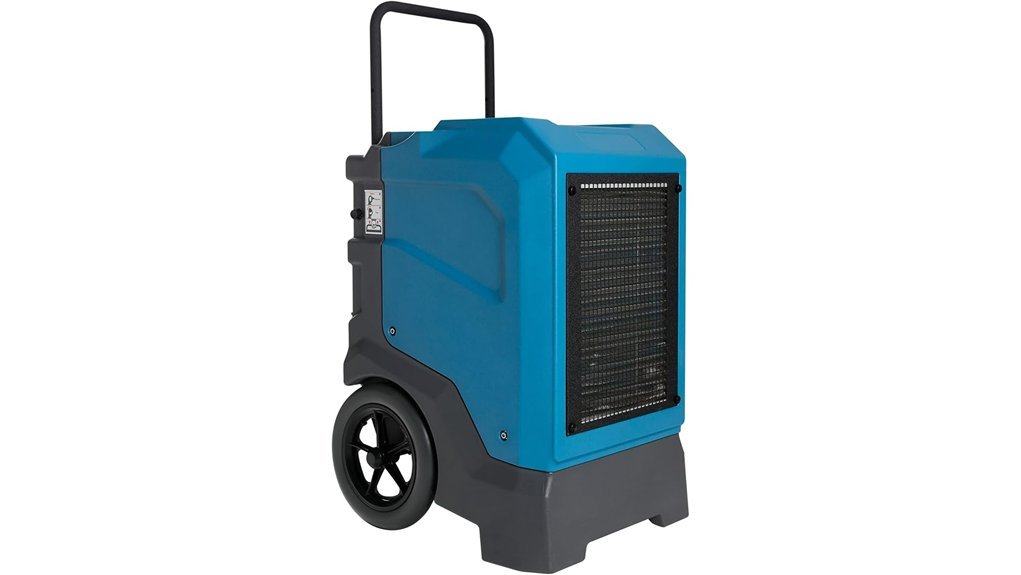
The MOUNTO 310-Pint LGR is the strongest restoration-focused machine in this list. It is published at approximately 165 pints per day under AHAM conditions and 310 pints per day at saturation. That output places it in a different class from compact crawl-space machines and makes it more appropriate for large drying chambers, major water losses, wet structural materials, and demanding commercial restoration work.
Its built-in condensate pump is listed with roughly 15 feet of lift, allowing continuous drainage from below-grade areas. The digital humidistat and temperature and humidity display help crews monitor operating conditions, although separate calibrated meters and material-moisture readings are still needed for professional drying decisions.
Why you’ll like it: The verified 165-pint AHAM rating provides substantially more comparable drying capacity than the smaller commercial units.
Best for: Professional water-damage restoration, large renovation projects, severe moisture loads, and crews that regularly operate multiple air movers.
Who should avoid it: Small contractors who rarely handle major water losses, sites with stairs or narrow access, and projects without sufficient circuit capacity.
Pros:
- Very high 165-pint AHAM capacity.
- LGR design is intended for demanding restoration cycles.
- Built-in pump supports continuous drainage from below-grade locations.
- Wheels and handle help move the machine across level surfaces.
- Digital controls provide convenient operating feedback.
Cons:
- Approximately 130 pounds and difficult to transport without planning.
- Higher electrical demand than compact fixed-space models.
- Too large and powerful for many small maintenance applications.
- Availability and seller support should be checked before relying on it for a time-sensitive project.
Airzentti 155-Pint Commercial Dehumidifier with Pump
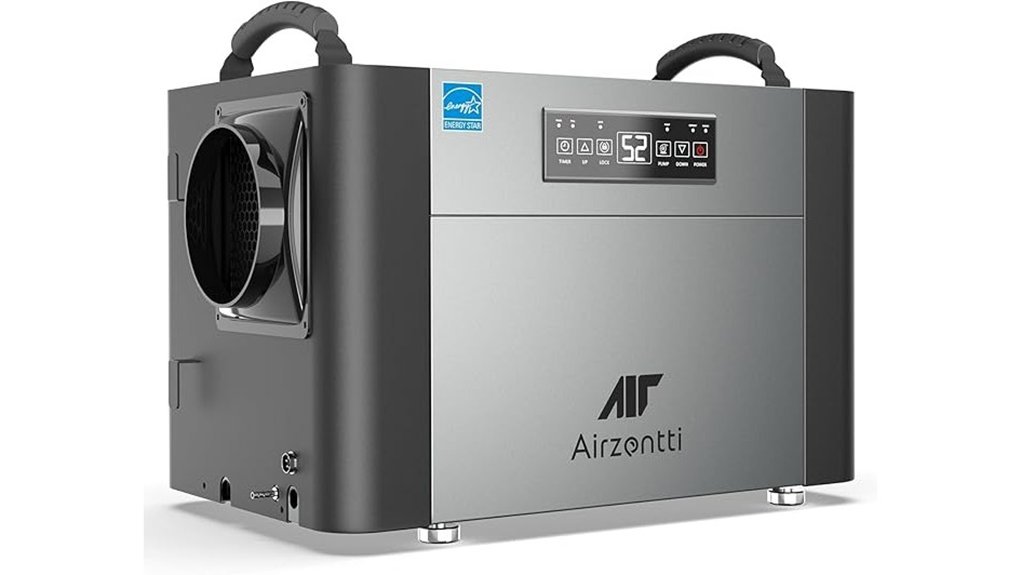
The Airzentti 155-Pint Commercial Dehumidifier sits between compact crawl-space models and large wheeled LGR equipment. Published specifications list 70 pints per day at AHAM conditions, up to 155 pints per day in near-saturated air, and approximately 220 CFM airflow. These figures make it suitable for contained warehouses, basements, attics, renovation zones, and moderate commercial drying work.
The current pump-equipped configuration includes built-in pump drainage, gravity drainage, automatic defrost, humidity controls, and a pump lift listed at up to approximately 16.4 feet. At about 60 pounds, it is manageable for occasional relocation but lacks the wheels and protected transport frame of a dedicated restoration machine.
Why you’ll like it: It offers a verified 70-pint AHAM figure, strong airflow, and two drainage methods in a relatively compact cabinet.
Best for: Contractors and property managers who need a high-output fixed or semi-portable machine in an enclosed commercial zone.
Who should avoid it: Crews that move equipment between water-loss jobs every day or buyers relying only on the large advertised square-foot figure.
Pros:
- Published 70-pint AHAM and 155-pint saturation ratings.
- Approximately 220 CFM airflow supports circulation in contained spaces.
- Built-in pump and gravity drainage increase placement flexibility.
- Automatic defrost supports operation in cooler environments.
- Compact dimensions are easier to position than a full-size LGR machine.
Cons:
- No large wheels for frequent restoration transport.
- Approximately 60 pounds and awkward in tight stairways.
- Coverage marketing should not replace a moisture-load calculation.
- The pump, drain line, filter, and coil require routine inspection.
ARGENDON Guardian 60 Pump Model 145-Pint Dehumidifier
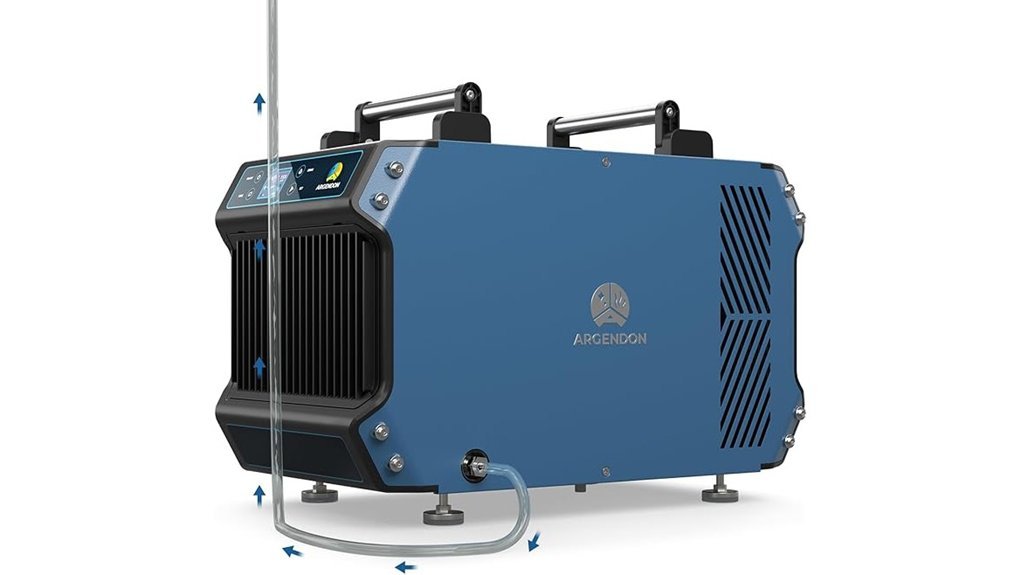
The Amazon ASIN in this article is associated with the ARGENDON Guardian 60 pump configuration. Published information lists 60 pints per day at AHAM conditions, up to 145 pints per day at saturation, and a built-in condensate pump in addition to gravity drainage. This makes it a more flexible fixed-space option than gravity-only crawl-space models.
The approximately 47.5-pound cabinet fits crawl spaces, basements, storage areas, garages, and contained renovation zones. It is better suited to ongoing moisture control and moderate drying than rapid structural drying after a major flood.
Why you’ll like it: It combines a useful 60-pint AHAM rating with pump drainage in a low-profile housing that can fit tighter areas.
Best for: Property managers, contractors, and installers who need a compact commercial unit where condensate may need to travel upward.
Who should avoid it: Restoration crews that need large wheels, a protected roto-molded shell, and high LGR capacity for daily water-loss work.
Pros:
- Published 60-pint AHAM rating.
- Built-in pump and gravity drainage support different installation layouts.
- Automatic defrost assists in cooler basements and crawl spaces.
- Compact dimensions fit many low-clearance locations.
- Lighter than wheeled restoration machines.
Cons:
- Not designed for convenient daily transport between jobsites.
- The 145-pint headline is a saturation figure.
- Low-profile equipment can be awkward to carry despite its lower weight.
- Warranty registration, labor, shipping, and component exclusions should be checked before purchase.
Airecoler GT-X5 125-Pint Commercial Dehumidifier
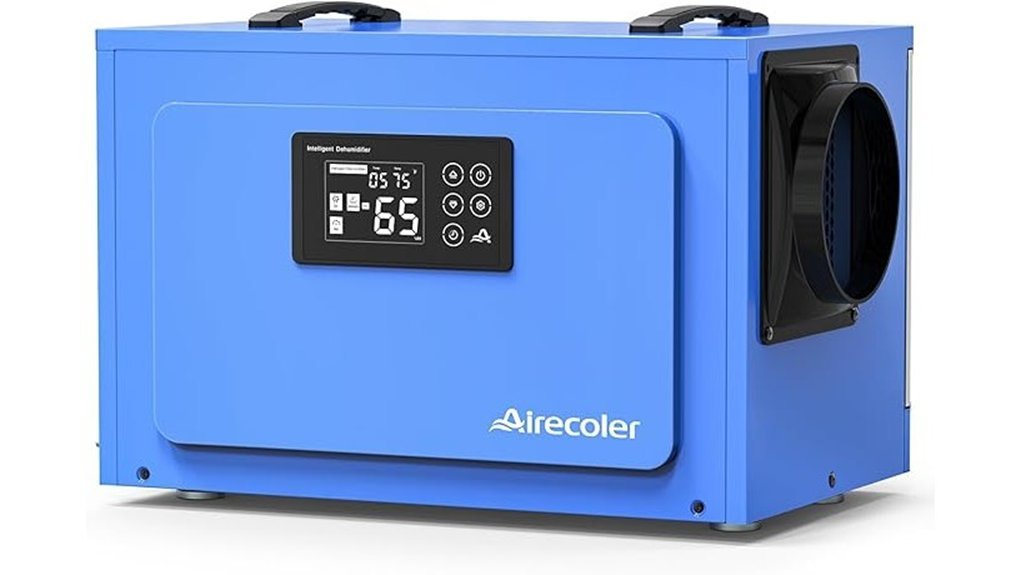
The Airecoler GT-X5 is a compact gravity-drain unit for crawl spaces, basements, garages, warehouses, and fixed commercial areas. The manufacturer’s detailed specifications list 58 pints per day at 80°F and 60% relative humidity, while its marketing copy rounds that figure to 60 pints. Its maximum-condition rating is 125 pints per day.
Airflow is listed at approximately 265 CFM, which is high for a low-profile unit of this size. Adjustable humidity control, automatic defrost, timer settings, memory restart, and continuous gravity drainage make it practical for unattended operation when the drain hose can descend continuously.
Why you’ll like it: It combines a compact shape with strong published airflow and a realistic standardized capacity near 60 pints per day.
Best for: Larger crawl spaces, basement renovation zones, garages, storage areas, and warehouses with a lower drain point.
Who should avoid it: Sites that need pumped drainage or crews seeking a wheeled machine for frequent restoration transport.
Pros:
- Approximately 58 to 60 PPD under standardized 80°F and 60% RH conditions.
- Published airflow around 265 CFM.
- Compact shape fits many low-clearance spaces.
- Automatic defrost and memory restart support unattended operation.
- Adjustable humidistat helps maintain a selected target.
Cons:
- Gravity drainage limits placement when no lower drain is available.
- The 125-pint figure represents maximum-condition output.
- Manufacturer square-foot claims should be treated as broad marketing guidance.
- At approximately 50 pounds, it may still be awkward in narrow crawl-space access points.
ALORAIR Sentinel HD55S Crawl-Space Dehumidifier
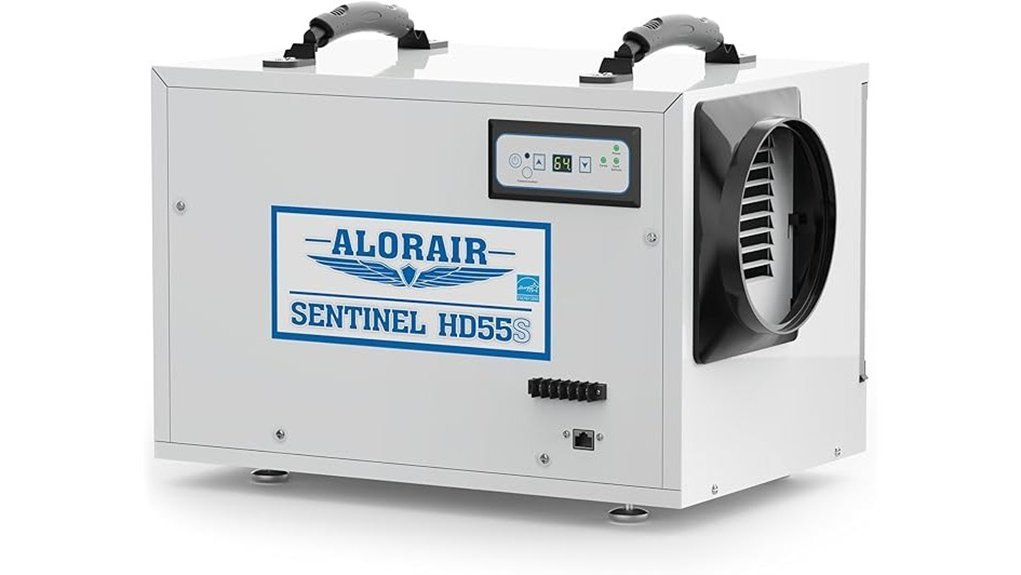
The ALORAIR Sentinel HD55S is a commercial-style fixed dehumidifier for crawl spaces, basements, workshops, storage areas, and light industrial zones. Current product information lists approximately 55 pints per day at AHAM conditions and up to 120 pints per day at saturation, with airflow around 130 CFM.
Its metal housing, automatic defrost, continuous gravity-drain connection, compact dimensions, and replaceable filter make it suitable for long-term installation. It does not include a built-in condensate pump in this configuration.
Why you’ll like it: It provides a rugged low-profile enclosure and a published 55-pint AHAM rating without taking up the space of a wheeled restoration machine.
Best for: Crawl-space remediation, basement renovation, workshops, storage areas, and smaller contained commercial zones.
Who should avoid it: High-volume flood-restoration crews and sites that cannot provide a continuously descending drain route.
Pros:
- Published 55-pint AHAM and 120-pint saturation ratings.
- Rugged metal housing protects internal components.
- Automatic defrost supports cooler crawl-space conditions.
- Continuous gravity drainage reduces routine water handling.
- Compact dimensions and moderate weight simplify fixed installation.
Cons:
- No built-in pump on this configuration.
- Lower capacity than dedicated restoration LGR equipment.
- Current seller descriptions vary regarding the exact included filter grade.
- Filter, coil, and drain-line maintenance remain necessary in dusty construction areas.
CADPXS Remois X70 80-Pint Commercial Dehumidifier
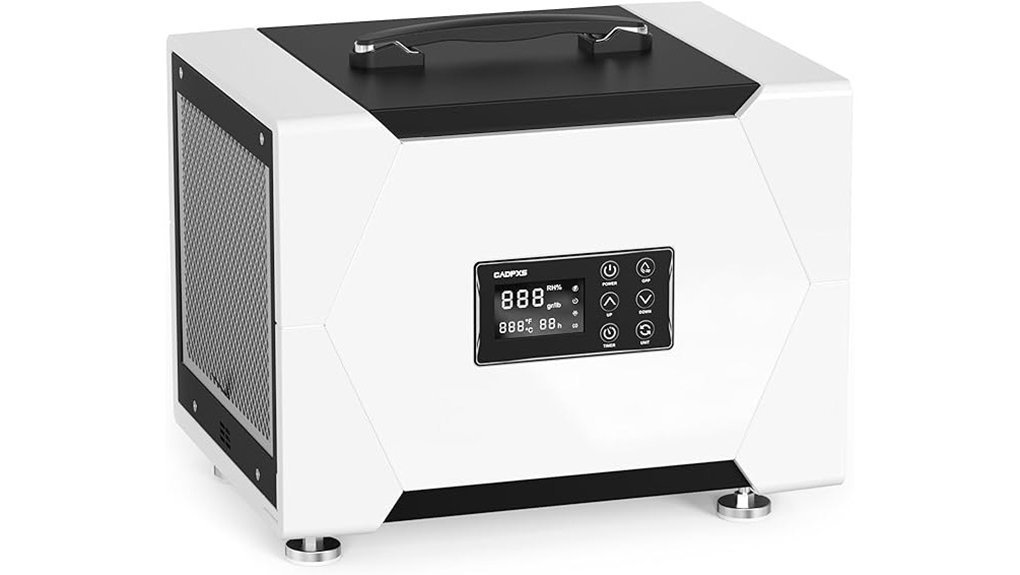
The CADPXS Remois X70 is the smallest verified commercial unit in this roundup. The manufacturer publishes three useful capacity figures: 24.2 pints per day under DOE conditions, 38 pints per day under AHAM conditions, and up to 80 pints per day at saturation. This makes it easier to size accurately than products that advertise only a maximum figure.
The compact cabinet weighs about 36 pounds and provides approximately 131 CFM airflow. Automatic defrost, memory restart, a timer, a washable filter, and an included gravity drain hose support unattended operation in isolated areas where a larger machine will not fit.
Why you’ll like it: It provides transparent standardized ratings and a genuinely compact body for tight installation locations.
Best for: Small crawl spaces, utility areas, mechanical rooms, closets under renovation, and localized drying tasks.
Who should avoid it: Large construction sites, severe water losses, open structures, or locations without a lower drain point.
Pros:
- Published DOE, AHAM, and saturation capacities.
- Compact dimensions and approximately 36-pound weight.
- About 131 CFM airflow for localized circulation.
- Included drain hose supports continuous gravity drainage.
- Automatic defrost and memory restart aid unattended use.
Cons:
- Limited capacity for large open areas or substantial water damage.
- No built-in pump on the X70 configuration.
- Requires clear intake and exhaust space despite its compact dimensions.
- Better suited to contained zones than rapid structural drying.
MOISWELL Defender ME-7 70-Pint Commercial Dehumidifier
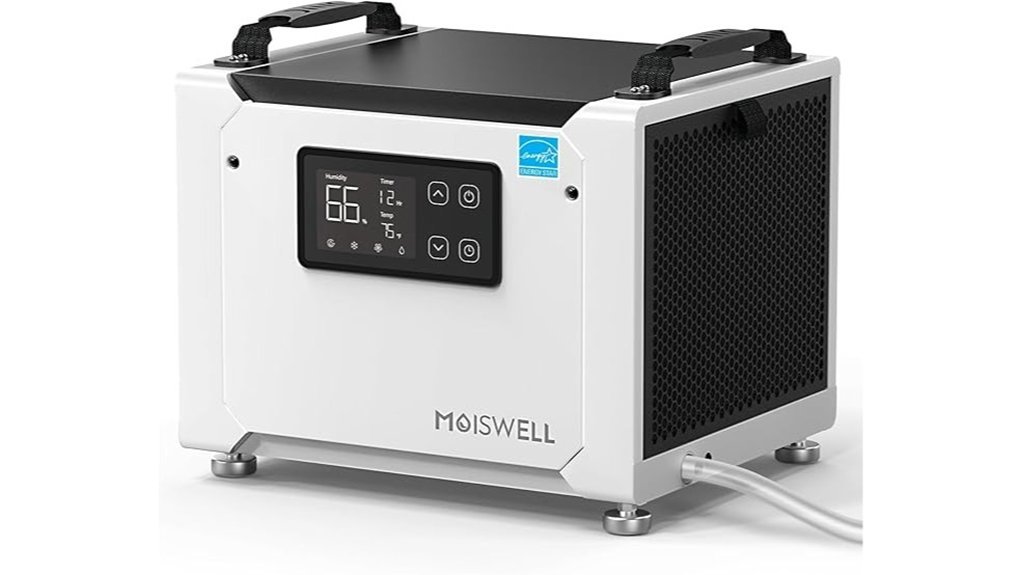
The MOISWELL Defender ME-7 is a compact gravity-drain model for smaller crawl spaces, basements, utility rooms, storage areas, and isolated renovation zones. Published specifications list 35 pints per day under AHAM conditions and up to 70 pints per day at saturation. That places it below the other commercial models in this guide and makes it most appropriate for lighter moisture loads.
The approximately 40-pound cabinet includes dual handles, automatic defrost, digital humidity controls, restart functions, and a continuous gravity-drain connection. It can support drying in a small contained area, but it should not be selected as the primary machine for a large water loss.
Why you’ll like it: It offers commercial-style continuous drainage and controls in a manageable, compact package.
Best for: Small renovation zones, crawl spaces, utility rooms, and light-duty commercial humidity control where gravity drainage is available.
Who should avoid it: Major flood restoration, wet structural assemblies, large open buildings, or any site that requires pumped drainage.
Pros:
- Published 35-pint AHAM rating.
- Compact body and dual handles improve portability.
- Gravity drain hose supports continuous operation.
- Automatic defrost and restart functions aid unattended use.
- Digital humidity control simplifies routine operation.
Cons:
- Lower capacity than the other retained commercial models.
- Requires a continuously descending drain route.
- The 70-pint headline is a saturation rating.
- Not an appropriate substitute for a high-capacity restoration dehumidifier.
Factors to Consider When Choosing a Construction Dehumidifier
A construction dehumidifier should be selected for the actual drying load, not only the advertised square footage or largest pint number. Compare capacities measured under the same conditions, confirm drainage and electrical requirements, and decide whether the unit will remain installed or move between jobs.
Decide Between Restoration and Fixed-Space Equipment
A mobile restoration dehumidifier is normally the better choice for water losses, wet drywall, carpet drying, and jobs that require frequent transport. These machines generally provide higher AHAM output, protected controls, pumps, wheels, and housings designed for movement.
A low-profile crawl-space dehumidifier is better suited to ongoing humidity control, contained renovation zones, basements, storage areas, and installations where the machine can remain in place. It should not automatically be treated as a replacement for LGR restoration equipment.
Compare AHAM, DOE, and Saturation Capacity
AHAM ratings are measured under standardized moderate conditions and are generally the most useful numbers for side-by-side commercial comparisons. DOE ratings may use cooler conditions and can be lower. Saturation ratings are measured in hotter, wetter air and can be two or more times the standardized figure.
When a listing displays only a maximum capacity, ask the manufacturer for an AHAM, DOE, or performance-chart figure before sizing a demanding project.
Match the Unit to the Moisture Load
Square footage alone is not enough. Consider ceiling height, open doors, air leakage, outdoor humidity, standing water, wet drywall, insulation, lumber, carpet, fresh concrete, and the amount of air entering the drying chamber.
A large open shell or active water loss may require multiple dehumidifiers, containment, heat management, and several air movers rather than one oversized unit placed in a corner.
Choose LGR or Conventional Refrigerant Drying
Low-grain refrigerant, or LGR, dehumidifiers are designed for restoration work and can continue removing moisture as the drying chamber becomes less humid. They are the stronger choice for many structural-drying projects.
Conventional commercial crawl-space units often provide better value for continuous humidity control, moderate renovation moisture, storage areas, and less severe drying. Desiccant equipment or a specialist drying plan may be more appropriate when temperatures are very low or an unusually low humidity level is required.
Check Drainage Before Buying
A gravity-drain model needs a hose that slopes continuously downward without kinks, traps, or uphill sections. The drain termination must be secure and able to accept the expected water flow.
A built-in pump is more flexible because it can move water upward to an approved drain point, but it adds noise, maintenance, and another possible failure component. Confirm the pump lift, included hose length, discharge restrictions, and whether the exact product configuration contains an internal pump.
Consider Airflow, Containment, and Placement
Airflow, normally measured in CFM, affects how quickly humid air reaches the dehumidifier’s coil. Keep the intake and exhaust clear, isolate the drying chamber when appropriate, and position air movers so that air travels across wet surfaces and back toward the dehumidifier.
Do not point hot dry exhaust directly at materials with controlled curing requirements unless the material manufacturer permits it. Fresh concrete, flooring, coatings, plaster, and wood products can have specific temperature and humidity limits.
Verify Low-Temperature Performance
Cool basements and winter jobs can cause frost to form on a refrigerant dehumidifier’s coil. Automatic defrost helps, but every machine has a minimum operating temperature and reduced moisture-removal output as the air becomes colder.
Check the manual’s operating range instead of assuming the maximum pint rating applies at every temperature.
Check Power and Jobsite Electrical Safety
Confirm voltage, amperage, plug type, available circuit capacity, and extension-cord restrictions before deployment. Large restoration equipment may need a dedicated circuit, especially when several air movers or other tools are operating nearby.
Follow the manufacturer’s electrical instructions and applicable jobsite rules. Do not operate damaged cords, overloaded circuits, unapproved adapters, or electrical equipment in standing water. Use qualified electrical assistance when circuit suitability is uncertain.
Evaluate Portability, Access, and Durability
Wheel-mounted restoration units are easier to move across floors but can remain extremely heavy on stairs. Measure doorways, stair landings, crawl-space openings, vehicle cargo areas, and the path to the drying chamber before buying.
Low-profile metal units fit tighter spaces and can remain installed, but they are less convenient for daily transport. Look for strong handles, protected controls, accessible filters, secure drain fittings, and service support that matches how often the machine will move.
Plan for Maintenance and Downtime
Construction dust can clog filters and coils quickly. Inspect the filter frequently, clean the intake and exhaust, examine the drain line, test the pump, and check for water leakage. Keep the unit upright during storage and transport when required by the manual.
Professional crews should plan for breakdowns. A backup unit, spare drain hose, replacement filter, or external condensate pump can prevent a drying project from stopping unexpectedly.
Monitor Materials, Not Only Room Humidity
Room relative humidity is only one part of a drying decision. Wet wood, drywall, subfloors, concrete, carpet, and insulation can remain damp even after the air feels comfortable. Use appropriate material-moisture measurements and document the drying trend when the project requires verification.
Before you buy:
- Record the jobsite temperature and starting relative humidity.
- Measure room volume, access openings, stairs, and transport clearances.
- Identify the wet materials and whether active water intrusion has stopped.
- Confirm the gravity-drain route or required pump lift.
- Check voltage, amperage, circuit capacity, and cord restrictions.
- Compare AHAM capacity, airflow, weight, filter availability, and operating range.
- Read the current warranty terms, including registration, labor, freight, and component exclusions.
Frequently Asked Questions
What Size Construction Dehumidifier Do I Need?
Start with the AHAM-rated capacity, room volume, temperature, moisture source, amount of wet material, and how tightly the area can be contained. A small contained renovation zone may be handled by one compact commercial model, while severe water damage or an open structure may require multiple restoration dehumidifiers and air movers.
Manufacturer square-foot ratings are rough placement guides and should not be the only sizing method.
What Is the Difference Between AHAM, DOE, and Saturation Pints?
AHAM and DOE figures are measured under defined test conditions, making them more useful for comparisons. DOE conditions can be cooler than commonly published AHAM conditions. Saturation pints are measured in much hotter and wetter air, so the number is normally much higher.
Always compare ratings measured under the same temperature and relative-humidity conditions.
Is an LGR Dehumidifier Better for Water Damage?
In many cases, yes. An LGR dehumidifier is designed for structural drying and can continue removing moisture effectively as the drying chamber becomes less humid. It is generally a better choice for significant water losses, wet drywall, carpet, subfloors, and restoration work.
A conventional commercial unit may still be sufficient for routine basement humidity, crawl spaces, storage areas, and smaller contained renovation zones.
Do I Need a Built-In Pump?
You need a pump when condensate must travel upward or when no suitable lower drain is available. Gravity drainage is simpler and can be more reliable when the hose can slope continuously downward.
Check whether the exact model includes a pump. Some listings mention pump compatibility, an external pump signal, or a drain hose without including an internal condensate pump.
Can I Use a Crawl-Space Dehumidifier for Water Damage?
A crawl-space model can assist with a small contained moisture problem, especially when standing water has been removed and the wet-material load is limited. It may be too slow for a major water loss, large open structure, or time-sensitive restoration project.
For substantial damage, use equipment sized for structural drying and monitor the materials rather than relying only on room humidity.
What Humidity Level Should a Construction Site Have?
There is no single target for every project. The correct range depends on the materials, curing instructions, coatings, flooring, wood-moisture targets, project specifications, and outdoor conditions.
Follow the material manufacturer’s instructions and measure both air conditions and material moisture. Drying the air too aggressively can be unsuitable for some curing materials.
Can a Construction Dehumidifier Remove Mold?
No. A dehumidifier can reduce excess humidity and make conditions less favorable for additional mold growth, but it does not remove established contamination. Existing mold, contaminated porous materials, and the underlying moisture source may require professional assessment and remediation.
Should I Run Air Movers with a Dehumidifier?
Air movers are commonly used to increase evaporation from wet surfaces and circulate humid air toward the dehumidifier. Their number and placement depend on the drying chamber, wet materials, equipment capacity, and restoration plan.
More evaporation can temporarily increase the moisture load on the dehumidifier, so both parts of the drying system need to be sized appropriately.
How Loud Are Commercial Dehumidifiers?
Noise varies by compressor, fan speed, airflow, pump operation, housing, and placement. Commercial and restoration units are normally noticeably louder than residential room dehumidifiers.
Check the published decibel rating when available and consider vibration, ducting, occupied rooms, and overnight operation before choosing a location.
How Do I Maintain a Construction Dehumidifier?
Disconnect power before maintenance. Inspect and clean or replace the filter, keep the coil and grilles free of dust, check the drain hose for kinks or clogs, test the pump, and confirm that condensate reaches a safe discharge point.
Follow the manual’s service schedule and use the specified replacement parts. Construction dust may require more frequent inspections than normal household operation.
How Many Dehumidifiers Do I Need for Water Damage?
The number depends on the drying-chamber volume, amount and type of wet material, temperature, containment, outdoor-air leakage, equipment AHAM capacity, and required drying time. A simple square-foot calculation can miss major differences in moisture load.
Restoration professionals commonly use moisture readings, psychrometric measurements, equipment performance, and drying progress to adjust the equipment plan.
Conclusion
The best construction dehumidifier is the machine that matches the real moisture load, drainage route, access limits, electrical supply, and required drying speed. The Abestorm Hurricane 850 is the most balanced option in this roundup for general mobile construction and restoration work, with a published 85-pint AHAM rating and built-in pump.
Choose the MOUNTO 310-Pint LGR when a major water-damage project justifies its 165-pint AHAM capacity and approximately 130-pound weight. The Airzentti 155-Pint is a strong middle-ground option for large contained zones, while the ARGENDON Guardian 60 Pump Model offers pump drainage in a more compact housing.
For fixed gravity-drain installations, the Airecoler GT-X5 and ALORAIR Sentinel HD55S provide moderate commercial capacity. The CADPXS Remois X70 and MOISWELL Defender ME-7 are better reserved for small isolated areas and light-duty moisture control rather than major structural drying.
Final recommendation: Compare AHAM capacity first. Then verify the exact model identity, drainage method, pump lift, minimum operating temperature, airflow, electrical load, weight, filter availability, and current warranty terms. For active restoration, do not substitute a small crawl-space unit merely because its saturation rating looks high.