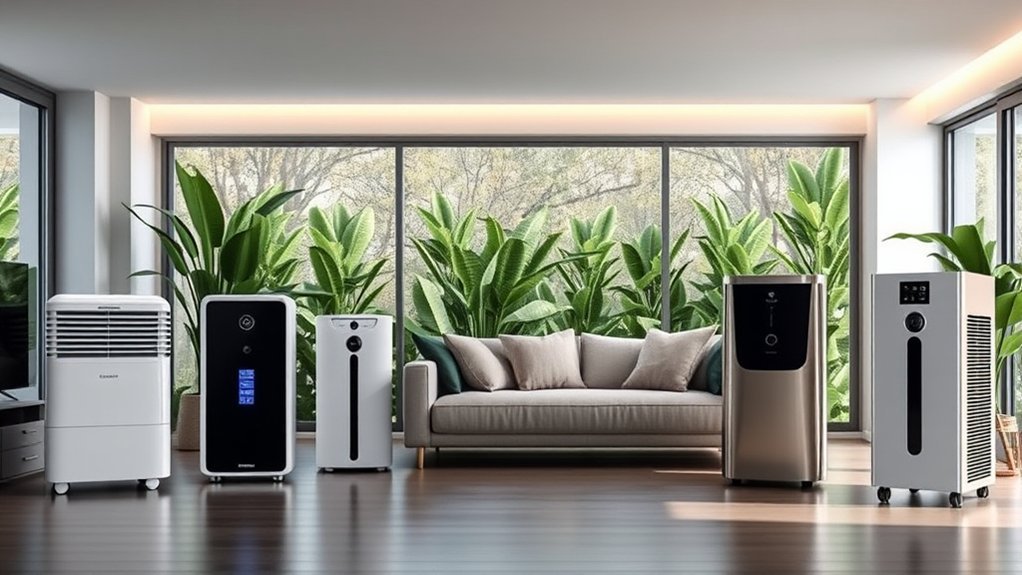
Last updated: August 2026
The best whole house dehumidifier for an HVAC system is not always the model with the biggest advertised pint rating. You need to match moisture-removal capacity, stated coverage, airflow, duct compatibility, drainage, controls, and installation requirements to your home. This guide compares six ductable or whole-home options for 2026, including smart models, fresh-air systems, compact units, and high-capacity choices.
Quick Verdict
Best overall for a large home: AprilAire E100 Bundle. It combines 100-pint capacity, broad stated coverage, ducting flexibility, and useful installation accessories.
Best smart option: AprilAire E070W Bundle. It suits medium-size homes and adds Wi-Fi monitoring plus pump-assisted drainage.
Best for smaller homes: AprilAire E050PZ Bundle. Its 50-pint output and thermostat-based control are a better fit when a larger unit would be unnecessary.
Best fresh-air option: ALORAIR Sentinel WHD 100. It combines an AHAM-rated 90-pint capacity with a fresh-air damper and flexible inlet and outlet orientation.
Best heavy-duty option: Waykar AFD2.5D. Its high advertised capacity and wired controls suit large, damp, or commercial-style spaces, but its capacity is stated at 95°F and 90% RH, so it should not be compared directly with ratings measured under different test conditions.
Important sizing note: Manufacturer coverage figures are useful starting points, not guarantees. Climate, building tightness, ceiling height, crawl-space conditions, ventilation, duct design, and the test conditions used for pint-per-day ratings can all affect real-world performance. A qualified HVAC installer can calculate the moisture load and confirm the correct duct and drain setup.
Key Takeaways
- Compare pint-per-day ratings only when the test conditions are the same.
- Choose a model that supports the duct layout, drainage route, and controls planned for your home.
- Treat seller bundle contents as changeable and verify every included accessory before ordering.
- Use professional sizing and installation for HVAC-connected systems, fresh-air intake, control wiring, or pumped drainage.
Quick Comparison of Whole House Dehumidifiers
| Product | Advertised Capacity | Stated Coverage | Best For | Control / Drainage | Amazon |
|---|---|---|---|---|---|
| ALORAIR Sentinel WHD 100 | 90 PPD at AHAM conditions | Up to 2,300 sq. ft. | Fresh-air and flexible ducting | Built-in controls; gravity drainage | Check Price on Amazon |
| AprilAire E070W Bundle | 70 pints/day | Up to 2,200 sq. ft. | Wi-Fi control | App control; condensate pump bundle | Check Price on Amazon |
| AprilAire E100 Bundle | 100 pints/day | Up to 5,500 sq. ft. | Large homes | Automatic control; continuous drain | Check Price on Amazon |
| AprilAire E050PZ Bundle | 50 pints/day | Up to 1,600 sq. ft. | Smaller homes and tight spaces | Wi-Fi thermostat; pump bundle | Check Price on Amazon |
| Waykar AFD2.5D | Up to 158 pints/day at 95°F, 90% RH | Up to 6,500 sq. ft. | Heavy-duty moisture loads | Wired remote and sensor; gravity drain | Check Price on Amazon |
| AprilAire E080 Bundle | 80 pints/day | Up to 4,400 sq. ft. | Balanced whole-home capacity | Digital control; pump bundle | Check Price on Amazon |
ALORAIR Sentinel WHD 100 Whole House Dehumidifier, 90 PPD
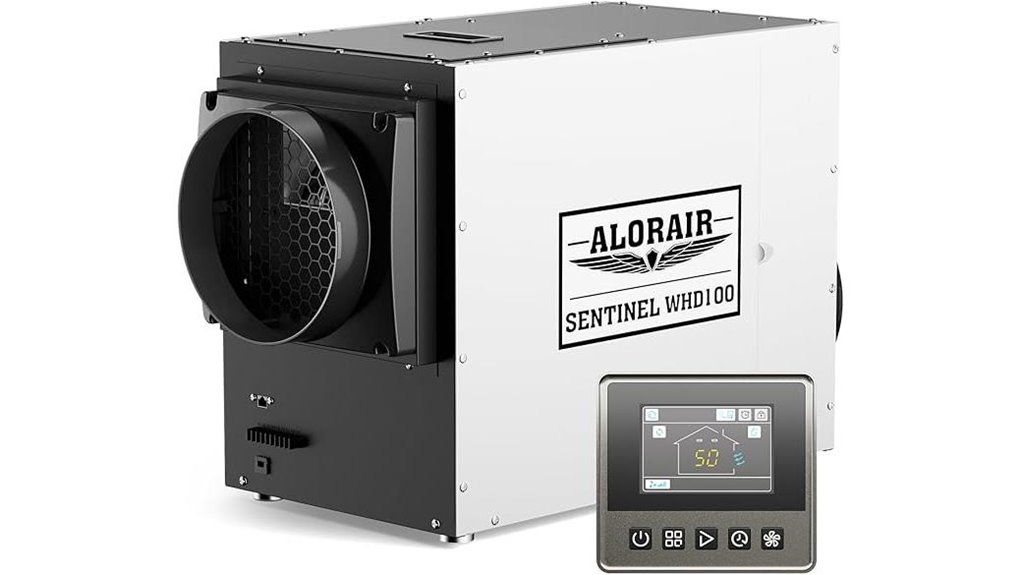
The ALORAIR Sentinel WHD 100 is a whole-house dehumidifier rated at 90 pints per day under AHAM conditions for spaces up to a stated 2,300 sq. ft. It is designed for ducted or standalone use in basements, crawl spaces, garages, storage areas, multi-room homes, and light-commercial settings. Its adjustable inlet and outlet orientation can make it easier to adapt the unit to different layouts.
Why You’ll Like It: The fresh-air damper, two airflow settings, continuous mode, timer, power-failure memory, gravity drainage, and automatic defrost provide useful flexibility for demanding installations.
Best For: Homeowners, property managers, or contractors who want a ductable 90-PPD unit with flexible airflow direction and fresh-air capability.
Who Should Avoid It: Buyers who need a built-in condensate pump or a simple portable unit that can move from room to room.
Pros:
- Direct whole-house and ducted-use positioning aligns well with HVAC moisture-control needs.
- Adjustable air direction, fresh-air damper, two airflow settings, timer, and memory function support flexible installation.
- Gravity drainage and automatic defrost reduce routine hands-on operation.
Cons:
- Gravity drainage requires a suitable downward drain path or a separately selected condensate pump.
- The controls and installation options may be excessive for a small or mildly damp room.
- Energy-cost savings depend on climate, runtime, duct design, and the system it replaces; they are not guaranteed.
AprilAire E070W Smart Wi-Fi Dehumidifier Bundle with Pump
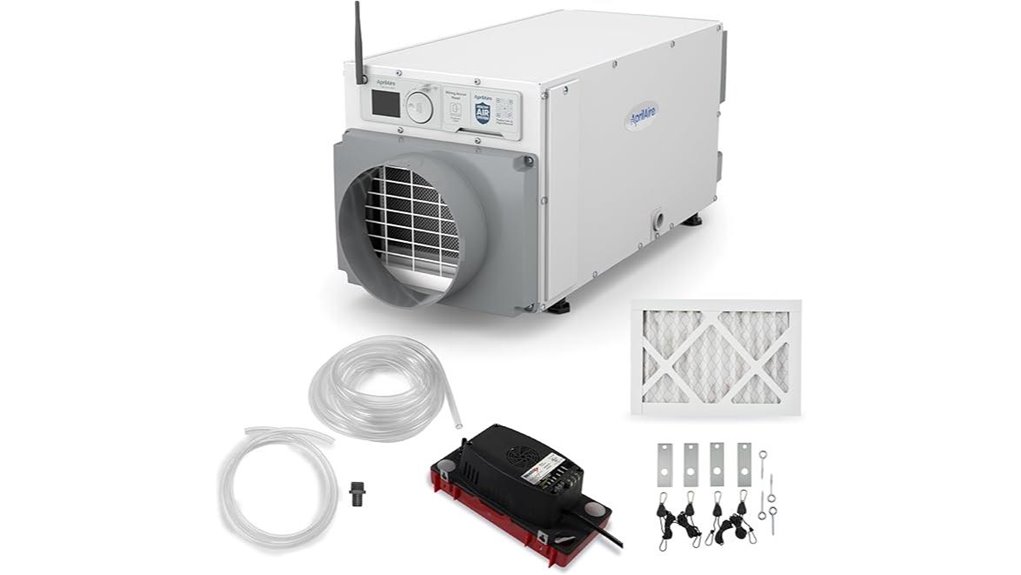
The AprilAire E070W is a 70-pint Wi-Fi dehumidifier for crawl spaces, basements, and whole-home applications up to a stated 2,200 sq. ft. The AprilAire Healthy Air app supports remote monitoring and adjustment, while Bluetooth can simplify initial pairing. The linked Amazon bundle is listed with a condensate pump, which is useful when gravity drainage is not available; confirm the exact included accessories before ordering.
Why You’ll Like It: It offers app-based humidity control, bucketless operation, ducting capability, automatic humidity management, and a lower-profile design than larger whole-house models.
Best For: Smaller-to-medium homes where the equipment will be difficult to access and remote monitoring or pump-assisted drainage will reduce maintenance.
Who Should Avoid It: Buyers who do not want app setup, do not have reliable Wi-Fi near the installation area, or need more than 70 PPD of capacity.
Pros:
- 70-pint capacity and stated coverage up to 2,200 sq. ft. suit many medium-size homes.
- Wi-Fi monitoring and app control make it easier to check humidity without entering a crawl space or utility area.
- The bundle’s condensate pump can move water when a gravity drain is impractical.
Cons:
- The pump and other installation accessories are bundle-specific, so buyers should confirm exactly what the current listing includes.
- Wi-Fi features add setup steps and depend on app and network compatibility.
- Professional duct, electrical, and drain installation may still be needed.
AprilAire E100 100-Pint Whole House Dehumidifier Bundle
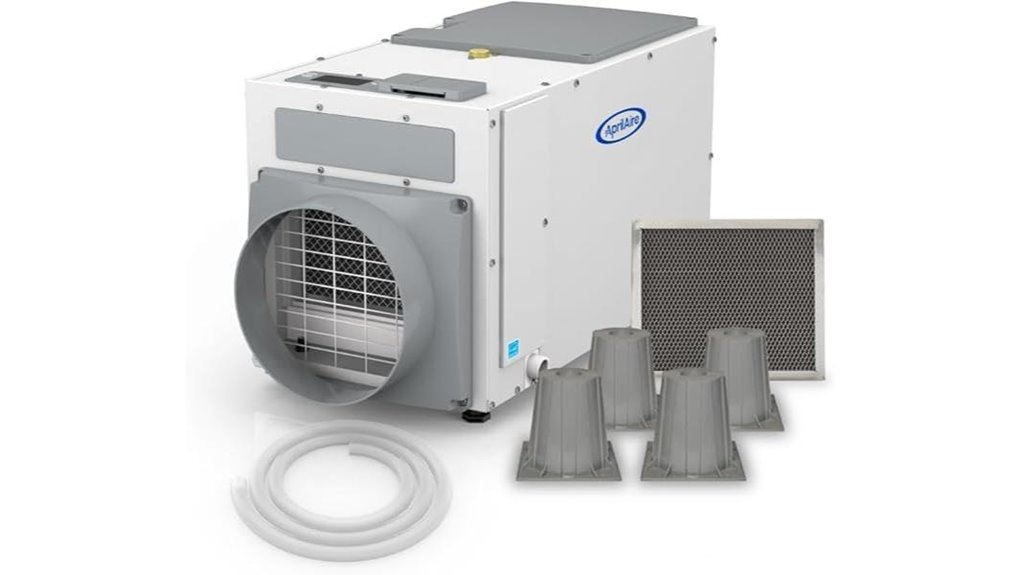
The AprilAire E100 is a 100-pint professional-grade dehumidifier for basements, crawl spaces, and whole-home applications up to a stated 5,500 sq. ft. Its automatic humidity control and broad ducting options make it a strong fit for larger homes that need continuous moisture management rather than room-by-room dehumidification.
Why You’ll Like It: The linked seller bundle is described as including a drain hose, extra filters, duct collars, and risers, which may reduce the number of installation accessories you need to source separately. The unit also uses corrosion-resistant aluminum coils and a bucketless drainage design.
Best For: Large homes, basements, or crawl spaces that need a high-capacity, permanently installed dehumidifier with straightforward continuous drainage.
Who Should Avoid It: Apartments, small homes, or lightly humid spaces where a 100-pint unit would be oversized and unnecessarily expensive to install.
Pros:
- 100-pint daily capacity and stated whole-home coverage up to 5,500 sq. ft.
- Automatic humidity control, corrosion-resistant aluminum coils, and bucketless drainage suit permanent whole-home use.
- Bundle accessories support common ducted and gravity-drain installations.
Cons:
- Correct sizing is essential; an oversized system can add cost without solving duct or moisture-source problems.
- A condensate pump may still be needed if the drain cannot run downhill.
- Bundle names and included accessories vary by seller, so the exact package should be checked before purchase.
AprilAire E050PZ 50-Pint Dehumidifier Bundle with Wi-Fi Thermostat
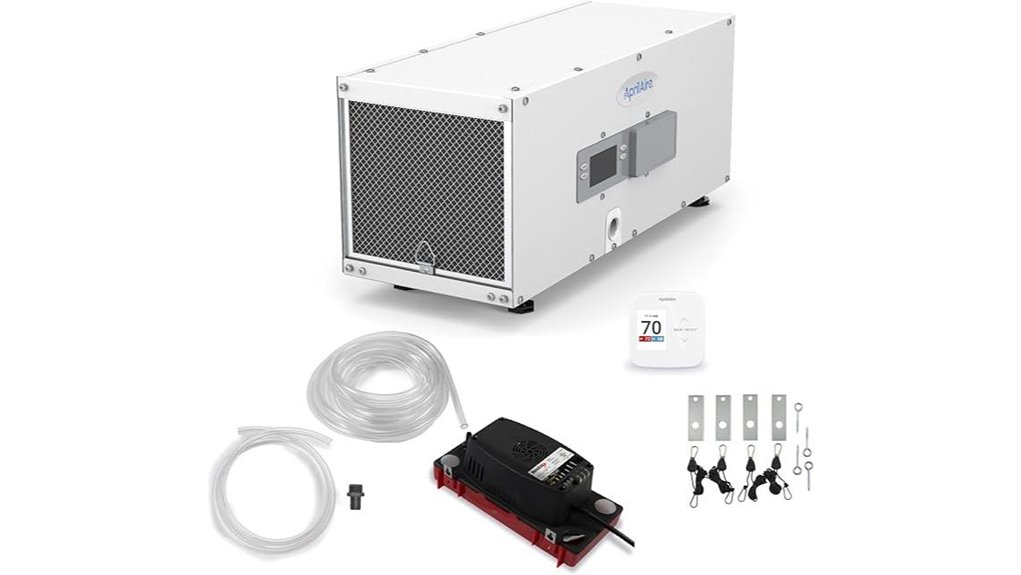
The AprilAire E050PZ bundle pairs a compact 50-pint dehumidifier with stated coverage up to 1,600 sq. ft. and an S86WMUPR Wi-Fi thermostat. It is designed for smaller homes, crawl spaces, basements, and tight mechanical areas where a larger E080 or E100 may be unnecessary.
Why You’ll Like It: The thermostat can coordinate humidity control from the living space, while the bucketless design and bundle pump support continuous drainage. A washable MERV 8 filter helps protect airflow through the unit.
Best For: Smaller homes or compact installations that need whole-home humidity control, remote thermostat access, and pump-assisted drainage.
Who Should Avoid It: Large homes, very wet crawl spaces, or projects where a load calculation shows that 50 PPD is not enough.
Pros:
- Compact 50-pint platform is easier to fit into limited mechanical space.
- Wi-Fi thermostat supports remote scheduling and humidity management.
- The listed bundle combines the dehumidifier, Wi-Fi thermostat, condensate pump, and installation hardware in one package.
Cons:
- Lower capacity may not keep up with severe infiltration, standing-water problems, or large open layouts.
- Thermostat wiring and HVAC integration are more involved than using an onboard control.
- Bundle contents and warranty terms should be verified on the current Amazon listing before purchase.
Waykar AFD2.5D 158-Pint Crawl Space Dehumidifier with Wired Remote
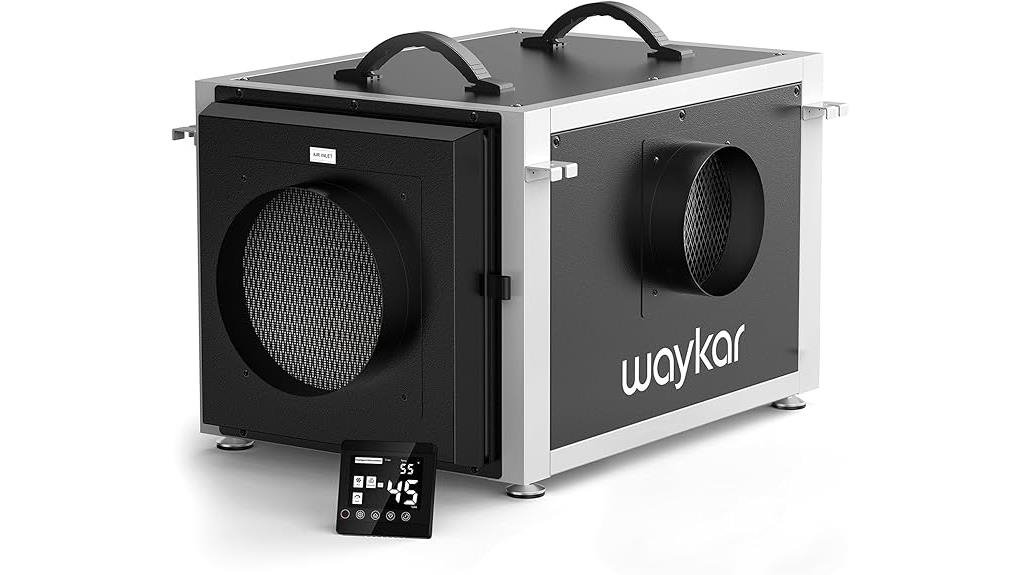
The Waykar AFD2.5D is a high-capacity crawl-space and commercial-style dehumidifier marketed for dual-duct HVAC and whole-house use, with 206 CFM airflow, a separate wired controller, and an external humidity sensor. The manufacturer states up to 158 pints per day and coverage up to 6,500 sq. ft., but the 158-pint figure is measured at 95°F and 90% RH. That hot, very humid test condition makes the number unsuitable for direct comparison with ratings measured at milder AHAM conditions.
Why You’ll Like It: It provides remote access from outside a crawl space, continuous gravity drainage, automatic defrost, restart memory, overload protection, and a 24-hour timer.
Best For: Large crawl spaces, basements, garages, warehouses, utility areas, or HVAC-connected projects with unusually heavy moisture loads.
Who Should Avoid It: Typical small homes or buyers who are choosing solely because 158 appears larger than the other pint ratings.
Pros:
- High advertised moisture-removal capacity for demanding environments.
- Dual-duct connections support directed intake and discharge routing when the installation is properly designed.
- Wired controller and separate sensor allow the unit to stay out of sight while the controls remain accessible.
Cons:
- The capacity test condition is different from many residential ratings, so raw PPD numbers can be misleading.
- At about 76 pounds, it needs secure placement, adequate service clearance, and careful installation.
- Gravity drainage needs a continuous downward path; a pump is required where that is impossible.
AprilAire E080 80-Pint Whole House Dehumidifier Bundle with Pump
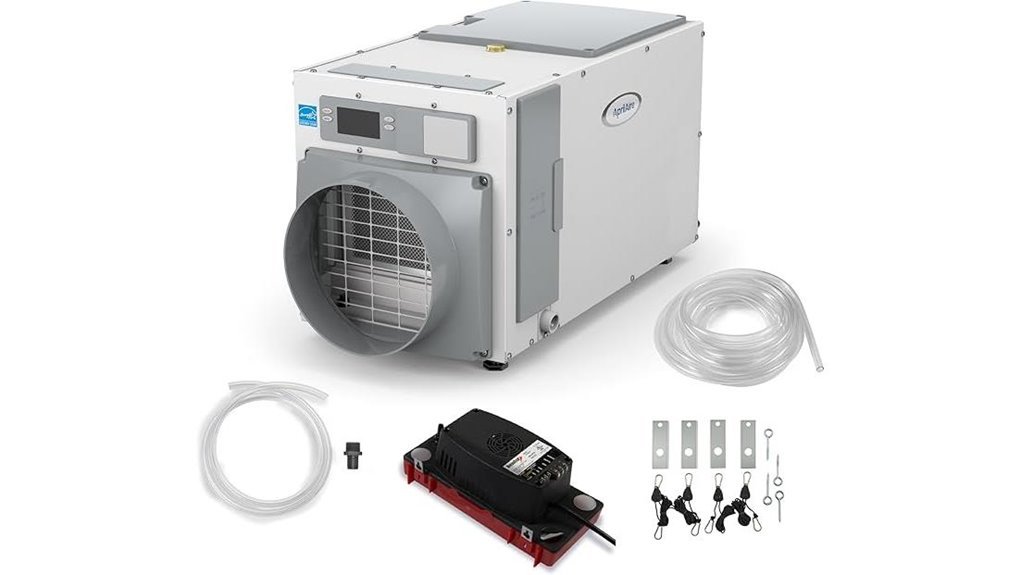
The AprilAire E080 provides 80 pints of daily moisture removal for crawl spaces, basements, and whole-home applications up to a stated 4,400 sq. ft. It sits between the compact E070 platform and the higher-capacity E100, making it a practical middle choice when a load calculation does not justify the larger model.
Why You’ll Like It: The linked Amazon bundle is listed with a pump, hanging kit, tubing, and washable MERV 8 filter; verify the current package contents before ordering. Digital controls, automatic humidity management, duct compatibility, and corrosion-resistant aluminum coils support long-term whole-home use.
Best For: Medium-to-large homes that need more capacity than a 50- or 70-pint model but do not require the E100.
Who Should Avoid It: Small spaces, portable-use buyers, or installations without adequate duct, drain, electrical, and service access.
Pros:
- 80-pint capacity and stated coverage up to 4,400 sq. ft.
- High-efficiency whole-home platform with automatic control and bucketless drainage.
- Bundle accessories can support suspended or pump-assisted installations.
Cons:
- Installation can require duct modifications, condensate safety controls, and professional commissioning.
- The current bundle contents should be checked before purchase because accessories may vary by seller.
- It may be oversized for a smaller or moderately humid home.
Factors to Consider When Choosing a Whole House Dehumidifier for an HVAC System
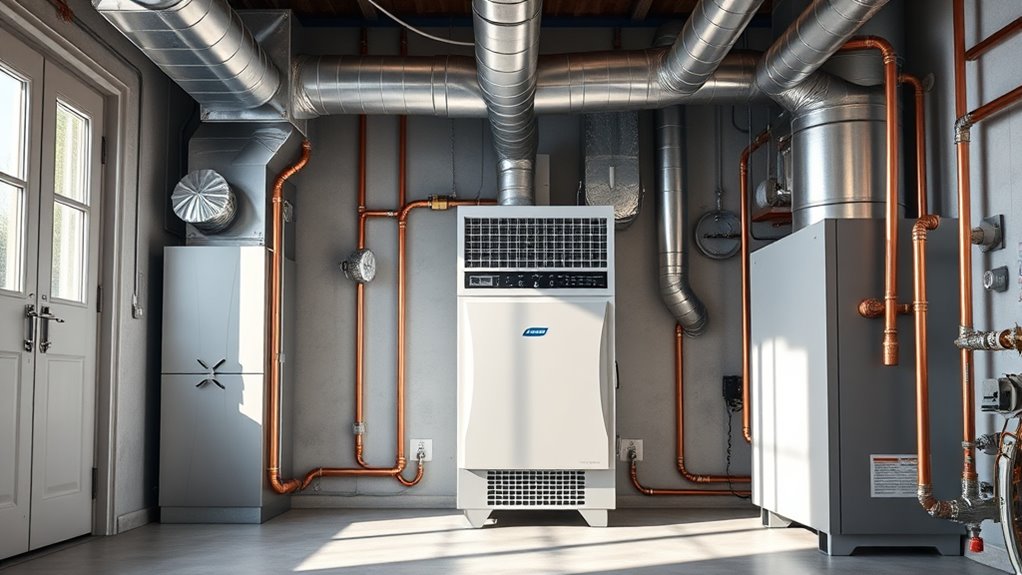
A whole-house dehumidifier must work with the home, duct system, drain path, and control strategy. Use the factors below to narrow the list before comparing seller bundles or accessories.
Compare Moisture-Removal Capacity at the Same Test Conditions
Capacity is usually listed in pints per day, but the number only makes sense when you know the test condition. A rating measured in very hot, very humid air will look much higher than a rating measured under standard residential conditions. Do not assume the Waykar’s 158-pint figure is automatically stronger than a 100-pint residential rating in the same home. Compare published performance at the same temperature and relative humidity, then size for the actual moisture load.
Treat Coverage Area as a Starting Point
Manufacturer coverage figures can help you create a shortlist, but square footage alone does not account for climate, ceiling height, foundation type, air leakage, occupancy, ventilation, or water intrusion. A tightly sealed 3,000-sq.-ft. home may need less capacity than a smaller home with a wet crawl space. Fix leaks, drainage problems, and standing water before expecting a dehumidifier to carry the entire load.
Check HVAC and Duct Compatibility
Confirm whether the unit supports standalone, return-to-return, return-to-supply, or dedicated-duct installation. The correct layout depends on the equipment manual and your HVAC design. Duct diameter, available static pressure, airflow direction, backdraft prevention, service clearance, and blower interaction all matter. Poor duct design can reduce capacity, create noise, or cause unwanted air movement.
Use Fresh-Air Options Carefully
A fresh-air connection can improve controlled ventilation, but it is not automatically beneficial in every climate. Outdoor air may add heat and moisture during humid weather. The intake must be filtered, dampered, sized, and balanced so the dehumidifier and HVAC system can handle the added load. A dedicated ventilating dehumidifier or contractor-designed setup may be preferable when outdoor-air management is a primary goal.
Plan Drainage and Condensate Protection
Whole-house units produce a steady flow of condensate. Gravity drainage is simple when the hose can slope continuously to an approved drain. If the unit sits below the drain point, choose a correctly sized condensate pump. A float switch, drain-pan safety switch, or other shutoff protection can help limit damage if a line blocks or a pump fails. Follow the manufacturer’s instructions for hose slope, traps, pump lift, and freeze protection.
Choose the Right Control Method
Onboard controls are simple, but they may be inconvenient in a crawl space or attic. A wired humidistat, remote sensor, Wi-Fi app, or compatible HVAC thermostat can make the system easier to monitor. Confirm whether the control measures humidity where people live or only at the equipment inlet, and check whether one thermostat can manage multiple indoor-air-quality accessories.
Compare Efficiency Without Assuming Guaranteed Savings
ENERGY STAR recognition can help identify efficient models, but operating cost still depends on runtime, climate, target humidity, airflow, and installation quality. A dehumidifier uses electricity even if it reduces some latent load on the air conditioner. Compare capacity and efficiency at the same test condition, then choose the smallest correctly sized unit rather than the largest model available.
Review Maintenance, Warranty, and Service Access
Check how easily you can reach the filter, coils, drain connection, control panel, and pump after installation. Filter schedules vary by model: some are washable, while others are replaceable. Confirm current warranty coverage, registration requirements, labor exclusions, replacement-part availability, and whether local HVAC technicians can service the brand.
Before You Buy Checklist
- Have the home’s moisture load and target humidity assessed.
- Compare PPD ratings at the same test conditions.
- Confirm duct size, airflow direction, static-pressure limits, and service clearance.
- Choose gravity drainage or a pump with adequate lift.
- Add condensate overflow protection where appropriate.
- Verify electrical requirements and outlet or hardwiring location.
- Check the exact bundle contents, filter type, warranty, and control compatibility.
Frequently Asked Questions
How Often Should Whole House Dehumidifier Filters Be Cleaned or Replaced?
Follow the schedule in the model’s manual. As a practical starting point, inspect the filter monthly after installation so you can see how quickly it loads with dust. Some washable filters may need cleaning only once a year under normal conditions, while dusty crawl spaces, construction debris, pets, or high runtime can require more frequent service. Restricted airflow can reduce performance and increase strain on the equipment.
Can a Whole House Dehumidifier Lower HVAC Energy Bills?
It can improve comfort and may reduce some air-conditioning runtime because drier air often feels more comfortable at a higher thermostat setting. However, the dehumidifier also uses electricity, so lower total bills are not guaranteed. Climate, equipment efficiency, target humidity, duct design, and operating hours determine the result.
Do Whole House Dehumidifiers Need Annual Maintenance?
Yes. Typical maintenance includes cleaning or replacing the filter, checking the drain and pump, inspecting the coils, looking for duct leaks, testing safety controls, and confirming that the humidity reading is reasonable. Follow the manufacturer’s manual and have a qualified technician inspect problems involving refrigerant, electrical components, or persistent drainage faults.
Will a Dehumidifier Work in a Very Cold Basement?
Performance usually falls as temperature drops, and frost can form on the coil. Automatic defrost helps, but it does not eliminate the loss of capacity. Check the model’s minimum operating temperature and consider correcting cold-air leakage, adding safe space conditioning, or using equipment designed for low-temperature applications.
Can Smart Dehumidifiers Integrate With Home Automation Systems?
Some models work through a manufacturer app or a compatible HVAC thermostat, but broad third-party home-automation support varies. Confirm the exact platform, Wi-Fi requirements, account setup, remote-sensor support, and whether the system can be controlled locally if the internet connection fails.
What Humidity Setting Should I Use?
Use the manufacturer’s recommended range and adjust it for comfort, climate, and building conditions. A setting that is too high may leave musty conditions, while an unnecessarily low setting increases runtime. Place or configure the sensor so it represents the living space rather than a damp corner or the unit’s discharge air.
Should a Whole House Dehumidifier Be Professionally Installed?
Professional installation is usually the safest choice when the unit connects to HVAC ductwork, requires control wiring, uses a condensate pump, or needs a dedicated electrical circuit. Correct commissioning helps protect airflow, drainage, noise, efficiency, and warranty compliance.
Conclusion
The best whole house dehumidifier for your HVAC system is the model that matches the home’s real moisture load and installation plan. The AprilAire E100 Bundle is the strongest all-around choice here for a larger home, while the AprilAire E070W Bundle is better for smart monitoring and the AprilAire E050PZ Bundle makes more sense for smaller spaces. The ALORAIR Sentinel WHD 100 is the clearest fresh-air option, while the Waykar AFD2.5D is a specialty heavy-duty choice whose high-capacity number uses a hotter and more humid test condition.
Before buying, verify the current listing, bundle accessories, capacity test condition, duct configuration, drainage route, electrical requirements, filter schedule, and warranty. Correct sizing and installation matter more than choosing the largest advertised pint rating.
Final Recommendation
Choose AprilAire E100 for a large home that needs broad whole-house capacity. Choose AprilAire E070W when Wi-Fi monitoring and pump drainage matter most. Choose AprilAire E050PZ for a smaller home or tight mechanical space. For fresh-air capability or unusual commercial-style loads, compare the ALORAIR and Waykar models with an HVAC contractor before ordering.
Use the Amazon buttons above to verify current specifications, included accessories, warranty terms, and seller details before purchase.