The best dehumidifier for an HVAC or ducted moisture-control project depends on the installation type, not simply the largest advertised pint rating. A true whole-home unit needs approved return-and-supply duct configurations, while a crawl-space or commercial model may provide only a ductable air discharge for one dedicated zone. Continuous drainage, realistic capacity, airflow, operating temperature, service access, and condensate routing all matter.
For most central-HVAC installations, the AprilAire E100 is the best overall choice because it is purpose-built for whole-home ductwork. The VEVOR 125 Pints Commercial Dehumidifier is a flexible ceiling-mount option for a dedicated basement, crawl space, or mechanical zone. The Airzentti 155 Pints Commercial Dehumidifier adds a built-in pump for difficult drain locations, while the ALORAIR Sentinel HD55S is the compact choice for a sealed crawl space that may benefit from a supply-air duct.
Quick Comparison
| Product | Best For | Published Capacity | Drainage | HVAC / Duct Fit | Amazon |
|---|---|---|---|---|---|
| AprilAire E100 | Best overall for central HVAC | 85 PPD under the current DOE listing; up to 100 PPD marketed | Continuous gravity drain; external pump if required | Purpose-built whole-home inlet and outlet duct connections | Check Product Details |
| VEVOR 125 Pints Commercial | Best ceiling-mount dedicated-zone option | 125 PPD at saturation; 60 PPD AHAM | Continuous gravity drain | Ductable outlet and ceiling-mount hardware | Check Current Availability |
| Airzentti 155 Pints Commercial | Best dedicated-zone option with a pump | 155 PPD at saturation; 70 PPD AHAM | Built-in pump or gravity drain | 6-inch ductable air-discharge collar | See Today’s Price |
| ALORAIR Sentinel HD55S | Best compact crawl-space pick | 120 PPD at saturation; 55 PPD AHAM | Continuous gravity drain | Optional supply/outlet duct for a dedicated zone | Check Price on Amazon |
How These Ducted Dehumidifiers Were Selected
This shortlist prioritizes products with a documented whole-home design, approved duct connection, ductable air discharge, or useful dedicated-zone installation feature. Continuous drainage, realistic moisture-removal ratings, airflow, installation flexibility, and service access were also considered. Portable room units without a meaningful duct or mechanical-zone use case were excluded.
The recommendations are based on published manufacturer specifications and installation features. They are not based on claimed hands-on testing. Product listings, included accessories, warranties, and model revisions can change, so confirm the current manual and seller details before ordering.
AprilAire E100 Whole-House Dehumidifier — Best Overall for Central HVAC
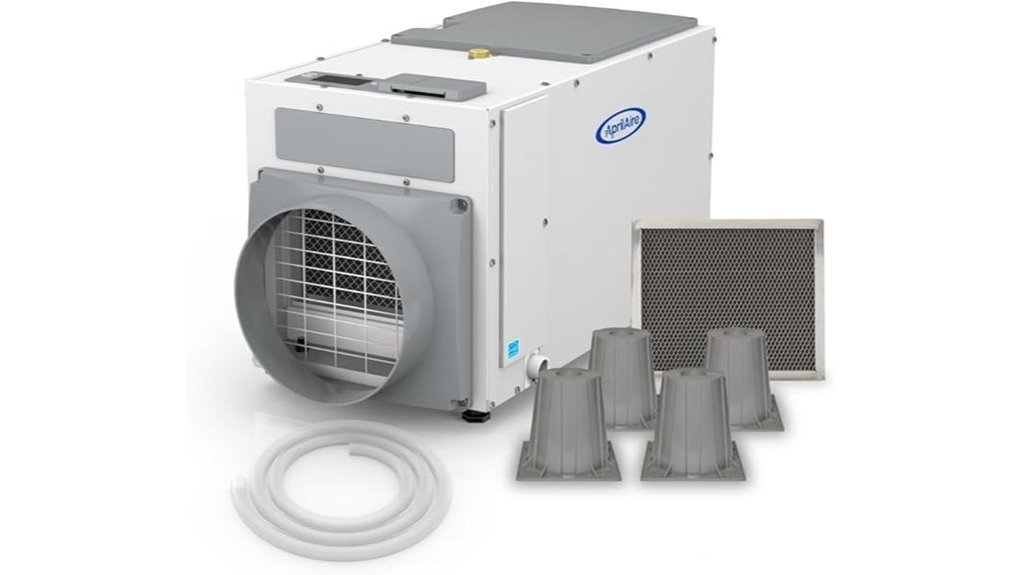
The AprilAire E100 is the strongest match for homeowners who want a dehumidifier designed for a central HVAC or dedicated whole-home duct system. It includes 10-inch inlet and outlet duct collars and can also serve a basement or sealed crawl space. AprilAire markets removal of up to 100 pints per day and coverage up to 5,500 square feet. The current ENERGY STAR product listing reports an 85-pint capacity under the newer DOE test procedure, which is the more useful number for comparison with other current whole-home ratings.
Why You’ll Like It: Unlike a commercial crawl-space unit with only a ductable discharge, the E100 supports approved inlet-and-outlet configurations. Its built-in digital control cycles the unit according to the selected humidity setting, while the washable MERV 8 filter reduces the need for frequent filter purchases.
Best For: Homeowners who want permanent, whole-home humidity control and are prepared to use a qualified HVAC installer.
Who Should Avoid It: Renters, shoppers who need a portable room unit, or homes without enough space for the cabinet, duct clearances, electrical connection, and continuous drain route.
Pros:
- True whole-home design: Includes inlet and outlet collars for approved ducted applications.
- Flexible installation: Supports dedicated ductwork and several central-air layouts when installed according to the manual.
- Continuous drainage: No collection bucket is required when the condensate line is routed correctly.
- Washable filtration: Includes a washable MERV 8 filter.
Cons:
- Professional installation is strongly recommended: Airflow, static pressure, electrical supply, duct placement, and condensate routing affect performance.
- More installation space is required: The cabinet and duct clearances require more planning than a portable dehumidifier.
- Gravity drainage may not suit every location: An external condensate pump may be needed when the available drain is above the unit.
- Amazon bundle details may vary: Confirm the model number, filters, drain accessories, risers, and warranty provider included by the seller.
VEVOR 125 Pints Commercial Dehumidifier — Best Ceiling-Mount Dedicated-Zone Option
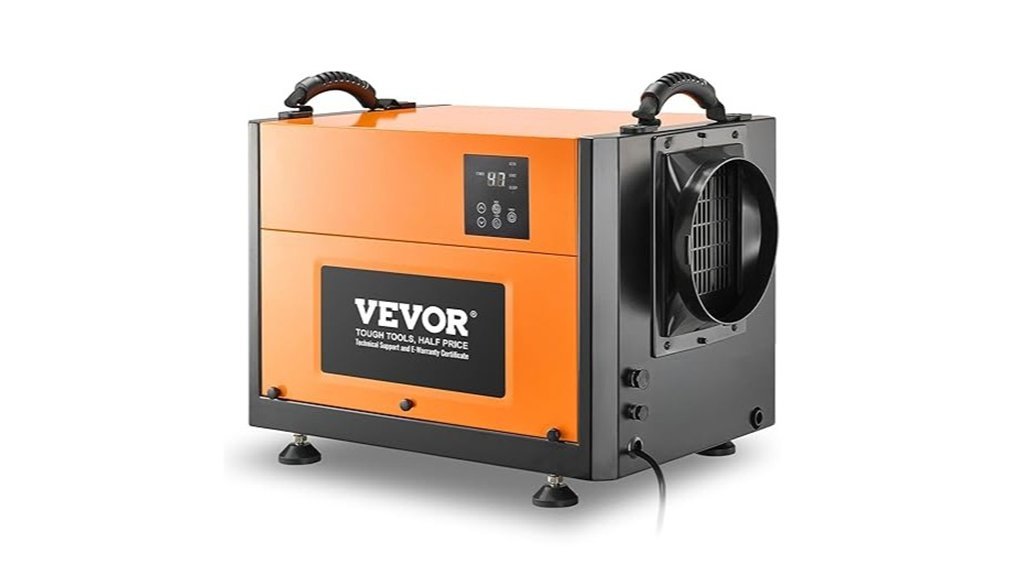
The VEVOR 125 Pints Commercial Dehumidifier is a practical fit for a crawl space, basement, storage area, workshop, or mechanical zone where floor space is limited. VEVOR lists 125 pints per day under saturation conditions, 60 PPD under AHAM conditions, and approximately 210 CFM of airflow for model OL60D-BD063D. The unit can sit on a floor or supported platform, or it can be suspended using the supplied mounting components.
Why You’ll Like It: The ceiling-mount hardware, removable or wall-positioned control arrangement, continuous drainage, operating modes, auto-defrost, and approximately 6.88-inch outlet adapter provide more placement flexibility than a normal portable dehumidifier.
Best For: Buyers who need a compact commercial dehumidifier for one dedicated zone and can provide a structurally safe mounting location, service access, and a nearby downhill drain.
Who Should Avoid It: Anyone expecting a direct whole-home HVAC replacement. The duct adapter is intended for the unit’s air outlet and does not by itself create a conventional return-and-supply central-HVAC system.
Pros:
- Flexible mounting: Can be placed on a floor or suitable platform, or suspended with the specified mounting components.
- Ductable discharge: The outlet adapter accepts user-supplied flexible ducting for targeted dry-air distribution.
- Continuous operation: Gravity drainage avoids carrying and emptying a collection bucket.
- Useful controls: Multiple operating modes, memory, timer functions, and auto-defrost support unattended use.
Cons:
- Saturation capacity can mislead: The 60-pint AHAM figure is the more useful comparison for normal sizing.
- No built-in lift pump: The drain must flow downhill unless a separate condensate pump is installed.
- Not a complete whole-home duct system: It should be treated as a dedicated-zone dehumidifier unless an approved design states otherwise.
- Suspended installation requires structural care: Use suitable supports, vibration control, and the manufacturer’s mounting instructions.
Airzentti 155 Pints Commercial Dehumidifier with Pump and Hose — Best for Pumped Drainage
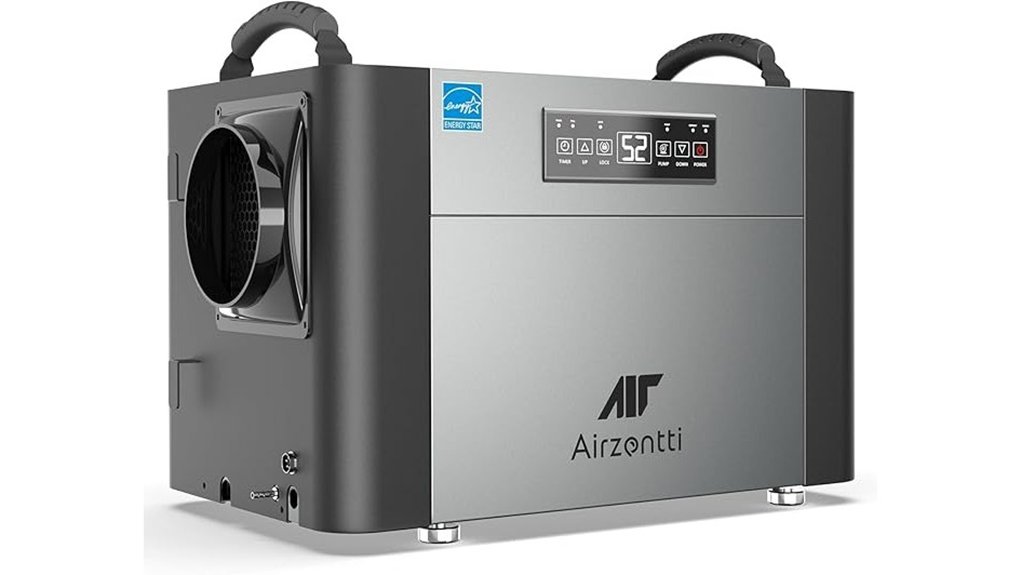
The Airzentti 155 Pints Commercial Dehumidifier is the capacity-focused dedicated-zone option in this group. Its manufacturer lists 155 pints per day in hot saturation conditions, 70 PPD under AHAM conditions, and approximately 220 CFM of airflow. The built-in pump can lift condensate vertically up to 16.4 feet, while a separate gravity-drain connection is available when a lower drain is nearby.
Why You’ll Like It: The combination of a 6-inch ductable air-discharge collar, built-in condensate pump, auto-defrost, timer, humidity control, and screen lock is useful in an attic, crawl space, basement, warehouse, or mechanical area where gravity drainage is difficult.
Best For: Larger dedicated moisture-control zones that need pumped drainage and targeted dry-air distribution through a discharge duct.
Who Should Avoid It: Small homes with modest humidity problems, bedrooms, buyers who lack space for a roughly 60-pound commercial cabinet, or anyone expecting a documented return-and-supply central-HVAC replacement.
Pros:
- Built-in condensate pump: Offers more placement freedom than a gravity-only model.
- Ductable air discharge: The 6-inch collar can direct dry air toward a target area using suitable user-supplied ductwork.
- High published moisture-removal capacity: Suitable for demanding dedicated zones when sized to realistic conditions.
- Automatic operation: Humidity control, timer, auto-defrost, restart memory, and continuous drainage reduce daily attention.
Cons:
- Large coverage claims require caution: Square-foot figures do not account for climate, leakage, ceiling height, open connections, or active water intrusion.
- Heavy cabinet: Moving and positioning the unit may require two people and a secure platform.
- Discharge-only ducting is not full HVAC integration: Obtain professional guidance before connecting it to any shared air-distribution system.
- Certification and warranty details should be checked: Confirm the exact model’s documentation, registration requirements, seller, and included accessories before purchase.
ALORAIR Sentinel HD55S Crawl-Space Dehumidifier — Best Compact Option
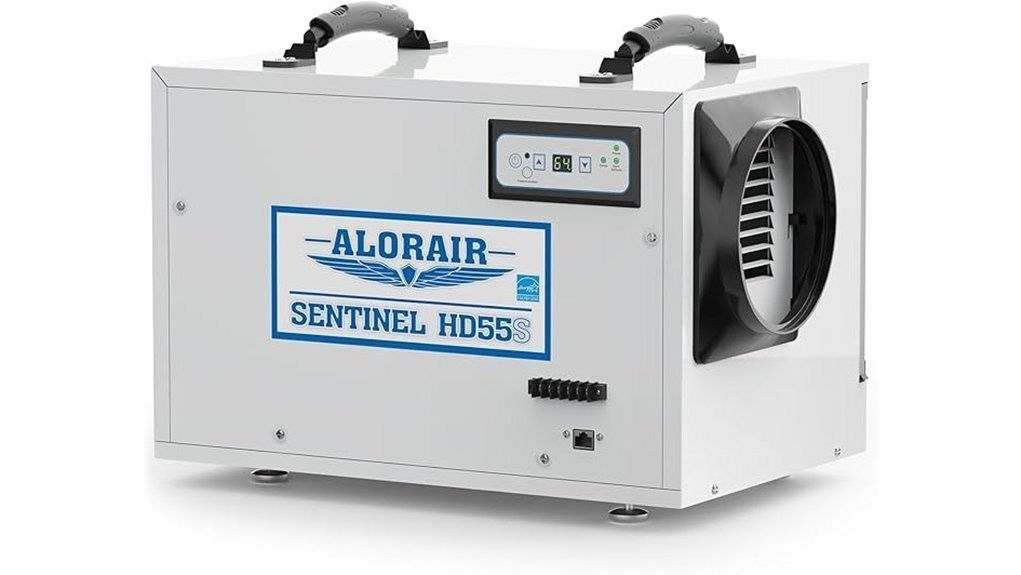
The ALORAIR Sentinel HD55S is a compact crawl-space and basement dehumidifier with a 120-pint saturation rating and a 55-pint AHAM rating. The manufacturer lists approximately 130 CFM of airflow, gravity drainage, automatic defrost, and coverage up to about 1,300 square feet under suitable conditions. A supply-air duct option is also advertised for directing the dry discharge air.
Why You’ll Like It: At about 41.7 pounds and roughly 19.2 by 12.2 by 13.3 inches, it is easier to position in a low crawl space than many whole-home cabinets. Its automatic humidistat, power-loss memory, MERV-1 filter, auto-defrost system, and gravity drainage support unattended moisture control.
Best For: Encapsulated crawl spaces or basements that need a compact, drain-connected dehumidifier and may benefit from directing dry discharge air through a short supply duct.
Who Should Avoid It: Buyers who need a conventional whole-home return-and-supply configuration, a built-in condensate pump, or enough capacity for a much larger moisture load.
Pros:
- Compact form: Fits low-clearance areas where a larger whole-home cabinet may be difficult to place.
- Realistic capacity disclosed: The 55-pint AHAM rating is more useful for comparison than the saturation figure alone.
- Continuous gravity drainage: Avoids carrying and emptying a water bucket.
- Cool-space features: Automatic defrost supports operation in cooler crawl spaces and basements within the approved operating range.
Cons:
- Gravity drain only: A separate condensate pump is needed when water must travel uphill.
- Dedicated-zone design: The advertised supply-duct option should not be confused with a complete whole-home HVAC installation.
- Lower airflow and capacity: It may take longer to control a large or severely damp area than the higher-capacity models.
- Accessories and variants can differ: Confirm whether the duct collar, drain hose, Wi-Fi functions, remote control, and filter type are included with the specific Amazon offer.
Factors to Consider When Choosing a Ducted Dehumidifier
A dehumidifier can operate through a true whole-home duct layout, use dedicated inlet-and-outlet ducts, direct only its dry discharge air through a short duct, or work as a standalone unit beside an HVAC system. Those arrangements are not interchangeable. Use the following checks to match the dehumidifier to the building and installation plan.
Whole-Home vs. Dedicated-Zone Design
A whole-home dehumidifier is purpose-built to draw air through an approved inlet or return duct and deliver dry air through an approved outlet or supply duct. A crawl-space or commercial model may provide only an air-discharge collar. Decide whether you need humidity control throughout the occupied home, only in a crawl space, or in a separate basement, attic, workshop, or mechanical zone.
Compare DOE or AHAM Capacity, Not Just Saturation Pints
Commercial listings often feature a high capacity measured near 90°F and 90% relative humidity. That saturation number can be useful for severe drying conditions, but it is not directly comparable with a rating measured in cooler air. When available, use the current DOE-listed or manufacturer-published AHAM pints per day as the main comparison figure.
Size for Moisture Load, Not Square Footage Alone
Square footage is only a starting point. Climate, outdoor-air infiltration, ceiling height, foundation dampness, ventilation, occupancy, open stairways, crawl-space sealing, and active water intrusion can change the required capacity substantially. A contractor should evaluate the moisture load rather than relying only on the largest advertised coverage number.
Duct Airflow and Static Pressure
Check the manufacturer’s approved duct diameter, maximum duct length, airflow, and permitted installation layouts. Long, undersized, crushed, dirty, or sharply bent ducts reduce airflow and moisture removal. A dehumidifier should not be connected to central ductwork in a way that causes backflow, pressure imbalance, air-handler interference, or uncontrolled air movement when either system is off.
Drainage Options
Gravity drainage is simple and reliable when a floor drain, sump, or other approved termination is lower than the unit. A built-in or separate condensate pump is useful when water must travel upward. Confirm the permitted pump lift, hose length, slope, trap or check-valve requirements, freeze protection, and termination point.
Operating Temperature and Auto-Defrost
Crawl spaces, basements, and attics can move outside a dehumidifier’s approved operating range. Choose a model suited to the expected temperature and verify how its automatic defrost cycle works. Auto-defrost does not make every unit suitable for freezing conditions or every unconditioned attic.
Electrical Requirements
Confirm the voltage, rated current, plug type, outlet location, grounding requirements, and whether the manufacturer requires a dedicated circuit. Do not use an undersized extension cord or install an outlet where it may be exposed to condensate, flooding, or physical damage.
Noise and Placement
Commercial and crawl-space units may transmit more fan and compressor noise than portable bedroom models. Place the cabinet away from sleeping areas where possible, use approved vibration isolation, and avoid attaching a suspended unit to framing that can carry noise throughout the home.
Maintenance and Service Access
Leave enough clearance to remove and clean the filter, inspect the coils, reach the control panel, clear the drain, and service the pump. Keep the inlet and outlet away from stored items, loose insulation, dust, and debris. A difficult-to-service installation is more likely to lose airflow or develop an unnoticed drainage problem.
Fix the Moisture Source
A dehumidifier controls water vapor in the air; it does not repair plumbing leaks, foundation seepage, roof leaks, standing water, missing vapor barriers, or poor exterior drainage. Correct active water problems and seal or encapsulate the space where appropriate before relying on mechanical dehumidification.
Frequently Asked Questions
What Is the Best Dehumidifier for a Central HVAC System?
The AprilAire E100 is the most direct fit in this lineup because it is designed with inlet and outlet collars for approved whole-home configurations. The VEVOR, Airzentti, and ALORAIR models are more appropriate for dedicated zones and should not automatically be treated as central-HVAC replacements.
Can a Dehumidifier Connect Directly to Existing Ductwork?
Only when the manufacturer approves the exact layout. The installer must account for airflow direction, blower operation, static pressure, backdraft prevention, filter access, service clearances, combustion safety, and condensate drainage. A single outlet collar does not prove that a product can be connected anywhere in a central duct system.
What Is the Ideal Humidity Level for My Home?
A practical target is generally 30% to 50% relative humidity. Keeping indoor humidity below 60% can also help limit condensation and conditions that support mold growth. In very cold weather, the target may need to be lowered to prevent condensation on windows, exterior walls, and other cold surfaces. See the EPA’s indoor-humidity guidance.
What Is the Difference Between Saturation, AHAM, and DOE Capacity?
Saturation capacity is measured in hotter, wetter air and normally produces a larger number. AHAM-labelled ratings are commonly published for commercial and crawl-space equipment under specified conditions. Current DOE ratings use a standardized test procedure intended to make consumer comparisons more consistent. Always compare the stated test condition, not only the headline pint number.
Do I Need a Dehumidifier With a Pump?
You need a pump when the condensate outlet is below the available drain or water must travel upward. If a suitable drain is lower than the unit and the hose can maintain a continuous downward slope, gravity drainage is usually simpler and has fewer mechanical parts.
Can I Install a Whole-Home Dehumidifier Myself?
A skilled homeowner may be able to place a standalone crawl-space unit and connect an approved gravity drain. Whole-home duct integration is more complex because poor airflow, incorrect duct placement, pressure imbalance, leaks, or bad condensate routing can reduce performance or damage the building. Professional installation is the safer choice for central-HVAC connections.
Can a Dehumidifier Fix a Wet Crawl Space?
It can reduce airborne humidity, but it cannot correct standing water, plumbing leaks, foundation seepage, poor grading, missing drainage, or an unsealed ground surface. Fix liquid-water sources and complete the required crawl-space sealing or encapsulation work before expecting stable humidity control.
How Do I Maintain My Dehumidifier for Optimal Performance?
Clean or replace the filter on the manufacturer’s schedule, inspect the drain hose and pump, keep the inlet and outlet clear, check for coil frost, and compare the built-in humidity reading with a separate hygrometer. Inspect suspended supports and vibration isolators periodically. Shut off power before internal cleaning or service.
Conclusion
The AprilAire E100 is the best overall choice for homeowners who want a purpose-built whole-home dehumidifier connected through an approved duct configuration. The VEVOR 125 Pints Commercial Dehumidifier is better suited to a ceiling-mounted or floor-mounted dedicated zone, while the Airzentti 155 Pints Commercial Dehumidifier is the stronger option when pumped drainage is essential. For a sealed crawl space with a nearby gravity drain, the compact ALORAIR Sentinel HD55S offers a simpler moisture-control setup.
Before buying, compare capacity ratings measured under similar conditions, confirm whether the product has full inlet-and-outlet ducting or only a discharge collar, plan the condensate route, verify the electrical requirements, and leave enough service clearance. Correct sizing and installation matter more than choosing the largest advertised pints-per-day number.