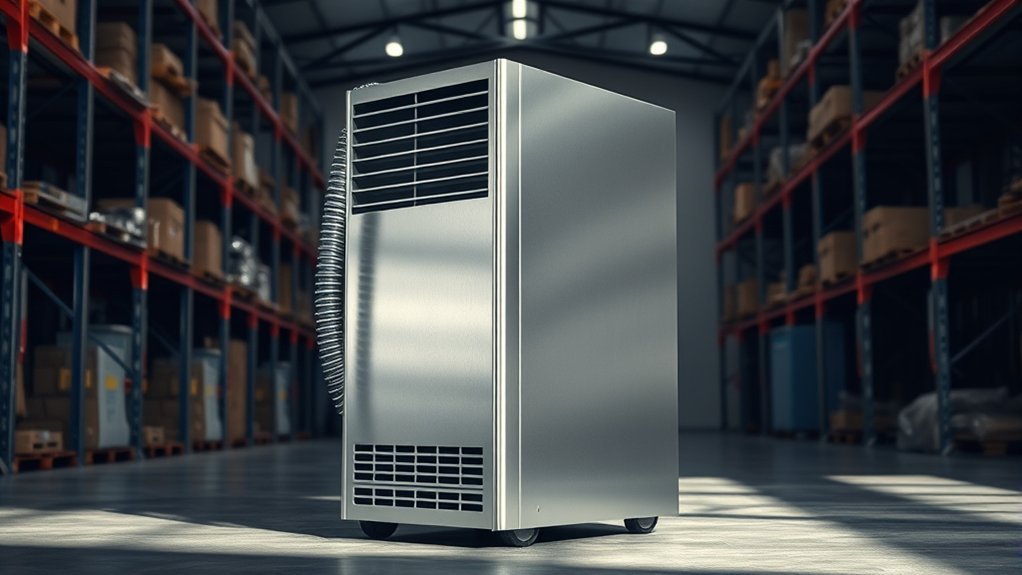
If you are looking for the best dehumidifiers for RVs with drain hoses in 2026, start by matching the appliance to your RV size, moisture level, available power, and drain location. A compact thermoelectric model is usually the easier fit for everyday window condensation, damp towels, and bathroom moisture in a camper or travel trailer. A higher-capacity compressor dehumidifier can make more sense for a large parked motorhome with persistent humidity and dependable shore power.
Every model below supports continuous drainage, but these portable units normally rely on gravity rather than a built-in pump. The hose must run downhill to a suitable drain without kinks. Manufacturer coverage and extraction figures are useful for comparison, although actual RV performance will depend on temperature, relative humidity, ventilation, occupants, cooking, wet gear, air leaks, and the condition of the RV.
Quick verdict
Best overall: The Levoair 68 OZ model offers the most balanced combination of compact dimensions, a 2-liter tank, a verified 5-foot drain hose, and a relatively low 48-watt listed power draw. Choose the ZELUNA when timers and a digital display matter most. Choose the AIUSEVO AS280 for a large parked motorhome or a serious humidity problem, but verify its space, ventilation, and electrical requirements before buying.
How these picks were compared
The products were evaluated by RV suitability, drain-hose support, tank size, listed extraction capacity, electrical demand, dimensions, portability, controls, and honest limitations. Manufacturer and Amazon listing figures are identified as claims rather than independent test results.
Quick Comparison of RV Dehumidifiers With Drain Hoses
| Product | Best For | Type / Listed Power | Tank / Listed Output | Drainage | Main Limitation | Amazon |
|---|---|---|---|---|---|---|
| Levoair 68 OZ | Best overall for most RVs | Thermoelectric / 48 W | 68 oz / 2 L tank; up to 35 oz per day at 86°F and 80% RH | 5 ft hose included | Best for light to moderate moisture | Check Availability |
| AGRUOO 68 OZ | Simple compact setup | Thermoelectric / verify current listing | 68 oz tank; listing claims up to 2 pints per day | Drain hose included | Test conditions for the output claim are not clearly stated | Check Availability |
| LasVacde 95 OZ | Large backup tank and small damp areas | Thermoelectric / listed under 1 kWh per day | 95 oz / 2.8 L tank; up to 280 ml per day | Drain hose included | Modest daily extraction | Check Availability |
| AIUSEVO AS280 | Large motorhomes and heavy humidity | Compressor / 120 W listed draw | 0.52-gallon tank; up to 21 pints per day at 95°F and 90% RH | 3.28 ft hose included | Needs more space, stable placement, and adequate electrical capacity | Check Availability |
| ZELUNA 66 OZ | Timers and digital controls | Thermoelectric / 90 W | 66 oz tank; Amazon page currently shows conflicting daily-output figures | Continuous drain connection | Performance falls in cool or less-humid conditions | Check Availability |
Levoair 68 OZ Dehumidifier With Drain Hose
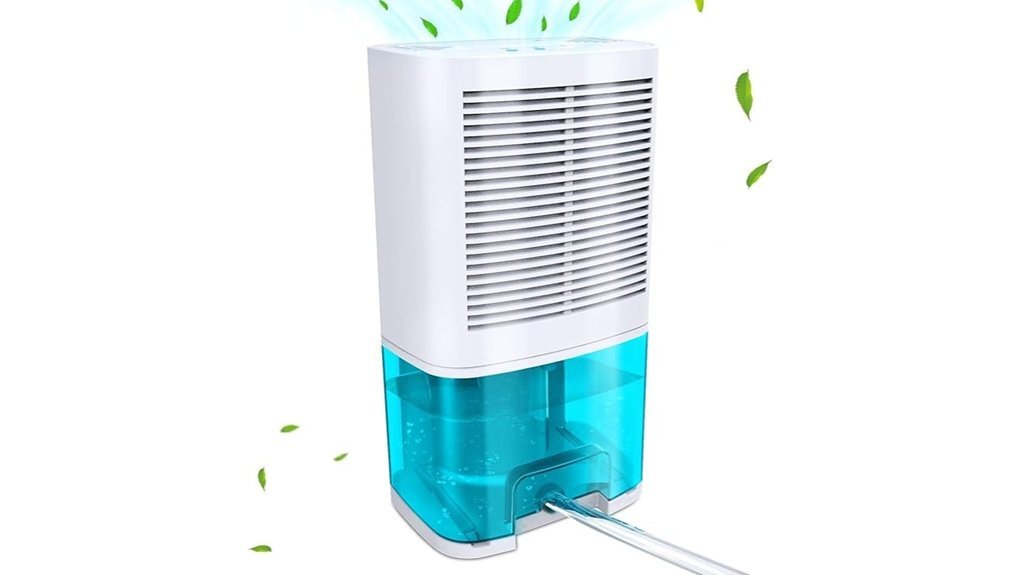
Best Overall
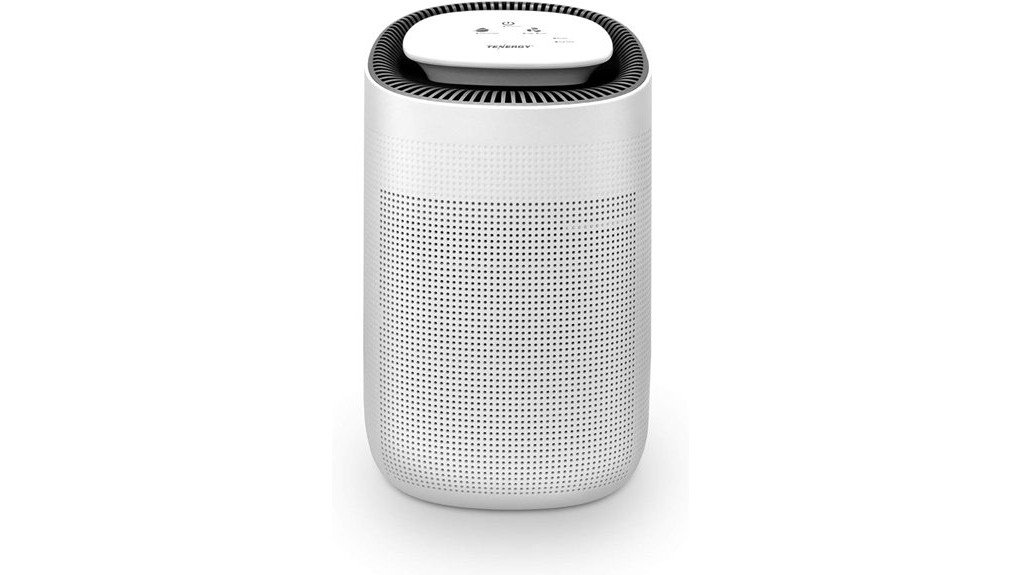
The Levoair 68 OZ dehumidifier offers the strongest overall balance for RV owners who want compact dimensions, a large tank for its class, continuous drainage, and modest listed power demand. It measures approximately 5.4 x 7.9 x 14 inches, weighs about 5 pounds, uses a 2-liter tank, and has a listed draw of 48 watts.
The Amazon listing states that it can collect up to 35 oz, or 1 liter, per day at 86°F and 80% relative humidity. That is a warm, humid test condition, so normal RV extraction may be lower. A verified 5-foot hose supports continuous gravity drainage while the RV is parked, and automatic shutoff helps prevent overflow when the tank is used.
Best For: Most campers and travel trailers dealing with light to moderate condensation in warm, humid weather.
Why You’ll Like It:
- The narrow footprint fits more easily into confined RV layouts.
- The 5-foot hose offers more routing flexibility than the shorter hoses included with some alternatives.
- The 48-watt listed draw is easier to plan around than the demand of a compressor model.
- The lightweight body is easy to relocate between the bathroom, bedroom, and living area.
Who Should Avoid It:
- Owners dealing with an active leak, saturated flooring, or widespread moisture damage.
- People expecting a mini thermoelectric unit to match compressor-level drying speed.
- Anyone without a drain point below the appliance when using the hose.
AGRUOO 68 OZ Small Dehumidifier With Drain Hose
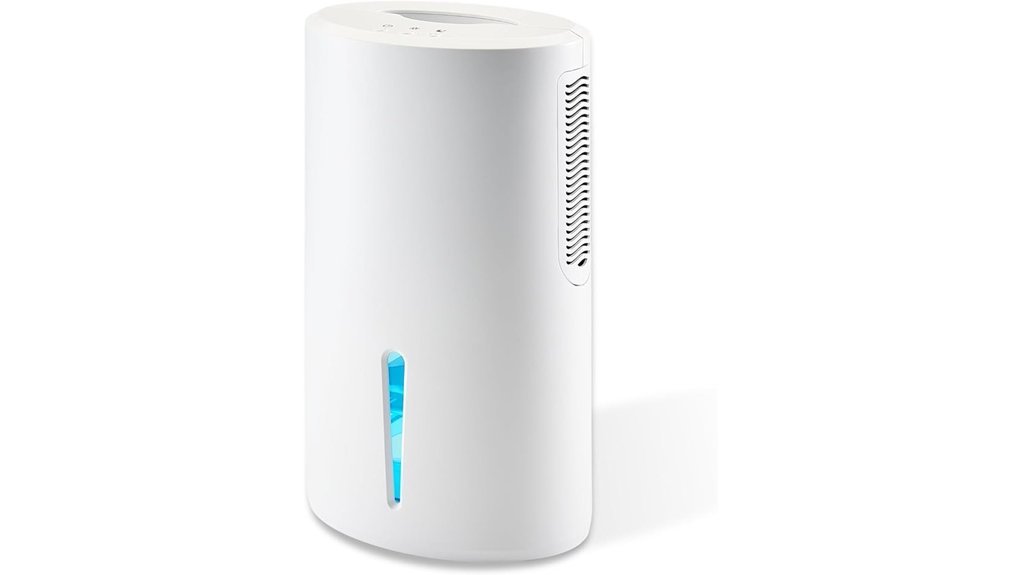
Best Simple Setup
The AGRUOO small dehumidifier is designed for compact areas such as RV sleeping spaces, bathrooms, closets, and storage compartments. Its approximately 6 x 8 x 13-inch body is easier to place than a full-size compressor unit, while the 68 oz water tank reduces how often you need to empty it when the drain hose is not connected.
The current Amazon product information lists continuous drainage, automatic shutoff, two operating speeds, sleep mode, and seven-color ambient lighting. It also lists up to 2 pints of moisture removal per day, but the test temperature and relative humidity are not clearly stated in the product information. Treat that figure and the 1,000-square-foot marketing label as comparison claims rather than guaranteed RV performance.
Best For: RV owners who want a straightforward, portable unit for light everyday condensation.
Why You’ll Like It:
- The compact footprint is easier to fit on an RV counter, shelf, or bathroom floor.
- The included drain hose supports longer stationary use.
- Sleep mode and two speeds provide more control over nighttime operation.
Who Should Avoid It:
- Buyers who need independently verified extraction performance.
- Owners dealing with major water intrusion or persistently saturated materials.
- Travelers who cannot secure and store the appliance before moving the RV.
LasVacde 95 OZ Dehumidifier With Drain Hose
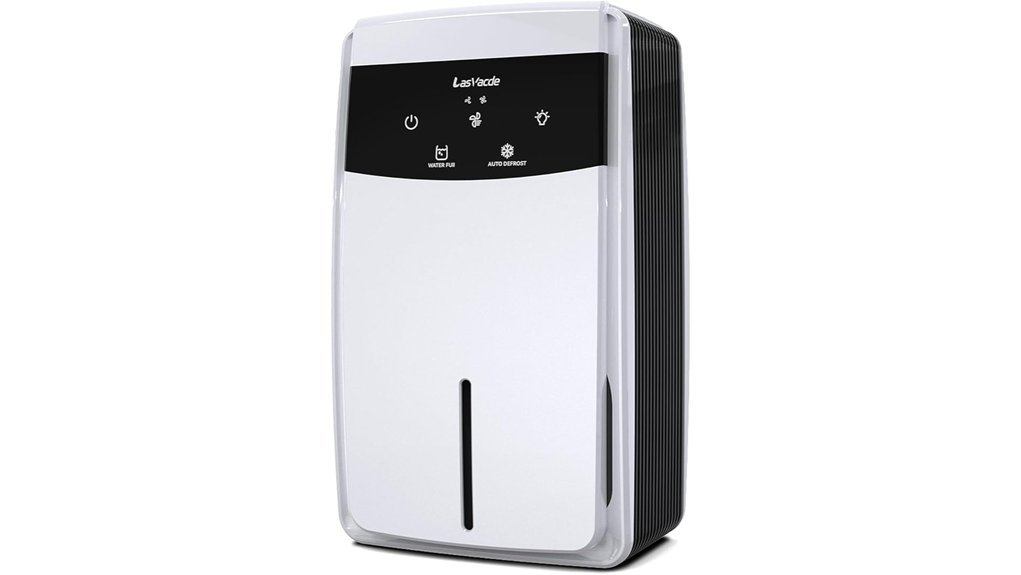
Best Large Tank
The LasVacde dehumidifier stands out for its 95 oz, or 2.8-liter, water tank. It measures approximately 8.27 x 5.91 x 13.94 inches and weighs about 4.9 pounds, so it remains portable enough for many RV bathrooms and living areas.
The Amazon listing states that it can remove up to 280 ml of water per day in an area up to 200 square feet, with power consumption of no more than 1 kWh per day under the seller’s assumptions. That modest extraction rate is better suited to a small damp zone and routine condensation than severe humidity. The included drain hose gives you the option of continuous gravity drainage when a suitable lower drain point is available.
Best For: RV bathrooms, small campers, and buyers who want a large collection tank as a backup to hose drainage.
Why You’ll Like It:
- The 2.8-liter tank can reduce manual-emptying frequency.
- The drain hose is included for continuous operation.
- Automatic shutoff and automatic defrost add practical protection.
- The built-in handle makes it easier to move between small RV zones.
Who Should Avoid It:
- Owners who need fast whole-RV drying.
- Buyers expecting the performance of a 20-pint-class compressor model.
- Anyone who cannot provide a steady downhill route for the drain hose.
AIUSEVO AS280 21-Pint Dehumidifier With Intelligent Humidity Control
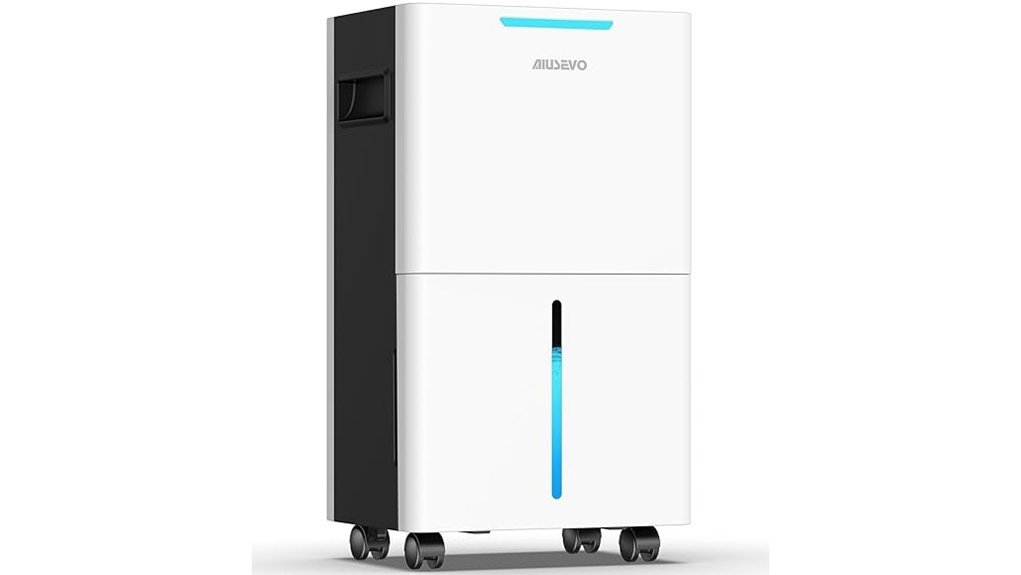
Best for Large Motorhomes
The AIUSEVO AS280 compressor dehumidifier is the strongest option in the group for a large motorhome, a parked RV in a very humid climate, or a rig recovering from substantial condensation after the moisture source has been corrected. It measures approximately 9.65 x 6.89 x 15.94 inches, weighs about 15.3 pounds, and has a listed power draw of 120 watts.
The manufacturer’s 21-pint-per-day figure is measured at 95°F and 90% relative humidity. Actual extraction will normally be lower in cooler or drier conditions. Its 1,500-square-foot coverage label also does not mean that every RV needs this much capacity.
The internal tank holds approximately 0.52 gallons. For extended use, the included 3.28-foot drain hose is the more convenient choice, provided the hose can maintain a downward slope. The unit also lists adjustable humidity control, a digital display, two fan speeds, a 24-hour timer, automatic shutoff, automatic restart, automatic defrost, and dehumidify, dry, and continuous modes.
Best For: Large motorhomes, parked RVs with shore power, and persistent high-humidity conditions.
Why You’ll Like It:
- Higher moisture-removal capacity than the compact thermoelectric models.
- Adjustable humidity control can cycle the unit based on the selected setting.
- Automatic defrost makes it more suitable for varying indoor temperatures.
- The 120-watt listed running draw is easier to evaluate than an unspecified electrical claim.
Who Should Avoid It:
- Owners of very small campers with limited floor or storage space.
- Travelers who depend on a low-capacity battery or inverter system.
- Anyone who only needs mild condensation control near a window or bathroom.
ZELUNA 66 OZ Mini Dehumidifier With Drain Hose
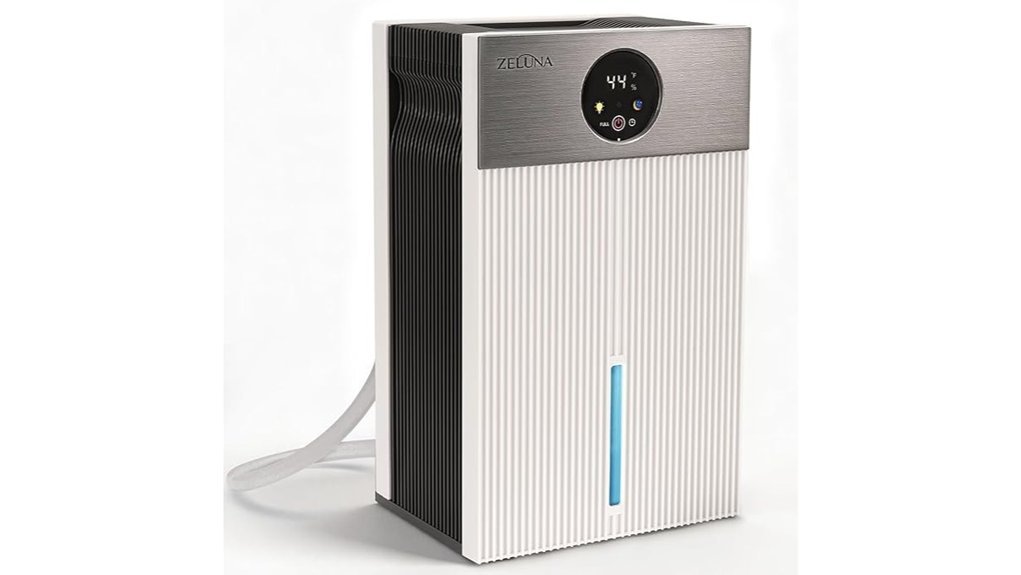
Best Controls
The ZELUNA combines a compact body with a digital humidity display, sleep mode, continuous drainage, and selectable 3, 6, 9, or 12-hour timers. It measures approximately 5.5 x 7.5 x 12.2 inches, weighs about 4.4 pounds, uses a 66 oz water tank, and has a listed power draw of 90 watts.
The current Amazon page contains an important specification inconsistency: the marketing copy says up to 30 oz of moisture per day at 86°F and 80% relative humidity, while the product-information table lists 0.7 liter per day, which is about 23.7 oz. The same page states approximately 0.96 kWh of daily energy use under the seller’s assumptions. Use these figures only as approximate listing claims and confirm the current specifications before ordering.
Best For: RV owners who value timers, a humidity display, sleep mode, and compact dimensions.
Why You’ll Like It:
- The digital display makes it easier to monitor changing humidity.
- Multiple timer settings provide more control over operating periods.
- The drain connection allows continuous drainage while the RV is parked.
- The compact footprint is easier to place than a compressor dehumidifier.
Who Should Avoid It:
- Buyers who need a single, clearly consistent published extraction figure.
- Owners dealing with heavy water intrusion or saturated materials.
- Anyone expecting strong performance in a cold, lightly humid RV.
Factors to Consider When Choosing a Dehumidifier for an RV With a Drain Hose
Choosing an RV dehumidifier involves more than comparing advertised square-foot coverage. Your available space, electrical system, typical temperature, moisture source, drain location, and travel routine all affect which model will work best.
Target Humidity and Moisture Monitoring
A small digital hygrometer can help you judge whether the dehumidifier is solving the problem. A practical indoor target is generally 30% to 50% relative humidity, while consistently staying below 60% helps reduce conditions that support mold growth. Avoid making the RV excessively dry, and watch for continued condensation on windows, walls, pipes, and cold surfaces.
Size and Installation Space
Measure the intended installation area before ordering. Leave enough clearance around the air intake and exhaust, and make sure doors, drawers, shower curtains, bedding, and stored gear will not block airflow. A lightweight mini model is easier to move, while a compressor unit requires a more stable location.
Do not leave a portable dehumidifier unsecured while driving. Store it safely or use a fixed installation approved for the appliance and RV.
Extraction Capacity and Test Conditions
Daily moisture-removal claims are measured under specified or seller-selected temperature and relative-humidity conditions. A unit advertised at 30 oz or 21 pints per day may remove much less water in a cool RV or when the air is only moderately humid. Compare the test conditions, not just the headline number.
For mild window condensation, damp towels, or bathroom moisture, a compact thermoelectric unit may be enough. Persistent wall condensation, wet flooring, or moisture throughout a large motorhome may justify a compressor model after any leaks have been repaired.
RV Power Requirements
Check the product’s current wattage, startup demand, voltage, and plug requirements before connecting it to an RV electrical system. Compare those figures with the outlet circuit, inverter, battery bank, generator, and shore-power connection.
A lower-wattage mini unit is generally easier to run for long periods, but lower electrical demand often comes with lower extraction capacity. A compressor model can remove more moisture but may not be appropriate for limited off-grid power. Do not call a model energy-efficient based on wattage alone; true efficiency also depends on how much water it removes per unit of electricity.
Drainage Options and Hose Routing
Continuous drainage on these models normally relies on gravity. Place the hose outlet below the dehumidifier’s drain connection and keep the hose running steadily downhill. Avoid loops, sharp bends, pinched sections, and an outlet submerged in standing water.
Possible RV drain destinations may include an appropriate shower drain, sink drain arrangement, or dedicated condensate outlet. Do not create an unsealed opening that could allow pests, exhaust, road spray, odors, or outside air into the RV. Follow the RV and appliance manuals before altering plumbing or cabinetry.
Noise Near Sleeping Areas
Thermoelectric dehumidifiers usually use small fans and are often better suited to sleeping areas than compressor models. However, manufacturer noise figures can be measured differently. Look beyond the decibel claim and consider fan tone, vibration, compressor cycling, startup noise, and the unit’s distance from the bed.
Placing the appliance on a level, stable surface can reduce vibration. Do not place it on bedding, soft carpet that blocks airflow, or an unstable shelf.
Humidity Controls, Timers, and Sleep Modes
A basic unit may offer only normal and sleep settings. More advanced models can include a digital humidity display, adjustable targets, timers, automatic cycling, dry modes, and continuous operation.
Choose features that solve a real RV problem. A humidity-controlled compressor model can be useful in a large parked motorhome, while a timer and sleep mode may be more valuable in a small camper.
Cold-Weather Performance
Compact thermoelectric models usually remove less moisture as temperature and humidity fall. Compressor models can also develop frost, which is why automatic defrost is useful. Check the manufacturer’s operating-temperature range before using any dehumidifier in an unheated RV during winter storage.
Travel, Stability, and Durability
Inspect the tank, drain cap, hose connection, handle, power cord, and base before each trip. Empty the tank and disconnect or secure the hose before moving the RV. Water left in a tank can spill during braking, cornering, or road vibration.
Maintenance and Moisture Sources
Clean the air inlet, filter if fitted, tank, and hose according to the manual. Restricted airflow reduces performance, while residue inside a hose can eventually slow or block drainage.
A dehumidifier manages airborne moisture but does not repair a leaking roof, window seal, plumbing connection, air conditioner, refrigerator drain, or damaged wall. Find and repair the water source before relying on continuous dehumidification. Wet materials may also need direct drying, cleaning, or replacement.
Before You Buy: RV Dehumidifier Checklist
- Measure the available installation and storage space.
- Confirm the appliance voltage, wattage, and any compressor startup demand.
- Check your shore-power, generator, inverter, battery, and circuit limits.
- Choose a drain point below the hose connection.
- Confirm the hose can run downhill without loops or kinks.
- Review the manufacturer’s operating-temperature range.
- Decide whether you need light condensation control or heavy-duty drying.
- Use a hygrometer to monitor the actual humidity level.
- Plan how the unit, tank, cord, and hose will be stored before travel.
- Verify current warranty terms, output claims, and included accessories on Amazon.
Frequently Asked Questions
How Often Should I Empty the Dehumidifier’s Water Tank?
Empty it whenever the full-tank indicator appears or before moving the RV. The interval could range from several hours to several days depending on tank size, temperature, humidity, and extraction rate. With continuous drainage, inspect the tank, connection, and hose regularly even when little water is collecting in the tank.
How Should I Route a Dehumidifier Drain Hose in an RV?
Keep the entire hose below the appliance’s drain outlet and maintain a steady downward slope. Avoid kinks, loops, sagging sections, and submerged hose ends. Test the setup for leaks and free flow before leaving the unit to run for an extended period.
Can I Run an RV Dehumidifier Overnight?
Many models are designed for extended indoor operation, but follow the product manual. Keep the appliance on a stable surface, maintain ventilation clearance, secure the hose, use a suitable electrical circuit, and make sure automatic shutoff works if you are collecting water in the tank.
Can I Use a Dehumidifier in Winter?
Yes, if the temperature remains within the manufacturer’s operating range. Small thermoelectric models may collect very little water in cold conditions. A compressor model with automatic defrost may handle cooler conditions better, but it still has a minimum operating temperature.
Should I Choose a Mini or Compressor Dehumidifier for My RV?
Choose a mini thermoelectric unit for light condensation, a compact installation, quieter fan-based operation, and lower electrical demand. Consider a compressor unit for a large motorhome, persistent high humidity, or faster drying when adequate space, ventilation, and shore power are available.
Will a Dehumidifier Stop RV Mold?
Lower humidity can make mold growth less likely, but a dehumidifier does not remove existing mold or repair wet building materials. Fix leaks, dry affected materials promptly, clean contamination safely, and seek professional help when damage is extensive or contaminated water is involved.
Can I Run the Dehumidifier While Driving?
A portable household dehumidifier is generally safest when the RV is parked and the appliance is stable. Before travel, empty the tank and secure the unit, cord, and hose. Only operate it while moving if the manufacturer explicitly permits that use and the installation is designed and secured for travel.
Are RV Dehumidifiers Energy-Efficient?
Efficiency varies by technology and operating conditions. Mini thermoelectric models tend to draw less power but also remove less water. Compressor models use more electricity but can remove substantially more moisture. Compare wattage, extraction capacity, and stated test conditions rather than relying only on a room-size claim.
Final Recommendation
Choose the Levoair 68 OZ model for the best overall balance of compact dimensions, a 2-liter tank, a 5-foot drain hose, and a 48-watt listed draw in most campers and travel trailers.
Choose the AGRUOO 68 OZ model for a simple compact setup with two speeds, sleep mode, and an included drain hose, while treating its coverage and output figures as seller claims.
Choose the LasVacde 95 OZ model when you want a large backup tank for a small bathroom or enclosed RV area and do not need fast extraction.
Choose the ZELUNA 66 OZ model when timers, sleep mode, and a digital humidity display are priorities, but verify its currently inconsistent output specifications.
Choose the AIUSEVO AS280 for a large parked motorhome or serious humidity, but verify its installation space, 120-watt listed draw, startup demand, and circuit capacity first.
The best RV dehumidifier is not necessarily the model with the largest advertised coverage. Match the appliance to your measured humidity, moisture source, available power, installation space, and drain location. A properly routed hose can reduce tank maintenance, but it still needs regular inspection. Most importantly, repair active leaks rather than using a dehumidifier to hide the underlying problem.