Choosing the best commercial dehumidifiers with drain hoses in 2026 comes down to three critical factors: true moisture removal capacity (measured in pints per day, or PPD), whether your layout requires a built-in condensate pump or a simple gravity drain hose, and the physical form factor your space demands. A low-clearance crawl space, a flooded job site, and an open warehouse all need different airflow patterns and drainage setups to run continuously without constant bucket emptying.
This guide compares 10 high-capacity dehumidifiers—ranging from roto-molded water damage restoration machines and compact horizontal crawl space units to Energy Star large-room models—so you can match the right drainage style, coverage rating, and electrical draw to your space.
Quick Verdict
Best Heavy-Duty Restoration Pick: Mounto 268 Pints Compact Dehumidifier with Pump — Highest moisture extraction (268 PPD saturation) with rugged roto-molded housing and a built-in pump for job sites.
Best Large-Space Pump Option: Waykar 155 Pints Commercial Dehumidifier with Pump — Strong airflow and a 16.4 ft vertical pump lift for warehouses, workshops, and large basements.
Best Energy-Conscious Large-Room Option: Waykar 150 Pints Energy Star Dehumidifier with Pump — Combines Energy Star efficiency with dual pump and gravity drainage.
Best Crawl Space Option with Pump: BaseAire Crawlspace Dehumidifier with Pump (70 PPD) — Low-profile horizontal housing backed by a built-in condensate pump and a 5-year limited warranty.
Affiliate Disclosure: As an Amazon Associate I earn from qualifying purchases. This article contains affiliate links, meaning if you buy through these links, the site may earn a commission at no extra cost to you.
Quick Comparison Table
| Product | Best For | Stated Capacity (Max) | Drainage Type | Amazon |
|---|---|---|---|---|
| Mounto 268 Pints Compact Dehumidifier with Pump | Flood restoration & construction sites | 268 PPD | Built-in condensate pump & hose | Check Price on Amazon |
| CADPXS 80 Pint Crawl Space Dehumidifier | Crawl spaces with floor drains or sump pits | 80 PPD | 6.56 ft gravity drain hose (no pump) | Check Price on Amazon |
| DECIUU Max 100 Pint Dehumidifier with Pump | Large basements & open rooms (up to 5,000 sq. ft.) | 100 PPD | Built-in pump (16.4 ft lift) & gravity hose | Check Price on Amazon |
| Waykar 150 Pints Energy Star Dehumidifier with Pump | Energy-conscious basements & commercial rooms | 150 PPD | Built-in pump & gravity drain hose | Check Price on Amazon |
| MOUNTO 150 Pint Commercial Dehumidifier with Pump | Contractors, basements & drying jobs (up to 2,500 sq. ft.) | 150 PPD | Built-in condensate pump & hose | Check Price on Amazon |
| Waykar 155 Pints Commercial Dehumidifier with Pump | Warehouses, workshops & large damp spaces | 155 PPD | Built-in pump (16.4 ft lift) & gravity hose | Check Price on Amazon |
| ARGENDON Commercial Dehumidifier for Crawlspace | Crawl spaces & industrial moisture control (1,500 sq. ft.) | 145 PPD | Continuous gravity drain hose (no pump) | Check Price on Amazon |
| AEOCKY 74 Pint Energy Star Dehumidifier | Quiet, energy-efficient residential & office rooms | 74 PPD | Gravity drain hose outlet & bucket (no pump) | Check Price on Amazon |
| BaseAire Crawlspace Dehumidifier with Pump | Confined crawl spaces & low-clearance basements | 70 PPD | Built-in condensate pump & hose | Check Price on Amazon |
| HBN 125 Pints Crawl Space Dehumidifier with Pump | Large crawl spaces & commercial basements | 125 PPD | Built-in pump (16.4 ft lift) & 6.6 ft gravity hose | Check Price on Amazon |
1. Mounto 268 Pints Compact Dehumidifier with Pump
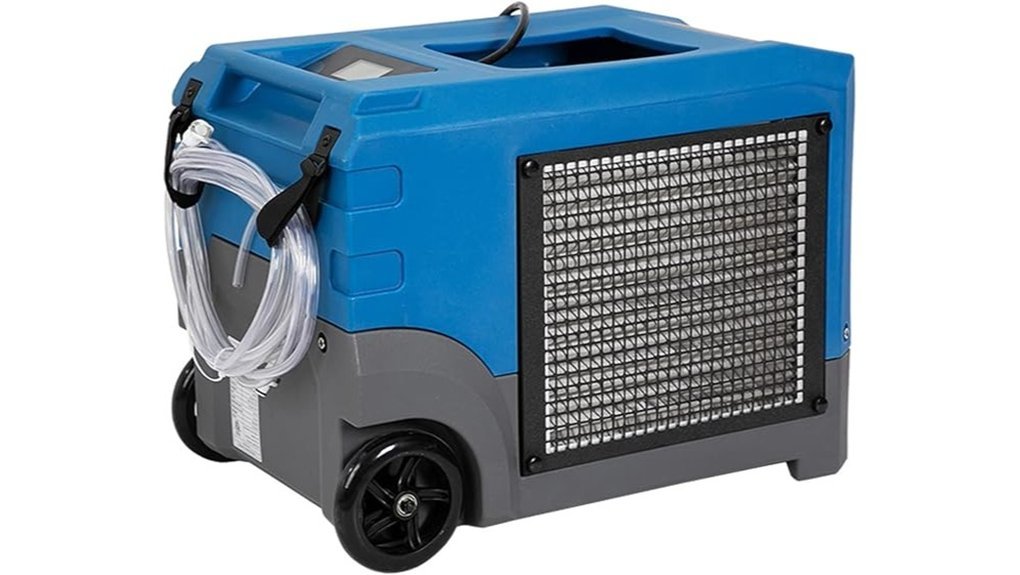
Best For: Water damage restoration professionals, construction sites, and flooded commercial buildings requiring maximum moisture extraction.
The Mounto 268 Pints Compact Dehumidifier with Pump is purpose-built for demanding drying jobs where speed, continuous unattended drainage, and job-site durability matter most. Rated at up to 268 PPD at saturation (90°F and 90% RH, or roughly 125–130 PPD under standard AHAM 80°F/60% RH test conditions), this low-grain refrigerant (LGR) machine pulls moisture out of saturated drywall, subfloors, and concrete far faster than standard residential units.
Because it has no internal water bucket to overflow, the unit relies on an integrated heavy-duty condensate pump and quick-connect drain hose that automatically purges collected water into a distant sink, floor drain, or standpipe. Its rugged roto-molded polyethylene shell resists dents on active construction sites, while the rigid transport handle and semi-pneumatic stair-climbing wheels make moving it across uneven terrain manageable.
Why You’ll Like It: The digital humidistat panel displays real-time inlet and outlet temperature and humidity readings, allowing contractors and facility managers to verify drying progress at a glance without babysitting the machine.
Who Should Buy This: Restoration contractors, property managers handling burst pipes or flooded basements, and commercial crews drying concrete or drywall.
Who Should Avoid This: Homeowners looking for a quiet everyday dehumidifier for a finished living room or small bedroom, or spaces without a dedicated 15-amp circuit.
Pros:
- Extreme Moisture Extraction: Removes up to 268 PPD at saturation for rapid structural drying after leaks or floods.
- Automatic Pump Drainage: Built-in condensate pump purges water continuously without manual bucket emptying.
- Job-Site Durability: Impact-resistant roto-molded housing, rigid handle, and large semi-pneumatic wheels withstand rough transport.
- Real-Time Diagnostics: Digital display tracks temperature and relative humidity to help monitor active drying stages.
Cons:
- High Electrical Draw: Draws 11.0 amps, meaning it requires a dedicated 15A circuit so it will not trip breakers alongside air movers.
- Industrial Size and Weight: Bulkier and heavier than residential portables despite its “compact” commercial classification.
- Job-Site Noise Level: High-CFM blower fan is noticeably louder than household dehumidifiers.
2. CADPXS 80 Pint Crawl Space Dehumidifier
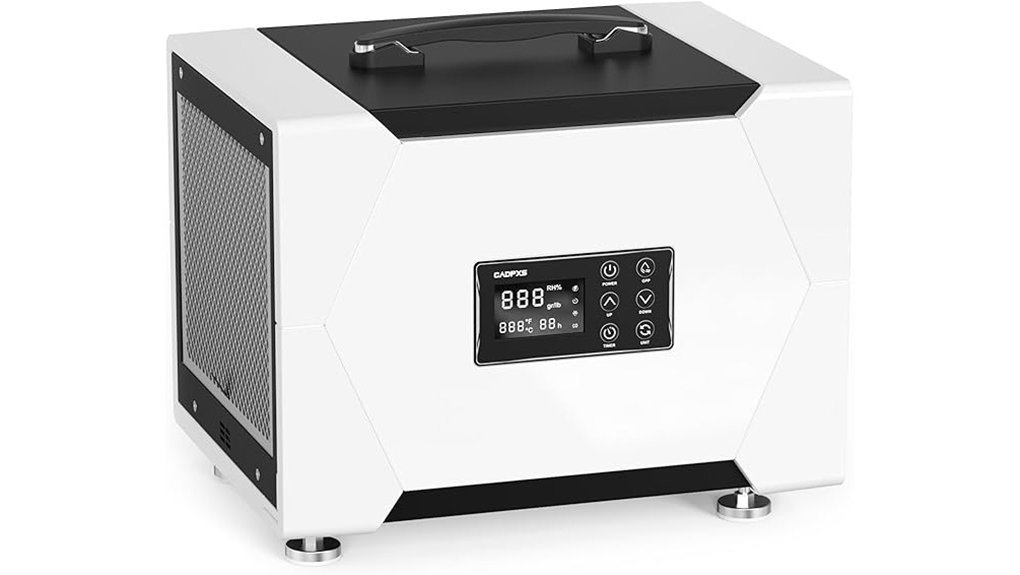
Best For: Homeowners needing a ultra-compact horizontal dehumidifier for low-clearance crawl spaces that already have a floor drain or sump pit.
When working with tight joist clearances or cramped utility rooms, the CADPXS 80 Pint Crawl Space Dehumidifier offers a remarkably small footprint of just 15.6 x 12 x 12.6 inches. It removes up to 80 pints of moisture per day at saturation (roughly 35 PPD at AHAM conditions), making it well suited for encapsulated crawl spaces, damp storage cellars, and mechanical rooms.
Unlike the pump-equipped models in this guide, this CADPXS unit uses a 6.56 ft continuous gravity drain hose. That means the hose must run on a steady downward slope into a nearby floor drain, sump pump basin, or external condensate pump. It also includes a 24-hour timer, auto-restart after power outages, and support for an optional remote humidistat controller.
Why You’ll Like It: Having no internal pump reduces mechanical complexity and upfront cost if your crawl space already has a sump basin right below the unit.
Who Should Buy This: Homeowners with encapsulated or low-clearance crawl spaces, small basements, or utility rooms where gravity drainage is straightforward.
Who Should Avoid This: Buyers who need to push water upward into a raised sink or out a high basement window (choose a built-in pump model instead), or those drying large warehouses.
Pros:
- Ultra-Compact Footprint: At 15.6 x 12 x 12.6 inches, it fits easily between floor joists or inside low crawl spaces.
- Solid Crawl Space Capacity: Extracts up to 80 pints daily at saturation to prevent musty odors and wood rot.
- Simple Gravity Drainage: Includes a 6.56 ft drain hose for direct routing into a floor drain or sump pit.
Cons:
- No Built-In Condensate Pump: Cannot lift water vertically unless paired with an external condensate pump.
- Optional Remote Control: Wall-mounted remote humidistat may be sold separately depending on the package.
- Airflow Noise in Living Areas: Audible fan hum if mounted directly beneath uninsulated hardwood floors.
3. DECIUU Max 100 Pint Dehumidifier with Pump
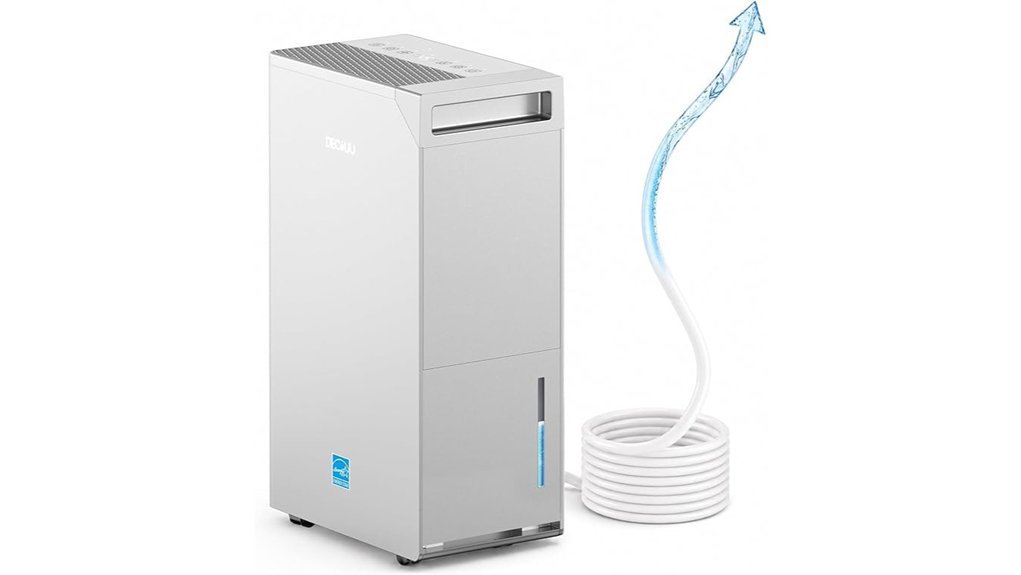
Best For: Finished basements, large offices, and light-commercial indoor spaces up to 5,000 sq. ft. that need an attractive upright unit with vertical pump drainage.
If you want high moisture removal without the industrial look of a metal crawl space machine, the DECIUU Max 100 Pint Dehumidifier with Pump bridges the gap between residential convenience and light-commercial performance. Rated to remove up to 100 pints per day at saturation in spaces up to 5,000 sq. ft. (best suited for 1,500 to 3,000 sq. ft. if the space is very damp), it pairs a rotary compressor with a vortex fan for steady air circulation.
Its standout feature is the three-way drainage flexibility: you can use the built-in pump to push water vertically up to 16.4 feet into a utility sink or window drain, connect a standard gravity hose to a floor drain, or use the internal bucket for short-term jobs. The top-mounted LED control panel lets you set target humidity between 35% and 80% RH and includes a child lock and 360-degree caster wheels.
Why You’ll Like It: It rolls smoothly from room to room on 360-degree casters and looks right at home in a finished basement, gym, or office while still providing automatic upward pump drainage.
Who Should Buy This: Homeowners and small business owners managing damp finished basements, open-plan offices, or storage rooms who want plug-and-play pump drainage.
Who Should Avoid This: Restoration contractors who need a rugged metal or roto-molded housing for rough construction sites, or buyers needing a low-profile unit for a tight crawl space.
Pros:
- Built-In 16.4 Ft Lift Pump: Easily pumps condensate upward into laundry sinks, standpipes, or basement windows.
- Precise Humidity Control: Adjustable humidistat maintains relative humidity between 35% and 80% RH.
- Finished-Space Friendly: Clean upright housing with LED controls, child lock, and 360-degree rolling casters.
Cons:
- Plastic Upright Housing: Less impact-resistant than metal or roto-molded commercial dehumidifiers on job sites.
- Optimistic Max Coverage Rating: The 5,000 sq. ft. rating applies to mildly humid areas; very wet basements require more conservative sizing.
- Routine Filter Cleaning Required: Washable mesh filter needs regular rinsing to prevent airflow drops.
4. Waykar 150 Pints Energy Star Dehumidifier with Pump
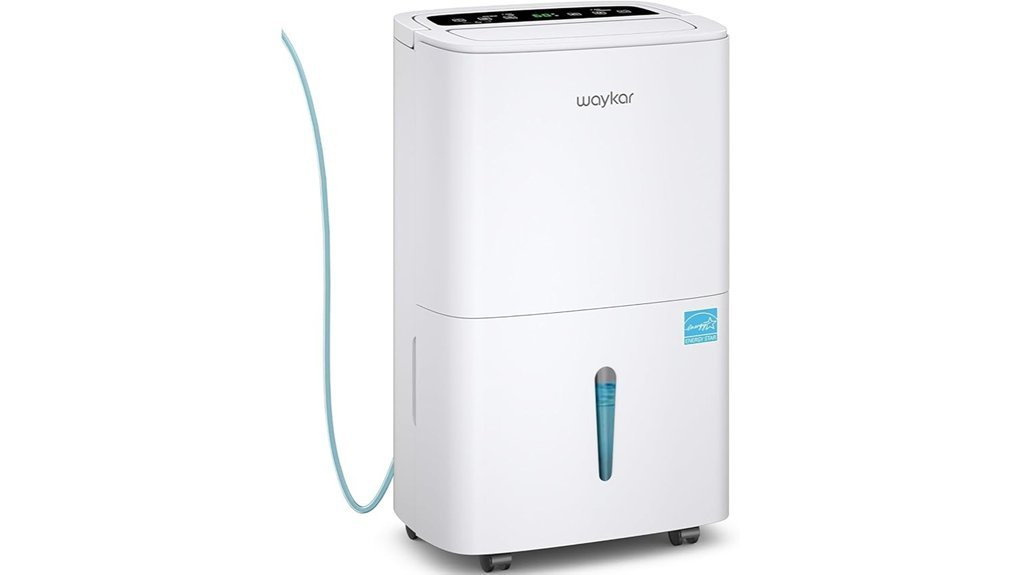
Best For: Large basements, workshops, and commercial storage areas where continuous 24/7 operation makes Energy Star power savings a priority.
Running a high-capacity dehumidifier all summer can noticeably raise your electric bill, which is why the Waykar 150 Pints Energy Star Dehumidifier with Pump stands out. Rated for up to 150 pints per day at saturation and marketed for enclosed spaces up to 7,000 sq. ft. (ideal for 2,500 to 4,500 sq. ft. in heavily damp conditions), it uses an Energy Star-certified compressor architecture to extract more moisture per kilowatt-hour than older non-certified designs.
You get full drainage versatility with both an internal condensate pump for vertical discharge and a gravity drain port for downward hose routing. Thoughtful operational details—including automatic coil defrost, internal self-drying before storage, power-outage memory restart, and responsive touch controls—make it reliable for long-term unattended moisture control.
Why You’ll Like It: It pairs high daily extraction capacity and automatic pump drainage with lower electricity consumption for spaces that need year-round humidity management.
Who Should Buy This: Facility managers, warehouse operators, and homeowners with expansive basements who want high capacity and pump drainage without excessive utility bills.
Who Should Avoid This: Users who need a horizontal low-clearance machine to slide inside a shallow crawl space, or those who only need to dry a single small room.
Pros:
- Energy Star Efficiency: Reduces long-term electricity costs during continuous warm-season operation.
- Dual Drainage Setup: Switch easily between the built-in vertical lift pump and standard gravity hose drainage.
- Smart Maintenance Features: Includes auto-defrost, internal self-drying mode, and automatic power-loss restart.
Cons:
- Upright Form Factor: Too tall to fit inside low-clearance crawl spaces.
- Heavy to Carry Upstairs: Rolling casters work well on flat floors, but moving the unit up basement stairs takes two people.
- Higher Upfront Price: Costs more initially than lower-capacity, non-pump portable units.
5. MOUNTO 150 Pint Commercial Dehumidifier with Pump
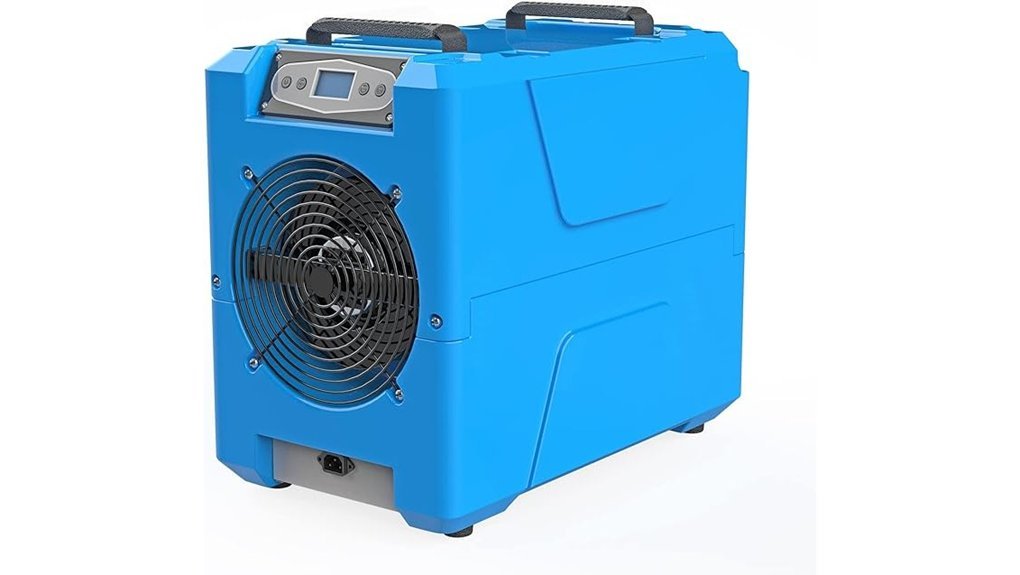
Best For: Contractors and property owners who want true commercial restoration durability for areas up to 2,500 sq. ft. on a standard household circuit.
Unlike residential units that inflate their coverage numbers, the MOUNTO 150 Pint Commercial Dehumidifier with Pump is conservatively rated for demanding drying jobs up to 2,500 sq. ft. It removes up to 150 pints per day at saturation (~70 PPD AHAM) using a heavy-duty rotary compressor while drawing just 550 watts—much lower amperage than the larger 268-pint MOUNTO model.
Designed specifically for commercial and restoration environments, it skips the removable water bucket entirely in favor of an automatic internal condensate pump and drain hose. The stackable, impact-resistant housing saves van and warehouse space, while the clear LED control board and automatic memory restart keep the machine working seamlessly even if job-site power flickers.
Why You’ll Like It: At 550 watts, it delivers authentic commercial build quality and automatic pump drainage without overloading residential 15-amp circuits.
Who Should Buy This: Restoration pros, landlords, and homeowners dealing with chronically wet basements, job-site leaks, or damp workshops.
Who Should Avoid This: Buyers who want a whisper-quiet bedroom appliance or an ultra-lightweight household portable unit.
Pros:
- True Commercial Build: Rugged housing designed for job sites, basements, and repeated transport.
- Manageable 550W Power Draw: Delivers 150 PPD saturation capacity without tripping standard 15A breakers.
- Integrated Condensate Pump: Automatically purges water through the included drain hose with memory auto-restart.
Cons:
- 65-Lb Weight: Solid commercial internal components make it heavy to lift into a truck bed solo.
- No Internal Bucket Option: Must always be routed to a drain sink, floor drain, or external container via the pump hose.
- Verify Warranty Terms: Commercial vs. residential warranty coverage periods should be confirmed with the seller before purchase.
6. Waykar 155 Pints Commercial Dehumidifier with Pump
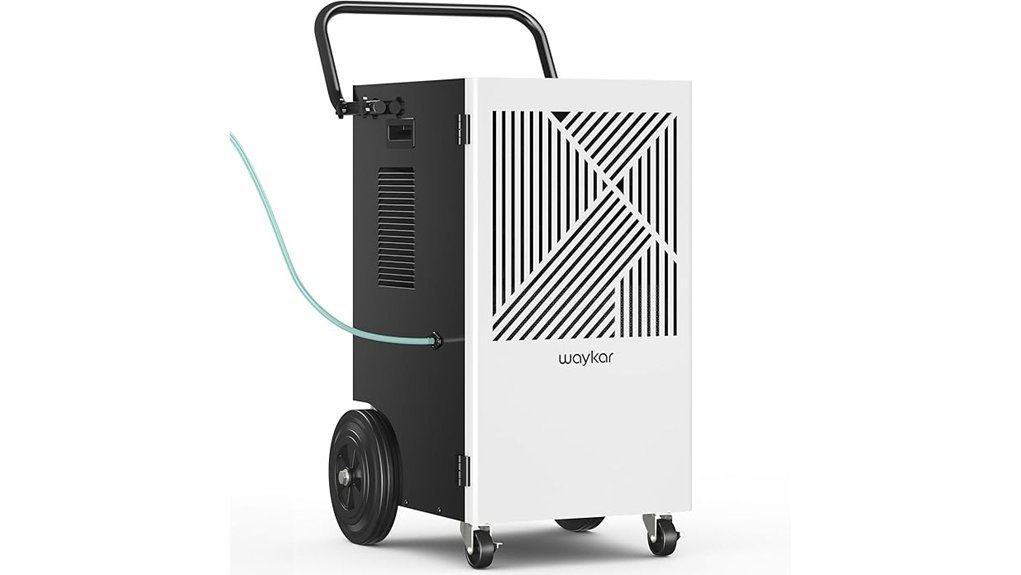
Best For: Warehouses, indoor grow rooms, workshops, and expansive commercial basements needing a rugged cart-style unit with pump lift.
Built inside a tough metal outer casing with large rear transport wheels and a push handle, the Waykar 155 Pints Commercial Dehumidifier with Pump is engineered for wide-open industrial and commercial floor plans. It removes up to 155 pints of moisture daily at saturation and is rated to circulate air across spaces up to 8,000 sq. ft. (best suited for 3,000 to 5,000 sq. ft. when ambient humidity is high).
The unit’s digital LCD control panel lets you enter humidity setpoints from 10% to 90% RH (note that like all standard refrigerant dehumidifiers, practical room dehumidification reaches down to roughly 30%–35% RH depending on temperature). Its built-in condensate pump lifts water vertically up to 16.4 feet, and it can also be configured for standard gravity hose drainage when placed next to a floor trench drain.
Why You’ll Like It: The hand-truck style frame with oversized wheels and a steel housing makes moving a heavy-duty commercial dehumidifier across warehouse floors effortless.
Who Should Buy This: Warehouse managers, gym owners, woodworking shops, and commercial basements that need high airflow and reliable upward pump drainage.
Who Should Avoid This: Homeowners with tight staircases or small rooms where a 79.4 lb cart-style machine is difficult to maneuver.
Pros:
- Heavy-Duty Cart Design: Metal housing, tubular push handle, and large rear wheels simplify movement across concrete floors.
- 16.4 Ft Pump Lift + Gravity Drain: Includes both an automatic lift pump and gravity drainage capability for flexible routing.
- High-Volume Airflow: Designed to pull damp air across large open commercial spaces, basements, and garages.
Cons:
- Substantial 79.4-Lb Weight: Heavy to move up or down stairs without a ramp or second person.
- Setpoint vs. Physical Floor: While the digital screen allows a 10% RH input, refrigerant coils practically achieve 30%–35% RH minimum.
- Higher Upfront Cost: Priced for commercial buyers rather than casual household use.
7. ARGENDON Commercial Dehumidifier for Crawlspace (145 PPD)
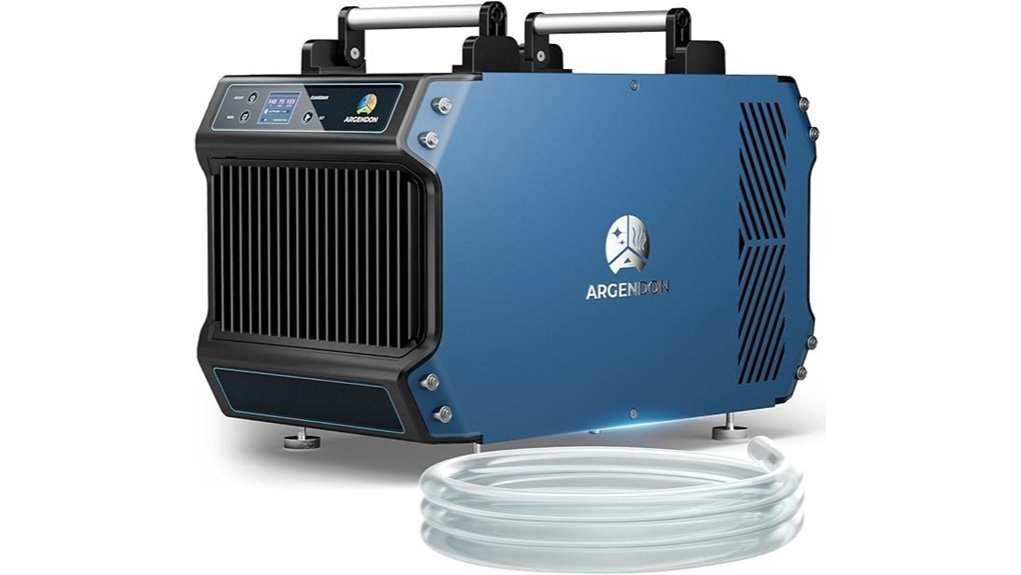
Best For: Damp crawl spaces and basements up to 1,500 sq. ft. where a durable metal horizontal unit and gravity drainage are preferred.
Engineered specifically for harsh under-home environments, the ARGENDON Commercial Dehumidifier for Crawlspace extracts up to 145 PPD at saturation (roughly 60–65 PPD AHAM) across spaces up to 1,500 sq. ft. Its 165 CFM airflow pushes dry air through low-clearance areas, and the unit features a dedicated GPP mode (Grains Per Pound)—a professional restoration setting that measures the actual weight of moisture per pound of dry air rather than relative humidity alone.
Keep in mind that this specific model uses an included continuous gravity drain hose rather than an internal lift pump, so the drain line must slope downward into a sump pit, floor drain, or external condensate pump. Housed in a corrosion-resistant metal cabinet and certified to ETL safety standards, it is built for years of stationary crawl space duty.
Why You’ll Like It: The GPP humidity control mode and realistic 1,500 sq. ft. coverage rating give you professional-grade moisture control in a rugged horizontal metal frame.
Who Should Buy This: Homeowners and waterproofing contractors installing a permanent dehumidifier in a crawl space or basement equipped with a sump basin or floor drain.
Who Should Avoid This: Buyers who need a built-in condensate pump to lift water vertically out of a basement without buying an external pump accessory.
Pros:
- High Crawl Space Extraction: 145 PPD saturation capacity with 165 CFM airflow handles wet 1,500 sq. ft. crawl spaces effectively.
- Professional GPP Mode: Regulates drying based on Grains Per Pound for more accurate moisture control across temperature swings.
- Rugged Metal Housing: ETL-certified metal cabinet resists corrosion and physical damage in tight under-home spaces.
Cons:
- Gravity Drainage Only: Does not include a built-in condensate pump; requires a downward slope or external pump.
- 55-Lb (24.95 kg) Stationary Weight: Built to be installed in place rather than wheeled between rooms daily.
- 1,500 Sq. Ft. Ceiling: Larger open warehouses will require a higher-CFM unit or multiple machines.
8. AEOCKY 74 Pint Energy Star Dehumidifier
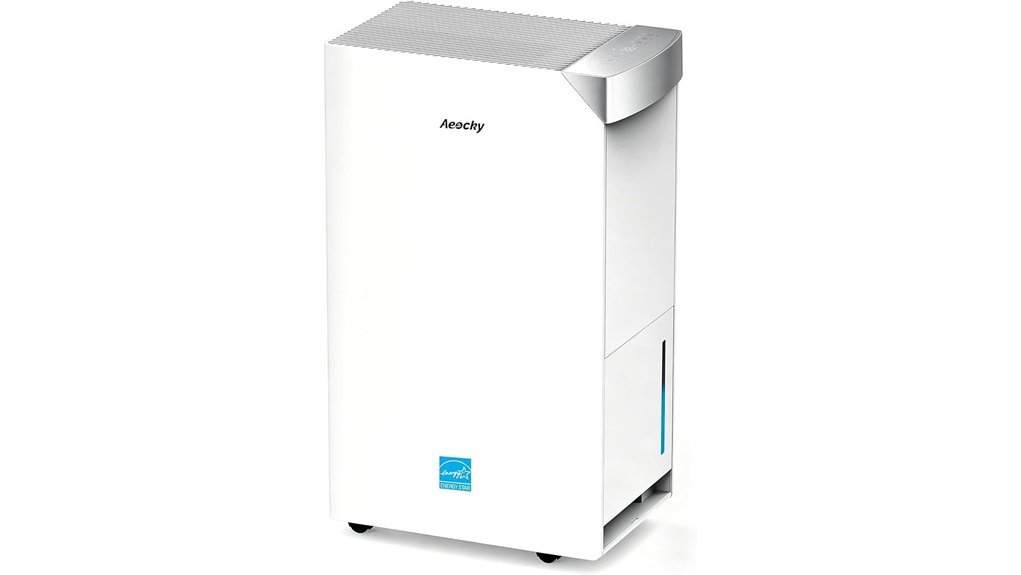
Best For: Occupied offices, finished basements, and residential spaces that prioritize quiet operation (~44 dB) and Energy Star Version 6.0 efficiency.
When a loud industrial blower would disrupt an office, studio, or finished basement, the AEOCKY 74 Pint Energy Star Dehumidifier offers a quiet, lightweight alternative. Rated at up to 74 pints per day for enclosed areas up to 4,500 sq. ft. (most effective in 1,000 to 2,500 sq. ft. damp rooms), it carries ENERGY STAR Version 6.0 certification to keep daily power draw low.
For continuous water removal without emptying the bucket, you can connect a gravity drain hose to the rear outlet and route it downward into a floor drain. Because this model does not include a built-in lift pump, water must flow downhill. It operates at approximately 44 dB—about the level of a quiet library—and includes an automatic coil defrost cycle to prevent frost buildup when room temperatures dip.
Why You’ll Like It: At just 31 lbs and 44 dB, it is the easiest unit in this lineup to move between occupied rooms where noise and power efficiency matter most.
Who Should Buy This: Homeowners, office managers, and retail spaces needing quiet, energy-efficient humidity control with simple gravity hose drainage.
Who Should Avoid This: Buyers who need a built-in condensate pump for upward drainage, or contractors tackling heavy structural water damage in cold crawl spaces.
Pros:
- ENERGY STAR Version 6.0 Certified: Delivers high moisture extraction per watt for lower monthly utility bills.
- Whisper-Quiet 44 dB Operation: Quiet enough for occupied offices, living areas, and finished basements.
- Lightweight 31-Lb Design: Much easier to carry up and down stairs than 65+ lb commercial machines.
Cons:
- No Built-In Lift Pump: Continuous drainage relies on gravity, requiring a floor-level drain below the outlet port.
- Reduced Extraction in Cold Rooms: Like standard upright compressor units, moisture removal slows down when temperatures drop below 65°F despite auto-defrost protection.
- Residential Construction: Built for indoor living and office environments rather than rough construction sites.
9. BaseAire Crawlspace Dehumidifier with Pump (70 PPD)
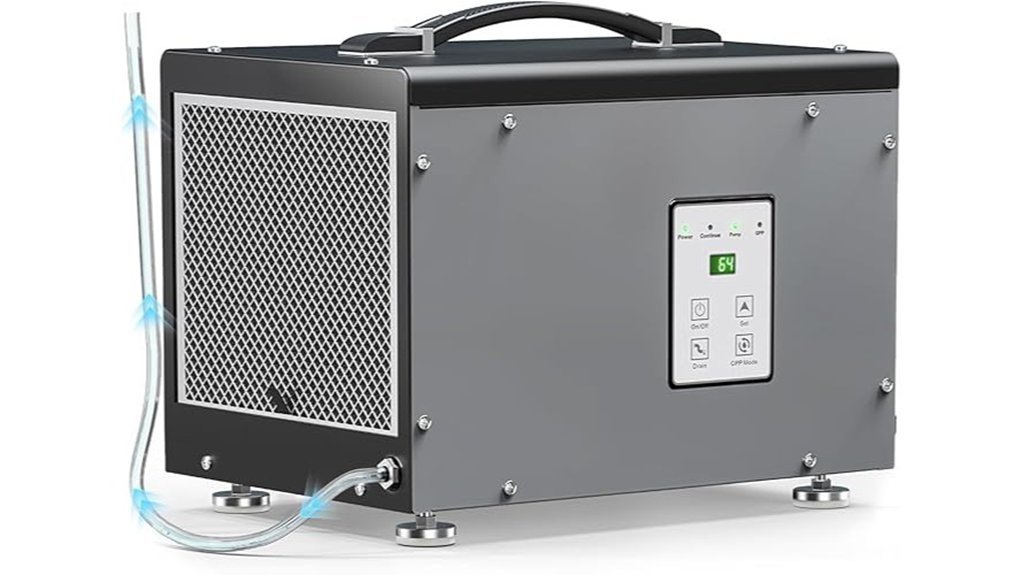
Best For: Confined crawl spaces and low-clearance basements up to 1,000 sq. ft. that need a built-in condensate pump and strong warranty backing.
The BaseAire Crawlspace Dehumidifier with Pump (70 PPD) is purpose-built for tight under-home spaces where gravity drainage is impossible. Removing up to 70 pints per day at saturation (~35 PPD AHAM) across areas up to 1,000 sq. ft., its low-clearance horizontal cabinet slides easily between crawl space piers or suspends from floor joists with a hanging kit.
Unlike basic gravity-drain crawl space units, this BaseAire model includes a built-in condensate pump that pushes collected water upward and across long runs to a plumbing standpipe or exterior drain line. Weighing just 38.2 lbs, it features automatic coil defrost for cool subterranean air and is backed by a standout 5-year limited warranty with lifetime technical support.
Why You’ll Like It: You get a true horizontal crawl space dehumidifier with an internal condensate pump and a 5-year limited warranty in a lightweight 38.2 lb package.
Who Should Buy This: Homeowners with crawl spaces or small basements up to 1,000 sq. ft. who need upward pump drainage and long-term warranty peace of mind.
Who Should Avoid This: Users with sprawling 2,000+ sq. ft. basements or commercial warehouses that require 125 to 268 PPD capacity.
Pros:
- Built-In Condensate Pump: Automatically lifts water out of low crawl spaces where gravity hoses cannot slope downward.
- Compact 38.2-Lb Horizontal Body: Easy for one person to position inside cramped crawl space access doors.
- 5-Year Limited Warranty: Strong manufacturer coverage and lifetime technical support add long-term value.
Cons:
- 1,000 Sq. Ft. Coverage Limit: Best restricted to small-to-medium crawl spaces and basements.
- Periodic Filter & Pump Checks: Crawl space dust requires periodic filter cleaning and annual pump line inspection.
- Higher Cost Per Pint: Commercial crawl space build and pump add to the initial price compared to plastic portables.
10. HBN 125 Pints Crawl Space Dehumidifier with Pump
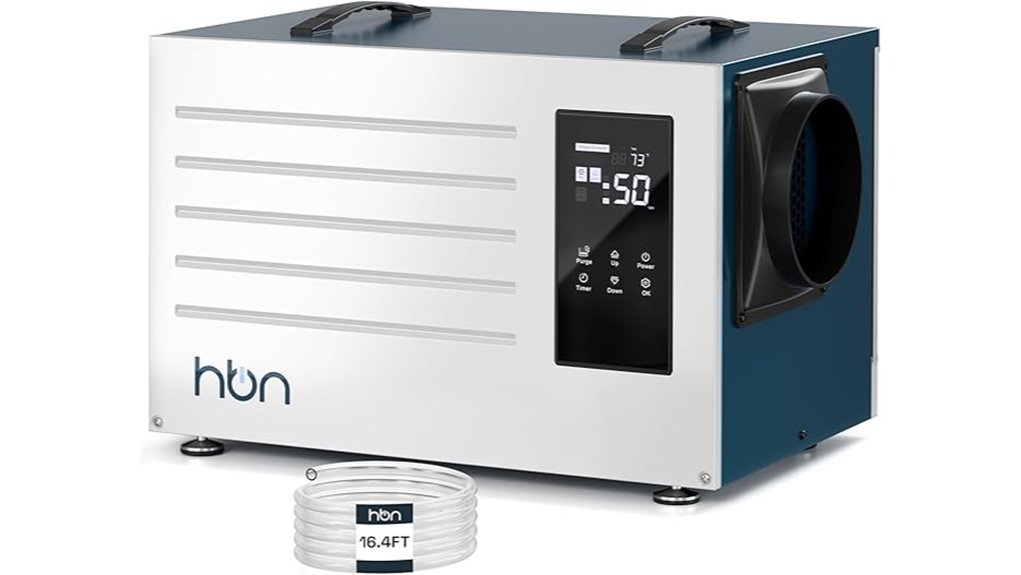
Best For: Larger crawl spaces, basements, and commercial storage rooms that need both high extraction capacity (125 PPD) and dual pump/gravity drainage.
When a 70- or 80-pint unit is too small for your footprint, the HBN 125 Pints Crawl Space Dehumidifier with Pump steps up to 125 pints per day at saturation. While the manufacturer rates its maximum air circulation for up to 5,900 sq. ft. in enclosed spaces, it performs at its best in damp crawl spaces, basements, and commercial rooms between 1,500 and 3,000 sq. ft.
Its dual drainage system includes both a 6.6 ft gravity drain hose and a built-in auto-pump capable of lifting water vertically up to 16.4 feet. An intuitive touchscreen control panel, automatic defrost cycle for cool basement conditions, optional remote control capability, and lifetime technical support make it a versatile workhorse for hard-to-reach installations.
Why You’ll Like It: Having both a 16.4 ft vertical pump and a gravity drain port in a horizontal crawl-space form factor lets you adapt the unit to any plumbing layout.
Who Should Buy This: Property managers and homeowners with large, damp crawl spaces or commercial basements where drain access is above the floor level.
Who Should Avoid This: Buyers who only need light humidity control in a small single room or bedroom.
Pros:
- 125 PPD High Capacity: Bridges the gap between small 70 PPD crawl space units and bulky 268 PPD restoration machines.
- Dual Gravity & Pump Drainage: Includes a 6.6 ft gravity hose plus an internal pump with 16.4 feet of vertical lift.
- Accessible Touchscreen Controls: Clear digital interface with auto-defrost and optional remote support.
Cons:
- Optimistic Max Square Footage Claim: The 5,900 sq. ft. rating is for lightly damp air; size closer to 1,500–3,000 sq. ft. for wet crawl spaces.
- Bulkier Horizontal Frame: Heavier to maneuver through narrow crawl space hatches than 70-pint models.
- Audible Blower Fan: High-CFM airflow produces noticeable sound when running at full capacity.
Factors to Consider When Choosing a Commercial Dehumidifier with a Drain Hose
Selecting the right commercial dehumidifier with a drain hose prevents overflowing buckets, frozen coils, and undersized setups that run nonstop without lowering your hygrometer reading. Below are the exact engineering and installation details to check before you buy.
Before You Buy Checklist
- Measure your square footage and ceiling height: Multiply length by width, and move up a capacity tier if ceilings exceed 8 to 10 feet.
- Verify your drainage elevation: Choose a gravity drain hose only if your floor drain or sump pit sits physically lower than the dehumidifier outlet; choose a built-in condensate pump if water must travel upward into a sink, standpipe, or window.
- Compare Saturation PPD vs. AHAM PPD: Check whether the advertised pint rating was tested at saturation (90°F / 90% RH) or AHAM conditions (80°F / 60% RH).
- Check clearance and doorway dimensions: Measure your crawl space access hatch and joist spacing before ordering a horizontal unit.
- Confirm electrical amperage: Standard 15A household circuits safely handle up to 12 amps continuous load; a 268 PPD restoration unit drawing 11A needs its own dedicated circuit.
- Plan for filter and pump access: Position the unit so you can slide out the air filter every 30 to 60 days without crawling over ducting.
Key Features to Evaluate: Form Factor and Selection Methodology
To evaluate the 10 models in this guide, we compared each machine across four core engineering criteria: drainage mechanism (internal lift pump vs. gravity port), moisture extraction under saturation and standard conditions, housing design (horizontal crawl space metal/roto-molded vs. upright portable), and electrical efficiency. Matching the form factor to your environment is essential:
- Roto-Molded Restoration Units (e.g., MOUNTO 268 & 150 PPD): Built with impact-resistant polyethylene shells, semi-pneumatic wheels, and no internal bucket. Ideal for contractors, flood drying, and rugged job sites.
- Horizontal Crawl Space Units (e.g., BaseAire 70, CADPXS 80, HBN 125, ARGENDON 145): Low-profile rectangular cabinets designed to sit on crawl space vapor barriers or hang from floor joists where upright units cannot fit.
- Upright Commercial & Large-Room Units (e.g., Waykar 150/155, DECIUU 100, AEOCKY 74): Vertical footprints on caster wheels that fit naturally into finished basements, warehouses, offices, and workshops.
Capacity and Coverage Area (Saturation vs. AHAM Ratings Explained)
One of the most confusing parts of shopping for a commercial dehumidifier is seeing a 150 PPD commercial unit rated for 2,500 sq. ft. right next to a 150 PPD large-room unit rated for 7,000 sq. ft. That happens because brands use two different testing standards:
- Saturation Capacity (90°F at 90% RH): Measures the maximum water a unit can pull in extreme tropical heat and humidity. Most commercial and crawl space titles (145 PPD, 155 PPD, 268 PPD) advertise this maximum number.
- AHAM Capacity (80°F at 60% RH) & DOE Standards: Measures realistic everyday performance in normal indoor conditions. A unit’s AHAM rating is typically 45% to 55% of its saturation rating (for example, a 150 PPD saturation unit removes roughly 70 PPD at AHAM).
| Space Size (Sq. Ft.) | Dampness Level | Recommended Saturation PPD | Equivalent AHAM PPD |
|---|---|---|---|
| Up to 1,000 sq. ft. | Damp crawl space or small basement | 70–85 PPD | 35–40 PPD |
| 1,000–2,000 sq. ft. | Wet crawl space or humid basement | 100–145 PPD | 50–65 PPD |
| 2,000–3,500 sq. ft. | Very wet basement, shop, or commercial space | 145–160 PPD | 70–80 PPD |
| 3,500+ sq. ft. or Flooded | Water damage restoration or warehouse | 200–268+ PPD (or multiple units) | 100–130+ PPD |
Drainage System Efficiency: Gravity Hose vs. Built-In Pump
A continuous drainage system eliminates manual bucket emptying, but only if the water path matches physics:
- Gravity Drainage Systems: Rely entirely on gravity to pull water down a 6 to 6.6 ft hose. The hose must slope downward continuously from the outlet port to a floor drain or sump basin with zero upward loops, kinks, or rises—otherwise an airlock will form and cause water to back up inside the drain pan.
- Built-In Condensate Pumps: Use an internal reservoir and float switch that automatically pumps water through a narrow vinyl tube up to 16.4 feet (5 meters) vertically. This allows you to sit the dehumidifier on a basement floor or inside a crawl space and pump water up into a laundry tub, plumbing standpipe, or exterior drain.
Energy Efficiency Ratings and Operating Temperature
Because commercial and basement dehumidifiers often run for months at a time, energy efficiency directly affects your operating budget. Look for ENERGY STAR certifications (such as on the Waykar 150-Pint and AEOCKY 74-Pint models) when conditioning large indoor spaces. Also pay attention to low-temperature performance: basement and crawl space air frequently stays between 50°F and 65°F. Models with auto-defrost sensors automatically pause the compressor while running the fan whenever frost forms on the evaporator coils, keeping the unit extracting moisture without turning into a block of ice.
Portability, Airflow, and Installation Design
Consider how often the dehumidifier will move. If you are a contractor loading equipment into a van between water damage jobs, prioritize models with semi-pneumatic wheels, rigid handles, and stackable housings like the MOUNTO series, or a cart-style frame like the Waykar 155-Pint. If the unit will live permanently inside a crawl space, prioritize compact height, leveling feet, and accessible slide-out filters like the BaseAire 70 PPD, CADPXS 80-Pint, or ARGENDON 145 PPD.
Warranty and Support Options
Commercial humidistats, compressors, and internal condensate pumps work under heavy moisture loads, making warranty coverage critical. Most units in this category carry warranties between 1 and 5 years—typically offering 1 year of bumper-to-bumper parts and labor coverage alongside 3 to 5 years on the sealed refrigeration system (compressor and coils). Before purchasing, check whether commercial/rental use alters the warranty period and whether the brand provides responsive technical support for replacement pump check valves and filters.
Safety and Setup Note
Always place your dehumidifier on a level surface (use concrete blocks or a leveling pad in uneven crawl spaces) so the internal float switch reads water levels accurately. Never plug a high-amperage commercial dehumidifier into a light-duty extension cord, and never discharge a drain hose outdoors where winter temperatures drop below 32°F—a frozen discharge line will block water flow and can damage the internal pump.
Pro Tips for Better Drain Hose & Pump Performance
- Prevent gravity hose airlocks: Trim any excess slack from a gravity drain hose so it runs in a straight, continuous downward slope without dips or hills that trap air pockets.
- Leave 12 to 18 inches of airflow clearance: Keep both the air intake grille and the dry-air exhaust louver clear of walls, plastic vapor barriers, and storage boxes.
- Seal the space first: Close crawl space vents, basement windows, and exterior doors while the dehumidifier is operating; otherwise you are paying to dehumidify the outdoors.
- Flush the condensate pump annually: Once a year, pour a small amount of warm water mixed with white vinegar (or a manufacturer-approved condensate pan tablet) into the pump reservoir to prevent algae and slime from clogging the check valve and tubing.
- Clean the intake filter every 30 to 60 days: Construction dust and crawl space debris rapidly coat mesh filters, restricting CFM airflow and causing coils to freeze up.
Frequently Asked Questions
How Do I Maintain My Commercial Dehumidifier?
Maintain your commercial dehumidifier by rinsing or replacing the air intake filter every 30 to 60 days, inspecting the drain hose for kinks or algae buildup, vacuuming dust off the evaporator coils twice a year, and flushing the internal condensate pump annually so the float switch and check valve never stick.
What Is the Average Lifespan of a Dehumidifier?
A commercial or crawl space dehumidifier typically lasts 5 to 10 years, while residential-grade portable units average 3 to 5 years of heavy use. Keeping the air filter clean, maintaining proper clearance around the vents, and sizing the unit so the compressor can cycle off periodically will maximize its lifespan.
Can I Use a Dehumidifier in a Cold Environment?
Yes, provided the model includes an automatic defrost system. Standard compressor dehumidifiers extract moisture fastest above 65°F, and coils begin to frost when ambient temperatures drop below 60°F. Commercial LGR and crawl space units with auto-defrost can operate safely down to roughly 41°F (5°C) by periodically melting coil frost.
How Noisy Are Commercial Dehumidifiers During Operation?
Commercial and crawl space dehumidifiers typically run between 52 dB and 62 dB due to their high-CFM blowers and heavy-duty compressors—comparable to a box fan on medium-high. Upright Energy Star room models like the AEOCKY 74-Pint run noticeably quieter at around 44 dB, making them better suited for occupied offices or living spaces.
What Warranty Options Are Available for These Dehumidifiers?
Warranties on commercial and crawl space dehumidifiers generally span 1 to 5 years. Dedicated crawl space brands like BaseAire often provide a 1-year all-parts warranty plus up to 5 years on the sealed refrigeration system (compressor and coils). Always register your serial number after purchase to lock in full coverage.
Is a Built-in Pump Better Than Gravity Drainage?
A built-in condensate pump is better whenever your drain point is higher than the dehumidifier or more than 6 feet away—it can push water up to 16.4 feet vertically into a sink or standpipe. Gravity drainage is simpler and has zero moving pump parts to fail, making it ideal when a floor drain or sump pit sits directly below the unit.
What Size Commercial Dehumidifier Do I Need?
For a damp crawl space or basement up to 1,000 sq. ft., choose a 70 to 80 PPD saturation unit (35–40 PPD AHAM). Spaces between 1,500 and 3,000 sq. ft. with heavy moisture need 125 to 155 PPD at saturation (60–80 PPD AHAM). Active flood restoration or spaces over 3,500 sq. ft. require a 200 to 268+ PPD commercial LGR unit.
Final Recommendation
Match your final pick to your space and drainage path: for heavy-duty water damage restoration and construction sites, the Mounto 268 Pints Compact Dehumidifier with Pump delivers the highest extraction rate, while the MOUNTO 150 Pint Commercial Dehumidifier with Pump offers rugged job-site durability at a lower 550W power draw. For large warehouses, workshops, and basements needing upward pump lift, compare the cart-style Waykar 155 Pints Commercial Dehumidifier with Pump and the energy-saving Waykar 150 Pints Energy Star Dehumidifier with Pump. Finally, if you are conditioning a low-clearance crawl space, choose the BaseAire 70 PPD or HBN 125 Pints when you need a built-in pump, or the CADPXS 80 Pint and ARGENDON 145 PPD if you already have a downward floor drain or sump pit.
Conclusion
Choosing the right commercial dehumidifier with a drain hose eliminates daily bucket emptying and keeps basements, crawl spaces, warehouses, and job sites safely within the ideal 30% to 50% relative humidity range. Before ordering, confirm whether your drainage path can rely on a downward gravity slope or needs a 16.4-foot built-in condensate pump, and size your PPD capacity for the dampest days of the year so your space stays permanently dry and protected.