The best dehumidifier for flood damage recovery is usually a commercial or light-commercial machine with verified moisture-removal capacity, strong airflow, automatic drainage, and construction suited to extended drying work. After removing the residential humidity-control models that did not match this buyer intent, three relevant options remain: the ALORAIR Storm LGR Extreme for demanding restoration work, the XPOWER XD-125 restoration package for buyers who also need air movers and filtration, and the compact ALORAIR Helios MP35 for smaller affected areas and crawl spaces.
Affiliate disclosure: This article contains Amazon affiliate links. We may earn a commission from qualifying purchases at no extra cost to you.
Updated: August 2026. Product specifications, warranty terms, package contents, and availability can change. Confirm the current Amazon listing and manufacturer documentation before ordering.
Quick Verdict
- Best Overall: ALORAIR Storm LGR Extreme — the strongest standalone restoration option, with 85 pints per day under AHAM conditions and a built-in pump.
- Best Complete Package: XPOWER XD-125 Restoration Package — combines a commercial dehumidifier, four mini air movers, and a mini HEPA air scrubber.
- Best Compact Option: ALORAIR Helios MP35 — a smaller pump-equipped unit for crawl spaces, isolated rooms, and lighter residual moisture.
Quick Comparison
| Product | Verified Capacity | Airflow | Drainage | Best For | Amazon |
|---|---|---|---|---|---|
| ALORAIR Storm LGR Extreme Best Overall |
85 PPD at AHAM 180 PPD at saturation |
Approximately 210 CFM | Built-in condensate pump and drain hose | Serious basement, crawl-space, and water-damage drying | Check Availability |
| XPOWER XD-125 Package Best Complete Package |
76 PPD at AHAM 125 PPD at saturation |
Approximately 235 CFM from the dehumidifier, plus separate air movers | Automatic purge pump with drainage hose | Buyers who need a coordinated drying and filtration setup | Check Availability |
| ALORAIR Helios MP35 Best Compact Option |
35 PPD at AHAM 70 PPD at saturation |
Approximately 126 CFM | Built-in pump plus gravity-drain option | Smaller rooms, crawl spaces, and localized residual moisture | Check Availability |
Capacity note: AHAM and saturation ratings are measured under different temperature and humidity conditions. Use the AHAM figure for a more conservative comparison between machines. A high saturation figure should not be treated as the amount a unit will remove every day in a typical building.
Flood-Cleanup Safety Note
A dehumidifier is only one part of flood recovery. Remove standing water and address structural, electrical, sewage, chemical, and contamination hazards before operating electrical drying equipment. Never place a dehumidifier or extension connection in standing water.
EPA and CDC guidance recommends cleaning and drying wet materials within 24–48 hours when possible. If visible mold is already present, do not aim air movers at it without an appropriate containment and remediation plan, because moving air may spread spores.
Review the EPA flooded-home guidance and CDC mold-cleanup guidance. Consider qualified professional help for sewage water, widespread mold, hidden wall or floor saturation, damaged electrical systems, or major structural damage.
How We Selected These Flood-Damage Dehumidifiers
The retained products were selected for direct relevance to water-damage drying rather than ordinary household comfort. We compared standardized and saturation moisture-removal ratings, airflow, pump drainage, operating temperature, portability, housing design, included drying equipment, and suitability for crawl spaces, basements, and restoration work.
We also removed standard residential models that relied mainly on large square-foot marketing claims. Coverage numbers can be useful for routine humidity control, but they do not account for the amount of water held in drywall, insulation, wood, carpet, subflooring, and enclosed cavities after a flood.
ALORAIR Storm LGR Extreme 180 PPD Dehumidifier — Best Overall
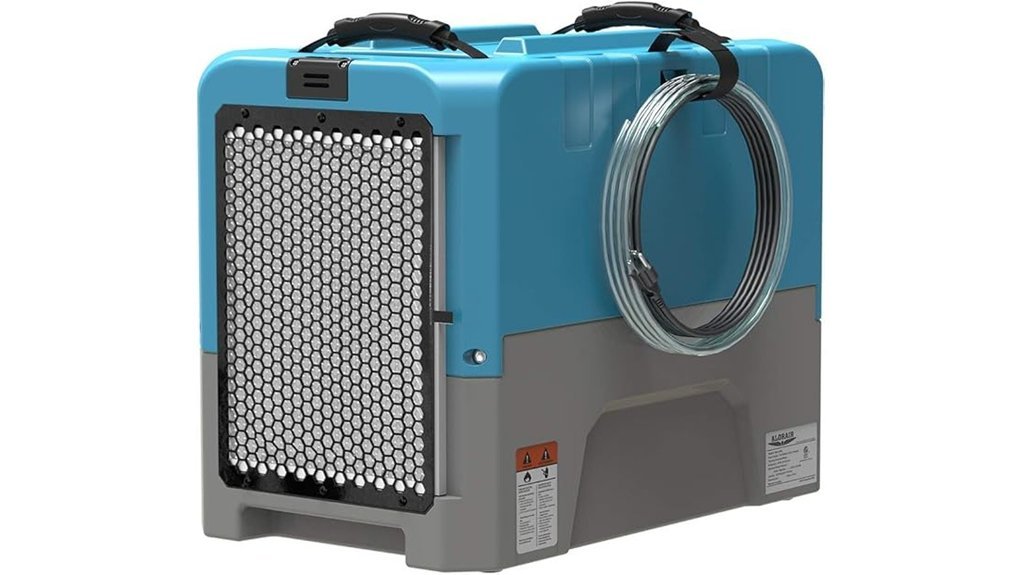
The ALORAIR Storm LGR Extreme is the strongest standalone flood-restoration dehumidifier in this comparison. It is rated to remove approximately 85 pints per day under AHAM conditions and up to 180 pints per day at saturation. That distinction matters: the 85-pint AHAM rating is the more useful figure for comparing it with other equipment under standardized conditions.
Its approximately 210 CFM airflow helps move humid air through the machine, while the built-in condensate pump supports automatic drainage without relying on a nearby floor drain. The compact horizontal housing is easier to position in crawl spaces, basements, utility areas, and other restricted locations than a tall household unit.
Why You’ll Like It
It combines restoration-level capacity, a pump, automatic defrost, continuous operation, and a portable body in one machine. This makes it the most balanced option for buyers who already have suitable air movers or can rent them separately.
Best For: Homeowners, property managers, contractors, and restoration crews drying wet basements, crawl spaces, garages, utility rooms, and moderately large affected areas.
Who Should Avoid It: Buyers dealing only with normal seasonal humidity may not need commercial equipment. A single unit may also be insufficient for a large multi-room flood, deeply saturated materials, or a building with many enclosed cavities.
Pros:
- Verified 85-pint AHAM capacity and 180-pint saturation capacity.
- Built-in condensate pump supports unattended continuous drainage.
- Compact, restoration-oriented housing with carrying handles.
- Automatic defrost supports operation in cooler affected spaces.
- Suitable for ducting and targeted drying configurations where supported by the current model.
Cons:
- Air movers and an air scrubber are not included.
- Commercial equipment is heavier and louder than a typical residential appliance.
- The advertised square-foot figure does not guarantee that one machine can dry every affected building of that size.
- Warranty terms may vary by seller, purchase date, and model revision, so they should be verified before ordering.
XPOWER XD-125 Water-Damage Restoration Package — Best Complete Package
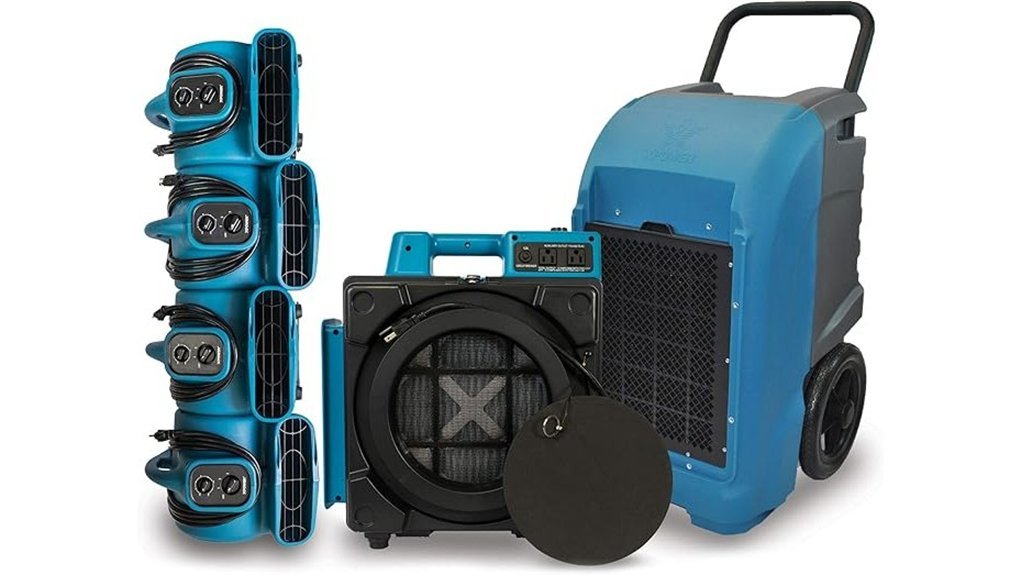
The XPOWER XD-125 Water-Damage Restoration Package is the most complete option because it combines several types of drying equipment. The package is listed with four mini air movers, an XD-125 commercial dehumidifier, and a mini HEPA air scrubber. This arrangement addresses three separate needs: removing water vapor, increasing evaporation from wet surfaces, and filtering airborne particles.
The XD-125 dehumidifier is rated for approximately 76 pints per day under AHAM conditions and 125 pints per day at saturation. It also produces approximately 235 CFM and uses an automatic purge pump with a drainage hose, eliminating the need to monitor a small household collection tank.
Why You’ll Like It
The package reduces the need to select separate air movers and filtration equipment. It is especially attractive for a buyer starting without restoration equipment or someone handling recurring drying work.
Best For: Contractors, landlords, facility managers, and homeowners who need a coordinated package for a substantial clean-water incident and have enough space and safe electrical capacity for several machines.
Who Should Avoid It: It may be excessive for a small isolated leak. Buyers should also avoid operating air movers around visible mold without proper containment and remediation guidance.
Pros:
- Includes a commercial dehumidifier, four mini air movers, and a mini HEPA air scrubber.
- Verified 76-pint AHAM and 125-pint saturation ratings for the XD-125.
- Automatic purge pump supports continuous drainage.
- Approximately 235 CFM dehumidifier airflow.
- Long power cord and drainage hose simplify jobsite positioning.
- Rugged housing and wheels support movement between affected areas.
Cons:
- The full package requires more storage space than a single dehumidifier.
- Multiple machines increase total electrical demand and noise.
- A HEPA air scrubber does not remove contaminated materials or replace professional mold remediation.
- Current package contents and Amazon availability should be confirmed before purchase.
- The manufacturer’s limited warranty for the XD-125 is shorter than some competing commercial-dehumidifier warranties.
ALORAIR Helios MP35 70-Pint Dehumidifier with Pump — Best Compact Option
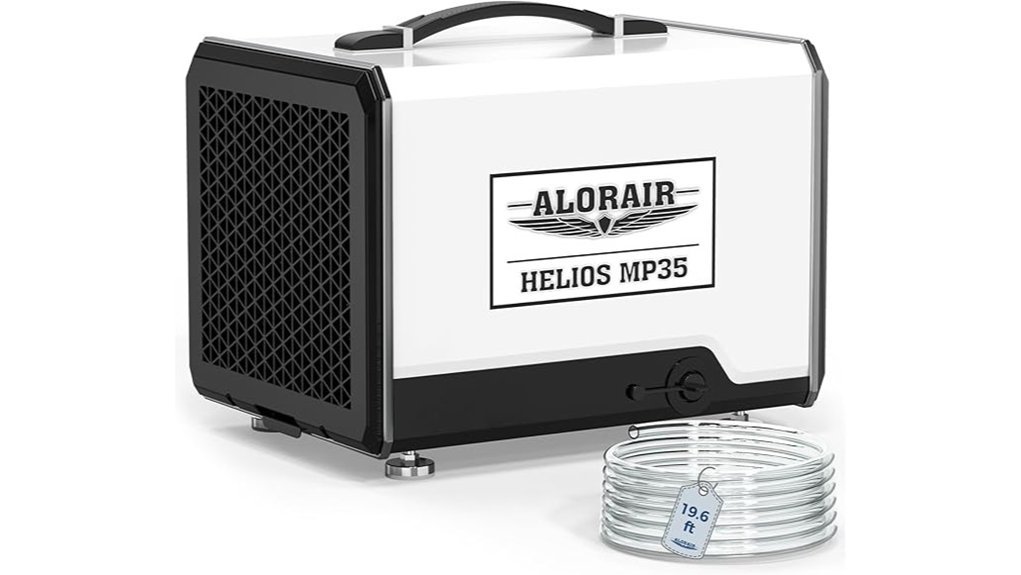
The ALORAIR Helios MP35 is a compact commercial and crawl-space dehumidifier for smaller affected areas. Its headline 70-pint rating is measured under saturated conditions. Under AHAM conditions, its verified capacity is approximately 35 pints per day, so it should not be compared directly with an 85-pint-AHAM restoration unit.
The machine covers areas up to a manufacturer-stated 1,000 square feet and produces approximately 126 CFM. Its built-in pump can move collected water through the included pump hose, while a separate gravity-drain option provides flexibility when a suitable lower drain is available.
Why You’ll Like It
It is smaller and easier to position than the higher-capacity machines, making it practical for a wet crawl space, utility room, storage area, or one isolated section of a basement after the bulk water has been extracted.
Best For: Localized clean-water damage, small crawl spaces, isolated rooms, and continued humidity removal after the most saturated materials have been addressed.
Who Should Avoid It: It is not the best single-machine choice for a severely flooded whole basement, several wet rooms, or heavily saturated structural materials.
Pros:
- Compact design is easier to place in crawl spaces and restricted areas.
- Built-in pump can discharge water vertically through the supplied pump hose.
- Also supports gravity drainage when an appropriate drain is available.
- Automatic operation and defrost reduce the need for constant adjustment.
- Corrosion-resistant casing is better suited to demanding areas than a standard household shell.
Cons:
- Actual AHAM capacity is 35 pints per day, not 70 pints.
- Lower airflow and capacity make it slower on major restoration jobs.
- Air movers and filtration equipment must be purchased or rented separately.
- The coverage figure should not be used as the only sizing measurement after a flood.
Factors to Consider When Choosing a Dehumidifier for Flood Damage
Flood-restoration equipment should be selected according to the amount and location of wet material, not simply the room’s floor area. A modest room with saturated drywall, insulation, carpet, and subflooring can create a much larger drying load than a bigger room with only humid air.
Restoration-Grade Versus Residential Equipment
A residential dehumidifier is normally designed to maintain comfortable humidity in a basement or living area. A restoration-oriented unit is better suited to extended operation, higher moisture loads, automatic drainage, cooler spaces, transport between work areas, and connection to drying accessories.
For a small plumbing leak caught immediately, a residential unit may help with final humidity control after water extraction. For a flooded basement, soaked building materials, or hidden cavity moisture, commercial equipment is usually the more appropriate category.
Compare AHAM and Saturation Capacity Correctly
Moisture-removal capacity is measured in pints collected over 24 hours at stated temperature and humidity conditions. A saturation figure measured near 90°F and 90% relative humidity will usually be much higher than an AHAM figure measured under less extreme conditions.
When comparing models, use ratings measured under the same conditions. The AHAM number provides the clearest conservative comparison among the three retained machines. Actual collection in your building may be lower or higher depending on temperature, humidity, airflow, and the amount of moisture that continues evaporating from materials.
Do Not Size by Square Feet Alone
Manufacturer coverage estimates are only a starting point. Flood-drying requirements depend on cubic volume, room layout, temperature, water depth, material porosity, wall cavities, insulation, airflow restrictions, and how long the materials were wet.
Moisture meters and repeated readings from affected materials provide more useful information than room humidity alone. A room can reach a lower relative humidity while moisture remains trapped behind drywall, under flooring, or inside framing.
Airflow and Air Movers
A dehumidifier removes moisture after water evaporates into the air. Air movers help increase evaporation across wet floors, walls, framing, and carpet. That is why restoration setups often use several air movers with one or more dehumidifiers.
Air movers must be positioned carefully. Do not blow air through contaminated areas or across visible mold without an appropriate remediation plan. Uncontrolled airflow can carry particles into unaffected rooms.
Automatic Drainage
Flood-recovery machines can collect a large amount of water. A built-in pump or automatic purge system allows water to move through a hose to an approved discharge point without shutting down when a small tank becomes full.
Check the pump’s supported lift, hose length, routing requirements, and discharge location. Secure the hose so it cannot pull loose, kink, freeze, drain back toward the machine, or create a slipping hazard.
Operating Temperature and Automatic Defrost
Cool basements and crawl spaces can cause frost to form on a dehumidifier’s coil. Automatic defrost helps protect performance, but every machine still has a specified operating-temperature range. Confirm that the affected area remains within that range.
Adding safe heat may increase evaporation and dehumidifier output, but improvised heaters can create fire, electrical, or carbon-monoxide hazards. Follow professional guidance and the equipment manufacturer’s instructions.
Electrical Capacity and GFCI Protection
Restoration equipment can place a substantial load on a circuit, especially when several air movers, an air scrubber, and a dehumidifier operate together. Confirm circuit capacity before connecting multiple machines.
Use properly grounded outlets and GFCI protection where required. Do not use damaged cords, place connections on wet floors, or operate equipment before a qualified person has determined that the electrical system is safe.
Portability, Filters, and Service Access
Check the machine’s weight, handles, wheels, cord storage, filter access, and pump-cleaning procedure. Flood environments may contain dust and debris that load filters quickly. A dirty filter reduces airflow and can slow moisture removal.
Warranty length is useful, but service access and replacement-part availability also matter. Read the current warranty terms because coverage may differ by seller, purchase date, component, and commercial-use conditions.
Before You Start Drying
- Document the damage. Photograph affected rooms and possessions and contact the insurer before discarding material when circumstances permit.
- Confirm that entry is safe. Check for structural instability, contaminated water, gas leaks, damaged wiring, and other hazards.
- Remove standing water. A dehumidifier is designed to remove water vapor, not pump floodwater from the floor.
- Remove unsalvageable materials. Wet insulation, drywall, carpet padding, and porous contents may need to be discarded rather than dried in place.
- Isolate unaffected areas. Close or contain openings where necessary to prevent moisture and contaminants from spreading.
- Position equipment safely. Keep air inlets and outlets clear, route drain hoses securely, and place electrical connections away from wet surfaces.
- Monitor the drying process. Record temperature, relative humidity, equipment operation, collected water, and moisture readings from affected materials.
- Continue until materials are dry. Do not stop merely because the room feels comfortable or the air-humidity display has fallen.
Frequently Asked Questions
How Long Does It Take to Dry Out a Flooded Area?
EPA and CDC guidance recommends cleaning and drying wet materials within 24–48 hours when possible to reduce mold risk. That is a target for beginning and accelerating cleanup, not a guarantee that a structure will be completely dry in two days. Full drying can take several days or longer depending on water depth, materials, weather, airflow, equipment capacity, and hidden moisture.
What Size Dehumidifier Do I Need for My Space?
Do not choose by square footage alone. Compare standardized pint capacity, airflow, room volume, temperature, the quantity of wet material, and whether water entered wall, ceiling, or floor cavities. Large or complicated losses may require several dehumidifiers and multiple air movers. A restoration professional can create an equipment plan using moisture readings and the building’s actual drying load.
Are Dehumidifiers Safe to Use Continuously?
Commercial dehumidifiers are generally designed for extended operation when installed and maintained according to the manufacturer’s instructions. Continuous use is only appropriate after the electrical system is declared safe, drainage is secured, filters are clean, airflow is unobstructed, and the unit remains within its approved temperature range.
Do I Need to Empty the Water Tank Frequently?
The three products retained in this guide use pump-based or automatic purge drainage, so they are not dependent on repeatedly emptying a small household bucket. The drain hose and discharge point still need regular inspection for leaks, clogs, kinks, freezing, or accidental movement.
Can Dehumidifiers Prevent Mold Growth After Flooding?
Dehumidifiers can reduce the moisture that supports mold growth, but they cannot guarantee prevention. Standing water, wet porous materials, hidden moisture, contaminated contents, and existing mold must also be addressed. Materials that cannot be cleaned and dried promptly may need removal.
Can I Use a Residential Dehumidifier After a Small Leak?
A household compressor dehumidifier may help after a minor clean-water leak when the water is removed immediately and only a limited area is affected. It should not be treated as a substitute for restoration equipment when drywall, insulation, subflooring, several rooms, or enclosed cavities are saturated.
Do I Also Need Air Movers?
Air movers often speed evaporation from wet surfaces, allowing the dehumidifier to capture the released vapor. The number and placement depend on the room layout and affected materials. Do not use air movers to blow across visible mold or contaminated material without proper containment and cleanup procedures.
When Should I Call a Restoration Company?
Professional help is strongly advisable for sewage or contaminated floodwater, widespread saturation, damaged electrical systems, structural movement, wet insulation, moisture inside wall or floor cavities, visible mold, vulnerable occupants, or damage extending through several rooms or levels.
Final Recommendation
Best Choice for Most Serious Drying Jobs
Choose the ALORAIR Storm LGR Extreme when you need a strong standalone restoration dehumidifier with an 85-pint AHAM rating, built-in pump, compact housing, and automatic defrost.
Choose the XPOWER XD-125 package when you also need air movers and a mini HEPA air scrubber. It provides the most complete starting setup, although package contents and availability should be checked carefully.
Choose the ALORAIR Helios MP35 for a smaller crawl space, isolated room, or localized residual-moisture problem where its 35-pint AHAM capacity is sufficient.
Whichever machine you select, begin with safe water extraction and removal of unsalvageable materials. Use standardized capacity, airflow, drainage, and material-moisture readings to guide the drying process instead of relying only on a large square-foot claim or the humidity shown on the control panel.