
If you are shopping for a 10L dehumidifier, focus on daily moisture-removal capacity rather than tank size or broad square-foot claims. The ZAFRO 21-pint model is the closest match at about 9.9 liters per day, while the Dravonic DA101 and AIRVIP offer higher 30- and 34-pint capacities for buyers who want more headroom in larger or damper rooms. Compare drainage, tank size, noise, controls, and operating conditions before choosing.
Affiliate disclosure: This article contains Amazon affiliate links. We may earn a commission from qualifying purchases at no extra cost to you.
Quick Answer: Choose the ZAFRO 21-Pint Dehumidifier if you want the closest match to a 10L-per-day rating. Pick the Dravonic DA101 for stronger automatic humidity control in larger rooms, or the AIRVIP 34-Pint when you want the highest listed extraction capacity of the three.
Important: Daily extraction ratings are measured under specific temperature and humidity conditions. Real-world water collection can be lower in cooler or less humid rooms.
Key Takeaways
- Closest to 10L: A 21-pint daily rating equals about 9.9 liters, making ZAFRO the most direct match.
- Best for larger or damper rooms: Dravonic and AIRVIP provide higher listed capacities, but their tanks are still small enough that continuous drainage may be preferable.
- Best buying metric: Compare daily extraction capacity, test conditions, drainage options, target-humidity controls, and low-temperature features—not tank volume alone.
Quick Comparison
| Product | Listed Daily Capacity | Tank | Drain Hose | Best For | Amazon |
|---|---|---|---|---|---|
| ZAFRO 21-Pint Best 10L-Class Match |
21 pints/day about 9.9L/day |
0.45 gallon | 3.3 ft included | Bedrooms, bathrooms, laundry areas, and moderately damp spaces | Check Price |
| Dravonic DA101 Best Automatic Control |
30 pints/day about 14.2L/day |
0.4 gallon | 3.28 ft included | Larger rooms, basements, laundry rooms, and continuous drainage | Check Price |
| AIRVIP 34-Pint Best Step-Up Capacity |
34 pints/day about 16.1L/day |
2.5 liters | 6.56 ft included | Buyers who want more capacity and a longer gravity-drain hose | Check Price |
Coverage figures and daily extraction ratings are seller-listed specifications, not guarantees for every room. Temperature, relative humidity, airflow, doors, windows, and the severity of the moisture problem can change actual performance.
ZAFRO 21-Pint Dehumidifier with Drain Hose
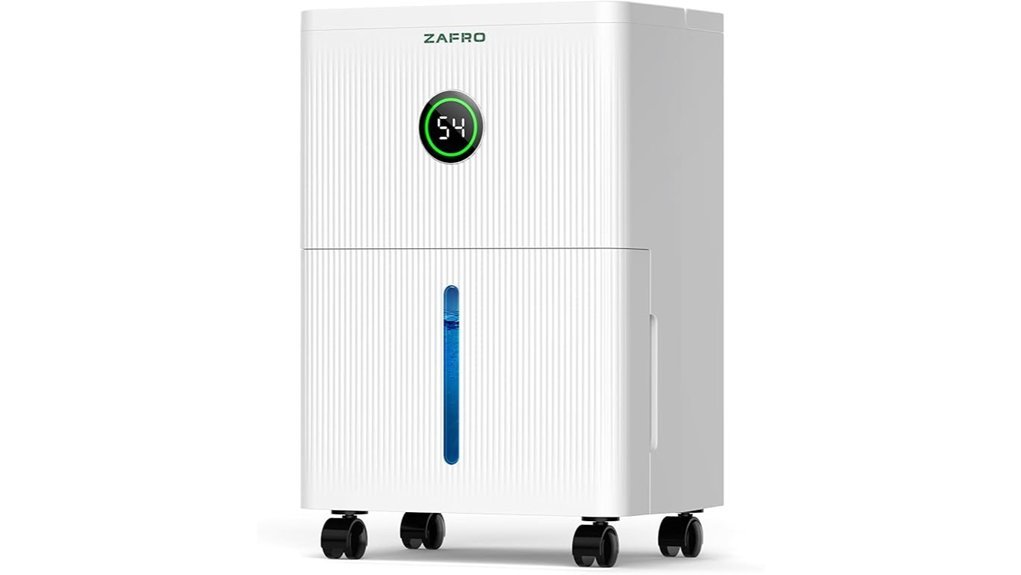
The ZAFRO is the most direct fit for someone searching for a 10L dehumidifier. Its listed 21-pint daily capacity converts to about 9.9 liters per day, placing it close to the target without moving into a much larger capacity class. It uses compressor technology and includes automatic humidity adjustment from 30% to 80%, a 24-hour timer, sleep mode, auto defrost, auto restart, a child lock, and a washable filter.
The 0.45-gallon tank is convenient for occasional manual emptying, but the included 3.3-foot hose is the better choice for long sessions. The seller lists operation as low as 41 dB, although perceived noise will depend on fan speed, room acoustics, and placement.
Why You’ll Like It: It combines a near-10L daily rating with continuous drainage, automatic humidity control, clear displays, and caster wheels.
Best For: Buyers who want the closest capacity match to 10L for bedrooms, bathrooms, laundry areas, and moderately damp rooms.
Who Should Avoid It: People dealing with severe flooding, active leaks, or very large open basements that need a substantially higher-capacity unit.
Pros:
- 21-pint rating is approximately 9.9 liters per day
- Includes a 3.3-foot gravity-drain hose and removable tank
- Automatic humidity control, timer, sleep mode, auto defrost, and auto restart
- Dual digital displays and a three-color humidity indicator improve visibility
Cons:
- The 0.45-gallon tank can fill quickly in damp conditions without hose drainage
- 41 dB is quiet for many users but not silent
- Real-world extraction may be lower than the maximum listed rating
Dravonic DA101 30-Pint Dehumidifier with Drain Hose
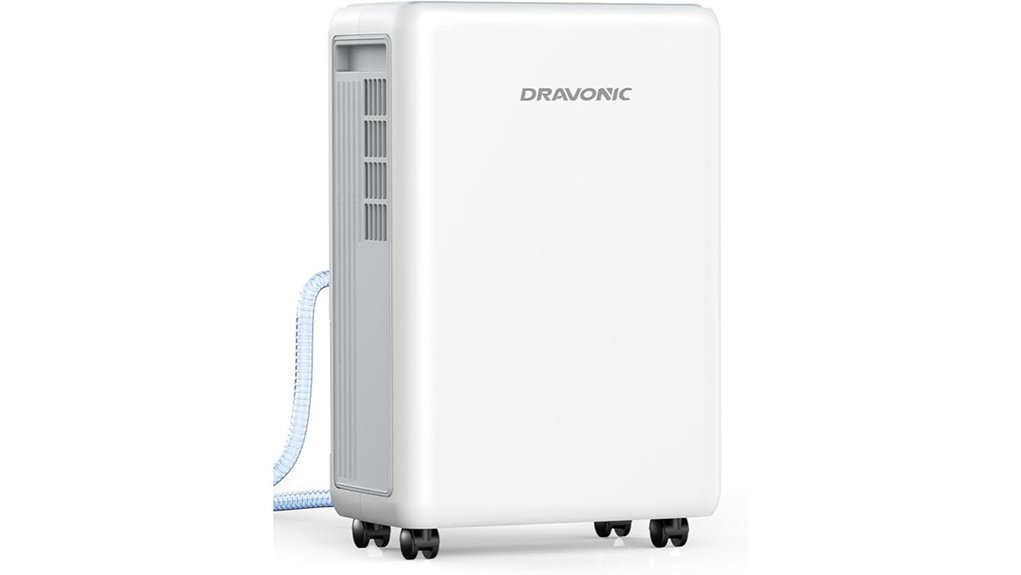
The Dravonic DA101 is a higher-capacity alternative for buyers who started with a 10L target but need extra moisture-removal headroom. It is listed at 30 pints per day, or about 14.2 liters, with coverage marketed up to 2,000 square feet. Treat that floor-area figure as a rough guide because room layout, temperature, air leakage, and moisture load can matter more than square footage alone.
Its digital controls monitor room humidity and can cycle the unit on or off around your selected setting. You also get comfort, quick-dry, and continuous modes, a 24-hour timer, child lock, automatic defrost, caster wheels, and built-in handles. The included 3.28-foot hose supports gravity drainage, while the 0.4-gallon tank works for shorter sessions.
Why You’ll Like It: It offers stronger capacity than a standard 10L unit while keeping automatic controls and continuous drainage simple.
Best For: Larger rooms, laundry areas, and basements where a 21-pint model may have to run almost continuously.
Who Should Avoid It: Buyers who only need light moisture control in a small closet or bathroom and prefer a very small, low-draw device.
Pros:
- Higher 30-pint daily rating for more demanding rooms
- Automatic target-humidity control and three operating modes
- Includes a 3.28-foot drain hose, auto defrost, child lock, and 24-hour timer
- Casters and handles make the roughly 16-pound unit easier to reposition
Cons:
- The 0.4-gallon tank is small relative to its listed extraction capacity
- It exceeds the 10L class, so it may be more machine than a lightly damp room needs
- The product uses automatic controls but should not be assumed to include app or Wi-Fi control
AIRVIP 34-Pint Dehumidifier with Drain Hose
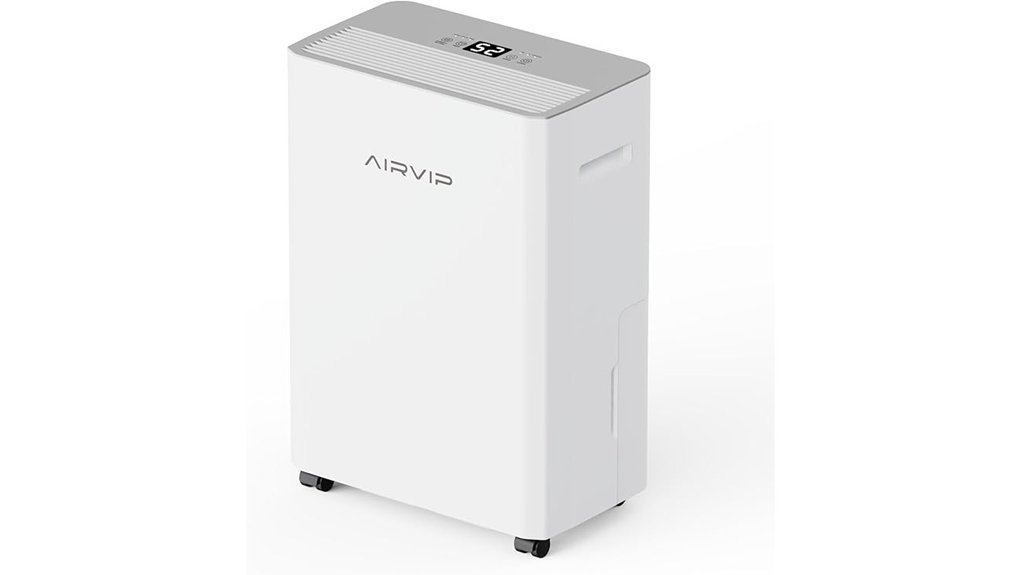
The AIRVIP is the highest-capacity option retained in this roundup. Its listing gives a maximum rating of 34 pints per day, or about 16.1 liters, under warm and humid test conditions. That makes it a step-up choice rather than a true 10L model. It may suit buyers who want shorter run times or more reserve capacity in a damp basement, laundry room, bathroom, or living area.
You can choose continuous, comfort, or manual humidity modes and use the included 6.56-foot hose for gravity drainage. The 2.5-liter tank offers manual drainage, while auto shut-off helps reduce overflow risk. The unit also includes caster wheels, a built-in handle, automatic defrost, and adjustable target-humidity controls.
Why You’ll Like It: It provides the strongest listed extraction rate here and the longest included drain hose.
Best For: Buyers who want more than 10L of daily capacity and expect to use continuous drainage in a larger or damper room.
Who Should Avoid It: Anyone who needs an exact 10L rating, verified app control, or a compact tabletop unit.
Pros:
- Highest listed capacity in the comparison at 34 pints per day
- Includes a longer 6.56-foot hose for gravity-fed continuous drainage
- Three humidity modes, automatic target shutoff, and auto defrost
- Wheels and a handle improve room-to-room mobility
Cons:
- Its 16.1L maximum rating is well above the original 10L target
- The 2.5-liter tank may still need frequent emptying without continuous drainage
- Noise and efficiency claims should be confirmed on the current product listing before purchase
Factors to Consider When Choosing a 10L Dehumidifier
A 10L dehumidifier should be chosen by its daily extraction rating, room conditions, drainage setup, and controls. Do not confuse the water-tank volume with the amount of moisture the machine can remove in 24 hours.
What a 10L Capacity Means
A 10L rating normally refers to the maximum amount of water a dehumidifier can extract from the air in 24 hours under stated laboratory conditions. It does not mean the tank holds 10 liters. A 21-pint model is approximately 9.9 liters per day, while 30- and 34-pint models equal roughly 14.2 and 16.1 liters per day.
Test Conditions and Real-World Output
Extraction capacity rises when the air is warmer and more humid. A unit advertised at its maximum rating may collect much less water in a cool room or after humidity falls. Compare the stated temperature and relative-humidity test conditions whenever the listing provides them, and use the rating as a comparison tool rather than a guarantee.
Room Size and Moisture Load
Square-foot coverage is only a starting point. A closed bedroom with mild condensation is easier to manage than an open basement with seepage, wet laundry, or frequent door traffic. Choose more capacity for colder, larger, leakier, or persistently damp spaces. Fix plumbing leaks, groundwater entry, and poor exterior drainage instead of relying on a dehumidifier alone.
Compressor Design
The retained models use compressor-style dehumidification, which is more appropriate for a genuine 10L-per-day target than small thermoelectric tabletop units. Compressor models are usually larger and more audible, but they can remove substantially more water in warm, humid conditions.
Tank Capacity
Tank size affects how often you must empty the unit; it does not determine daily extraction performance. A high-capacity machine with a small tank may stop several times per day in very damp conditions. Choose continuous drainage when a suitable floor drain, sink, or other lower drain point is available.
Continuous Drainage
A drain hose reduces daily maintenance, but gravity drainage needs a continuous downward slope without kinks or raised sections. Confirm that the hose reaches the drain and that the outlet remains above the drain point. Check the connection after moving the unit.
Humidity Controls
Automatic target-humidity controls let the compressor cycle instead of running nonstop. For general comfort, many households start around 45% to 55% relative humidity and adjust for the room, season, and condensation level. Avoid setting the target unnecessarily low because that can increase runtime and energy use.
Noise Level
Compressor dehumidifiers make fan and compressor noise. Sleep modes may lower fan speed or dim the display, but they do not make the machine silent. Place the unit on a firm, level surface and keep it away from the bed or seating area when sound sensitivity is important.
Energy Consumption
Daily electricity use depends on wattage and runtime. Calculate it with this formula: watts ÷ 1,000 × hours used = kWh. For example, a 130-watt unit running for eight hours uses about 1.04 kWh before normal cycling is considered. Use the current wattage listed for the exact model and multiply by your local electricity rate to estimate cost.
Low-Temperature Operation
Compressor coils can frost in cool rooms, reducing extraction. Auto defrost helps the machine pause and clear frost, but performance can still fall as temperature drops. Check the model’s operating-temperature range before using it in an unheated basement, garage, or seasonal property.
Portability and Maintenance
Casters and handles are useful when moving a compressor unit between rooms. Keep the air inlet and outlet clear, clean the washable filter as directed, empty and rinse the tank, and inspect the drain hose for kinks or buildup. Always unplug the appliance before cleaning or moving it.
Before You Buy
- Confirm that the listing states daily extraction in pints or liters—not only tank size.
- Check the temperature and humidity conditions used for the capacity rating.
- Measure the route from the unit to the drain before relying on the included hose.
- Verify whether the drain is gravity-fed and must sit below the outlet.
- Compare tank size, target-humidity range, auto defrost, restart behavior, and noise information.
- Read the current warranty, return terms, and included-accessory list on Amazon before ordering.
Frequently Asked Questions
Is a 21-Pint Dehumidifier the Same as 10L?
It is very close. Twenty-one US pints equal about 9.9 liters, so a 21-pint model is commonly suitable for shoppers seeking a 10L-per-day class.
Which Model Is Closest to a True 10L Rating?
The ZAFRO 21-pint model is the closest match in this article. Dravonic and AIRVIP are higher-capacity step-up options at approximately 14.2L and 16.1L per day.
Can a 10L Dehumidifier Handle a Basement?
It can help in a small or moderately damp basement, but basement conditions vary widely. A larger, colder, or persistently wet basement may need more capacity, continuous drainage, improved airflow, and repairs to stop the moisture source.
How Much Electricity Does a 10L Dehumidifier Use?
Use the model’s wattage and actual runtime. Divide watts by 1,000, then multiply by operating hours. A 130-watt unit running eight hours uses about 1.04 kWh; automatic cycling may reduce the actual runtime once the target humidity is reached.
Can a Dehumidifier Prevent Mold?
A dehumidifier can help reduce mold-friendly moisture, but it cannot repair leaks, remove existing mold, or replace ventilation and drainage work. Keep the room dry, address the moisture source, and clean affected materials safely.
Do 10L Dehumidifiers Work in Winter?
They can work in winter, but compressor models usually extract less water in colder air. Auto defrost helps manage coil frost. Check the operating-temperature range and avoid expecting the warm-weather maximum rating in an unheated room.
How Often Should the Water Tank Be Emptied?
Empty it whenever the full-tank indicator appears. In damp weather, a small tank may fill more than once per day. Continuous drainage is the easier option when the unit can sit above a suitable drain.
Can the Drain Hose Run Uphill?
Not with a basic gravity-drain setup. The hose should slope continuously downward from the dehumidifier to the drain. An uphill route generally requires a separate condensate pump that is compatible with the setup.
Conclusion
For the closest match to a 10L dehumidifier, the ZAFRO 21-Pint is the clearest choice. The Dravonic DA101 is better when you want more capacity and automatic humidity control for a larger room, while the AIRVIP 34-Pint offers the strongest listed extraction rate and the longest included drain hose.
Final Recommendation: Start with ZAFRO for a true 10L-class need. Move up to Dravonic or AIRVIP only when your room is larger, damper, or likely to benefit from extra capacity. Whichever model you choose, verify the current listing, test conditions, warranty, and drainage requirements before buying.


[…] Best 10L Dehumidifier: 3 Models Compared for 2026 […]