Updated: August 2, 2026. This is an editorial comparison based on published manufacturer and product information, not a claim of hands-on testing.
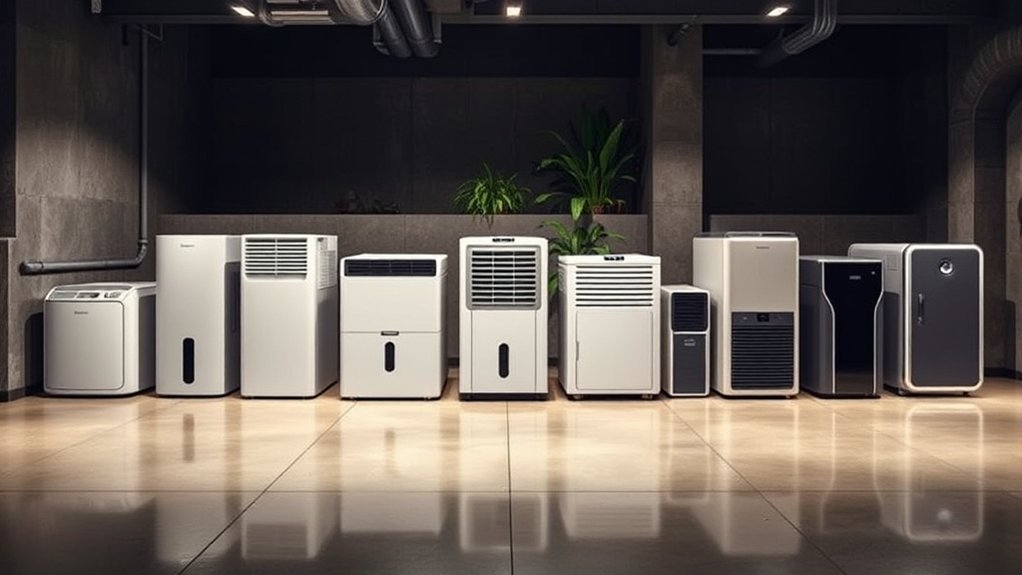
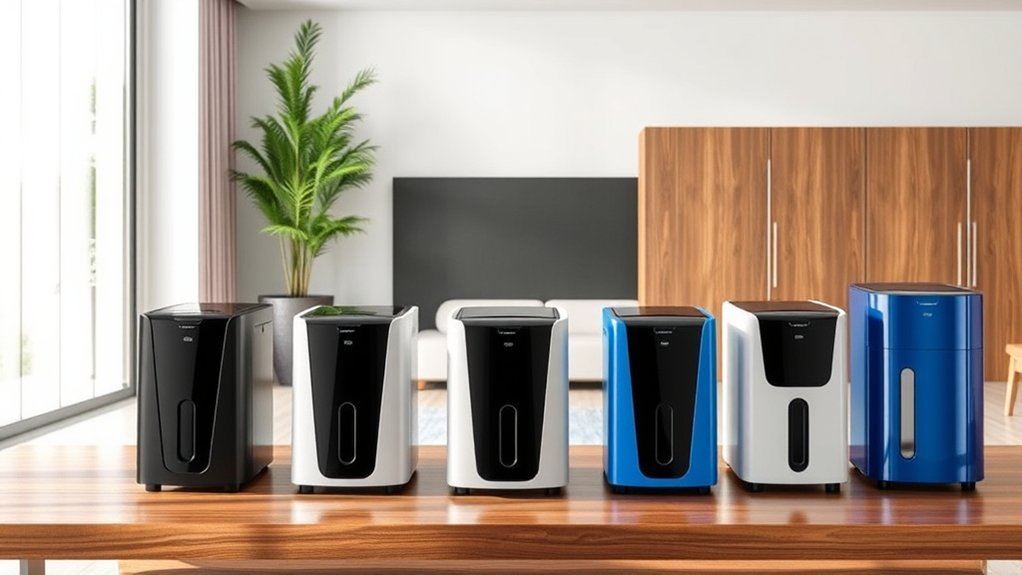
If you’re comparing the best compact dehumidifiers with pumps for 2026, start with the installation shape, standardized moisture-removal capacity, pump lift, and drainage route. A low-profile crawl-space model can fit beneath joists but may weigh nearly 40 pounds, while a tall portable model may use less floor space and provide a removable bucket.
The BaseAire AirWerx 35P and Abestorm Guardian SN35P are the clearest matches for low-clearance crawl spaces. The Sijipt Guardian SJ80P is a slimmer room-style alternative, but its advertised 80-pint figure is measured in unusually hot and humid conditions. The HBN 125-Pint Max provides more standardized moisture-removal capacity for wetter or larger installations, although it is the heaviest option in this guide.
Quick verdict: The BaseAire AirWerx 35P is the strongest all-around compact crawl-space pick because it combines a low-profile body, a 35-pint AHAM rating, pump and gravity drainage, automatic defrost, and clearly published operating specifications.
Closest alternative: The Abestorm Guardian SN35P offers almost the same dimensions and capacity, making current warranty, seller support, and listing terms important tie-breakers.
Need more capacity? The HBN 125-Pint Max is the better fit when moisture load matters more than low weight or room-to-room portability.
How these products were compared
The comparison prioritizes physical dimensions, standardized or clearly identified capacity, pump lift, drainage flexibility, low-temperature features, service access, and honest limitations. Manufacturer square-foot claims were treated as general guidance rather than guaranteed coverage.
Quick Comparison
| Product | Best For | Moisture Rating | Dimensions | Pump and Drainage | Key Limitation | Check Details |
|---|---|---|---|---|---|---|
| BaseAire AirWerx 35P | Low-clearance crawl spaces | 35 pints/day AHAM; 70 pints/day at saturation | 15.35 × 11.2 × 11.4 in | Built-in pump with listed 19.6-ft line; 6.5-ft gravity hose | About 39.7 lb and not designed like a wheeled room appliance | Check Amazon Availability |
| Abestorm Guardian SN35P | Compact crawl-space installations | 35 pints/day at 80°F and 60% RH; 70 pints/day at saturation | 15.2 × 11.2 × 11.4 in | 19.6-ft pump drain line; 6.5-ft gravity hose | Very similar to the BaseAire, so support and warranty details may decide the choice | Check Amazon Availability |
| Sijipt Guardian SJ80P | Finished rooms needing a slim floor footprint | 80 pints/day maximum at 95°F and 90% RH; prior DOE record listed 23.41 pints/day | 13 × 10 × 19 in | Built-in pump up to 16.4 ft; 6.56-ft gravity hose; removable tank | The 80-pint marketing figure is not comparable to an 80-pint standardized rating | Check Amazon Availability |
| HBN 125-Pint Max | High-moisture crawl spaces and commercial areas | 125 pints/day maximum at 95°F and 90% RH; about 60 pints/day under AHAM conditions | 19.3 × 12.6 × 13.8 in | Built-in pump up to 16.4 ft; approximately 6.6-ft gravity hose | About 57.9 lb, and published standard-condition data should be checked against the exact model label | Check Amazon Availability |
Important rating note: AHAM, DOE Appendix X1, and 95°F/90% RH maximum-capacity figures are measured under different conditions. Do not rank these products by the largest pint number alone. Use the standardized rating when it is available and treat hotter-condition maximum figures as separate specifications.
BaseAire AirWerx 35P Crawlspace Dehumidifier With Pump
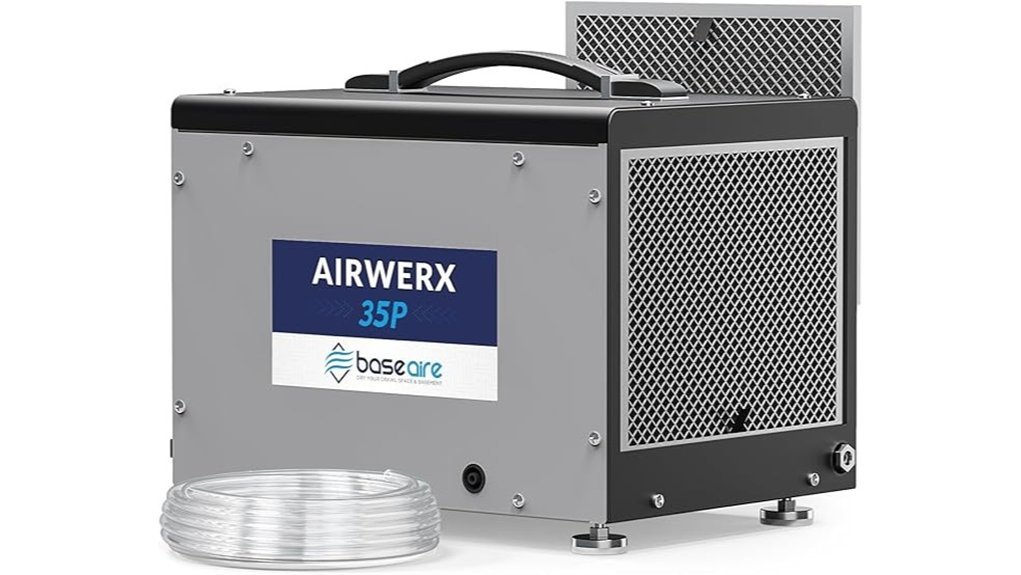
The BaseAire AirWerx 35P is designed for buyers who need pump drainage in a low-clearance crawl space, basement, storage area, or garage. Its horizontal body measures about 15.35 × 11.2 × 11.4 inches, so it can fit in locations where a tall bucket-style dehumidifier may be impractical.
Its capacity is stated clearly as 35 pints per day under AHAM conditions and up to 70 pints per day at saturation. BaseAire also lists a 19.6-foot pump drain line, a 6.5-foot gravity hose, automatic defrost, power-loss restart, operation from approximately 33°F to 105°F, sound below 50 dBA, and a weight of about 39.7 pounds.
The manufacturer markets it for spaces up to 1,000 square feet, but that figure should be treated as a sizing guide. Temperature, exposed soil, open vents, groundwater, air leakage, standing water, and the quality of crawl-space encapsulation can change the actual moisture load substantially.
Why You’ll Like It: It combines a genuinely low-profile footprint with clearly separated AHAM and saturation ratings, flexible drainage, and specifications suited to confined installations.
Best For: Encapsulated or reasonably sealed crawl spaces where the condensate line must rise or travel away from the unit.
Who Should Avoid It: Buyers who need casters, a removable room-style bucket, or frequent one-person carrying.
Pros:
- Low-profile dimensions suit confined installations.
- Clearly lists 35-pint AHAM and 70-pint saturation capacities.
- Provides both pump and gravity drainage.
- Listed operating range begins near 33°F.
- Automatic defrost and power-loss restart support semi-permanent use.
- Manufacturer currently advertises a five-year warranty.
Cons:
- The prominent 70-pint figure is a saturation rating, not its AHAM capacity.
- At roughly 39.7 pounds, it is compact but not especially lightweight.
- It still needs accessible space for filter, pump, and hose maintenance.
- The 1,000-square-foot claim cannot account for active water entry or an unsealed crawl space.
Installation tip: Test both the pump and any power-loss restart behavior before leaving the unit unattended. Route the hose where a loose connection or pump fault cannot damage finished materials.
Abestorm Guardian SN35P Compact Crawl Space Dehumidifier
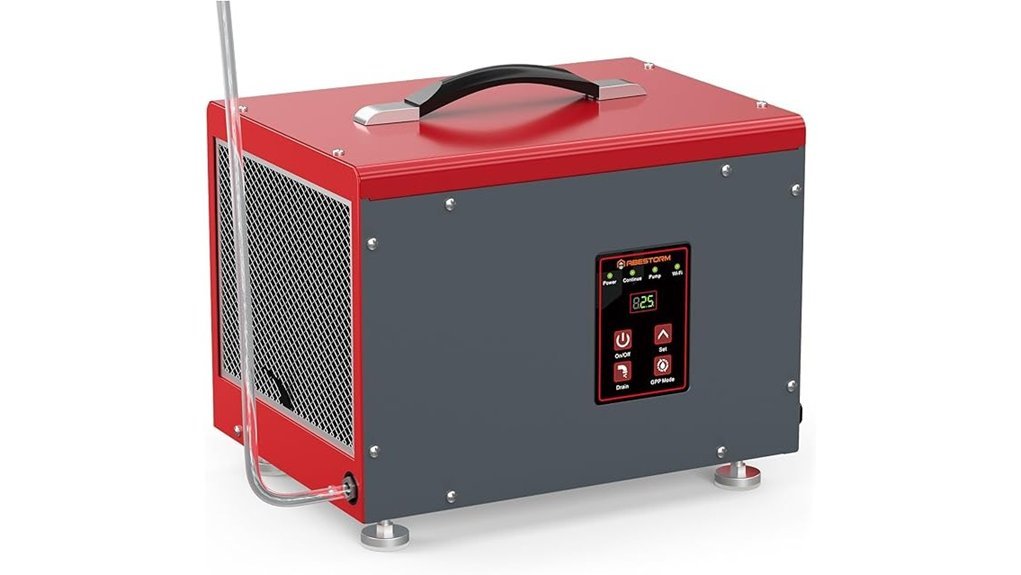
The Abestorm Guardian SN35P is another close match for crawl spaces, basements, garages, and storage areas with limited vertical clearance. Its body measures about 15.2 × 11.2 × 11.4 inches and weighs approximately 38.18 pounds.
Abestorm lists 35 pints per day at 80°F and 60% relative humidity and up to 70 pints per day at 90°F and 90% relative humidity. It includes a 19.6-foot pump drainage line and a 6.5-foot gravity drain hose. Published specifications also include a 33.8°F–110°F operating-temperature range, 25%–80% humidity-control range, automatic defrost, restart after a power interruption, and a 50 dBA sound rating.
Why You’ll Like It: The small horizontal body and long listed pump line provide flexibility when the nearest suitable drain is above or away from the unit.
Best For: Confined installations where buyers want clearly stated test conditions, drainage lengths, operating range, and unit weight.
Who Should Avoid It: Anyone who cannot provide a level surface, safe condensate route, adequate electrical supply, or maintenance access.
Pros:
- Compact low-profile housing for restricted spaces.
- Standard and saturation ratings are listed separately.
- Includes pump and gravity drainage options.
- Published operating range extends from approximately 33.8°F to 110°F.
- Automatic defrost and restart support longer unattended cycles.
Cons:
- Its capacity and dimensions are extremely close to the BaseAire, limiting meaningful performance differentiation on specifications alone.
- Its 38.18-pound weight is substantial for a unit of this size.
- Pump tubing, filter condition, and drain outlets require periodic inspection.
- Maximum coverage depends heavily on air sealing and moisture entry.
BaseAire or Abestorm? Their published size and capacity are nearly identical. Compare the current warranty wording, return terms, replacement-filter availability, seller support, and included accessories before deciding.
Sijipt Guardian SJ80P Dehumidifier With Pump
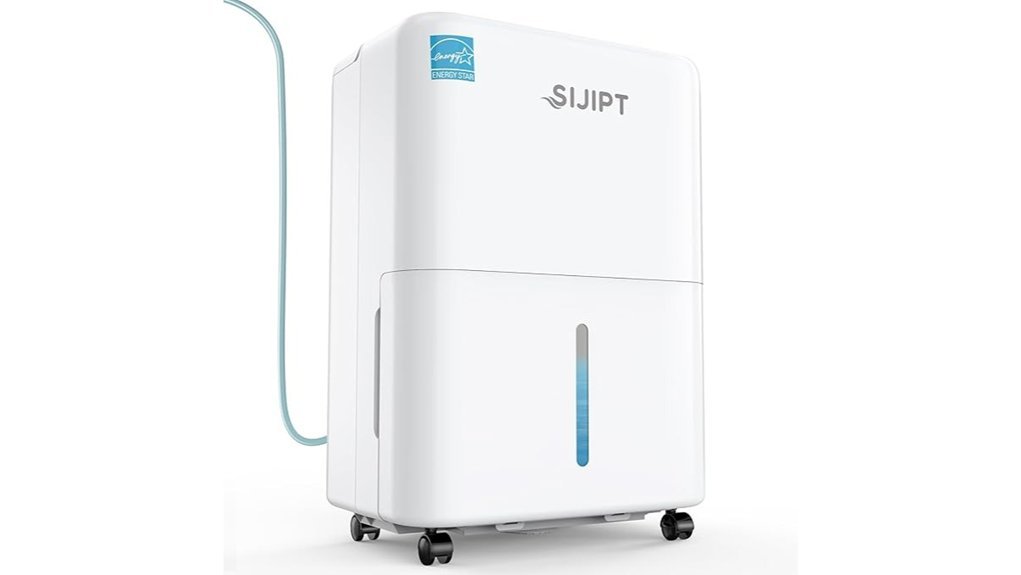
The Sijipt Guardian SJ80P is the room-style option in this comparison. Its body measures approximately 13 inches deep, 10 inches wide, and 19 inches high, giving it a smaller floor footprint than the horizontal commercial models while still providing wheels, a handle, a removable tank, automatic controls, and a built-in pump.
The manufacturer states that the pump can move condensate horizontally or vertically up to 16.4 feet and includes a 6.56-foot gravity drain hose. It also advertises a five-liter removable tank, two fan speeds, adjustable humidity control, automatic defrost, a timer, child lock, memory restart, and a washable filter.
Capacity requires careful interpretation. The advertised 80-pint maximum is measured at 95°F and 90% relative humidity. A previous ENERGY STAR qualification record for the Guardian SJ80P listed 23.41 pints per day under DOE Appendix X1 and a delisting date of December 31, 2025. That standardized figure makes it unsuitable to describe this model as more powerful than a current 35- or 50-pint standardized unit solely because “80 pint” appears in the product name.
Why You’ll Like It: It provides pump drainage, a removable tank, and room-to-room mobility without occupying much floor space.
Best For: Finished basements, laundry areas, garages, or other rooms where a tall portable design is easier to use than a heavy horizontal crawl-space machine.
Who Should Avoid It: Buyers who need the strongest standardized capacity, a low-profile body for installation beneath joists, or verified current certification without checking the exact listing.
Pros:
- Small 10 × 13-inch floor footprint.
- Built-in pump supports drainage up to the manufacturer-listed 16.4 feet.
- Includes gravity drainage and a removable five-liter tank.
- Wheels, a handle, timer, child lock, and operating modes improve room use.
- Washable filter and automatic defrost simplify routine ownership.
Cons:
- The 80-pint figure is measured at 95°F and 90% relative humidity.
- A prior DOE standardized record listed only 23.41 pints/day.
- The prior certification record shows a December 31, 2025 delisting date, so current certification should be verified.
- Its tall body is unsuitable for a low crawl space.
- Manufacturer coverage and noise claims may not reflect every real installation.
Rating caution: Do not compare this product’s 80-pint maximum directly with a 35-pint AHAM or 50-pint DOE rating. Check the current model label, EnergyGuide information, and certification database before treating efficiency or capacity claims as current.
HBN 125-Pint Max Crawl Space Dehumidifier With Pump
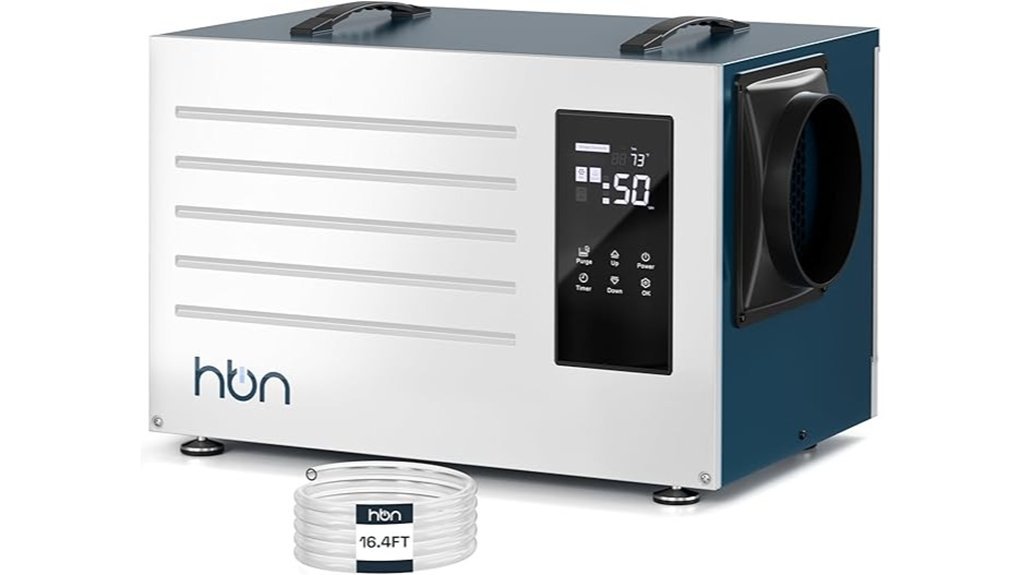
The HBN is the heavy-duty choice in this roundup. It is intended for crawl spaces, basements, warehouses, garages, workshops, and commercial locations where moisture-removal capacity matters more than easy room-to-room portability.
The available product data describes a horizontal metal body measuring about 19.3 × 12.6 × 13.8 inches and weighing approximately 57.9 pounds. It includes pump and gravity drainage, automatic defrost, humidity controls, a timer, power-loss memory, adjustable feet, carrying handles, and a washable filter.
The product is advertised at 125 pints per day at 95°F and 90% relative humidity. Current exact-model retailer data describes approximately 60 pints per day under AHAM conditions, although some related brand material uses a 63-pint standard-condition figure. Check the specification label or current manual supplied with the exact unit before making a capacity comparison.
The built-in pump is promoted with a lift of up to 16.4 feet, while the gravity hose is listed at approximately 6.6 feet. Its published coverage claim of up to 5,900 square feet is best treated as a broad manufacturer guide rather than a guarantee for wet, open, or poorly drained spaces.
Why You’ll Like It: It provides substantially more standardized moisture-removal headroom than the smaller products while retaining a reasonably compact horizontal shape for its class.
Best For: Larger or wetter crawl spaces, garages, workshops, storage areas, and commercial installations with a planned continuous-drain route.
Who Should Avoid It: Buyers who need a lightweight appliance, a removable bucket, or easy movement between furnished rooms.
Pros:
- Approximately 60-pint AHAM capacity is available in current exact-model product data.
- Built-in pump is listed for up to 16.4 feet of lift.
- Horizontal metal housing is relatively space-efficient for its capacity.
- Automatic defrost, power-loss memory, and timer support longer operating cycles.
- Adjustable feet and carrying handles help with permanent positioning.
Cons:
- The 125-pint headline is measured at 95°F and 90% relative humidity.
- Published standard-condition figures vary between approximately 60 and 63 pints/day.
- At roughly 57.9 pounds, it is not a convenient portable room appliance.
- Published square-foot figures should not replace moisture-load calculations.
- The heavy-duty design may be excessive for a small finished room.
Before choosing the HBN: Confirm that the installation surface can support the unit, that there is enough clearance to remove and clean the filter, and that the exact electrical circuit meets the model’s requirements.
Factors to Consider When Choosing a Compact Dehumidifier With Pump
A compact footprint is useful, but it should not be the only deciding factor. Compare the unit’s shape, standardized capacity, pump lift, drainage setup, temperature range, weight, noise, service access, and current warranty terms.
1. Separate Standardized and Maximum Capacity
Do not compare pint numbers until you know the test conditions. AHAM and DOE ratings are intended to support more meaningful product comparisons. Figures measured at 90°F or 95°F and 90% relative humidity represent much hotter and wetter air and will normally be higher.
For example, a crawl-space model advertised at 70 pints per day may be rated at only 35 pints per day under AHAM conditions. Likewise, the Sijipt’s 80-pint maximum should not be interpreted as a standardized 80-pint capacity.
2. Measure Height, Width, Depth, and Service Clearance
“Compact” can mean a short horizontal body or a tall unit with a small floor footprint. Measure the actual opening, joist height, doorway, and path to the installation point. Then add the manufacturer-required airflow clearance and enough space to reach the filter, controls, pump outlet, and power cord.
3. Measure the Pump Route
A pump is useful when water must travel upward to a suitable sink, condensate drain, or other approved discharge point. Check both the maximum vertical lift and total hose route. A product may include a long hose without being able to lift water that entire distance vertically.
For gravity drainage, maintain a continuous downward slope without kinks, loops, or standing water. Secure every connection and keep the outlet where overflow will not damage the building.
4. Size for Moisture Load, Not Just Square Footage
A sealed 1,000-square-foot crawl space may be easier to control than a smaller space with standing water, open vents, exposed soil, plumbing leaks, or groundwater intrusion. Fix active leaks and exterior drainage problems first. A dehumidifier manages airborne moisture but does not repair the source of water entry.
5. Check the Operating-Temperature Range
Compressor dehumidifiers collect less water as the air becomes cooler. Automatic defrost can protect the coils from frost, but it does not guarantee full rated capacity in cold conditions. Confirm the manufacturer’s minimum operating temperature and consider how cold the space becomes during winter.
6. Verify Current Efficiency Certification
Certification status can change when product revisions or program requirements change. Search the exact brand and model number in the current certification database instead of relying only on an Amazon title, product image, or older manual.
Choose enough standardized capacity for the moisture load rather than automatically selecting the largest maximum figure. A properly sized humidistat-controlled unit can cycle off after reaching its target, while an undersized unit may run continuously.
7. Consider Noise, Vibration, and Placement
Published decibel ratings are useful but incomplete. Fan speed, compressor cycling, pump activation, floor construction, and nearby framing can affect perceived sound. Place the unit on a firm, level surface and avoid direct contact with framing that can transmit vibration into living areas.
8. Leave Room for Maintenance
Even a continuously drained dehumidifier needs maintenance. Clean the filter according to the manual, inspect hoses for kinks and buildup, check the intake and exhaust openings, and test the pump and float controls periodically.
Do not permanently enclose a unit where the filter, electrical connection, pump, or drain fittings cannot be reached without dismantling the installation.
Before You Buy Checklist
- Measure the installation opening and access path.
- Confirm whether the body is low-profile or simply narrow.
- Compare standardized capacity, not only maximum-condition capacity.
- Measure the vertical lift and total route to the drain.
- Confirm that condensate may be discharged at the planned location.
- Check the operating-temperature range for a cool basement or crawl space.
- Confirm unit weight and whether one person can position it safely.
- Verify the current warranty, certification status, included hoses, and replacement-filter availability.
- Provide a grounded outlet that matches the manufacturer’s electrical requirements.
- Test the pump, hose connections, humidistat, and power-loss restart after installation.
Frequently Asked Questions
Does a Long Pump Hose Equal the Maximum Vertical Lift?
No. Included hose length and maximum vertical pump lift are different specifications. A 19.6-foot hose does not automatically mean the pump can lift water 19.6 feet straight upward. Follow the exact routing and lift limits in the manufacturer’s manual.
How Often Should I Empty the Pump Reservoir?
If the built-in pump is installed and functioning correctly, regular manual emptying should not be necessary during pumped operation. Designs vary, however. Test the pump and float system after installation, inspect the hose periodically, and respond promptly to any bucket-full or pump-error alert.
Are Compact Pump Dehumidifiers Noisy?
Noise varies by model, fan speed, surface, compressor cycle, and pump operation. Low-profile crawl-space units may be less noticeable when installed away from occupied rooms, while a portable model is easier to hear in a bedroom or office. Prevent the cabinet or hose from touching framing that can amplify vibration.
What Is the Difference Between AHAM and Saturation Pints?
An AHAM or DOE standardized figure measures moisture removal under specified comparison conditions. A saturation or maximum figure is usually measured in hotter, wetter air, such as 90°F or 95°F at 90% relative humidity. The maximum number will normally be higher and should not be compared directly with a standardized rating.
How Long Does a Dehumidifier With a Pump Last?
There is no universal lifespan. Runtime, dust, temperature, drainage setup, electrical conditions, component quality, and maintenance all affect service life. Warranty length can be a comparison point, but it does not guarantee how long the compressor, fan, pump, sensors, or controls will last.
Can I Use These Dehumidifiers in a Basement?
Yes, provided the chosen model has enough standardized capacity for the moisture load and its operating-temperature range suits the basement. A pump is particularly useful when no floor drain is available. Correct plumbing leaks, standing water, foundation seepage, and poor exterior drainage before relying on a dehumidifier alone.
Can I Use a Room-Style Dehumidifier in a Crawl Space?
Only when it physically fits, has suitable temperature and drainage specifications, receives adequate airflow, and can be accessed for maintenance. A tall portable unit may not fit beneath joists and may be less convenient to service than a horizontal crawl-space model.
Do Pump Dehumidifiers Require Regular Maintenance?
Yes. Clean or replace the filter as directed, inspect the air openings, test the pump, check drain hoses, and confirm that floats and automatic shutoff controls work. Unplug the unit before cleaning or servicing it and follow the manufacturer’s safety instructions.
What Humidity Level Should I Set?
A starting target near 50% relative humidity is practical for many basements and crawl spaces. Observe the space and adjust gradually. Avoid choosing the lowest setting automatically, because that can increase runtime and energy use without solving active water entry or wet building materials.
Can a Dehumidifier Fix Standing Water?
No. Remove standing water safely and correct its source first. A dehumidifier can help dry the remaining air and damp materials, but it cannot repair a plumbing leak, failed sump system, poor grading, groundwater intrusion, or foundation drainage problem.
Conclusion
The best compact dehumidifier with a pump depends on what “compact” means for your installation. The BaseAire AirWerx 35P is the most balanced low-profile option because its AHAM capacity, dimensions, pump drainage, temperature range, and warranty are clearly published. The Abestorm Guardian SN35P is a close alternative with almost identical dimensions and moisture-removal ratings.
The Sijipt Guardian SJ80P is easier to treat as a portable room appliance and uses little floor space, but its 80-pint maximum should not be confused with an 80-pint standardized rating. Choose the HBN 125-Pint Max when you need more standardized capacity and can accommodate its greater weight.
Final recommendation: Measure the opening, service clearance, and drain route first. Then compare standardized capacity and pump lift instead of selecting the largest advertised pint or square-foot figure.
Before purchasing, confirm the exact model number, current certification status, test conditions, included hoses, warranty terms, electrical requirements, and Amazon listing details.