If you need a powerful dehumidifier for a damp basement, garage, laundry room, or large living area, the right choice depends on verified moisture-removal capacity, drainage setup, room temperature, and tank size—not a square-footage claim alone. The 10 compressor-based models below include high-capacity options, continuous-drain units, one model with a built-in pump, and a smart compact alternative for medium-sized rooms.
Important capacity note: Manufacturers may advertise a maximum pint rating measured in very warm, humid conditions. A maximum figure such as 80, 90, 100, or 115 pints per day is not automatically the same as a standardized DOE Appendix X1 capacity. Compare models using the same test conditions whenever possible, and verify the exact model number in the current Amazon listing, product label, manufacturer documentation, and ENERGY STAR database.
Quick Verdict
Best overall with a pump: The Avylo is the most convenient choice for a large basement when water must be pumped upward to a sink or another elevated drain point.
Best high-capacity option: The Gasbye combines a 1.72-gallon tank with manufacturer-published output at several humidity conditions, making its performance easier to interpret than a single maximum number.
Best for wide airflow: The Waykar 80-Pint uses an automatic-swing outlet to distribute dry air across a large open space.
Best balanced efficiency pick: The Vellgoo combines a listed maximum of 64 pints per day, flexible drainage, and an ENERGY STAR Most Efficient 2024 claim for the listed model; verify the exact model in the official database.
Best smart compact alternative: The Midea Cube offers Wi-Fi control and a large removable bucket for medium-sized rooms, but it is not intended to replace a high-capacity basement unit.
How We Compared These Dehumidifiers
We compared the models by capacity test conditions, drainage choices, bucket size, operating-temperature information, humidity controls, portability, and the clarity of current manufacturer or retailer documentation. We did not treat a large advertised coverage area or maximum pint number as proof of standardized performance.
- For very damp basements: Prioritize a clearly documented standardized capacity and continuous drainage.
- For an elevated drain: Choose a built-in pump rather than trying to force a gravity hose uphill.
- For manual emptying: A larger tank can reduce trips, but a full tank is heavier to carry.
- For bedrooms or offices: Favor lower noise, a suitable capacity, and an accessible low fan setting.
Quick Comparison of the Best Powerful Dehumidifiers
| Product | Best For | Listed Capacity | Listed Coverage | Drainage | Amazon |
|---|---|---|---|---|---|
| Avylo with Pump | Best Overall With Pump | Maximum 90 pints/day at 95°F/95% RH | Up to 4,500 sq. ft. | Tank, gravity hose, or pump | Check Details |
| Gasbye | Large Tank and High Maximum Rating | 115 pints at 86°F/80% RH; 73 at 80°F/60% RH | Up to 4,500 sq. ft. | Tank or continuous hose | Check Details |
| Waykar 80-Pint | Large Rooms and Wide Airflow | Maximum 80 pints/day at 95°F/90% RH | Up to 5,000 sq. ft. | Tank or continuous hose | Check Details |
| DECIUU | Large-Space Moisture Removal | Maximum 100 pints/day; 70-pint standard rating listed | Up to 5,000 sq. ft. | Tank or continuous hose | Check Details |
| Vellgoo 64-Pint | Balanced Efficiency and Capacity | Maximum 64 pints/day at 95°F/90% RH | Up to 4,000 sq. ft. | Three drainage options | Check Details |
| AEOCKY 50-Pint | Medium-to-Large Rooms | Maximum 50 pints/day listed | Up to 3,500 sq. ft. | Tank or drain hose | Check Details |
| VEAGASO | Basements Up to 2,500 sq. ft. | Maximum 34 pints/day | Up to 2,500 sq. ft. | 2-liter tank or hose | Check Details |
| SEMKAP | Value-Focused Large-Room Use | Maximum 32 pints/day | Up to 2,500 sq. ft. | 2.5-liter tank or hose | Check Details |
| Waykar 34-Pint | Efficient Medium-Room Use | Maximum 34 pints/day listed | Up to 2,000 sq. ft. | 0.62-gallon tank or hose | Check Details |
| Midea Cube 20-Pint | Smart Controls and Large Bucket | 20 pints/day | Up to 1,500 sq. ft. | 3.2-gallon bucket or hose | Check Details |
Midea Cube 20 Pint Dehumidifier With Smart Control
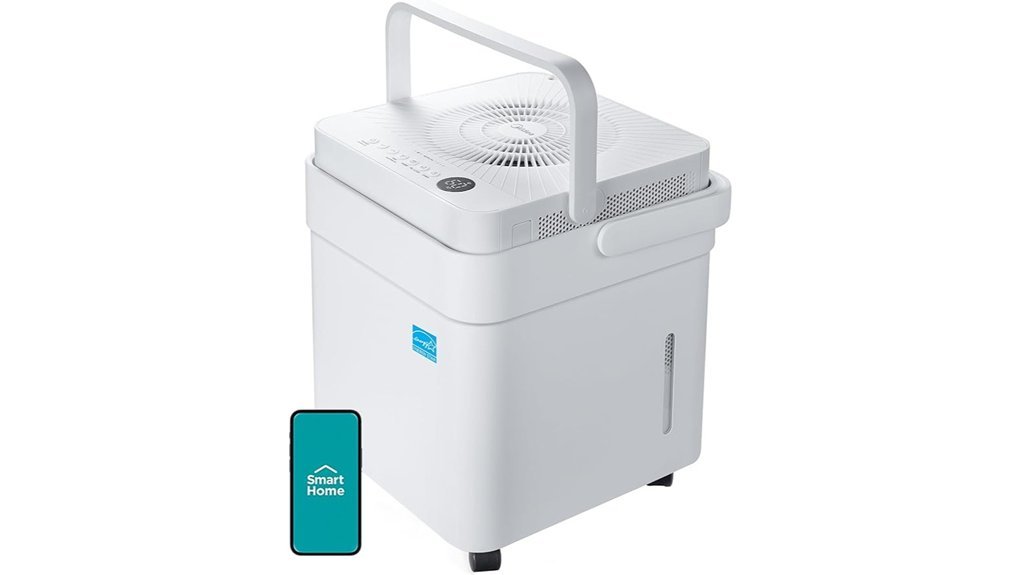
Best smart compact pick: The Midea Cube is a practical choice for people who want app control without sacrificing bucket capacity. It is listed for spaces up to 1,500 square feet and removes up to 20 pints of moisture per day under its standardized rating.
Its unusual lift-and-twist design lets you operate the unit in an extended position and nest it for storage. The removable bucket holds approximately 3.2 gallons, which can reduce how often it needs to be emptied compared with many conventional 20-pint models. Continuous gravity drainage is also supported with the included hose.
Why You’ll Like It
- Wi-Fi control through the Midea SmartHome app.
- Compatible with Alexa and Google Assistant.
- Large 3.2-gallon removable bucket.
- Continuous-drain option and auto restart.
- Washable filter and a one-year limited warranty listed by the manufacturer.
Best For: Bedrooms, offices, apartments, and medium-sized rooms where smart control and a larger bucket are more important than maximum extraction power.
Consider Another Model If: You have a very wet basement, standing-water problems, or a large open area that requires substantially more than 20 pints of standardized daily removal.
VEAGASO 2500 Sq. Ft. Dehumidifier With Drain Hose
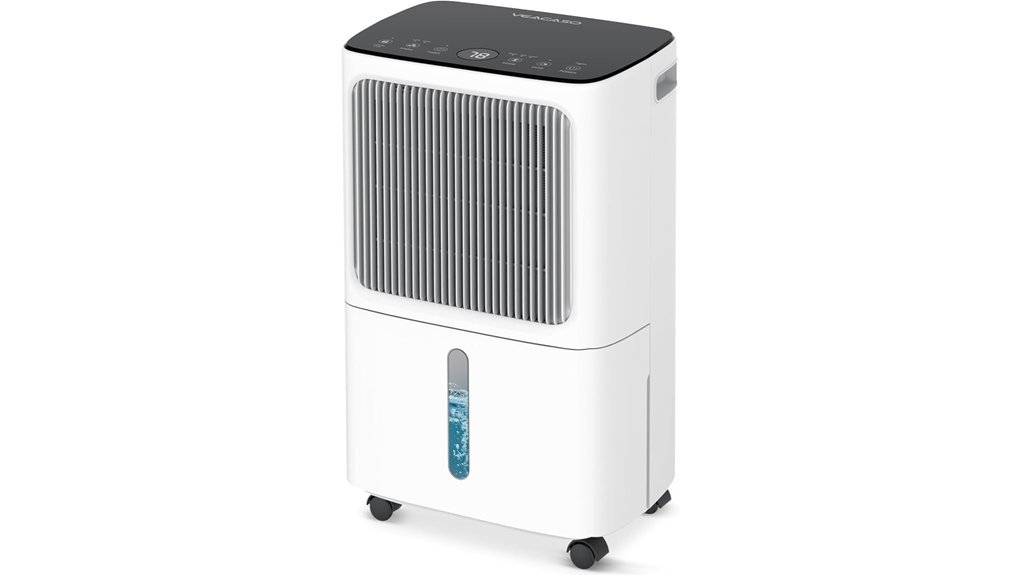
Best for flexible operating modes: The VEAGASO VG380 is a portable compressor model with Dehumidify, Continuous, and Clothes-Drying modes. Its current manufacturer page lists a maximum removal rate of 34 pints per day and coverage up to 2,500 square feet.
The 2-liter tank is relatively small, so the included 3.28-foot gravity-drain hose is especially useful for a damp basement or long operating periods. The digital controls let you select a target humidity, timer, and operating mode without a complicated setup.
Why You’ll Like It
- Three modes for automatic humidity control, continuous operation, and laundry drying.
- Continuous gravity drainage with an included hose.
- Automatic shutoff when the tank is full.
- Washable filter, timer, wheels, and carrying handle.
- Manufacturer-listed operating noise of 40 dB or less.
Best For: Medium-sized basements, bathrooms, laundry areas, and bedrooms where continuous drainage is available.
Consider Another Model If: You need a large manual water bucket, a built-in pump, or a clearly documented standardized capacity for direct cross-brand comparison.
Gasbye Dehumidifier for Large Rooms
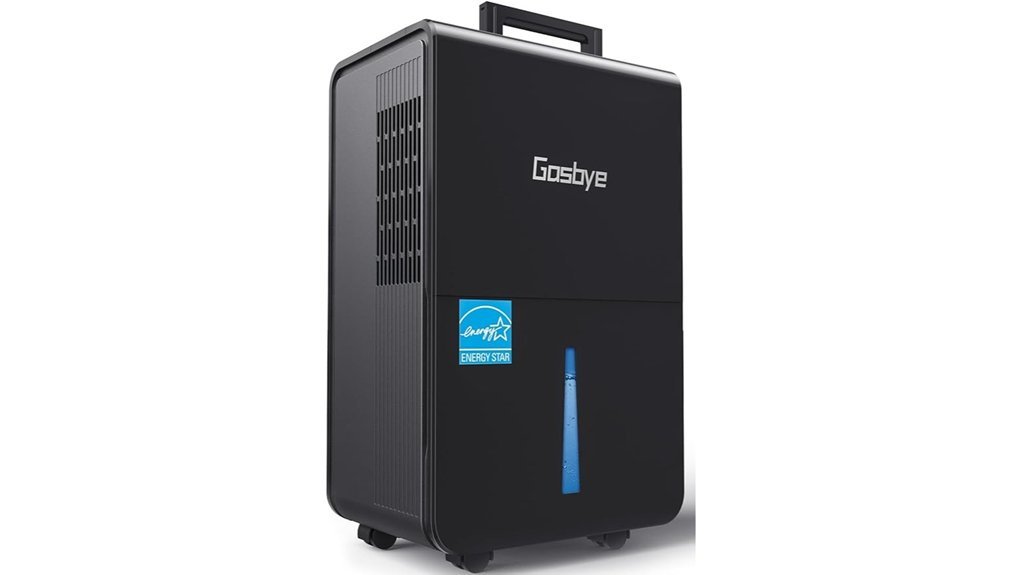
Best high-capacity tank option: The Gasbye DryPrime-50-B is designed for large rooms and basements, with listed coverage up to 4,500 square feet. The manufacturer publishes several output figures: 115 pints per day at 86°F and 80% RH, 73 pints at 80°F and 60% RH, and 50 pints at 65°F and 60% RH.
That multi-condition disclosure makes the performance easier to interpret than a single maximum number. The 1.72-gallon tank is useful when a floor drain is unavailable, while continuous gravity drainage can reduce maintenance in persistently damp areas. Auto shutoff and auto restart are also listed.
Why You’ll Like It
- Performance figures disclosed at three temperature and humidity conditions.
- Large 1.72-gallon water tank.
- Continuous-drain compatibility and included hose options.
- Auto shutoff, auto restart, and digital humidity controls.
- Manufacturer-listed operating noise of approximately 44 dB.
Best For: Buyers who want a high-capacity compressor model with a large bucket and more transparent condition-based output figures.
Consider Another Model If: You need a built-in pump, a smaller cabinet, or an exact current certification record that you have not yet confirmed by model number.
DECIUU 5000 Sq. Ft. Energy Star Dehumidifier
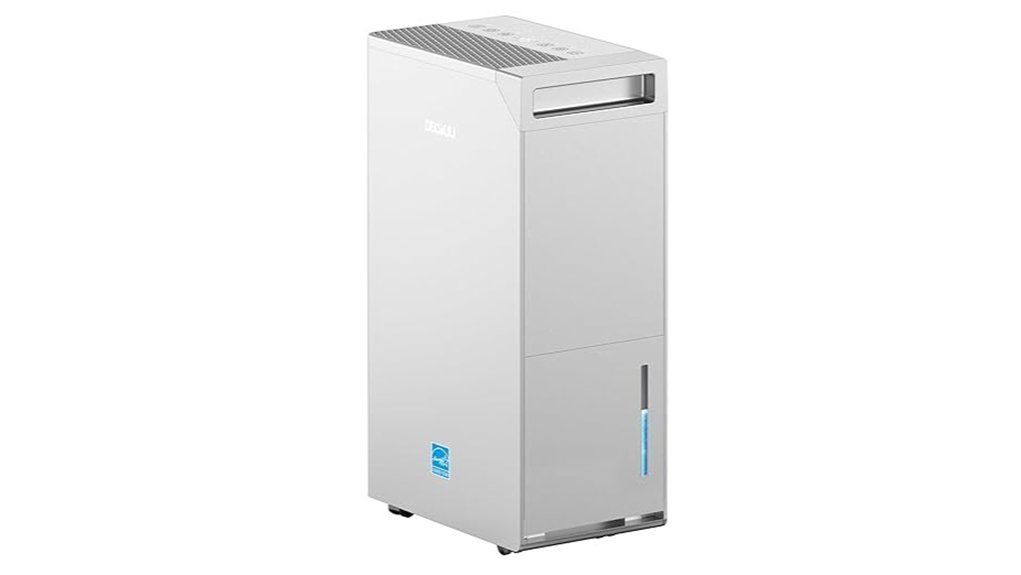
Best for large-space moisture removal: The DECIUU DER32S01-50 listing describes a maximum output of 100 pints per day and a 70-pint standard rating for spaces up to 5,000 square feet. Keeping both figures visible is important because the 100-pint maximum should not be compared directly with another model’s standardized capacity.
The listing also describes a removable tank, drain hose, garden-hose adapter, three fan speeds, auto defrost, auto restart, timer, and child lock. At approximately 32.8 pounds, it is lighter than some other large-capacity options, and casters help with room-to-room movement.
Why You’ll Like It
- High manufacturer-rated maximum with a separate 70-pint standard figure listed.
- Large-room coverage and continuous gravity drainage.
- Three fan speeds and adjustable humidity control.
- Auto defrost, restart, timer, and child-lock functions.
- Drain hose and garden-hose adapter listed as included accessories.
Best For: Large basements, garages, storage areas, and laundry rooms with a nearby floor drain.
Consider Another Model If: You need a built-in pump, a larger clearly documented bucket, or a certification record you have not yet verified by exact model number.
Waykar 2000 Sq. Ft. 34 Pint Energy Star Dehumidifier
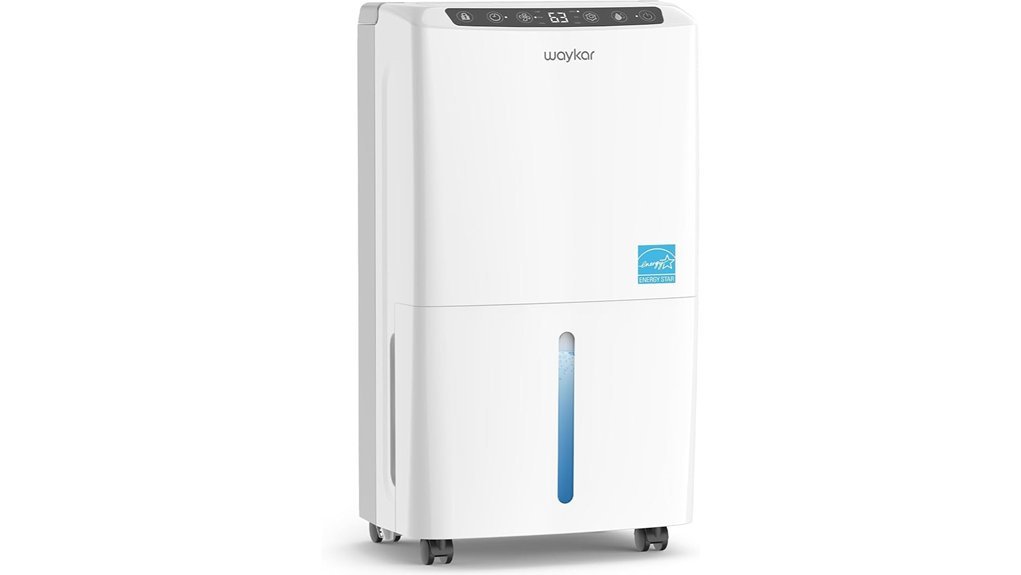
Best efficient medium-room pick: The current listing tied to ASIN B0DHCGC8RD identifies this model as a maximum 34-pint dehumidifier for spaces up to 2,000 square feet—not the 30-pint, 1,500-square-foot specification previously associated with the article.
The listing describes an ENERGY STAR Most Efficient 2025 designation, a 0.62-gallon tank, quiet operation around 33 dB, adjustable humidity control, and automatic or manual drainage. These features make it a practical option for bedrooms, offices, living rooms, and moderately damp basements.
Why You’ll Like It
- Maximum 34-pint listed daily capacity.
- Coverage marketed for up to 2,000 square feet.
- ENERGY STAR Most Efficient 2025 designation shown on the listing.
- Automatic humidity control and continuous drainage.
- 0.62-gallon tank and washable filter.
Best For: Medium-sized rooms where quiet operation and energy efficiency matter more than maximum extraction capacity.
Consider Another Model If: You need high-capacity control for a very wet basement, pumped drainage, or a much larger manual bucket.
Vellgoo 64 Pint Energy Star Dehumidifier for Home
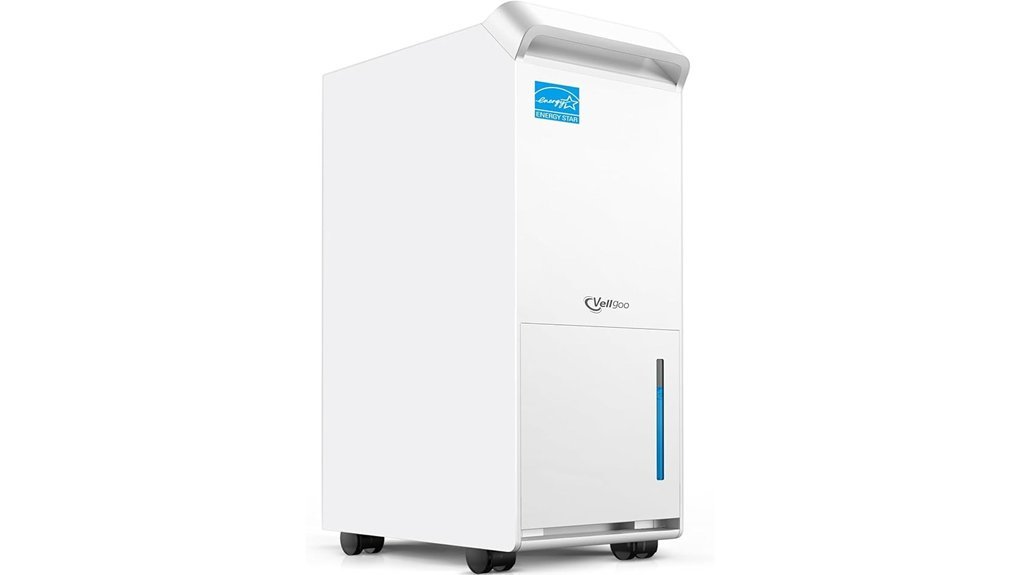
Best balanced efficiency pick: The current listing associated with this 4,000-square-foot option describes a maximum removal rate of 64 pints per day at 95°F and 90% RH. That is a high-temperature maximum, not a standardized 64-pint DOE rating.
The product listing also displays an ENERGY STAR Most Efficient 2024 designation and describes smart humidity control, three drainage options, auto defrost, auto restart, a timer, and mobility features. This makes it a useful middle ground for buyers who want more capacity than a compact model but do not need an integrated pump.
Why You’ll Like It
- Maximum 64-pint listing for warm, very humid conditions.
- Coverage marketed for up to 4,000 square feet.
- Three drainage options.
- Auto defrost and auto restart.
- Portable design with wheels and a carrying handle.
Best For: Basements, garages, living areas, and laundry rooms where flexible drainage and a higher manufacturer-rated maximum are priorities.
Consider Another Model If: You need pumped drainage or require an exact standardized capacity and current certification record before choosing.
Waykar 80 Pints Energy Star Dehumidifier for Large Rooms
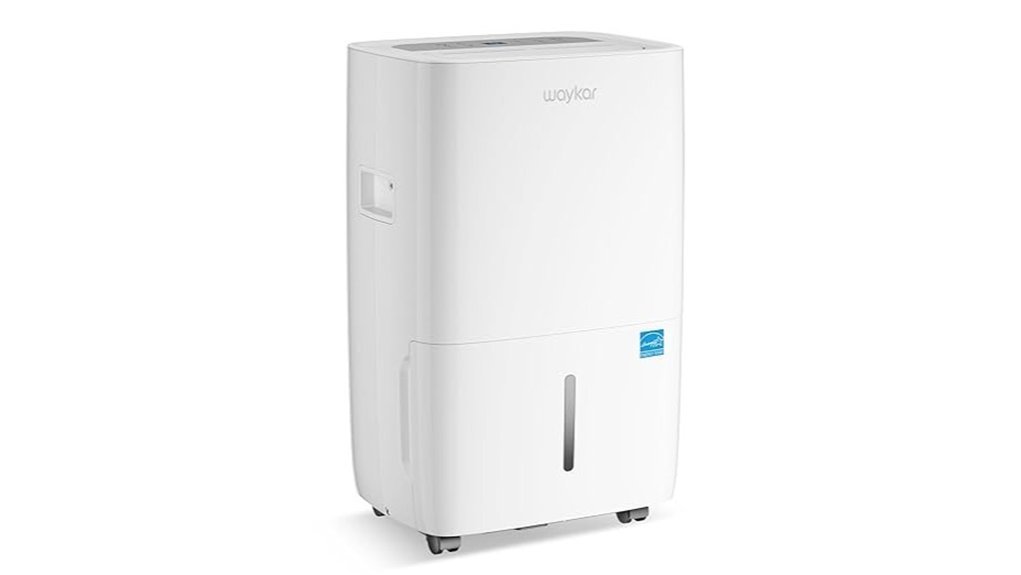
Best for wide airflow: The Waykar model is marketed for spaces up to 5,000 square feet and removes a maximum of 80 pints per day at 95°F and 90% RH. Its 30- to 90-degree automatic-swing outlet is designed to distribute dry air across a broad open area.
You can adjust the target humidity, schedule operation with the 24-hour timer, or use continuous gravity drainage when a suitable lower drain is available. The current manufacturer page also lists a 1.14-gallon tank, approximately 42 dB operation, and auto defrost.
Why You’ll Like It
- Maximum 80-pint rating at 95°F and 90% RH.
- Coverage marketed for up to 5,000 square feet.
- Automatic 30- to 90-degree swing airflow.
- Continuous drainage, timer, and adjustable humidistat.
- Auto defrost and a 1.14-gallon tank listed by the manufacturer.
Best For: Open basements, large living rooms, laundry spaces, and other areas where broad airflow is useful.
Consider Another Model If: You need water pumped vertically, require a clearly stated standardized capacity, or have limited floor space for a larger cabinet.
AEOCKY 50 Pint Compressor Dehumidifier for Home
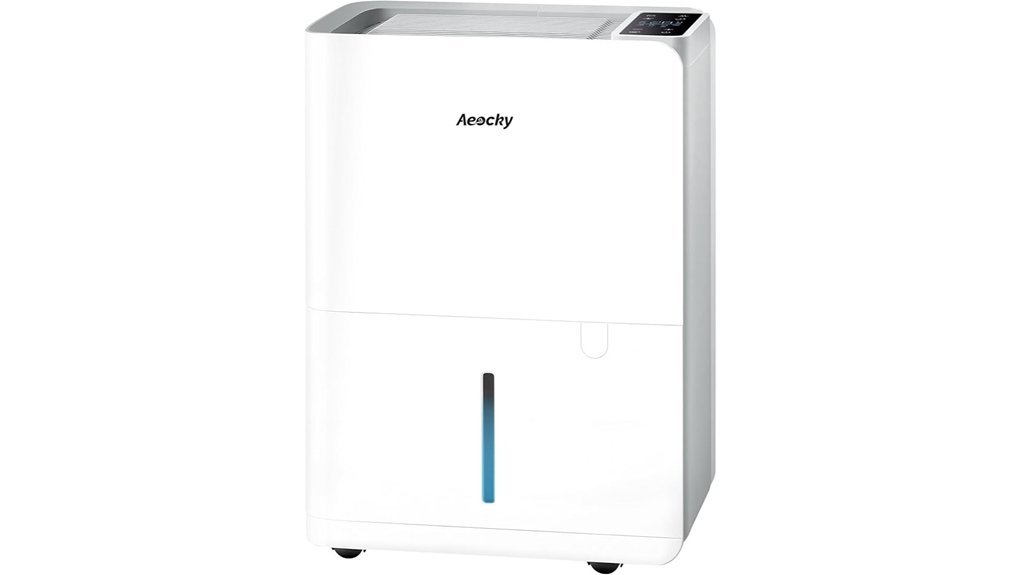
Best mid-to-large room pick: The AEOCKY Boreas listing describes a maximum 50-pint-per-day compressor dehumidifier for areas up to 3,500 square feet. Because the manufacturer uses “max” language, buyers should not assume the figure is a standardized 50-pint DOE capacity without checking the exact test conditions.
The product includes an intelligent humidistat, continuous-drain support, and a portable cabinet for basements, bedrooms, bathrooms, RVs, and garages. The manufacturer also lists approximately 40 dB operation and a three-year warranty, but both should be confirmed on the exact Amazon offer before purchase.
Why You’ll Like It
- Maximum 50-pint listed daily capacity.
- Coverage marketed for up to 3,500 square feet.
- Continuous drainage and intelligent humidity control.
- Manufacturer-listed sound level of approximately 40 dB.
- Portable design for several residential spaces.
Best For: Buyers who want more capacity than a compact model without stepping up to the largest 80- to 100-pint maximum-rated units.
Consider Another Model If: You need an integrated pump, a clearly documented standardized capacity, or reliable operation below the model’s published minimum temperature.
SEMKAP 32 Pints Dehumidifier for Home and Basement
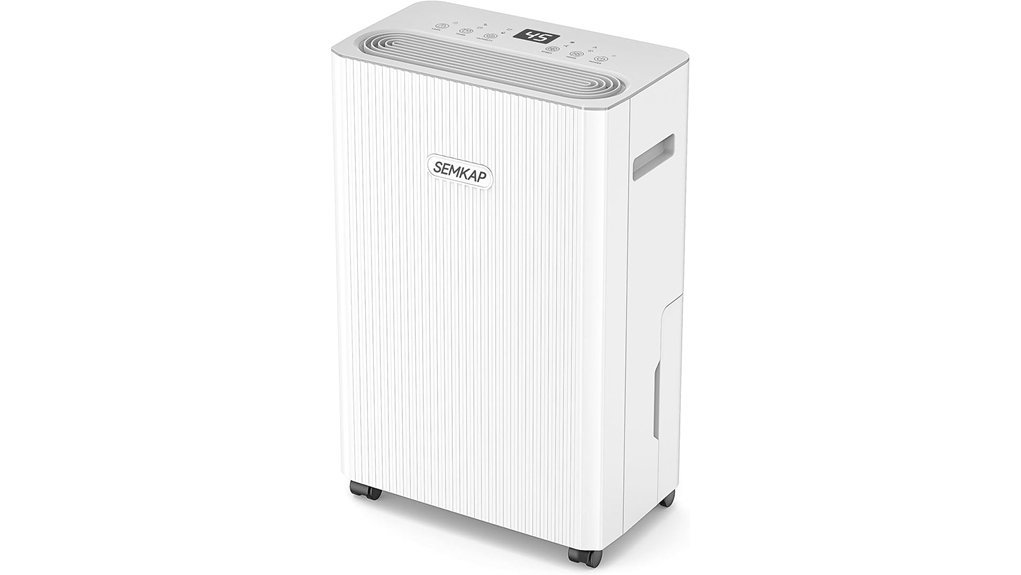
Best value-focused 2,500-square-foot pick: The SEMKAP PD8R-03ME listing describes a 32-pint compressor dehumidifier for rooms up to 2,500 square feet with a 2.5-liter tank.
The included 3.28-foot drain hose allows continuous gravity drainage. Other listed features include automatic shutoff, auto defrost, auto restart, a timer, child lock, digital humidity control, wheels, and a washable filter.
Why You’ll Like It
- 32-pint listed capacity for medium-sized residential spaces.
- 2.5-liter tank with full-tank shutoff.
- Included hose for continuous gravity drainage.
- Auto defrost, restart, timer, child lock, and humidistat.
- Wheels and handle for easier relocation.
Best For: Buyers seeking a straightforward compressor dehumidifier for a basement, office, living room, or laundry area.
Consider Another Model If: You need a verified standardized rating, a larger bucket, or a built-in pump.
Avylo Dehumidifier for Basement With Pump
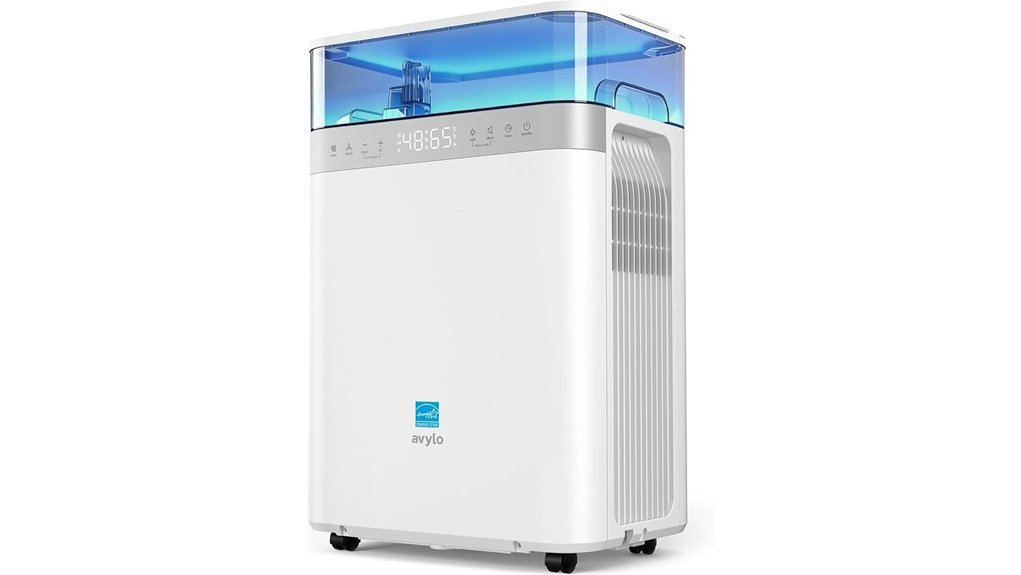
Best overall with a pump: The Avylo ADC018 is the most convenient option in this roundup when gravity drainage is not possible. Its built-in pump can move collected water toward an elevated drain point, reducing the need to empty the bucket manually.
The manufacturer advertises a maximum removal rate of 90 pints per day at 95°F and 95% RH, coverage up to 4,500 square feet, a 2.11-gallon top-mounted tank, and three drainage methods. The pump is listed for a vertical drainage height up to 15 feet with a 15-foot hose included.
Why You’ll Like It
- Built-in pump for more flexible drainage placement.
- Maximum 90-pint rating at 95°F and 95% RH.
- Large 2.11-gallon top-mounted tank.
- Gravity drainage and manual tank collection are also available.
- Auto shutoff, auto defrost, and intelligent humidity control.
Best For: Large basements where the nearest sink, window, or drain is above the dehumidifier.
Consider Another Model If: You have a nearby floor drain and do not need pump functionality, or you want a model with a clearly confirmed standardized capacity and current certification record.
Factors to Consider When Choosing a Powerful Dehumidifier
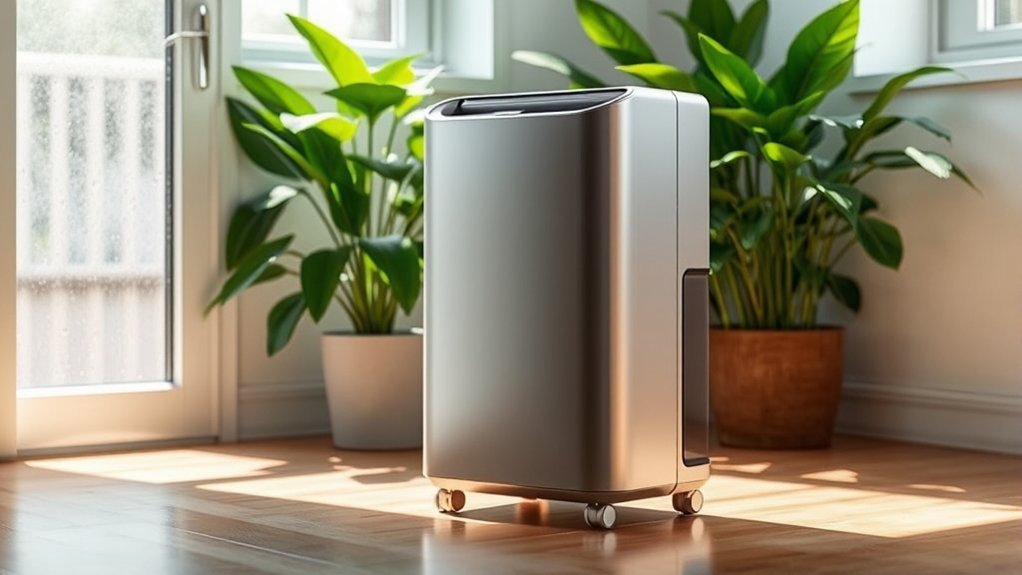
A powerful dehumidifier should match the moisture load, room temperature, drainage setup, and noise tolerance of the space. Do not choose a unit based on square-footage marketing alone.
Compare Capacity Test Conditions
Look for the conditions used to produce the pint-per-day rating. A maximum rating measured at 95°F and 90% relative humidity can be much higher than the amount the same unit removes in a cooler basement. Standardized DOE capacity is more useful when comparing different brands.
When the listing provides only a maximum capacity, treat it as an upper limit rather than an expected daily result. Real output changes with temperature, starting humidity, airflow, room leakage, and how often doors are opened.
Match the Unit to the Moisture Problem
A mildly humid bedroom does not need the same machine as a wet basement. Smaller 20- to 30-pint compressor units may work well for medium rooms, while persistently damp basements often benefit from a larger standardized capacity and continuous drainage.
A dehumidifier will not repair a plumbing leak, foundation seepage, failed sump pump, or ongoing water intrusion. Correct the moisture source whenever possible before relying on an appliance.
Coverage Area Considerations
Coverage numbers are useful as a general guide, but they are marketing estimates rather than a complete performance measurement. Ceiling height, room layout, closed doors, furniture, outdoor-air leakage, and basement temperature can all change the result.
For connected rooms, place the unit where air can circulate freely and keep interior doors open when practical. A single portable dehumidifier may not control separate closed rooms evenly.
Drainage Options Available
Manual tank drainage offers the easiest setup but requires regular emptying. A small tank may fill quickly in severe humidity.
Continuous gravity drainage sends water through a hose to a lower floor drain. The hose must slope downward without kinks or raised sections.
Pump drainage is useful when water must move upward or across a longer distance. A pump adds convenience but also adds cost and another component that may need maintenance.
Noise Level Preferences
Compressor dehumidifiers create fan noise, compressor vibration, and occasional changes in sound as the system cycles. Compare decibel ratings only when manufacturers specify the fan speed and testing method.
For bedrooms, look for a sleep mode, low fan setting, stable cabinet, and vibration-resistant placement. Large-capacity models are usually more appropriate for basements, garages, and utility spaces than beside a bed.
Energy Efficiency Ratings
ENERGY STAR certification helps identify products that remove moisture efficiently. Compare the model number in the official product database rather than relying only on a logo or seller-written title.
The most useful efficiency measurement is the integrated energy factor, shown in liters of water removed per kilowatt-hour. A higher figure indicates that the unit removes more moisture for the same amount of electricity.
Low-Temperature Operation
Compressor coils can collect frost in cool rooms. Auto defrost helps manage temporary icing, but it does not make a unit suitable for every temperature. Check the manufacturer’s minimum operating temperature before placing a dehumidifier in an unheated basement, garage, or crawlspace.
Before You Buy Checklist
- Confirm whether the capacity is standardized or a high-temperature maximum.
- Measure the room and consider ceiling height and airflow barriers.
- Choose manual, gravity, or pump drainage before deciding on a model.
- Check the tank size if continuous drainage is unavailable.
- Verify the minimum operating temperature.
- Check current ENERGY STAR certification by model number.
- Confirm hose length, included accessories, and warranty terms.
- Leave adequate clearance around the intake and exhaust.
Frequently Asked Questions
Are Maximum Pint Ratings Directly Comparable?
No. A maximum rating measured at 95°F and very high relative humidity may look much larger than a standardized capacity measured under different conditions. Compare standardized figures whenever possible and read the test conditions behind any “maximum” rating.
How Often Should I Clean My Dehumidifier’s Filter?
Inspect the filter every two to four weeks during regular use and clean it according to the manufacturer’s instructions. Dusty rooms, pet hair, construction debris, and continuous operation may require more frequent cleaning.
Can I Use a Dehumidifier in Winter?
Yes, provided the room remains within the unit’s operating-temperature range. Compressor models remove less moisture in colder air and may enter defrost mode more often. Do not operate a unit below its published minimum temperature.
What Is the Ideal Humidity Level for My Home?
A relative humidity range of approximately 30% to 50% is suitable for many homes. During humid weather, a target near 45% to 50% is a practical starting point. In cold weather, a lower indoor setting may help limit window condensation. Avoid making the air excessively dry.
Are Dehumidifiers Noisy During Operation?
All compressor dehumidifiers make some noise. Smaller models on a low fan setting may be suitable for bedrooms, while larger units are usually better placed in basements, laundry rooms, garages, or utility areas.
How Much Energy Do Dehumidifiers Consume?
Energy use varies by capacity, efficiency, fan speed, room conditions, and operating time. To estimate consumption, multiply the unit’s wattage by the hours used and divide by 1,000. For example, a 300-watt unit running for 10 hours uses approximately 3 kilowatt-hours.
Is a Built-In Pump Worth It?
A pump is worthwhile when the only practical drain is above the dehumidifier or too far away for a continuously downward-sloping hose. A gravity-drain model is usually simpler and less expensive when a nearby floor drain is available.
Will a Dehumidifier Fix a Wet Basement?
It can reduce airborne moisture, condensation, and dampness, but it cannot repair water intrusion. Address leaking pipes, foundation cracks, poor grading, drainage failures, or sump-pump problems before depending on a dehumidifier alone.
Final Recommendation
Choose the Avylo when the drain is above the unit and a built-in pump is the deciding feature.
Choose the Gasbye when you want a large tank and output figures shown at several temperature and humidity conditions.
Choose the DECIUU or Waykar 80-Pint for a large open space with continuous gravity drainage, while remembering that their highest pint figures are maximum ratings.
Choose the Vellgoo or Waykar 34-Pint when balanced residential performance and efficiency are more important than the highest advertised capacity.
Choose the Midea Cube when smart control, a large removable bucket, and compact storage matter more than high-capacity basement performance.
Whichever model you select, match the exact model number, compare capacity under the same test conditions, verify the minimum operating temperature, and confirm drainage accessories, ENERGY STAR status, warranty, and current Amazon offer before ordering.