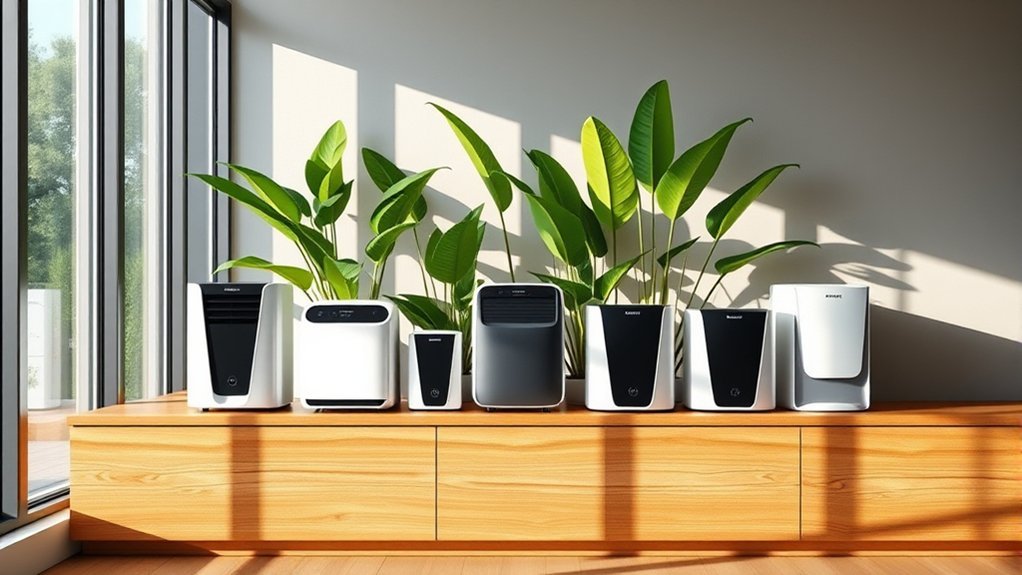
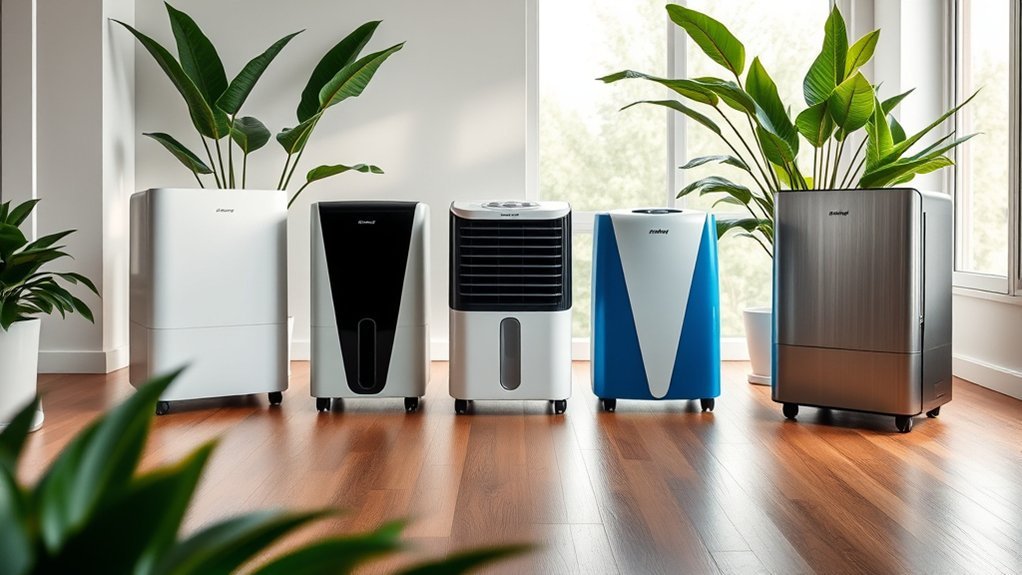
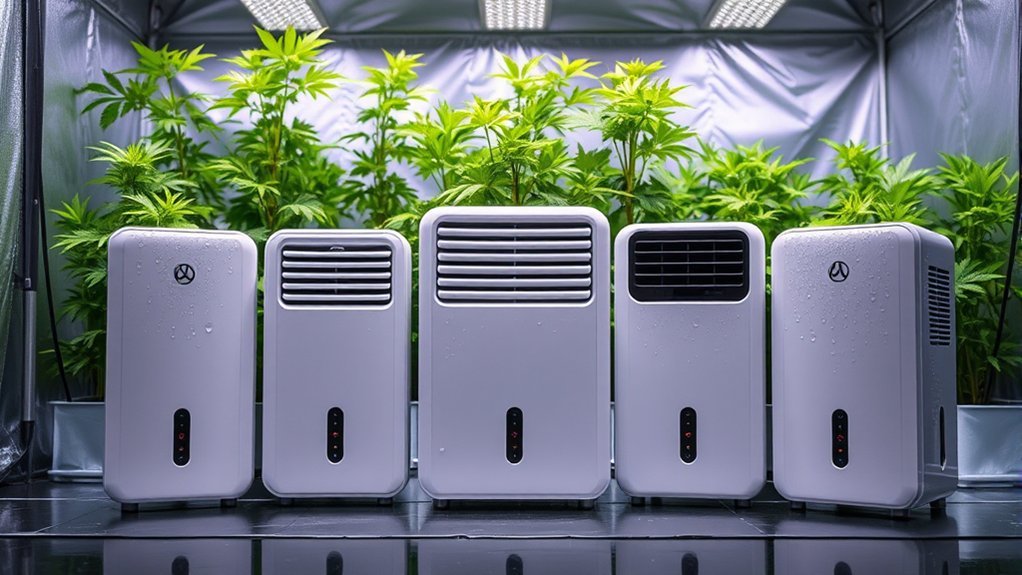
An electric dehumidifier can reduce condensation, musty air, and excess moisture inside an RV, but no single size fits every camping setup. Compact Peltier or semiconductor models are easiest to place near a bed, bathroom, closet, or storage compartment. A compressor model removes far more water, but it is heavier and usually makes the most sense in a large or stationary RV with dependable shore power.
For an RV, compare daily moisture-removal output, power draw, operating temperature, tank or drainage setup, noise, dimensions, and safe placement. Seller-rated square-foot coverage is only a rough comparison point because real performance changes with temperature, relative humidity, airflow, open doors, slide-outs, cooking, showering, and hidden leaks.
- Choose a compact Peltier model for light daily condensation and a compressor model for persistent dampness.
- Compare ounces, milliliters, or pints removed per day, not tank size or square-foot claims alone.
- Check watts, voltage, startup load, and inverter capacity before using any dehumidifier off-grid.
- Empty and secure the unit before driving; use continuous drainage only while parked and level.
- A dehumidifier supports moisture control but cannot repair roof, plumbing, window, or seal leaks.
Quick Verdict
- Best overall compact pick: TABYIK 35 OZ for its balanced tank size, portability, and low listed noise.
- Best balanced small-RV pick: Pro Breeze 52 OZ for its 1.5L tank and listed extraction up to 500ml per day.
- Best for tiny spaces or optional 12V use: Eva-Dry EDV-1100.
- Best for continuous drainage: WoEleLigt 98 OZ with its included drain hose.
- Best for heavy moisture on shore power: GoGuess 21-Pint compressor dehumidifier.
Selection and freshness note: These products were rechecked against current Amazon, manufacturer, and retailer records on August 19, 2026. Extraction, coverage, noise, and temperature figures remain manufacturer or seller claims unless independently standardized. Marketplace variations, inventory, manuals, and specifications can change, so confirm the exact model and variation before ordering.
Quick Comparison of Electric Dehumidifiers for RVs
| Product | Type | Listed Coverage | Tank / Drainage | Listed Extraction | Best Fit | Amazon |
|---|---|---|---|---|---|---|
| GoGuess 21-Pint | Compressor | Up to 1,600 sq. ft. (seller-rated) | 2.3L reservoir plus drain hose | Up to 21 pints/day at 95°F and 90% RH | Large or stationary RVs with dependable shore power | Check Product Details |
| SANVINDER 25 OZ | Peltier | Up to 285 sq. ft. on linked title | 25 oz (750ml) | Up to 450ml/day at 86°F and 80% RH | Small RVs, closets, and light daily condensation | Check Product Details |
| Eva-Dry EDV-1100 | Thermoelectric | Up to 1,100 cu. ft. (manufacturer-rated) | Internal reservoir; verify current listing | Not stated on current manufacturer spec page | Tiny campers, closets, cabinets, and 12V-capable setups | Check Product Details |
| BeOkay 58 OZ | Semiconductor | Up to 230 sq. ft. (seller-rated) | 58 oz (1,657ml) | Up to 300ml/day on listing-derived specs | Scheduled use with a larger compact tank | Check Product Details |
| Deyagoo DY501 | Thermoelectric | Up to 300 sq. ft. (seller-rated) | 50 oz (1.5L) | Up to 300ml/day at 86°F and 80% RH | Quiet bedrooms, bathrooms, and small RVs | Check Product Details |
| WoEleLigt 98 OZ | Dual-core semiconductor | Up to 1,000 sq. ft. (seller-rated) | 98 oz | Up to 1 liter/day under listed conditions | Parked RVs with a safe downhill drain route | Check Product Details |
| Spacekey 106 OZ | Dual-semiconductor | Up to 1,000 sq. ft. (seller-rated) | 106 oz | Up to 40 oz/day under listed conditions | Longer parked use with fewer emptying stops | Check Product Details |
| Pro Breeze 52 OZ | Peltier | About 220–250 sq. ft. / 2,200 cu. ft. (listing-dependent) | About 52 oz (1.5L) | Up to about 500ml/day (roughly 17–18 oz) | Small and midsize RVs in mild-to-warm conditions | Check Product Details |
| NeedDuck 44 OZ | Semiconductor | Up to 215 sq. ft. (seller-rated) | 44 oz | Not clearly stated | Portable RV use with timer and defrost controls | Check Product Details |
| TABYIK 35 OZ | Peltier | Up to 280 sq. ft. (seller-rated) | 35 oz | Up to 16 oz/day at 86°F and 80% RH | Most small RVs and sleeping areas | Check Product Details |
Best for Heavy Moisture on Shore Power: GoGuess 21-Pint
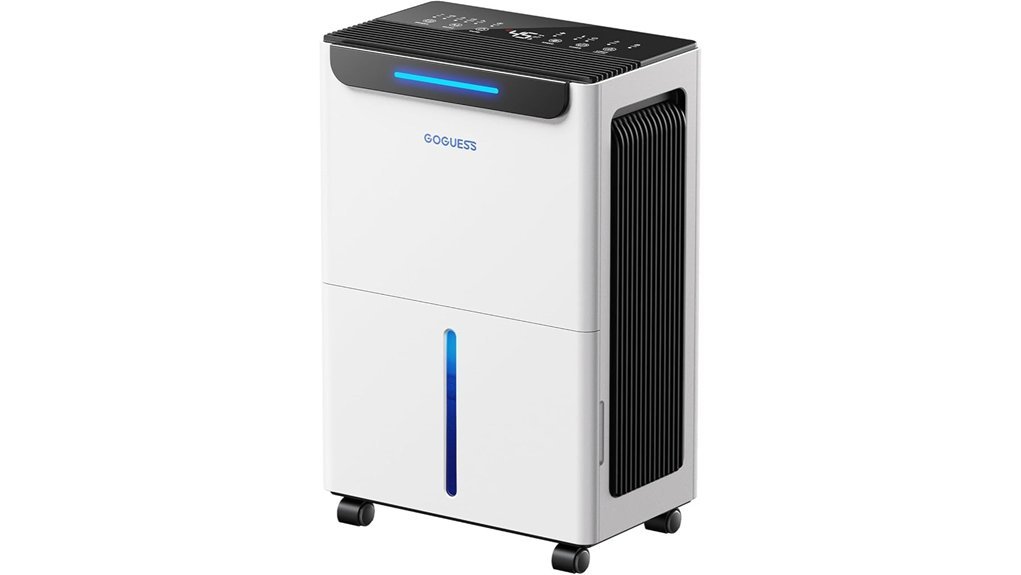
The GoGuess YC3D6-PRO is the only compressor dehumidifier in this group. Current Amazon records describe seller-rated coverage up to 1,600 sq. ft., removal up to 21 pints per day at 95°F and 90% relative humidity, a listed 75W running draw, a 2.3L tank, adjustable humidity control, DEHU, TURBO, and SLEEP modes, a 24-hour timer, and an included drain hose.
Its higher output is the better match for a large motorhome, a persistently damp stationary RV, wet laundry, or frequent window condensation. It is also much heavier, with current records listing about 30 lb, and should be treated as a shore-power appliance unless your RV electrical system and inverter are specifically sized for its running and startup load.
Who Should Buy This: Large RVs, fifth wheels, or stationary campers with dependable shore power and a secure operating location.
Why You’ll Like It: It offers adjustable humidity control and far greater listed extraction than the compact semiconductor picks.
Who Should Avoid It: Boondockers with limited battery capacity, very small rigs, or users without enough floor space and ventilation clearance.
Pros:
- Highest listed extraction capacity in the roundup.
- Adjustable humidistat, multiple modes, timer, and hose drainage.
- Better suited to persistent dampness than a mini Peltier unit.
Cons:
- About 30 lb and substantially bulkier than compact models.
- Compressor startup and running power require careful RV electrical planning.
- Noise and vibration are likely to be more noticeable in a small sleeping area.
Best Simple Compact Pick: SANVINDER 25 OZ
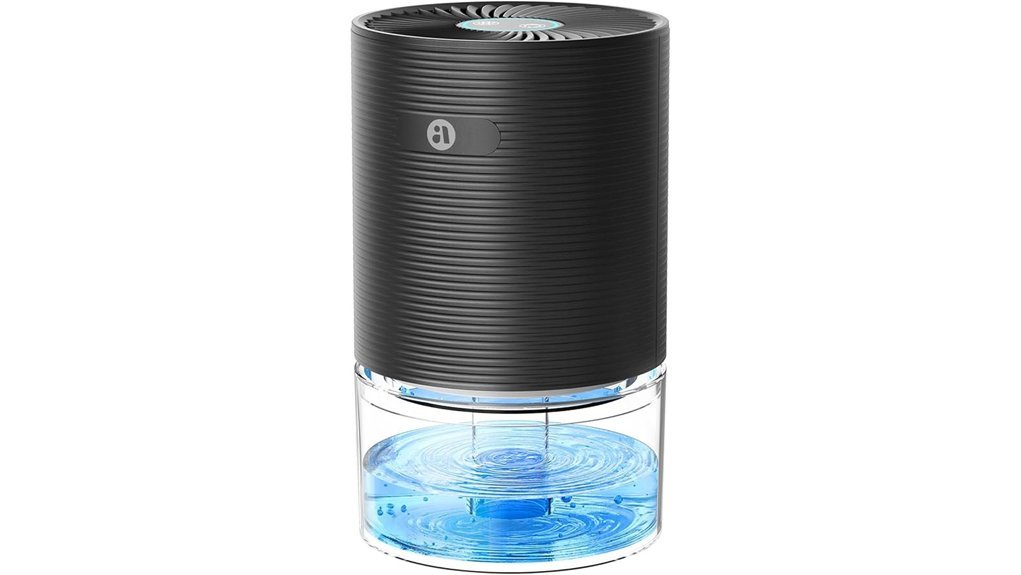
The SANVINDER CS03 is a compact Peltier model with a 25 oz tank. The linked product title markets coverage up to 285 sq. ft., while accessible listing mirrors describe collection up to 450ml per day at 86°F and 80% relative humidity and operation below 35dB.
That makes it a straightforward choice for a small RV bedroom, bathroom, wardrobe, or storage zone. Treat the extraction figure as a best-case seller claim: real collection will usually be lower in cooler or less humid conditions.
Who Should Buy This: Small campers that need simple, quiet control of light condensation in a closed area.
Why You’ll Like It: It is compact, uncomplicated, and easy to place where floor and counter space are limited.
Who Should Avoid It: Severe dampness, active water intrusion, large open motorhomes, or unattended use outside the stated temperature range.
Pros:
- 25 oz tank and compact body suit narrow RV spaces.
- Listed below 35dB for quieter operation.
- Auto shutoff and a full-tank warning light help prevent overflow.
Cons:
- Light-duty output compared with a compressor dehumidifier.
- Tank size may require frequent emptying during humid weather.
- Seller coverage figures vary across mirrored listings, so compare the exact Amazon variation before ordering.
Best for Tiny Spaces and Optional 12V Power: Eva-Dry EDV-1100
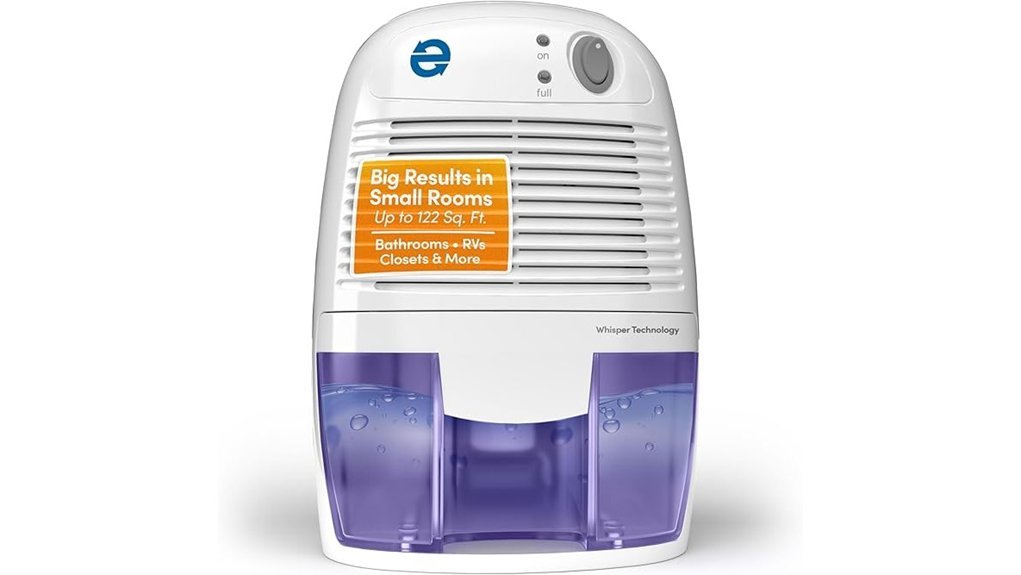
The Eva-Dry EDV-1100 is designed for continuous moisture control in very small living areas. Eva-Dry currently lists coverage up to 1,100 cubic feet, approximately 33dB operation, 22W power use, automatic shutoff, and 110–120V input.
A useful RV-specific detail is the optional EDV-12V power cord sold by Eva-Dry for compatible cigarette-lighter outlets. The current manufacturer specification block does not publish a daily extraction rate or reservoir volume, so verify those details on the exact Amazon variation rather than relying on older third-party figures.
Who Should Buy This: Tiny campers, closets, cabinets, storage compartments, and RV owners interested in the optional manufacturer 12V cord.
Why You’ll Like It: It has a small footprint, low 22W draw, quiet operation, and direct manufacturer support for an optional 12V setup.
Who Should Avoid It: Anyone who needs fast drying, a published high extraction rate, or continuous hose drainage.
Pros:
- Manufacturer lists approximately 33dB operation and 22W power use.
- Optional Eva-Dry 12V cord adds flexibility for compatible RV outlets.
- Automatic shutoff and simple continuous operation are easy to manage.
Cons:
- Current manufacturer page does not state daily extraction or tank volume.
- No continuous-drain connection is listed.
- Best suited to a small enclosed zone, not an entire large RV with heavy moisture.
Best Timer and Lighting Controls: BeOkay 58 OZ
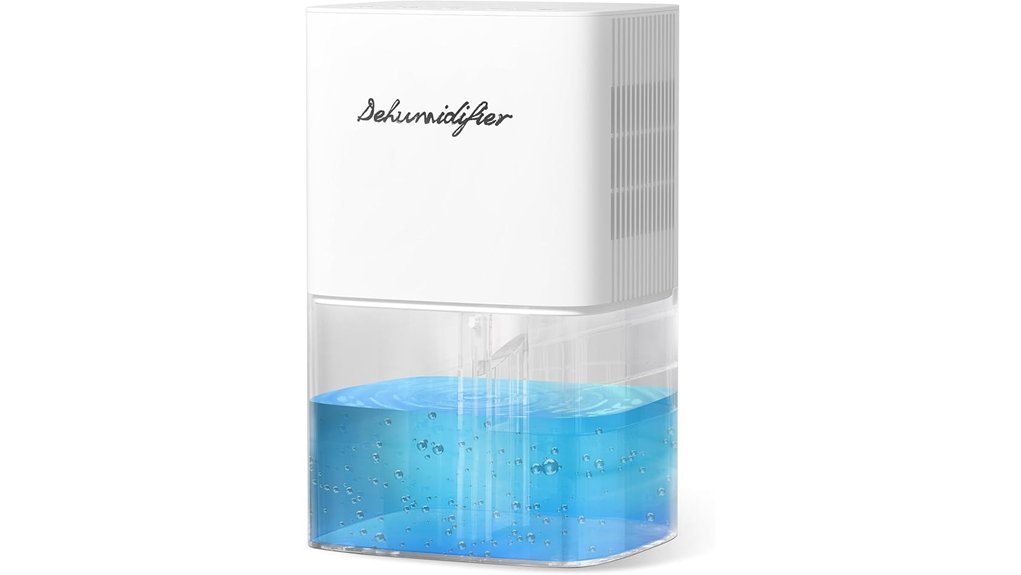
The BeOkay DH-A2 uses a 1,657ml or 58 oz tank and a compact 28W semiconductor system. Current listing-derived specifications show seller-rated coverage up to 230 sq. ft., dehumidification capacity around 300ml per day, three speeds or modes, multiple timers, auto shutoff, defrosting, and selectable lighting.
Its strength is control rather than raw water removal. The listing does not clearly standardize the temperature and humidity conditions behind the 300ml figure, so compare it as a convenience-focused compact model rather than a high-capacity dryer.
Who Should Buy This: RV owners who value timer choices, a larger compact tank, sleep settings, and adjustable lighting.
Why You’ll Like It: It offers more scheduling and display control than a basic one-button mini dehumidifier.
Who Should Avoid It: Buyers who need continuous drainage, compressor-level output, or a fully documented standardized capacity rating.
Pros:
- 58 oz tank reduces emptying frequency for a compact model.
- Timers, multiple modes, sleep operation, and adjustable lighting.
- Auto shutoff and defrosting improve day-to-day convenience.
Cons:
- The extraction test conditions are not clearly documented.
- Sleep-mode noise is listed below 40dB, higher than some smaller competitors’ claims.
- Model and variation details should be checked carefully on Amazon before purchase.
Best Quiet Mid-Size Tank: Deyagoo DY501
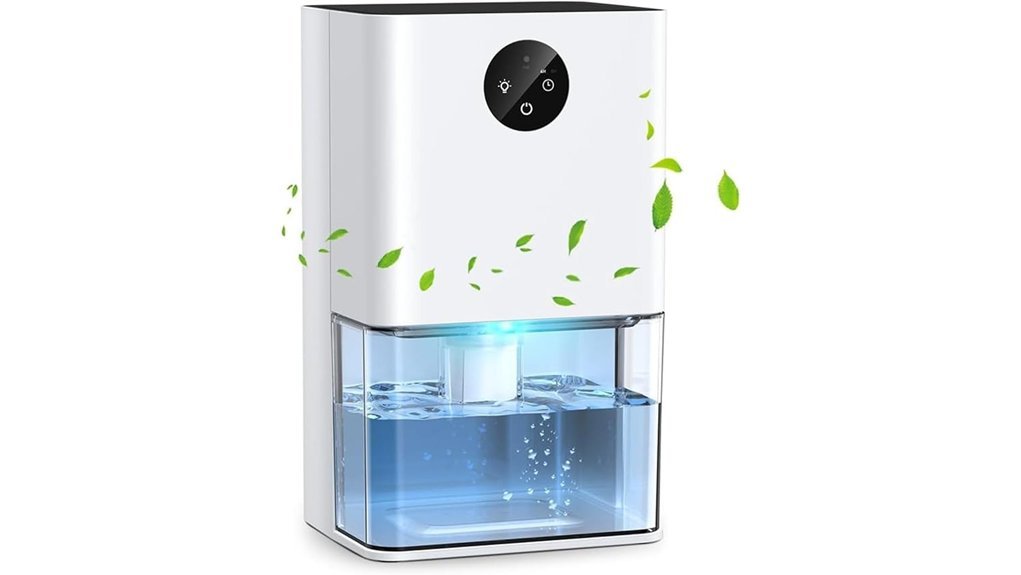
The Deyagoo DY501 combines a 1.5L or 50 oz transparent tank with a compact 28W body. Accessible listing records describe up to 300ml of daily collection at 86°F and 80% relative humidity, seller-rated coverage up to 300 sq. ft., 30dB operation, and automatic shutoff.
It is a useful middle-ground option when a 25 oz or 35 oz tank feels too small but a 98 oz or 106 oz model would take too much room. Leave clearance around the intake and exhaust so the thermoelectric system can move air and release heat.
Who Should Buy This: Small RV bedrooms, bathrooms, and closets where low noise and a mid-size tank matter.
Why You’ll Like It: The 50 oz tank reduces emptying while the 28W draw remains modest for a plug-in mini unit.
Who Should Avoid It: Users who need continuous drainage or quick recovery after a major moisture event.
Pros:
- Listed 30dB operation is suitable for many sleeping areas.
- Clear 50 oz tank and compact 28W design.
- Auto shutoff helps reduce overflow risk.
Cons:
- The 300ml/day claim applies to warm, very humid test conditions.
- No drain-hose connection is listed.
- It needs open airflow around the intake and exhaust.
Best Continuous Drainage Pick: WoEleLigt 98 OZ
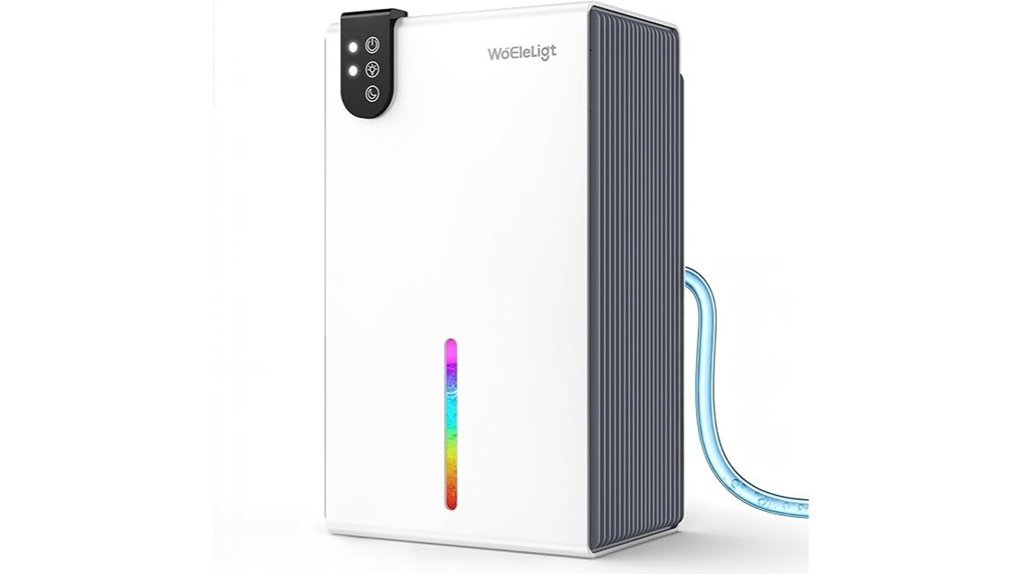
The product linked under ASIN B0GG9Z66NF is identified in current listing-derived records as a WoEleLigt CT9 dehumidifier. It combines a 98 oz tank, an included drain hose, an 85W dual-core semiconductor system, Sleep and Turbo modes, automatic shutoff, and a listed maximum collection rate of 1 liter per day.
The seller-rated 1,000 sq. ft. coverage should not be compared directly with a compressor dehumidifier rating. Its more useful RV benefit is the drain-hose option, which can reduce tank maintenance during a long parked stay when the unit is level and the hose has a secure downhill route.
Who Should Buy This: Parked RVs, extended stays, and storage setups with a safe and permitted drain location.
Why You’ll Like It: It is the only compact semiconductor pick here with a clearly listed included drain hose and continuous-drain option.
Who Should Avoid It: Travelers who cannot route a hose safely or anyone expecting compressor-level performance in a wet, open space.
Pros:
- 98 oz tank plus included hose for manual or continuous drainage.
- Listed 1 liter/day maximum output and 85W dual-core design.
- Sleep and Turbo modes add useful control.
Cons:
- The 1,000 sq. ft. seller claim is optimistic for a compact semiconductor unit.
- Continuous drainage requires a level unit, secure connection, and uninterrupted downward slope.
- The 85W draw is higher than many basic mini Peltier models.
Best Large Tank: Spacekey 106 OZ
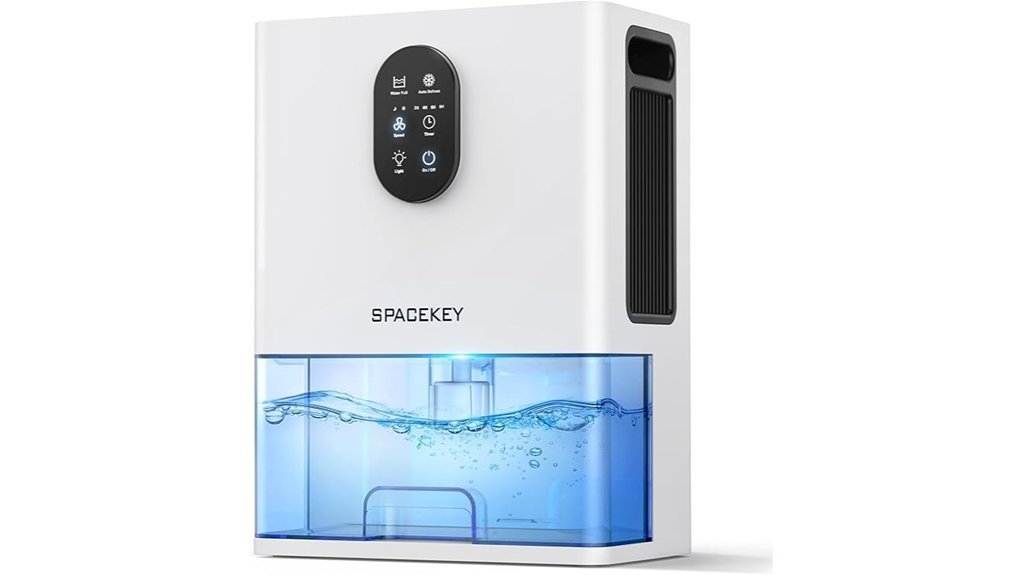
The Spacekey model has the largest reservoir in this roundup at 106 oz. Current listing-derived records describe dual-semiconductor operation, up to 40 oz of daily collection under favorable conditions, Sleep and Powerful modes, timer settings, auto shutoff, a washable filter, and selectable lighting.
Its main advantage is convenience rather than guaranteed whole-room coverage. The large tank can run longer between emptying stops, but the seller-rated 1,000 sq. ft. figure should be treated cautiously in an RV with open doors, air leaks, or heavy moisture generation.
Who Should Buy This: Stationary RV owners who prioritize tank capacity and fewer interruptions.
Why You’ll Like It: The 106 oz reservoir is the largest in the comparison and is paired with a washable filter and timer controls.
Who Should Avoid It: Travelers who need the smallest possible footprint, continuous drainage, or independently standardized compressor capacity.
Pros:
- Largest tank in this roundup.
- Listed up to 40 oz/day under favorable conditions.
- Sleep mode, timer, auto shutoff, washable filter, and carrying handle.
Cons:
- The large reservoir increases the unit’s footprint and full-tank weight.
- Seller-rated 1,000 sq. ft. coverage should not be treated as a compressor-equivalent rating.
- Extraction will vary substantially with temperature, humidity, airflow, and RV leakage.
Best Balanced Small-RV Pick: Pro Breeze 52 OZ
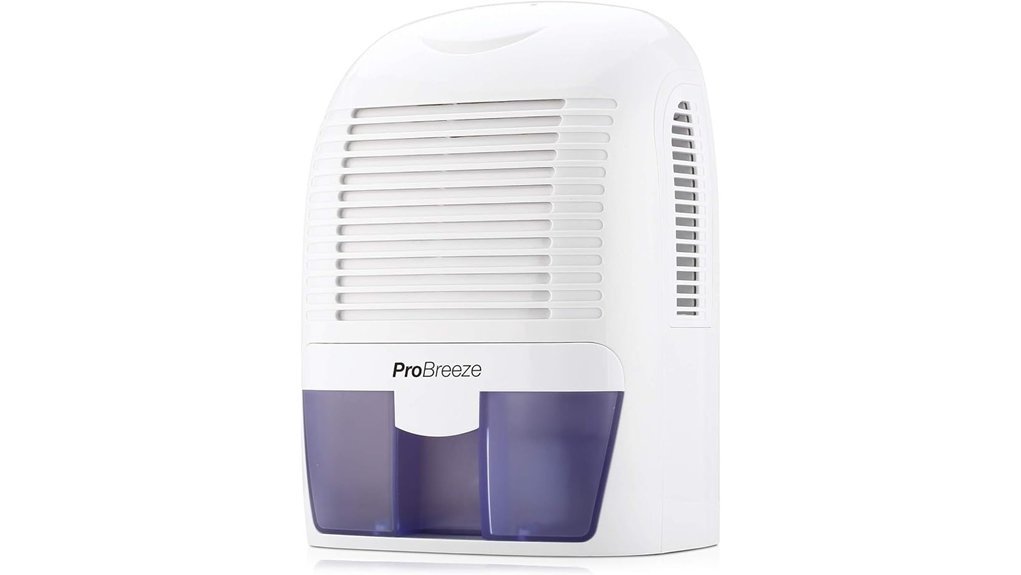
The Pro Breeze PB-03-US is a 40W Peltier dehumidifier with a 1.5L or 52 oz tank. Current manufacturer and Amazon records describe maximum extraction at roughly 17 to 18 oz per day, or about 500ml, with coverage marketed around 2,200 cubic feet. Current square-foot figures vary by source, roughly from 220 to 250 sq. ft., so daily extraction is the better comparison point.
Its temperature limits matter in an RV. Current Pro Breeze specifications list a working range of about 60°F to 122°F, so it is better for warm-weather camping or a climate-controlled rig than cold, unheated winter storage.
Who Should Buy This: Small and midsize RVs that need a larger compact tank without moving to a compressor unit.
Why You’ll Like It: The 1.5L reservoir and roughly 17 to 18 oz daily listed maximum offer a practical middle ground between tiny Peltier units and a compressor model.
Who Should Avoid It: Cold-weather campers, off-grid users with a very small battery bank, or anyone needing a drain hose.
Pros:
- Roughly 17 to 18 oz/day listed maximum extraction, depending on the current source and rounding.
- 1.5L tank reduces how often it must be emptied.
- 40W Peltier design, auto shutoff, and a long-established model number.
Cons:
- Performance drops as temperature and humidity fall.
- No continuous-drain connection is listed for this model.
- Current square-foot figures vary between manufacturer and marketplace pages, so output matters more than coverage marketing.
Best Auto-Defrost Mini Pick: NeedDuck 44 OZ
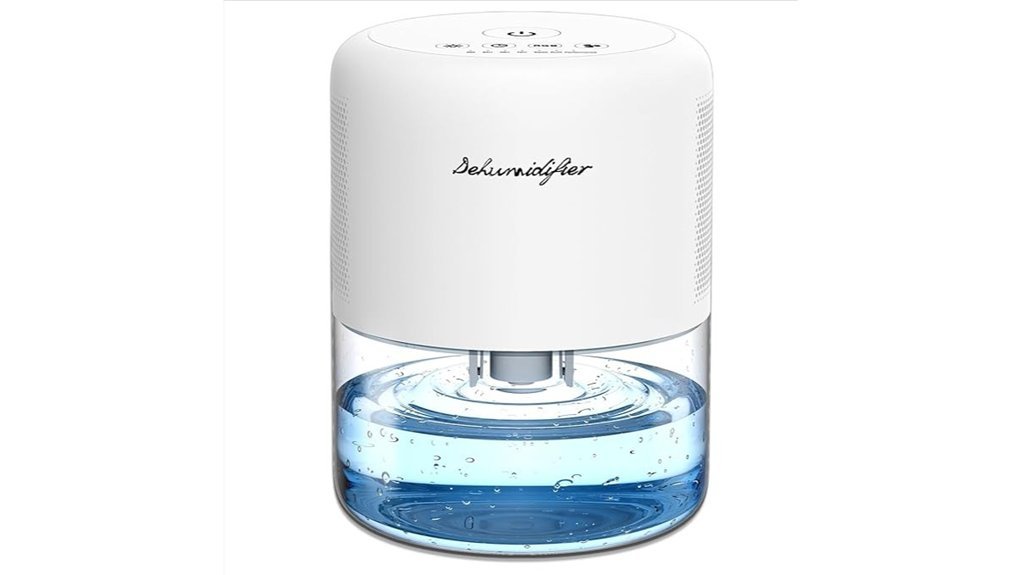
The NeedDuck B-2 is a compact 28W semiconductor dehumidifier with a 44 oz tank. Current listing-derived records show seller-rated coverage up to 215 sq. ft., automatic defrosting, automatic shutoff, multiple modes, four timer choices, selectable lighting, and a rear carrying handle.
The current records do not provide a dependable daily extraction figure, so this model should be judged by its size and convenience features. Auto-defrost can protect the cold surface during operation, but it does not make the unit suitable for freezing temperatures or use outside the manufacturer’s limits.
Who Should Buy This: RV owners who want a portable mini unit with timer settings and automatic defrosting.
Why You’ll Like It: The 44 oz tank, 28W draw, handle, and control options make it easy to reposition and schedule.
Who Should Avoid It: Buyers who require a verified daily extraction rate or continuous hose drainage.
Pros:
- 44 oz tank balances capacity and portability.
- Auto-defrost, auto shutoff, timers, and multiple modes.
- Compact listed dimensions make it easier to place in an RV.
Cons:
- Daily water-removal output is not clearly stated.
- Designed for small enclosed areas rather than a large open interior.
- Lighting features may add little value for buyers focused only on moisture removal.
Best Overall Compact Pick: TABYIK 35 OZ
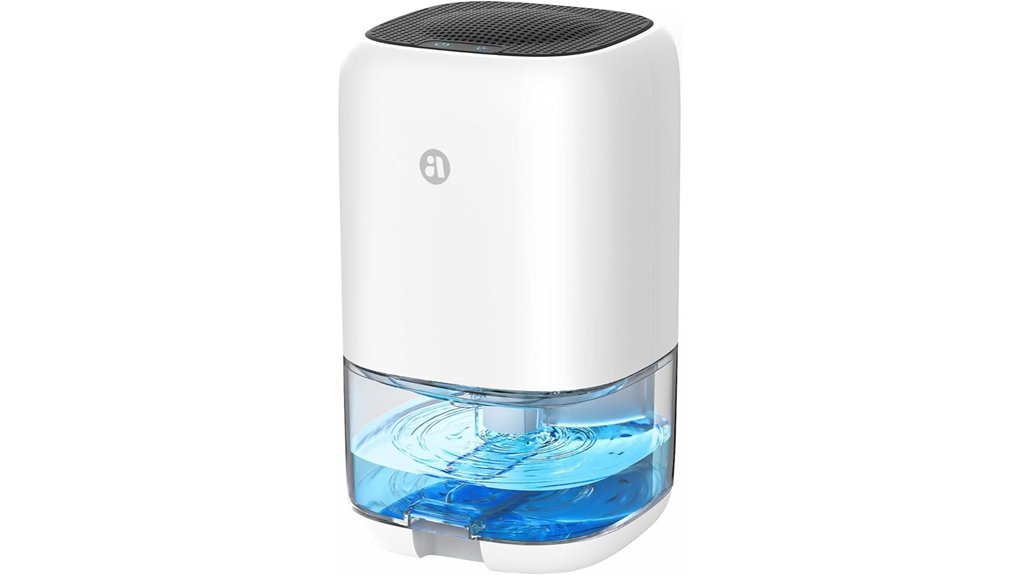
The TABYIK 35 OZ is the most balanced compact option in this roundup for an RV bedroom, bathroom, closet, or small living area. The linked listing describes a 35 oz transparent tank, seller-rated coverage up to 280 sq. ft., and moisture collection up to 16 oz per day at 86°F and 80% relative humidity.
Its biggest RV advantages are the compact body, carrying handle, visible tank, separate light control, and listed 28dB operation. Because it uses Peltier technology, expect slower collection in cool weather or when indoor humidity is only moderate.
Who Should Buy This: Most small-RV owners who want a quiet, easy-to-move unit for everyday condensation control.
Why You’ll Like It: It combines a useful tank, low listed noise, auto shutoff, and an RV-friendly footprint.
Who Should Avoid It: Large rigs with severe dampness, active leaks, or a need for continuous hose drainage.
Pros:
- Listed 28dB operation is attractive for bedrooms and nighttime use.
- 35 oz transparent tank makes the water level easy to monitor.
- Auto shutoff, carrying handle, and switchable ambient light improve daily usability.
Cons:
- Maximum extraction is based on warm, highly humid test conditions.
- The tank requires manual emptying.
- It is a maintenance dehumidifier, not a substitute for repairing leaks or drying soaked materials.
How to Choose an Electric Dehumidifier for an RV
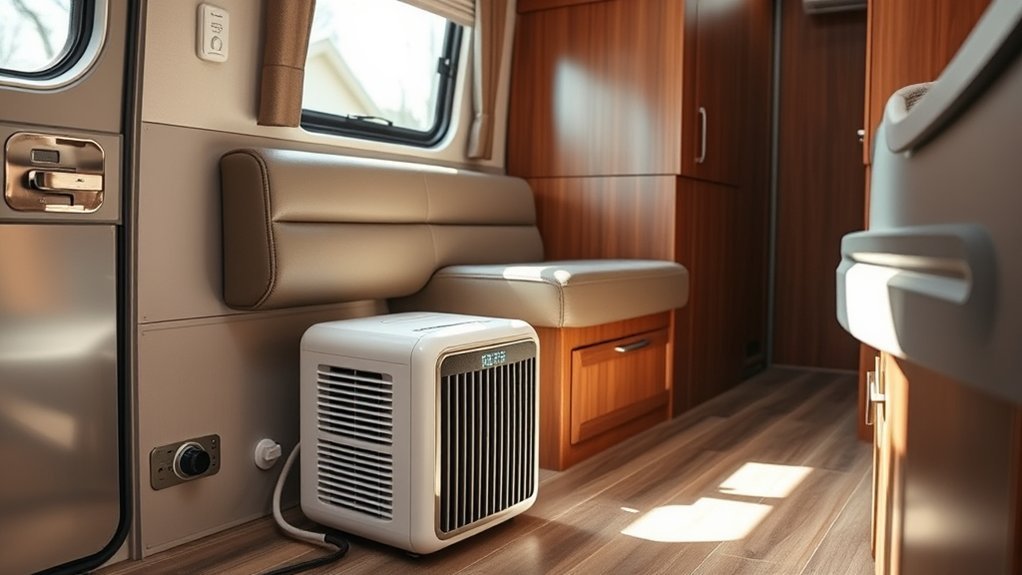
The best RV dehumidifier is not automatically the model with the largest tank or square-foot number. Start with the moisture load, available electrical capacity, expected temperature, RV layout, and the exact place where the unit can operate safely.
- Measure the operating space and leave the manufacturer-required clearance around every air intake and exhaust.
- Check input voltage, running watts, and compressor startup load against the RV circuit, inverter, and battery bank.
- Compare daily extraction at the stated temperature and humidity, not only tank capacity or seller-rated coverage.
- Decide whether you can empty a tank regularly or can safely route a drain hose while parked.
- Confirm minimum operating temperature for shoulder-season camping or winter storage.
- Plan a secure travel-storage location; do not leave a full or loose dehumidifier on a counter while driving.
Peltier vs. Compressor Dehumidifiers
Peltier, thermoelectric, or semiconductor models are compact and usually quiet. They work best for light condensation in small enclosed zones, but their output can fall sharply in cool air or moderate humidity.
Compressor dehumidifiers remove much more water and can maintain a selected humidity level. They are heavier, louder, and more demanding electrically, so they are usually better in a large or stationary RV connected to shore power.
RV Size, Layout, and Real Coverage
Use square-foot coverage only as a rough guide. RVs have compact floor areas but unusual moisture loads from sleeping, cooking, showers, wet clothing, temperature swings, and air leakage. Compare daily extraction, interior volume, closed doors, slide-outs, and ventilation before choosing.
Moisture-Removal Rate
Daily extraction is the most useful performance number, but test conditions matter. Many compact units advertise maximum output near 86°F and 80% relative humidity, while compressor capacity may be reported under a different test condition. Do not compare unlike ratings as though they were measured the same way.
Power Use and RV Electrical Capacity
Check watts and voltage rather than relying on “energy-saving” language. A 22W to 40W mini unit can still consume meaningful battery energy when it runs for many hours. The WoEleLigt is listed at 85W, while the GoGuess compressor model currently lists a 75W running draw; a compressor can still require a higher startup surge than its normal running load. Include inverter losses and other RV appliances when calculating capacity.
Tank Size and Drainage
A larger tank means fewer emptying stops, but it also adds weight and spill risk. Empty the reservoir before travel. For continuous drainage, keep the RV parked and level, secure the hose, maintain an uninterrupted downward slope, and discharge only where permitted.
Temperature Performance and Defrosting
Thermoelectric models generally collect more water in warm, humid air. Check the minimum operating temperature and do not assume an auto-defrost feature makes a mini unit suitable for freezing storage. In cold conditions, leak repair, winterization, ventilation, and passive moisture control may be more appropriate.
Noise Level and Sleeping Areas
Sound is more noticeable in a small RV. Seller claims around 28dB to 35dB may be easier to tolerate near a bed, while compressor vibration and fan noise are more noticeable. Sleep Mode may reduce fan speed and lights, but it can also reduce moisture removal.
Auto Shutoff and Safe Placement
Choose a model with automatic full-tank shutoff. Operate it on a stable, level surface with unobstructed airflow and keep it away from bedding, curtains, clothing, and splash zones. Follow the manual for outlet, clearance, cleaning, and unattended-operation requirements.
Use a Separate Hygrometer
A digital hygrometer shows whether the unit is making a meaningful difference. For indoor moisture control, a practical target is generally 30% to 50% relative humidity, with levels kept below 60% where possible. Avoid over-drying and investigate leaks if humidity remains high despite continuous operation.
Cleaning and Maintenance
Empty and rinse the tank regularly, dry it before storage, and clean filters or air inlets according to the manual. A dirty intake, blocked exhaust, kinked hose, or poorly seated tank can reduce performance or cause shutoffs.
Frequently Asked Questions
How Often Should I Empty an RV Dehumidifier Tank?
Empty it when the full-tank light appears, when the unit shuts off, or before the water reaches the manual’s limit. That may be daily in humid weather or every few days in milder conditions. Always empty and dry the tank before driving or long-term storage.
Can I Run an RV Dehumidifier While Driving?
The safer practice is to turn it off, unplug it, empty the tank, and secure the unit before travel. RV movement can tip the appliance, spill water, pull a drain hose loose, or block airflow. Operate it while parked and level unless the manufacturer specifically approves mobile operation.
Do RV Dehumidifiers Need a Drain Hose?
No. Most compact models collect water in a removable tank. A hose is useful during a long parked stay, but only when the dehumidifier can remain level and the hose has a secure downhill path to an approved discharge point.
Which Power Source Works Best for RV Dehumidifiers?
Shore power is the simplest choice, especially for a compressor model. A low-wattage Peltier unit may work with a correctly sized inverter or a manufacturer-approved 12V adapter, but account for continuous draw, inverter losses, startup load, and every other appliance on the circuit.
Are RV Dehumidifiers Safe in Winter Storage?
Only when the product is within its stated temperature range, has safe power, clear airflow, and regular inspection. Many mini units perform poorly in cold air, and auto-defrost does not automatically make them safe below freezing.
Will a Dehumidifier Stop Mold in an RV?
It can lower the humidity that supports mold, but it cannot repair a roof leak, plumbing leak, failed seal, wet insulation, or soaked wall material. Fix the water source, dry wet materials promptly, improve ventilation, and clean existing growth appropriately.
How Big a Dehumidifier Do I Need for an RV?
For light condensation in a small RV or closed sleeping zone, a compact Peltier model may be enough. For frequent window condensation, wet laundry, persistent mustiness, or a large stationary rig, prioritize a much higher daily extraction rate or a compressor model.
What Humidity Level Is Best Inside an RV?
A useful target is generally 30% to 50% relative humidity, with levels kept below 60% where possible. Use a separate hygrometer because many mini dehumidifiers do not include an accurate humidistat.
Final Recommendation
For most small RVs, the TABYIK 35 OZ offers the best compact balance of low listed noise, useful tank capacity, and portability. Choose the Pro Breeze 52 OZ when you want a larger 1.5L tank and a more clearly documented 500ml-per-day seller claim.
The Eva-Dry EDV-1100 is the most interesting tiny-space option, especially for buyers considering Eva-Dry’s optional 12V cord. Choose the WoEleLigt 98 OZ when a drain hose is the priority or the Spacekey 106 OZ when you prefer the largest tank.
For a large or stationary RV with persistent dampness and dependable shore power, the GoGuess 21-Pint compressor model is the strongest listed performer. Whichever model you select, confirm the current Amazon variation, check electrical requirements, keep airflow clear, monitor humidity with a hygrometer, and treat the appliance as one part of a broader leak-prevention and ventilation plan.