Affiliate disclosure: As an Amazon Associate, we may earn from qualifying purchases at no extra cost to you. Product specifications and seller claims can change, so confirm important details on the product page and appliance label before ordering.
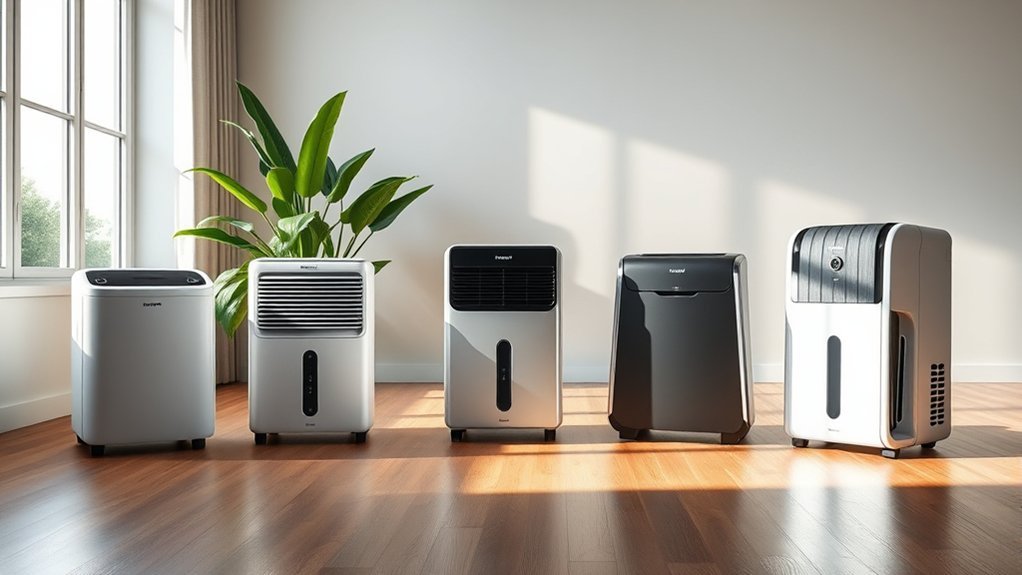
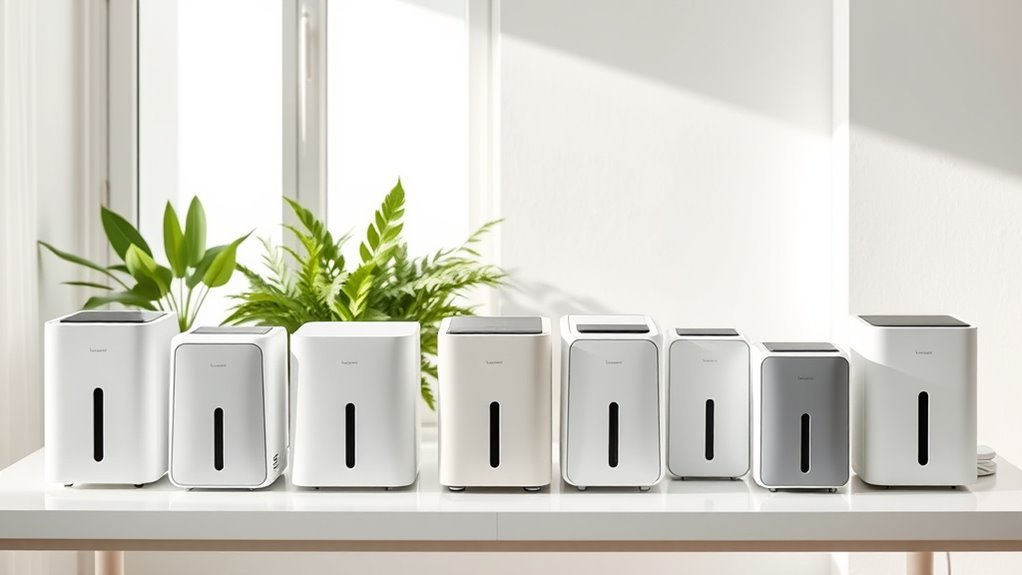
The best quiet dehumidifier depends on whether you need serious moisture removal for a basement or gentle humidity control in a bedroom, bathroom, closet, or RV. For persistent dampness and larger areas, compressor models such as the AEOCKY 50-Pint, 34-Pint Dehumidifier, and BANABIE 32-Pint are the strongest options in this roundup. Compact models from NineSky, BEDRED, Onsekin, and NeedDuck are quieter and easier to move, but they are better suited to mild moisture in smaller enclosed spaces.
This guide compares published product specifications, drainage options, controls, tank sizes, noise claims, and buyer-friendly features. It does not claim independent laboratory testing. Because manufacturers may measure noise and moisture removal under different conditions, use the figures as comparison clues rather than guaranteed real-world results.
Important note for Canadian shoppers:
The protected product links in this article may open Amazon.com. Before ordering, confirm that the seller ships to your province or territory and review the final currency, import fees, warranty coverage, return terms, and electrical specifications. Check the product itself for a recognized Canadian certification mark such as CSA, cUL, or cETL. Do not rely only on a logo shown on the packaging or product page.
How these picks were evaluated:
The ranking emphasizes product type, published moisture-removal capacity, drainage options, humidity controls, tank size, portability, sleep features, and the strength of the available noise information. No product received extra credit for an unverified square-foot claim, and compact thermoelectric models were not treated as substitutes for properly sized compressor dehumidifiers.
Quick Verdict
- Best Overall: AEOCKY 50-Pint Dehumidifier for strong moisture removal, quiet compressor operation, and flexible drainage.
- Best Sleep-Mode Compressor: 34-Pint Dehumidifier for bedrooms, laundry rooms, and moderately damp basements.
- Best Smart-Control Pick: BANABIE 32-Pint Dehumidifier for automatic humidity management and continuous drainage.
- Best for Very Small Spaces: NeedDuck Portable Dehumidifier for bathrooms, closets, RVs, and compact bedrooms.
- Best Compact Large-Tank Pick: NineSky 95-Ounce Dehumidifier for mild bedroom or bathroom moisture.
- Best Ambient-Light Pick: BEDRED CT11 for quiet small-room use with a sleep-friendly light setting.
- Best with Aromatherapy: Onsekin CS08 for buyers who want a compact dehumidifier with a designated fragrance feature.
Key Takeaways
- Choose a compressor model when the space is persistently damp, large, cool, or affected by laundry moisture.
- Choose a compact thermoelectric model only for mild humidity in a smaller enclosed room, closet, bathroom, camper, or RV.
- Compare standardized pints-per-day capacity before square-foot coverage or tank size.
- Treat seller noise figures as estimates unless the measurement mode, distance, and test method are clear.
- For Canadian use, verify the certification mark directly on the appliance before plugging it in.
Quick Comparison of Quiet Dehumidifiers
| Product | Best For | Published Capacity | Published Noise | Main Limitation | Amazon |
|---|---|---|---|---|---|
| AEOCKY BOREAS-001 | Large rooms and damp basements | Maximum 50 pints per day; 0.8-gallon tank | Approximately 40 dB official claim; independent measurements may be higher | Maximum output uses hot, humid test conditions | Check Details |
| 34-Pint Dehumidifier (ASIN B0GDJWSLZM) | Bedrooms, laundry rooms, and moderate basement moisture | Maximum 34 pints per day; 0.6-gallon tank | Approximately 38 dB claimed | Brand and warranty details should be confirmed on the current listing | Check Details |
| BANABIE 32-Pint | Automatic humidity control and continuous drainage | Maximum 32 pints per day; 2.5-litre tank | 32 dB seller claim | Noise figure is not independently verified | Check Details |
| NeedDuck B-2 | Bathrooms, closets, RVs, and small bedrooms | 44-ounce tank; 215-square-foot published coverage | Quiet operation claimed; exact dB not confirmed | Not intended for a wet or full-size basement | Check Details |
| NineSky CT2 | Mild bedroom and bathroom moisture | 95-ounce tank | Night mode; exact dB not confirmed | No standardized pint-per-day output confirmed | Check Details |
| BEDRED CT11 | Quiet bedrooms and compact living areas | 95-ounce tank | Sleep mode and quiet operation claimed; exact dB not confirmed | Thermoelectric output is limited in cool or very damp rooms | Check Details |
| Onsekin CS08 | Small spaces where aromatherapy is preferred | Published 1,000-square-foot coverage claim | Below 45 dB claimed | Not a replacement for a high-capacity basement unit | Check Details |
AEOCKY 50-Pint Dehumidifier for Home and Basement
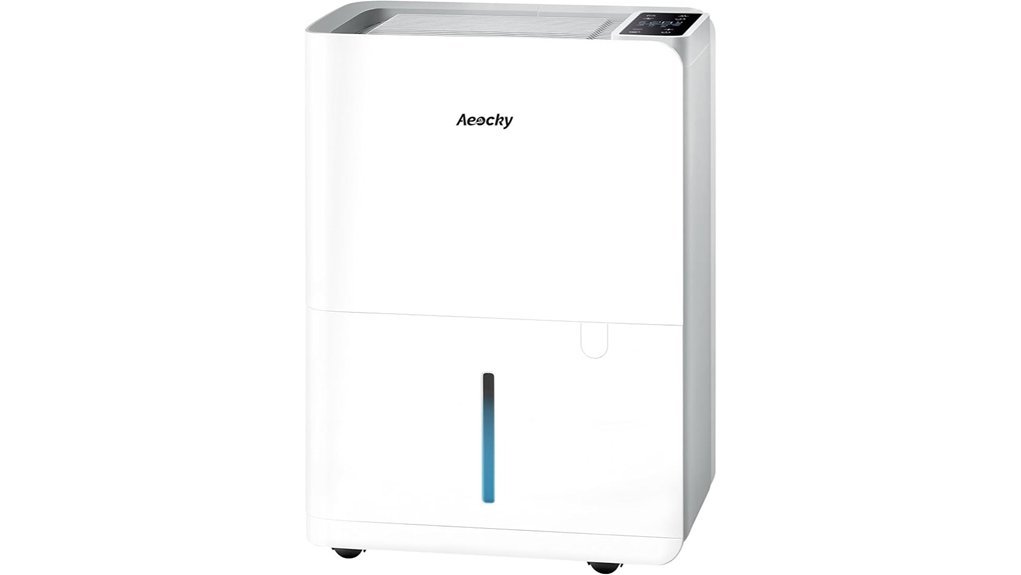
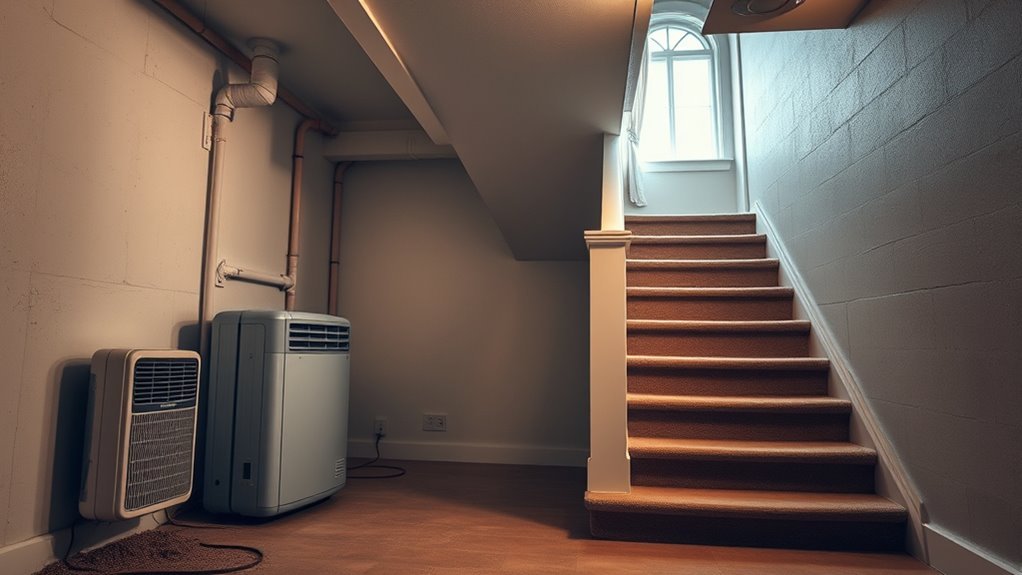
The AEOCKY BOREAS-001 is the strongest all-around option in this roundup for a damp basement, laundry room, garage, or larger living area. It uses compressor-based dehumidification and carries a published maximum removal rating of 50 pints per day, with advertised coverage up to 3,500 square feet.
The unit includes a 0.8-gallon tank, drain hose, garden-hose adapter, adjustable humidity control, fan-speed settings, timer, and child lock. The official product page lists approximately 40 dB, but an independent 2026 review measured roughly 48 to 53 dB at three feet under its test setup. Sound can change with fan speed, compressor cycling, flooring, room acoustics, and measurement distance. A three-year machine warranty is also listed.
Why you may like it: It combines meaningful moisture-removal capacity with automatic humidity control and continuous-drain flexibility. That makes it more practical for persistent humidity than a small thermoelectric unit.
Consider before buying: The 50-pint figure is a published maximum measured under very hot, humid conditions rather than a promise of daily collection in every Canadian basement. The manufacturer also publishes a lower 38-pint figure at 86°F and 80% relative humidity. Real output depends on temperature, starting humidity, airflow, and the test standard used. The internal bucket may also fill quickly during very damp weather, so continuous drainage is worth using when a suitable drain is available.
Best For: Homeowners who need a relatively quiet compressor dehumidifier for larger or consistently damp spaces.
Pros:
- High published maximum moisture-removal capacity.
- Official listing states approximately 40 dB, although third-party measurements may be higher.
- Humidistat, timer, fan controls, child lock, and drainage accessories.
- Three-year machine warranty listed by the manufacturer.
Cons:
- The advertised square-foot figure should not replace proper capacity sizing.
- The 0.8-gallon tank may need frequent emptying in a wet basement.
- Current Canadian certification and warranty eligibility should be confirmed before ordering.
34-Pint Dehumidifier for Home and Basement
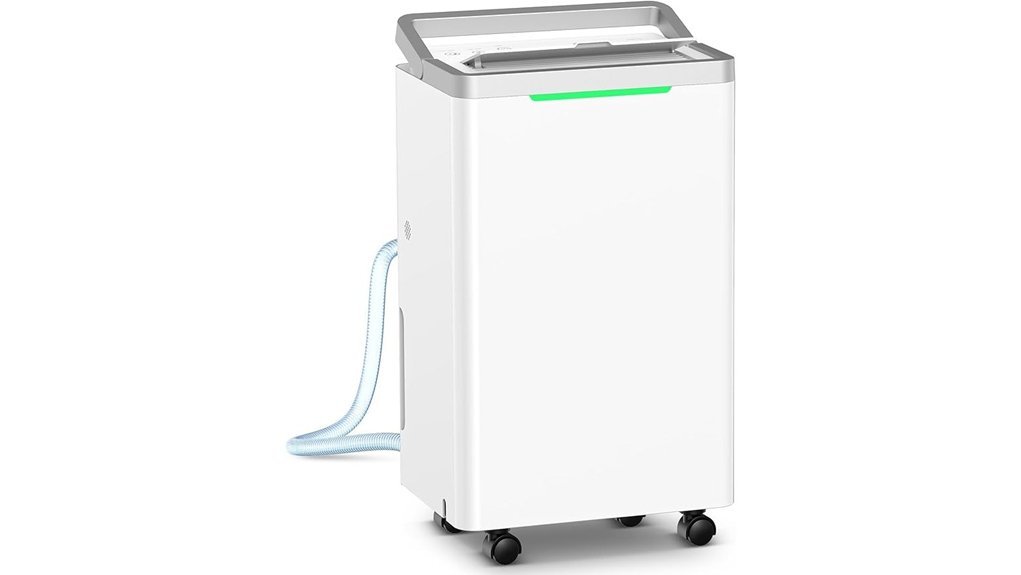
This 34-pint compressor dehumidifier is a practical middle-ground option for bedrooms, laundry rooms, and moderately damp basements. The current listing tied to ASIN B0GDJWSLZM publishes a maximum output of 34 pints per day at 95°F and 90% relative humidity. Because the indexed product information did not consistently identify a stable brand name, this guide refers to it by capacity and ASIN rather than using an unverified brand label.
Its approximately 38 dB seller-listed noise level and dedicated sleep mode make it appealing when sound is an important concern. Other useful features include an adjustable humidistat, automatic swing louvers, a 24-hour timer, humidity indicator, child lock, auto-defrost, memory function, casters, and an included drain hose.
Why you may like it: It offers more moisture-removal ability than the compact semiconductor models while retaining bedroom-friendly controls and a relatively low published noise figure.
Consider before buying: The published 34-pint rating uses hot and extremely humid test conditions, so collection in a cooler Canadian basement may be lower. The 0.6-gallon tank is also modest for a compressor unit, making the continuous-drain option especially useful. Confirm the current seller, warranty, certification mark, and included drain-hose details before ordering.
Best For: Buyers seeking a quiet compressor model for moderate humidity without moving up to a larger 50-pint machine.
Pros:
- Approximately 38 dB published noise claim.
- Sleep mode turns down potential nighttime distractions.
- Humidistat, auto-defrost, child lock, timer, and continuous drainage.
- Casters and a built-in handle improve portability.
Cons:
- Maximum output is based on very warm and humid conditions.
- The 0.6-gallon tank may fill quickly.
- Brand, warranty, and Canadian electrical certification require confirmation on the current product and listing.
BANABIE 2500 Sq.Ft Dehumidifier with Smart Humidity Control
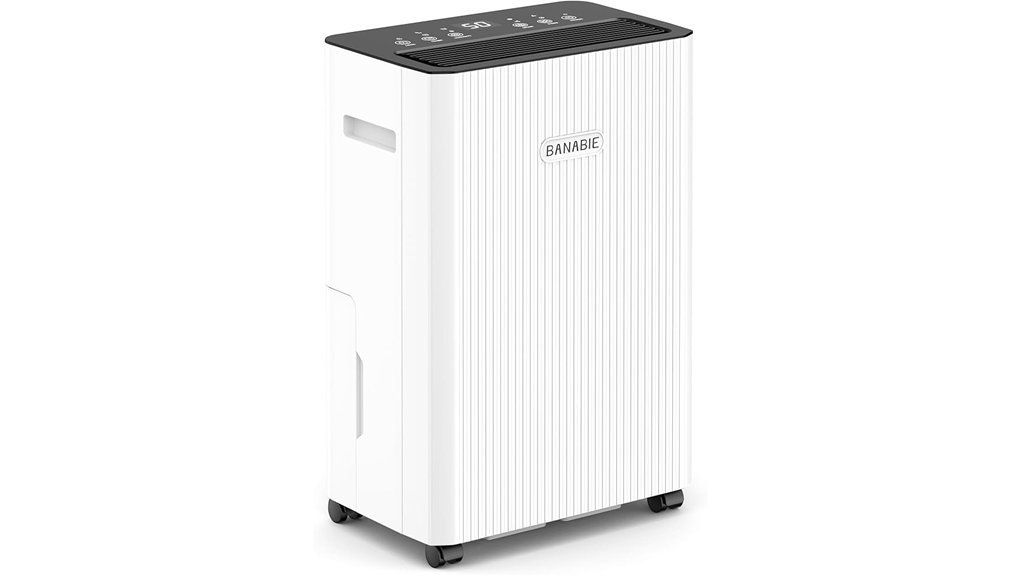
The BANABIE dehumidifier is designed for buyers who want automatic humidity control in a basement, bedroom, bathroom, or open living area. It carries a published maximum capacity of 32 pints per day and advertised coverage up to 2,500 square feet.
Its controls can maintain a selected humidity range, and the available operating choices include automatic, continuous, and customized modes. The unit also includes a 24-hour timer, 2.5-litre tank, drain hose, washable filter, overheat protection, handles, and rolling wheels.
Why you may like it: The combination of a humidistat and continuous drainage lets the unit operate with less daily attention than a tank-only compact model.
Consider before buying: The seller lists a very low 32 dB operating figure. Treat this as a published claim rather than an independently verified result because compressor noise can change with fan speed, cycling, room acoustics, and measurement distance.
Best For: Buyers who prioritize automatic controls, drainage flexibility, and a quiet published specification.
Pros:
- Published 32-pint maximum output.
- Automatic humidity regulation and multiple operating modes.
- Drain hose and washable filter included.
- Handles and wheels make room-to-room movement easier.
Cons:
- The 32 dB claim may not represent every operating mode.
- The 2.5-litre tank may fill quickly under high moisture loads.
- Canadian certification, warranty, and shipping terms require confirmation.
NeedDuck Portable Quiet Dehumidifier with Auto Shutoff
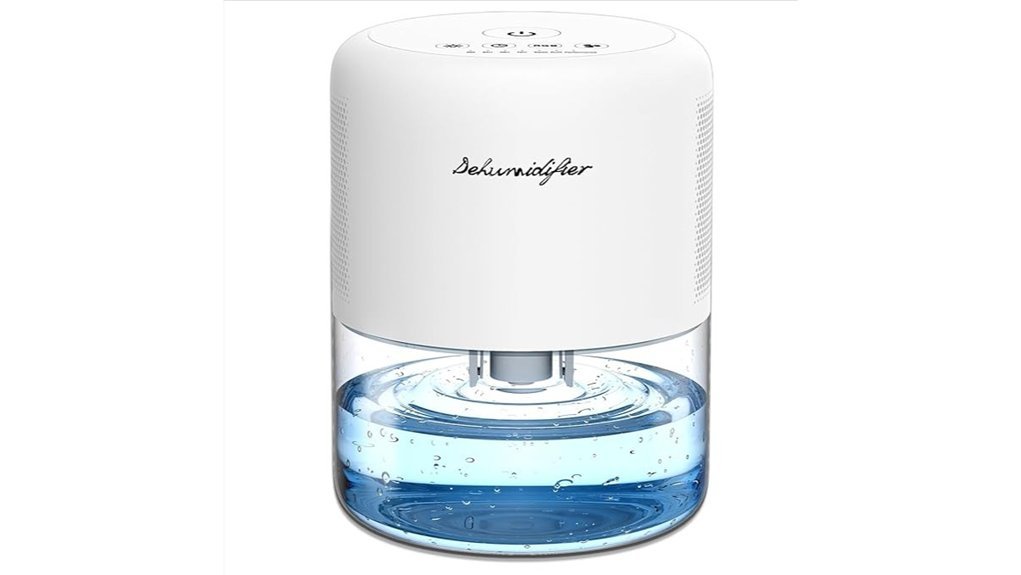
The NeedDuck B-2 is the clearest small-space option in this roundup. Its published coverage is 215 square feet, which is more realistic for a compact bathroom, closet, RV, or small bedroom than the much larger coverage figures attached to some other mini dehumidifiers.
It has a 44-ounce tank, automatic shutoff, automatic defrost, three operating modes, four timer options, ten light colours, three brightness levels, and published power consumption of 28 watts. At approximately 5.91 inches wide and 8.46 inches high, it is easy to place on a stable counter or shelf with sufficient clearance around the air vents.
Why you may like it: It is compact, light, easy to move, and designed around mild moisture control rather than pretending to replace a full-size basement appliance.
Consider before buying: This model is not appropriate for standing water, wall seepage, a wet full-size basement, or a high laundry load. It will also need regular tank emptying unless moisture levels are low.
Best For: Small bathrooms, closets, compact bedrooms, campers, and RVs with mild condensation.
Pros:
- Small footprint and lightweight design.
- Automatic defrost and full-tank shutoff.
- Multiple modes, timers, and adjustable lights.
- Low published 28-watt power draw.
Cons:
- Limited to small spaces and modest moisture loads.
- The 44-ounce tank requires manual emptying.
- No verified standardized pint-per-day output was found.
NineSky Dehumidifier for Home with 95-Ounce Tank
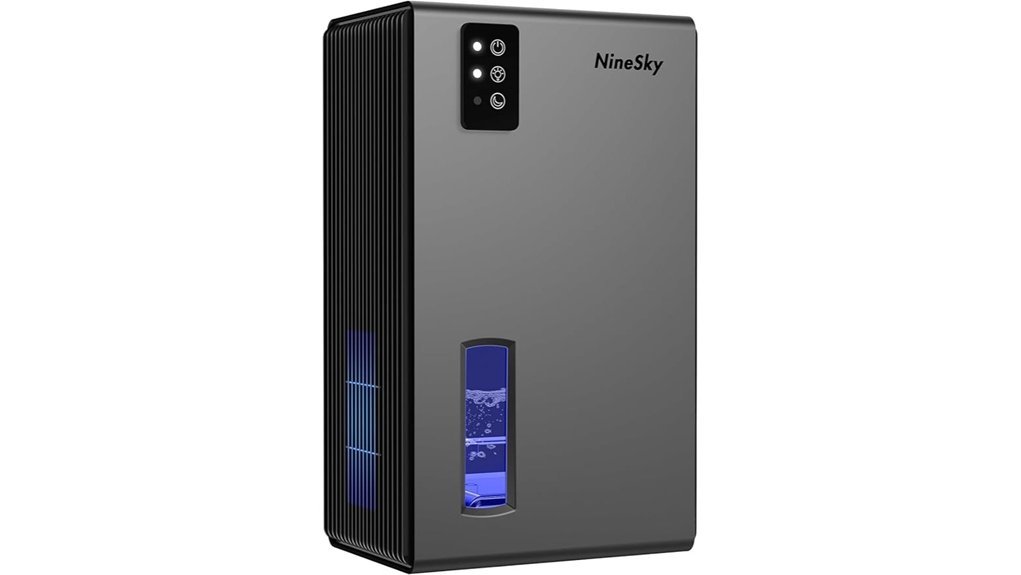
The NineSky CT2 combines a relatively large 95-ounce tank with a compact body, two speeds, night mode, automatic shutoff, and seven-colour ambient lighting. It is best considered for mild moisture in an enclosed bedroom, bathroom, office, or similar space.
The automatic shutoff stops operation when the tank is full or incorrectly seated. Night mode reduces distractions, while the light can be switched to a preferred colour or used as a simple night light.
Why you may like it: The larger tank can reduce how often you empty the unit compared with smaller desktop-style models, depending on how much water it actually collects.
Consider before buying: Tank volume is not the same as daily moisture-removal capacity. Although the listing advertises coverage up to 1,000 square feet, a standardized pint-per-day output was not confirmed. Do not select this model for a wet basement based on the square-foot number alone.
Best For: Buyers who want a quiet compact dehumidifier with a larger reservoir for mild room moisture.
Pros:
- Large 95-ounce tank for its compact category.
- Night mode and two operating speeds.
- Automatic shutoff helps prevent tank overflow.
- Seven-colour ambient light can be turned into a night-light feature.
Cons:
- No verified standardized moisture-removal rating was found.
- Advertised 1,000-square-foot coverage may overstate practical capability.
- Not the best choice for cold or severely damp basements.
BEDRED CT11 Dehumidifier with Ambient Light
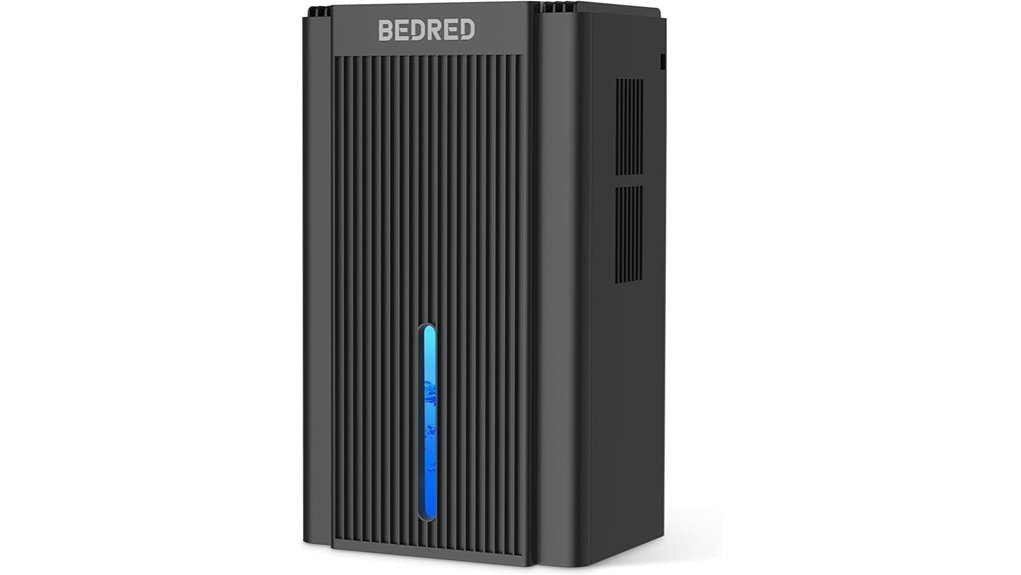
The BEDRED CT11 is a semiconductor dehumidifier designed for quiet use in bedrooms, bathrooms, compact living areas, and RVs. It weighs approximately 5.9 pounds and includes a 95-ounce tank, automatic shutoff, sleep mode, and seven-colour ambient lighting.
The seller promotes quiet operation, and sleep mode turns off the atmosphere lighting to reduce nighttime distractions. However, a consistent, independently verified decibel figure was not found for this exact model. Its compact footprint also makes it easier to position than a full-size compressor model.
Why you may like it: It offers simple operation, a large tank for its size, and low published noise for rooms where a compressor cycling on and off would be distracting.
Consider before buying: Semiconductor models generally remove moisture more slowly than compressor units and can lose effectiveness in colder conditions. Treat the advertised 1,000-square-foot figure as a marketing limit, not proof that it can control a full wet basement.
Best For: Bedrooms, bathrooms, RVs, and small living areas with mild humidity.
Pros:
- Sleep mode and quiet operation are promoted for bedroom use.
- Sleep mode turns off distracting lighting.
- 95-ounce tank and automatic shutoff.
- Compact, lightweight design.
Cons:
- Not suitable for heavy basement moisture or water intrusion.
- Performance may drop in cool Canadian rooms.
- No independently verified output figure was found.
Onsekin CS08 Dehumidifier with Aromatherapy Diffuser
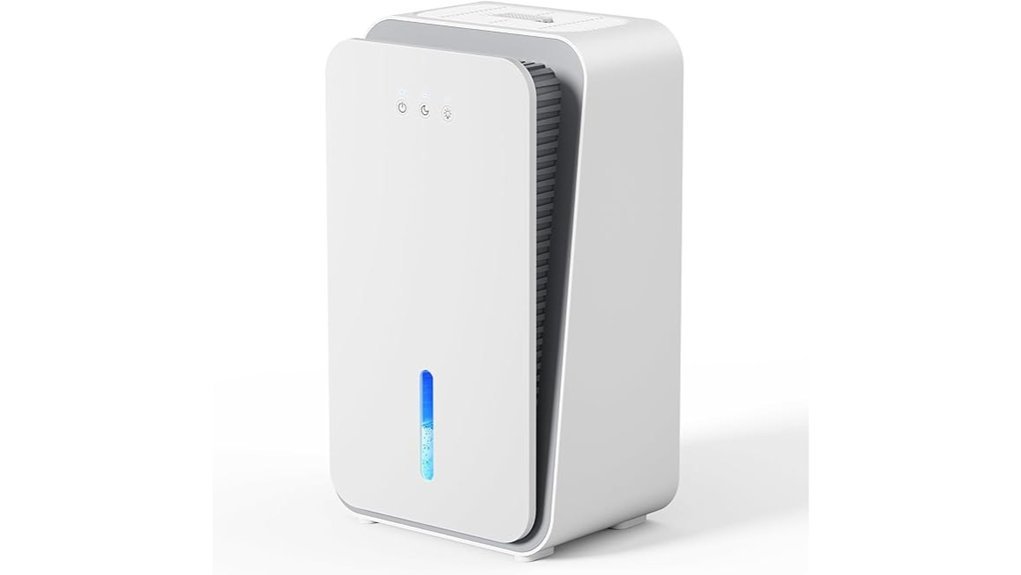
The Onsekin CS08 is a compact semiconductor dehumidifier with a designated aromatherapy feature, seven-colour lighting, two speed settings, sleep mode, automatic shutoff, a carrying handle, and a continuous-drain option.
Its combination of humidity control and fragrance diffusion may appeal to buyers who want one small appliance for a bedroom or relaxation area. The seller publishes coverage up to 1,000 square feet and noise below 45 dB, but practical performance should be judged by the amount of water collected in the actual room.
Why you may like it: It offers more lifestyle features than a basic mini dehumidifier and can operate without bright lighting in sleep mode.
Consider before buying: Use essential oil only in the designated aromatherapy pad or compartment and follow the manual. Never add oil to the water tank or other internal components. People who are sensitive to fragrance may prefer to leave the aromatherapy feature unused.
This compact model should be used for mild humidity. It is not a substitute for a high-capacity compressor unit where walls sweat, water seeps into the basement, or laundry creates a heavy moisture load.
Best For: Small bedrooms or relaxation spaces where quiet operation, lighting, and an optional fragrance feature are priorities.
Pros:
- Built-in aromatherapy compartment.
- Sleep mode and two operating speeds.
- Automatic shutoff and continuous-drain capability.
- Compact design with a carrying handle.
Cons:
- Published coverage is not supported by a confirmed standardized capacity rating.
- Not intended for severe basement humidity.
- Fragrance may not suit users with scent sensitivity.
Factors to Consider When Choosing a Quiet Dehumidifier in Canada
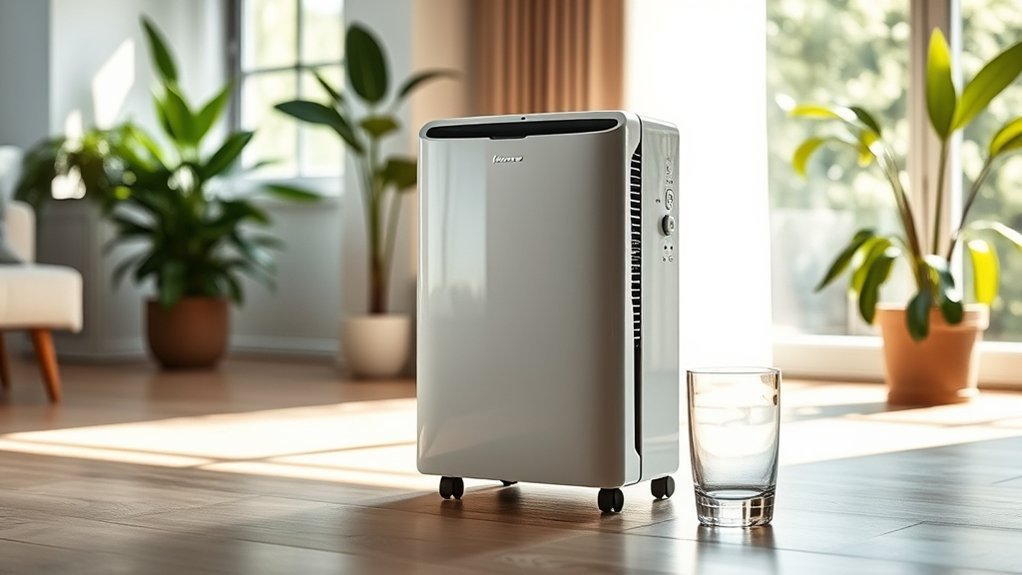
A low noise rating is useful, but it should not be the only factor in your decision. Match the dehumidifier to the moisture problem first, then compare sound, drainage, energy efficiency, temperature range, controls, and Canadian certification.
Compressor vs. Thermoelectric Dehumidifiers
Compressor dehumidifiers are usually the better choice for basements, laundry rooms, larger areas, and persistent humidity. They remove more moisture but may produce compressor cycling, fan noise, and vibration.
Thermoelectric or semiconductor dehumidifiers are compact and often quieter. They are best for closets, bathrooms, RVs, small bedrooms, and mild condensation. They normally remove moisture more slowly and may struggle in cool rooms or severe humidity.
Noise Level Ratings
Published noise ratings for quiet dehumidifiers commonly fall in the 28 to 45 dB range, but figures from different sellers are not always directly comparable. The measurement may have been taken in sleep mode, at the lowest fan speed, from a favourable distance, or before the compressor cycled on.
A 3 dB difference represents roughly a doubling or halving of sound energy, not a doubling or halving of perceived loudness. A difference of about 10 dB is generally much more noticeable to the listener.
For a bedroom, look beyond the headline number. Check whether sleep mode turns off lights, whether the fan changes speed abruptly, and whether reviewers mention clicking, vibration, or compressor cycling.
Coverage Area and Moisture Load
Do not size a dehumidifier by square footage alone. Consider:
- The room’s floor area and ceiling height.
- Starting relative humidity.
- Whether walls or floors feel damp.
- Laundry drying, showers, or other moisture sources.
- Airflow between rooms.
- Room temperature.
- Whether water is entering through a leak or foundation problem.
A compact machine may work well in a closed bathroom but perform poorly in an open basement with the same floor area. For persistent dampness, a properly sized compressor unit with a humidistat is usually the safer choice.
Understanding Pint Capacity
Pints per day describes how much water a unit can remove in 24 hours under specified test conditions. Current standardized portable-dehumidifier capacity testing uses cooler basement-like conditions than some seller “maximum” ratings. A claim measured at 95°F and 90% or 95% relative humidity should not be treated as directly equivalent to a standardized rating measured under cooler conditions.
Do not confuse tank volume with extraction capacity. A 95-ounce tank only tells you how much collected water the reservoir can hold. It does not mean the unit removes 95 ounces every day.
Tank Size and Drainage
A larger tank reduces emptying frequency, but it also becomes heavier when full. Automatic shutoff is important because it stops the machine when the bucket reaches capacity.
For a basement or laundry room, look for a continuous-drain connection. Gravity drainage requires the hose to slope downward without kinks. A model without a pump cannot normally move water upward into a sink.
Energy Efficiency
For a compressor model sold in Canada, verify ENERGY STAR certification in the official product finder rather than relying only on seller artwork. Compare the Integrated Energy Factor, or IEF: a higher IEF means the unit removes more water per kilowatt-hour of electricity under the applicable test method.
A humidistat also helps reduce unnecessary operation. Set a reasonable target instead of running continuously at the lowest possible humidity. Keep the filter clean, close doors and windows during operation, and correct leaks or water entry rather than expecting the appliance to compensate indefinitely.
Winter Operation in Canada
Check the manufacturer’s stated operating-temperature range before placing a dehumidifier in a cool basement, garage, cottage, or crawl space. Performance can fall and frost can form as the room cools. Automatic defrost is useful, but it does not make every unit suitable for an unheated or near-freezing space.
During winter, many Canadian homes need a lower indoor humidity target to reduce condensation on cold windows. A range near 30% to 40% RH may be appropriate, while the broader year-round indoor target is generally 30% to 50% RH.
Controls and Smart Features
Useful controls include an adjustable humidistat, timer, auto restart, memory function, child lock, full-tank warning, filter reminder, and multiple fan speeds. Wi-Fi and voice control can be convenient, but they are less important than accurate humidity control, drainage, and sufficient moisture-removal capacity.
Do not assume a product is app-enabled because its listing uses the word “smart.” In many dehumidifier listings, “smart humidity control” only means that the appliance cycles automatically according to its built-in humidistat.
Portability and Placement
For a compressor model, casters and handles are more useful than an arbitrary weight limit. Compact thermoelectric units are easier to carry, but they still need a stable, level surface and clear space around the inlet and outlet.
Do not place a dehumidifier directly against a wall, inside a closed cabinet, on bedding, or where water can splash onto its electrical components. Follow the clearance instructions in the product manual.
Maintenance and Durability
Clean a washable filter according to the manufacturer’s schedule, empty and rinse the tank regularly, and inspect the drain hose for kinks or buildup. Let the tank dry if the unit will be stored.
Dust on the air intake or humidity sensor can reduce airflow or affect readings. Unplug the unit before cleaning and never spray water or cleaner directly into the controls, fan, or electrical openings.
Canadian Electrical Certification
Before using a plug-in dehumidifier in Canada, check the product itself for a recognized Canadian certification mark such as CSA, cUL, or cETL. Also confirm the required voltage and frequency, particularly when buying from a seller outside Canada.
A marketplace listing, brand claim, or logo printed only on the box is not a substitute for the certification mark on the appliance.
Before You Buy Checklist
- Measure the room and assess how damp it is.
- Choose a compressor model for persistent or large-space moisture.
- Use a compact unit only for mild humidity in a smaller enclosed area.
- Check the published pint-per-day rating and its test conditions.
- Confirm the minimum operating temperature for a Canadian basement.
- Decide whether you need a tank, gravity drain, or built-in pump.
- Compare sleep mode, fan speeds, vibration, and light controls.
- Verify Canadian electrical certification on the appliance.
- Review shipping, warranty, returns, currency, and import fees.
- Repair leaks and water intrusion instead of relying only on dehumidification.
Frequently Asked Questions
How Do I Maintain My Dehumidifier for Optimal Performance?
Clean or wash the filter according to the manual, empty and rinse the tank, keep the air inlet and outlet clear, and inspect the drain hose for clogs or kinks. Unplug the machine before cleaning. Periodically check the humidity reading against a separate hygrometer if the unit appears to run too long or stop too early.
Can I Use a Dehumidifier During a Canadian Winter?
Yes, provided the room stays within the model’s stated operating-temperature range. Performance can fall and frost can develop in cool basements or garages. Look for automatic defrost, but do not assume it makes the appliance suitable for an unheated or near-freezing room.
What Size Dehumidifier Do I Need?
Base the choice on both room size and moisture severity. A mildly damp bedroom may need much less capacity than a smaller laundry area with wet floors or frequent clothes drying. For a wet basement, select a properly rated compressor unit rather than relying on the advertised square-foot figure of a compact thermoelectric model.
What Humidity Level Should I Set?
A general indoor target is between 30% and 50% relative humidity. During a cold Canadian winter, a setting near 30% to 40% may help reduce condensation on windows. Adjust the target according to outdoor temperature, condensation, room comfort, and the manufacturer’s guidance.
Are Quiet Dehumidifiers Energy-Efficient?
Noise level alone does not determine efficiency. For compressor models, look for ENERGY STAR certification and a high Integrated Energy Factor. A humidistat, timer, clean filter, proper sizing, and closed doors and windows can also reduce unnecessary runtime.
Is a Thermoelectric Dehumidifier Good for a Basement?
It may help in a small, warm, mildly damp basement room, but it is usually not the best choice for a full basement with persistent humidity, condensation, laundry, seepage, or musty surfaces. A compressor dehumidifier with a verified capacity and continuous drainage is normally more appropriate.
Do All Dehumidifiers Need Replacement Filters?
No. Many models use a washable reusable filter, while others may require replacement parts. Check the manual for the exact model. A filter should never be assumed to purify the air like a dedicated air cleaner unless the manufacturer specifically provides tested filtration information.
Will a Dehumidifier Remove Existing Mould?
No. A dehumidifier can help control the moisture conditions that support mould growth, but it does not remove established mould or repair the source of water. Fix leaks, improve ventilation, dry wet materials promptly, and follow appropriate mould-cleaning or remediation guidance.
Conclusion
The AEOCKY 50-Pint is the most complete option in this roundup for a larger or persistently damp space. The 34-Pint Dehumidifier is a strong alternative when sleep-mode controls and moderate compressor capacity are the main priorities, while the BANABIE 32-Pint stands out for automatic humidity control and drainage flexibility.
For a bathroom, closet, RV, or compact bedroom with mild moisture, the NeedDuck, NineSky, BEDRED, and Onsekin models offer smaller and quieter designs. Their large tank or square-foot claims should not be confused with the moisture-removal capability of a compressor machine.
Final recommendation:
Choose capacity and technology for the moisture problem first, then compare noise. Before ordering for use in Canada, verify the certification mark, operating temperature, warranty, shipping eligibility, and final delivered cost.