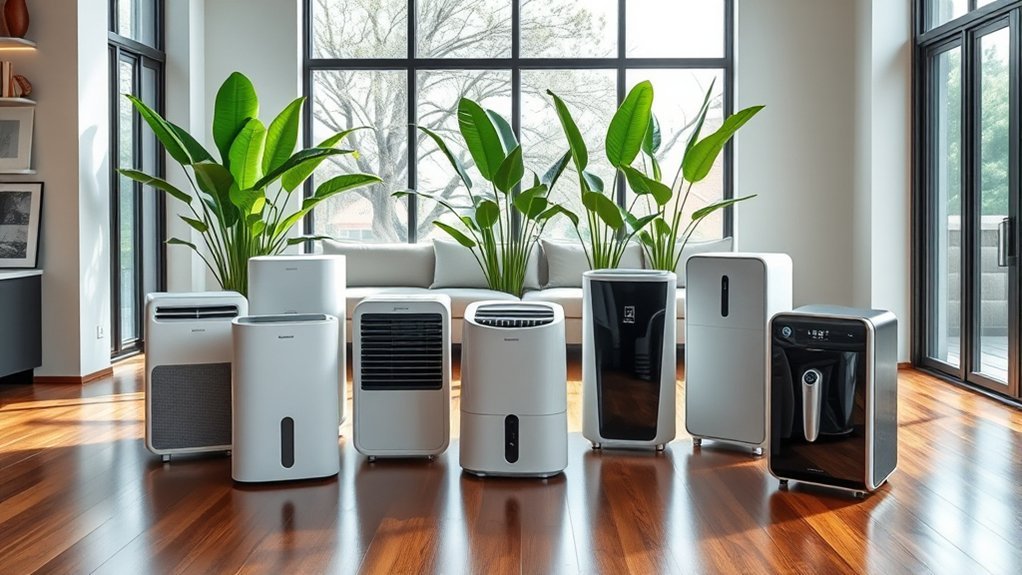
If you’re comparing the best dehumidifiers for 2026, start with the moisture problem you need to solve. Compressor models such as Midea, Waykar, Candy, and PLUSCENT are better suited to larger or consistently damp rooms. Compact thermoelectric models such as Frizzlife, NineSky, and TABYIK are easier to place in bedrooms, bathrooms, closets, and RVs, but they remove less water and work best for mild, localized humidity. Compare daily moisture-removal capacity, drainage options, noise, tank size, operating temperature, and humidity controls rather than relying on square-foot claims alone.
Affiliate Disclosure: This article contains Amazon affiliate links. We may earn a commission at no extra cost to you. Product specifications, sellers, and availability can change, so confirm the current product details on Amazon before ordering.
Quick Verdict: The Midea 22-Pint Dehumidifier offers the most balanced combination of compressor performance, humidity control, drainage, energy certification, and smart features for a typical medium room. Choose the Waykar for a larger or persistently damp area, the Candy when app and voice control matter, the PLUSCENT for a smaller compressor option, or the TABYIK for mild moisture in a compact room.
How We Compared: We reviewed listed moisture-removal capacity, dehumidification technology, room suitability, drainage, tank size, noise, controls, portability, and maintenance requirements. We did not perform hands-on testing. Maximum extraction and coverage figures are manufacturer or seller claims and can change with temperature and relative humidity.
Capacity Note: Do not compare a “maximum” rating measured in very hot, humid conditions directly with a DOE- or AHAM-rated pint figure. Use the stated test conditions, drainage setup, and actual dampness of your room to make a fair comparison.
Quick Comparison of the Best Dehumidifiers
| Product | Best Use | Listed Capacity | Drainage | Key Limitation | Amazon |
|---|---|---|---|---|---|
| Midea Best Overall for Medium Rooms |
Bedrooms, offices, bathrooms, smaller basements | Up to 22 pints/day | 0.8-gallon tank or standard hose connection | Drain hose is not included | Check Product Details |
| Waykar Best for Large Damp Spaces |
Large basements and living areas | Up to 80 pints/day under listed conditions | 1.14-gallon tank or included hose | Larger than needed for a small room | Check Product Details |
| Candy Best Smart Large-Room Pick |
Basements, laundry rooms, vacation homes | 53 pints/day at 86°F/80% RH; max 80 at 95°F/90% RH | 1.35-gallon tank or included hose | Smart functions depend on compatible Wi-Fi and services | Check Product Details |
| PLUSCENT Best Mid-Capacity Value |
Bedrooms, living areas, smaller basements | Up to 32 pints/day | 2-liter tank or included hose | Small tank for a compressor model | Check Product Details |
| Frizzlife DH80 Best Large-Tank Compact Pick |
Bedrooms, bathrooms, dorms, RVs | Up to 1.2 liters/day under listed conditions | 135-ounce tank | No hose drainage or precise humidistat | Check Product Details |
| NineSky Best Compact 95-Ounce Pick |
Bedrooms, closets, bathrooms, RVs | Daily output not clearly stated | 95-ounce tank | Not designed for severe basement humidity | Check Product Details |
| TABYIK Best Budget Small-Room Pick |
Small bedrooms, bathrooms, closets, RVs | Up to 450 ml/day at 86°F and 80% RH | 35-ounce tank | No target-humidity control or hose drainage | Check Product Details |
PLUSCENT 32-Pint Dehumidifier for Large Rooms
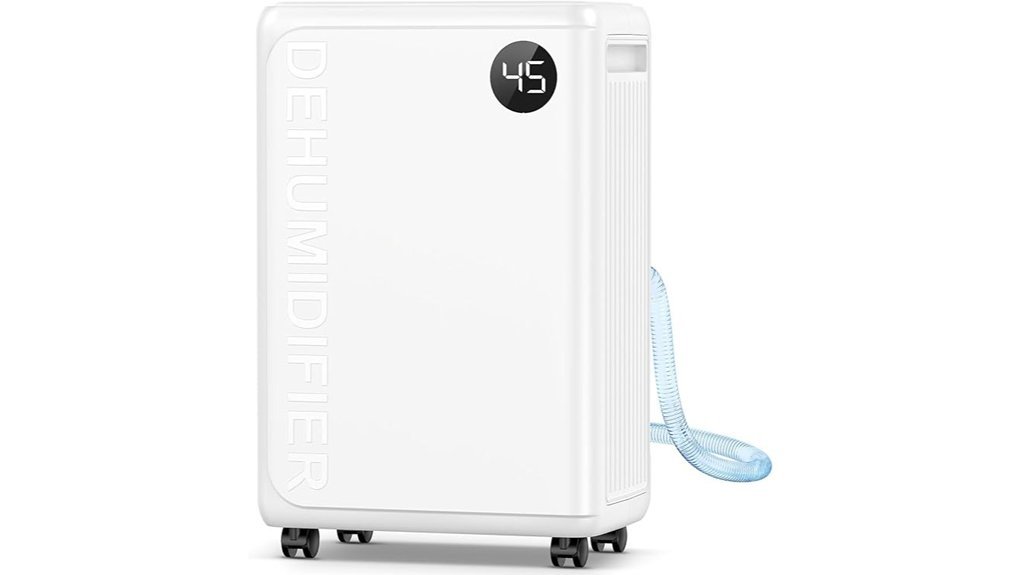
Best Mid-Capacity Value: The PLUSCENT is a practical step up from a tabletop dehumidifier when you need compressor performance without choosing one of the largest units in this guide. It is advertised for rooms up to 2,500 square feet and moisture removal up to 32 pints per day under the seller’s test conditions.
DEHU mode lets you select a target humidity, CONT supports continuous operation, and DRY mode is intended for faster laundry or room drying. You also get a 24-hour timer, child lock, automatic restart, auto defrost, a washable filter, wheels, and carrying handles. The included hose makes continuous gravity drainage possible, although the 2-liter tank may fill quickly in a damp room.
Why You’ll Like It: Its combination of humidity control, included hose, portability, and seller-listed 39–42 dB operation suits bedrooms and shared living spaces better than many larger compressor units.
Who Should Avoid It: Choose a higher-capacity model if you are dealing with water intrusion, a very wet full-size basement, or a large open area that remains above your target humidity.
Pros:
- Up to 32 pints of advertised daily moisture removal.
- Included drain hose, timer, child lock, and automatic restart.
- Smaller footprint than many high-capacity compressor models.
Cons:
- The 2-liter tank may require frequent emptying without hose drainage.
- Noise and capacity figures are manufacturer or seller claims.
- Less suitable than a higher-pint model for severe whole-basement dampness.
NineSky 95-Ounce Compact Dehumidifier
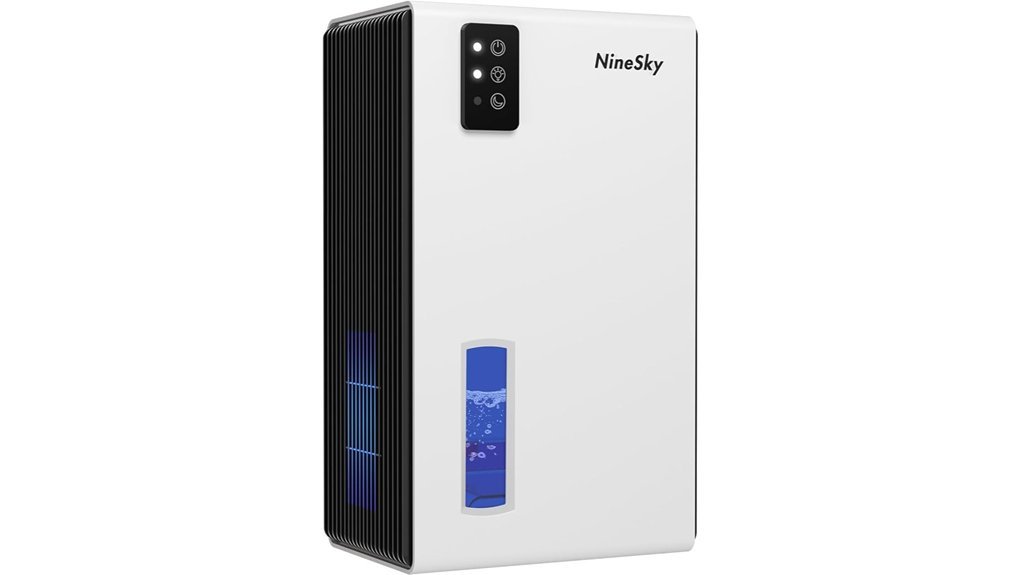
Best Compact 95-Ounce Pick: The NineSky is better suited to mild moisture in a bedroom, bathroom, closet, dorm, or RV than to a severely damp basement. Its semiconductor or thermoelectric system is compact and generally quieter than a compressor, but it also removes water more slowly.
The seller advertises coverage up to 1,000 square feet, although shoppers should treat that as a placement guideline rather than proof that it can control heavy humidity throughout a large room. The useful features are its 95-ounce tank, high-speed mode, quieter night mode, automatic shutoff, and seven-color ambient light that can be turned off.
Why You’ll Like It: The larger-than-average tank reduces emptying compared with many miniature dehumidifiers, while the compact body is easy to place on a shelf, dresser, or counter.
Who Should Avoid It: Do not choose it as a substitute for a 22-, 32-, or 50-pint compressor dehumidifier in a wet basement or large open living area.
Pros:
- Compact design with a relatively large 95-ounce tank.
- Night mode, ambient-light control, and automatic shutoff.
- Suitable for localized moisture in small enclosed spaces.
Cons:
- No clearly stated daily moisture-removal rate in the available product information.
- Thermoelectric performance drops in cooler or less humid conditions.
- The advertised 1,000-square-foot figure may overstate its practical heavy-humidity capability.
TABYIK 35-Ounce Small Quiet Dehumidifier
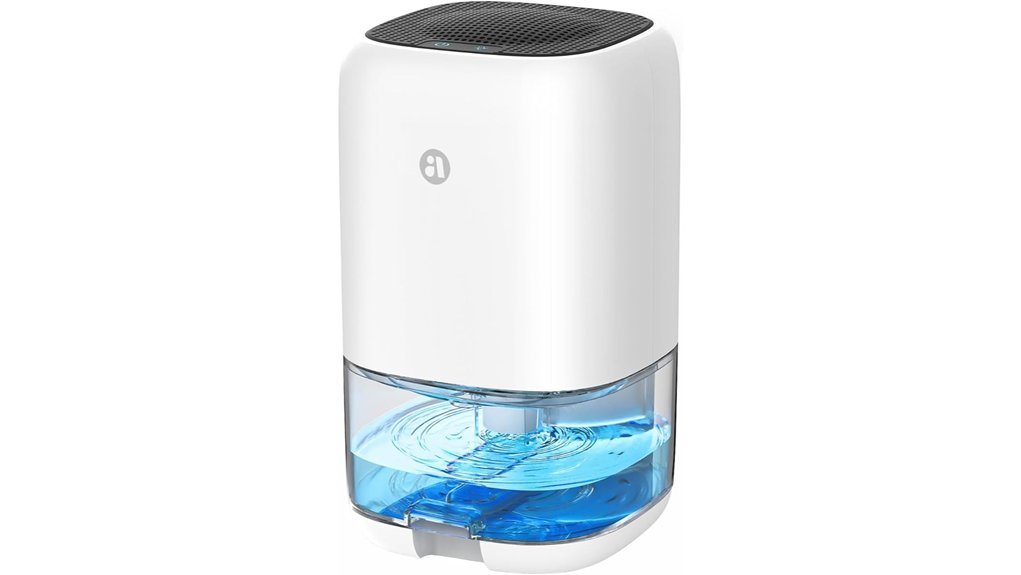
Best Budget Small-Room Pick: The TABYIK is intended for mild humidity in compact spaces such as a small bedroom, bathroom, closet, camper, or RV. The seller advertises coverage around 280 square feet and extraction up to approximately 450 ml per day under favorable warm and humid conditions.
Its 35-ounce transparent tank lets you monitor the water level, while automatic shutoff stops operation when the tank is full or incorrectly seated. The rear handle makes it easy to move, and the seven-color light can add a soft glow. Seller-listed 28 dB operation also makes it one of the quieter options in the roundup.
Why You’ll Like It: It is simple, compact, easy to move, and does not require an app, hose, or complicated control panel.
Who Should Avoid It: It is not suitable for a large basement, water-damaged room, or situation requiring a precise target-humidity setting.
Pros:
- Compact footprint and built-in carrying handle.
- Seller-listed 28 dB operation and automatic shutoff.
- Transparent tank makes the water level easy to check.
Cons:
- Small 35-ounce tank requires manual emptying.
- No continuous drainage or adjustable target humidity.
- Maximum extraction depends on warm, humid test conditions.
Frizzlife DH80 Dehumidifier with Air-Purifying Function
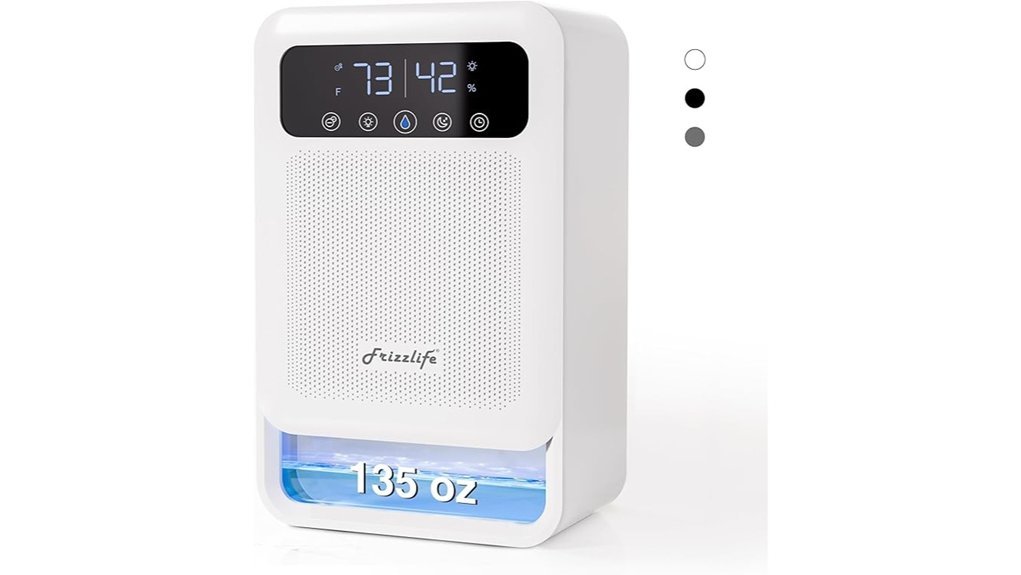
Best Large-Tank Compact Pick: The Frizzlife DH80 uses dual semiconductor technology and pairs it with a 135-ounce collection tank. The current product information lists dehumidification capacity at 1.2 liters per day, which is about 40.6 fluid ounces, under favorable warm and humid conditions. Output will be lower in cooler or less humid rooms.
The current listing gives a 350-square-foot floor-area figure, but its thermoelectric design is still best viewed as a localized solution for a bedroom, bathroom, dorm, RV, or other small enclosed area. It also offers a one-to-24-hour timer, automatic shutoff, seven-color night light, seller-listed 28 dB sleep mode, and a switchable negative-ion function.
Why You’ll Like It: Its 135-ounce tank is much larger than the tanks found in many tabletop models, reducing how often you need to empty it.
Who Should Avoid It: Choose a compressor model if you need rapid humidity reduction, continuous hose drainage, or reliable performance in a cool basement.
Pros:
- Large 135-ounce tank for a compact thermoelectric model.
- Seller-listed extraction of about 1.2 liters per day under favorable conditions.
- Timer, sleep mode, automatic shutoff, and ambient-light controls.
Cons:
- No hose connection for continuous drainage.
- Cannot maintain a user-selected target humidity in the same way as a compressor humidistat.
- Negative-ion purification should not be treated as a substitute for verified HEPA filtration.
Waykar 80-Pint Energy Star Dehumidifier for Large Rooms
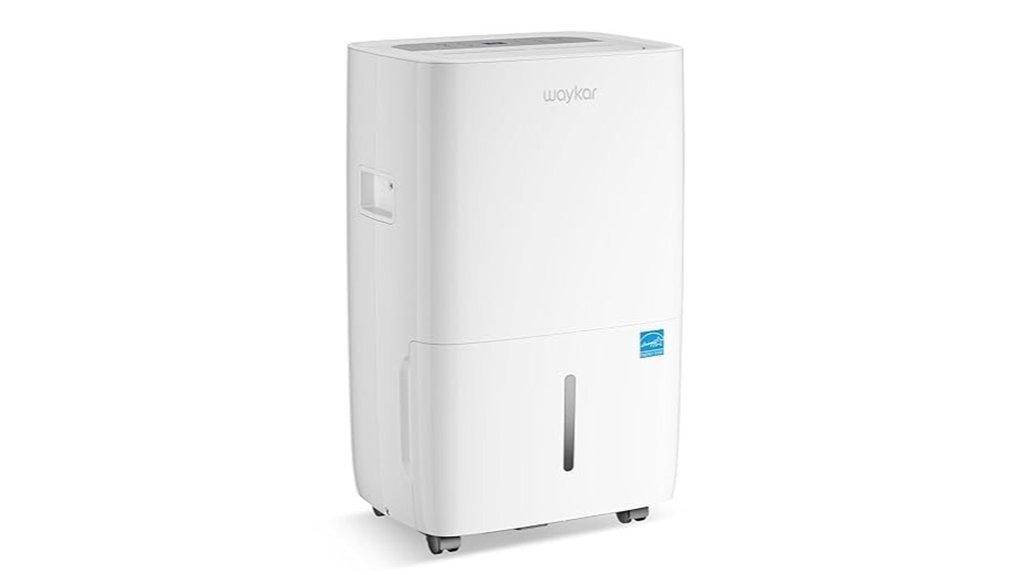
Best for Large Damp Spaces: The Waykar is designed for homeowners who need compressor-based moisture control in a basement, large living area, laundry room, or other consistently humid space. The listing advertises an 80-pint capacity and coverage up to 5,000 square feet, although real extraction depends on temperature, relative humidity, and room layout.
You can set humidity from 30% to 80%, use a 24-hour timer, and choose between the approximately 1.14-gallon tank and the included gravity-drain hose. Its 90-degree auto-swing outlet helps distribute dry air, while automatic defrost, overload protection, a washable filter, wheels, and carrying handles support everyday use. The model is also listed as Energy Star certified.
Why You’ll Like It: It combines high-capacity positioning, continuous drainage, adjustable humidity, and energy-efficiency certification.
Who Should Avoid It: It may be larger, heavier, and more powerful than needed for a bathroom, closet, or small bedroom.
Pros:
- High advertised capacity for large and persistently damp rooms.
- Energy Star certification and automatic humidity control.
- Included hose, auto swing, timer, washable filter, and auto defrost.
Cons:
- Advertised capacity should not be treated as guaranteed daily collection.
- The approximately 1.14-gallon tank can still fill quickly in severe humidity.
- Larger footprint than the compact and mid-capacity models.
Candy Smart Wi-Fi Dehumidifier with Hose
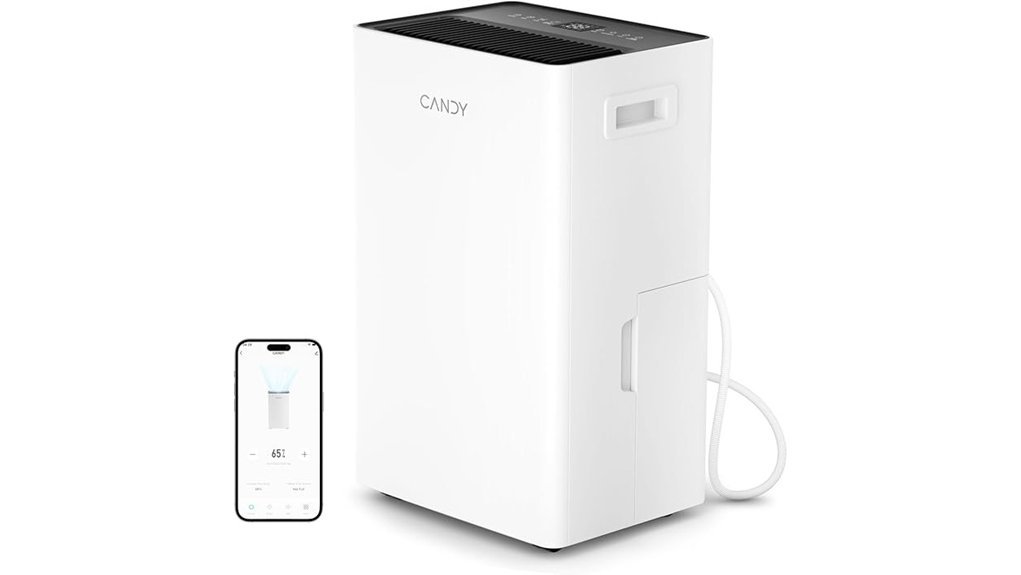
Best Smart Large-Room Pick: The Candy dehumidifier is designed for large rooms where remote humidity control and continuous drainage are useful. The current listing states moisture removal up to 53 pints per day at 86°F and 80% relative humidity, with a maximum claim of 80 pints per day at 95°F and 90% relative humidity. It also advertises coverage up to 4,500 square feet, which should be treated as a placement claim rather than a guarantee for every room layout.
You can adjust the target humidity from 30% to 90%, select Continuous, Auto, or Sleep mode, and choose among three fan speeds. Wi-Fi support allows control through the Candy Home app, Google Home, or Alexa. The unit also includes a 1.35-gallon tank, 6.67-foot drain hose, washable filter, timer, child lock, auto defrost, wheels, and a seller-listed noise level around 43 dB.
Why You’ll Like It: It combines remote humidity control, an included drain hose, a large tank, and adjustable fan speeds for spaces that need regular monitoring.
Who Should Avoid It: Choose a simpler model if you do not plan to use Wi-Fi or voice control, if the exact seller is unavailable, or if you only need light moisture removal in one small room.
Pros:
- Wi-Fi app, Alexa, and Google Home control.
- 53-pint daily extraction claim at 86°F and 80% RH, with an 80-pint maximum claim at hotter, wetter conditions.
- Included hose, large tank, three fan speeds, and multiple modes.
Cons:
- Smart functions depend on a compatible network, app, and third-party service.
- A large-capacity model takes up more floor space than a compact unit.
- The maximum capacity and coverage figures depend on room conditions.
Midea 22-Pint Energy Star Smart Dehumidifier
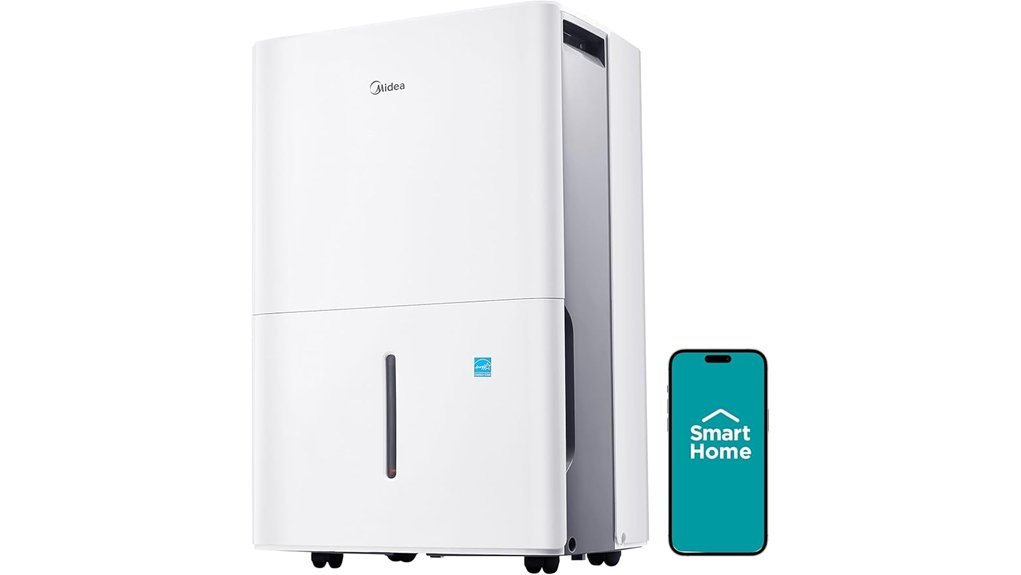
Best Overall for Medium Rooms: The Midea 22-pint model offers a balanced combination of compressor performance, smart controls, energy certification, portability, and clearly documented maintenance features. It is advertised for rooms up to 1,500 square feet and can remove up to 22 pints of moisture per day under its rated conditions.
You can set a target humidity from 35% to 85%, select continuous, comfort, or turbo operation, and schedule the unit with its 24-hour timer. The SmartHome app supports remote humidity checks and adjustments, while the model also lists Alexa and Google Assistant support. Auto restart, auto defrost, a washable filter, caster wheels, and seller-listed 47 dBA operation make it suitable for bedrooms, offices, bathrooms, and smaller basements.
The 0.8-gallon bucket is easy to remove but smaller than the tanks on some competing compressor models. You can connect a standard hose for gravity drainage, although the hose is not included.
Why You’ll Like It: It provides useful smart features and genuine compressor capacity without the size and output of an oversized 50- or 80-pint unit.
Who Should Avoid It: Choose a larger model for an extremely wet full-size basement, or a compact thermoelectric model if you only need mild moisture control in a closet.
Pros:
- 22-pint compressor capacity with Energy Star certification.
- Wi-Fi, voice-control support, timer, turbo mode, and adjustable humidity.
- Auto defrost, auto restart, washable filter, and continuous-drain connection.
Cons:
- The 0.8-gallon bucket may need frequent emptying in damp conditions.
- A gravity-drain hose is not included.
- Less powerful than the high-capacity models for severe whole-basement humidity.
Factors to Consider When Choosing a Dehumidifier
The right dehumidifier depends on more than the room-size number printed in a product title. Compare the machine’s technology, listed daily extraction, drainage method, operating temperature, noise, controls, and maintenance requirements. A small thermoelectric unit can be convenient in a bathroom, while a compressor model is usually the better tool for a damp basement.
Compressor vs. Thermoelectric Dehumidifiers
Compressor dehumidifiers use refrigerant coils and a compressor to condense larger amounts of water. They are generally better for basements, laundry rooms, and continuously damp living areas. They are also heavier and usually produce more operating noise.
Thermoelectric dehumidifiers use a semiconductor cooling plate. They are compact, simple, and often quieter, but their extraction rate is much lower and falls as the room becomes cooler or less humid. Choose one for mild localized moisture, not active water intrusion or serious whole-basement dampness.
Coverage Area and Room Layout
Treat square-foot coverage as a rough guide rather than a guarantee. A closed 500-square-foot room is easier to manage than a 500-square-foot area divided by walls, open doors, stairways, or connected hallways. Air must circulate back to the dehumidifier for its humidistat to measure and control the space effectively.
For compact thermoelectric models, pay particular attention to the stated daily extraction. A large tank does not automatically mean the machine removes moisture quickly.
Moisture Removal Capacity
Compressor capacity is normally listed in pints per day, while compact models may use ounces or milliliters. These ratings are measured under defined temperature and humidity conditions. A unit advertised to remove its maximum amount in a hot, very humid test room will collect less water in a cooler bedroom. Do not treat hot-saturation maximums, DOE ratings, and compact-model extraction claims as directly interchangeable.
Choose a higher-capacity model when the room smells persistently musty, condensation returns quickly, laundry dries slowly, or the machine will serve a large basement. Choose a compact unit when the issue is limited to a small bathroom, closet, camper, or bedside area.
Drainage and Tank Size
A larger tank means fewer trips to the sink, but it does not increase the machine’s extraction power. For continuous operation, look for a gravity-drain connection and check whether the hose is included. The hose must run downhill without kinks to a suitable drain.
Automatic shutoff is essential for tank drainage because it stops the unit when the bucket is full or incorrectly installed. A clear tank or full-bucket indicator also makes routine checks easier.
Noise and Bedroom Use
Manufacturer decibel ratings can help you compare products, but test methods may differ. Compressor units normally produce compressor and fan noise, while thermoelectric models usually produce a softer fan sound. Sleep mode often lowers fan speed and turns off display lighting, but it can also reduce moisture-removal speed.
Electrical Safety and Placement
Place the dehumidifier on a stable, level surface with the air inlet and outlet clear. Do not use an extension cord unless the manufacturer specifically permits it, and do not place a household unit where it can be splashed or exposed to standing water. In a bathroom, follow the manual’s clearance and outlet requirements and keep the unit outside wet zones.
For hose drainage, make sure the hose connection is secure and the line runs continuously downhill without loops or kinks. Never allow the hose to drain where water can damage flooring or create a slip hazard.
Smart Controls and Energy Efficiency
Wi-Fi control is useful in a basement, vacation home, or room you do not visit frequently. Look for remote humidity readings, target-humidity adjustment, schedules, full-tank alerts, and automatic restart after a power interruption.
Energy Star certification can help identify efficient compressor models, but operating cost still depends on wattage, runtime, room conditions, and the selected humidity target. A correctly sized dehumidifier that cycles off is generally more practical than an underpowered unit that runs continuously without reaching the target.
Air-Purification Features
A washable pre-filter mainly protects the dehumidifier from dust and lint. It should not be treated as a HEPA air purifier. When a combo model includes an H13 or other particle filter, check replacement availability, replacement cost, airflow specifications, and whether filtration can operate at the same time as dehumidification.
Lowering humidity may make a room less favorable for moisture-related problems, but a dehumidifier does not directly remove all pollen, smoke, pet dander, odors, or airborne particles.
Before You Buy:
- Measure the room and consider whether doors will remain open or closed.
- Decide whether you need compressor power or compact thermoelectric operation.
- Compare daily extraction and test conditions, not just tank size or square-foot marketing.
- Check whether a drain hose is included and whether gravity drainage is possible.
- Confirm the operating-temperature range for a cool basement.
- Check filter-cleaning requirements and replacement-filter availability.
- Verify current dimensions, voltage, seller, warranty, included accessories, and Amazon availability.
Frequently Asked Questions
Are All Dehumidifiers Fan and Dehumidifier Combos?
No. A dehumidifier normally has an internal fan that moves air across its coils, but that does not mean it provides a separate room-fan mode. Check the control panel or manual if you specifically want fan-only operation.
Which Type Is Best for a Damp Basement?
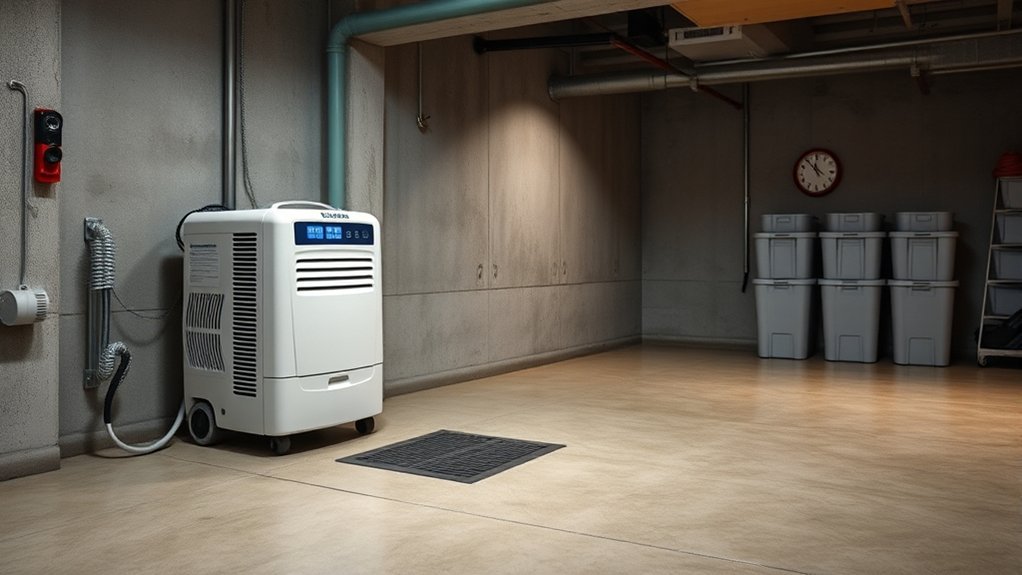
A compressor dehumidifier is usually the better choice for a damp basement because it removes substantially more water than a tabletop thermoelectric model. Look for adequate pint capacity, automatic defrost, a washable filter, and continuous hose drainage.
Can a Compact Dehumidifier Really Cover 1,000 Square Feet?
Some compact models advertise coverage up to 1,000 square feet, but the practical result depends on their daily extraction rate, temperature, humidity, airflow, and room layout. A thermoelectric unit may provide localized moisture reduction in that area without controlling severe humidity throughout the entire space.
Will a Dehumidifier Cool the Room?
No. Removing moisture can make the air feel less clammy, and the internal fan creates some air movement, but a dehumidifier is not an air conditioner. Compressor models may release a small amount of heat into the room while operating.
Can a Dehumidifier Help With Allergens?
A dehumidifier controls moisture rather than directly capturing most airborne particles. A model with a genuine particle filter may provide additional filtration, but it should not replace regular cleaning, source control, ventilation, or a properly sized air purifier when particle removal is the main goal.
Why Do Dehumidifier Capacity Numbers Look Inconsistent?
Different listings may use different temperature and humidity test conditions. A “maximum” figure measured in very hot, wet air can be much higher than a standard-condition rating. Compare the stated test conditions and avoid assuming that two products with the same headline pint number will perform identically in your room.
How Much Electricity Does a Dehumidifier Use?
Check the product’s wattage and estimate consumption with this formula: watts divided by 1,000, multiplied by operating hours. For example, a 300-watt unit running for eight hours uses about 2.4 kWh. Multiply that number by your electricity rate to estimate cost.
Can I Run a Dehumidifier Overnight?
Many models are designed for extended operation when they are correctly positioned and maintained. Place the unit on a level surface, keep the air inlet and outlet clear, use the correct grounded outlet, secure the drain hose, and follow the manufacturer’s safety instructions. Automatic shutoff is especially important when using the tank.
Do Dehumidifiers Work in Winter?
They can, but performance falls as the room becomes colder. Compressor coils may frost in cool conditions, so a basement model should have automatic defrost and an operating-temperature range suitable for the room. Thermoelectric models also collect less water at lower temperatures.
How Often Should the Filter and Tank Be Cleaned?
Inspect the tank regularly and wash it before residue or odor develops. Clean the air filter according to the manual or when the filter indicator appears. Unplug the unit before cleaning, allow washable filters to dry completely, and keep the air inlet and outlet free from dust.
Conclusion
The best dehumidifier is the one whose extraction capacity, technology, drainage, and controls match your actual moisture problem. For a typical medium room, the Midea 22-Pint Dehumidifier provides the strongest all-around balance. The Waykar is better positioned for a larger or persistently damp space, while the Candy adds app and voice control for buyers who want remote monitoring. The PLUSCENT offers a smaller compressor-based option with an included drain hose.
For mild humidity in a bedroom, bathroom, closet, dorm, or RV, the TABYIK, NineSky, and Frizzlife DH80 are easier to place and generally quieter. Their thermoelectric systems are best for localized moisture and should not be expected to match the water-removal speed of a full-size compressor unit.
Final Recommendation: Choose by daily moisture-removal capacity and test conditions first, drainage second, and convenience features third. Do not pay for oversized coverage claims, app controls, lighting, or purification features until you know the machine can remove enough water for your room.
Before purchasing, confirm the current Amazon listing, seller, included accessories, operating-temperature range, filter requirements, dimensions, warranty, and availability for the exact ASIN.