
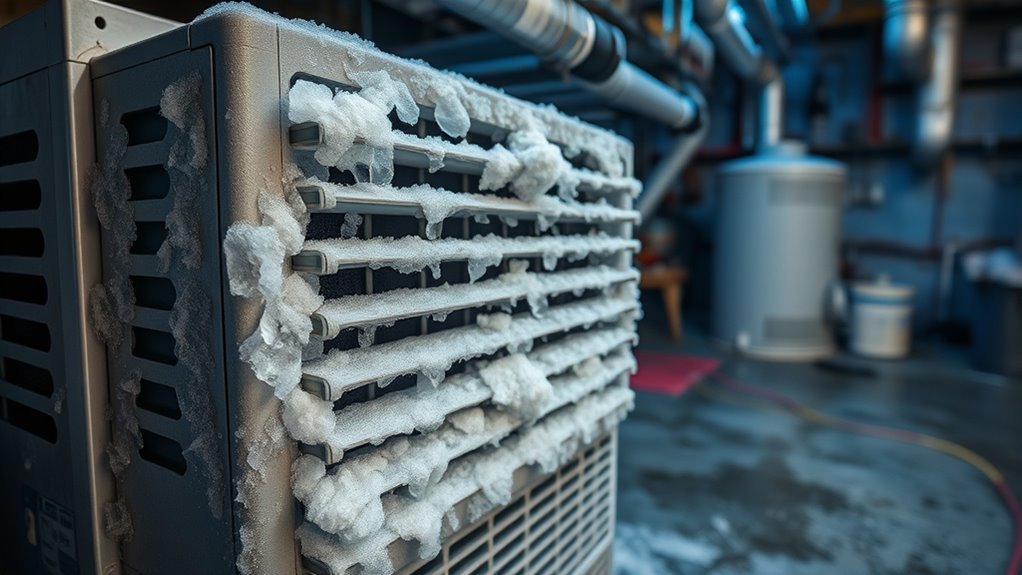
Dehumidifier coils usually freeze because the room is too cold for the unit, airflow is restricted, or the machine cannot defrost the evaporator coil correctly. A dirty filter, dusty coil, blocked intake, weak fan, or sensor problem can all contribute. Frost reduces water collection and may force the unit into repeated defrost cycles, so the cause should be corrected before normal operation resumes.
Quick Answer
Dehumidifier coils freeze most often because the room is too cold or airflow across the evaporator is restricted. Turn the unit off, unplug it, let all ice melt naturally, clean the filter, clear blocked vents, and confirm the room is within your model’s operating-temperature range before restarting it.
Key Takeaways
- Temperatures below about 65°F can increase frost risk, but the true minimum depends on the dehumidifier. Some current models are rated for operation near 41°F.
- Dirty filters, dusty coils, blocked grilles, and poor placement can reduce airflow enough to promote icing.
- Turn off and unplug a frozen dehumidifier and allow the ice to melt naturally. Do not attack the ice with a hair dryer, heater, or sharp object.
- If the coils freeze again in a warm room after airflow problems are corrected, the fan, frost sensor, humidity sensor, controls, or sealed refrigeration system may need service.
- For normal indoor moisture control, a moderate humidity target around 40–50% works well in many homes; EPA and ENERGY STAR generally describe 30–50% RH as an ideal indoor range.
Why Dehumidifier Coils Freeze
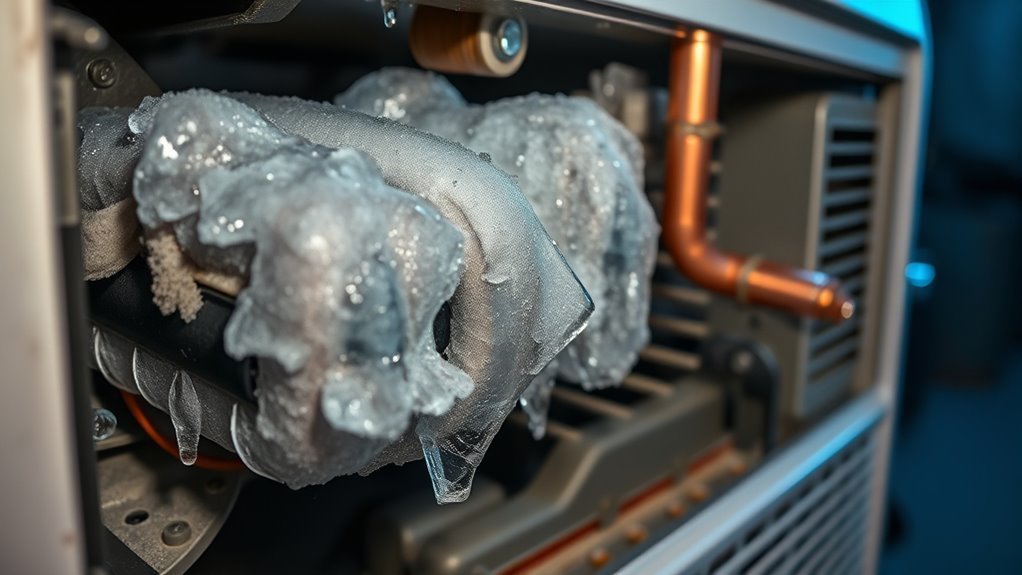
A compressor-style dehumidifier pulls humid room air across a cold evaporator coil. Water vapor normally condenses on that coil and drains into the bucket or through a drain hose. If the coil surface becomes too cold, that moisture can freeze instead.
Low room temperature is one of the most common reasons. ENERGY STAR notes that frost can form when room temperature drops below about 65°F and recommends choosing a product designed for lower-temperature operation when the space is regularly cooler than that.
However, 65°F is not a universal minimum. Some modern dehumidifiers include automatic defrost controls and are rated for substantially cooler rooms. For example, Frigidaire’s current frost guidance describes a 41°F low limit for applicable units. Always check the operating-temperature range in your own manual.
Restricted airflow is another major cause. A dirty filter, dust-coated evaporator, blocked intake, crowded exhaust, or weak fan reduces the amount of relatively warm room air moving over the cold coil. That can let the evaporator remain cold enough for frost to grow faster than the unit can remove it.
Note: Treat 65°F as a useful frost-risk warning, not a universal shutoff temperature. The operating limits printed in your model’s owner’s manual take priority.
Cold Room Temperatures and Coil Icing
When room temperature falls, the air passing across the evaporator supplies less heat to the refrigeration cycle. The evaporator can then remain at or below freezing long enough for condensed moisture to turn into frost rather than drain away as liquid water.
That is why a dehumidifier may continue running while collecting much less water in a cold basement, garage, crawl space, or utility room. A unit with automatic defrost may shut the compressor off while leaving the fan running so room air can warm the coil. Other models may require the user to stop operation until the frost disappears.
GE’s dehumidifier guidance also explains that operating limits vary by model and that frost controls can cycle the compressor when icing occurs.
A cool room does not automatically mean the dehumidifier is defective. The key question is whether the room is below the operating range specified for that particular model.
Airflow Problems That Freeze Coils
Poor airflow can also make the evaporator coils freeze. The dehumidifier needs a steady stream of room air moving across the cold coil so heat transfer, condensation, and drainage remain balanced.
Check the air filter first. A filter packed with dust, lint, or pet hair can choke the intake. Then check the intake and exhaust grilles for dust, curtains, furniture, boxes, or walls that block circulation.
Do not rely on a universal clearance number. Some manufacturers require more space than others. Follow the clearance listed in your owner’s manual and make sure every intake and exhaust opening remains unobstructed.
If the filter is clean and the unit has plenty of open space but airflow still feels unusually weak, listen to the fan. A slow, intermittent, noisy, or non-running fan can allow the evaporator to become too cold and may require service.
Recommended Products
Includes 3 replacement filters

BUY WITH CONFIDENCE Genuine AprilAire MERV 8 Replacement Filter for your AprilAire Whole Home Dehumidifier Models E080 or E100 or Dehumidifying Ventilator 8192A (and all variations of these models)

【Compatibility】 Our MERV 13 Replacement Dehumidifier Filter Media is Compatible with Honeywell TrueDRY DH65 DR65, Part 50049537-002/U, 50049537-005.
Dirty Filters, Dust, and Debris
A dirty filter restricts air entering the dehumidifier. Dust on the evaporator fins can create an additional airflow barrier and reduce heat transfer. Both conditions can lower moisture-removal performance and increase the chance of frost buildup.
Dust and debris can also interfere with normal condensate drainage. A drain problem by itself is not usually the main reason an evaporator freezes, but blocked drainage can create leaking, overflowing, or poor water-collection symptoms that make troubleshooting more confusing.
Filter Blockage Effects
The cleaner the airflow path, the easier it is for the dehumidifier to move room air across the evaporator and condenser. A clogged filter increases resistance and reduces performance.
| Condition | Airflow | Coil-Icing Risk |
|---|---|---|
| Clean filter | Normal | Lower |
| Dust and debris | Reduced | Higher |
| Heavily blocked filter | Poor | High |
Inspect and clean the filter according to the manufacturer’s schedule. Some washable filters can be cleaned with warm, soapy water, but they should be completely dry before being reinstalled. Never assume every filter is washable; check the manual first.
Dust Build-Up On Coils
Dust on the evaporator fins can reduce airflow and heat exchange. A lightly dusty surface may be cleanable according to the owner’s manual, while thick, embedded debris can be harder to remove without bending the delicate fins or damaging nearby components.
If the coil is heavily contaminated, inaccessible, oily, corroded, or easily damaged, professional cleaning may be safer than aggressive DIY scrubbing.
Cleaning For Better Airflow
Start with the filter, intake grille, and exhaust grille. Turn the dehumidifier off and unplug it before cleaning. Vacuum loose dust with a soft brush attachment or use the cleaning method specified by the manufacturer.
Do not spray water or cleaner into electrical components, controls, or the sealed refrigeration system. If the filter is washable, let it dry fully before reinstalling it.
GE recommends regular filter inspection and cleaning, with frequency depending on the model and operating hours.
Pro Tip: If a dehumidifier repeatedly freezes, check the filter before assuming an expensive component has failed. Airflow problems are among the easiest causes to identify and correct.
Fan and Sensor Problems
If the fan is not moving enough air, the evaporator may stay too cold. Listen for scraping, clicking, surging, intermittent operation, or a fan that does not start even though the compressor appears to be running. Dirty or obstructed fan blades can also reduce circulation.
Sensor and control problems can cause similar symptoms. Many units use a coil-temperature or frost sensor to decide when to stop the compressor and allow defrosting. A humidity sensor determines when dehumidification is needed. If one of these systems reports the wrong condition, the compressor may run when it should cycle off.
Frigidaire’s current error-code guidance identifies temperature/humidity sensor failures, electronic-control failures, compressor overload protection, and sealed-system failures as service conditions on applicable models.
What If the Dehumidifier Freezes Again?
If the coils freeze again after a complete thaw, use the pattern below to narrow the cause.
| What You Notice | Likely Area to Check | Next Step |
|---|---|---|
| Room is below the model’s minimum temperature | Operating environment | Warm the room or use a low-temperature-rated dehumidifier. |
| Filter is dirty or airflow is weak | Filter, grilles, placement, fan | Clean the filter, clear obstructions, and check fan operation. |
| Heavy frost returns in a warm room with good airflow | Sensor, defrost control, fan, or refrigeration system | Stop repeated operation and contact qualified service or the manufacturer. |
| Error code appears | Electronic diagnostic system | Look up the exact code in the owner’s manual before restarting. |
How to Defrost a Frozen Dehumidifier
Defrosting is straightforward, but the dehumidifier should be completely disconnected from power before you work around wet coils or meltwater.
At a Glance
| Time Required | About 10–20 minutes for inspection and basic cleaning, plus enough time for all ice to melt naturally; heavy icing may take several hours. |
| Difficulty | Easy for thawing and basic airflow checks; internal electrical or refrigeration faults require service. |
| Tools Needed | Towel, room thermometer or hygrometer, soft vacuum brush, and filter-cleaning supplies approved by the manufacturer. |
| Cost | Usually $0 for basic inspection and cleaning; replacement parts or professional service cost extra. |
Warning: Turn the dehumidifier off and unplug it before thawing or cleaning. Do not use a hair dryer, space heater, heat gun, knife, screwdriver, or other sharp object to remove ice. Manufacturer guidance warns that forced heat and sharp objects can damage the coil and create a safety risk.
Recommended Products

COMPATIBILITY: Our DH02 HEPA filter compatible with Afloia (AQ8/Q8)/ Honati/ Hysure Q7/ Tenergy Sorbi 2-in-1 Air Purifier/Dehumidifier(1000ML) or please double check before order

【𝐂𝐨𝐦𝐩𝐚𝐭𝐢𝐛𝐥𝐞 𝐌𝐨𝐝𝐞𝐥𝐬】This 9 x 11 x 1 MERV 13 Replacement Dehumidifier Filter is compatible with Santa Fe Compact70, Ultra70, Element, Compact2, UA 65H. Not compatible with Santa Fe other models, please check your model before ordering.

Cleaner, fresher indoor air with our PureAir Premium Filter
Turn Off And Unplug
Press the power button to turn the dehumidifier off, then unplug it from the wall outlet. This removes power while ice melts and water drains around the coil assembly.
Place a towel under or around the unit to catch meltwater. If the grille can be opened normally without tools, follow the owner’s manual so room air can reach the coil. Do not disassemble sealed or electrical sections simply to speed the thaw.
Let Ice Melt
Allow all frost and ice to melt naturally. Moving the unplugged unit to a warmer, dry room can help, provided you can move it safely and keep meltwater away from electrical parts.
| Action | Purpose | Result |
|---|---|---|
| Natural thaw | Avoid damaging the coil | Ice clears safely |
| Towel placement | Capture meltwater | Helps protect the floor |
| Warmer room | Increase natural heat around the coil | Can shorten thaw time |
TCL’s icing guidance similarly advises owners to unplug the appliance, let the ice melt completely, use a towel for runoff, and avoid hair dryers, heaters, and sharp objects.
Inspect Before Restarting
Once the coil is completely free of ice:
- Check and clean the air filter according to the owner’s manual.
- Clear furniture, curtains, storage boxes, dust, and other obstructions from the intake and exhaust.
- Confirm the fan can move air normally.
- Measure the room temperature and compare it with the model’s rated operating range.
- Check that the bucket is seated correctly or that the drain hose is open, properly routed, and not kinked.
- Set a moderate humidity target rather than continuous operation unless continuous mode is actually needed.
- Restart the unit and watch for fresh frost during the next operating cycle.
If heavy ice quickly returns even though the room is warm enough and airflow is good, stop repeatedly restarting the unit. An internal control, sensor, fan, or sealed-system problem may require manufacturer support or qualified service.
How to Keep Dehumidifier Coils From Freezing
Preventing another freeze-up mainly means controlling temperature, airflow, cleanliness, and runtime.
- Know the minimum operating temperature. If the room regularly falls below about 65°F, check whether your specific dehumidifier is designed for low-temperature use.
- Keep the filter clean. Inspect it regularly and follow the cleaning interval in the owner’s manual.
- Keep the grilles open. Give the cabinet the clearance required by the manufacturer rather than pushing it tightly against a wall or furniture.
- Keep the evaporator clean. Remove accessible surface dust using the manufacturer-approved method.
- Use a reasonable humidity setting. A target around 40–50% RH is practical in many homes. EPA guidance recommends keeping indoor humidity around 30–50%.
- Avoid unnecessary continuous operation. Extremely low settings or continuous mode can increase compressor runtime, especially in cool conditions.
- Watch for repeat icing. Persistent heavy frost after basic maintenance is a reason to investigate the fan, sensors, defrost controls, or refrigeration system.
A light coating of frost can appear temporarily on some dehumidifiers and disappear during normal defrost operation. Thick ice that keeps growing, blocks airflow, or stops water collection is different and should be corrected.
Recommended Products
【ENERGY STAR 25 ≠ ENERGY STAR Most Efficient 2025】Don't fall for competitors' word games. With only 2.6% of ENERGY STAR models earning "Most Efficient 2025" title, these options are exceptionally rare on the market. RHEA-001 is one of the few to truly hold this top-tier certification. Many brands use misleading phrases like "Energy Star Efficient 25" or "Energy Star 25" to imply a standard they haven't met. Choosing them is a risk.With AEOCKY, you get verified performance and the peace of mind of authentic, top-tier efficiency.

Semiconductor dehumidifiers use thermoelectric cooling to remove moisture from the air. They create a drier, more comfortable environment by reducing humidity and improving air quality.

Tackle Whole-Home Humidity on Your Terms: Three modes — Auto, Continuous, and Manual — give you precise control over moisture removal to match the exact needs of your space
Related Guides
Frequently Asked Questions
Why is my dehumidifier icing up and not collecting water?
The most common causes are a room that is too cold for the model, restricted airflow from a dirty filter or blocked grille, dirty coils, or a fan or defrost-control problem. Once ice covers the evaporator, normal condensation and drainage fall sharply, so the bucket may stay nearly empty.
Are dehumidifier coils supposed to be wet?
Yes. During normal dehumidification, moisture condenses on the cold evaporator coil and the surface can be wet. Some models may briefly develop light frost that disappears during defrost. Heavy or persistent ice is not normal operation.
What is the lifespan of a dehumidifier?
Actual life varies with build quality, operating hours, environment, maintenance, and repairability. For regulatory economic modeling, the U.S. Department of Energy has used estimated average lifetimes of about 10 years for portable dehumidifiers and 12 years for whole-home units. Those figures are planning assumptions, not guaranteed service lives.
How do you unfreeze a dehumidifier?
Turn it off, unplug it, protect the floor with a towel, and let all ice melt naturally. Once thawed, clean the filter, clear the intake and exhaust, confirm the room is within the model’s operating-temperature range, and restart it at a moderate humidity setting.
Is it safe to run a dehumidifier with frozen coils?
It is better to turn the unit off and correct the icing instead of letting it continue. Heavy frost blocks airflow, reduces moisture removal, and can cause repeated compressor cycling or defrost operation. Unplug the unit and let it thaw before troubleshooting.
Why does my dehumidifier freeze even when the room is above 65°F?
Check the filter, evaporator, intake, exhaust, and fan first. If airflow is normal and heavy ice still returns, a frost sensor, humidity sensor, electronic control, fan motor, or sealed refrigeration-system fault may be involved. Persistent icing in normal conditions is a good reason to contact the manufacturer or qualified service.
Can I use a dehumidifier in a cold basement during winter?
Yes, but only within the temperature range specified for the unit. ENERGY STAR recommends looking for a model designed for lower-temperature operation when the space commonly falls below 65°F. Some current models can operate near 41°F, while others have higher minimums.
Conclusion
When dehumidifier coils freeze, start with the causes you can check safely: room temperature, filter condition, airflow, placement, and visible dust. Turn off and unplug an iced unit, let the coils thaw completely, correct the cause, and then restart it within the manufacturer’s operating range.
If heavy frost keeps returning despite a clean filter, good airflow, and suitable room temperature, the problem may be deeper than routine maintenance. A fan, sensor, control, compressor-protection circuit, or sealed refrigeration system may need professional attention. Regular cleaning and sensible humidity settings can prevent many repeat freeze-ups and keep moisture removal working normally.
Sources
- ENERGY STAR — Dehumidifiers — operating-temperature guidance, frost risk below about 65°F, humidistats, and recommended indoor RH range.
- U.S. EPA — Care for Your Air — indoor relative-humidity guidance of approximately 30–50%.
- Frigidaire — Dehumidifier Frost Buildup — low-temperature operation, frost sensing, airflow, filter, and heavy-ice troubleshooting.
- GE Appliances — Dehumidifier Ideal Operating Conditions — airflow, placement, temperature limits, frost, and automatic-defrost behavior.
- TCL Support — Dehumidifier Coils Icing Up — safe thawing, airflow checks, humidity settings, and warning against forced heat or sharp tools.
- U.S. Department of Energy — Energy Conservation Standards for Dehumidifiers — dehumidifier lifetime assumptions used in federal economic analysis.

[…] Cold garages need a low-temperature compressor model or a desiccant unit because standard compressor units can frost up. […]