A full basement needs more than a small, quiet moisture collector. The best basement dehumidifier should have enough compressor capacity for the actual moisture load, a dependable drain setup, automatic humidity control, and an operating-temperature range that fits the space. For most basements, the AEOCKY BOREAS-001 offers the best balance of capacity and everyday convenience. The Waykar 120-Pint is the stronger choice for an unusually large or persistently damp basement, while the KNKA, VEAGASO, and PLUSCENT models suit more moderate conditions.
Affiliate disclosure: This article contains Amazon affiliate links. We may earn a commission from qualifying purchases at no extra cost to you. Product specifications and listing details can change, so confirm the current Amazon information before ordering.
Quick verdict
- Best overall: AEOCKY BOREAS-001 for a strong balance of compressor capacity, drainage, automatic defrost, and manageable size.
- Best for a very large or very damp basement: Waykar 120-Pint for its higher maximum extraction claim, large-space design, and ENERGY STAR certification.
- Best balanced 34-pint option: KNKA PD22SC-12 for three operating modes, dual drainage, and straightforward humidity control.
- Best for a smaller basement: Aiusevo AS280 or Trazico when the moisture problem is moderate rather than severe.
Before you buy: Advertised square-foot coverage is only a starting point. Daily water-removal capacity, basement temperature, air movement, and the severity of the moisture problem matter more. Several capacities below are maximum manufacturer claims measured in hot, highly humid test conditions, so actual collection may be lower in a cool basement.
Quick Comparison of the Best Full Basement Dehumidifiers
| Product | Listed Maximum Capacity | Claimed Coverage | Drainage | Best For |
|---|---|---|---|---|
| AEOCKY BOREAS-001 | Up to 50 pints/day | Up to 3,500 sq. ft. | Tank or continuous drain | Most full basements |
| Waykar 120-Pint | Up to 120 pints/day | Up to 6,000 sq. ft. | Tank or gravity drain | Very large or heavily damp spaces |
| KNKA PD22SC-12 | Up to 34 pints/day | Up to 2,500 sq. ft. | 3L tank or drain hose | Moderately damp basements |
| VEAGASO VG380 | Up to 34 pints/day | Up to 2,500 sq. ft. | Tank or drain hose | Simple everyday control |
| PLUSCENT 32-Pint | Up to 32 pints/day | Up to 2,500 sq. ft. | 2L tank or drain hose | Moderate moisture and lower listed noise |
| Aiusevo AS280 | Up to 21 pints/day | Up to 1,500 sq. ft. | 2L tank or drain hose | Smaller, moderately damp basements |
| Trazico 21-Pint | Up to 21 pints/day | Up to 1,500 sq. ft. | Tank or drain hose | Compact compressor performance |
How These Basement Dehumidifiers Were Selected
The products were compared by compressor capacity, drainage options, automatic humidity control, defrost protection, tank size, portability, and intended room size. Decorative lighting and broad coverage claims were given less weight than the features that affect long-term basement use. These are portable compressor dehumidifiers rather than ducted whole-house systems.
Moisture-source warning: A dehumidifier controls water vapor in the air, but it does not repair foundation seepage, plumbing leaks, flooding, blocked gutters, or poor exterior drainage. Fix active water entry and dry wet materials promptly before relying on a dehumidifier for ongoing humidity control.
AEOCKY 50 Pint Dehumidifier with Drain Hose — Best Overall
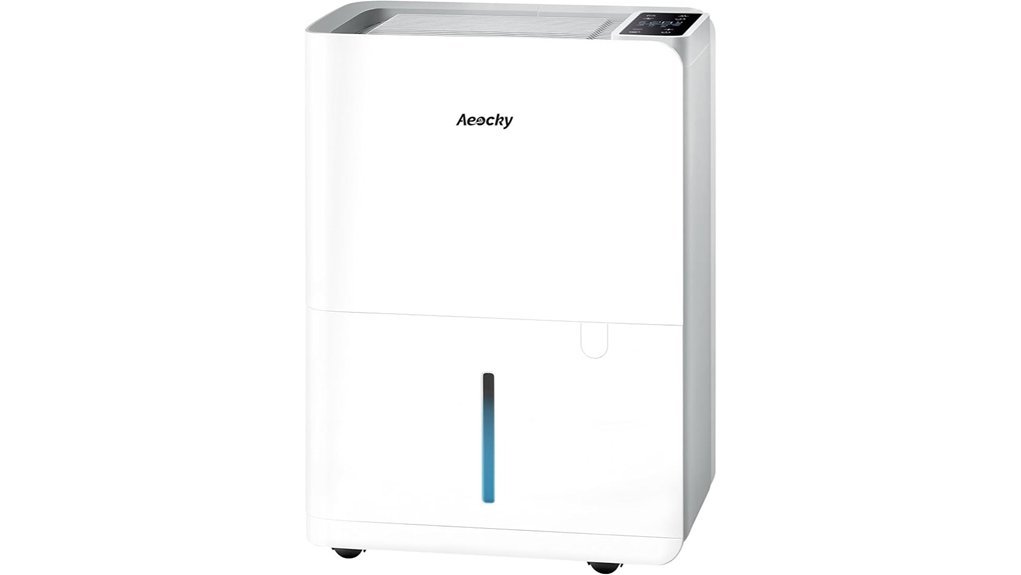
The AEOCKY BOREAS-001 is the strongest all-around choice for a typical full basement because it combines a higher-capacity compressor with automatic humidity control, automatic defrost, and continuous drainage. The manufacturer lists a maximum removal rate of 50 pints per day in hot, highly humid conditions and coverage up to 3,500 square feet.
You can use the removable 0.8-gallon tank or connect continuous drainage for less hands-on maintenance. Its humidistat lets the unit cycle according to the selected target instead of running without regard to current conditions. Automatic defrost is also useful in a cooler basement, although you should still confirm that the room stays within the manufacturer’s operating-temperature range.
Best For: Homeowners who want one portable compressor dehumidifier for a medium or large basement with moderate to heavy seasonal humidity.
Why You’ll Like It: It offers more extraction headroom than the 21- to 34-pint models without moving into the size and output of the largest Waykar option.
Who Should Avoid It: Buyers with only a small, mildly humid room may not need this much capacity. A basement with recurring standing water needs leak or drainage repairs in addition to dehumidification.
Pros:
- Listed for up to 50 pints of moisture removal per day under maximum test conditions
- Continuous drainage and removable-tank options
- Automatic humidistat and defrost functions
- Suitable balance of capacity and portability for many full basements
Cons:
- Actual collection will be lower in cooler or less humid conditions
- The tank still needs regular emptying when continuous drainage is not used
- Larger and heavier than the 21-pint models
Waykar 120-Pint Energy Star Dehumidifier with Drain Hose — Best for Very Large Basements
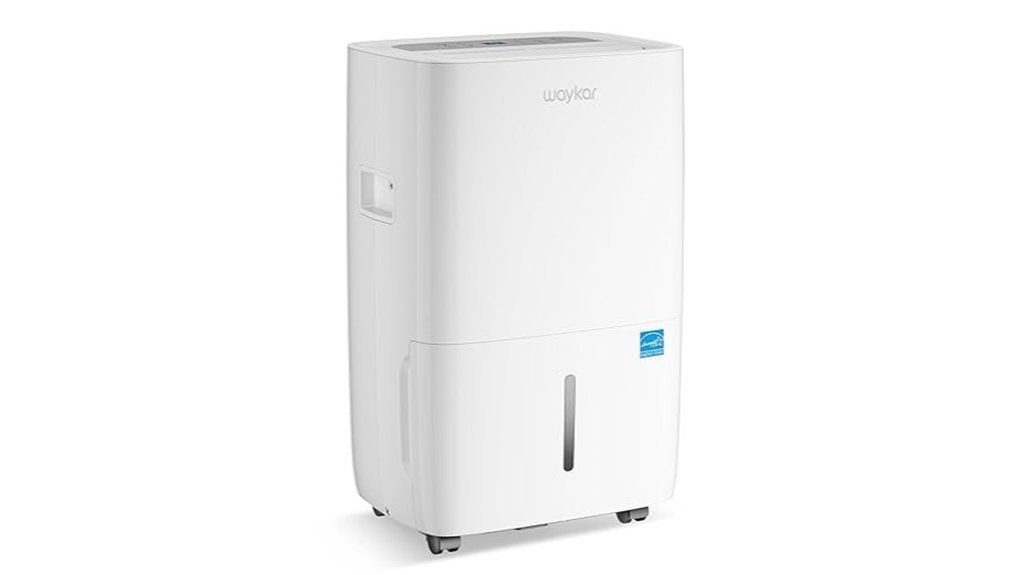
The Waykar is the high-capacity option for a very large, open, or persistently damp basement. Its listing states a maximum extraction rate of 120 pints per day at 95°F and 90% relative humidity, with advertised coverage up to 6,000 square feet. That figure should be treated as a maximum-condition rating rather than the amount every basement will collect daily.
The unit includes adjustable humidity control, automatic defrost, a 24-hour timer, a 1.14-gallon tank, and a 3.3-foot gravity-drain hose. It is also listed as ENERGY STAR certified. The adjustable outlet helps circulate dry air, but an open layout and good airflow are still important when using one portable unit across a large basement.
Best For: Large finished basements, open storage levels, landlords, workshops, or spaces with a high seasonal moisture load.
Why You’ll Like It: It provides the most capacity headroom in this comparison and reduces the risk of choosing a unit that cannot keep up with a large damp area.
Who Should Avoid It: It may be unnecessarily large for a small basement or a space that only rises slightly above the target humidity.
Pros:
- Highest maximum extraction claim among the retained products
- ENERGY STAR certified
- Large tank plus continuous gravity drainage
- Automatic defrost, timer, and adjustable humidity control
Cons:
- The 120-pint figure is based on hot, highly humid test conditions
- Bulkier than lower-capacity portable units
- Gravity drainage requires a lower drain and a properly routed hose
KNKA 2500 Sq.Ft Dehumidifier with Drain Hose — Best Balanced 34-Pint Option
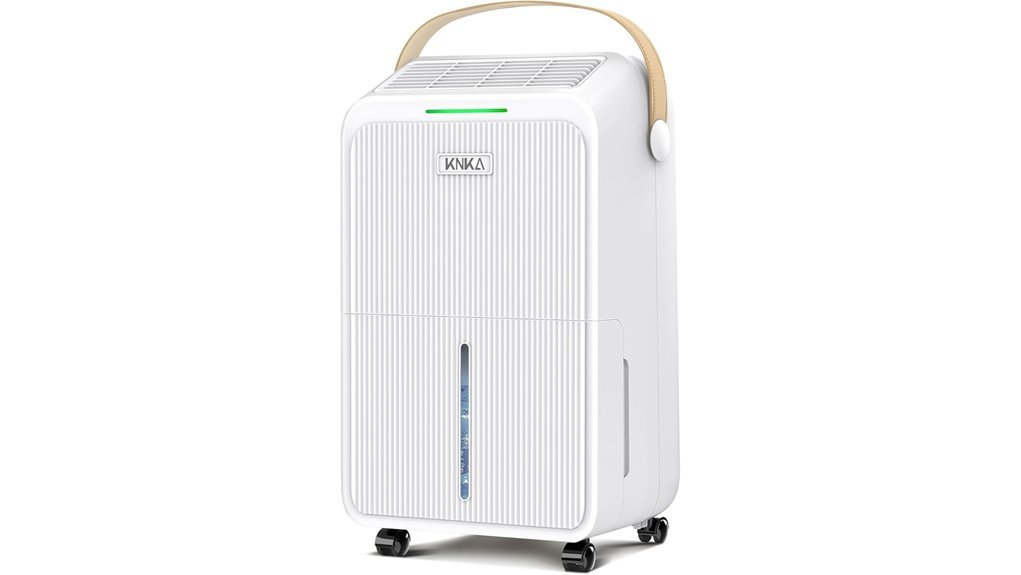
The KNKA PD22SC-12 is a practical middle-ground choice for a moderately damp basement. Its listing states a maximum capacity of 34 pints per day at 95°F and 90% relative humidity, with advertised coverage up to 2,500 square feet. It gives you DEHU, DRY, and continuous modes, along with a target-humidity range from 30% to 80%.
The included drain hose supports hands-off gravity drainage, while the 3-liter tank provides an alternative when a drain is unavailable. A timer, child lock, automatic shutoff, automatic defrost, washable filter, casters, and handles make it easier to manage as an everyday basement appliance.
Best For: Moderate basement humidity where a 21-pint unit may be undersized but a 50- or 120-pint option is unnecessary.
Why You’ll Like It: It balances useful compressor capacity with straightforward controls, dual drainage, and easy portability.
Who Should Avoid It: Choose a higher-output model when the basement remains wet, has frequent condensation, or quickly rises well above the selected humidity target.
Pros:
- Up to 34 pints per day under the manufacturer’s maximum test conditions
- DEHU, laundry-drying, and continuous modes
- 3-liter tank and included drain hose
- Automatic defrost, timer, washable filter, and child lock
Cons:
- The coverage figure should not replace proper capacity sizing
- The bucket may fill quickly during humid weather
- No app or remote smart-home control is listed
VEAGASO 34-Pint Dehumidifier with Drain Hose — Best for Simple Controls
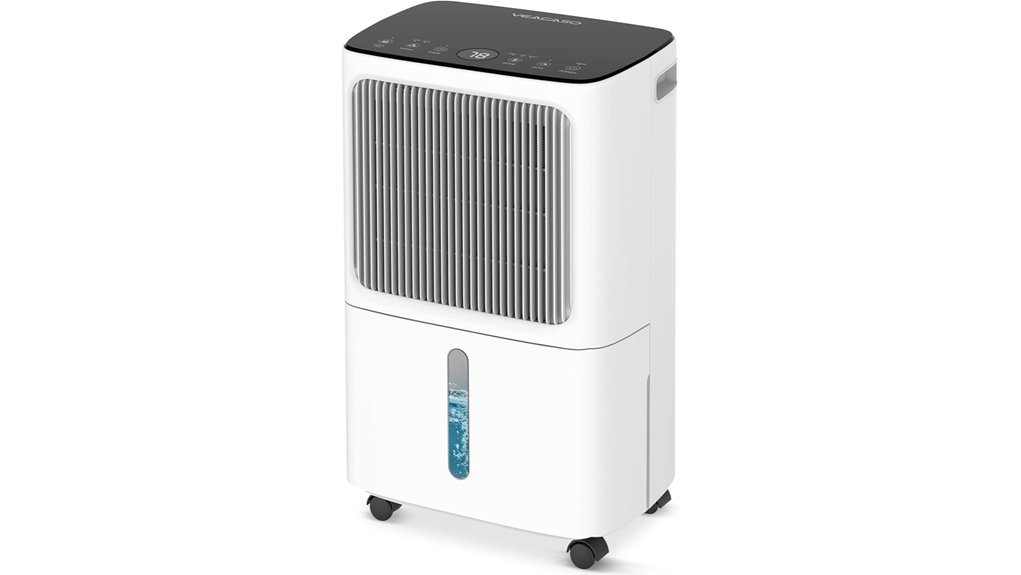
The VEAGASO VG380 is another suitable 34-pint option for a moderately damp full basement. Its listing gives it a maximum capacity of 34 pints per day and advertised coverage up to 2,500 square feet. DEHU mode handles normal humidity control, DRY mode supports indoor laundry drying, and CONT mode keeps the compressor operating continuously when conditions demand it.
The touch panel controls the target humidity, fan speed, and timer. You can collect water in the removable 0.53-gallon tank or connect the supplied hose for gravity drainage. Built-in handles and swivel casters make placement easier.
Best For: Buyers who want uncomplicated controls and a mid-capacity compressor unit for seasonal basement dampness.
Why You’ll Like It: Its three operating modes make it easy to switch between automatic humidity maintenance, laundry drying, and continuous operation.
Who Should Avoid It: A very wet or unusually large basement may need the added capacity of the AEOCKY or Waykar.
Pros:
- Up to 34 pints per day according to the current listing
- Three useful operating modes
- Tank and continuous-drain options
- Timer, touch controls, casters, and carrying handles
Cons:
- The relatively small tank can require frequent emptying
- Advertised noise figures may differ depending on fan speed and room acoustics
- Not intended to solve active water intrusion
PLUSCENT 32 Pint Dehumidifier for Home Basement — Best Quiet Mid-Capacity Option
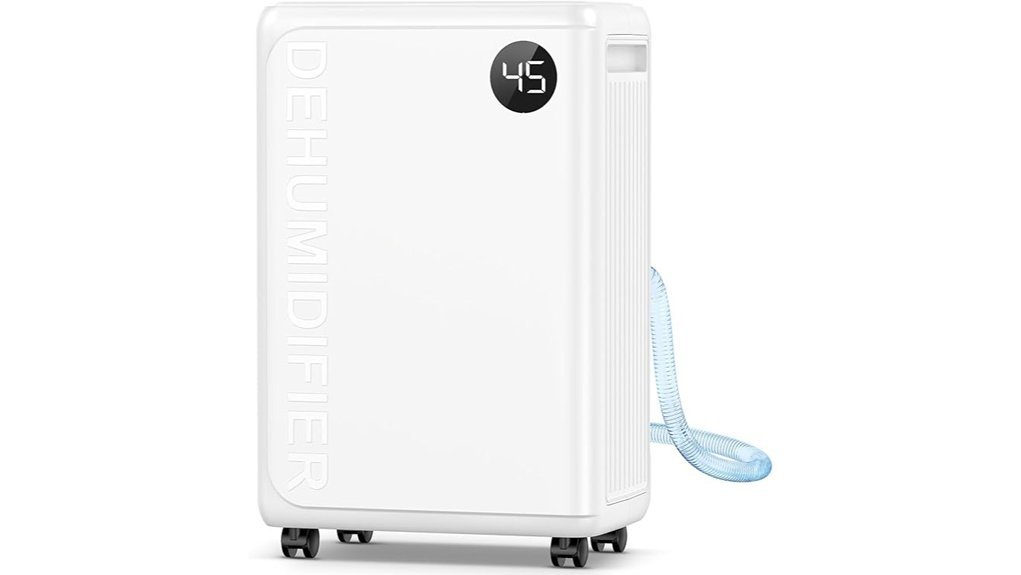
The PLUSCENT model offers a listed maximum capacity of 32 pints per day and claimed coverage up to 2,500 square feet. It is a reasonable fit for a moderately damp basement where you want more capacity than the 21-pint models but do not need the size of the Waykar.
DEHU, CONT, and DRY modes cover routine humidity control, nonstop operation, and laundry use. The listing also includes automatic defrost, automatic restart, tank-full shutoff, a 24-hour timer, a 2-liter tank, and a drain hose. Its stated 39–42 dB sound range is a manufacturer claim and may vary with fan speed, placement, and room acoustics.
Best For: A moderate-size basement near a living, exercise, or work area where listed operating noise is an important comparison point.
Why You’ll Like It: It combines three operating modes with automatic defrost and continuous drainage in a relatively compact format.
Who Should Avoid It: It is not the strongest choice for severe dampness, standing water, or an unusually large open basement.
Pros:
- Up to 32 pints per day according to the listing
- Three modes and adjustable humidity control
- Automatic defrost and restart
- Tank or continuous-hose drainage
Cons:
- The 2-liter tank is small for sustained basement use
- Continuous drainage is preferable in humid weather
- Sound in the home may differ from the advertised laboratory figure
Aiusevo AS280 1500 Sq. Ft. Dehumidifier with Drain Hose — Best for a Smaller Basement
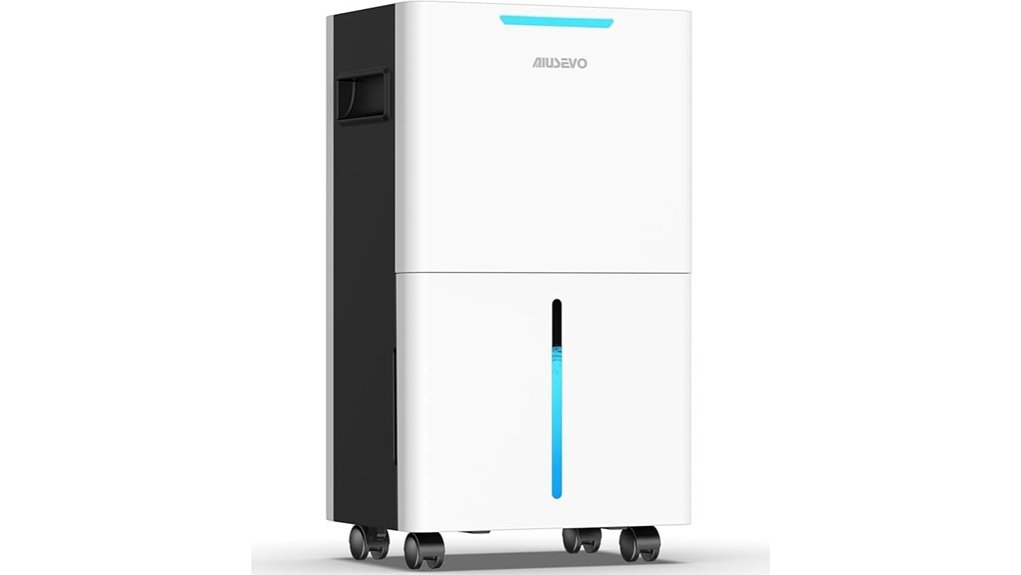
The Aiusevo AS280 is a compact compressor model for a smaller basement with mild to moderate dampness. It is listed to remove up to 21 pints per day at 95°F and 90% relative humidity, with claimed coverage up to 1,500 square feet. That makes it better suited to a lower moisture load than the 32-, 34-, 50-, and 120-pint options.
DEHU mode lets you choose a target from 30% to 80%, while DRY and CONT modes handle laundry or nonstop operation. The 2-liter tank shuts the unit off when full, and the included hose supports continuous gravity drainage. It also includes automatic defrost, automatic restart, a timer, wheels, and lift-up handles.
Best For: Small basements, divided basement rooms, or moderately humid spaces where portability matters.
Why You’ll Like It: It provides true compressor-based extraction and a drain hose without taking up as much space as the higher-capacity models.
Who Should Avoid It: Do not rely on it for a large basement with rapid moisture buildup, regular condensation, or significant seepage.
Pros:
- Up to 21 pints per day under the listed maximum test conditions
- Three operating modes and adjustable humidistat
- 2-liter tank plus continuous drainage
- Portable design with automatic defrost and restart
Cons:
- Lower capacity than the other full-basement picks
- The small tank can fill quickly if a hose is not used
- Best for moderate rather than severe humidity
Trazico 21-Pint Dehumidifier with Smart Humidity Control — Best Compact Compressor Option
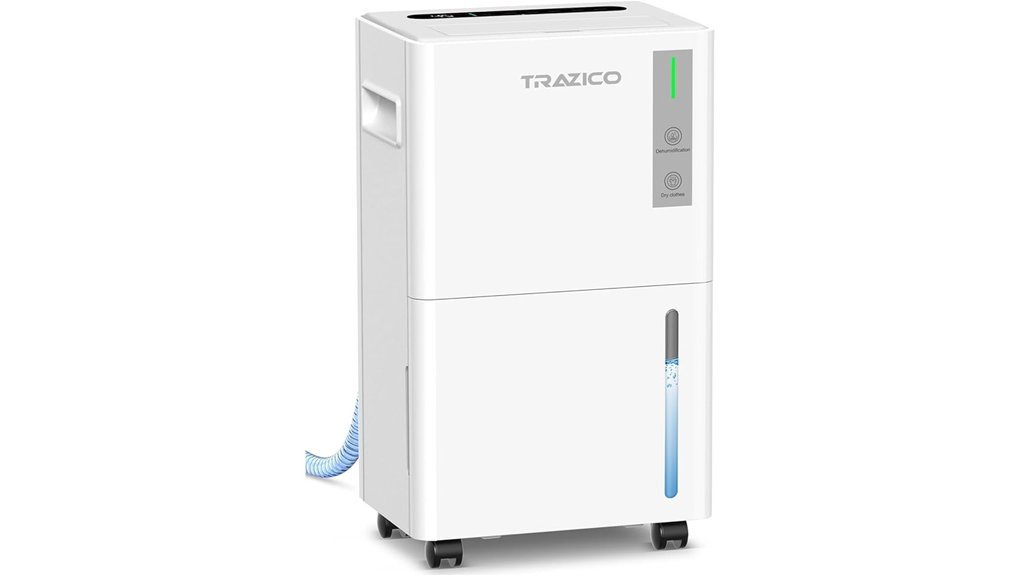
The Trazico is another 21-pint compressor option for a smaller or moderately damp basement. Its listing states coverage up to 1,500 square feet, a maximum extraction rate of 21 pints per day, and adjustable humidity control from 30% to 80%.
Smart DEHU, DRY, and CONT modes let you choose automatic maintenance, laundry drying, or continuous operation. You can use its approximately 0.41-gallon tank or attach a hose for gravity drainage. The listing also includes automatic shutoff, automatic defrost, automatic restart, a timer, wheels, and a carrying handle.
Best For: A smaller basement where you want a compact compressor model with a clear display and flexible operating modes.
Why You’ll Like It: It offers many of the controls found on larger models while remaining easier to move and place.
Who Should Avoid It: Its 21-pint capacity is unlikely to be the best match for severe dampness or a large open basement.
Pros:
- Up to 21 pints of daily extraction according to the listing
- Adjustable humidistat and three operating modes
- Tank and hose drainage options
- Automatic defrost, restart, and shutoff
Cons:
- Lower extraction capacity than the 32-pint and larger models
- The small tank may require frequent attention
- Best suited to moderate moisture conditions
Factors to Consider When Choosing a Full Basement Dehumidifier
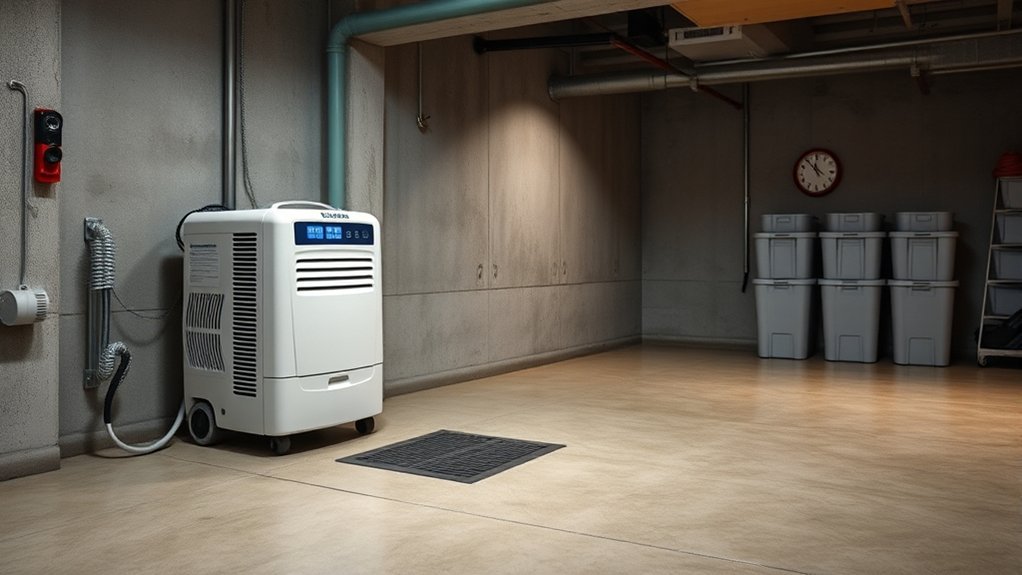
Choose a basement dehumidifier by matching its daily extraction capacity, drainage setup, temperature range, and controls to the actual conditions in your basement. A large advertised coverage number is not enough by itself.
Basement Size and Moisture Load
Measure the open basement area, but also evaluate how quickly humidity rises. A small basement with seepage, wet masonry, or indoor laundry can need more capacity than a larger basement with only mild seasonal humidity. Closed rooms, shelving, and stored belongings can restrict airflow, so one portable unit may not control every corner equally.
Within this comparison, the 21-pint models are most appropriate for smaller and moderately damp spaces. The 32- to 50-pint choices offer more headroom for a typical full basement, while the Waykar targets unusually large or demanding areas.
Moisture Removal Capacity
Capacity describes how much water a unit can collect over 24 hours under stated test conditions. Check those conditions whenever they are provided. Several products in this article advertise their maximum output at 95°F and 90% relative humidity, which is much warmer and wetter than many basements.
Actual extraction generally falls when the room becomes cooler or less humid. For that reason, compare capacity, room conditions, drainage, and runtime rather than choosing solely by the largest number printed in the product title.
Drainage Options
Continuous drainage is one of the most useful features for a basement. A built-in tank works when no drain is nearby, but it may need frequent emptying during humid weather. Automatic shutoff prevents overflow, although the unit stops removing moisture until the bucket is emptied.
Most portable models use gravity drainage. The hose must run continuously downhill without loops, kinks, or a raised outlet. Confirm the included hose length and connection type before deciding where to place the unit. A condensate pump may be needed when water must travel upward to a sink or window.
Operating Temperature and Automatic Defrost
Cool basement air can cause frost to form on a compressor unit’s coils. Automatic defrost helps protect performance, but every product still has a specified operating-temperature range. Check that range carefully if the basement regularly falls below 65°F, especially during winter.
Do not assume that a defrost feature makes a portable dehumidifier suitable for freezing or near-freezing conditions. Follow the manual and stop using the appliance if temperatures fall outside its stated limits.
Noise Level
Manufacturer decibel ratings are useful for comparison, but they are not a guarantee of how a machine will sound in your basement. Fan speed, compressor cycling, floor vibration, nearby walls, and room acoustics all affect perceived noise.
Place the unit on a firm, level surface and make sure it does not touch furniture, pipes, or walls that could vibrate. A lower fan setting may be preferable near a home office, bedroom, gym, or recreation area, provided the unit can still control humidity.
Humidistat and Automatic Controls
An adjustable humidistat lets the dehumidifier cycle according to the selected target instead of running continuously. For many homes, an indoor relative-humidity target of approximately 30% to 50% is appropriate. A separate hygrometer can help you compare the room reading with the appliance display.
Automatic restart is useful after a power interruption, while a timer can limit operation during selected periods. “Smart humidity control” does not necessarily mean Wi-Fi or app access, so check the listing when remote control is important.
Energy Efficiency
A basement dehumidifier may operate for many hours, so efficiency can affect long-term running costs. ENERGY STAR certification is more useful than an unsupported percentage-savings claim. The official efficiency measure is the Integrated Energy Factor, expressed as liters of water removed per kilowatt-hour. A higher IEF indicates more water removal for the energy consumed under the applicable test procedure.
Correct sizing also matters. An undersized unit may run continuously without reaching the target, while an oversized model may be unnecessary for a mild moisture problem. Keep the filter clean and avoid blocking the inlet or outlet.
Portability, Tank Access, and Maintenance
Casters and handles are helpful when moving the unit for cleaning or seasonal storage. Check the dimensions and leave the clearance required by the manual around the air inlet and outlet. Do not force a large unit into a tight corner merely to keep it out of sight.
Also inspect how easily the bucket and filter can be removed. A washable filter reduces replacement needs, but it still requires regular cleaning. Compare warranty terms and support information before buying because compressor appliances can be difficult to ship after the return period.
Frequently Asked Questions
How Often Should Basement Dehumidifier Filters Be Cleaned?
Inspect the filter about every two to four weeks during frequent use and follow the model’s manual. Clean it sooner when dust, pet hair, reduced airflow, or unusual noise appears. Unplug the unit before removing the filter, and allow a washable filter to dry fully before reinstalling it.
Can a Dehumidifier Run Continuously in Winter?
It can run for extended periods only when the basement remains within the manufacturer’s operating-temperature range. In a cold basement, frost can reduce water removal and make the compressor cycle repeatedly. Use a model with automatic defrost, monitor the room temperature, and do not operate it outside the manual’s limits.
Do Basement Dehumidifiers Increase Energy Bills Significantly?
Any compressor dehumidifier adds electricity use, and the total depends on its wattage, efficiency, runtime, humidity target, and local electricity rate. You can reduce unnecessary operation by using the humidistat, choosing an appropriately sized unit, keeping doors and windows closed, cleaning the filter, and repairing moisture sources.
Should I Place the Dehumidifier Near a Wall or in the Center?
Follow the clearance distances in the manual rather than automatically choosing the center or pushing the appliance against a wall. Keep the inlet and outlet unobstructed. For continuous drainage, place it where the hose can run safely downhill to a suitable drain without creating a trip hazard.
How Do I Know if My Basement Humidity Is Too High?
Use a hygrometer rather than relying only on smell or touch. Persistent readings above approximately 50% to 60%, musty odors, condensation, damp fabrics, peeling finishes, or visible mold can signal excessive moisture. Investigate leaks or seepage as well as controlling airborne humidity.
Will a Dehumidifier Stop Basement Leaks or Remove Mold?
No. A dehumidifier can lower airborne humidity, but it cannot repair a plumbing leak, foundation crack, drainage problem, or recurring flood. Existing mold must be addressed safely, and the underlying moisture source must be corrected. Do not run an electrical appliance in standing water.
Conclusion
For most full basements, the AEOCKY BOREAS-001 provides the best balance of extraction capacity, automatic control, drainage, and portability. Choose the Waykar 120-Pint when the space is exceptionally large or has a much heavier moisture load. The KNKA, VEAGASO, and PLUSCENT models are sensible mid-capacity alternatives, while the Aiusevo and Trazico are better reserved for smaller or moderately damp basements.
Final recommendation: Start with the AEOCKY for a typical full basement. Move up to the Waykar when humidity rises quickly or the area is unusually large. Move down to a 21- to 34-pint model only when the basement is smaller, reasonably sealed, and free from active water intrusion.