By Editorial Team · Reviewed for accuracy · Last updated August 2026
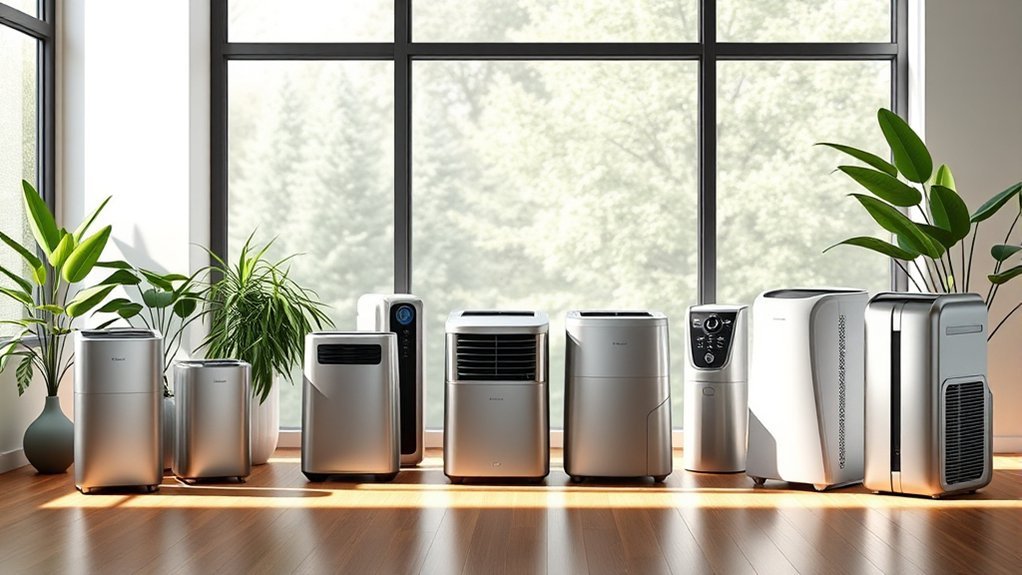
For 2026, the best 100-pint-class dehumidifier is the one that fits your room size, drainage setup, humidity level, operating temperature, and noise tolerance. The Landeagle 6000 Sq. Ft. Dehumidifier, Kesnos 120-Pint Energy Star model, MEPTY 6000 Sq.Ft unit, DECIUU 100 Pint Dehumidifier with Pump, and Yaufey 6000 Sq. Ft. Energy Star Dehumidifier all target large, damp spaces where smaller units may struggle.
These picks focus on moisture-removal capacity, drainage flexibility, energy-conscious operation, and practical controls for basements, garages, large rooms, and open living areas. Landeagle, MEPTY, and DECIUU are seller-listed as up-to-100-pint models, while Kesnos and Yaufey are 120-pint higher-capacity alternatives. Compare the test conditions behind the pint rating as well as coverage, tank size, pump support, drainage setup, and operating environment before choosing.
Affiliate disclosure: This article contains Amazon affiliate links. If you buy through these links, we may earn a commission at no extra cost to you.
Quick Verdict
If you want a balanced large-space 100-pint-class option, start with the Landeagle 6000 Sq. Ft. Dehumidifier. If you need to move condensate upward instead of relying on gravity, the DECIUU 100 Pint Dehumidifier with Pump is the most practical pick. The MEPTY is a strong choice if you want an exact 100-pint-class model with easy humidity monitoring. Choose the Kesnos or Yaufey if you specifically want a higher seller-listed 120-pint maximum capacity.
How We Chose These 100-Pint-Class Dehumidifiers
We focused on large-space coverage, seller-listed moisture-removal capacity, drainage options, tank size, pump capability, noise claims, portability, control layout, and practical features such as washable filters, timers, child locks, auto defrost, and auto shut-off. Product listings and certifications can change, so confirm current specifications, warranty terms, included hoses, Energy Star status, operating-temperature limits, and buying options on Amazon before purchase.
Important: Compare Pint Ratings Carefully
A seller-listed 100 or 120 pints per day is usually a maximum measured under stated temperature and relative-humidity conditions. Two dehumidifiers with similar headline ratings may therefore perform differently in a cooler basement or less-humid room. Treat the pint figure as one comparison point, then check the stated test conditions, drainage method, room temperature, humidity level, airflow, and recommended coverage.
Quick Comparison
|
Product |
Best For |
Key Advantage |
Check Details |
|---|---|---|---|
|
Landeagle 6000 Sq. Ft. Dehumidifier |
Best overall for large rooms and basements |
Seller-listed max 100-pint/day capacity with hose drainage and simple controls |
|
|
Kesnos 120-Pint Energy Star Dehumidifier |
Best higher-capacity alternative |
120-pint maximum rating, 6,500-sq.-ft. positioning, and Energy Star listing |
|
|
MEPTY 6000 Sq.Ft Dehumidifier |
Best for easy humidity monitoring |
100-pint maximum rating, digital humidity display, and multiple operating modes |
|
|
DECIUU 100 Pint Dehumidifier with Pump |
Best for basements needing pump drainage |
Built-in pump can move collected water upward up to 16.4 ft |
|
|
Yaufey 6000 Sq. Ft. Energy Star Dehumidifier |
Best for flexible room modes |
120-pint maximum rating, three speeds, multiple modes, and continuous drainage |
Landeagle 6000 Sq. Ft Dehumidifier with Drain Hose
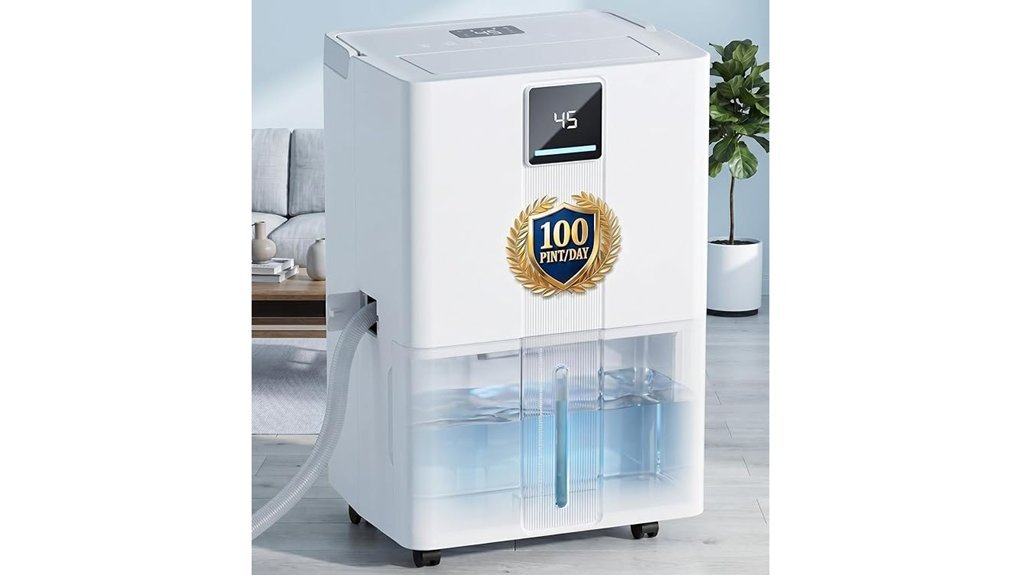
If you’re looking for a high-capacity dehumidifier for a large room, basement, garage, or open living space, the Landeagle 6000 Sq. Ft. model is a strong place to start. The seller lists it for up to 100 pints of moisture removal per day under its stated rated conditions and coverage up to 6,000 sq. ft. Actual moisture removal will depend on temperature, relative humidity, airflow, room layout, and how well the space is sealed.
You can use hose drainage to reduce manual tank emptying, while the adjustable humidity control, timer, child lock, fan-speed controls, washable filter, and display give you useful everyday control. That combination makes it a practical option when you want a large-space dehumidifier without an overly complicated setup.
Best For: Homeowners, renters, or small-business users who need a 100-pint-class dehumidifier for a large damp space and want flexible humidity controls with hose drainage.
Why You’ll Like It: It combines large-area positioning, a seller-listed 100-pint maximum rating, drainage flexibility, and straightforward controls in one large-room unit.
Who Should Avoid It: Skip it if you only need moisture control for a small bedroom, closet, or lightly humid room, where a lower-capacity unit may be easier to place and operate.
Pros:
- Seller-listed for up to 6,000 sq. ft. with up to 100 pints/day moisture removal under stated conditions.
- Supports hose drainage for lower-maintenance operation.
- Useful controls include adjustable humidity, a timer, fan-speed control, child lock, washable filter, and display indicators.
Cons:
- The maximum pint rating should not be treated as guaranteed output in normal basement conditions.
- Large-capacity units take up more floor space than compact dehumidifiers.
- Performance can fall as temperature or humidity drops, so check the current operating-temperature guidance before use in colder spaces.
Kesnos 120-Pint Energy Star Dehumidifier for Large Rooms
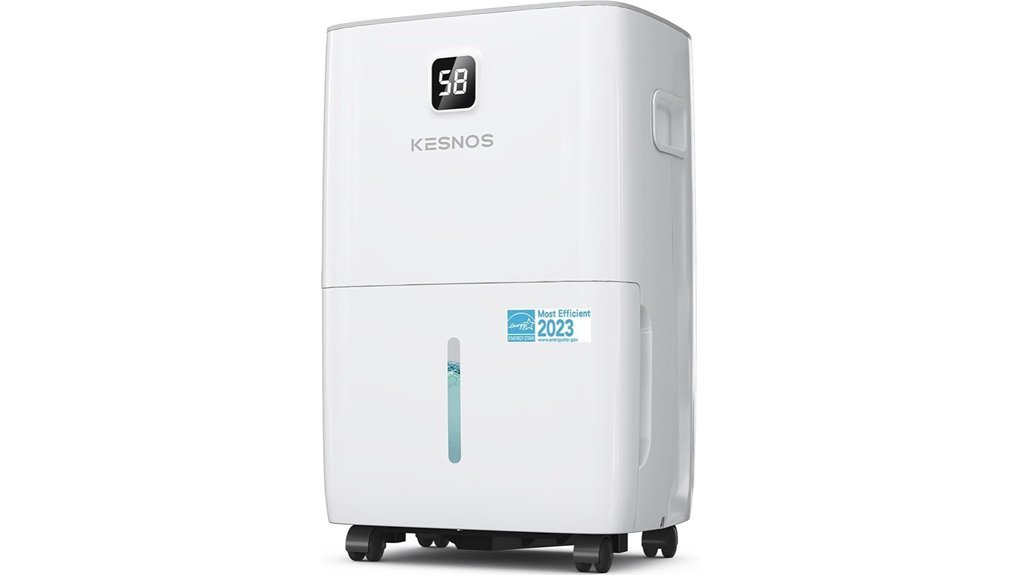
The Kesnos 120-Pint Energy Star Dehumidifier is the higher-capacity alternative in this guide. Its listing states moisture removal of up to 120 pints per day at 95°F and 90% relative humidity and coverage up to 6,500 sq. ft., so it makes the most sense for very large or persistently damp areas rather than buyers looking specifically for an exact 100-pint model.
You can adjust the target humidity from 30% to 80% in 5% steps and select low or high fan speed. The current listing also describes a 1.06-gallon tank, drain-hose setup, front humidity display, and Energy Star certification. Those features make it attractive if you want higher maximum capacity while still having straightforward humidity controls.
Best For: Homeowners and renters with large, damp basements, open living spaces, storage areas, or other areas where additional moisture-removal headroom is useful.
Why You’ll Like It: It combines a higher 120-pint maximum rating, broad humidity adjustment, a visible humidity display, drainage flexibility, and Energy Star positioning.
Who Should Avoid It: Avoid it if your space is small or only mildly humid, or if you specifically want an exact 100-pint-listed model.
Pros:
- Seller-listed to remove up to 120 pints/day at 95°F and 90% RH.
- Listed for spaces up to 6,500 sq. ft. with adjustable humidity from 30% to 80%.
- Includes two fan speeds, front humidity monitoring, a tank, drainage support, and Energy Star positioning.
Cons:
- It is a 120-pint model, so it is a higher-capacity alternative rather than an exact 100-pint pick.
- The headline capacity reflects high-temperature/high-humidity test conditions and will not represent every room.
- The 1.06-gallon tank makes continuous drainage especially useful in persistently damp areas.
MEPTY 6000 Sq.Ft Dehumidifier with Smart Humidity Control
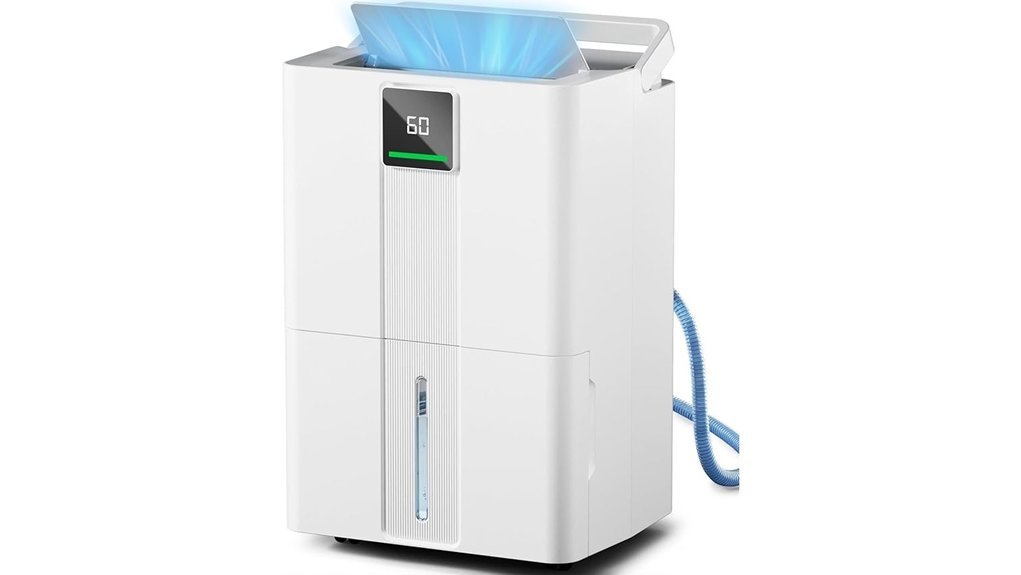
Need a 100-pint-class dehumidifier for a large home, basement, garage, or open area? The MEPTY 6000 Sq.Ft model is seller-listed for up to 100 pints of moisture removal per day and coverage up to 6,000 sq. ft., making it one of the more direct matches for shoppers specifically seeking a 100-pint-class unit.
The current listing includes adjustable humidity from 30% to 80%, continuous drainage, automatic defrost, digital humidity monitoring, Sleep mode, a 24-hour timer, child lock, a washable filter, and a 1.5-gallon tank. The seller also advertises a 35dB figure for Sleep mode. Treat that as a mode-specific seller claim rather than an expectation for every operating condition.
Best For: Homeowners who want a large-area, 100-pint-class unit with a clear humidity display, adjustable controls, and continuous drainage.
Why You’ll Like It: Its display and controls make changing humidity conditions easier to monitor without repeatedly checking a separate hygrometer.
Who Should Avoid It: It may be more capacity than you need for a small room, and manual tank use can still require regular emptying in a very damp space.
Pros:
- Seller-listed for up to 100 pints/day and up to 6,000 sq. ft.
- Adjustable 30%–80% humidity control with digital monitoring, Sleep mode, timer, child lock, and auto defrost.
- 1.5-gallon tank plus continuous-drain capability and a washable filter.
Cons:
- The 100-pint figure is a maximum seller rating rather than guaranteed everyday extraction.
- The 1.5-gallon tank can still require frequent attention if hose drainage is not used in a very damp area.
- Like most large compressor dehumidifiers, actual noise and performance vary with fan speed and operating conditions.
DECIUU 100 Pint Dehumidifier with Pump
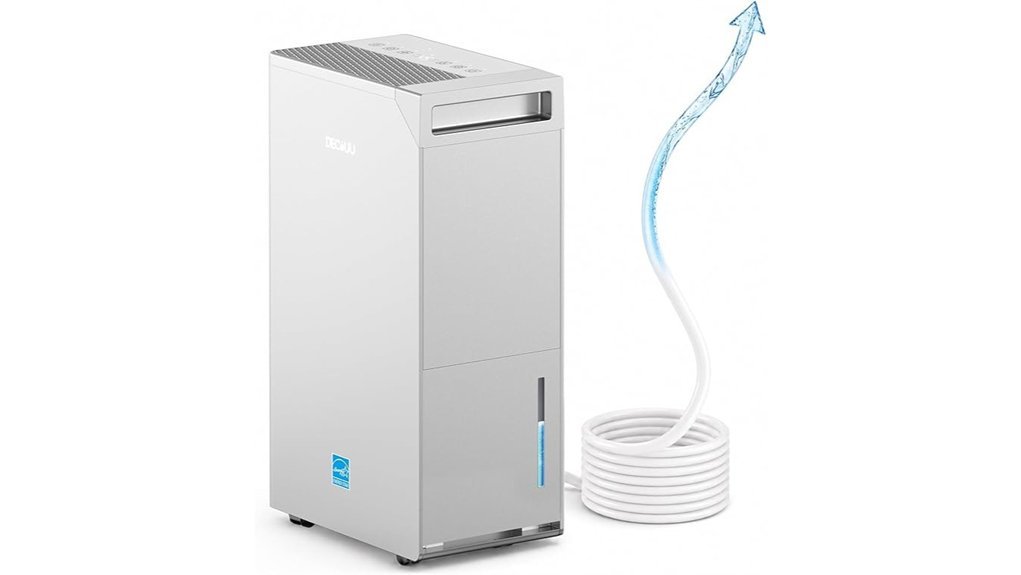
With built-in pump drainage and seller-listed coverage up to 5,000 sq. ft., the DECIUU 100 Pint Dehumidifier is especially useful in basements, utility rooms, garages, and other areas where gravity drainage is inconvenient. Instead of requiring the hose to slope continuously downward, its condensate pump is listed to move water upward as much as 16.4 feet.
The current Amazon listing states up to 100 pints/day at 95°F and 90% RH and up to 70 pints/day at 86°F and 80% RH. That illustrates why test conditions matter when comparing dehumidifiers. The listing also describes a 35%–80% humidity range, auto defrost, a 1.45-gallon tank, included continuous-drain hose, washable filter, casters, and ENERGY STAR Most Efficient 2024 recognition.
Best For: Basements and other large damp spaces where collected water must travel upward to reach a sink, utility tub, window, or elevated drain point.
Why You’ll Like It: The built-in pump solves a specific drainage problem that ordinary gravity-drain models cannot solve without additional equipment.
Who Should Avoid It: If the unit will sit directly beside a suitable floor drain, a simpler gravity-drain model may meet your needs without paying for pump functionality.
Pros:
- Seller-listed for up to 100 pints/day at 95°F and 90% RH.
- Built-in condensate pump is rated to move water upward up to 16.4 ft.
- Offers a 1.45-gallon tank, continuous drainage, humidity control, auto defrost, washable filter, and mobility features.
Cons:
- The 100-pint maximum drops under less extreme temperature and humidity conditions.
- Pump capability may be unnecessary if a convenient gravity drain is already available.
- The 1.45-gallon tank can fill quickly in damp conditions if neither pump nor continuous drainage is used.
Yaufey 6000 Sq. Ft. Energy Star Dehumidifier
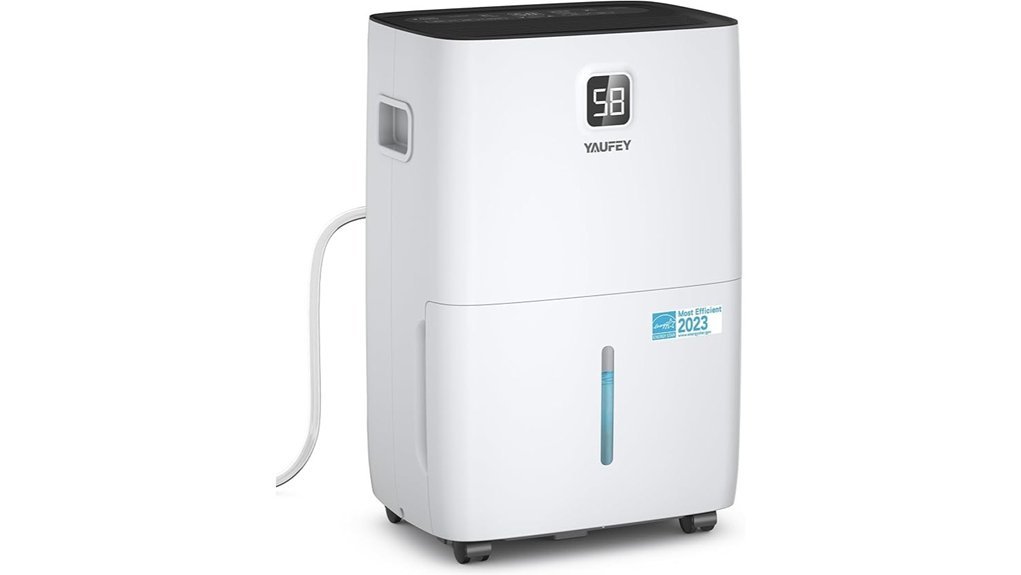
Yaufey’s 6000 sq. ft. Energy Star dehumidifier is the second higher-capacity 120-pint alternative in this guide. The current listing identifies a 120-pint capacity, 6,000-sq.-ft. floor-area claim, 1.06-gallon tank, three fan speeds, and continuous-drain capability.
You can choose modes intended for sleeping areas, living areas, basements, or continuous operation. The listing also includes adjustable humidity control, auto defrost, automatic tank-full shutoff, memory restart, timer functionality, a reusable filter, handles, casters, and a drain hose. This makes it a good fit for buyers who value flexible settings more than having an exact 100-pint label.
Best For: Homeowners or office users wanting a higher-capacity dehumidifier with multiple operating modes, three fan speeds, and both tank and continuous drainage.
Why You’ll Like It: It gives you more mode and speed choices than many basic large-space models, making it easier to tailor operation to different rooms.
Who Should Avoid It: Skip it if you specifically need an exact 100-pint-listed unit or if you plan to rely only on its relatively small tank in a persistently damp room.
Pros:
- Seller-listed 120-pint capacity and coverage up to 6,000 sq. ft.
- Three fan speeds and several room-oriented operating modes.
- Includes a 1.06-gallon tank, drain hose, washable filter, auto defrost, auto shutoff, wheels, and handles.
Cons:
- It is a 120-pint model rather than an exact 100-pint unit.
- The 1.06-gallon tank makes continuous drainage preferable for heavy moisture loads.
- Headline capacity and coverage are seller-listed maximums, so real-world results depend on conditions.
Factors to Consider When Choosing a 100 Pint Dehumidifier
When you choose a 100-pint-class dehumidifier, start with the moisture level, room size, temperature, and drainage setup rather than the headline pint number alone. You should also compare tank size, pump support, energy efficiency, noise, humidity controls, auto defrost, safety features, portability, and maintenance requirements. The goal is to choose a unit that controls humidity reliably without creating unnecessary daily work.
Coverage Area
The products in this guide carry seller-listed coverage claims from about 5,000 to 6,500 square feet, but a coverage number should be treated as a guideline rather than a promise that one unit will perform equally in every room. A very damp basement, divided floor plan, poor airflow, open stairway, or cold garage can behave differently from a warm open room. Match the unit to both square footage and moisture severity, and make sure air can circulate around the dehumidifier.
Moisture Removal Rate
A dehumidifier’s pints-per-day rating describes how much moisture it can remove under specified test conditions. Pay attention to the temperature and relative humidity attached to that figure. A model advertised at 100 pints/day under very warm, humid conditions can remove substantially less water in a cooler or drier room. Use pint capacity to compare models, but do not treat it as guaranteed daily bucket volume in your home.
Drainage Options
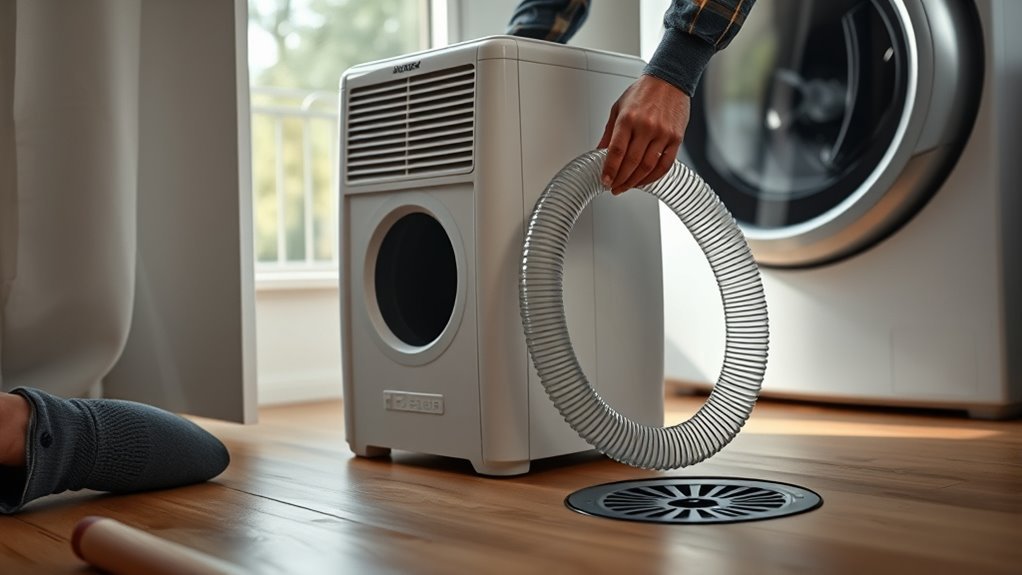
Drainage matters just as much as capacity if you do not want to empty a bucket repeatedly. Continuous gravity drainage works well when the hose can slope downward to a floor drain or sump. A built-in pump is useful when water must travel upward to a sink, window, utility tub, or elevated drain. A removable tank remains useful when a drain is unavailable, especially when the dehumidifier includes automatic tank-full shutoff.
Tank, Gravity Drainage, or Pump Drainage?
- Choose tank drainage if you run the unit occasionally and can empty the bucket easily.
- Choose gravity drainage if the unit can sit near a floor drain, sump, or lower drain point.
- Choose pump drainage if collected water must move upward to reach the available drain.
Energy Efficiency
If a large dehumidifier will run for many hours, energy efficiency becomes more important. Check the current Energy Star information for the exact model and compare capacity with the size and dampness of your space. A humidistat that cycles the compressor after reaching your selected humidity can also reduce unnecessary runtime compared with leaving a unit in continuous mode.
Noise Level
Large compressor dehumidifiers produce fan and compressor noise, so placement matters in bedrooms, offices, finished basements, and other quiet areas. Compare seller-listed decibel claims carefully and check whether a number applies only to a low-speed or Sleep mode. Lower fan settings are usually more comfortable for quiet rooms, while higher airflow can be useful when faster moisture removal is the priority.
Humidity Control
Good humidity controls let you choose a target relative humidity instead of running the compressor continuously. Look for an easy-to-read display, useful adjustment range, and automatic cycling. Modes such as Auto, Sleep, Dry, Basement, or Continuous can simplify setup, but the most important feature is reliable control of the target humidity in the room you are actually treating.
Portability Features
Large dehumidifiers can be awkward to reposition, so casters and built-in handles are worthwhile if you plan to move the unit between rooms. Check dimensions and weight before purchase if you have narrow basement stairs, tight utility spaces, or limited storage. Remember that casters make movement easier on one floor but do not make a heavy compressor appliance easy to carry upstairs.
Safety And Maintenance
Look for automatic tank-full shutoff, a washable or reusable filter, auto defrost where appropriate, restart protection, child lock, and clear manufacturer instructions. Clean the filter at the interval specified for your model and keep the air inlet and outlet clear. Use a properly grounded outlet, follow the manual for extension-cord restrictions, and route drain hoses where they cannot create a tripping hazard or leak near electrical equipment.
Low-Temperature Use
If your basement, garage, or utility room becomes cold, check the exact model’s listed operating-temperature range. Compressor dehumidifiers can lose moisture-removal performance as temperatures fall, and frost may form on the evaporator coil. Auto defrost can help manage frost, but it does not mean a standard compressor dehumidifier is designed for freezing conditions.
Before You Buy Checklist
- Measure the actual space you want to dehumidify.
- Consider both square footage and how damp the space becomes.
- Check the test conditions behind the advertised pint-per-day rating.
- Decide whether you need tank drainage, gravity drainage, or a built-in pump.
- Check tank capacity if continuous drainage is not possible.
- Confirm whether the drain hose is included and whether its length works for your setup.
- If choosing a pump model, confirm the pump’s maximum lift and hose requirements.
- Check the target-humidity range and adjustment increments.
- Look for auto defrost if the unit will run in a cool basement or garage.
- Choose lower-noise settings or models for bedrooms and offices.
- Confirm current Energy Star information, warranty terms, safety listings, included accessories, and Amazon product details before purchase.
Frequently Asked Questions
How Often Should a 100 Pint Dehumidifier’s Filter Be Cleaned?
Follow the cleaning interval in your model’s manual. A filter may need attention more often when the unit runs daily, operates in a dusty area, or is used around pets. Inspect it regularly and clean it whenever dust buildup begins restricting airflow.
Can a 100 Pint Dehumidifier Run Continuously in Freezing Conditions?
A standard compressor dehumidifier should not be assumed to work normally in freezing conditions. Low temperatures can reduce moisture removal and cause frost on the coil. Check the exact operating-temperature range and auto-defrost instructions for your model.
How Long Can a 100 Pint Dehumidifier Last?
There is no reliable lifespan that applies to every large dehumidifier. Service life depends on compressor quality, runtime, maintenance, room conditions, drainage, storage, and how heavily the unit is used. Regular filter cleaning, unobstructed airflow, proper drainage, and following the manufacturer’s operating instructions can help reduce unnecessary strain.
Do 100 Pint Dehumidifiers Work Well in Finished Basements?
They can be a good fit for large or persistently damp finished basements when correctly sized. Pay attention to square footage, moisture severity, room temperature, airflow, drainage access, and noise. A built-in pump may be especially useful when the basement lacks a convenient floor drain.
How Noisy Are 100 Pint Dehumidifiers During Nighttime Operation?
Large compressor dehumidifiers normally produce a combination of fan noise and compressor sound. Noise varies by model, fan speed, room acoustics, and operating mode. If the unit will run near a bedroom or office, compare mode-specific noise claims and place it on a stable, level surface away from beds and desks.
Is a Built-In Pump Worth It?
A built-in pump is especially useful when condensate must move upward to a sink, utility tub, window, or higher drain point. If the dehumidifier can drain directly downhill into a nearby floor drain, gravity drainage is usually simpler.
What Humidity Level Should I Set?
Choose a target that keeps the room comfortable and prevents persistent dampness without making the air unnecessarily dry. Your ideal setting can change with climate, season, room use, and moisture problems. Use the dehumidifier’s humidity display or a separate hygrometer to see how the room responds.
Is a 120 Pint Dehumidifier Too Large for a 100 Pint Guide?
A 120-pint model can be a useful higher-capacity alternative when the buyer is comparing large-space dehumidifiers around the 100-pint class. It should, however, be labeled clearly so readers do not mistake it for an exact 100-pint model. For smaller or only mildly humid rooms, a lower-capacity unit may be sufficient.
Why Can Two 100 Pint Dehumidifiers Perform Differently?
The headline pint rating is only one part of the comparison. Test temperature, relative humidity, compressor design, airflow, defrost cycles, fan speed, room temperature, and moisture level can all affect actual daily water removal. Compare the test conditions behind the advertised rating instead of assuming every “100-pint” model will collect exactly the same amount of water in your home.
Conclusion
Choosing the right 100-pint-class dehumidifier starts with your room conditions and drainage setup, not just the largest advertised number. The Landeagle 6000 Sq. Ft. Dehumidifier is a balanced starting point for large spaces, while the MEPTY 6000 Sq.Ft Dehumidifier is another direct 100-pint-class option with useful humidity monitoring. Choose the DECIUU 100 Pint Dehumidifier with Pump when upward drainage is the priority. The Kesnos and Yaufey models are better treated as 120-pint higher-capacity alternatives. Before buying, compare the pint-rating test conditions, room temperature, drainage requirements, tank size, operating controls, and current Amazon listing so you choose the model that makes humidity control easiest for your space.