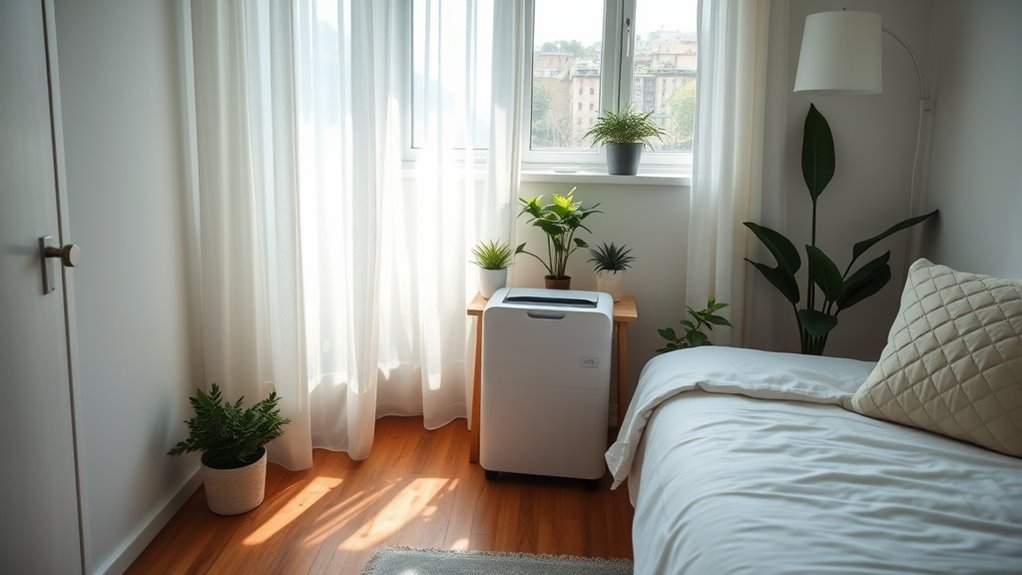
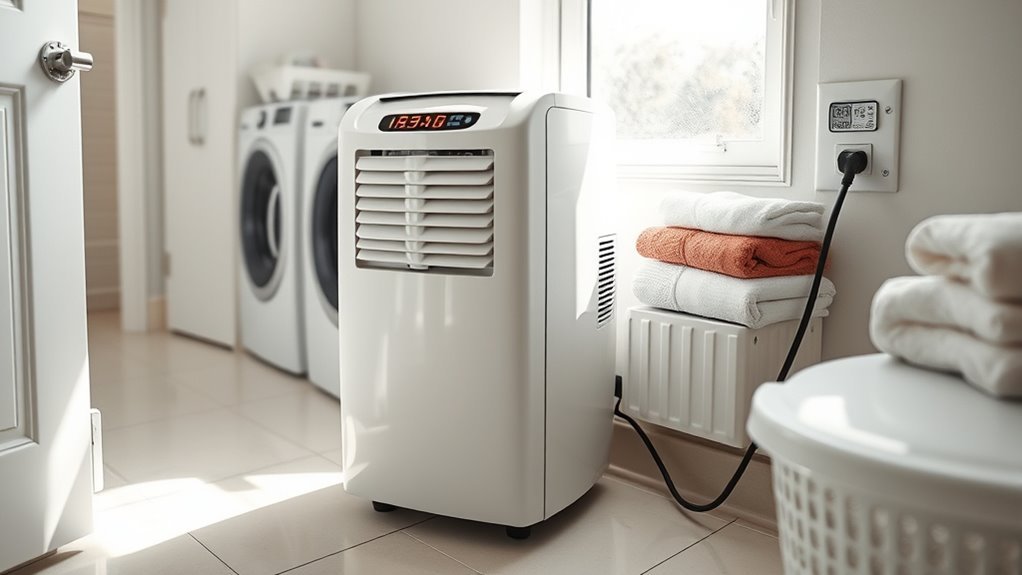
A window sill dehumidifier can help when condensation leaves the area around your glass, frame, or sill feeling damp. For a narrow sill, a slim rechargeable desiccant unit is usually the easiest fit. A disposable calcium-chloride box can provide low-maintenance moisture control on a deeper, stable sill, while a small electric dehumidifier is better placed on a dry table or extra-deep ledge near the window.
These products can reduce airborne moisture, but they cannot repair leaking windows, failed seals, rain penetration, damaged caulk, or poor insulation. Fix the moisture source first when water enters from outdoors or returns despite regular ventilation.
Quick Verdict
- Best Overall Reusable: Eva-Dry E-333 for silent, cordless moisture control without a liquid collection tray.
- Best for a Narrow Sill: USB-C Rechargeable Desiccant Dehumidifier for its slim, lightweight body.
- Best Disposable Box: Vacplus Moisture Absorber Boxes for simple, fragrance-free operation.
- Best Value Pack: Ksend Moisture Absorbers when you need boxes for several windows or rooms.
- Best Reusable Bag: Wisedry Silica Gel Packets for a wide sill, vehicle, storage space, or nearby shelf.
- Best Electric Option: Windangel 44-Ounce Dehumidifier for a deep sill or dry surface beside the window.
Window and electrical safety
Do not place a powered dehumidifier where condensation can drip into its vents, adapter, outlet, or cord. Keep passive liquid-collection boxes upright and place them in a washable tray, especially on painted or wooden sills. Leave enough clearance for the window to open and for air to move around the product.
Quick Comparison
| Product | Type | Best Use | Placement Note | Amazon |
|---|---|---|---|---|
| Eva-Dry E-333 | Renewable silica gel | Quiet everyday moisture control | Suitable for a stable sill with enough width and clearance | Check Price |
| USB-C Rechargeable Desiccant Unit | Rechargeable silica gel | Narrow sills and compact spaces | Slim body; remove it from the sill before recharging | Check Price |
| Vacplus Boxes | Disposable calcium chloride | Low-maintenance moisture collection | Keep upright in a tray on a deeper sill | Check Price |
| Ksend 12 Pack | Disposable calcium chloride | Multiple windows and storage spaces | Compact, but still requires a flat and stable surface | Check Price |
| Wisedry 500g Packets | Rechargeable silica-gel bags | Wide sills, vehicles, and storage | Check sill strength and protect the surface underneath | Check Price |
| Windangel 44-Ounce | Electric semiconductor | Active moisture collection near a wet window | Requires a dry surface about 5.91 inches deep | Check Price |
Eva-Dry Wireless Mini Dehumidifier, White (E-333)
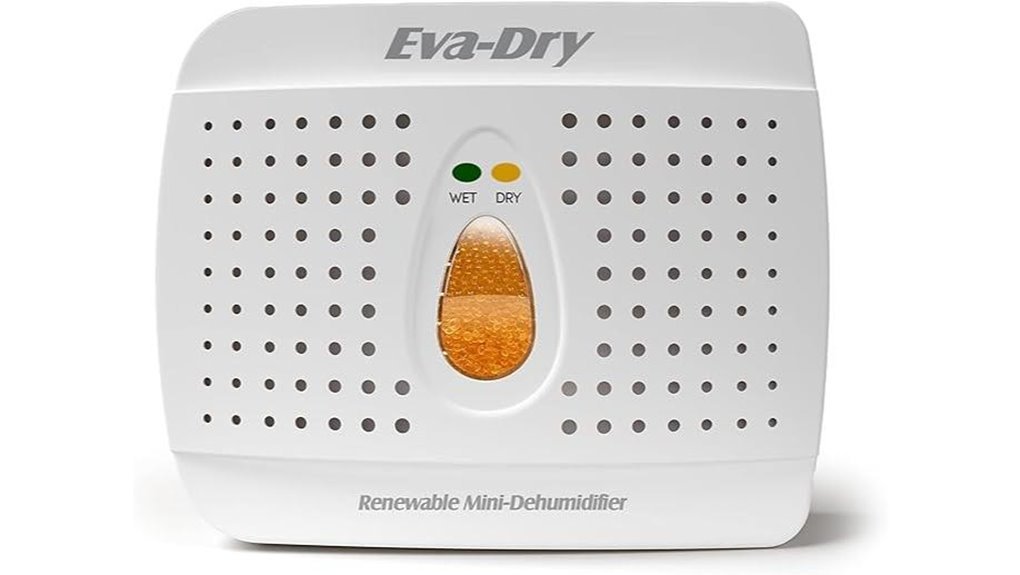
The Eva-Dry E-333 is the strongest all-around choice for a window area when you want silent and cordless moisture control without a liquid reservoir. It uses renewable silica-gel beads and works without electricity while it is absorbing moisture. Its narrow body is easier to position than a conventional tank-style dehumidifier, provided your sill is wide and stable enough.
The color-changing indicator lets you know when the beads need to be renewed. You then remove the unit from the sill and plug it into an appropriate outlet until the beads return to their dry color. The manufacturer lists it for small spaces up to 333 cubic feet, but passive performance will still depend on ventilation, temperature, and the amount of moisture entering the area.
Why You’ll Like It: It has no bucket to empty, makes no fan noise, and can be reused instead of discarded after one cycle.
Best For: Narrow window areas, closets, cabinets, RVs, and other small spaces with gradual moisture buildup.
Before You Buy: This is a passive unit, so it will not clear severe room-wide humidity as quickly as an electric dehumidifier. It also needs to be removed and plugged in periodically for renewal.
Pros:
- Cordless and silent during normal use
- No liquid collection chamber that could spill on the sill
- Reusable silica-gel system with a visible moisture indicator
- Narrow profile works better than many tank-style units in tight areas
Cons:
- Designed for small areas rather than an entire damp room
- Passive absorption is slower than powered moisture extraction
- Requires access to a suitable outlet during the renewal cycle
USB-C Rechargeable Desiccant Dehumidifier
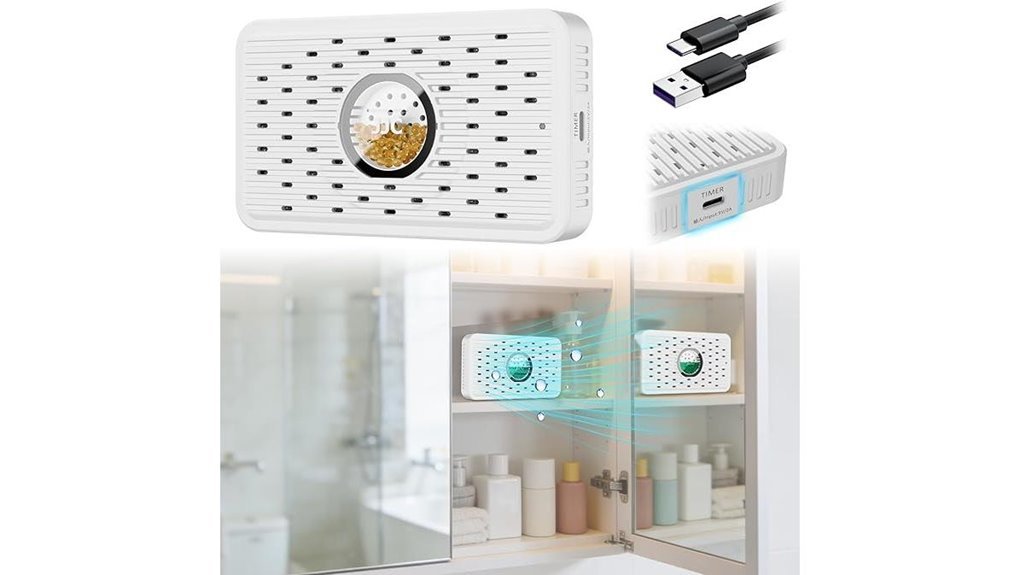
This USB-C rechargeable desiccant dehumidifier is the most practical option here for a genuinely narrow sill. Its slim body takes up less depth than a tank-style appliance, while the enclosed silica-gel beads absorb moisture without producing a liquid reservoir that needs to be emptied.
The beads change color as they become saturated. A built-in heating system restores the desiccant during recharging, and the listed safety features include automatic power-off and overheat protection. Recharge it on a dry, heat-resistant surface rather than leaving it beside wet glass, curtains, or standing condensation.
Why You’ll Like It: It combines the slim shape of a desiccant pack with a convenient USB-C reactivation system.
Best For: Narrow sills, small cabinets, safes, camera storage, RV compartments, and other confined spaces.
Before You Buy: It is still a passive moisture absorber during use. It is better for localized dampness than for a large room with ongoing heavy condensation.
Pros:
- Very slim and lightweight design
- Reusable silica-gel beads with a color indicator
- USB-C reactivation avoids disposable refills
- No open water tank to empty
Cons:
- Limited to small or localized moisture problems
- Must be removed from the window area for recharging
- Absorption speed depends heavily on surrounding conditions
Vacplus Moisture Absorber Boxes, 6 Pack
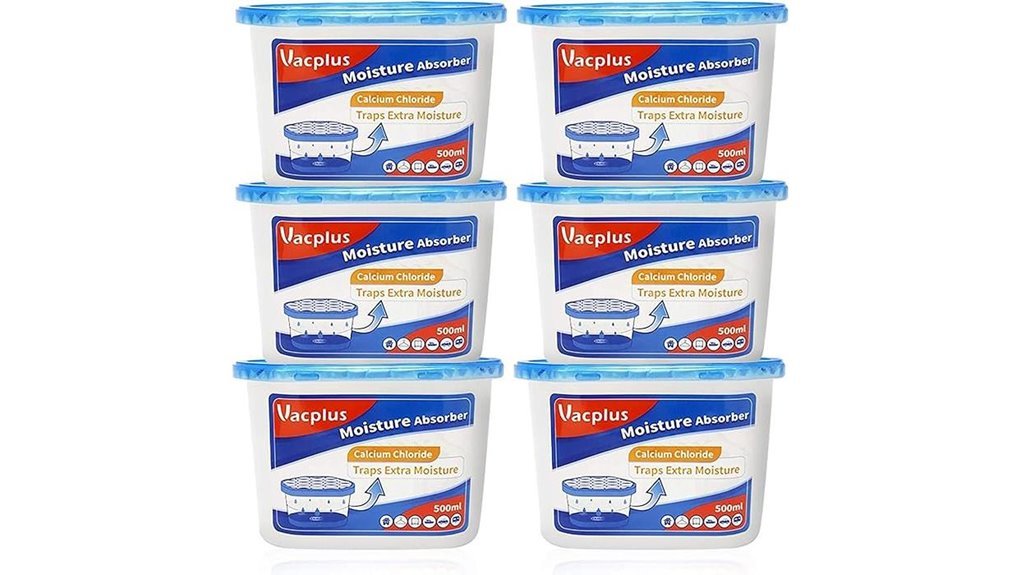
Vacplus Moisture Absorber Boxes are a convenient choice when you prefer non-electric and fragrance-free moisture collection. Each compact box uses calcium chloride to attract moisture from the air. The resulting liquid collects in a lower chamber that lets you see when the product is working and when it is approaching capacity.
The box format can work on a deep sill, shelf, or table near a window, but it must remain upright. Place it in a washable tray so the calcium-chloride solution cannot contact painted wood, metal hardware, fabric, or flooring if the container is disturbed.
Why You’ll Like It: There is no charging, cord, fan, filter, or bucket-emptying routine. You activate the box and replace it after the absorbent has been used.
Best For: Deeper sills, bathrooms, laundry rooms, closets, and windows with light or seasonal condensation.
Before You Buy: The box needs replacement rather than recharging. Keep it upright and out of reach of children and pets.
Pros:
- Fragrance-free calcium-chloride formula
- Transparent lower chamber shows collected liquid
- No electricity, charging, or fan noise
- Six-pack can cover several small damp areas
Cons:
- Disposable rather than renewable
- Must stay upright after activation
- Can fill more quickly in persistently humid conditions
Ksend Moisture Absorbers, 12 Pack
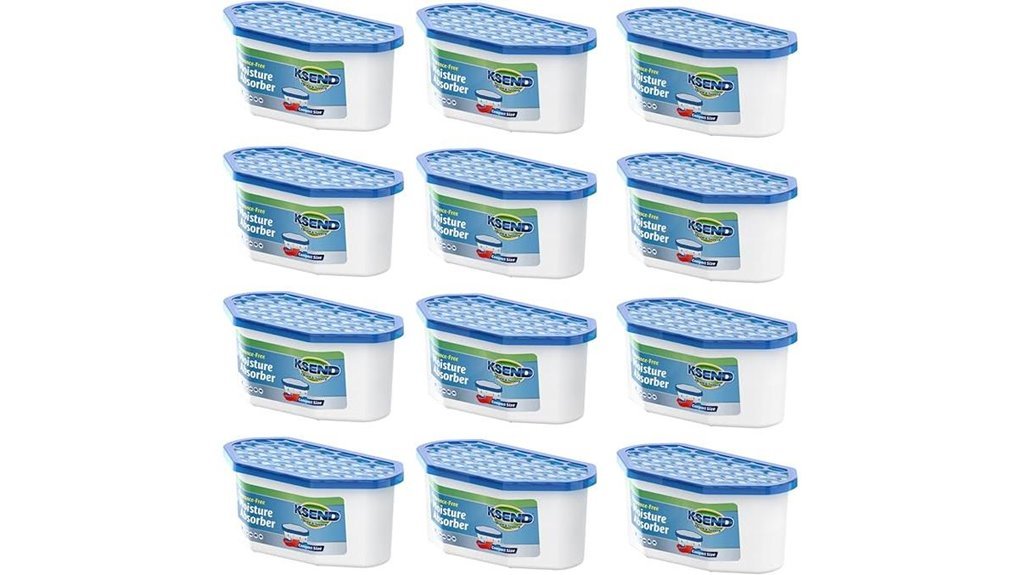
Ksend’s 12-pack is useful when you have several condensation-prone windows or want passive absorbers for multiple small spaces. Each compact box uses calcium-chloride particles that gradually collect moisture as liquid in the lower section.
The listed 300 ml container format is smaller than many full-size moisture buckets, which makes these boxes easier to position on a deep sill or nearby shelf. Their moisture-locking layer is designed to reduce leakage, but the boxes should still remain upright in a protective tray.
Why You’ll Like It: The large pack makes it easier to place a separate absorber near several windows instead of moving one product from room to room.
Best For: Multiroom use, deeper window ledges, bathrooms, cabinets, kitchens, and closets.
Before You Buy: Calcium-chloride absorbers work gradually and may show little collected liquid when humidity is low or temperatures are cool.
Pros:
- Twelve compact boxes for multiple locations
- Visible liquid collection helps with maintenance checks
- No electricity, charging, filters, or operating noise
- Fragrance-free format suits users who do not want added scent
Cons:
- Every box eventually requires disposal and replacement
- Must remain upright to reduce spill risk
- Not intended to solve severe whole-room humidity
Wisedry Rechargeable Silica Gel Dehumidifier Packets
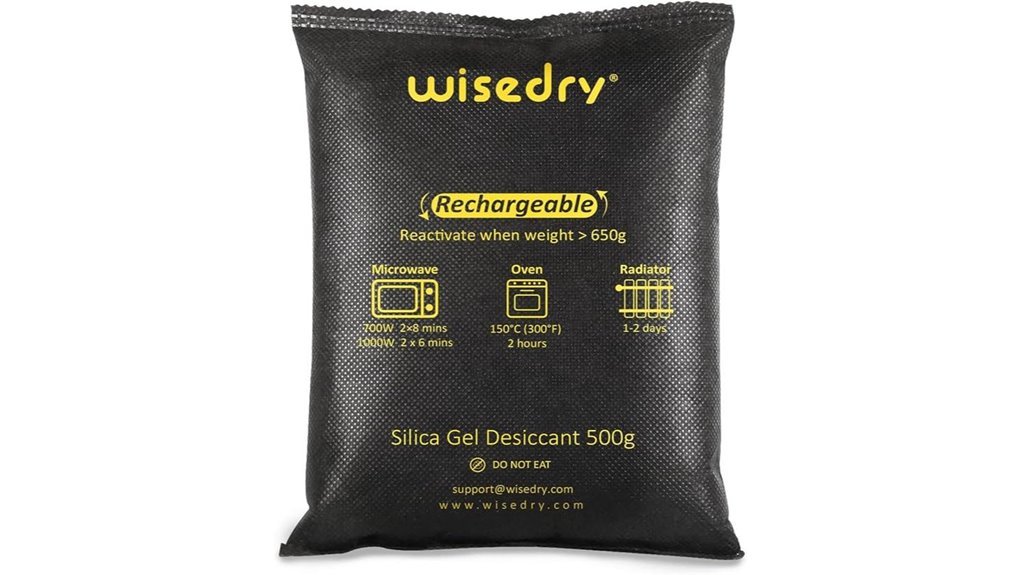
Wisedry’s set includes two large 500-gram rechargeable silica-gel packets. The soft bag format works differently from a rigid sill dehumidifier: you can lay a packet on a wide, sturdy ledge, place it in a tray near the window, or use it in a vehicle, cabinet, safe, RV, or storage area.
When the packets become saturated, they can be reactivated in a microwave or oven according to the manufacturer’s instructions. Allow them to cool fully on a heat-safe surface before returning them to a painted, wooden, or plastic sill.
Why You’ll Like It: The packets offer reusable moisture control without a cord, liquid reservoir, or disposable calcium-chloride refill.
Best For: Wide sills, vehicles with fogging problems, garages, storage areas, RVs, boats, and enclosed cabinets.
Before You Buy: The two-packet set is heavier and bulkier than slim desiccant devices. Confirm that your sill is wide, level, and strong enough before placing a packet there.
Pros:
- Two large reusable silica-gel packets
- No liquid collection chamber
- Can be reactivated instead of discarded
- Flexible shape works in spaces where a rigid box may not fit
Cons:
- Too large for many narrow window sills
- Requires careful heating and cooling during reactivation
- Does not provide active fan-driven moisture removal
Windangel 44oz Small Portable Dehumidifier with 3 Modes
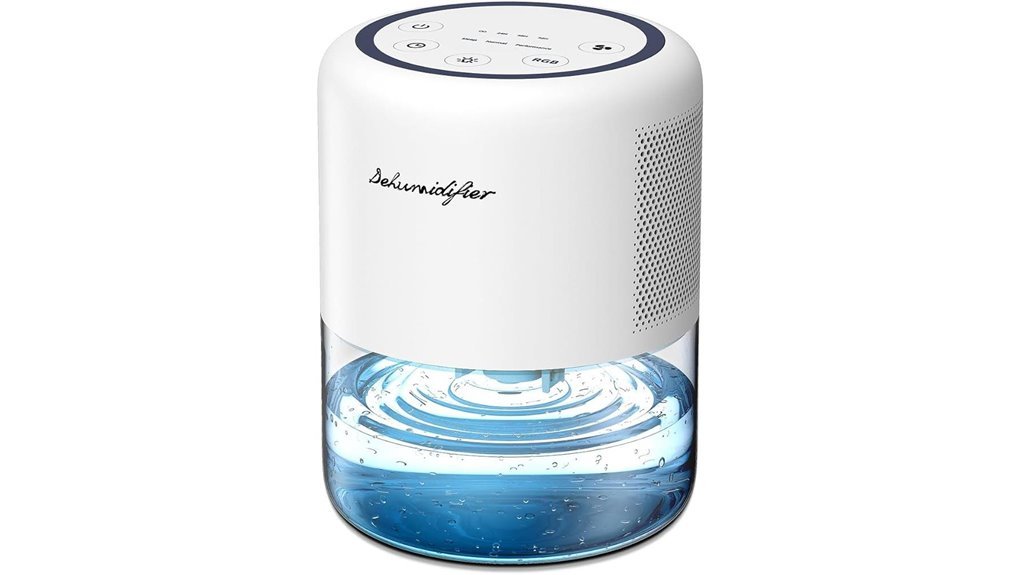
The Windangel model is the best choice in this list when you want active electric moisture collection instead of passive desiccant absorption. It has a 44-ounce tank, three operating modes, timer settings, automatic shutoff, and automatic defrost.
Its footprint is approximately 5.91 inches square, so it will not fit many narrow residential sills. Use it only on an extra-deep, level sill that stays dry, or place it on a stable table beside the problem window. Keep the air inlet and outlet unobstructed and make sure water cannot drip into the appliance or power connection.
Why You’ll Like It: Unlike passive absorbers, this unit uses a semiconductor cooling system to condense water into a removable tank while it is running.
Best For: Bedrooms, bathrooms, RVs, or condensation-prone windows with a safe nearby surface and a convenient outlet.
Before You Buy: Small semiconductor dehumidifiers perform best in warmer, humid conditions. They are not substitutes for a properly sized compressor dehumidifier in a wet basement or a large room.
Pros:
- Active electric moisture collection
- 44-ounce removable tank
- Sleep, Auto, and Performance modes
- Automatic shutoff, automatic defrost, and timer controls
Cons:
- Approximately 5.91-inch depth is too large for many window sills
- Needs a dry surface, airflow clearance, and access to an outlet
- Performance decreases in cooler or less humid conditions
Factors to Consider When Choosing a Window Sill Dehumidifier
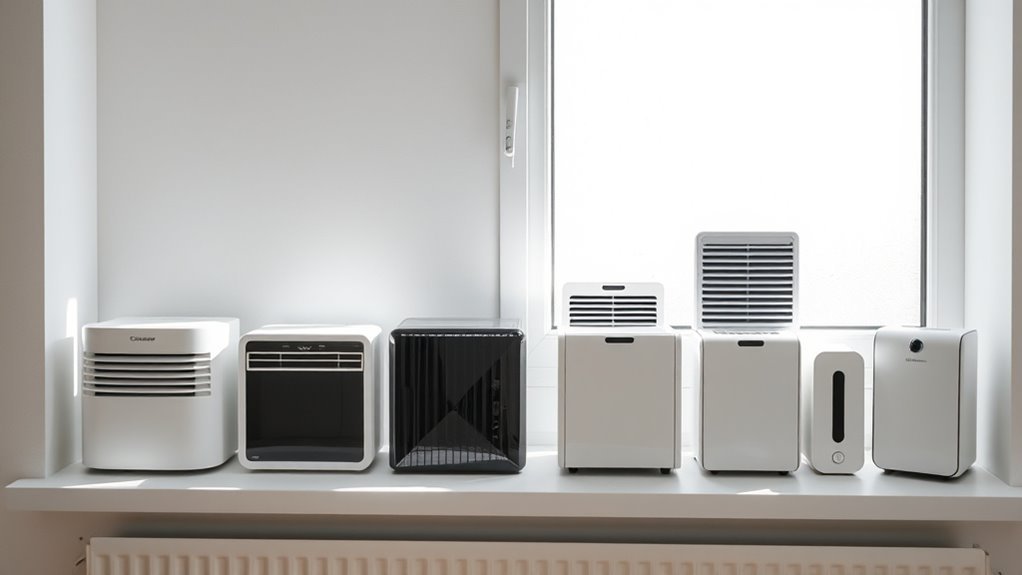
The right product depends on the size of your sill, the source of the moisture, the amount of condensation, and how much maintenance you are willing to do. Measure the available space before buying and decide whether you need localized passive absorption or powered room-air treatment.
Identify the Moisture Source
Start by determining whether the water comes from indoor condensation or an actual leak. A dehumidifier may help when warm, humid indoor air reaches cold glass. It will not repair failed exterior caulk, damaged flashing, a leaking roof, a plumbing problem, or a broken window seal. Water that appears during rain or enters from one specific joint should be investigated before you rely on an absorber.
Measure the Actual Sill
Measure the sill’s usable depth, width, height clearance, and load capacity. Confirm that the product will not interfere with blinds, curtains, locks, handles, or the movement of the window. A device that technically fits but blocks its own air inlet will perform poorly.
For an electric unit, also measure the safe distance to an outlet and check whether condensation could run toward the appliance or cord. Use a nearby dry table instead when the sill is narrow, sloped, unstable, or regularly wet.
Passive Versus Electric
A passive silica-gel or calcium-chloride product is silent and does not require continuous power. It works best for a small area with light or gradual moisture buildup. Passive products are also useful when there is no convenient outlet.
An electric semiconductor dehumidifier actively condenses moisture into a tank. It can be more useful for a small room with recurring dampness, but it needs electricity, airflow clearance, regular tank checks, and a dry placement surface.
Reusable Versus Disposable
Reusable silica-gel products cost more initially but can be renewed many times. They need periodic heating or powered reactivation, and you must follow the product’s instructions carefully.
Disposable calcium-chloride boxes are easy to activate and require no charging. However, you must buy replacements and dispose of the collected solution responsibly. Keep every box upright and protect the surface underneath.
Protect Painted and Wooden Sills
Use a shallow washable tray beneath any product that can collect liquid. Check the sill regularly for dampness, peeling paint, staining, swelling, corrosion, or mold growth. Wipe condensation promptly rather than allowing water to remain trapped beneath the absorber.
Do not place a recently heated silica-gel packet or rechargeable unit directly on painted wood, plastic, fabric, or another heat-sensitive surface. Let it cool completely first.
Airflow and Placement
Leave open space around a powered unit’s inlet and outlet. Do not press it directly against glass, curtains, blinds, or a wall. Passive absorbers also work better when air can move around them, although they are generally most effective in smaller or lightly ventilated spaces.
Maintenance and Monitoring
Check liquid-collection boxes before they reach capacity, recharge desiccant products when their indicators change, and empty electric tanks before overflow shutoff becomes a routine occurrence. A small hygrometer can help you judge whether the room itself remains humid even after the visible window condensation improves.
Before You Buy Checklist
- Measure the sill’s usable depth and width.
- Confirm that the window can still open and lock.
- Check whether the sill is level and strong enough.
- Choose a passive product for light localized moisture.
- Use an electric model only on a dry surface with safe cord placement.
- Protect painted or wooden surfaces with a tray.
- Investigate leaks, damaged seals, and recurring mold separately.
Frequently Asked Questions
Do Window Sill Dehumidifiers Lower Whole-Room Humidity?
Small passive absorbers mainly provide localized moisture control. They may help around a condensation-prone window, but they usually cannot manage a large or persistently humid room. A powered dehumidifier sized for the room is more appropriate when humidity affects several walls, windows, or furnishings.
Which Type Fits a Narrow Window Sill?
A slim rechargeable silica-gel unit is usually the easiest fit. Measure the sill before buying because even compact products vary considerably in depth. Tank-style electric units often need a deep ledge or a separate table beside the window.
Can a Dehumidifier Stop Window Condensation Completely?
It may reduce condensation when high indoor humidity is the main cause, but it cannot guarantee completely dry glass. Cold outdoor temperatures, poor ventilation, weak insulation, failed seals, and indoor activities such as cooking or showering can continue to produce moisture.
Are Calcium-Chloride Boxes Safe for Wooden Sills?
They can be used carefully, but the box must remain upright and should sit inside a washable tray. Collected calcium-chloride solution can damage some finishes and materials. Keep the container away from children and pets, and clean any spill according to the product instructions.
Can an Electric Dehumidifier Sit Beside Wet Glass?
Only when the placement surface remains dry and water cannot drip into the appliance, adapter, outlet, or cord. A stable table beside the window is safer than a wet or sloped sill. Maintain the required clearance around the unit’s air inlet and outlet.
How Often Do Passive Moisture Absorbers Need Attention?
It depends on the product, room temperature, ventilation, and humidity. Check color indicators and liquid chambers regularly rather than relying on a fixed number of days. Recharge or replace the product when it reaches the manufacturer’s stated limit.
Final Recommendation
Best choice for most window areas: The Eva-Dry E-333 offers the most balanced combination of silent operation, a narrow profile, reusable desiccant, and no liquid reservoir.
Best for the narrowest sill: Choose the USB-C rechargeable desiccant unit when physical space is your main limitation.
Best low-maintenance disposable option: Choose the Vacplus boxes, but keep each box upright in a protective tray.
Best for stronger active moisture removal: Choose the Windangel electric model only when you have a deep, dry surface or a safe table beside the window.
Conclusion
The best window sill dehumidifier is one that physically fits the available space, safely handles the amount of moisture present, and matches your maintenance preference. Slim renewable desiccant units work well for narrow areas, calcium-chloride boxes provide simple disposable moisture collection, and compact electric models can help when you need more active operation near the window.
Whichever type you choose, protect painted or wooden surfaces, keep powered equipment away from drips, and investigate the underlying cause when condensation is heavy, widespread, or accompanied by leaks or recurring mold.