Disclosure: As an Amazon Associate I earn from qualifying purchases. If you click a link on this page and make a purchase, we may receive a small commission at no extra cost to you.
Last updated: October 19, 2026
If you are shopping for a 22 pint dehumidifier in 2026, focus on three things first: the verified Department of Energy (DOE) pint rating, the room dampness and square footage it can realistically handle, and how easy it is to drain. Under current DOE testing standards (65°F and 60% relative humidity), a 22-pint or 22.27-pint dehumidifier delivers the same moisture removal that older testing standards used to label as a 30- to 35-pint unit—making this size the sweet spot for bedrooms, bathrooms, home offices, laundry rooms, and moderately damp basements up to 1,500 square feet.
Use this guide to compare top 22-pint and 22.27-pint models side by side, including Energy Star options, everyday portable units, continuous gravity drainage setups, washable filters, and automatic humidity controls.
Quick Verdict
The best 22 pint dehumidifier for most homes combines reliable continuous drainage, an accurate adjustable humidistat, and enough airflow for spaces up to 1,500 sq. ft. Choose the BLACK+DECKER 22.27-Pint if you want a dependable everyday value with a 6.8-pint tank, the Midea 22-Pint Energy Star if quiet efficiency matters most for bedrooms and living spaces, and the Keystone 22-Pint if you want a straightforward portable unit with normal and turbo fan modes.
Quick Picks
- Best everyday 22-pint value: BLACK+DECKER Portable Dehumidifier 22.27-Pint 1500 Sq. Ft. Coverage
- Best quiet Energy Star 22-pint option: Midea 22 Pint Energy Star Dehumidifier with Filter
- Best simple 22-pint room unit: Keystone 22-Pint Portable Dehumidifier for Large Rooms
22 Pint Dehumidifier Comparison
Use this table to compare key specifications before reading the individual reviews. All three models sit in the 22-pint (10.5-liter) daily moisture-removal class for medium-to-large residential rooms.
| Product | Rated Capacity | Max Coverage | Controls & Smart Features | Drainage Setup | Best For | CTA |
|---|---|---|---|---|---|---|
| BLACK+DECKER Portable Dehumidifier 22.27-Pint 1500 Sq. Ft. Coverage | 22.27 pints/day (10.5 L) | Up to 1,500 sq. ft. | Top electronic humidistat, no app controls | 6.8-pint bucket or continuous drain hose | Everyday medium-room moisture control | Check Price on Amazon |
| Midea 22 Pint Energy Star Dehumidifier with Filter | 22 pints/day | Up to 1,500 sq. ft. | Digital humidistat (Wi-Fi/voice control on select variants) | Removable tank or continuous gravity drain | Quiet bedrooms, bathrooms, and basements | Check Price on Amazon |
| Keystone 22-Pint Portable Dehumidifier for Large Rooms | 22 pints/day | Up to 1,500 sq. ft. | LED digital display with Normal/Turbo modes, no app | Removable bucket or continuous drain outlet | Simple basement, garage, or living-room use | Check Price on Amazon |
Buyer note: Dehumidifier pint ratings depend on testing temperature and humidity. Current US DOE ratings measure water removal at 65°F and 60% relative humidity (RH). Always compare the standard DOE rating, bucket volume, and drain hose compatibility rather than relying on “maximum pint” numbers tested at hotter saturation conditions.
Before You Buy
- Match capacity to dampness: Pick a 22-pint model for moderately damp spaces up to 1,500 sq. ft., including bedrooms, bathrooms, home offices, laundry rooms, and small-to-medium basements.
- Plan for bucket math: A 22-pint dehumidifier pulling full capacity removes nearly 3 gallons of water per day—meaning a typical 6- to 7-pint bucket will fill three times daily unless you attach a continuous drain hose.
- Check drain elevation: Gravity drainage requires a floor drain or sump below the unit’s outlet; if you need to drain upward into a utility sink or window, pair the unit with an external condensate pump or choose a pump-equipped model.
- Monitor room accuracy: Built-in humidistats read air right next to the intake grille, so place an inexpensive standalone digital hygrometer across the room for the truest humidity reading.
- Know when to size up: If your basement has wet walls, water seepage, or over 1,500 sq. ft. of open space, step up to a 35- or 50-pint DOE dehumidifier so the compressor does not run nonstop.
How We Chose These 22 Pint Dehumidifiers
We evaluated residential portable dehumidifiers in the 22-pint DOE capacity class—including metric-converted 22.27-pint (10.5-liter) units—designed for spaces up to 1,500 square feet. Focusing specifically on this capacity tier helps you compare units with similar power draw, physical footprint, and airflow rather than mixing in undersized mini-dehumidifiers or heavy-duty 50-pint basement machines.
Each model was assessed across practical ownership criteria: verified moisture-removal rating, water tank capacity, continuous gravity drainage convenience, automatic defrost and power-outage restart, washable filter access, portability (caster wheels and integrated handles), and operating noise. This article is based on manufacturer specifications, DOE efficiency standards, and verified owner feedback rather than hands-on laboratory testing.
BLACK+DECKER Portable Dehumidifier 22.27-Pint 1500 Sq. Ft. Coverage

Best Everyday Value: The BLACK+DECKER BDM22WCDA removes up to 22.27 pints (10.5 liters) of moisture per day and is built for medium-to-large residential rooms up to 1,500 sq. ft. It is a practical, no-nonsense choice if you want a recognizable brand, straightforward top-mounted electronic controls, and flexible bucket-or-hose water management.
Its removable 6.8-pint (0.85-gallon) water bucket features an audible full-bucket alert and automatic overflow shutoff to prevent floor spills. When humidity spikes in summer, you can attach the included drain hose for continuous gravity drainage so you do not have to empty the bucket multiple times a day. Built-in caster wheels, recessed side handles, auto-defrost, and auto-restart after power interruptions round out a reliable daily package.
Key Specifications:
- Moisture Removal: 22.27 pints/day (10.5 liters/day)
- Coverage Area: Up to 1,500 sq. ft.
- Bucket Capacity: 6.8 pints (0.85 gallons) with full-tank alert and auto shutoff
- Drainage: Removable bucket or continuous gravity drain hose (no internal pump)
- Controls & Maintenance: Electronic LED display, adjustable humidistat, 24-hour timer, slide-out washable mesh filter
Best For: Homeowners or renters who want a dependable, easy-to-operate 22-pint-class dehumidifier for bedrooms, living areas, or moderately damp basements up to 1,500 sq. ft.
Who Should Skip It: Skip it if you want smartphone app monitoring or need a built-in condensate pump for vertical drainage into a high sink.
Pros:
- Removes a full 22.27 pints (10.5 L) per day with straightforward, clutter-free electronic controls.
- Includes both a 6.8-pint pull-out tank and a drain-hose connection for continuous gravity drainage.
- Auto-restart and auto-defrost keep it running reliably in cooler basements and after brief power outages.
- Slide-out washable air filter requires no replacement filter purchases.
Cons:
- Solid compressor build is heavier to carry up or down stairs than ultra-compact thermo-electric units.
- No Wi-Fi app or smart-speaker voice integration.
- Under peak humidity, the 6.8-pint bucket will need emptying up to three times daily unless you connect a drain hose.
Verdict: If you want set-and-forget humidity control without fussing over smartphone apps, the BLACK+DECKER 22.27-Pint is a durable, well-rounded workhorse for everyday home moisture control.
Midea 22 Pint Energy Star Dehumidifier with Filter

Best Quiet Energy Star Pick: The Midea 22 Pint Energy Star Dehumidifier is an excellent choice for buyers who prioritize quiet operation, lower electricity bills, and smooth airflow in occupied spaces like bedrooms, nurseries, home offices, bathrooms, and finished basements. Because dehumidifiers often run for hours at a time during humid months, its Energy Star certification helps keep monthly utility costs in check.
It offers an adjustable relative humidity range (typically 35% to 85% RH), a washable dust filter with a clean-filter reminder, auto-restart after power loss, four 360-degree swivel wheels, and continuous gravity drainage support. Note that Midea offers both standard digital-panel models and smart Wi-Fi/voice-enabled variants across its 22-pint listings, so confirm which control option is selected on the product page before checking out.
Key Specifications:
- Moisture Removal: 22 pints/day (DOE standard)
- Coverage Area: Up to 1,500 sq. ft.
- Efficiency Rating: Energy Star certified
- Drainage: Front/rear removable water tank or continuous gravity hose outlet (hose sold separately on most packages)
- Controls & Features: Digital humidistat, auto-restart, auto-defrost, washable filter alert (Wi-Fi app and voice control available on select listing variants)
Best For: Shoppers who want a quiet, Energy Star-certified 22-pint dehumidifier from one of the largest residential HVAC manufacturers.
Who Should Skip It: Skip it if you need a built-in vertical drain pump or if you are trying to dry out a large, chronically wet basement over 1,500 sq. ft.
Pros:
- Energy Star efficiency reduces electricity consumption during multi-month summer humidity seasons.
- Smooth, relatively quiet fan and compressor profile makes it well suited for bedrooms and home offices.
- 360-degree caster wheels, ergonomic handles, and auto-restart make room-to-room use effortless.
- Reusable filter with a built-in cleaning indicator simplifies routine upkeep.
Cons:
- Does not include an internal condensate pump for upward drainage.
- Continuous drain hose typically needs to be supplied separately using a standard garden hose connection.
- Smart Wi-Fi features depend on the specific variant selected on the listing and require a 2.4 GHz network setup.
Verdict: For living spaces, bedrooms, and finished basements where low noise and energy savings matter every day, the Midea 22-Pint Energy Star model is the most refined all-around performer in this class.
Keystone 22-Pint Portable Dehumidifier for Large Rooms

Best Simple Portable Pick: The Keystone 22-Pint Portable Dehumidifier is built for buyers who want straightforward, room-size moisture extraction without complicated menus or app pairing. It handles damp basements, garages, laundry rooms, and living rooms up to 1,500 sq. ft. where a dependable 22-pint compressor unit is the right fit.
Helpful everyday features include selectable Normal and Turbo fan speeds, automatic defrost for cooler spaces, auto-restart after power outages, a clear LED display, a water-level indicator with audible full-bucket alert, automatic shutoff, a clean-filter warning light, and a continuous gravity drain outlet. Rolling casters and integrated side handles make it easy to reposition wherever dampness shows up first.
Key Specifications:
- Moisture Removal: 22 pints/day
- Coverage Area: Up to 1,500 sq. ft.
- Operating Modes: Normal and Turbo fan settings, adjustable electronic humidistat, 24-hour timer
- Drainage: Removable water bucket with transparent water-level window or continuous gravity drain outlet
- Maintenance & Safety: Auto shutoff, full-bucket alert, auto-defrost, auto-restart, washable dust filter with indicator alert
Best For: Homeowners who want a durable, easy-to-read 22-pint portable dehumidifier with Normal and Turbo airflow modes for basements, garages, or family rooms.
Who Should Skip It: Skip it if you want smart-home app integration, voice assistant support, or pump-assisted upward drainage.
Pros:
- Intuitive LED control panel with Normal and Turbo fan speeds for quick moisture knockdown.
- Transparent water-level window and audible full-tank alert take the guesswork out of emptying the bucket.
- Auto-defrost prevents coil icing in cooler basement or garage environments.
- Continuous drain port allows hands-free gravity drainage into a nearby floor drain.
Cons:
- No Wi-Fi app or remote humidity monitoring.
- Drain hose for continuous gravity operation is not always included in the box.
- Turbo fan mode increases airflow noise compared with low-speed bedroom operation.
Verdict: The Keystone 22-Pint Portable Dehumidifier is a practical, user-friendly choice for utility rooms, basements, and living spaces where physical controls and reliable moisture removal come first.
Factors to Consider When Choosing a 22 Pint Dehumidifier
When comparing 22-pint dehumidifiers, look past the headline square-footage claim and evaluate how the unit handles real-world household conditions: verified DOE pint capacity, room dampness, water drainage logistics, operating temperature, noise level, and electricity use.
Moisture Removal Capacity (DOE vs. Max Ratings)
A 22-pint dehumidifier removes 22 pints (2.75 gallons) of water per 24 hours under current US Department of Energy (DOE) test conditions of 65°F and 60% relative humidity. Before 2019, the DOE tested dehumidifiers at a much warmer 80°F and 60% RH—under that older scale, today’s 22-pint unit was labeled as a 30- to 35-pint dehumidifier. You will also see models rated at 22.27 pints per day, which is simply the exact US liquid conversion of a 10.5-liter-per-day factory metric rating. Always compare the 65°F DOE pint figure first and treat “up to 35- or 50-pint max” claims (measured at 86°F and 80% RH) as secondary.
Room Coverage Area and Dampness Level
While all three models on our list are rated for spaces up to 1,500 square feet, square footage only tells half the story. Ceiling height, air circulation, climate, and moisture sources change how hard the unit has to work. Use this reference table to see how a 22-pint unit fits different room conditions:
| Room Condition | Signs in Your Home | Ideal Room Size for a 22-Pint Unit |
|---|---|---|
| Moderately Damp | Space feels clammy or muggy ONLY in humid summer weather; mild bathroom or laundry moisture. | Up to 1,500 sq. ft. |
| Very Damp | Room feels damp year-round; occasional musty odor or window condensation in humid months. | 500 to 1,000 sq. ft. |
| Wet | Persistent musty smell; damp spots on concrete walls or floors; high basement humidity. | 300 to 500 sq. ft. (or size up to 35 pints) |
| Extremely Wet | Standing water seepage, wet foundation walls, or large open crawl spaces. | Size up to a 50-pint DOE dehumidifier |
Drainage Options and Bucket Math
Most 22-pint portable dehumidifiers come with a removable water bucket holding between 4 and 7 pints (0.5 to 0.85 gallons). Because the unit can extract up to 22 pints of water in 24 hours, a full day of heavy moisture removal will fill the bucket three to four times. Choose the removable tank only if humidity is mild or you run the unit for a few hours at a time.
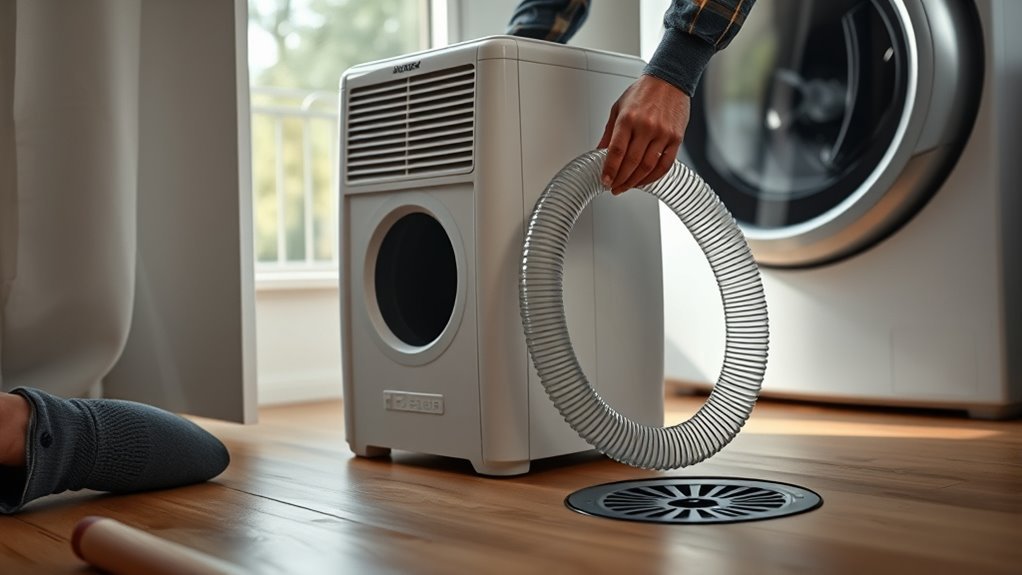
For daily or overnight use, connect a hose to the continuous gravity drain port. Make sure the hose slopes steadily downward without kinks or upward loops into a floor drain or sump pit. Since standard 22-pint units do not include an internal water pump, if your only drain is an elevated utility sink or basement window, you can place the dehumidifier on a sturdy counter or drain it into a small external automatic condensate pump.
Smart Control Features and Humidistats
Every quality 22-pint dehumidifier includes a built-in electronic humidistat that cycles the compressor on and off to maintain your target relative humidity. Wi-Fi app and voice controls are worth seeking out if the dehumidifier sits in an unfinished basement, vacation cabin, or rental property where you want full-tank notifications and remote adjustments. For a bedroom, bathroom, or living room you walk past every day, standard digital buttons and a 24-hour timer are simple and dependable.
Noise and Portability
Compressor-based 22-pint dehumidifiers typically run at roughly 46 to 52 decibels (dBA)—similar to a quiet refrigerator hum mixed with a box fan on low. For bedrooms and home offices, choose a model with multiple fan speeds so you can use high/turbo mode during the day and low mode overnight. Four swivel caster wheels, recessed side handles, and a cord wrap make it much easier to roll a 30- to 35-pound unit between your bathroom, laundry area, and bedroom.
Energy Efficiency and Operating Temperature
An Energy Star-certified 22-pint dehumidifier uses roughly 10% to 15% less electricity than a standard minimum-efficiency model, saving money over a humid four-month summer. Also check your room’s temperature: standard compressor dehumidifiers operate best above 65°F. In basements or garages that dip toward 60°F or lower, moisture on the cooling coils can freeze into frost, making an automatic defrost mode essential to protect the compressor.
22-Pint vs. Larger Capacity Models
A 22-pint dehumidifier offers a smaller footprint, lighter weight, lower wattage draw (usually around 200 to 280 watts under normal conditions), and quieter fan noise than a 35- or 50-pint machine. Stick with a 22-pint model for single rooms, apartments, and moderately damp basements. Step up to a 35- or 50-pint DOE unit only when dealing with large open floor plans over 1,500 sq. ft. or severe basement moisture, as a larger unit will reach your target humidity faster and cycle off instead of running continuously.
Humidity Tip
The US EPA and ENERGY STAR recommend keeping indoor relative humidity between 30% and 50%. For most homes in summer, setting your 22-pint dehumidifier to 45% or 50% RH stops mold growth, dust mites, and musty odors without overworking the compressor or driving up your electric bill.
Frequently Asked Questions
Is a 22 Pint Dehumidifier Enough for a Basement?
Yes, a 22-pint dehumidifier is enough for a small-to-medium basement (up to 1,000–1,500 sq. ft.) that is only moderately damp, especially when connected to a continuous gravity drain hose. If your basement has wet concrete walls, standing water seepage, or stays above 55% RH after hours of runtime, size up to a 35- or 50-pint model.
Why Is a Dehumidifier Rated at 22.27 Pints Instead of 22 Pints?
A 22.27-pint rating is the exact US liquid conversion of a 10.5-liter-per-day factory metric rating (10.5 liters equals 22.19 to 22.27 US pints depending on rounding). In real-world home use, 22-pint and 22.27-pint dehumidifiers belong to the exact same capacity class and perform identically.
How Is a 22-Pint Dehumidifier Different From an Older 30- or 35-Pint Model?
They are actually the same capacity class. In June 2019, the US Department of Energy lowered its testing temperature from 80°F to 65°F (at 60% relative humidity) to better reflect real basement conditions. Because cooler air holds less moisture, an older 30- to 35-pint dehumidifier is now rated at 20 to 22 pints under current DOE rules.
How Often Should a 22 Pint Dehumidifier Be Cleaned?
Clean the washable air filter every two to four weeks by rinsing it with warm water and letting it dry completely before reinstalling. If you use the removable water bucket instead of a drain hose, rinse and wipe the tank every one to two weeks with mild soap and water to prevent slimy biofilm and mold buildup.
Can a 22 Pint Dehumidifier Run Continuously Overnight?
Yes, a 22-pint dehumidifier can safely run overnight because all modern residential units include automatic full-bucket shutoff and thermal overload protection. Empty the bucket before bed—or attach a continuous gravity drain hose—keep at least 8 to 12 inches of clearance around the air vents, and close room doors and windows.
Does Humidity Level Affect Dehumidifier Performance?
Yes, both relative humidity and room temperature directly affect how fast water collects. A dehumidifier extracts water fastest in warm, humid air above 65°F and 60% RH. Set your humidistat between 45% and 50% RH so the compressor automatically cycles off once the room reaches a comfortable, mold-safe level.
Are 22 Pint Dehumidifiers Noisy in Bedrooms?
Most 22-pint compressor dehumidifiers produce 46 to 52 dBA of steady white noise, comparable to a box fan on low or a quiet window AC unit. For the best bedroom sleep experience, run the unit on high during the evening to drop humidity first, then switch it to low fan speed at bedtime and place it several feet from your bed.
What Maintenance Extends a Dehumidifier’s Lifespan?
Wash the intake filter monthly, vacuum dust off the internal condenser coils twice a year, keep 12 inches of airflow clearance around the cabinet, and wait at least three minutes before restarting the unit after unplugging it. Also avoid running a compressor dehumidifier in rooms colder than 41°F to 60°F, where heavy coil icing can strain the system.
Conclusion
Choosing the right 22-pint dehumidifier comes down to matching your room’s layout and drainage setup to the features you will actually use. Choose the BLACK+DECKER 22.27-Pint for dependable, straightforward everyday operation, the Midea 22-Pint Energy Star for quieter efficiency in bedrooms and living spaces, or the Keystone 22-Pint for simple Normal and Turbo moisture control in basements and utility rooms.
Before placing your order, verify the selected variant on Amazon—especially if you want Wi-Fi controls—and decide whether you will empty the bucket manually or hook up a continuous gravity drain hose for hands-free humidity protection.