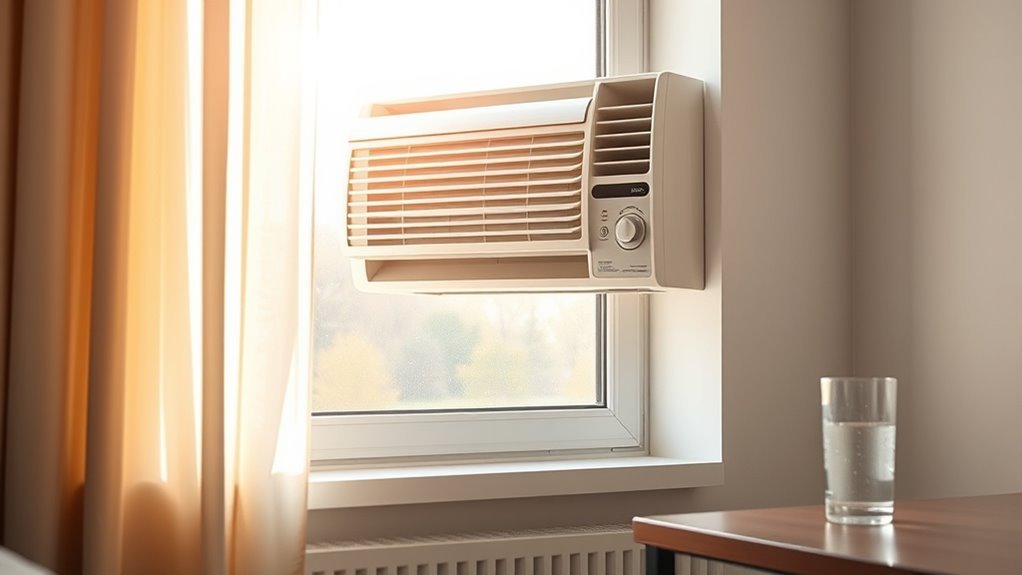
Yes, window air conditioners dehumidify the air while the evaporator coil is cold. Warm, humid room air passes over that cold coil, water vapor condenses into liquid, and the collected moisture moves into the unit’s base pan or drainage system. A window AC is still primarily a cooling appliance, not a dedicated humidity controller, so the result depends on unit size, runtime, controls, installation, airflow, and how much moisture is entering the room. A room can therefore feel cool but remain sticky.
Last updated: August 19, 2026 — EPA, ENERGY STAR, U.S. Department of Energy, GE Appliances, and LG guidance was rechecked for this update.
Quick Answer
Yes. A window air conditioner dehumidifies as warm, humid room air passes over a cold coil and water vapor condenses. It works only while the coil is cold, and capacity varies by model and conditions. Proper sizing, clean airflow, sealed gaps, and Dry mode can help.
Key Takeaways
- A window AC removes moisture only while its evaporator coil is cold enough to form condensation.
- An oversized unit may cool the room quickly and shut off before removing enough moisture.
- Dry mode may help, but temperature and fan controls vary by model, so check the owner’s manual.
- Aim for indoor relative humidity near 30% to 50% when practical and keep it below 60%.
- Persistent high humidity may require moisture-source repairs or a dedicated dehumidifier.
Why Your Window AC Feels Humid
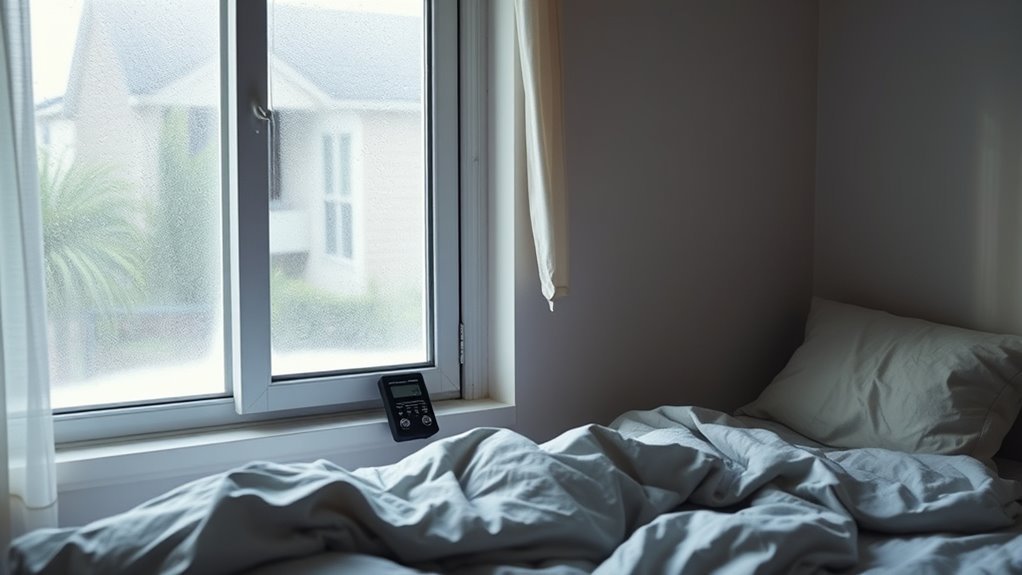
If your window AC leaves the room feeling humid, the unit may be lowering the temperature faster than it removes water vapor. This often happens when the air conditioner is too large for the room. It reaches the thermostat setting quickly, stops the compressor, and completes only a short moisture-removal cycle.
The room may also remain damp when humid outdoor air enters through gaps around the unit, open windows, or an open fresh-air vent. Cooking, showers, wet laundry, plumbing leaks, damp basements, and poor bathroom ventilation can add moisture faster than a small window unit can remove it.
Some models continue moving air after the compressor stops. If water remains on the warming evaporator coil, part of it may evaporate back into the room. This does not necessarily mean the appliance is broken, but it can reduce humidity control during light cooling conditions.
Quick Diagnosis: Why Is the Room Still Humid?
| What You Notice | Likely Explanation | First Test |
|---|---|---|
| Room gets cold quickly but stays clammy | The AC may be oversized or short-cycling | Compare the BTU rating with the room size and heat load |
| RH percentage rises as the room gets colder | Relative humidity changes with temperature | Compare readings at similar temperatures and watch the trend over several hours |
| Humidity remains high despite long runtime | Moist outdoor air, leaks, cooking, showers, laundry, or another moisture source may be overwhelming the unit | Close and seal the room, then control moisture sources |
| No water drips outside | The unit may be reusing condensate or the air may contain little moisture | Check the manual and look for indoor leakage rather than drilling the base pan |
| Water leaks into the room | Installation angle, drainage, blockage, or icing may be involved | Turn the unit off and check its model-specific installation instructions |
EPA guidance recommends keeping indoor relative humidity below 60% and ideally between 30% and 50% when practical. See the EPA’s mold and moisture guidance.
How Does a Window Air Conditioner Dehumidify?
A window air conditioner dehumidifies through condensation. The indoor fan pulls warm, moist air across a cold evaporator coil. When the coil cools the air below its dew point, some of the water vapor changes into liquid water.
- Humid room air enters the unit. The return grille and filter guide the air toward the evaporator coil.
- The cold coil removes heat and moisture. Water vapor condenses into droplets on the coil.
- Condensate moves into the base pan. Depending on the design, some water may drip outside while some remains in the pan.
- The outdoor fan may reuse the water. Many window units have a slinger ring that throws condensate onto the outdoor condenser coil to improve heat transfer.
- Cooler, drier air returns to the room. Moisture removal continues only while operating conditions keep the evaporator cold.
Because many models reuse condensate, the absence of a steady outdoor drip does not prove that the unit is failing to dehumidify. GE Appliances explains that base-pan water and slinger-ring sounds are normal in many room air conditioners. See its guidance on window AC condensate and water sounds.
Note: Do not drill a drain hole or remove a drain plug unless the owner’s manual specifically tells you to do so. Some units are designed to keep water in the base pan for efficient operation.
Best Window AC Settings for Humidity
There is no single setting that works best on every window air conditioner. Control behavior differs among mechanical, electronic, fixed-speed, and inverter models. Use the following settings as a practical starting point, then confirm the result with a hygrometer.
Recommended Products
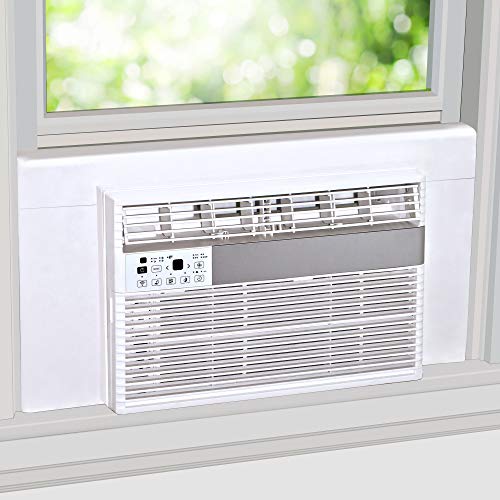
MATERIAL - 1’’ thick insulating foam covered in white flexible vinyl

Multi-Season Comfort - Midea 8000 BTU window air conditioner with heat is better than standard ac units. It will beat the heat in summer with powerful cooling and dehumidification and keep you warm through the fall with supplemental heat. Best for large rooms up to 350 square feet. NOTE: heat pump function works when outside temp> 41°F.
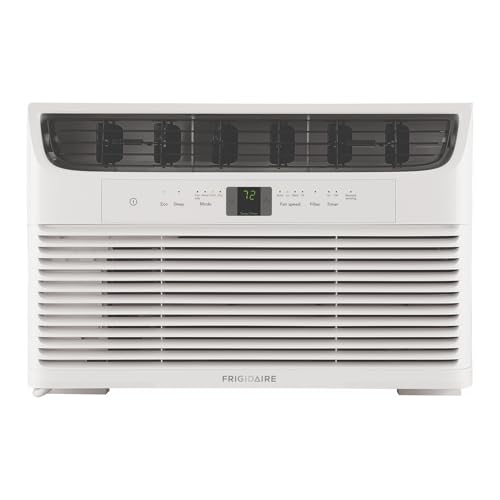
Customizable Cooling: Achieve optimal comfort with custom temperature settings, 6-way directional airflow, and three different fan speeds
Use Dry Mode When the Unit Supports It
Dry mode is intended to reduce moisture while providing some cooling. On certain models, the unit automatically selects the temperature, compressor cycle, or fan speed. On others, you can adjust one or more of those settings. Follow the instructions for your exact model rather than forcing a universal fan setting.
LG’s window-air-conditioner guidance, for example, describes dehumidification operation with weak airflow on some models, while other models manage settings differently. See the manufacturer’s window AC dehumidification instructions.
Use a Sensible Cooling Setpoint
A setting around 75°F to 78°F can be a reasonable starting range, depending on the model and your comfort. Raising the thermostat does not make the compressor run longer; a higher setpoint normally reduces cooling runtime. If the room remains humid because the compressor barely operates, try Dry mode or lower the cooling setpoint by a small amount while watching both temperature and humidity.
Avoid lowering the thermostat until the room becomes uncomfortably cold. If the only way to control humidity is excessive overcooling, a dedicated dehumidifier or a moisture-source repair is usually the better solution.
Choose Fan Speed Carefully
ENERGY STAR advises using a lower fan speed on humid days because slower air movement can improve moisture removal. However, the correct choice still depends on the unit. Low airflow can contribute to icing when the filter is dirty, the coil is blocked, or operating conditions are outside the model’s recommended range. See the ENERGY STAR room air conditioner guidance.
If the unit controls fan speed automatically in Dry mode, leave it on the programmed setting. If humidity rises after the compressor stops, test Auto or another manufacturer-approved fan setting and compare the hygrometer readings.
Test Eco Mode Instead of Assuming It Helps
Eco or Energy Saver mode often reduces compressor and fan operation after the room reaches its temperature setting. That may save electricity, but shorter cooling cycles can reduce moisture removal. If the room stays clammy, compare Eco mode with normal Cool or Dry mode for several hours under similar conditions.
Pro Tip: Judge each setting with a separate hygrometer placed away from the cold-air outlet. The percentage shown immediately beside the AC may not represent the humidity across the room.
How to Measure Indoor Humidity
Use a digital hygrometer to measure relative humidity instead of relying only on how the room feels. Place it away from the AC discharge, direct sunlight, exterior walls, bathrooms, cooking appliances, and other local moisture sources.
Track the reading over several hours because relative humidity changes as the room temperature and compressor cycle change. A brief spike after the compressor stops is less concerning than humidity that remains near or above 60% for long periods.
Why Can Humidity Rise After the AC Cools the Room?
Relative humidity is temperature-dependent. Cooler air can show a higher RH percentage even when the actual amount of water vapor in the room has not increased. That means a hygrometer can show a higher percentage after the AC lowers the temperature even though the unit removed some moisture. Compare RH readings at similar room temperatures when possible. If your meter also shows dew point, that can help you track changes in the room’s actual moisture load. NOAA explains the temperature relationship in its guide to relative humidity and water vapor.
- 30% to 50% RH: The general indoor target recommended by the EPA.
- 50% to 60% RH: Monitor conditions and look for condensation, musty odors, or damp surfaces.
- Above 60% RH: Investigate moisture sources and use a more deliberate dehumidification strategy.
For additional guidance, see the EPA’s Care for Your Air guide.
Why a Window AC Won’t Lower Humidity
Even with reasonable settings, a window unit may struggle because its primary job is temperature control. Work through the following causes before assuming that the appliance needs replacement.
1. The Unit Is Oversized
An oversized air conditioner cools the room quickly and shuts off before completing a long moisture-removal cycle. The U.S. Department of Energy warns that oversized room air conditioners can produce poor humidity removal because of excessive on-and-off cycling.
Variable-speed or inverter room air conditioners operate differently from conventional on/off models. ENERGY STAR notes that variable-speed compressors can adjust their output instead of operating only at full capacity or off. This can reduce simple on-and-off cycling, although actual humidity control still depends on the model, controls, room load, and operating conditions.
The following ENERGY STAR sizing ranges provide a starting point for rooms with approximately eight-foot ceilings:
| Room Area | Suggested Cooling Capacity |
|---|---|
| 100–150 sq. ft. | 5,000 BTU/h |
| 150–250 sq. ft. | 6,000 BTU/h |
| 250–300 sq. ft. | 7,000 BTU/h |
| 300–350 sq. ft. | 8,000 BTU/h |
| 350–400 sq. ft. | 9,000 BTU/h |
| 400–450 sq. ft. | 10,000 BTU/h |
| 450–550 sq. ft. | 12,000 BTU/h |
| 550–700 sq. ft. | 14,000 BTU/h |
Sun exposure, ceiling height, kitchen use, insulation, room shape, and occupancy can change the required capacity. Consult the complete ENERGY STAR room air conditioner sizing guide before replacing the unit.
2. Humid Air Keeps Entering the Room
Check the expandable side panels, foam seals, sash gap, and wall opening around the appliance. ENERGY STAR notes that an improperly installed room air conditioner can leak as much air as a six-square-inch hole, increasing energy use and reducing comfort. Close the unit’s outside-air vent during normal cooling unless ventilation is specifically needed. Also close nearby windows and exterior doors while testing humidity performance.
3. The Room Produces Too Much Moisture
Use bathroom and kitchen exhaust fans that vent outdoors. Avoid drying wet clothes in the room. Repair plumbing, roof, wall, or foundation leaks. A window AC cannot solve a continuing water-intrusion problem.
4. The Filter or Coil Has Restricted Airflow
A dirty filter reduces airflow and may contribute to weak cooling or coil icing. Remove and clean the reusable filter according to the owner’s manual. Maintenance intervals vary by model. For example, LG recommends about every two weeks on many window and portable air conditioners, while GE commonly specifies about every 30 days for room air conditioners.
Do not scrape ice from the evaporator coil. Turn the unit off, allow it to thaw, clean the filter, and confirm that the indoor and outdoor grilles are unobstructed. Repeated icing may require professional service.
5. The Installation or Drainage Is Incorrect
Water leaking into the room may indicate an installation-angle or drainage problem. Window units may need to be level or tilted slightly toward the outdoors depending on the manufacturer’s installation instructions. Follow the instructions for the exact model rather than using a universal tilt angle.
Do not assume that standing water in the rear base pan is a defect. Many models intentionally use that water to improve condenser performance.
Warning: Unplug the air conditioner before cleaning or inspecting accessible parts. Do not remove electrical covers, puncture refrigerant lines, drill the base pan, or alter the installation hardware. Use the model-specific manual or a qualified technician for repairs.
How to Lower Humidity With a Window AC
- Measure the room’s RH. Use a hygrometer placed away from the AC outlet.
- Close the room. Shut exterior windows and doors while the unit operates.
- Seal the installation gaps. Inspect side panels, foam strips, and the window sash.
- Select Dry mode. Use it when the model includes it and outdoor conditions allow normal compressor operation.
- Test normal Cool mode. If Dry mode is unavailable, use a comfortable setpoint and a manufacturer-approved fan speed.
- Clean the filter. Restore airflow before changing several settings at once.
- Control moisture sources. Vent showers and cooking, stop indoor clothes drying, and repair leaks.
- Check the unit’s size. Compare its BTU rating with the room area and heat load.
- Monitor the result. Record temperature and RH for several hours and compare readings at similar temperatures.
- Add dedicated dehumidification when needed. Use a properly sized dehumidifier if RH remains near or above 60% despite correcting the causes above.
Recommended Products

Semiconductor dehumidifiers use thermoelectric cooling to remove moisture from the air. They create a drier, more comfortable environment by reducing humidity and improving air quality.

High Efficient Dehumidifiers for Home: This compact 44oz dehumidifier efficiently removes excess moisture in rooms with 86°F and 80% RH, collecting up to 11.8oz (349ml) of water in 24 hours. It maintains an ideal humidity level of 45%-55% while operating at ultra-low energy consumption (24W/hour, 576W/day). Perfect for bedrooms, bathrooms, and small spaces.

🍃Advanced Small Dehumidifier for Home: Designed for lasting home use, our bathroom dehumidifier works gently and steadily to maintain a balanced humidity level. The large 44 OZ (1.3L) water tank minimizes emptying frequency. Suitable for dorm room, camper, apartment, room, office and living room. No more dampness-just fresh, comfortable air everywhere
Window AC vs. Dehumidifier for Damp Rooms
A window AC and a dehumidifier both condense water from indoor air, but they are designed for different jobs. Choose based on whether the room primarily needs cooling, humidity control, or both.
| Feature | Window Air Conditioner | Dedicated Dehumidifier |
|---|---|---|
| Primary job | Cool the room | Control relative humidity |
| When moisture is removed | While the evaporator is cold during cooling or Dry operation | Whenever the humidistat calls for dehumidification |
| Capacity description | Varies by model and operating conditions | Rated in pints removed per 24 hours under specified test conditions |
| Effect on room temperature | Lowers room temperature | Usually warms the surrounding space slightly |
| Best use | Hot rooms with a moderate moisture load | Persistent dampness, basements, or mild weather when cooling is unnecessary |
Do not compare the appliances with a universal pints-per-hour number. ENERGY STAR explains that dehumidifier capacity is measured in pints removed during 24 hours under test conditions. Actual household performance changes with room temperature, starting humidity, airflow, and moisture entering the space.
Recommended Products

Effortless Cooling: Achieve optimal comfort with customizable temperature settings and two fan speeds; Effortless Temperature Control helps to maintain your preset temperatures for consistent comfort

3 IN 1 COMFORT - The Midea EasyCool Window Air Conditioner unit has three modes to help your house, apartment, office, or room be as comfortable as possible. It can cool a space up to 150 sq. ft. quickly, circulate air with its 3-speed fan, or reduce humidity utilizing the dehumidifier mode.Controller type:Remote Control.
3 IN 1 COMFORT - The Midea EasyCool Window Air Conditioner unit has three modes to help your house, apartment, office, or room be as comfortable as possible. It can cool a space up to 250 sq. ft. quickly, circulate air with its 3-speed fan, or reduce humidity utilizing the dehumidifier mode.Controller type:Remote Control.Air Flow efficiency:168.82 CFM.Core material : Copper..Frequency : 60 hz
Related Guides
Frequently Asked Questions
Can You Use a Window Air Conditioner as a Dehumidifier?
You can use it for limited moisture removal when the room also needs cooling. It will not control humidity as consistently as a dedicated dehumidifier because the compressor responds mainly to temperature. Use Dry mode when available, size the unit correctly, seal the window, and verify the result with a hygrometer.
What Is the Three-Minute Rule for Air Conditioners?
Many air conditioners delay compressor operation for about three minutes after the appliance is stopped and restarted. This protection allows refrigerant pressure to stabilize and reduces compressor stress. It does not mean you must wait three minutes before making a normal temperature adjustment. Avoid repeatedly switching the unit off and on.
What Causes 80% Humidity in a House?
An 80% reading can result from humid outdoor air, open windows, shower steam, cooking, indoor clothes drying, plumbing or roof leaks, wet basements, poor exhaust ventilation, flooding, or an inaccurate humidity sensor. Confirm the reading with a second hygrometer and inspect for visible water, condensation, and musty odors.
Why Is My Window AC Not Dripping Water Outside?
The air may not contain much moisture, the compressor may not have run long, or the unit may be reusing condensate in its base pan. Many models use a slinger ring to throw water over the outdoor coil, so a constant outdoor drip is not required. Check for indoor leaks or installation problems instead of drilling a drain hole.
Should the Window AC Fan Run Continuously?
It depends on the model and selected mode. Continuous airflow may improve temperature mixing, but airflow over a warming wet coil can return some moisture to the room after the compressor stops. Compare Auto, Cool, Dry, and Energy Saver settings using the manual and a hygrometer rather than assuming one fan pattern is always best.
Sources
- U.S. Environmental Protection Agency: Care for Your Air — indoor humidity and moisture-control guidance.
- U.S. Environmental Protection Agency: A Brief Guide to Mold, Moisture and Your Home — below-60% RH guidance and the ideal 30% to 50% range.
- ENERGY STAR: Room Air Conditioners — room sizing, oversizing, installation, variable-speed operation, and humid-weather fan guidance.
- U.S. Department of Energy: Purchasing Energy-Efficient Room Air Conditioners — oversizing, cycling, efficiency, and humidity removal.
- ENERGY STAR: Dehumidifier Testing and Capacity — pints-per-day capacity ratings and test conditions.
- GE Appliances: Air Conditioner Water Sounds — condensate collection and slinger-ring operation.
- LG Support: Window Air Conditioner Dehumidification — Dry/dehumidification mode behavior on supported window models.
- LG Support: Compressor Operation Delay — explanation of the three-minute restart delay.
- LG Support: Window/Portable AC Filter Cleaning — example two-week filter-cleaning guidance.
- GE Appliances: Room Air Conditioner Filter Cleaning — example 30-day filter-cleaning guidance.
- NOAA: What Is Humidity? — explanation of relative humidity and its relationship with air temperature.
Conclusion
A window AC does remove moisture from the air, but only when its evaporator is cold and the compressor runs long enough. Proper BTU sizing, clean airflow, sealed window gaps, controlled moisture sources, and the correct operating mode can improve the result.
Use a hygrometer instead of guessing, and remember that RH can change simply because the room temperature changes. If the room remains near or above 60% RH after basic troubleshooting, look for leaks or ventilation problems and consider a properly sized dedicated dehumidifier. The goal is not to make the room as cold as possible. It is to control both temperature and moisture.