Affiliate disclosure: As an Amazon Associate, we may earn from qualifying purchases made through links in this article, at no extra cost to you. Product specifications and availability can change, so confirm the current listing before ordering.
A dehumidifier can help when a baby’s room stays damp, develops condensation, or regularly measures above the recommended indoor humidity range. The best dehumidifier for a baby’s room should be quiet, easy to clean, stable on a flat surface, and appropriately sized for the actual moisture problem. For most nurseries, start with a separate hygrometer and aim for about 30% to 50% relative humidity rather than running a dehumidifier continuously without measuring.
Quick verdict: The BREEZOME 60 OZ is the strongest all-around compact pick because it combines a larger tank, timer, sleep mode, and higher claimed moisture removal than most mini units. The Pure Enrichment PureDry Mini is the better choice for a very small nursery when brand support and a five-year warranty matter most. The CLEVAST 30 OZ is the quietest stated option in this guide.
Important limitation: These are thermoelectric mini dehumidifiers. Their advertised extraction rates are generally measured in warm, very humid test conditions, so real-world performance may be much lower in a cool or only moderately humid bedroom.
Nursery safety note: Keep the appliance and cord completely out of the crib area and out of a child’s reach. Place it on a stable, level surface with clear airflow, keep water away from outlets, empty and clean the tank regularly, and do not use the unit to cover up a leak or visible mold problem.
A dehumidifier is not a medical treatment. Speak with your child’s healthcare professional if you have concerns about breathing, allergies, or persistent respiratory symptoms.
Quick Comparison
| Product | Best For | Tank | Claimed Maximum Extraction* | Key Feature | Amazon |
|---|---|---|---|---|---|
| BREEZOME 60 OZ | Best overall compact option | 60 oz / 1.8 L | Up to 700 ml/day | Timer and sleep mode | Check Amazon |
| Pure Enrichment PureDry Mini | Very small nurseries | 27 oz / 0.8 L | About 300 ml/day | Five-year warranty | Check Amazon |
| CLEVAST 30 OZ | Low-noise operation | 30 oz | Up to 295 ml/day | Stated 24 dB operation | Check Amazon |
| Deyagoo DY501 | Simple one-button use | 50 oz / 1.5 L | Up to 300 ml/day | Auto shut-off | Check Amazon |
| AlohaAir 34 OZ | Compact rooms and easy monitoring | 34 oz / 1 L | Up to 280 ml/day | Transparent tank | Check Amazon |
| TABYIK 38 OZ | Energy-conscious buyers | 38 oz | Up to 11 oz/day | 40-watt power rating | Check Amazon |
| KeepGlad 98 OZ | Larger tank and drain option | 98 oz | Up to 40 oz/day | Humidity display and drain hose | Check Amazon |
*Maximum extraction figures are manufacturer claims measured under favorable temperature and humidity conditions. They are not guaranteed daily results in a typical nursery.
BREEZOME 60 OZ Quiet Portable Dehumidifier with Timer
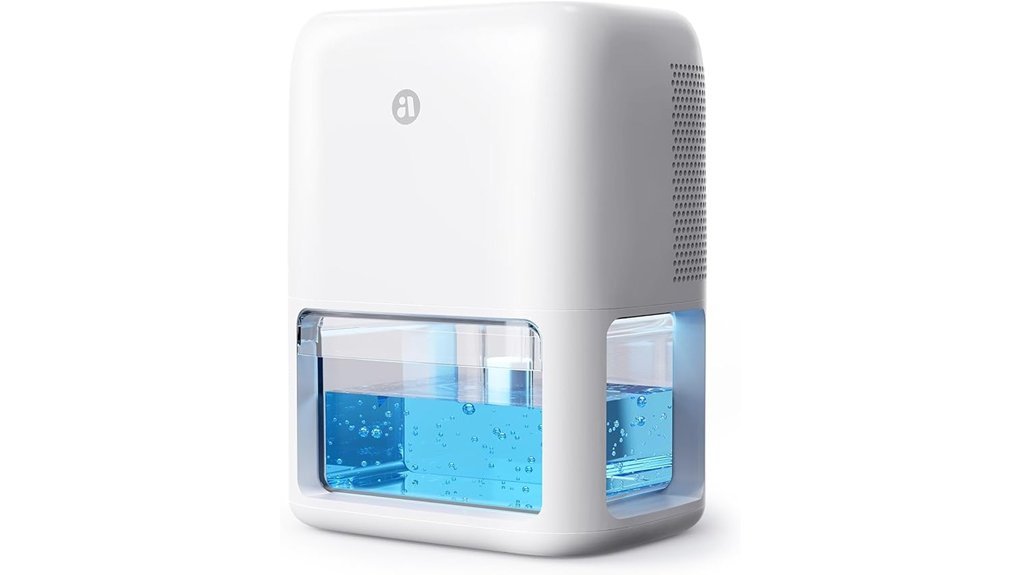
Best Overall Compact Pick. The BREEZOME 60 OZ is the most balanced option in this guide for a small nursery with mild to moderate excess humidity. Its dual-semiconductor design is advertised to remove up to 700 ml of moisture per day under favorable test conditions, while the 1.8-liter tank reduces how often you need to empty it.
Why you’ll like it: The timer, sleep mode, auto shut-off, and optional light make it easier to adapt the unit to a bedtime routine. The stated 35 dB operating level is quiet for a compact dehumidifier, although any fan noise should still be considered if your baby is a light sleeper.
Who should buy this: Parents who want a larger mini-dehumidifier tank and more controls than a basic one-button model.
Who should avoid this: Anyone dealing with a leak, visible mold, or persistent room humidity above 60%. A mini thermoelectric unit may not have enough capacity for that job.
Pros:
- Large 60 oz tank for a compact model.
- Timer, sleep mode, auto shut-off, and optional night light.
- Higher claimed extraction rate than most mini units in this comparison.
Cons:
- Real-world extraction can be much lower than the laboratory-style maximum.
- The colored light may be distracting; confirm from the current controls whether it can be fully disabled.
- It does not replace a full-size compressor dehumidifier for severe dampness.
Pure Enrichment PureDry Mini Dehumidifier 27oz
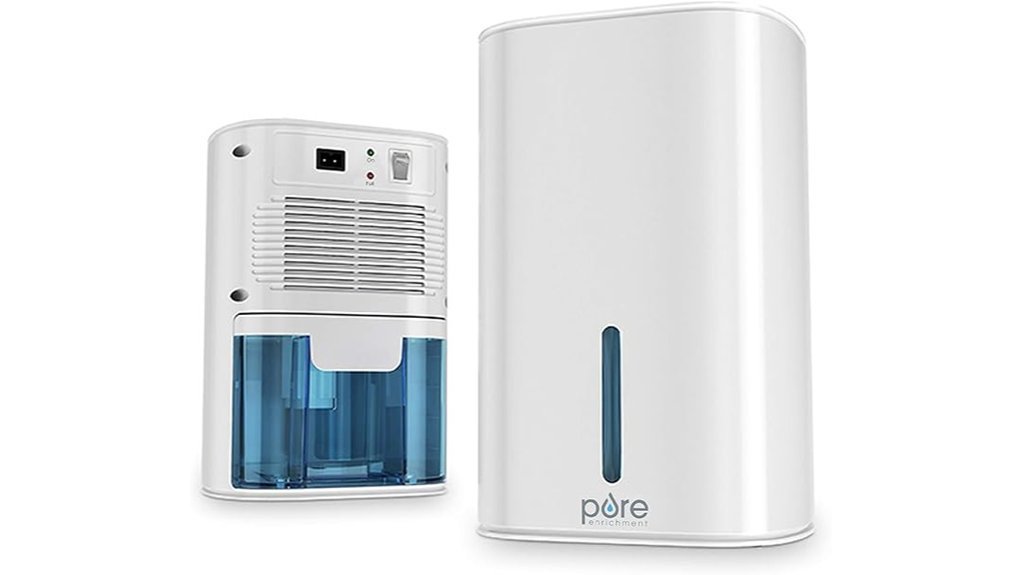
Best for a Very Small Nursery. The Pure Enrichment PureDry Mini has a 27 oz transparent tank and is designed for spaces up to 110 square feet. The manufacturer states that it can remove about 10 oz (300 ml) of moisture per day at 86°F and 80% relative humidity, so expect less collection in cooler or drier conditions.
Why you’ll like it: It has simple controls, automatic shut-off, a visible water tank, and a five-year manufacturer warranty. Those features make it a practical choice for buyers who prefer straightforward operation and established support.
Who should buy this: Parents with a genuinely small room and a mild humidity problem confirmed by a hygrometer.
Who should avoid this: Buyers who need adjustable target humidity, a digital display, or enough capacity for a larger bedroom.
Pros:
- Transparent tank makes the water level easy to check.
- Automatic shut-off helps prevent overflow.
- Backed by a five-year manufacturer warranty.
Cons:
- Limited to very small spaces and light moisture control.
- No built-in humidistat or target-humidity setting.
- Performance depends heavily on room temperature and relative humidity.
CLEVAST Small Quiet Mini Dehumidifier for Home
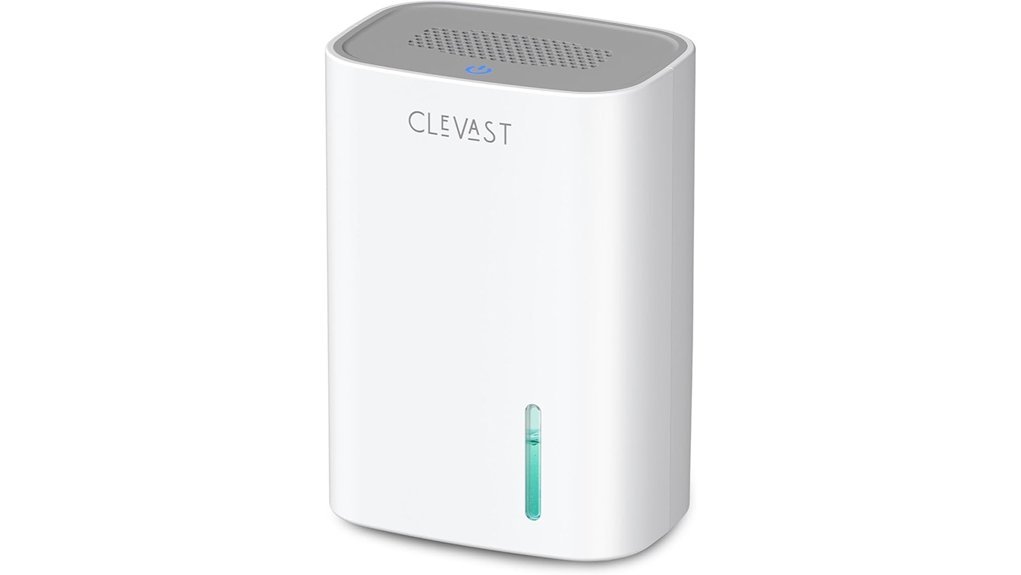
Best Stated Noise Level. The CLEVAST Small Quiet Mini Dehumidifier uses a 30 oz tank and has a stated operating level of 24 dB. Its maximum collection claim is about 10 oz (295 ml) per day in a closed room at 86°F and 85% relative humidity.
Why you’ll like it: The simple one-button design, rear handle, automatic shut-off, and low stated energy use make it easy to place and operate in a small room. Its compact footprint is useful when nursery floor space is limited.
Who should buy this: Buyers who prioritize low stated noise and uncomplicated controls over advanced humidity settings.
Who should avoid this: Anyone who needs a built-in humidity display or automatic control to a chosen RH level.
Pros:
- Lowest stated noise level among the retained models.
- Compact, portable design with auto shut-off.
- Low stated daily energy consumption.
Cons:
- No built-in humidistat or digital humidity display.
- Maximum extraction is based on unusually warm, humid conditions.
- Not designed for serious moisture intrusion.
Deyagoo DY501 1500ML Dehumidifier
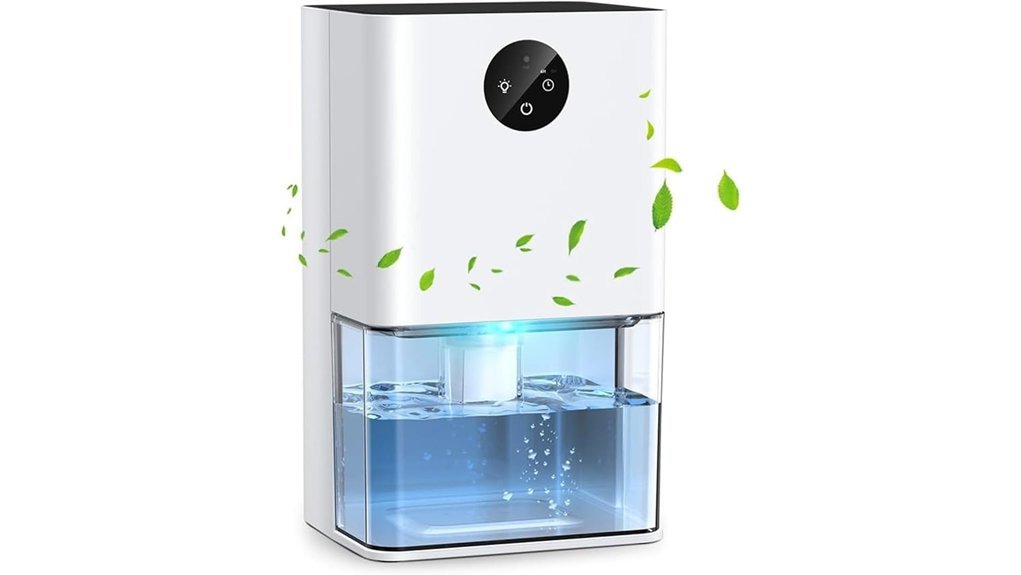
Best Simple Large-Tank Mini Pick. The Deyagoo DY501 combines a 1,500 ml (50 oz) tank with a claimed maximum extraction rate of about 300 ml per day. It is marketed for rooms up to 300 square feet, but that coverage number should be treated as a placement estimate rather than proof that it can control high humidity throughout a room of that size.
Why you’ll like it: Its one-button operation, transparent tank, and automatic shut-off make daily use uncomplicated. The stated 30 dB sound level may suit a bedroom, but placement and room acoustics will affect how noticeable it is.
Who should buy this: Parents who want a basic mini dehumidifier with a larger tank and no complicated controls.
Who should avoid this: Buyers who need a target-humidity setting, continuous drainage, or high-capacity moisture removal.
Pros:
- Large 1,500 ml tank compared with many mini models.
- Automatic shut-off when the tank is full.
- Simple controls and compact format.
Cons:
- No built-in humidistat for precise humidity control.
- Advertised room coverage may overstate practical performance.
- Extraction rate varies with temperature and humidity.
AlohaAir 34 oz Quiet Dehumidifier with Night Light
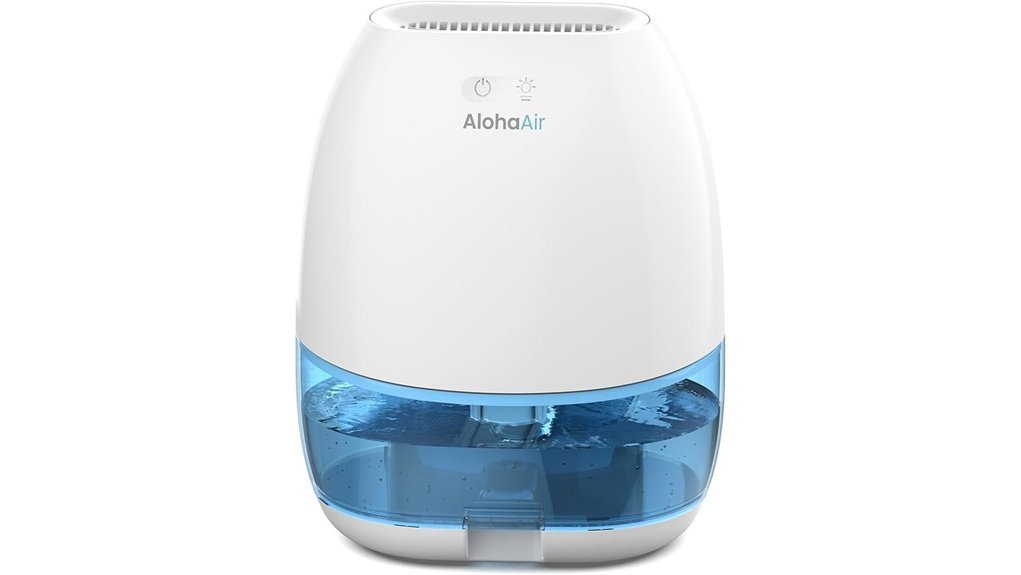
Best for Easy Water-Level Monitoring. The AlohaAir DH001 uses a 34 oz (1,000 ml) transparent tank and is advertised to collect up to 280 ml of water per day. Its small footprint is a better match for localized moisture control than for a large or persistently damp room.
Why you’ll like it: The visible tank, automatic shut-off, optional seven-color light, and stated 35 dB operation make it easy to use in a compact bedroom. Parents who prefer a completely dark nursery should confirm from the current listing or manual that the light can be fully disabled.
Who should buy this: Buyers who want a compact unit with a clearly visible tank and an optional night-light feature.
Who should avoid this: Anyone who needs stronger extraction, a timer, or target-humidity control.
Pros:
- Transparent 34 oz tank is easy to monitor.
- Automatic shut-off helps prevent overflow.
- Includes an ambient-light feature for buyers who want one.
Cons:
- Limited moisture-removal capacity.
- No digital humidity reading or adjustable RH target.
- May require frequent emptying in very humid conditions.
TABYIK 38OZ Quiet Energy-Saving Dehumidifier
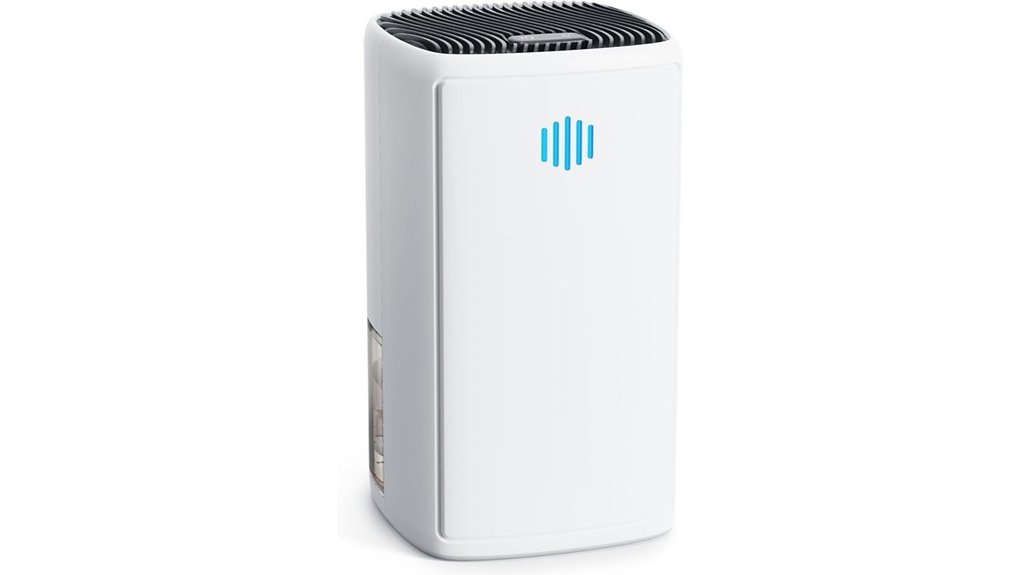
Best Low-Wattage Pick. The TABYIK 38OZ is a compact 40-watt thermoelectric model with a claimed maximum collection rate of 11 oz per day at 86°F and 80% relative humidity. The brand markets it for spaces up to 280 square feet, but its extraction capacity is more useful for mild, localized dampness than for controlling a seriously humid room.
Why you’ll like it: It combines a 38 oz tank, automatic shut-off, and stated operation below 30 dB in a lightweight body. It is a straightforward choice when low power draw matters more than advanced controls.
Who should buy this: Parents who want a quiet, low-wattage mini unit for a small nursery with modest moisture.
Who should avoid this: Buyers who need a humidistat, timer, drain hose, or faster moisture removal.
Pros:
- 40-watt rated power consumption.
- Stated operation below 30 dB.
- Automatic shut-off when the tank is full.
Cons:
- No adjustable humidity target.
- Limited extraction for persistent dampness.
- Advertised room size should not be treated as guaranteed performance.
KeepGlad 98OZ Dehumidifier for Home
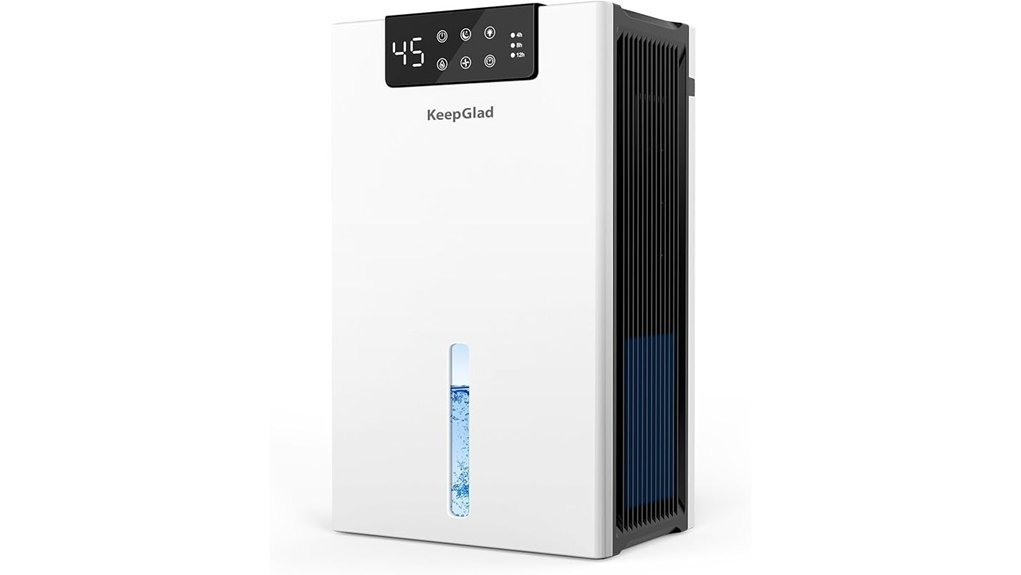
Best Larger-Tank Feature Set. The KeepGlad 98OZ offers the largest tank in this comparison, along with a humidity display, timer, washable filter, automatic shut-off, and drain-hose option. Its claimed maximum extraction is up to 40 oz per day under favorable conditions.
Why you’ll like it: The display helps you see a humidity reading without buying a separate gauge, and the drain option can reduce tank-emptying chores when a safe drainage route is available. For a nursery, place any drain hose and power cord where a child cannot access or pull them.
Who should buy this: Buyers who want a larger tank and more convenience features than a basic mini model.
Who should avoid this: Parents who need a compact tabletop unit or who cannot safely route the cord and optional hose away from the crib and walking area.
Pros:
- Large 98 oz tank with optional continuous drainage.
- Humidity display, timer, and washable filter.
- Automatic shut-off for tank operation.
Cons:
- Advertised 1,000-square-foot coverage is a marketing figure and should not be treated as equivalent to a pint-rated compressor model.
- Larger footprint and more cords or hoses require careful nursery placement.
- Maximum extraction depends on warm, humid test conditions.
Factors to Consider When Choosing a Dehumidifier for a Baby’s Room
The right choice depends on the room’s measured humidity, temperature, size, and moisture source. A quiet machine is helpful, but accurate humidity control and safe placement matter more than a large advertised coverage number.
1. Measure Humidity First
Use a separate hygrometer before buying or running a dehumidifier. The U.S. Environmental Protection Agency generally recommends keeping indoor relative humidity around 30% to 50%. If the room is already within that range, a dehumidifier may be unnecessary. Avoid pushing humidity below 30%, which can make the air uncomfortably dry.
2. Match Capacity to the Moisture Problem
Mini thermoelectric dehumidifiers are best for light condensation and small enclosed rooms. They are not equivalent to full-size compressor models rated in pints per day. If humidity stays above 60%, water is entering the room, or mold is visible, correct the moisture source and consider professional guidance or a properly sized compressor dehumidifier.
3. Read Extraction Claims Carefully
Many mini units publish maximum collection rates measured around 86°F with 80% to 85% relative humidity. A nursery is usually cooler and less humid, so daily water collection may be much lower. Compare the extraction rate and test conditions, not only the tank size or advertised square footage.
4. Check Noise, Lights, and Sleep Modes
Look for a stated noise level around 35 dB or lower, but remember that manufacturer measurements may not match your room. Choose a model with lights that can be turned off, and avoid placing the unit close enough to the crib that fan noise, indicator lights, or warm exhaust disturb sleep.
5. Plan Safe Placement
Use a stable, level surface where the air inlet and outlet remain clear. Keep the unit, cord, tank, and any drain hose completely outside the crib area and beyond a child’s reach. Do not use an extension cord unless the manufacturer specifically permits it, and never place the appliance where spilled water could reach an electrical outlet.
6. Prioritize Easy Maintenance
Choose a tank that is easy to remove, carry, and clean. Empty standing water promptly, wipe the tank regularly, and follow the manufacturer’s cleaning instructions. A washable filter can reduce replacement costs, but it still requires routine cleaning to maintain airflow.
7. Avoid Unnecessary Ionizing Features
For a nursery, a straightforward moisture-control appliance is the safer and simpler choice. Avoid products that market negative-ion or ozone-style air treatment unless their emissions and suitability for occupied child spaces are independently verified.
Before You Buy Checklist
- Measure the room’s RH for several days with a hygrometer.
- Confirm whether the problem is humidity, a leak, poor ventilation, or condensation.
- Check that the product’s lights can be turned off.
- Confirm a safe location away from the crib, changing table, and walking path.
- Compare extraction rate and test conditions, not just advertised square footage.
- Choose a tank size you can empty and clean comfortably.
- Recheck room humidity after the unit starts running to prevent over-drying.
Frequently Asked Questions
How Do I Know if My Baby’s Room Needs a Dehumidifier?
Use a hygrometer. A dehumidifier may help if the room repeatedly stays above 50% to 60% RH, shows condensation, or smells musty. Fix leaks, wet materials, and ventilation problems first rather than relying on the appliance alone.
What Size Dehumidifier Is Best for a Baby Room?
There is no single correct pint size for every nursery. A small thermoelectric model may be enough for mild humidity in a compact room, while persistent high humidity may require a properly sized compressor unit. Base the decision on measured RH, room temperature, square footage, and the severity of the moisture problem.
Are Dehumidifiers Safe to Use Around Infants?
They can be used safely when the appliance is in good condition, placed on a stable surface, kept well away from the crib, and operated according to the manual. Keep cords and tanks out of reach, maintain clear airflow, and monitor RH so the room does not become too dry.
How Often Should I Empty the Dehumidifier’s Water Tank?
Empty it whenever the tank is full and check it at least daily during the first week of use. The actual schedule depends on room humidity and the unit’s capacity. Do not leave collected water standing longer than necessary, and clean the tank regularly.
Can a Dehumidifier Help Reduce Allergens in a Baby’s Room?
Maintaining appropriate humidity can make the room less favorable for mold and dust mites, but a dehumidifier does not remove all allergens and is not a substitute for cleaning, leak repair, ventilation, or medical care.
Should a Dehumidifier Run All Night in a Nursery?
Only when needed and when the model is suitable for unattended operation under its manual. Use a hygrometer or built-in humidistat, keep the unit safely positioned, and stop or adjust operation once the room reaches the target range.
Conclusion
Final recommendation: Choose the BREEZOME 60 OZ when you want the best balance of compact size, tank capacity, timer controls, and claimed extraction. Choose the Pure Enrichment PureDry Mini for a very small room and stronger warranty support, or the CLEVAST 30 OZ when the lowest stated noise level is your main priority.
Whichever model you select, measure humidity first, keep the unit and cord away from the crib, and treat persistent dampness as a moisture-source problem rather than an appliance-only problem.