Affiliate disclosure: As an Amazon Associate, we earn from qualifying purchases.
Last updated: August 1, 2026
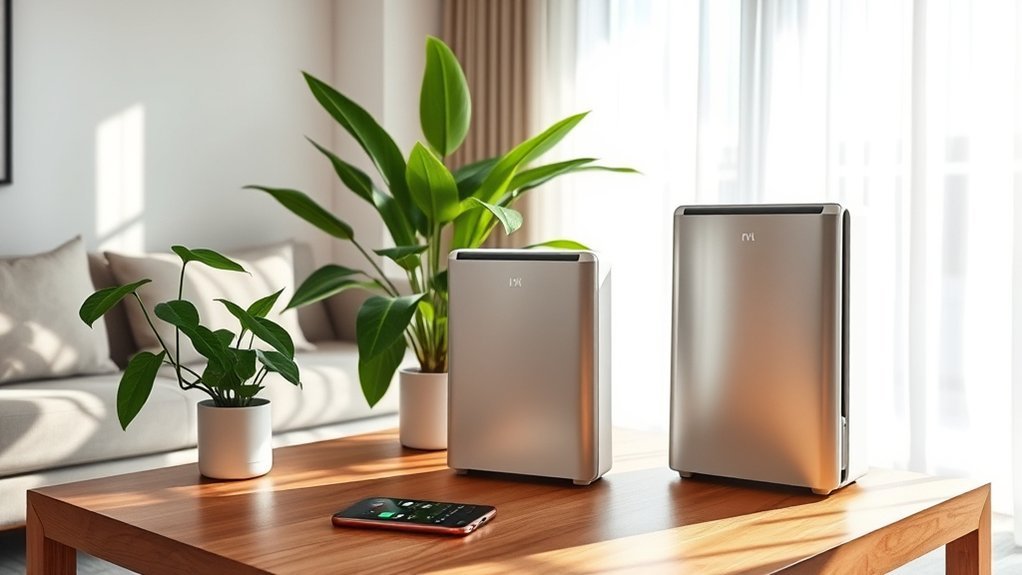
Choosing a quiet portable dehumidifier starts with matching the technology to the moisture problem. Compact Peltier models are easy to carry and generally better suited to bedrooms, bathrooms, closets, offices, boats, and RVs with mild humidity. Compressor models remove much more water and are the better choice for basements, laundry rooms, and persistent dampness, but they are larger and produce more fan and compressor noise.
This 2026 guide compares six relevant options by listed noise, moisture-removal method, tank size, drainage, portability, and realistic use case. Manufacturer coverage figures are not directly comparable, so use them only as a starting point and pay closer attention to water-removal capacity, room temperature, and the severity of the humidity problem.
Selection note: These picks were evaluated from current product listings, available manuals, specifications, and buyer-use fit. This article does not claim hands-on testing.
Quick Verdict
The TABYIK 35 OZ Dehumidifier is the most balanced pick for quiet bedroom use. Choose the Levoair Mini Dehumidifier when continuous drainage is a priority, the NineSky CT2 when you want a larger tank without moving to a compressor, and the Waykar 120-Pint for a basement or other persistently damp large space.
Key Takeaways
- Pick a Peltier model for quiet, small-space moisture control—not for flood cleanup or a wet basement.
- Compare daily water removal and operating conditions, not room-size claims alone.
- A drain hose is more useful than a large tank when the unit will run for long periods.
- For severe dampness, choose a compressor dehumidifier with a humidistat and continuous drainage.
Quick Comparison of Quiet Portable Dehumidifiers
| Product | Best For | Listed Noise | Water Handling | Type | Amazon |
|---|---|---|---|---|---|
| TABYIK 35 OZ | Quiet nighttime use | 28 dB | 35 oz tank | Peltier | Check Details |
| Deyagoo DY501 | Small bedrooms, closets, and RVs | 30 dB | 1.5 L tank | Peltier | Check Details |
| Pro Breeze PB-03-US | Bathrooms, offices, and caravans | No exact dB listed | 52 oz tank | Peltier | Check Details |
| Levoair Mini | RVs and continuous drainage | Up to 40 dB listed | 2 L tank plus hose | Semiconductor | Check Details |
| NineSky CT2 | Larger tank and simple controls | Quiet mode; no exact dB listed | 95 oz tank | Semiconductor | Check Details |
| Waykar 120-Pint | Basements and large damp rooms | 40 dB on low; higher at max | Tank plus drain hose | Compressor | Check Details |
How to Read This Table
The mini models are designed for mild humidity in enclosed spaces. The Waykar is a different class of machine: it is a movable floor appliance with compressor-level capacity for larger moisture loads. Do not treat advertised square footage as an equal-performance measurement across these two categories.
TABYIK 35 OZ Dehumidifier for Bedrooms and Small Spaces
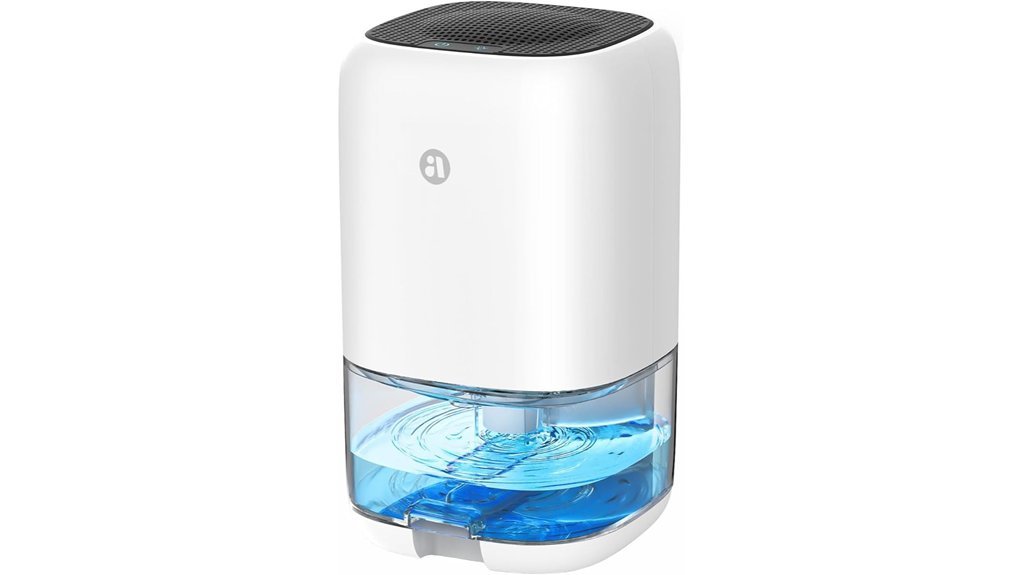
Best Overall for Bedrooms: The TABYIK 35 OZ model is a strong match for shoppers who prioritize low listed noise, a compact footprint, and simple operation. It is rated at 28 dB and measures about 5.9 × 5.9 × 10.1 inches, so it can fit on a dresser, shelf, bathroom counter, or stable RV surface without taking over the room.
Under the manufacturer’s warm and humid test conditions of 86°F and 80% relative humidity, it can collect up to 16 ounces of water per day. Its 35-ounce transparent tank, auto shut-off, red full-tank indicator, built-in handle, and separate light control are practical for nighttime use.
Problem It Solves: Mild condensation, musty air, or excess humidity in a small enclosed room where low noise and portability matter more than fast drying.
Why You’ll Like It: It combines one of the lowest listed noise figures in this roundup with a visible tank, simple controls, and an easy-carry design.
Who Should Buy This: Light sleepers and apartment, bathroom, closet, office, or RV users with a mild humidity problem.
Who Should Avoid This: Anyone who needs a humidistat, drain hose, or high-capacity moisture removal for a basement or laundry area.
Pros:
- Listed 28 dB operating noise.
- Compact body with a built-in carrying handle.
- Transparent tank, auto shut-off, and separate light control.
Cons:
- Daily water removal is limited compared with compressor models.
- Performance drops in cool or only slightly humid rooms.
- No continuous drainage or adjustable target humidity.
Deyagoo DY501 1500ML Small Quiet Dehumidifier
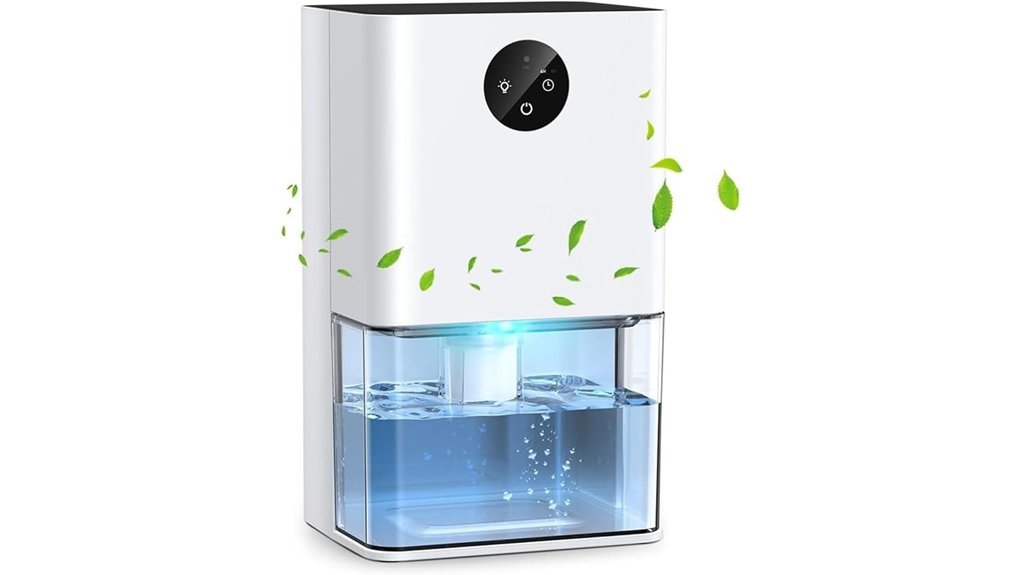
Best Slim Large-Tank Mini: The Deyagoo DY501 pairs a 1.5-liter tank with a narrow Peltier body. Under the manufacturer’s warm, humid test conditions of 86°F and 80% relative humidity, it is listed to collect up to 300 ml of water per day. Real-world output will usually be lower in cooler or less humid rooms.
The unit is promoted for spaces up to 300 square feet and has a listed 30 dB noise level. Its approximate dimensions are 5.9 × 4.7 × 9.8 inches. Auto shut-off and a flashing indicator help reduce overflow risk when the tank fills.
Problem It Solves: Small-space humidity where a narrow footprint and less frequent tank emptying are more important than rapid moisture removal.
Why You’ll Like It: The 1.5-liter tank is generous for a compact Peltier unit, while the slim shape is easy to place on a shelf or counter.
Who Should Buy This: Bedroom, closet, office, bathroom, or RV users dealing with light condensation or musty air.
Who Should Avoid This: Buyers who need rapid drying after a leak or expect a mini unit to control a consistently wet basement.
Pros:
- Quiet 30 dB manufacturer rating.
- 1.5-liter transparent tank with auto shut-off.
- Compact footprint and simple controls.
Cons:
- Maximum collection depends on warm, high-humidity test conditions.
- No continuous-drain hose is listed.
- Ambient lighting may not appeal to every buyer.
Pro Breeze PB-03-US Electric Mini Dehumidifier
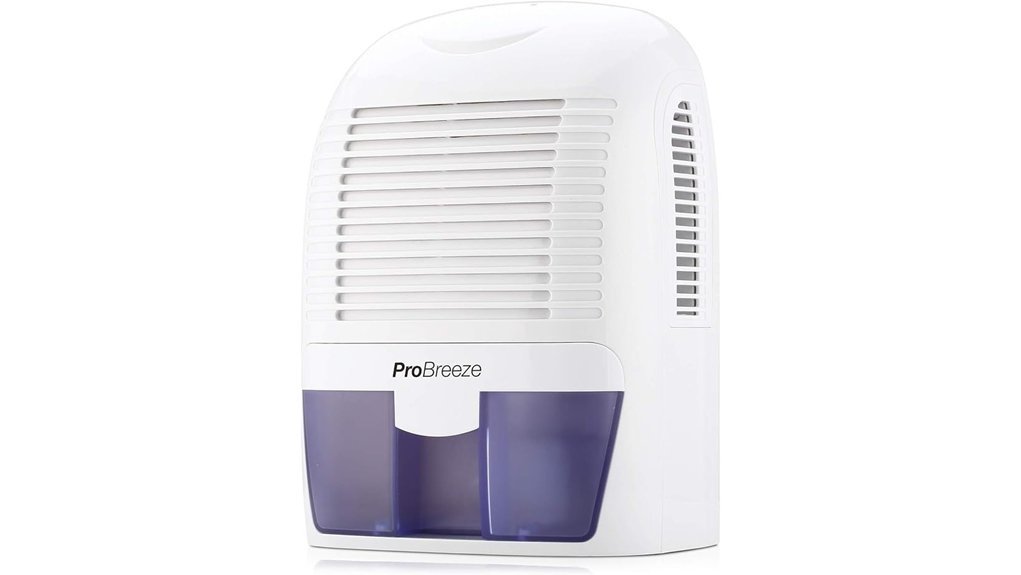
Best Established Mini Pick: The Pro Breeze PB-03-US is a compact thermoelectric model designed for small rooms. The current listing uses both a cubic-foot figure and an approximate coverage claim of up to 250 square feet, but actual results depend on room temperature, humidity, and how enclosed the space is.
It weighs about 3.3 pounds and measures roughly 6.3 × 8.7 × 11.8 inches. The listing states that it can remove up to 18 ounces of moisture per day and stores water in a 52-ounce tank. Auto shut-off and a full-tank indicator simplify unattended operation, while the compressor-free design avoids compressor cycling noise.
Problem It Solves: Everyday moisture in a bathroom, bedroom, office, caravan, wardrobe, or closet where you want a familiar, straightforward mini design.
Why You’ll Like It: It offers a larger tank than many tabletop units, simple one-purpose operation, and broad placement flexibility.
Who Should Buy This: Users who need uncomplicated moisture control in a warm, enclosed small space.
Who Should Avoid This: Cold-room users or anyone trying to dry a large basement, laundry room, or area with an active water problem.
Pros:
- Compact 3.3-pound design.
- 52-ounce tank and auto shut-off.
- Quiet Peltier operation without a compressor.
Cons:
- No exact decibel rating is provided in the current specifications used here.
- No humidistat, app, or continuous-drain hose.
- Designed for small-space moisture loads only.
Levoair Mini Dehumidifier with Drain Hose
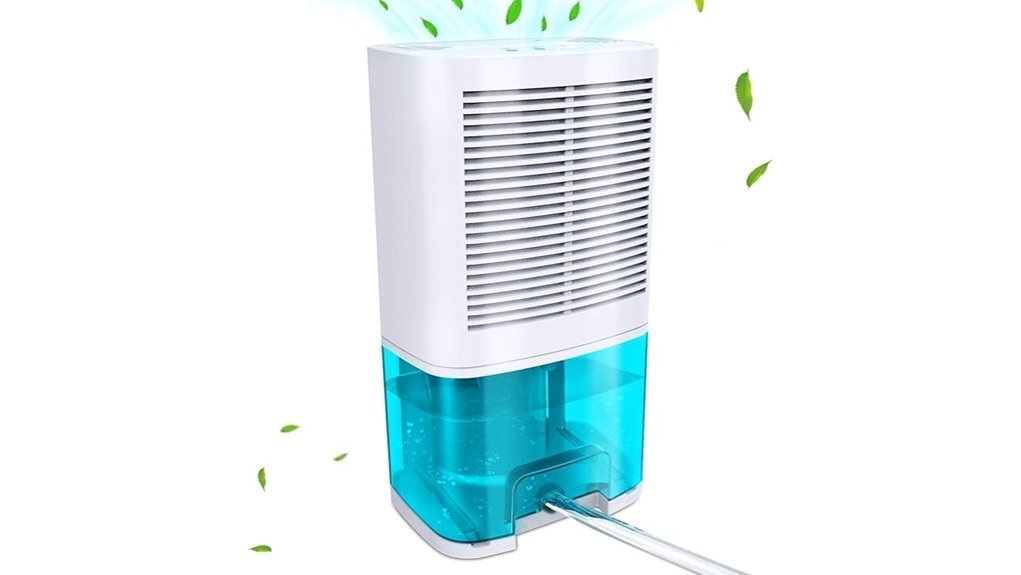
Best Continuous-Drain Mini Pick: The Levoair model stands out because it supports both manual tank emptying and continuous gravity drainage. It has a 2-liter tank, includes a drain hose, weighs about 5 pounds, and is listed to remove up to 1 liter of water per day under favorable conditions.
The manufacturer promotes coverage up to 650 square feet and a noise level at or below 40 dB. Those figures make it appealing for RVs, boat cabins, bedrooms, bathrooms, and other enclosed spaces where the hose can run continuously downward to a suitable drain. As with every semiconductor model, output will fall in cooler or less humid conditions.
Problem It Solves: Frequent tank emptying during extended use in an RV, cabin, boat, bathroom, or other space with access to a gravity drain.
Why You’ll Like It: Continuous drainage can reduce daily maintenance without requiring a full-size compressor dehumidifier.
Who Should Buy This: Buyers who want a compact unit with a hose rather than relying only on a collection tank.
Who Should Avoid This: Users who cannot place the unit above a gravity drain or who need true basement-capacity moisture removal.
Pros:
- Manual and continuous drainage options.
- 2-liter tank and portable 5-pound body.
- Listed noise level at or below 40 dB.
Cons:
- Drainage depends on correct hose placement and continuous downward slope.
- Advertised coverage may be optimistic in open or very humid rooms.
- No adjustable humidistat is listed.
NineSky CT2 Dehumidifier with 95 OZ Tank
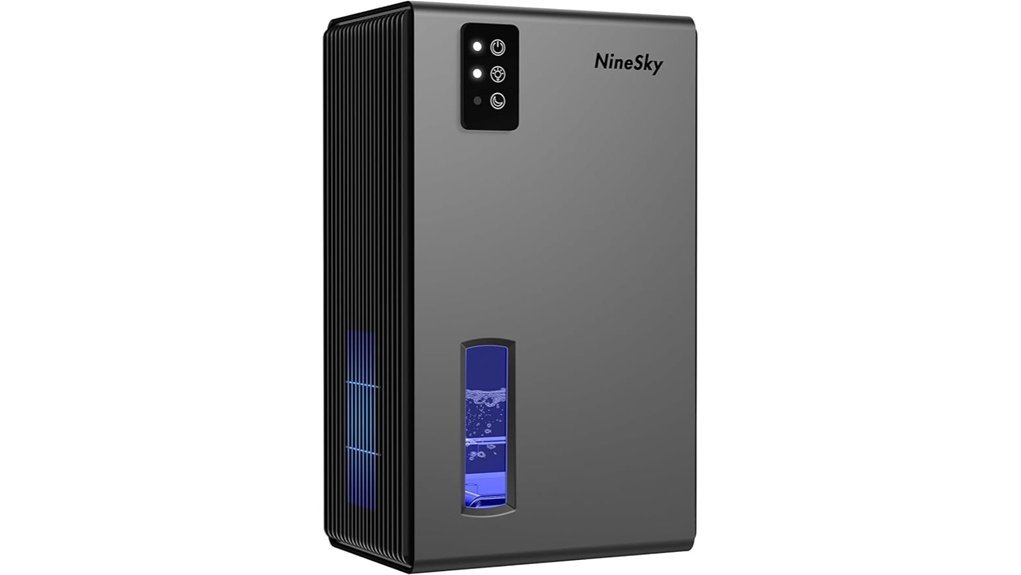
Best Large-Tank Bedroom Pick: The NineSky CT2 combines a 95-ounce water tank with two operating speeds, auto shut-off, and seven-color ambient lighting. It is advertised for spaces up to 1,000 square feet and weighs about 2.81 kilograms, so it remains movable even though it is larger than a basic 35-ounce tabletop model.
The higher-speed mode is intended for stronger moisture collection, while the quieter mode is better suited to sleep. The tank-full shut-off helps reduce overflow risk, and the lighting can add a night-light effect where that is useful. No exact decibel figure is used here because the current listing emphasizes quiet operation without a clear verified number.
Problem It Solves: Mild room humidity when you want a much larger tank and fewer emptying trips but do not need a compressor machine.
Why You’ll Like It: The 95-ounce tank offers a practical middle ground between small tabletop models and heavy floor units.
Who Should Buy This: Buyers who want more tank capacity for a bedroom, bathroom, living area, or enclosed basement corner.
Who Should Avoid This: Anyone who needs verified pint-per-day output, a built-in drain hose, or automatic target-humidity control.
Pros:
- Large 95-ounce tank.
- Two operating modes with auto shut-off.
- Movable design and simple controls.
Cons:
- No precise verified sound level is provided here.
- The 1,000-square-foot claim should be treated as a manufacturer estimate.
- High-speed mode may be more noticeable in a quiet bedroom.
Waykar 120-Pint Dehumidifier for Large Spaces
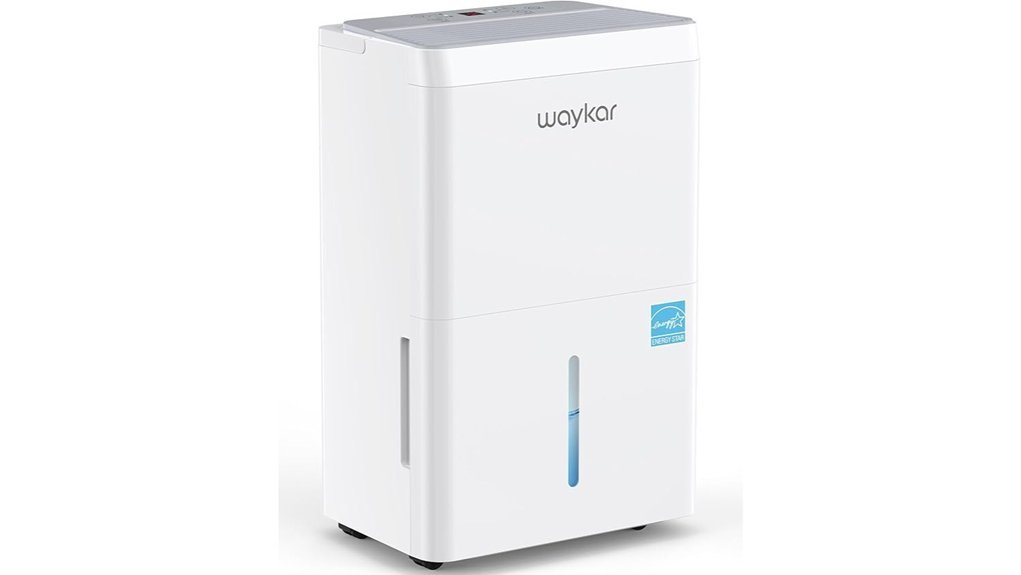
Best Large-Space Pick: The Waykar CTH120A is the outlier in this roundup because it is a full compressor dehumidifier rather than a tabletop Peltier unit. It is listed for spaces up to 6,000 square feet and up to 120 pints per day under the manufacturer’s high-temperature, high-humidity rating conditions. That makes it the better fit for basements, laundry rooms, storage areas, and persistent dampness.
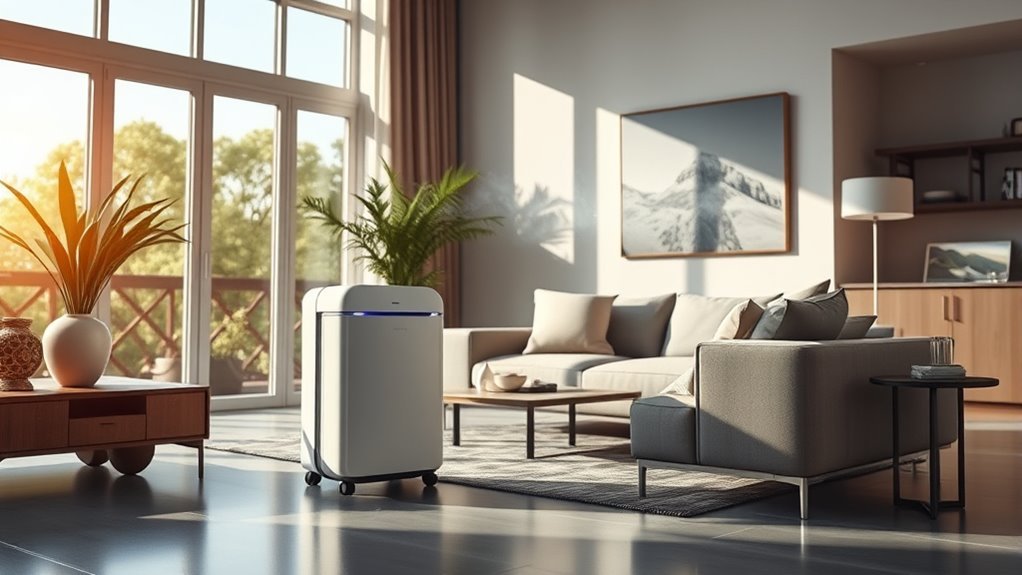
The unit weighs about 28.8 pounds and is designed as a movable floor appliance with casters and a handle. The manufacturer lists noise around 40 dB on low and up to about 55 dB at maximum operation. It also includes a removable tank, continuous drainage, automatic defrost, adjustable humidity control, three fan speeds, and an Auto Comfort mode.
Problem It Solves: High moisture loads that mini Peltier units cannot control, especially in a basement or large room where a drain hose can be used.
Why You’ll Like It: It offers meaningful moisture-removal capacity, a humidistat, and drainage controls while remaining movable within the home.
Who Should Buy This: Homeowners who need stronger moisture control in a basement, laundry room, storage room, or other large damp space.
Who Should Avoid This: Shoppers looking for a tiny bedside unit or a lightweight machine they can frequently carry between an RV and home.
Pros:
- High-capacity compressor performance for large spaces.
- Adjustable humidity, automatic defrost, and continuous drainage.
- Casters and a handle for room-to-room movement.
Cons:
- Much heavier and larger than the other portable picks.
- More noticeable at higher fan and compressor settings.
- The 120-pint rating reflects specified test conditions, not every room environment.
How We Evaluated These Dehumidifiers
We compared the products using the details that matter most for this search intent: dehumidification technology, listed sound level, daily water-removal conditions, tank size, drainage, operating temperature, weight, controls, and realistic room fit. Manufacturer square-foot claims were treated cautiously because a mini Peltier unit and a compressor dehumidifier can advertise similar coverage while delivering very different moisture-removal performance.
No product was labeled as hands-on tested. Recommendations are based on available product information and the type of humidity problem each model is designed to address.
Factors to Consider When Choosing a Quiet Portable Dehumidifier
The right dehumidifier is not automatically the model with the largest advertised room size. Compare the moisture-removal technology, tested capacity, noise, tank size, drainage, room temperature, and portability before deciding.
Peltier vs. Compressor Technology
Peltier or semiconductor dehumidifiers are compact, quiet, and easy to carry. They work best in small, enclosed, warm rooms with mild humidity. Compressor dehumidifiers move much more water and usually include a humidistat, stronger airflow, and continuous drainage, but they are heavier and create more fan and compressor noise.
Noise Level Considerations
For a bedside unit, a manufacturer rating around 30 dB or lower is a useful starting point. Ratings around 40 to 45 dB may still be comfortable in a bathroom, office, basement, or across the room, but sound character and fan speed matter as much as the headline number. Use sleep mode when available and place the machine on a stable, level surface to reduce vibration.
Coverage Area and Moisture Load
Room-size claims are not directly comparable across brands. A small Peltier unit advertised for several hundred square feet may only manage mild condensation, while a compressor model rated in pints per day can handle persistent dampness. Consider ceiling height, open doors, laundry drying, shower steam, outdoor humidity, and how much water the unit actually collects in your room.
Tank Size and Drainage
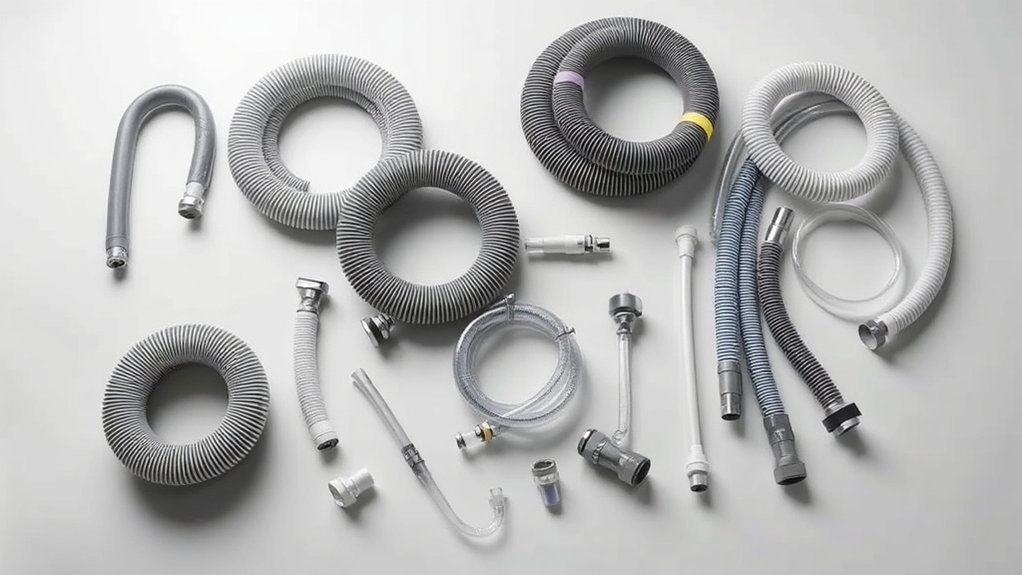
A larger tank means fewer emptying trips, but it also adds weight and bulk. Auto shut-off is important for tank operation. For basements, RVs, cabins, or extended use, a drain hose can be more valuable than a large tank. Confirm that the hose can slope continuously downward to a suitable drain unless the unit includes a pump.
Energy Efficiency
Do not compare units only by daily kilowatt-hours because a low-power mini model may also remove very little water. For compressor models, confirm current ENERGY STAR certification and compare the integrated energy factor when available. For mini units, check wattage and realistic water collection in your room.
Cold-Temperature Performance
Peltier units lose effectiveness as temperatures fall. Compressor models can also frost, so automatic defrost is useful in basements and storage rooms. Always follow the manufacturer’s minimum operating temperature and keep air inlets and outlets clear.
Maintenance and Cleaning
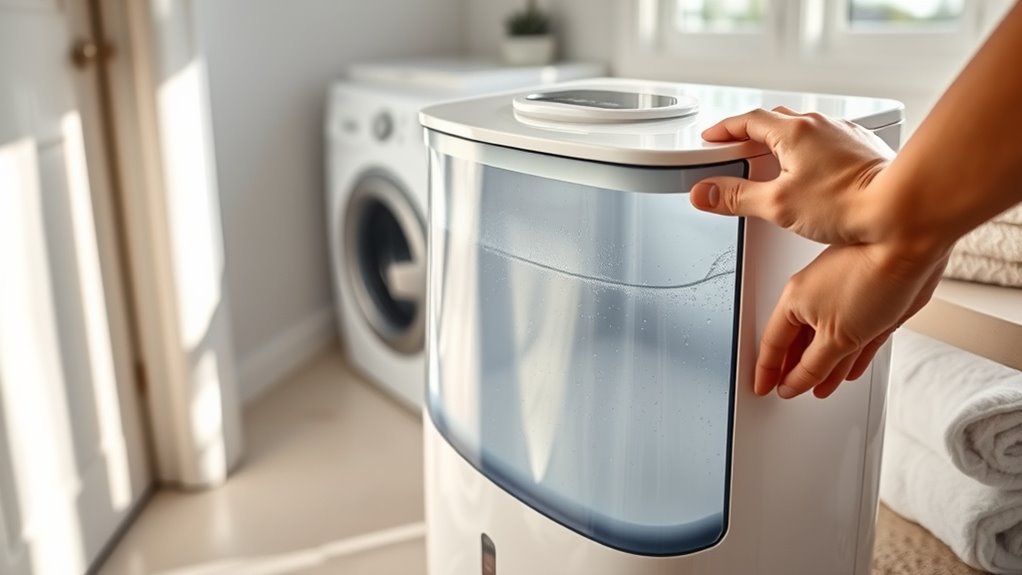
Empty and rinse the tank regularly, wipe away residue, clean or wash the filter according to the manual, and check the drain hose for kinks or buildup. Unplug the unit before cleaning. A transparent tank, washable filter, and easy-access air intake make routine care simpler.
Portability and Placement
For frequent room-to-room movement, look for a built-in handle and a weight under about 6 pounds. Larger compressor units may still be labeled portable, but they are better treated as movable floor appliances. Leave the clearance recommended in the manual so the machine can circulate air properly.
Before You Buy
- Measure the room and identify whether the problem is mild condensation or persistent dampness.
- Choose Peltier for quiet small-space use and compressor power for high moisture loads.
- Check the listed operating temperature, tank size, sound level, and daily removal conditions.
- Confirm whether the light can be turned off for bedroom use.
- Verify current warranty, included drain hose, voltage, and Amazon listing details before ordering.
- Do not use a household dehumidifier for standing water or active leak cleanup; correct the water source first.
Frequently Asked Questions
Are Peltier Dehumidifiers Good for Bedrooms?
Yes, when the room has mild humidity and stays within the unit’s operating-temperature range. Their compressor-free design is generally compact and quiet, but they are less suitable for large, cold, or severely damp rooms.
What Noise Level Is Quiet for a Dehumidifier?
A manufacturer rating near 30 dB or lower is a useful target for close-range sleeping. A 40 to 45 dB unit may still be acceptable farther from the bed or in a basement, office, or bathroom. Remember that fan speed, vibration, and compressor cycling can change how noticeable the sound feels.
Can a Mini Dehumidifier Handle a Basement?
Usually not if the basement is consistently damp. A mini unit may help in a small enclosed corner, cabinet, or closet, but a compressor model with a rated pint-per-day capacity, humidistat, automatic defrost, and continuous drainage is the better choice for a full basement.
How Do I Know If a Mini Dehumidifier Is Too Small?
It is probably undersized if it runs continuously, collects little water, and the room still feels damp or shows condensation after several days. Open doors, shower steam, drying laundry, cool temperatures, or an unresolved leak can also overwhelm a mini unit.
How Do I Maintain My Portable Dehumidifier?
Empty and rinse the tank, clean the filter and air vents according to the manual, inspect any drain hose, and keep adequate clearance around the unit. Unplug it before cleaning or moving it, and never drink or reuse collected water.
Can I Use a Dehumidifier in Cold Temperatures?
Only within the manufacturer’s stated operating range. Mini Peltier units become less effective in cool air, while compressor models may need automatic defrost to reduce ice buildup.
Are Dehumidifiers Safe Around Pets and Children?
They are generally suitable for household use when placed on a stable surface with the cord, tank, drain hose, and air openings kept out of reach. Follow the product manual, prevent tipping, and do not allow children or pets to access the collected water.
How Much Energy Do Portable Dehumidifiers Use?
Energy use varies widely. Small Peltier units often draw much less power than compressor models, but they also remove much less moisture. Compare wattage, expected run time, and water removed rather than judging efficiency by wattage alone.
Is a Large Tank Better Than a Drain Hose?
A large tank is convenient when no drain is nearby. A hose is usually better for extended or unattended operation, provided it can maintain a continuous downward slope to a suitable drain and the manual permits gravity drainage.
Conclusion
The best quiet portable dehumidifier depends on the moisture load, room temperature, and how often you want to empty the tank. The TABYIK 35 OZ is the most balanced choice for a bedroom or other small enclosed space, while the Deyagoo DY501 provides a slim design with a 1.5-liter tank. Choose the Pro Breeze PB-03-US for a straightforward established mini model, the Levoair when a drain hose is important, and the NineSky CT2 when you want a 95-ounce tank without moving to a compressor.
For a damp basement, laundry room, or other high-moisture area, the Waykar 120-Pint is the relevant heavy-duty option in this roundup. It is movable on the floor, but it should not be confused with a lightweight tabletop dehumidifier.
Final Recommendation
For quiet bedroom use, start with the TABYIK and monitor how much water it collects over several days. Choose the Levoair when continuous drainage matters. If humidity remains high, condensation continues, or the mini unit runs without meaningful improvement, move up to a compressor dehumidifier sized for the actual moisture load.