Last reviewed: August 2, 2026. Product names and published specifications were checked against current manufacturer, retailer, and Amazon information. Seller specifications, included accessories, warranty terms, and availability can change.
If you need a commercial dehumidifier for a basement, begin with the type of installation rather than the largest headline pint rating. A compact gravity-drain model is usually the simplest choice for permanent installation beside a floor drain or sump. A built-in pump is more useful when condensate must travel upward or across the room. For flooding, construction drying, or severe temporary moisture, a wheeled restoration dehumidifier may be easier to deploy.
The five models below match demanding basement, crawl-space, storage, job-site, and water-damage applications. Comparisons emphasize manufacturer-listed moisture-removal capacity, drainage method, automatic defrost, airflow, portability, and honest limitations rather than square-foot claims alone.
Quick Verdict
Best value for a fixed basement or crawl space: VEVOR 125 Pints Commercial Dehumidifier. Choose it when a continuously downward-sloping gravity drain is available.
Best for water-damage restoration: MOUNTO 150 Pint Commercial Dehumidifier. Its pump, wheels, and restoration-style housing are better suited to temporary drying projects and job-site movement.
Best compact option with a pump: MOISWELL Defender ME-7S. It is easier to fit into a smaller basement where condensate must be pumped to a higher drain.
Best pump-equipped choice for a larger basement: Airzentti 155 Pints Commercial Dehumidifier. It combines a higher published lower-condition capacity with pump, gravity-drain, and ducting options.
Best compact gravity-drain model: ALORAIR Sentinel HD55. It is a strong permanent-installation option when a lower drain is already available.
The list prioritizes commercial or crawl-space construction, continuous drainage, automatic defrost, published capacity information, basement suitability, and clear use-case differences. It is based on published product information and is not presented as hands-on laboratory testing.
Quick Comparison of Commercial Basement Dehumidifiers
| Product | Published Capacity | Drainage | Best For | Amazon |
|---|---|---|---|---|
| VEVOR 125 Pints | 60 PPD manufacturer-listed AHAM 125 PPD saturation |
Continuous gravity hose | Fixed crawl-space and basement installations | Check Details |
| MOUNTO 150 Pint | Up to 150 PPD at saturation Lower-condition rating differs between current seller sources |
Built-in pump with lift capability | Restoration work and mobile job-site use | Check Details |
| MOISWELL Defender ME-7S | 35 PPD manufacturer-listed AHAM 70 PPD saturation |
Built-in pump | Smaller basements and tight crawl spaces | Check Details |
| Airzentti 155 Pints | 70 PPD manufacturer-listed AHAM 155 PPD saturation |
Built-in pump and gravity drain | Large basements and longer drain routes | Check Details |
| ALORAIR Sentinel HD55 | 53 PPD manufacturer-listed AHAM 113 PPD saturation |
Continuous gravity drain | Compact permanent installations | Check Details |
Published coverage is a rough manufacturer estimate. Temperature, ceiling height, open vents, foundation moisture, recent flooding, wet materials, and air movement can change the required capacity substantially.
Best Value: VEVOR 125 Pints Commercial Dehumidifier with Drain Hose
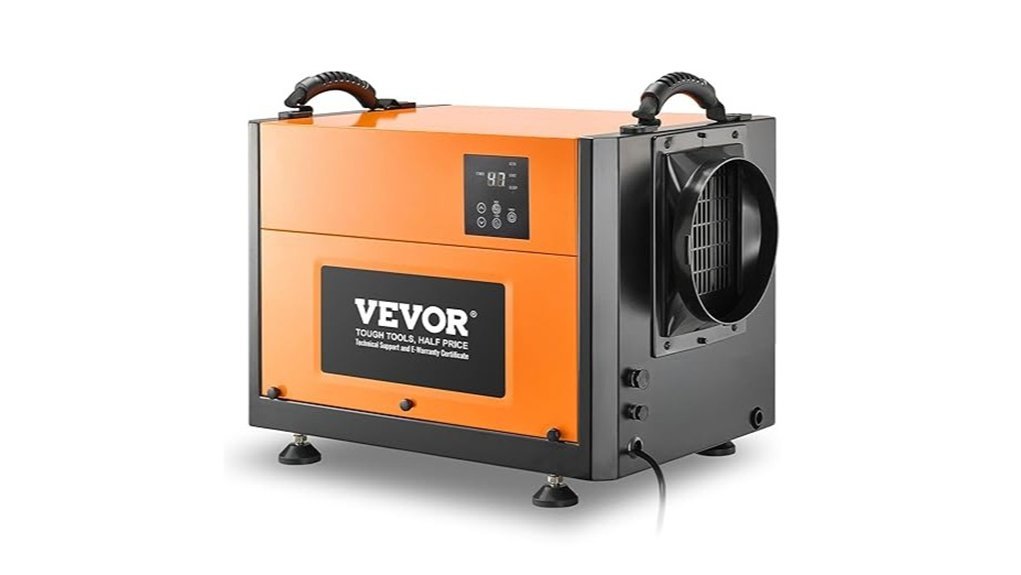
The VEVOR 125 Pints Commercial Dehumidifier is a practical option for a basement, crawl space, storage room, or light-commercial area where a floor drain or sump is available. VEVOR lists approximately 60 pints per day under its stated AHAM conditions and 125 pints under hot, highly humid saturation conditions, with airflow of approximately 210 CFM.
The heavy-duty galvanized-steel housing is better suited to an equipment area than a decorative residential machine. It supports continuous gravity drainage through a hose, eliminating the need to carry a collection tank. Automatic defrost helps manage frost formation when the basement becomes cool, although moisture removal will still decline as the air temperature falls.
Best For: Basements and crawl spaces with a nearby drain positioned below the dehumidifier outlet.
Who Should Avoid It: Buyers who must pump condensate upward to a sink, window, or elevated drain. This model relies on gravity drainage unless a separate approved condensate-pump arrangement is installed.
Pros:
- Manufacturer-listed 60-pint AHAM capacity and 125-pint saturation capacity.
- Approximately 210 CFM of published airflow.
- Heavy-duty galvanized-steel construction.
- Continuous gravity drainage without a collection tank.
- Automatic defrost and adjustable humidity controls.
- Compact shape for crawl spaces and utility areas.
Cons:
- No built-in condensate pump.
- Not designed for the easy job-site mobility of a wheeled restoration unit.
- Requires careful drain-hose routing to prevent water from backing up.
- The maximum pint figure should not be confused with ordinary lower-condition performance.
Best for Restoration: MOUNTO 150 Pint Commercial Dehumidifier with Pump
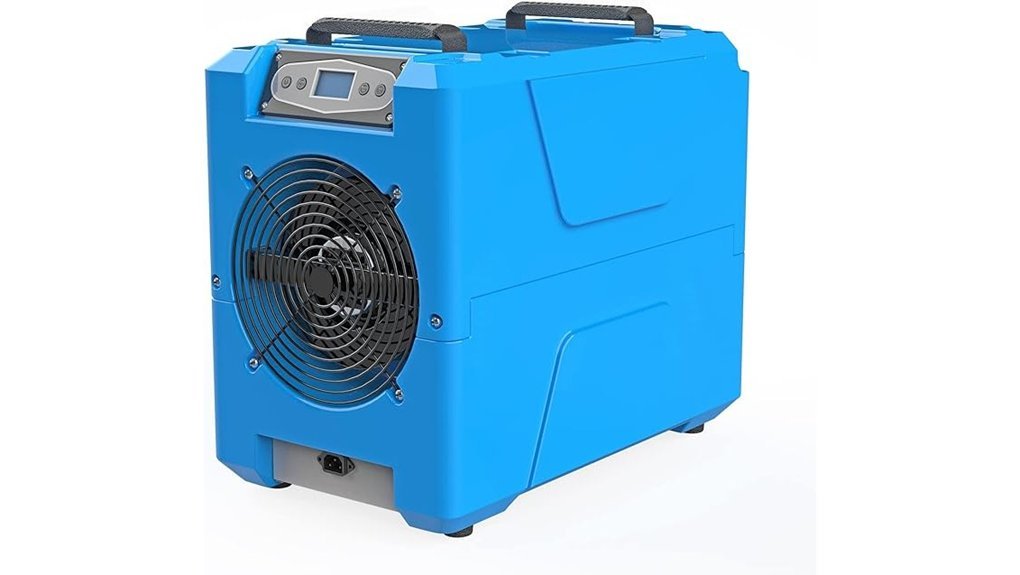
The MOUNTO 150 Pint Commercial Dehumidifier is the strongest fit here for water-damage restoration, construction drying, and situations where the machine must be moved between locations. Its rotomolded housing, transport wheels, long power cord, and built-in pump are more job-site focused than the features found on a typical permanent basement dehumidifier.
Current product sources consistently associate this model with moisture removal of up to 150 pints per day under saturation conditions. However, current seller sources do not agree on the lower-condition figure, with published numbers including 80 and 95 pints per day under their respective stated conditions. Buyers should therefore confirm the current rating, test temperature, test humidity, and model designation in the Amazon specifications or supplied manual before comparing it directly with another machine.
Best For: Contractors, property managers, restoration work, warehouses, job sites, and owners dealing with severe temporary moisture loads.
Who Should Avoid It: Buyers who need a quiet, compact machine for an occupied bedroom, office, or mildly damp finished basement.
Pros:
- Restoration-focused commercial design.
- Built-in pump can move water toward an elevated drain within the limits stated in the manual.
- Large wheels and handle improve job-site mobility.
- Restart capability supports operation after a power interruption.
- Suitable for demanding drying projects and large open work areas.
Cons:
- Heavier and bulkier than compact crawl-space models.
- Likely to be louder than a residential portable dehumidifier.
- Current sources conflict on the lower-condition moisture-removal rating.
- May be unnecessarily large for a mildly damp, enclosed basement.
- Its restoration design may be less convenient for a permanent under-joist installation.
Best Compact Pump Model: MOISWELL Defender ME-7S
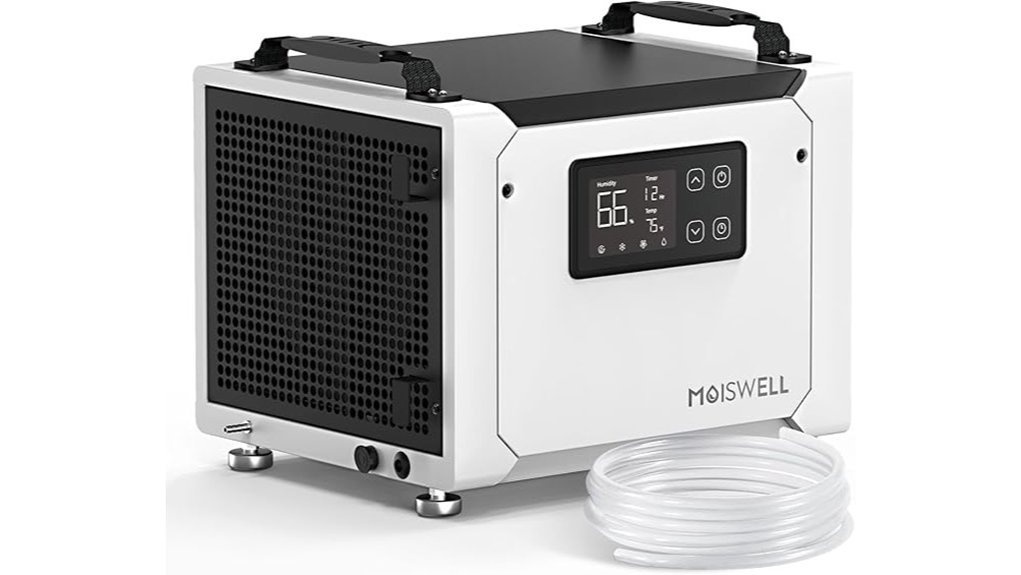
The MOISWELL Defender ME-7S is a compact commercial dehumidifier for smaller basements, crawl spaces, floor-joist areas, and utility rooms. MOISWELL lists approximately 35 pints per day under its stated AHAM conditions and up to 70 pints under saturation conditions.
Its main advantage is the built-in pump. Condensate can be moved to a higher drain point when gravity drainage is impractical. The compact metal cabinet, automatic defrost, restart function, and continuous operation mode make it a more suitable unattended-space solution than a small tank-based bedroom dehumidifier.
Best For: Smaller basements and crawl spaces where water must be pumped upward or routed across the room.
Who Should Avoid It: Buyers handling extensive water damage or very large open commercial areas that require substantially more lower-condition moisture-removal capacity and airflow.
Pros:
- 35-pint manufacturer-listed AHAM and 70-pint saturation ratings are clearly distinguished.
- Built-in pump supports flexible drainage routing.
- Compact metal construction fits tighter spaces.
- Automatic defrost and power-outage restart.
- Manufacturer warranty information currently distinguishes between full and limited coverage periods.
Cons:
- Lower AHAM-labeled capacity than the larger commercial models in this comparison.
- Still substantial equipment despite its compact dimensions.
- May run for long periods in a severely wet basement.
- Pump operation adds another component that must be inspected and tested.
- Current warranty exclusions and claim requirements should be reviewed before ordering.
Best for Large Basements: Airzentti Commercial Dehumidifier with Pump
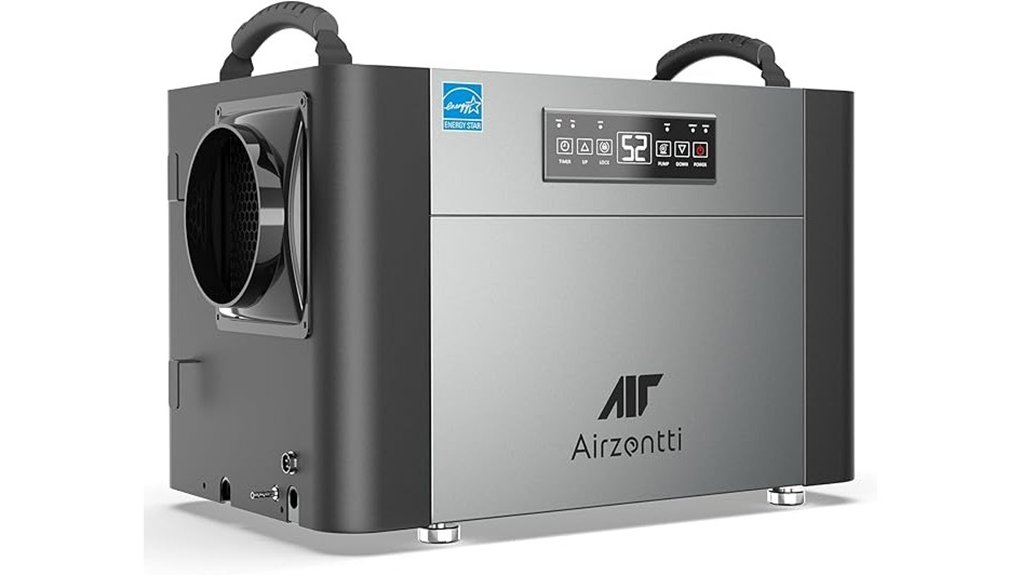
The Airzentti 155 Pints Commercial Dehumidifier is intended for large basements, crawl spaces, attics, garages, warehouses, and other demanding areas. Published specifications list approximately 70 pints per day under the manufacturer’s stated AHAM conditions, up to 155 pints under nearly saturated conditions, and airflow of approximately 220 CFM.
It offers both pump-assisted and gravity drainage. The pump is listed to move condensate up to 16.4 feet vertically, while the gravity outlet can be used when a lower floor drain is available. A duct collar also makes it more flexible for installations where dry air must be directed toward an adjoining area.
Best For: Large basements, storage spaces, and installations requiring upward drainage, a long drain route, or optional ducting.
Who Should Avoid It: Buyers who want a lightweight portable appliance or who cannot provide the required intake, exhaust, filter, hose, and duct-collar clearances.
Pros:
- Seller-listed 70-pint AHAM and 155-pint saturation capacities.
- Approximately 220 CFM of published airflow.
- Built-in pump with a listed vertical lift of up to 16.4 feet.
- Gravity drainage provides a second water-removal option.
- Automatic defrost, timer, and humidity controls.
- Duct collar can support more flexible airflow placement.
Cons:
- Not designed for frequent casual movement between living areas.
- Published coverage remains an estimate and will vary with the building and moisture load.
- Noise may be noticeable in a finished or occupied basement.
- The pump, gravity hose, and ducting setup require sufficient service clearance.
- Certification, included accessories, and warranty details should be checked on the current listing.
Best Compact Gravity-Drain Model: ALORAIR Sentinel HD55
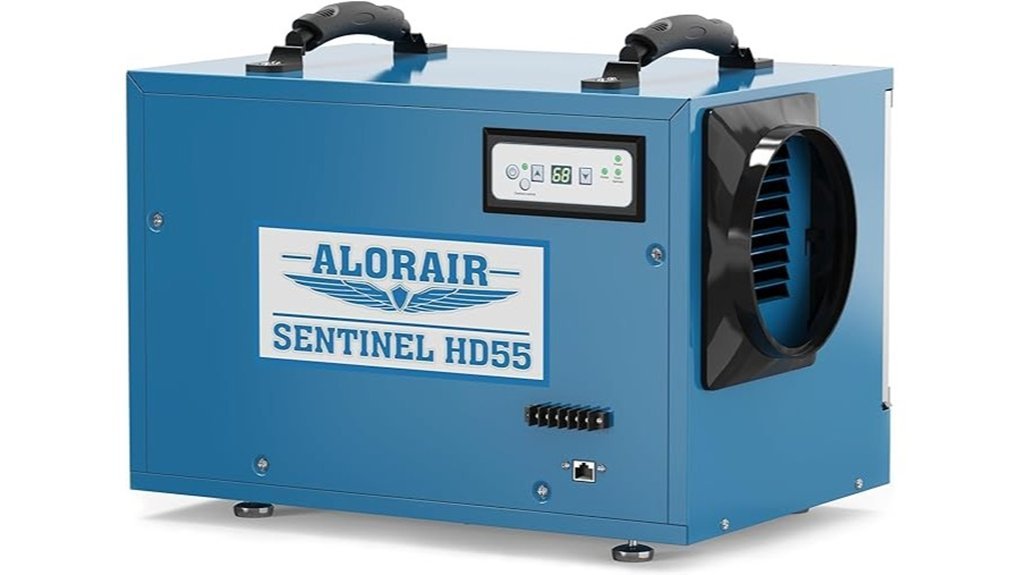
The ALORAIR Sentinel HD55 is a compact commercial dehumidifier designed for basements, crawl spaces, storage areas, offices, and similar spaces. ALORAIR lists its capacity as 53 pints per day under its stated AHAM conditions and 113 pints at saturation, with approximately 120 CFM of airflow and suggested coverage of up to approximately 1,200 square feet.
This model uses continuous gravity drainage rather than an internal tank or built-in pump. That makes it well suited to a permanent installation near a sump or floor drain. Automatic defrost supports operation in cooler conditions, and ALORAIR publishes an operating range beginning at approximately 33.8°F. Moisture-removal output will still decline as the temperature approaches the lower end of that range.
Best For: Permanent basement or crawl-space installations with a properly positioned gravity drain.
Who Should Avoid It: Anyone who needs to discharge water upward. A pump-equipped model is usually safer and simpler than an improvised drain arrangement.
Pros:
- 53-pint manufacturer-listed AHAM and 113-pint saturation ratings.
- Approximately 120 CFM of published airflow.
- Compact commercial-style metal housing.
- Continuous gravity drainage eliminates tank emptying.
- Automatic defrost for cooler environments.
- Published sound-pressure level below 50 dBA under the stated test conditions.
Cons:
- No built-in pump.
- Requires a drain lower than the outlet.
- Not a wheeled restoration machine.
- The 1,200-square-foot figure is a manufacturer estimate rather than a complete sizing method.
- Optional accessories and current warranty terms should be confirmed before ordering.
Factors to Consider When Choosing a Commercial Dehumidifier for a Basement
A commercial basement dehumidifier should be selected according to the actual moisture load, drainage route, room temperature, airflow requirements, and installation conditions. The largest advertised pint or square-foot figure is not automatically the best choice.
Permanent Crawl-Space Model vs Restoration Dehumidifier
A compact crawl-space dehumidifier is usually the better choice for continuous humidity control in one basement. Its rectangular housing can fit beside a sump, beneath floor joists, or in a utility area, and it may support optional ducting or a remote controller.
A restoration dehumidifier uses a more portable housing with wheels or a carrying handle. It is designed to be moved between drying areas and may include job-site readings, pump drainage, and controls intended for temporary structural drying. That mobility is useful after a leak, but the machine may be louder, heavier, and less convenient for a permanent installation.
Compare Published Test Conditions
Always check the conditions under which a capacity figure was measured. Saturation ratings are normally recorded in hotter and more humid air, allowing a dehumidifier to collect considerably more water than it would in an ordinary basement.
A manufacturer-listed AHAM figure usually offers a more useful comparison point than a saturation number, but readers should still check the stated temperature and humidity. Do not assume that every seller uses the term AHAM for exactly the same rating method or test period.
For example, a unit advertised as “125 pints” may have a lower-condition capacity closer to 60 pints per day. That does not make the machine ineffective, but it changes how it should be compared with competing models.
Match the Unit to the Moisture Load
Square-foot coverage is only a starting point. Also consider:
- Basement ceiling height
- Standing water or recent flooding
- Wet carpet, drywall, framing, or stored materials
- Foundation, roof, appliance, or plumbing leaks
- Outside air entering through open doors, vents, or unsealed penetrations
- Room temperature
- Unsealed crawl-space soil
- Laundry equipment or other moisture-producing appliances
- Whether the basement is one open area or several divided rooms
A smaller unit may maintain an already dry enclosed basement, while a restoration project can require substantially more capacity, airflow, containment, and air movement.
Choose Between Pump and Gravity Drainage
A gravity-drain dehumidifier needs a hose that slopes continuously downward toward a floor drain, sump, or other approved outlet. The hose must not rise, kink, become crushed, or terminate in standing water.
A pump-equipped dehumidifier can move condensate upward toward a sink or elevated drain. Check the listed vertical lift, total hose length, hose diameter, fittings, cleaning procedure, and installation instructions before relying on the pump.
Check What Is Included
Product titles may mention a drain hose, pump hose, duct collar, remote controller, or filter without making the complete package clear. Review the current included-components list and manual before ordering. Accessories sold separately can affect installation cost and determine whether the machine can be used as planned.
Check the Operating Temperature
Basements and crawl spaces can become cool enough for frost to form on a dehumidifier’s evaporator coil. Look for automatic defrost and verify the manufacturer’s minimum operating temperature. Even with automatic defrost, moisture-removal performance usually falls as the air becomes colder.
If a basement remains close to freezing, correcting insulation, air leakage, drainage, or heating problems may be necessary before a refrigerant dehumidifier can operate effectively.
Consider Portability and Installation
A wheeled restoration dehumidifier is useful when the machine must move between rooms or job sites. A compact crawl-space model is generally better for long-term installation under floor joists or beside a sump.
Before ordering, measure the access opening and confirm space for:
- Air intake and exhaust clearance
- Filter removal and cleaning
- Drain-hose and pump-hose connections
- Duct collars or optional ducting
- Power-cord routing
- Control-panel visibility
- Future inspection and maintenance access
Review Noise and Airflow
Commercial dehumidifiers can be louder than portable residential models because they move more air and use heavier compressors. Published decibel figures are useful only when the test conditions and measurement distances are comparable.
Place the unit away from sleeping areas when possible. Do not block the intake or outlet in an attempt to reduce noise, because restricted airflow can lower performance and contribute to freezing or overheating.
Verify Electrical Requirements
Confirm the voltage, rated amperage, plug type, circuit capacity, grounding requirements, and extension-cord restrictions in the manual. Commercial equipment should be connected to a properly grounded outlet and kept away from standing water.
Avoid sharing an overloaded circuit with sump pumps, freezers, heaters, air movers, or power tools. After flooding, do not energize equipment until the electrical system and outlet location are safe.
Before You Buy: Basement Dehumidifier Checklist
- Measure the basement and note the ceiling height.
- Identify and repair active water leaks first.
- Remove standing water before relying on a dehumidifier.
- Compare lower-condition ratings rather than headline saturation ratings alone.
- Check the temperature and humidity conditions used for each published rating.
- Decide whether you need gravity drainage or a built-in pump.
- Confirm the pump lift and total hose route where applicable.
- Confirm the minimum operating temperature.
- Measure doors, stairs, crawl-space openings, and installation clearances.
- Check filter access and cleaning requirements.
- Verify which hoses, filters, duct collars, and controllers are included.
- Verify the outlet, voltage, plug, amperage, and electrical circuit.
- Review current warranty terms and claim requirements.
- Use a separate hygrometer to confirm actual room humidity.
Safety and Moisture-Control Notes
A dehumidifier can manage moisture in the air, but it cannot repair a foundation crack, leaking pipe, failed sump pump, roof leak, exterior grading problem, or blocked drainage system. Correct the water source whenever possible. Wet building materials should be dried promptly, and damaged porous materials may need removal.
For most occupied indoor spaces, a relative-humidity target around 30% to 50% is a practical range. Keeping humidity below 60% helps reduce conditions that support condensation and mold growth. Setting the machine unnecessarily low can waste energy and may make the air uncomfortable.
A commercial label does not automatically mean that a product is suitable for every industrial process, whole-building HVAC system, hazardous environment, or contaminated-water restoration project. Follow the product manual and obtain professional guidance when the drying conditions exceed normal basement humidity control.
If a basement has widespread mold, sewage contamination, structural damage, contaminated floodwater, damaged electrical equipment, or substantial flooding, consult an appropriate remediation, electrical, plumbing, or building professional rather than relying on a dehumidifier alone.
Frequently Asked Questions
What Size Commercial Dehumidifier Do I Need for a Basement?
Use lower-condition pints-per-day capacity, temperature, moisture severity, airflow, drainage conditions, ceiling height, and the amount of wet material rather than square footage alone. A moderately damp enclosed basement may need less capacity than a smaller area containing wet drywall, carpet, framing, or standing water.
What Is the Difference Between AHAM and Saturation Pints?
AHAM-labeled and saturation capacities are measured under different environmental conditions. Saturation testing uses hotter, wetter air, so the resulting pint figure is usually much higher. A manufacturer-listed AHAM figure normally provides a more useful comparison for basement operation, but the stated temperature and humidity should still be checked.
Is a Restoration Dehumidifier Better Than a Crawl-Space Model?
Not automatically. A wheeled restoration model is better when the machine must move between drying areas or handle temporary water-damage work. A compact crawl-space model is often easier to install permanently beside a sump, beneath floor joists, or in a basement utility area.
Is a Built-In Pump Worth It?
A pump is useful when the drain is above the dehumidifier or across an area where a continuously downward-sloping hose is impossible. Gravity drainage is simpler and may require less maintenance when a suitable lower drain is available.
A pump should be tested regularly because a blocked hose, dirty pump reservoir, failed fitting, or pump malfunction can interrupt drainage.
Can I Run a Commercial Dehumidifier Continuously?
Many commercial models support continuous operation, but they should still be installed and maintained according to the manual. Check the filter, drain hose, pump operation, electrical connection, airflow clearance, coil condition, and target humidity regularly.
How Often Should I Clean the Filter?
Inspect the filter at least monthly and more often in dusty crawl spaces, construction areas, workshops, or restoration projects. Clean or replace it according to the manufacturer’s instructions. A blocked filter reduces airflow and moisture-removal performance.
Can a Commercial Dehumidifier Stop Basement Mold?
Lowering humidity can make conditions less favorable for mold, but a dehumidifier does not remove existing contamination or repair the water source. Fix leaks, dry wet materials, clean appropriate surfaces safely, and seek professional help for extensive contamination.
Can I Use a Commercial Dehumidifier After Flooding?
Restoration-style dehumidifiers are commonly used during structural drying, but standing water should be removed first. Confirm that the electrical system is safe, use appropriate air movement and containment when required, and obtain professional help when the water is contaminated or the damage is extensive.
Where Should I Place the Dehumidifier?
Place it on a stable surface with the intake and exhaust unobstructed. Keep it away from standing water and allow enough space to clean the filter, inspect the drain connection, and service the pump. For divided basements, ducting, transfer airflow, or more than one unit may be needed to achieve even humidity control.
Can I Drain a Dehumidifier Into a Sump Pit?
A sump pit may be a suitable destination when local requirements and the equipment instructions allow it. Route a gravity hose continuously downward, secure it so it cannot move, and confirm that the sump pump and discharge system operate correctly. Do not allow the hose end to become submerged if the manual prohibits it.
How Long Do Commercial Dehumidifiers Last?
Lifespan varies with operating hours, temperature, dust exposure, drainage maintenance, compressor quality, refrigerant-system condition, and access to replacement parts. Regular filter cleaning, unobstructed airflow, proper drainage, and correct electrical use can help reduce premature failure, but no fixed lifespan is guaranteed.
Final Recommendation
The best commercial dehumidifier for your basement depends mainly on the moisture load, drainage route, and whether the unit will remain installed or move between drying areas.
Choose the VEVOR 125 Pints Commercial Dehumidifier for a compact fixed installation with gravity drainage. Pick the MOUNTO 150 Pint when restoration mobility, wheeled transport, and a built-in pump matter most, but verify its current lower-condition rating before comparing it with another model.
The MOISWELL Defender ME-7S is the easiest pump-equipped option to fit into a smaller space. The Airzentti 155 Pints model offers higher published lower-condition capacity, pump and gravity drainage, and optional airflow flexibility for a larger basement. The ALORAIR Sentinel HD55 is a strong compact choice when a dependable gravity drain is already available.
Compare the disclosed test-condition capacity, confirm the complete drainage route, check the operating-temperature range, verify the electrical requirements, and repair active water intrusion before ordering. A correctly sized commercial unit with safe continuous drainage is usually more useful than the product with the largest unqualified pint or square-foot number.