Affiliate disclosure: This article contains Amazon affiliate links. If you buy through these links, we may earn a commission at no extra cost to you.
For a boat cabin, you need a small dehumidifier or moisture absorber that fits tight spaces, runs quietly, and helps control damp air without wasting space or power. The best choice depends on how you use your boat. An electric mini dehumidifier works well for cabins with shore power, while a passive moisture absorber is better for lockers, closets, storage bins, and unattended spaces. Top picks include Better Boat Moisture Absorber, Eva-Dry EDV-2400, Pure Enrichment PureDry Mini, and Home Mini Dehumidifier with a drain hose. You can also consider the Eva-Dry Wireless Mini and hanging charcoal moisture bags for small enclosed areas where cords are not practical.
If you want an electric unit, look for about 300–350 ml daily moisture removal, quiet operation near 30 dB when possible, auto shutoff, and a compact tank or drain-hose option. If you only need odor and dampness control in a locker or berth, a charcoal or silica-gel absorber may be simpler. Use the guide below to compare each option by space, power needs, drainage, and maintenance.
Quick Verdict
Best overall active moisture control: Eva-Dry EDV-2400 Compact Portable Dehumidifier, because it gives you stronger mini-unit moisture removal, a 2-liter tank, humidistat, and drain hose.
Best low-power compact pick: Small Dehumidifier for Home, Bedroom, Bathroom, RV, because it has a compact footprint, quiet sleep mode, and 350 ml daily output for tight spaces.
Best no-power option: Better Boat Moisture Absorber with Activated Charcoal, because it is simple, fragrance-free, and easy to place in lockers, cabins, and storage areas.
Best cordless reusable option: Eva-Dry Wireless Mini Dehumidifier, because it works well in small enclosed storage areas without cords, batteries, or tanks.
Quick Picks for Boat Cabins
- Best passive moisture absorber: Better Boat Moisture Absorber with Activated Charcoal, 6 Pack
- Best compact electric option: Small Dehumidifier for Home, Bedroom, Bathroom, RV
- Best higher-capacity mini unit: Eva-Dry EDV-2400 Compact Portable Dehumidifier
- Best for tiny cabins: Pure Enrichment PureDry Mini Dehumidifier
- Best with continuous drainage: Home Mini Dehumidifier with Drain Hose
- Best cordless option: Eva-Dry Wireless Mini Dehumidifier, White (E-333)
- Best hanging absorber: 4 Pack Hanging Moisture Absorber Bags with Charcoal
How These Boat Cabin Picks Were Chosen
For small boat cabins, the most useful products are not always the largest. This list focuses on compact size, easy placement, moisture control method, power needs, noise, drainage, and maintenance. Electric units are better when you need active water removal from the air. Passive absorbers are better for closed lockers, closets, cabinets, and storage areas where cords are not practical.
Because boats can have tight layouts, salty air, limited outlets, and uneven surfaces, each option is positioned by real use case instead of one-size-fits-all performance claims.
Small Boat Dehumidifier Comparison Table
| Product | Type | Best Use | Key Benefit | CTA |
|---|---|---|---|---|
| Better Boat Moisture Absorber with Activated Charcoal, 6 Pack | Passive absorber | Cabins, closets, lockers, and storage spaces | Controls moisture and musty odors without power | Check Price on Amazon |
| Small Dehumidifier for Home, Bedroom, Bathroom, RV | Electric mini dehumidifier | Small boat cabins, RVs, bathrooms, and bedrooms | 350 ml daily output with quiet sleep mode | Check Price on Amazon |
| Eva-Dry EDV-2400 Compact Portable Dehumidifier | Electric thermoelectric dehumidifier | Warm, humid boat cabins and RV spaces | Drain hose, humidistat, and 2-liter tank | Check Price on Amazon |
| Pure Enrichment PureDry Mini Dehumidifier | Electric mini dehumidifier | Very small cabins and enclosed rooms | Compact 27 oz tank and simple one-switch use | Check Price on Amazon |
| Home Mini Dehumidifier with Drain Hose | Electric mini dehumidifier | Boat cabins where continuous drainage helps | Drain hose plus auto shutoff backup | Check Price on Amazon |
| Eva-Dry Wireless Mini Dehumidifier, White (E-333) | Rechargeable silica-gel absorber | Lockers, safes, cabinets, berths, and gear storage | Cordless, battery-free, and reusable | Check Price on Amazon |
| 4 Pack Hanging Moisture Absorber Bags with Charcoal | Passive hanging absorber | Closets, lockers, cabins, bathrooms, and RV spaces | Hangs easily and helps reduce musty odors | Check Price on Amazon |
Before You Buy
- Check your power setup: Electric units are best when you have shore power or a safe onboard power plan.
- Match the space: Use electric units for cabins and passive absorbers for lockers, closets, cabinets, and gear bins.
- Plan drainage: A drain hose is helpful for docked storage, but only if you can route it safely.
- Watch temperature: Small thermoelectric dehumidifiers usually perform best in warmer, humid conditions.
- Use ventilation too: A dehumidifier helps, but it should work with leak checks, dry gear, and basic airflow.
Better Boat Moisture Absorber with Activated Charcoal, 6 Pack
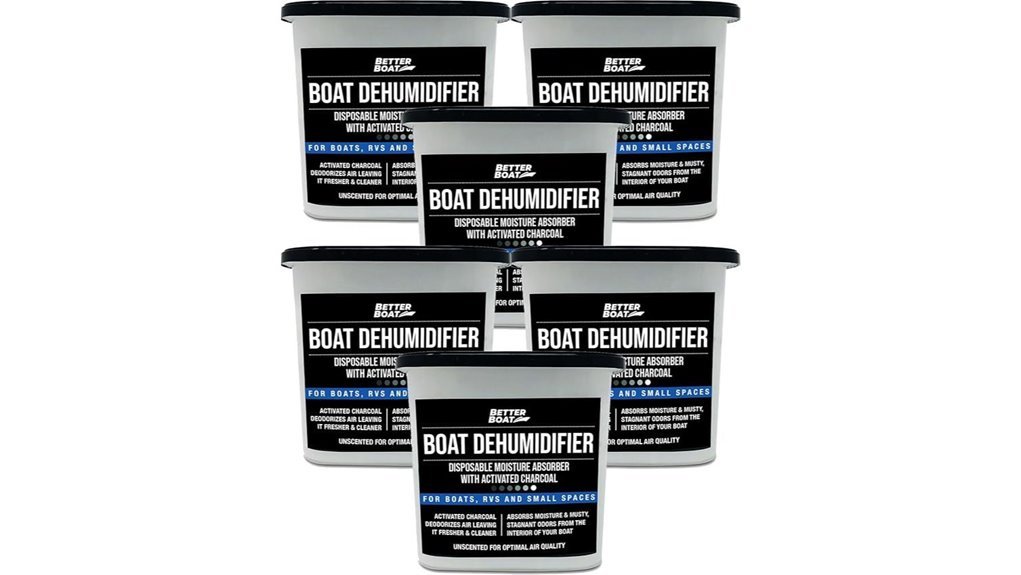
Best passive moisture absorber for lockers and closed storage. If you want a low-fuss moisture solution for a boat cabin or other tight, enclosed space, the Better Boat Moisture Absorber 6 Pack is a practical passive option. You get six spill-resistant buckets that use activated charcoal and crystals to pull moisture from the air and cut musty odors. Since this is not an electric dehumidifier, it is best for smaller spaces where you want dampness control without cords, tanks, or power draw.
Each fragrance-free unit covers up to 250 square feet, so you can place them in cabins, closets, or storage areas. Setup is simple: remove the lid, peel the seal, and snap it shut. Each bucket lasts 30 to 60 days, and Better Boat backs it with a satisfaction guarantee.
Why you’ll like it: It solves the most common small-boat storage problem: stale, damp air in enclosed spaces where you do not want to run a cord. It is also easy to split across several problem areas, such as a berth, locker, closet, and storage bin.
Best For: Boat owners, RV travelers, and anyone needing a simple fragrance-free moisture absorber for small enclosed spaces like closets, cabins, or storage areas.
Choose it if: You want a no-power option for lockers, closets, storage spaces, or a cabin that only needs light moisture and odor control.
Skip it if: You need active daily water removal from a very damp cabin, because an electric dehumidifier will usually be stronger.
Pros:
- Uses activated charcoal and crystals to reduce moisture and musty odors.
- Easy setup with spill-resistant, snap-on buckets.
- Each bucket lasts 30 to 60 days and covers up to 250 square feet.
Cons:
- Best suited for smaller enclosed areas rather than large open rooms.
- Must be replaced regularly once the crystals bind and fill up.
- No added fragrance may be a drawback for users who prefer scented options.
Small Dehumidifier for Home, Bedroom, Bathroom, RV
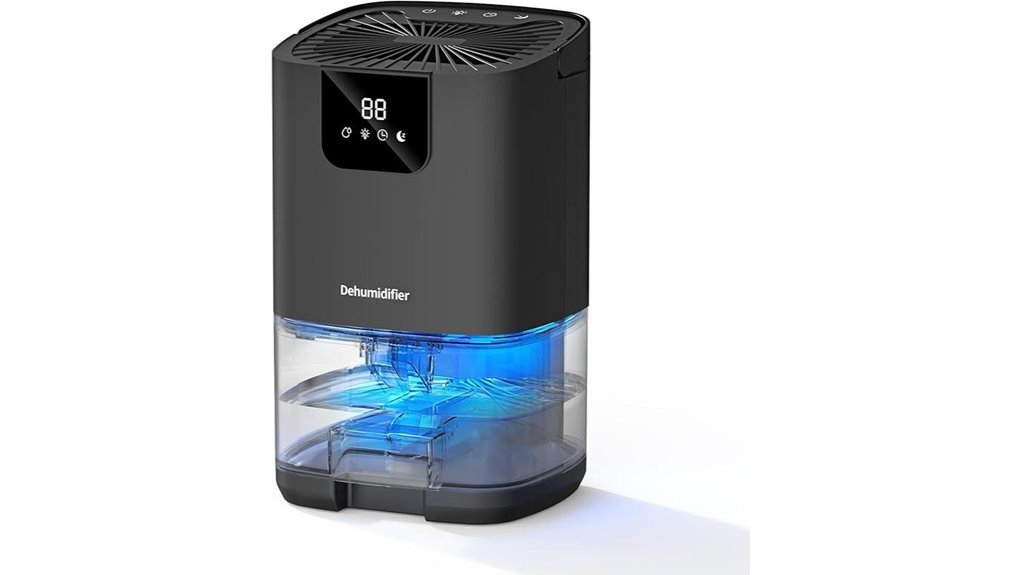
Best compact electric option for small cabins. For small spaces, this dehumidifier keeps your bedroom, bathroom, RV, or compact boat cabin more comfortable and dry. You can use it in areas from 30 to 350 sq. ft., and it removes up to 350ml of moisture daily. Its compact 6.1 x 6.1 x 9.2-inch design fits easily on a shelf, counter, or stable cabin surface.
Sleep mode runs quietly at 32dB, so it should not disturb you while you rest onboard. The timer, status screen, and 7-color night light add convenience. It also auto-shuts off when the 1000ml tank fills, and it uses just 0.54kWh in 24 hours. That makes it a good fit for users who want active moisture removal but still need a compact, low-power design.
Why you’ll like it: It gives you a balance of small size, active moisture removal, quiet running, and simple controls. It is a strong pick when you want more than a passive absorber but do not have room for a full-size dehumidifier.
Best For: People looking for a compact, energy-efficient dehumidifier for small spaces like bedrooms, bathrooms, RVs, or small boat cabins.
Choose it if: You want an electric dehumidifier with a small footprint, quiet mode, tank protection, and simple controls.
Skip it if: Your cabin stays very damp for long periods or you need heavy-duty moisture removal for a larger marine space.
Pros:
- Removes up to 350ml of moisture per day, making it effective for small areas.
- Quiet 32dB sleep mode and 7-color night light are great for bedrooms and cabins.
- Easy to use with timer, status screen, auto shut-off, and low energy consumption.
Cons:
- Best suited only for small spaces, so it may not work well in larger rooms.
- 1000ml tank may need frequent emptying in very humid conditions.
- Cooling-based design may be less effective than larger compressor dehumidifiers in tougher climates.
Eva-Dry EDV-2400 Compact Portable Dehumidifier
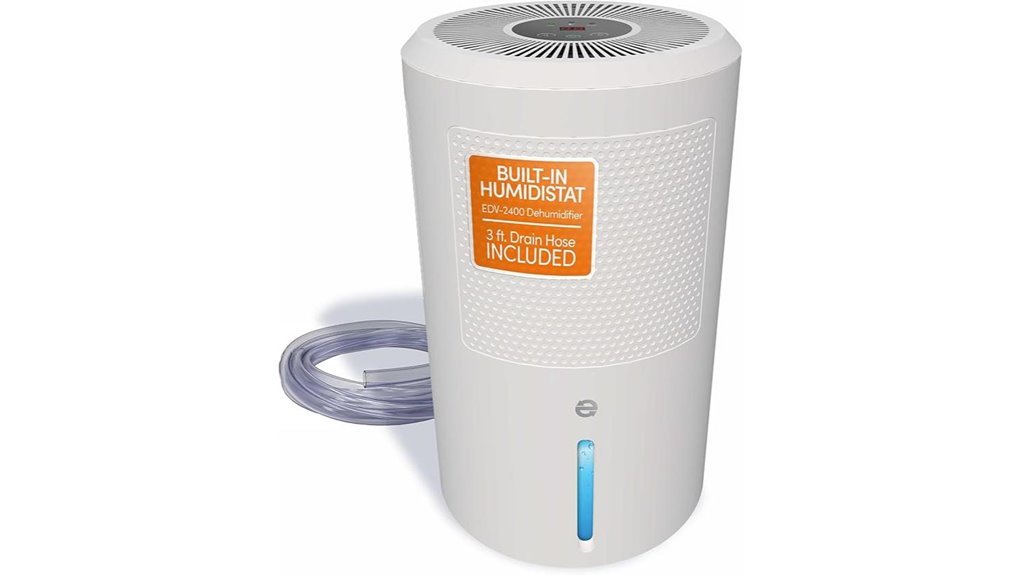
Best higher-capacity mini unit for warm, humid cabins. The Eva-Dry EDV-2400 suits boat owners who need quiet, low-power moisture control from an electric unit. You get a compact 5-pound design that is easy to move, and its 43dB operation should feel reasonable in many small cabin setups. The thermoelectric design uses just 60 watts while removing up to 0.73 liters of moisture per day.
You can set humidity with the digital humidistat, and the 2-liter tank shuts off automatically when full. With the included drain hose, you can run it continuously for winterization, docked storage, or longer trips where manual emptying is inconvenient. It works best in warm, humid spaces and includes a one-year warranty.
Why you’ll like it: This is the better choice when a tiny 300–350 ml unit feels too limited. The tank, humidistat, and drain hose make it easier to manage cabin humidity without checking the unit as often.
Best For: Boat owners, RV travelers, and anyone needing a compact, quiet, low-power dehumidifier for small warm, humid spaces.
Choose it if: You want more moisture removal than a tiny 300–350 ml unit and you like having a drain hose and humidistat.
Skip it if: You need a nearly silent unit for sleeping close by, since 43dB is quieter than many appliances but still noticeable in a small berth.
Pros:
- Quiet 43dB operation is well-suited for cabins, bedrooms, and other small spaces.
- Uses only 60 watts while still removing up to 0.73 liters of moisture per day.
- Compact 5-pound design with a 2-liter tank and included drain hose for continuous use.
Cons:
- Lower dehumidification capacity than larger compressor-based units.
- Works best in warmer environments, so it may be less effective in cool spaces.
- 2-liter tank is relatively small, requiring attention if not using the drain hose.
Pure Enrichment PureDry Mini Dehumidifier (27oz Tank)
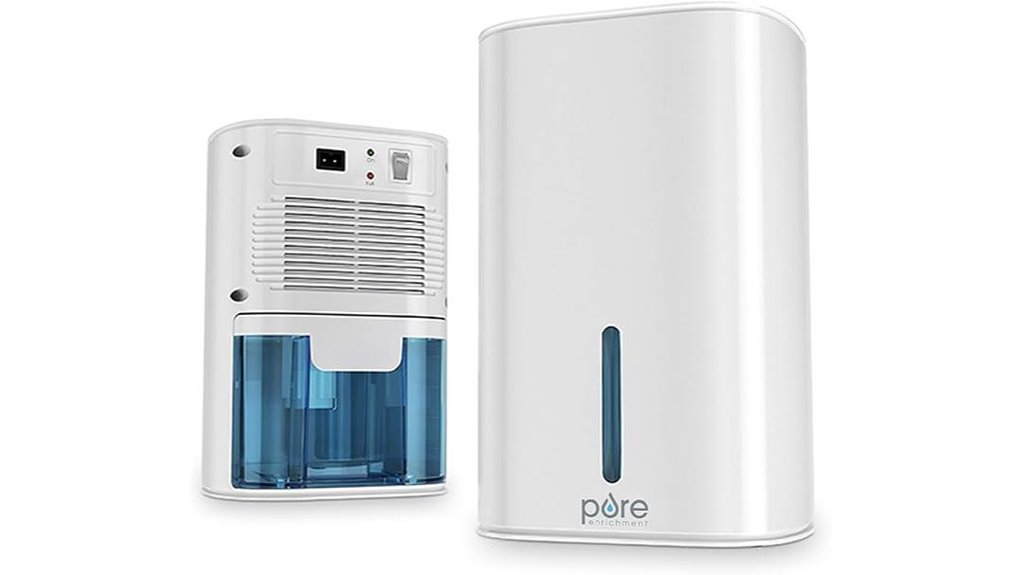
Best for tiny cabins and small enclosed rooms. Pure Enrichment’s PureDry Mini suits small boat cabins, thanks to its 27-ounce tank and compact size. You can tuck it into tight spaces, and its 300ml-per-day output helps control dampness in areas up to 110 square feet. This makes it a better match for small enclosed cabins, bathrooms, closets, or berths than for a larger salon or whole-boat setup.
The transparent tank lets you check water levels at a glance, while the automatic shutoff stops overflow when it fills. With one simple switch, 25-watt operation, and quiet performance, it is easy to use on board. You will also appreciate the removable tank, which makes emptying quick, plus the 5-year warranty for added peace of mind.
Why you’ll like it: It keeps things simple. There are no complicated settings, and the transparent tank makes it easy to see when it needs attention. For a tiny berth, bathroom, or compact cabin, that simplicity can be a real advantage.
Best For: Boat owners, RV users, and anyone needing a compact, quiet dehumidifier for small spaces up to 110 square feet.
Choose it if: You have a very small cabin or storage space and want a simple plug-in unit with low energy use.
Skip it if: You need continuous drainage or stronger daily output for a very humid boat.
Pros:
- Compact and lightweight design fits easily in tight spaces like cabins, closets, and bathrooms.
- 300ml/day moisture removal with automatic shutoff and a transparent tank for easy monitoring.
- Quiet, energy-efficient 25-watt operation plus a 5-year warranty.
Cons:
- Small 27 oz tank means more frequent emptying in humid conditions.
- Best suited only for very small areas, not larger rooms or whole-home use.
- No advanced settings or controls beyond a simple on/off switch.
Home Mini Dehumidifier with Drain Hose
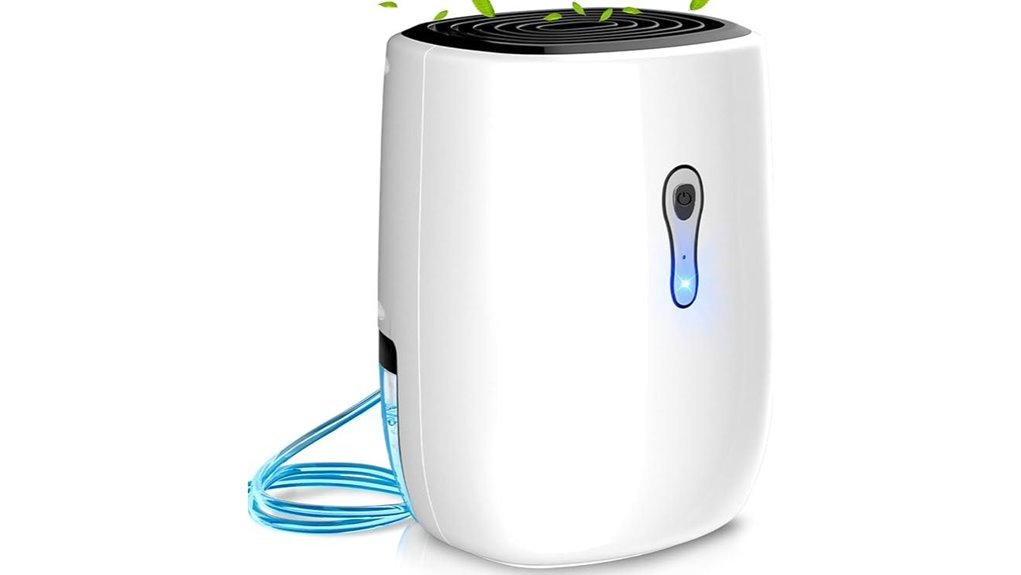
Best mini dehumidifier with continuous drainage. Posdry’s VS-DH07 keeps moisture in check with a 3.28-foot drain hose and auto shut-off. You can run it continuously in tight boat cabins, bathrooms, closets, or RV spaces up to 260 sq ft. It pulls up to 350 ml of moisture daily at 86°F and 80% RH, and its 27 oz tank gives you backup when you do not want to drain.
At about 30 dB, it stays quiet, which is useful if the unit sits close to your sleeping area. The red indicator tells you when to empty the tank. Use it best between 59 and 104°F for steady humidity control. The drain hose is the standout feature here, especially if you want less hands-on maintenance while docked or during storage.
Why you’ll like it: The drain hose makes this one especially useful when you want less tank-emptying work. It gives you the convenience of continuous drainage while still keeping auto shutoff as a backup feature.
Best For: People who need a compact, quiet dehumidifier for small spaces like bathrooms, closets, RVs, boat cabins, or basements up to 260 sq ft.
Choose it if: You want a mini dehumidifier that can drain continuously instead of relying only on a small tank.
Skip it if: Your boat storage area is too cold for efficient dehumidifier performance or you do not have a safe drainage path.
Pros:
- Supports both manual emptying and continuous drainage with a 3.28 ft hose.
- Runs quietly at about 30 dB, making it suitable for bedrooms and other peaceful spaces.
- Auto shut-off and a red indicator help prevent overflow and make maintenance simple.
Cons:
- Best performance is limited to smaller areas, up to 260 sq ft.
- Dehumidification is less effective below 41°F.
- The 27 oz tank is relatively small, so frequent emptying may still be needed without the hose.
Eva-Dry Wireless Mini Dehumidifier, White (E-333)
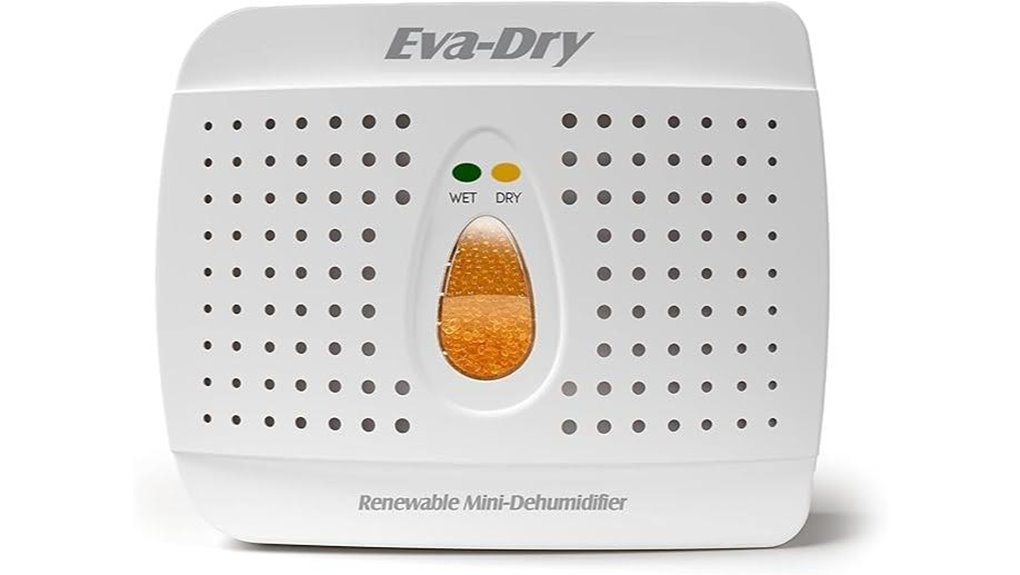
Best cordless reusable option for lockers and small storage spaces. If you need a cordless fix for a cramped boat cabin, locker, or gear compartment, the Eva-Dry E-333 fits well. You can tuck this white mini unit almost anywhere, since it measures just 6.25 x 1.25 x 4.75 inches and weighs 16 ounces. It covers up to 333 cubic feet, making it a smart pick for small berths, lockers, cabinets, and gear storage.
The silica gel beads absorb moisture for 20 to 30 days, then shift from orange to green when it is time to recharge. It is non-toxic, battery-free, and backed by a 5-year warranty for peace of mind. Since it is a reusable absorber rather than an electric water-collecting unit, it is best for maintenance moisture control, not heavy daily drying.
Why you’ll like it: It is reusable, compact, and easy to move. It is also helpful when you want moisture control in spaces where plugging in an electric unit would be inconvenient, unsafe, or impossible.
Best For: People needing a compact, cordless dehumidifier for very small enclosed spaces like boat cabins, lockers, closets, cars, or gun safes.
Choose it if: You want a reusable, cordless option for small storage areas where an electric cord would be annoying or unsafe.
Skip it if: You need fast moisture removal from a damp cabin after rain, leaks, or long periods of closed-up storage.
Pros:
- Cordless, battery-free, and easy to place almost anywhere.
- Compact size with coverage up to 333 cubic feet.
- Non-toxic silica gel design with a 5-year warranty.
Cons:
- Limited moisture removal compared with electric dehumidifiers.
- Requires periodic recharging every 20–30 days.
- Best suited only for small spaces, not larger rooms.
4 Pack Hanging Moisture Absorber Bags with Charcoal
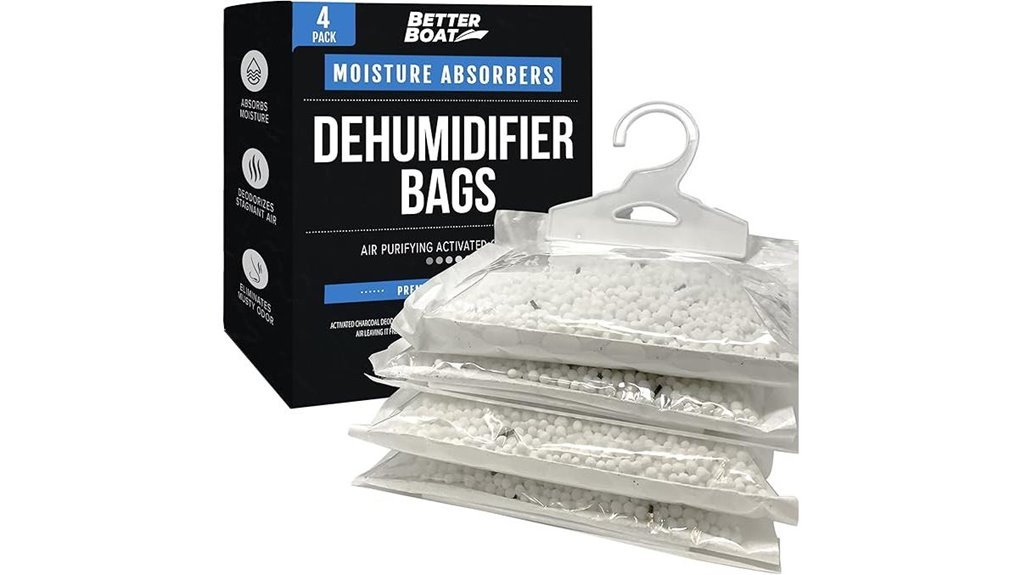
Best hanging absorber for closets and small cabin areas. For boaters battling damp cabins, these 4-pack hanging moisture absorber bags are a simple pick. You can hang them in tight spaces to absorb excess moisture and help keep your cabin, closet, or locker drier. The activated charcoal works to eliminate musty odors instead of covering them up, and the unscented design will not add fragrance.
They are handy for boats, cars, RVs, closets, and bathrooms, so you can move them wherever humidity builds. When the pellets saturate, just toss the bag and replace it. Built by boaters, they offer practical, reliable moisture control for spaces where a plug-in dehumidifier is not needed.
Why you’ll like it: The hanging format is useful in vertical spaces where buckets or electric units are awkward. It is especially convenient for closets, hanging lockers, and small storage corners that smell musty after the boat sits closed.
Best For: Boaters, RV owners, and anyone needing a simple unscented solution to control moisture and musty odors in small enclosed spaces.
Choose it if: You want a hanging, no-power moisture absorber for closets, lockers, bathrooms, or compact cabin areas.
Skip it if: You want a reusable product or an electric unit that actively collects measurable water each day.
Pros:
- Absorbs excess moisture to help keep enclosed areas drier.
- Activated charcoal helps eliminate odors instead of masking them.
- Easy hanging design makes it convenient for boats, cars, closets, and bathrooms.
Cons:
- Needs to be replaced once the pellets are saturated.
- Best suited for smaller enclosed spaces rather than large open areas.
- Doesn’t offer a reusable or refillable design.
Factors to Consider When Choosing a Small Dehumidifier for Boat
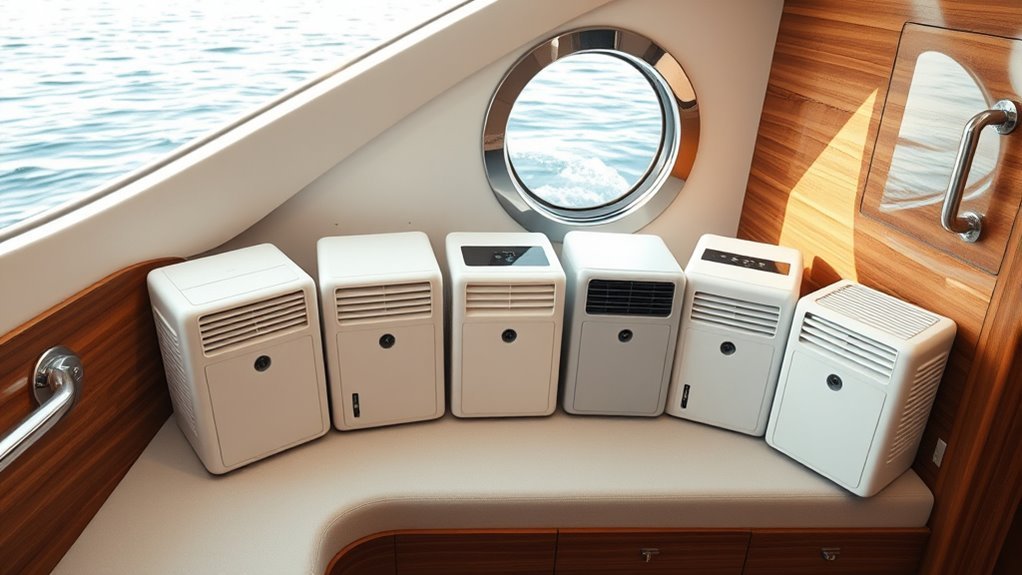
When you choose a small dehumidifier for your boat, focus on how much moisture it can remove and whether it covers the space you need. You will also want to check its power use and noise level so it fits your routine without draining your battery or disturbing your time onboard. Since boat space is limited, pick a model that is compact, lightweight, and easy to move.
Electric vs Passive Moisture Control
Boat owners often need two different kinds of moisture control. An electric mini dehumidifier actively pulls water from the air into a tank or drain hose, so it is better for cabins, bathrooms, and damp sleeping spaces. A passive absorber uses crystals, charcoal, or silica gel, so it works better in closets, lockers, cabinets, and storage bins where you do not want cords or moving parts. If your boat has real condensation, stale damp air, or musty bedding, start with an electric unit. If your problem is light odor and closed-up storage, a passive absorber may be enough.
Moisture Removal Capacity
Moisture removal capacity is one of the most important specs to check, since it tells you how much water a dehumidifier can pull from the air each day, usually measured in liters, pints, or milliliters. For a small boat cabin, you should aim for an electric unit that removes at least 300–350 ml per day so it can handle everyday dampness. Pay attention to how the model performs in warm, humid conditions, because output can drop when temperatures and humidity shift.
If you often deal with sticky air above 80% RH, choose a dehumidifier rated for that environment. A built-in humidistat also helps you track moisture levels and keep the cabin dry without overworking the unit. Passive absorbers do not remove water as quickly as electric models, but they can help reduce trapped moisture in smaller compartments.
Coverage Area Size
After you compare moisture removal capacity, check the coverage area a unit can handle. You will find small boat dehumidifiers rated from about 30 to 350 square feet, so match the model to your cabin, berth, or storage compartment. If you buy one that is too small, it will not keep humidity down; if it is oversized, you may waste space without improving results.
Look for products that state both square footage and extraction performance, since larger or damper areas usually need stronger moisture control. Also, make sure the unit can work in your boat’s typical temperature range, because capacity can drop when conditions shift. Choosing the right coverage keeps enclosed spaces drier, helps protect gear, and lets you manage moisture with less hassle overall.
Power Consumption
Power consumption matters because a small boat dehumidifier needs to run often without draining your battery or driving up shore-power costs. You should look for models that stay in the 25 to 60 watt range, since they are usually efficient in tight marine spaces. If you need faster moisture removal, expect higher power use because stronger extraction often demands more energy.
Some efficient units use just 0.54 kWh over 24 hours, which can help keep operating costs low. Also check the operating temperature range, because a model tuned for warmer conditions may draw power differently as cabin conditions change. Match the unit’s output to your boat’s humidity load, and you will avoid paying for extra capacity you do not need.
Noise Level
Noise level matters just as much as dehumidifying performance on a boat, because a noisy unit can ruin the calm of a cabin or berth. You will want a compact dehumidifier that stays around 30 dB or lower, since that range usually blends into the background in tight marine spaces. If you sleep aboard, pay close attention to models with quiet-operation features, including semiconductor cooling technology, which can keep sound down while still pulling moisture from the air.
Avoid units above 50 dB if you value peace in small cabins or berths, because they can feel intrusive. Always check the manufacturer’s decibel rating before you buy, so you know the unit fits your noise tolerance while you are out on the water.
Portability And Size
Beyond sound, size and portability matter a lot when you are choosing a small dehumidifier for a boat. You need a unit that fits tight cabins, lockers, or galley corners, so compact models around 5 to 6 inches wide and tall are usually a smart pick. Weight matters too: a 1 to 5 pound dehumidifier lets you lift it easily and shift it from berth to salon without hassle.
Check the coverage area as well; a model rated for up to 350 square feet can handle moisture in a small cabin effectively. Battery-free or rechargeable designs also help you avoid cord clutter in cramped spaces. Finally, choose a quiet unit, ideally around 30 to 40 dB, so it will not disturb your onboard comfort.
Auto Shutoff Feature
An auto shutoff feature is one of the most important safety features to look for in a small boat dehumidifier, because it automatically turns the unit off when the tank is full. You will not have to worry about overflow, which helps protect your cabin from water damage and keeps the unit from working harder than it should.
That extra protection can also extend the dehumidifier’s life by reducing wear on its parts. Many models add a warning light or sound, so you will know when the tank needs attention without guessing. The feature also saves energy by stopping operation once moisture collection is complete. For boat life, that means less maintenance, less stress, and true set-it-and-forget-it convenience in tight, enclosed spaces.
Drainage Options
When you are choosing a small dehumidifier for a boat, drainage options should be high on your list because they affect how often you need to empty the unit and how reliably it runs. A removable water tank works well if you do not mind manual emptying and want a simple setup. If you would rather avoid frequent checks, choose a model with continuous drainage and a drain hose so moisture leaves the cabin without interruption.
That is especially useful in humid weather or when you are away for long periods. You should also confirm the unit has automatic shut-off, so it stops before the tank overflows. Check the daily moisture removal rating too, since drainage only helps if the dehumidifier can handle your boat’s humidity level. Quiet operation matters as well.
Odor Control Features
Odor control matters just as much as moisture control on a boat, especially in tight cabins where stale air builds up fast. You should look for small dehumidifiers or absorbers with activated charcoal, since it absorbs moisture and helps eliminate musty smells instead of hiding them with perfume. Some models pair moisture-absorbing crystals with odor-neutralizing materials, so you can tackle dampness and bad odors at the same time.
If you are sensitive to scents, choose fragrance-free options to avoid lingering smells in enclosed spaces. Keep up with maintenance by replacing or recharging the dehumidifying agent on schedule, or odor control will weaken. Placement also matters: set the unit where air movement is limited, and you will improve its reach and keep your cabin fresher longer.
Where to Place a Small Dehumidifier on a Boat
Place an electric dehumidifier on a flat, stable surface where air can move around the vents. Keep it away from splashing water, loose bedding, and cramped corners that block airflow. If you use a drain hose, route the hose safely so it does not kink, spill into the cabin, or create a trip hazard. For passive absorbers, place one in each problem area, such as a hanging locker, under-seat storage space, bathroom cabinet, or closed berth.
Boat Storage and Winter Use
For storage, moisture control works best when you combine a dehumidifier with basic prevention. Dry wet gear before putting it away, crack safe ventilation where possible, check seals for leaks, and remove standing water from bilges or compartments. During winter storage, confirm the dehumidifier can operate in the temperature range your boat will experience. Some small thermoelectric units lose performance in cool conditions, so passive absorbers may help in lockers even when an electric unit is not ideal.
Safety Note for Boat Use
Keep electric dehumidifiers away from splashing water, wet bilges, loose bedding, and blocked vents. Use stable surfaces only, inspect cords, avoid unsafe extension-cord setups, and check the tank or drain hose often. A dehumidifier can help reduce dampness, but it should not replace leak repairs, safe ventilation, or regular boat inspections.
Frequently Asked Questions
How Do I Size a Dehumidifier for My Boat Cabin?
Measure your cabin’s cubic footage or square footage, then choose a dehumidifier rated for that size and your moisture level. You will need more capacity for damp, poorly ventilated boats, and less for small, dry cabins. For compact cabins, an electric unit around 300–350 ml per day may work for normal dampness, while a larger warm, humid space may need stronger moisture removal.
Can Boat Dehumidifiers Run Safely While Docked?
Yes, you can run a boat dehumidifier while docked if you have shore power, proper ventilation, and a safe, dry setup. Use a stable location, keep cords away from water, avoid blocking vents, and check the unit regularly. A drain hose can reduce emptying work, but it must be routed safely.
Do Portable Dehumidifiers Work in Saltwater Environments?
Yes, they can, if you choose a suitable model and maintain it well. You are fighting salty air, not saltwater itself, so protect vents, keep the unit dry, clean it as directed, and expect a shorter lifespan if the cabin has heavy salt exposure. Passive absorbers can also help in storage areas where you do not want an electric unit exposed.
How Often Should I Empty or Recharge a Boat Dehumidifier?
You should empty or recharge it whenever it is full or saturated. That may mean daily in humid conditions or every few days in drier weather. Passive moisture absorbers often last longer, but they still need replacement or recharging once the crystals, pellets, or silica gel stop absorbing moisture.
Can a Dehumidifier Prevent Mold During Winter Storage?
Yes, a dehumidifier can help reduce the damp conditions that encourage mold during winter storage. It works best when you also fix leaks, dry the cabin before storage, improve ventilation, and check the boat regularly. A dehumidifier helps, but it should not be the only mold-prevention step.
Is a Passive Moisture Absorber Enough for a Boat?
A passive absorber can be enough for a small locker, closet, cabinet, or lightly damp cabin area. It is not usually enough for a very humid cabin with condensation, wet upholstery, or constant musty air. In those cases, an electric mini dehumidifier with a tank or drain hose is usually the better choice.
What Is the Best Small Dehumidifier for a Boat Without Shore Power?
If you do not have shore power, look at passive options such as the Eva-Dry Wireless Mini, hanging moisture absorber bags, or charcoal moisture absorber buckets. These options do not need electricity, so they are easier to place in lockers, berths, closets, and storage spaces.
Should I Choose a Drain Hose or a Water Tank?
Choose a drain hose if the dehumidifier will run for long periods while docked or in storage. Choose a water tank if you only run the unit while you are onboard and can empty it often. The safest option is a model that has both a tank with auto shutoff and a drain hose for continuous use.
Where Should I Not Place a Dehumidifier on a Boat?
Do not place an electric dehumidifier where it can tip over, get splashed, sit in standing water, block its vents, or create a cord hazard. Avoid soft bedding, unstable shelves, wet bilge areas, and tightly packed corners with no airflow. Passive absorbers are more flexible, but they should still be placed where they will not spill, tear, or contact items that could be damaged by collected moisture.
Final Recommendation
For most small boat cabins with shore power, start with an electric mini dehumidifier because it actively collects water and gives you clearer moisture control. The Eva-Dry EDV-2400 is the strongest mini option here if you want a drain hose, humidistat, and larger tank. The Small Dehumidifier for Home, Bedroom, Bathroom, RV is a smart compact choice if you want quiet operation and a smaller footprint.
For lockers, closets, berths, cabinets, and unattended spaces, add passive absorbers such as Better Boat Moisture Absorber buckets, Eva-Dry Wireless Mini, or hanging charcoal bags. Combining one electric unit in the cabin with passive absorbers in closed storage areas often gives boat owners the most practical moisture-control setup.
Conclusion
Choosing the right small dehumidifier for your boat helps you protect your cabin, gear, cushions, and peace of mind. If you want active moisture removal, the electric mini dehumidifiers in this list are better for cabins, bathrooms, and small living spaces. If you want a no-power option for lockers or storage, the Better Boat buckets, Eva-Dry Wireless Mini, and hanging charcoal bags are easier to place and maintain.
Why let mold, mildew, and musty odors take over your time on the water? Pick the option that fits your space, power setup, drainage needs, and maintenance style, and you will keep your boat fresher all season long.